Thesis statement generator examples
Topics students typed and one of the five thesis statements that came back for each essay type.
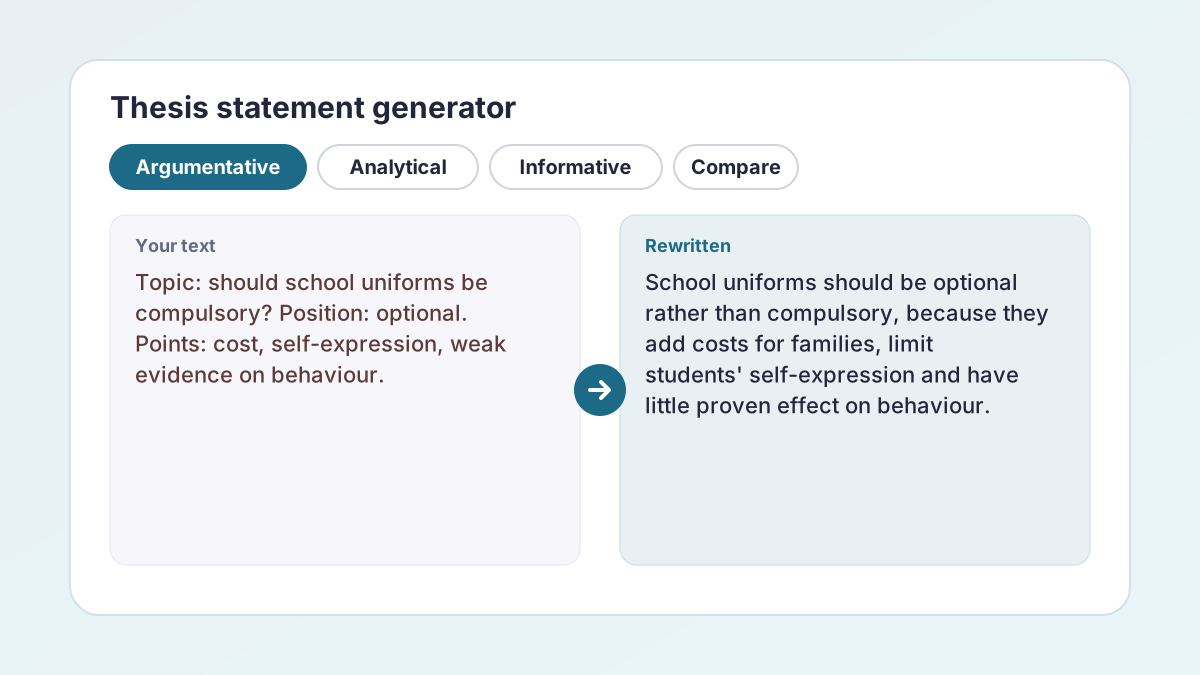
TopicShould school uniforms be compulsory? Position: optional.
Thesis statementSchool uniforms should be optional rather than compulsory, because they add costs for families, limit self-expression and have little proven effect on behaviour.
A clear position with three reasons the body paragraphs can follow.
TopicThe green light in The Great Gatsby.
Thesis statementIn The Great Gatsby, Fitzgerald uses the green light to show how Gatsby's dream depends on distance: the closer he comes to Daisy, the more the symbol loses its power.
A claim about how a symbol works, which the essay must prove from the text.
TopicHow vaccines train the immune system.
Thesis statementVaccines prepare the immune system by exposing it to a harmless form of a germ, which teaches the body to recognise the real germ and respond faster.
States what the essay explains without arguing for a side.
TopicOnline learning versus classroom learning.
Thesis statementAlthough online and classroom learning cover the same material, classroom learning offers stronger motivation through routine and contact, while online learning rewards independent students with flexibility.
Names the key difference and why it matters.
TopicShould cities ban cars from their centres?
Thesis statementCity centres should be car-free, because streets designed for people are safer, cleaner and better for local businesses.
Direct and confident, written to move the reader.
TopicMicroplastics in drinking water.
Thesis statementThis paper argues that current water treatment removes most large microplastics but not the smallest particles, and that monitoring standards need to catch up with the research.
States the paper's central claim; any figures go in the body with citations.
How to use the thesis statement generator
If you know your position, add it. The thesis statements will be closer to the essay you actually want to write.
- Type your topic or question. Enter the essay question or topic, such as “should school uniforms be compulsory?”.
- Add your position and points. Optional: your answer to the question and the main reasons or points your essay will cover.
- Choose the essay type. Argumentative, analytical, informative, compare and contrast, persuasive or research paper.
- Choose the form. With main points (a roadmap thesis) or one focused claim.
- Pick and refine. Select Write my thesis, choose the statement closest to your argument, and adjust it until it says exactly what your essay proves.
What is a thesis statement?
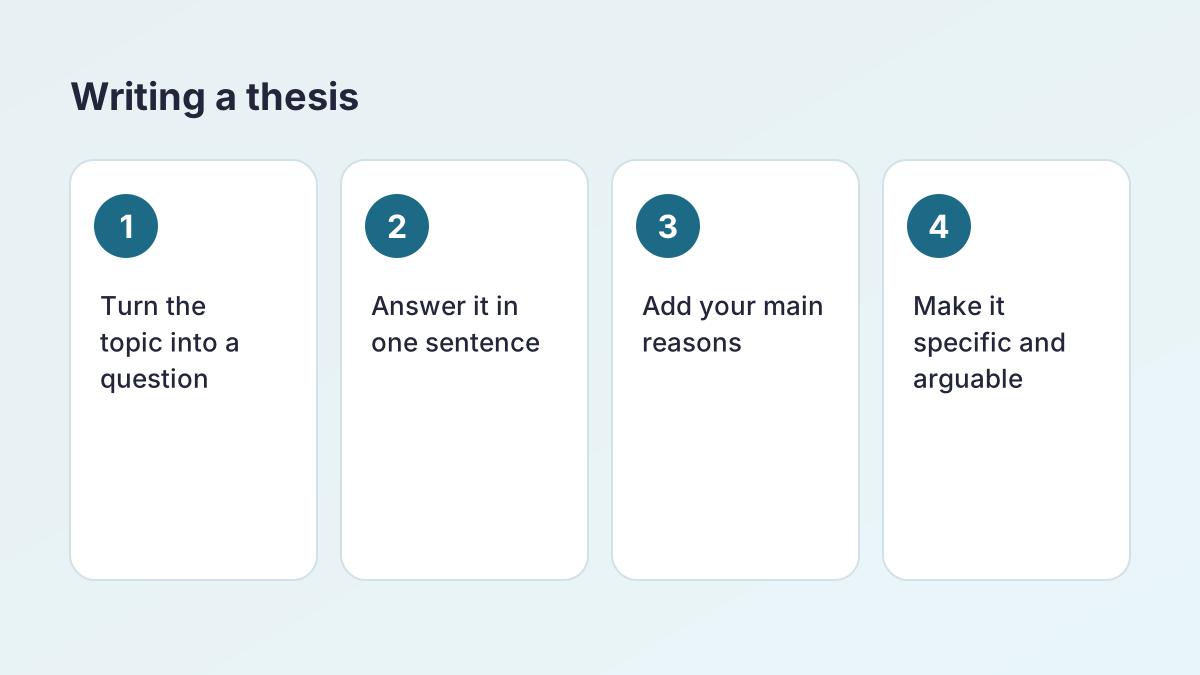
A thesis statement is the sentence, usually at the end of your introduction, that states the main point of your essay. It tells the reader what you will argue, analyse or explain, and it gives every body paragraph a job: to support it.
The University of North Carolina's Writing Center, in its guide to thesis statements, describes the thesis as an interpretation of a question or subject, not the subject itself, and as a road map for the paper.
What a thesis statement does
- States your position or main idea in one or two sentences.
- Narrows the topic to something an essay of your length can cover.
- Previews the structure, often by naming the main points.
- Makes a claim that the rest of the essay supports with evidence.
What a thesis statement is not
- A topic: “School uniforms” is a topic, not a thesis.
- A fact: “Many schools have uniforms” cannot be argued.
- An announcement: “In this essay I will discuss uniforms” says nothing about your view.
What makes a strong thesis statement
Each statement from the thesis statement generator is written to meet these tests. Use them to check your own thesis too.
Specific
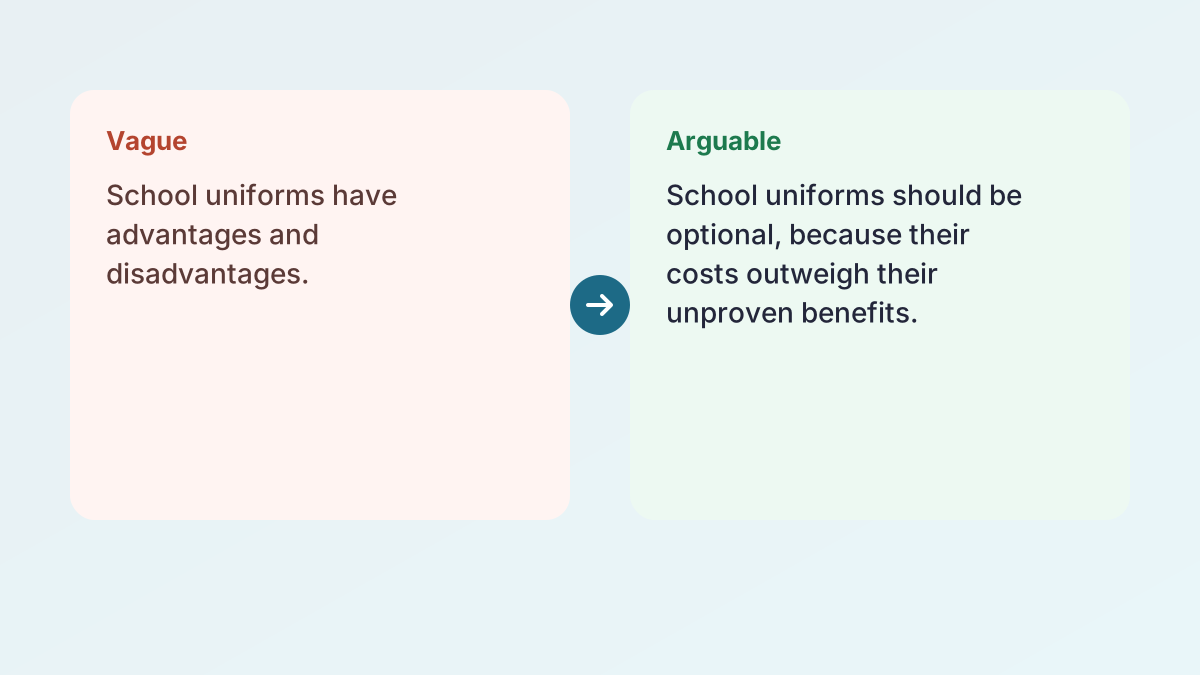
“Social media is bad” is too broad. “Late-night social media use harms teenagers' sleep and concentration” tells the reader exactly what you will prove.
Arguable (for argumentative and analytical essays)
Someone could reasonably disagree. If no one could, it is a fact, not a thesis.
Supportable
You can back it up with the evidence you have and the space you have. A thesis that needs a book to prove is too big for a 1,000-word essay.
Focused
One main idea. If your thesis has two unrelated claims, choose one or connect them.
Clear
Plain words, no vague terms such as good, bad, interesting or important without saying how or why.
The “so what?” test
Read your thesis and ask: so what? Why would a reader care? If you can answer, add that answer to the thesis or to the sentence before it.
Argumentative thesis generator
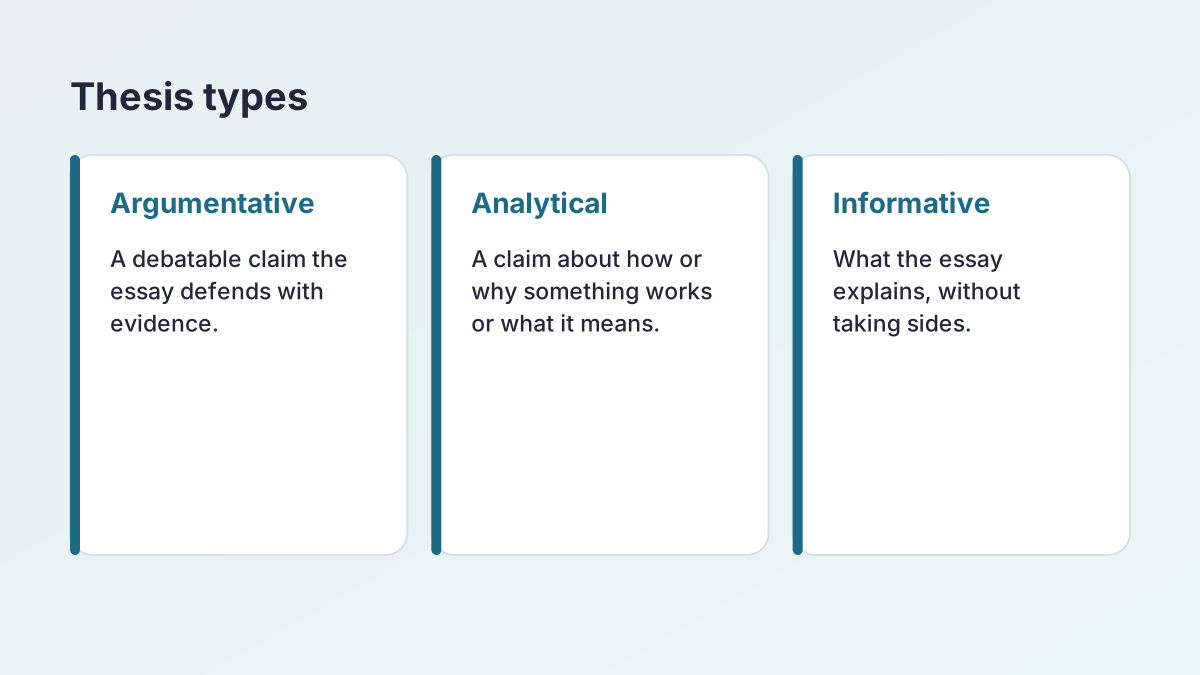
Choose Argumentative and the tool works as an argumentative thesis generator. An argumentative thesis takes a clear position on a debatable question and usually previews the reasons that support it.
The pattern
[Position] because [reason 1], [reason 2] and [reason 3].
School uniforms should be optional rather than compulsory, because they add costs for families, limit self-expression and have little proven effect on behaviour.
Acknowledging the other side
A more advanced pattern starts with a concession: Although [opposing view], [your position] because [reasons]. This shows the reader you have considered both sides, which makes your argument stronger.
Although uniforms may reduce visible differences in wealth, schools should make them optional, because the costs and limits on self-expression outweigh this benefit.
Persuasive versus argumentative
Choose Persuasive for a more direct, confident thesis meant to move the reader to agree or act. Argumentative essays weigh evidence more formally; persuasive essays put more weight on convincing.
Analytical thesis statements
An analytical thesis makes a claim about how something works, what it means or why it matters. It is common in literature, history, art and social science essays. Choose Analytical for these.
The pattern
In [text or subject], [author or factor] uses or shows [technique or evidence] to [effect or meaning].
In The Great Gatsby, Fitzgerald uses the green light to show how Gatsby's dream depends on distance: the closer he comes to Daisy, the more the symbol loses its power.
Analysis, not summary
A common mistake is a thesis that summarises the plot or lists techniques. An analytical thesis must say what those techniques do. Ask yourself: how? and why? Then put your answer in the thesis.
Literary analysis tips
- Name the author and the text.
- Focus on one technique, theme or character relationship.
- Make an interpretive claim that another reader could see differently.
Informative thesis generator
Choose Informative and the tool works as an informative thesis generator. An informative (or expository) thesis states what the essay will explain, without taking a side. It is common in science reports, history explanations and how-it-works essays.
The pattern
[Subject] [does or works by] [main explanation], [which involves or leads to] [main points].
Vaccines prepare the immune system by exposing it to a harmless form of a germ, which teaches the body to recognise the real germ and respond faster.
Still specific
An informative thesis does not argue, but it should still be precise. “This essay is about vaccines” is a topic; the example above tells the reader exactly what will be explained.
Research papers
For a research paper, choose Research paper. The thesis states the paper's central claim or the question it answers, and any figures belong in the body with citations, not in the thesis.
Compare and contrast thesis statements
A compare-and-contrast thesis names the two subjects, the key similarity or difference, and why the comparison matters. Choose Compare and contrast for these.
The pattern
Although [A] and [B] both [similarity], [A] [difference] while [B] [difference], which shows [significance].
Although online and classroom learning cover the same material, classroom learning offers stronger motivation through routine and contact, while online learning rewards independent students with flexibility.
Avoid the list thesis
“Online and classroom learning have similarities and differences” is true of any two things. Say which similarity or difference matters most and why.
Point-by-point or block structure
Your thesis can hint at the essay's structure. A roadmap thesis naming two or three points of comparison suits a point-by-point essay.
From working thesis to final thesis
Most writers start with a working thesis and refine it as they research and draft. That is normal, and the thesis statement generator is useful at both stages.
At the start
Generate thesis statements from your topic alone to see possible positions. Choose one that interests you and that you think you can support.
During research
As you find evidence, your view may change. Come back with your new position and the points you have found, and generate again.
After drafting
Read your body paragraphs, then write the thesis that matches what they actually argue. Change the thesis, not the evidence.
Check the whole essay
- Does every body paragraph support the thesis?
- Does the conclusion return to it in new words? The Restate Thesis Generator can help.
- Do your topic sentences link back to it? Try the Topic Sentence Generator.
Common thesis statement mistakes
- Too broad: “Technology has changed the world.” Narrow it to one technology, one change, one group.
- A question: “Should uniforms be compulsory?” is your essay question; your thesis is your answer.
- An announcement: “This essay will discuss…” Say what you will argue instead.
- Two unrelated claims: choose one, or connect them with because or which.
- A fact: “Uniforms are worn in many countries.” Facts support a thesis; they are not one.
- Hedging: “Uniforms may possibly be somewhat helpful.” Take a clear position you can defend.
- Invented evidence: do not put statistics in your thesis unless you have a source. The tool never adds made-up figures.
Where does it go?
Usually as the last sentence of the introduction, after the hook and context. If you need help building the full paragraph, try the Introduction Generator.
Thesis statement generator examples by subject
The thesis statement generator works for any subject. Here is how a strong thesis looks in a few common ones.
English literature
Through Scout's narration, Harper Lee shows that childhood innocence is not ignorance but a clearer way of seeing injustice. An analytical thesis about a narrative technique and its effect.
History
The printing press did more to weaken the authority of the medieval Church than any single reformer, because it put ideas beyond the Church's control. An argumentative thesis that weighs causes.
Science
Coral bleaching is driven mainly by rising sea temperatures, which break the partnership between corals and the algae that feed them. An informative thesis that explains a process.
Social studies
Although social media helps young people stay connected, its design rewards constant checking, which harms sleep and concentration. An argumentative thesis with a concession.
Using the examples
Type your own subject's question into the thesis statement generator, choose the matching essay type, and compare the results with these patterns. Then adjust the wording until the thesis says exactly what your essay will prove.
Quick guide: which thesis type do I need?
Not sure which essay type to choose in the thesis statement generator? Look at the verb in your assignment.
- Argue, evaluate, to what extent, do you agree: choose Argumentative. The tool works as an argumentative thesis generator and takes a clear side.
- Analyse, examine, how does, explore the effect of: choose Analytical.
- Explain, describe, outline, inform: choose Informative. The tool then works as an informative thesis generator that states what the essay will explain.
- Compare, contrast, similarities and differences: choose Compare and contrast.
- Convince, persuade, write a letter urging: choose Persuasive.
- Investigate, research, report on: choose Research paper.
If your question mixes two verbs, such as “explain and evaluate”, choose the one that carries the marks, usually the evaluative one, and generate again with the other to compare.
Is this a good thesis statement? Five weak ones, revised
Seeing what is wrong with your own thesis is harder than knowing the rules. Below are five weak thesis statements, each followed by the kind of revision the thesis statement generator aims for and a note on what changed. All of them are invented examples, not real student work.
1. The fact
- Weak: Many teenagers use social media every day.
- Revised: Schools should teach healthy social media habits alongside online safety, because daily use now shapes how teenagers sleep, study and see themselves.
What changed: a fact nobody disputes became a claim someone could argue against.
2. The announcement
- Weak: This essay will discuss the causes of the French Revolution.
- Revised: Royal debt, more than Enlightenment ideas, set off the French Revolution, because the financial crisis forced Louis XVI to call the Estates-General.
What changed: the topic became a position, with a reason the essay can test.
3. The list with no link
- Weak: Video games improve reaction time, they can be social, and some are educational.
- Revised: Video games can build real skills, from faster reactions to teamwork, so schools should stop treating them only as a distraction.
What changed: three loose points now serve one claim.
4. The vague word
- Weak: The storm in King Lear is very interesting.
- Revised: In King Lear, the storm turns Lear's inner collapse into something the audience can see and hear, which makes his madness feel physical rather than abstract.
What changed: “interesting” became a claim about what the storm does.
5. The claim that is too big
- Weak: Climate change is the biggest problem in the world.
- Revised: Because rising seas threaten low-lying island nations first, coastal adaptation there deserves a larger share of international climate funding.
What changed: one place, one effect and one recommendation, which a 1,500-word essay can support.
Check yours with the thesis statement generator
Each option from the thesis statement generator is written to pass these tests, so it makes a useful comparison. Type your current thesis into Your position or main idea, add your reasons, select Write my thesis and set the five results beside your own. If several are more specific than yours, borrow the precision, not the wording.
Thesis statements for cause and effect, rhetorical analysis, history and speeches
Not every assignment matches an essay type by name. Here is how to write a thesis for five of them, and which setting to choose in the thesis statement generator for each. The example theses are invented.
Cause and effect essays
A cause and effect thesis names the cause, the effect and the link between them. In the thesis statement generator, choose Analytical if you are explaining why something happened, or Argumentative if you are claiming one cause matters more than the others.
Pattern: [Cause] led to [effect] because [link].
Late-night phone notifications are cutting into teenagers' sleep, because each alert pulls attention back to the screen just as the day should be winding down.
Rhetorical analysis
A rhetorical analysis thesis names the speaker, the techniques and the purpose they serve. Choose Analytical, and put the speaker and the text in the thesis statement generator's topic box.
In his “I Have a Dream” speech, Martin Luther King Jr. uses repetition and references to America's founding documents to present civil rights as a promise the nation had already made.
History essays and DBQs
History questions usually ask you to weigh causes, change or significance, so choose Argumentative in the thesis statement generator. For AP document-based questions (DBQs), the College Board rubric asks for a historically defensible claim that establishes a line of reasoning, so a thesis that only restates or rephrases the question does not earn the point.
Although the New Deal did not end the Great Depression, it permanently expanded the federal government's role in protecting ordinary Americans from economic risk.
Informative speeches
A speech thesis, often called the central idea, tells the audience in one sentence what they will learn. Choose Informative and keep it short enough to say aloud.
Honeybees use a “waggle dance” to tell the hive where food is, with each part of the dance signalling direction or distance.
Narrative and reflective essays
The thesis statement generator has no narrative setting, and personal essays rarely need a formal thesis: the introduction usually ends with an insight instead. Write that sentence yourself, about what the experience changed for you.
Which form to choose
For a speech or a long essay, choose One focused claim in the thesis statement generator; a list of five reasons makes a thesis clumsy.
Is the thesis statement generator free?
Yes. The thesis statement generator is free, with no account or sign-up. A fair hourly allowance per visitor keeps it fast for everyone.
Your topic, position and points are sent to our AI providers (Groq, with Google Gemini as a backup) only to write the statements you see. The Study Corp does not save them.
Using it responsibly
A thesis is your argument, so choose one you believe and can support, and adjust the wording until it is yours. Check your school's policy on AI tools for assessed work.
Usage allowance
The thesis statement generator is part of The Study Corp's free writing tools. If the thesis statement generator is busy, wait a little and try again; the free allowance is counted per hour.
Thesis statement generator FAQ
Is the thesis statement generator free?
Yes. It is free with no account or sign-up. A fair hourly allowance per visitor keeps it fast for everyone.
What is a thesis statement?
The sentence, usually at the end of the introduction, that states your essay's main argument or point and guides every body paragraph.
Can it write an argumentative thesis?
Yes. Choose Argumentative for a debatable claim with reasons, or Persuasive for a more direct, convincing thesis.
Does it work for informative essays?
Yes. Choose Informative for a thesis that states what the essay explains without taking sides.
Where did the separate thesis generators go?
The argumentative, analytical, informative and compare-and-contrast thesis generators are now essay types in this one tool.
How long should a thesis statement be?
Usually one sentence, sometimes two, long enough to state your claim and, if you like, your main points.
Does it add statistics or quotes?
No. A thesis states your claim; evidence and citations belong in your body paragraphs.
What is a 3 part thesis statement?
A thesis that states your claim and names three reasons, one for each body paragraph: “School uniforms should be optional because of cost, self-expression and weak evidence on behaviour.” It suits five-paragraph essays. In the thesis statement generator, choose With main points for this form, or One focused claim for longer essays.
How do you write a thesis for a cause and effect essay?
Name the cause, the effect and the link in one sentence: “Late-night notifications push teenagers' bedtimes later, which cuts the sleep they need to concentrate at school.” In the thesis statement generator, choose Analytical to explain why something happened, or Argumentative to claim one cause matters most.
More free writing tools
- Book Title GeneratorTitle ideas for your book, chapters or series, in any genre.
- Essay Title GeneratorTen clear, catchy titles for any essay type, with notes on each.
- Story Title GeneratorOriginal titles for short stories, fan fiction and school stories.
- Poem GeneratorWrite a poem on any topic: free verse, rhyming, haiku, sonnet and more.
- Shape Poem GeneratorLay a poem out inside a heart, star, tree and more, then download it.
- Paragraph ExpanderMake a paragraph or essay longer with explanation, not filler.
- Personal Statement GeneratorDraft a UCAS or college statement and check it against the word limit.
- Introduction GeneratorThree introductions that move from a hook to your thesis.
- Essay Hook GeneratorNine opening hooks for your essay, each a different technique.
- Poetry Prompt GeneratorTen fresh poem prompts on any theme, for any level.
- Acrostic Poem GeneratorA poem whose first letters spell any name or word.
- Random Paragraph GeneratorRandom paragraphs for reading, typing and handwriting practice.
- Essay Outline GeneratorPlan your essay section by section, from thesis to conclusion.
- Topic Sentence GeneratorTopic sentences that tie each body paragraph to your thesis.
- Paragraph GeneratorWrite a clear paragraph from a topic, or turn notes into one paragraph.
- Conclusion GeneratorThree conclusions for your essay, or a concluding sentence for a paragraph.
- Poem Title GeneratorTen title ideas for your poem, from simple to striking.
- Haiku Poem GeneratorHaiku, sonnets and limericks with syllables counted on every line.
- Argumentative Essay GeneratorDraft an argumentative essay with a clear claim, counterargument and rebuttal.
- Persuasive Essay GeneratorDraft a persuasive essay aimed at a real reader, with a call to action.
- Informative Essay GeneratorDraft a clear, neutral informative (expository) essay on any topic.
- Analytical Essay GeneratorDraft an analytical essay that explains how and why, not just what.
- Compare and Contrast Essay GeneratorDraft a comparison essay, point-by-point or block, with a real judgment.
- Scholarship Essay GeneratorDraft a scholarship essay built from your own story and goals.
- Name GeneratorCharacter names for stories and games, 12 at a time, in any genre.
See all 80 free tools for students
Related tools
Last updated by The Study Corp editorial team.