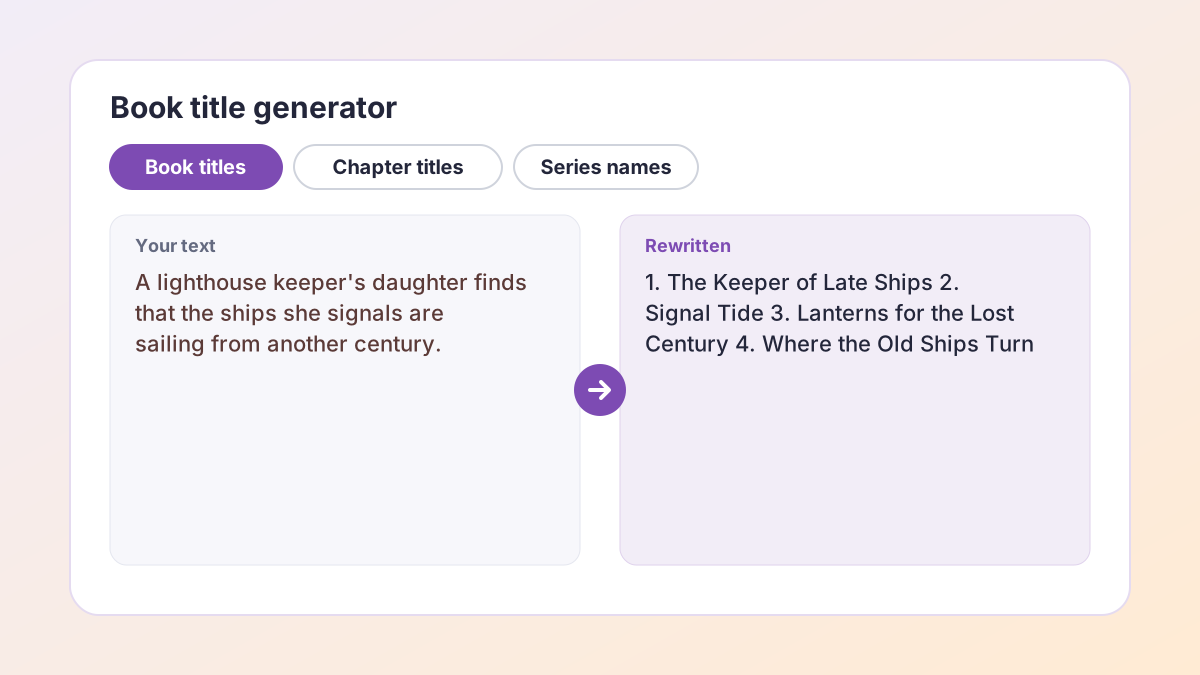
Book title generator examples
What students and writers typed, and a few of the ten titles that came back. Each note explains the idea behind the title.
You typedA lighthouse keeper's daughter discovers that the ships she signals each night are sailing from another century.
Title ideasThe Keeper of Late Ships · Signal Tide · Lanterns for the Lost Century
Each title points to the time-slip twist without giving it away.
You typedA retired teacher solves thefts in a small seaside town using only the gossip she hears at the bakery.
Title ideasCrumbs of Evidence · The Bakery Line · Murder by Morning Bun
Cosy mysteries often use food or place puns; the generator leans into the genre.
You typedTwo rival debaters are forced to share a hotel room at a national competition.
Title ideasPoints of Order · Closing Arguments · Rebuttal
Debate vocabulary doubles as romance and conflict vocabulary.
You typedA guide for first-year university students on managing money, food and time on a small budget.
Title ideasThrive on Less: A Student's Guide to Money, Meals and Time
Non-fiction titles work best with a clear subtitle that names the benefit.
You typedChapter where the heroine first rows out to the strange ship in a storm.
Title ideasThe Rowboat · Against the Tide · A Ship with No Lights
Chapter titles can be shorter and more concrete than a book title.
You typedThree books following a family of clockmakers who can repair broken moments in time.
Title ideasThe Clockmender Chronicles · The Hours Trilogy · Keepers of the Minute
A series name should still work when the story grows beyond the first book.
How to use the book title generator
You get the best ideas from a specific description: who the main character is, what they want, and what stands in their way.
- Describe your book. Write two or three sentences about the main character, the central conflict and the setting. Specific details give specific titles.
- Choose book, chapter or series. Book titles is the default. Choose Chapter titles to title one chapter, or Series names for a group of books.
- Pick a genre and style. Genre shapes the feel of the titles; style decides whether they are short, mysterious, poetic, descriptive or a mix.
- Generate and shortlist. Select Generate book titles. Copy the ideas you like, then select Generate more for a fresh set.
- Test your favourites. Say each title out loud, search for it online, and ask a friend which one makes them want to read the book.
What makes a good book title?
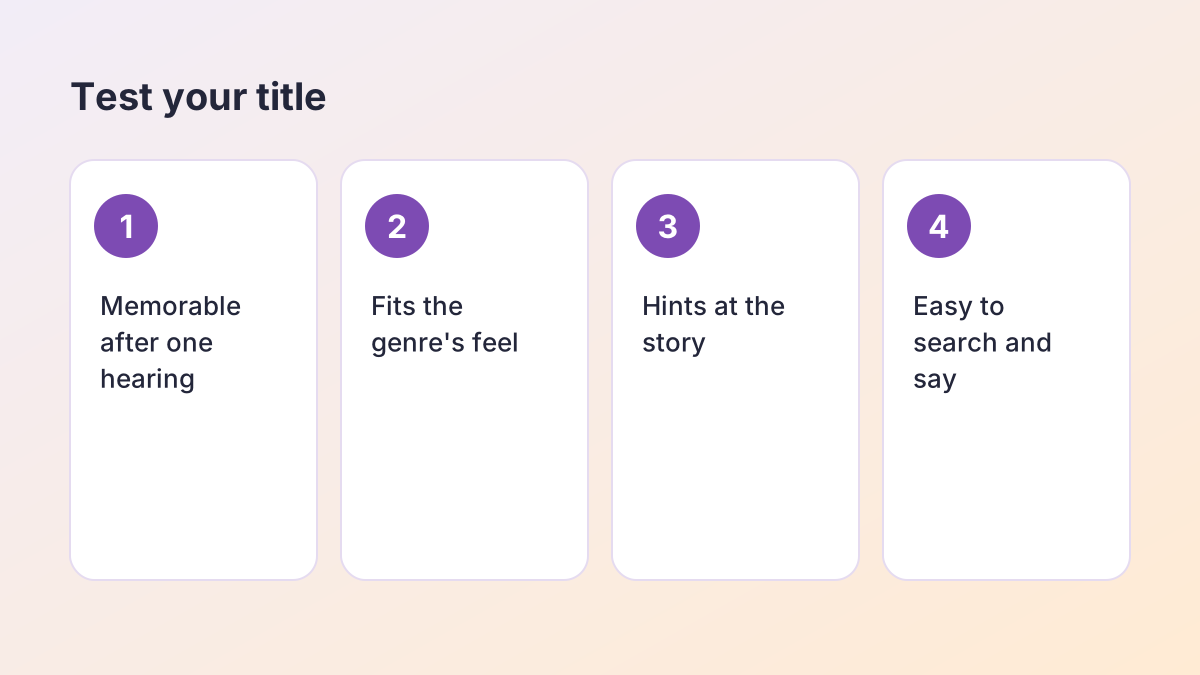
A good book title does three jobs at once. It is memorable, so a reader can recommend it after one conversation. It signals the genre, so the right readers pick it up. And it makes a promise: it hints at the story, the mood or the question at the heart of the book.
Look at titles you remember and you will notice a pattern. Most are short, concrete and slightly surprising. They name an object, a place, a person or an action rather than a vague idea. “The Book Thief” works better than “Stolen Words in Wartime” because it gives you a character and a mystery in three words.
Specific beats generic
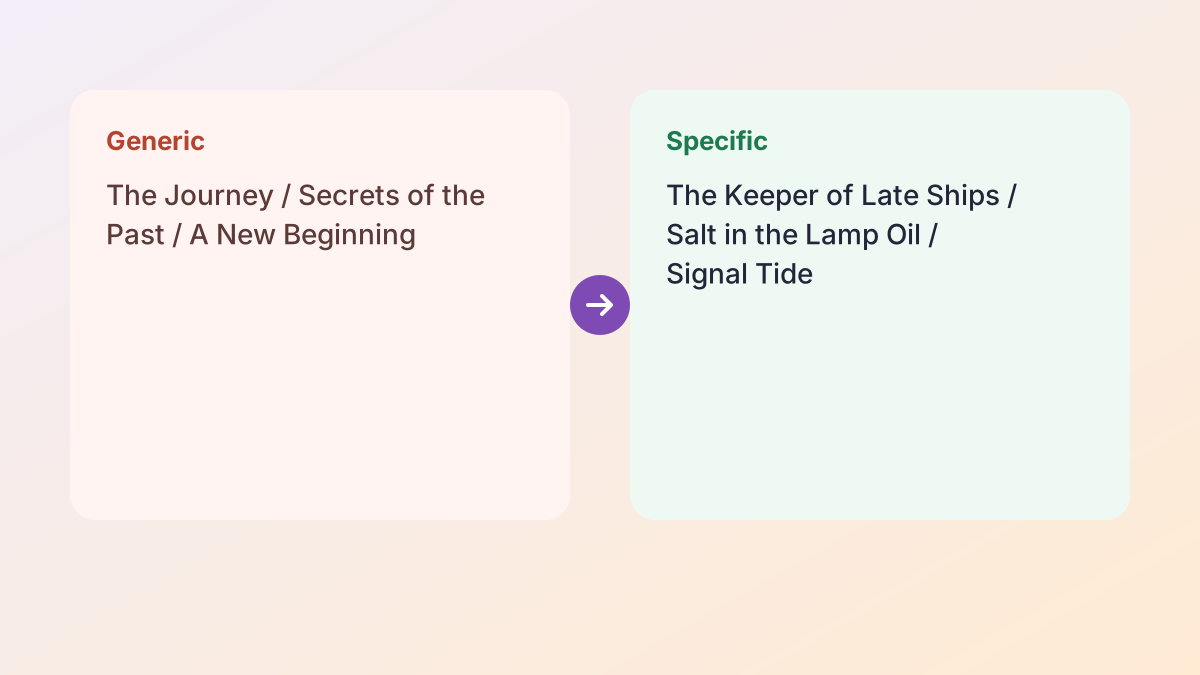
Titles like The Journey, Secrets or A New Beginning could belong to any book. Readers scroll past them, and search engines bury them under thousands of others. Replace the abstract word with a specific image from your story: a lighthouse, a broken clock, a red coat.
Match the genre's music
Every genre has its own sound. Fantasy titles often use “of” constructions and invented names. Thrillers favour short, punchy phrases. Romance titles play with emotion and wordplay. Literary fiction prefers quiet, poetic images. Choosing a genre in the tool tunes the suggestions to that music.
Book name generator: getting ideas you can actually use
A book name generator is only as good as what you give it. If you type “a fantasy story”, you will get generic fantasy titles. If you type “a lighthouse keeper's daughter who signals ships from another century”, you will get titles built from lighthouses, signals, tides and time.
What to include in your description
- The main character: who they are in a few words.
- The conflict: what they want and what stops them.
- The setting: a place or time with a strong image.
- A key object or symbol: something that appears again and again.
- The mood: cosy, eerie, funny, tragic, hopeful.
Use the words box
If there are words you want in the title, such as a character's name, a place or a theme, add them in “Words or themes to include”. The generator will try to work them in naturally, without forcing every title to use them.
Generate more than once
Treat each run as a brainstorm. Copy the two or three titles that spark something, then generate again with a different style. Many writers end up combining parts of two suggestions into a title that is entirely their own.
Chapter title generator: naming every chapter
Not every book needs chapter titles, but they add personality and help readers find their place. Choose Chapter titles in the tool, describe what happens in the chapter, and the chapter title generator suggests ten options.
Three chapter title styles
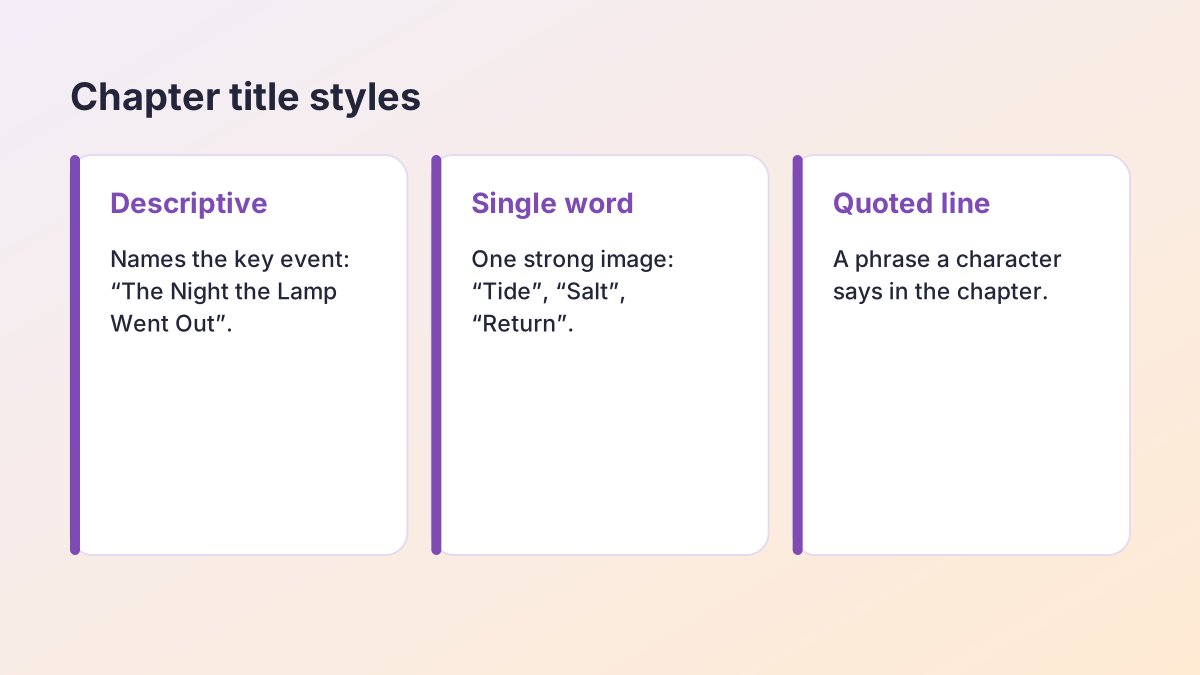
- Descriptive titles name the key event or setting: “The Night the Lamp Went Out”. They work well for middle-grade and adventure stories.
- Single-word titles use one strong image: “Tide”, “Salt”, “Return”. They suit literary fiction and thrillers.
- Quoted lines borrow a phrase a character says in the chapter. Readers get a small thrill when they reach the line.
Keep a consistent pattern
Whatever style you choose, use it for every chapter. Mixing long descriptive titles with single words can feel messy. If you want variety, vary the images, not the format.
Avoid spoilers
A chapter title should make readers curious, not tell them what happens. “The Captain's Betrayal” gives the twist away; “What the Captain Kept” keeps the question open.
Book title ideas by genre
Genre is the biggest single influence on how a title should sound. Here is what usually works in each, with the kind of ideas the tool suggests.
Fantasy
Fantasy titles often use “The [Noun] of [Noun]” patterns, invented names and objects with power: The Keeper of Late Ships, A Crown of Salt. Aim for something that sounds like a world, not just a story.
Mystery and thriller
Short and urgent. Thrillers favour two- or three-word titles with tension: Signal Tide, No Safe Harbour. Cosy mysteries enjoy puns and setting details: Crumbs of Evidence.
Romance
Romance titles play with emotion, wordplay and the central relationship: Points of Order, The Seat Next to Yours. A light tone signals a romantic comedy; a lyrical one signals drama.
Science fiction
Science fiction titles often hint at technology, distance or a big idea: The Last Light from Kepler, Signal Delay. A single invented word can work if it is easy to pronounce.
Horror
Horror titles promise dread through ordinary things made strange: The Quiet Room, What the Water Keeps. Fewer, plainer words are often scarier.
Non-fiction and memoir
Clarity matters more than mystery. Use a short, memorable main title with a subtitle that explains the benefit or subject: Thrive on Less: A Student's Guide to Money, Meals and Time.
Six title formulas the book title generator uses
Most memorable titles follow a handful of patterns. The book title generator mixes these on purpose, so every set of ten gives you different shapes to compare. You can also use them by hand.
- The [Noun] of [Noun]: The Keeper of Late Ships. Classic for fantasy and historical fiction.
- A character's role: The Book Thief, The Night Watchman. It tells the reader who the story follows.
- A strong single word: Tide. Bold and easy to remember, but harder to find in search.
- A place with a twist: The House at the End of the Tide. Setting plus a hint of mystery.
- A phrase from the story: a line a character says, or a phrase that sums up the theme.
- Main title plus subtitle: essential for non-fiction, where the subtitle explains the benefit.
Mix and match
If two suggestions from the book title generator each have something you like, combine them. Signal Tide and Lanterns for the Lost Century could become Lanterns at Low Tide. The best titles often come from that kind of remix, and the result is fully yours.
When a book name generator gives you nothing
If a whole set of ideas misses the mark, change the input rather than the button. Add a stronger image, name the main character, or switch the style from mixed to mysterious or poetic. One new detail changes all ten suggestions.
How to test your book title ideas
Once you have a shortlist of three to five titles from the book title generator, test them before you commit.
Say it out loud. If you stumble, readers will too. A title should be easy to say in a recommendation: “Have you read…?”
Search for it. Look the title up on bookshop sites and search engines. If several well-known books share it, yours will be hard to find. Titles cannot be copyrighted, but a unique one is easier to discover and remember.
Check the genre shelf. Put your title next to books in your genre. Does it look like it belongs, while still standing out?
Ask real readers. Show friends or classmates your shortlist with a one-line summary and ask which book they would pick up. Ask why.
Picture the cover. Imagine the title on a cover, a spine and a small thumbnail. Long titles can become unreadable at small sizes.
Sleep on it. A title that still excites you a week later is usually the right one.
Can I use a title that already exists?
In the United States, book titles cannot be copyrighted. The US Copyright Office lists names, titles and short phrases among works not protected by copyright, because they are too short to count as original authorship. That is why many different books share the same title.
Legal and wise are different things, though:
- Discoverability: if your title matches a bestseller, readers searching for your book will find the other one first.
- Trademarks: some series names and brand-like titles are protected as trademarks. Avoid titles linked to big franchises.
- Confusion: a title too close to a famous book can look like an imitation.
The generator is instructed to avoid the titles of well-known books and films, but always run your own search before you decide. This is general information, not legal advice; if you plan to publish commercially, check with your publisher or a qualified adviser.
Using a book title generator for school
Creative writing assignments often ask for a title, and it is easy to leave it until the last minute. A title generator helps you finish strong.
For a story assignment
Describe your story in two sentences and choose the genre your teacher asked for. Pick a title that reflects your theme as well as your plot. If your story is about courage, a title that hints at courage will impress more than a title that only names the setting.
For a book report or review
If you are reviewing a book, you do not need a new title for the book itself, but you might need a title for your report. The Essay Title Generator is a better fit for that.
Make it yours
Teachers can tell when a title does not match the writing. Use the suggestions as a starting point, then adjust a word or combine two ideas so the title fits your voice.
How to come up with a book title: a five-step method
Most writers find their title inside their own story. If you are wondering how to come up with a book title, work through these five steps, then use the book title generator to widen your list.
1. Build a title word bank
Skim your draft or plan and list 20 to 30 words and short phrases: the main character's role, objects that keep coming back, places, a strange rule of your world, lines of dialogue you like. A long list gives you raw material; a short one tends to give you clichés.
2. Sum up the book in one sentence
Write one sentence that says who wants what, and what stands in the way. Circle the two or three words that feel most alive. This sentence is also the best input for the book title generator.
3. Look at titles in your genre
Find ten recent books in your genre on a bookshop site or a library shelf, and note how long their titles are and which patterns they use. You are learning what readers expect, not copying.
4. Try different shapes
Combine words from your bank using the formulas on this page: a character's role, a place with a twist, a phrase from the story. Aim for eight to ten rough options.
5. Run the book title generator with keywords
Paste your one-sentence summary into “What is your book about?” and put three to five words from your bank into “Words or themes to include”. That makes it a book title generator with keywords: the suggestions are built from your own vocabulary, so they sound like your book rather than any book.
A worked example
Here is the method on an invented novel.
- Summary: A girl who repairs radios on the rooftops of a flooded city hears a voice from a station that went silent fifty years ago.
- Word bank (part of it): static, frequency, rooftops, dial, salvage, signal, the last station.
- Hand-made shortlist: The Station That Went Silent, Rooftop Frequency, Salvage Girl.
- Next step: enter the summary and “static, rooftops, frequency” in the book title generator, then keep the best two or three ideas from both lists and test them.
What should I name my book if nothing fits?
Go back to step 2. A vague summary (“a girl goes on an adventure”) produces vague titles, by hand or with a tool. Add the one detail that makes your story different, and naming a book gets much easier.
Series names, children's book titles and other special cases
Some books need a different kind of title. Here is how to adapt the method.
Series name generator: name the world, not the first plot
A series name has to survive several books, so build it from what stays the same: the setting, the family, the group or a central object. A name built from book one's villain may not fit book three. Choose Series names and describe the whole series, not just the first book, to use the tool as a series name generator.
Titles for each book in the series
Readers spot a series by its pattern. Pick one and keep it:
- The same structure: A Crown of Salt, A Crown of Ash, A Crown of Glass
- A shared word: Signal Tide, Signal Fire, Signal Lost
- One strong word each: Tide, Ember, Frost
Run the book title generator once for each book, describing that book's plot, and add the shared word in “Words or themes to include”. Then keep only the ideas that fit your pattern.
Children's book title ideas
Children's books are often read aloud, so sound matters as much as meaning. Many titles name the main character or the problem and use rhythm, repetition or a question. Invented examples: Milo and the Missing Moon, Who Ate the Rainbow?, Not Tonight, Thunder! Choose the Children's genre and the Catchy or Short style to use it as a children's book title generator, then read your favourites aloud.
Comic books and cookbooks
For a comic book name, lead with the hero or the team: a name, a role or a place a reader can picture on the cover. In the book title generator, choose the genre that fits the story and the Short style.
For a cookbook, clarity sells. Choose Non-fiction and the Descriptive style, and add the cuisine or promise in the words box, such as “student budget, one pot”. A short main title with a plain subtitle tells readers exactly what they get, as in this invented example: Small Kitchen, Big Flavour: One-Pot Meals for Students.
Is the book title generator free and private?
Yes. The book title generator is free, with no account or sign-up. A fair hourly allowance per visitor keeps it fast for everyone.
Your description is sent to our AI providers (Groq, with Google Gemini as a backup) only to create the titles you see. The Study Corp does not save your story idea or the titles. Because ideas are generated fresh each time, two people describing similar books will usually get different suggestions.
The titles you choose are yours to use. Since titles cannot be copyrighted, nobody can claim ownership of a title the tool suggests, including us.
Usage allowance
The book title generator is part of The Study Corp's free writing tools. If the book title generator is busy, wait a little and try again; the free allowance is counted per hour.
Book title generator FAQ
Is this book title generator free?
Yes. It is free with no account or sign-up. A fair hourly allowance per visitor keeps it fast for everyone.
How many titles do I get?
Ten ideas each time, each with a short note on why it works. Select Generate more for a fresh set.
Can it suggest chapter titles?
Yes. Choose Chapter titles, describe what happens in the chapter, and you get ten chapter title ideas.
Can I use the titles commercially?
Titles cannot be copyrighted in the US, so you can use them. Always search first to make sure a well-known book doesn't already use the same title.
What should I type to get the best ideas?
Describe the main character, their conflict and the setting in two or three sentences, and add any key words you want in the title.
Does it work for non-fiction?
Yes. Choose the non-fiction genre and the descriptive style for clear titles with explanatory subtitles.
Is it a book name generator for series?
Yes. Choose Series names to get names for a trilogy or longer series.
How do I come up with a book title?
Build a word bank from your story, sum up the book in one sentence, check how titles in your genre are shaped, then combine your strongest words. Put your summary and three to five key words into the book title generator to widen the shortlist, then test your favourites.
Can I use it as a children's book title generator?
Yes. In the book title generator, choose the Children's genre and the Catchy or Short style, and describe the main character and their problem. Then say each idea out loud: children's titles are often read aloud.
More free writing tools
- Essay Title GeneratorTen clear, catchy titles for any essay type, with notes on each.
- Story Title GeneratorOriginal titles for short stories, fan fiction and school stories.
- Poem GeneratorWrite a poem on any topic: free verse, rhyming, haiku, sonnet and more.
- Shape Poem GeneratorLay a poem out inside a heart, star, tree and more, then download it.
- Paragraph ExpanderMake a paragraph or essay longer with explanation, not filler.
- Personal Statement GeneratorDraft a UCAS or college statement and check it against the word limit.
- Introduction GeneratorThree introductions that move from a hook to your thesis.
- Essay Hook GeneratorNine opening hooks for your essay, each a different technique.
- Poetry Prompt GeneratorTen fresh poem prompts on any theme, for any level.
- Acrostic Poem GeneratorA poem whose first letters spell any name or word.
- Random Paragraph GeneratorRandom paragraphs for reading, typing and handwriting practice.
- Thesis Statement GeneratorFive clear, arguable thesis statements for any essay type.
- Essay Outline GeneratorPlan your essay section by section, from thesis to conclusion.
- Topic Sentence GeneratorTopic sentences that tie each body paragraph to your thesis.
- Paragraph GeneratorWrite a clear paragraph from a topic, or turn notes into one paragraph.
- Conclusion GeneratorThree conclusions for your essay, or a concluding sentence for a paragraph.
- Poem Title GeneratorTen title ideas for your poem, from simple to striking.
- Haiku Poem GeneratorHaiku, sonnets and limericks with syllables counted on every line.
- Argumentative Essay GeneratorDraft an argumentative essay with a clear claim, counterargument and rebuttal.
- Persuasive Essay GeneratorDraft a persuasive essay aimed at a real reader, with a call to action.
- Informative Essay GeneratorDraft a clear, neutral informative (expository) essay on any topic.
- Analytical Essay GeneratorDraft an analytical essay that explains how and why, not just what.
- Compare and Contrast Essay GeneratorDraft a comparison essay, point-by-point or block, with a real judgment.
- Scholarship Essay GeneratorDraft a scholarship essay built from your own story and goals.
- Name GeneratorCharacter names for stories and games, 12 at a time, in any genre.
See all 80 free tools for students
Last updated by The Study Corp editorial team.