Essay hook generator examples
Topics students typed and one hook from the nine that came back. Brackets mark a fact or quote to fill from a real source.
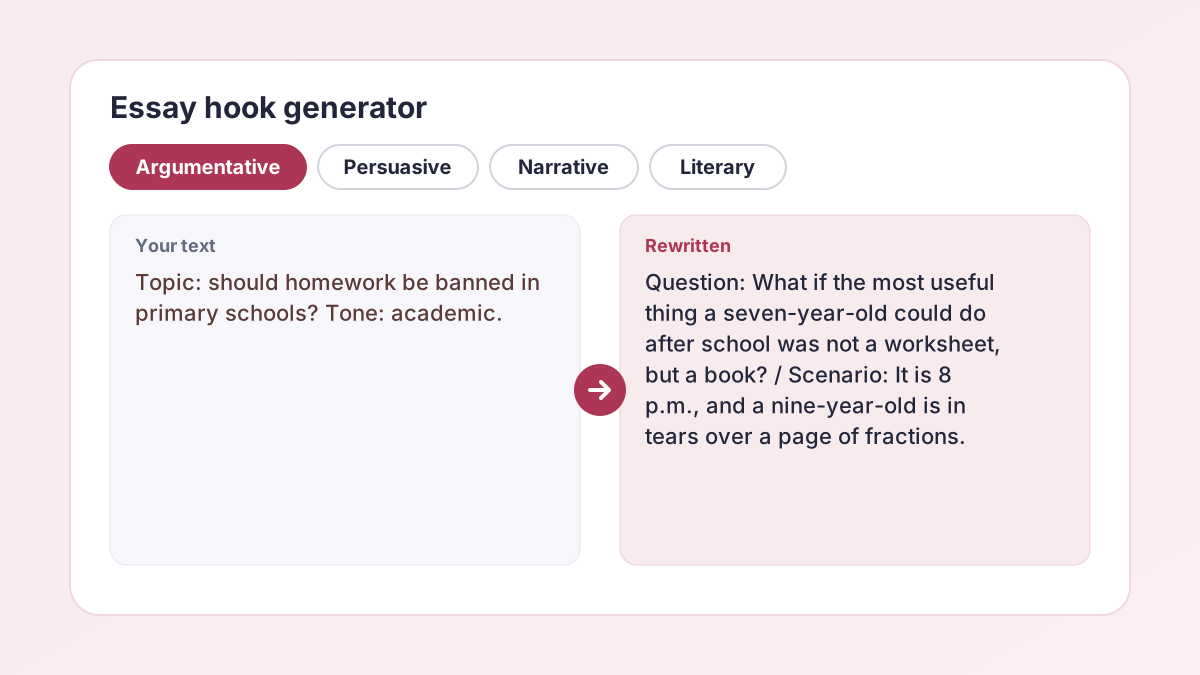
TopicShould homework be banned in primary schools?
HookWhat if the most useful thing a seven-year-old could do after school was not a worksheet, but a book?
A question works when the essay goes on to answer it.
TopicSingle-use plastics should be banned.
HookSomewhere off the coast, a sea turtle is trying to swallow a plastic bag it has mistaken for a jellyfish.
A short scene makes an abstract issue concrete.
TopicHow social media affects teenagers' sleep.
Hook[Statistic on how many teenagers use their phones after midnight, from your source] — and most of them say they wish they did not.
The bracket tells you exactly what kind of fact to find and cite.
TopicThe role of the green light in The Great Gatsby.
HookThe most important character in The Great Gatsby never speaks: it is a small green light across the bay.
A bold, arguable claim sets up an analytical thesis.
TopicThe day I moved to a new country.
HookThe airport smelled of coffee and floor polish, and every sign was in a language I could not read.
Sensory detail pulls the reader straight into a personal essay.
TopicOnline learning versus classroom learning.
HookOne student learns in pyjamas at the kitchen table; another sits in a classroom of thirty. Both are doing the same lesson.
A contrast hook previews the comparison the essay will make.
How to use the essay hook generator
Your hook should lead to your thesis, so add your main argument if you know it.
- Type your essay topic. Enter the topic or question, such as “should homework be banned in primary schools?”.
- Add your thesis (optional). If you know your main argument, add it so every hook points towards it.
- Choose the essay type and tone. Argumentative, narrative, literary analysis and more; academic, lively or serious.
- Generate nine hooks. Select Write my hooks. Each uses a different technique and comes with a note on when it works best.
- Choose, fill and adapt. Pick the hook that fits, fill any [bracket] from a real source and rewrite it in your own voice.
What is an essay hook?
An essay hook is the opening sentence or two of your essay, written to catch the reader's attention and make them want to keep reading. It is the first part of the introduction, followed by context and then the thesis statement.
A hook matters because first impressions shape how a reader approaches everything that follows. A marker who reads a vivid, relevant opening leans in; one who reads “Since the dawn of time…” starts skimming.
Where the hook goes
The classic introduction has three parts:
- Hook: one or two sentences that grab attention.
- Context: two or three sentences that explain the background and narrow down to your topic.
- Thesis: one sentence that states your main argument.
A hook must connect
The best hook is not the cleverest, but the one that leads naturally to your thesis. A brilliant opening on a different topic confuses the reader. Ask yourself: does this hook make my thesis feel like the obvious next step?
How to write a good hook for an essay
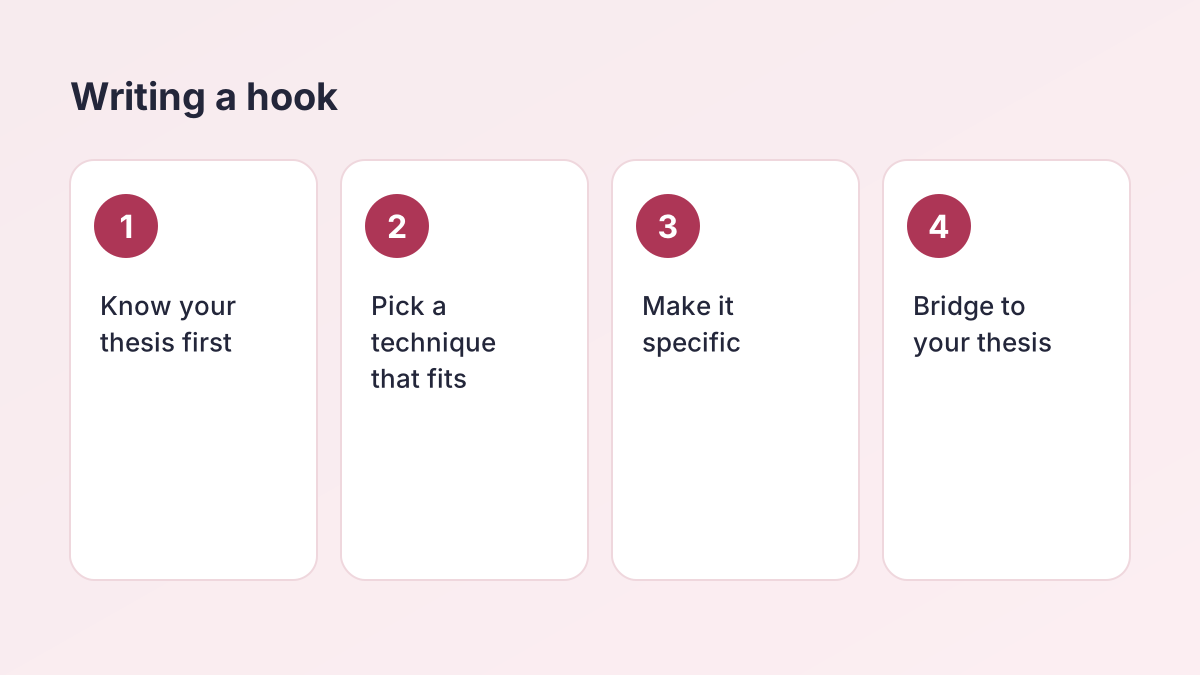
Knowing how to write a good hook for an essay is mostly about doing things in the right order. Many students try to write the hook first and get stuck. Write it last.
1. Know your thesis first
You cannot hook a reader towards an argument you have not decided. Write your thesis and body paragraphs first, then come back to the opening.
2. Choose a technique that fits your essay type
- Argumentative and persuasive: bold claim, question, problem statement.
- Narrative and personal: scene, vivid description, anecdote.
- Expository and research: surprising fact, definition with a twist, contrast.
- Literary analysis: bold claim about the text, a striking detail, a quotation from the text itself.
3. Make it specific
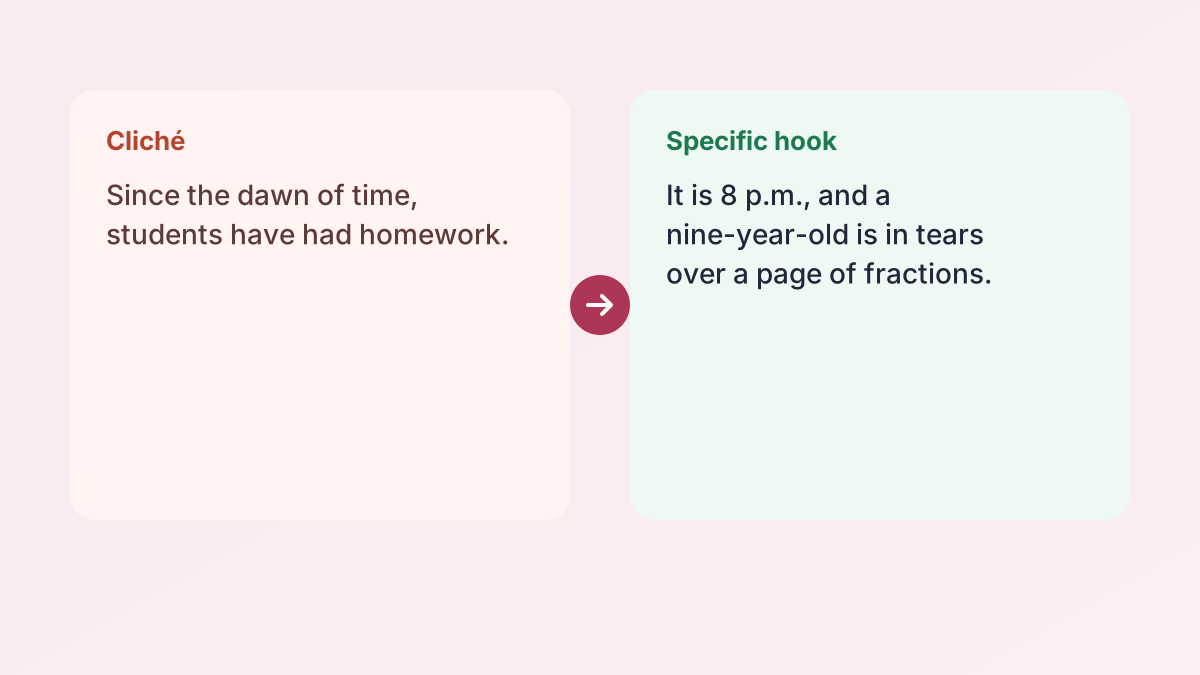
Specific details are more interesting than general statements. “Students have a lot of homework” is flat; “It is 8 p.m., and a nine-year-old is in tears over a page of fractions” is a scene the reader can see.
4. Bridge to your thesis
After the hook, write one or two sentences that connect it to the wider issue and lead into your thesis. The hook opens the door; the bridge walks the reader through it.
5. Read it aloud
If the opening sounds like something you would say to a friend who asked what your essay is about, it is probably working. If it sounds like a greeting card, rewrite it.
Types of hooks the hook generator writes
Each set from the hook generator uses nine different techniques, so you can compare them side by side. Las Positas College's writing guide to hooks and grabbers describes several of the same openers, including the intriguing question, the personal example and the problem statement.
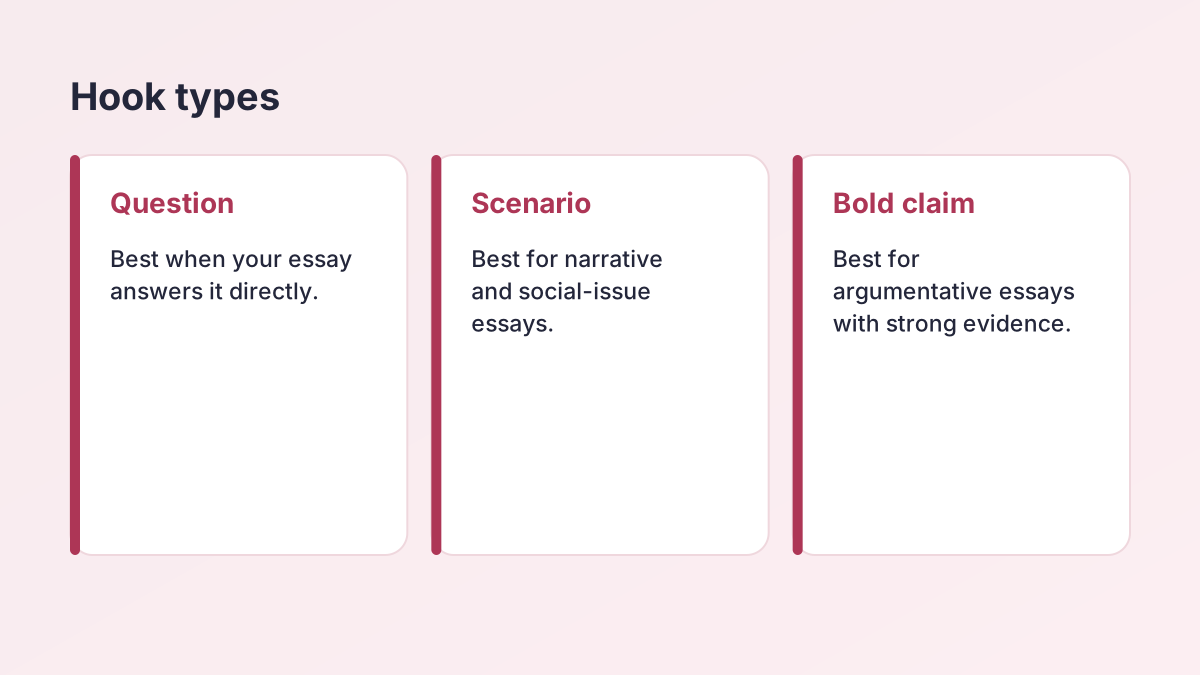
Question
An intriguing question the essay goes on to answer. What if the most useful thing a seven-year-old could do after school was read? Avoid questions with obvious yes-or-no answers.
Surprising fact or statistic
A fact that makes the reader stop. The hook generator writes these with a bracketed placeholder, so you fill in a real, cited figure.
Anecdote or scenario
A short scene, real or imagined, that makes the issue human.
Bold claim
A strong, arguable statement. It works when your evidence can support it.
Contrast
Two opposing images or ideas side by side, which previews a comparison or tension.
Vivid description
Sensory detail that drops the reader into a place or moment.
Definition with a twist
Not “The dictionary defines…”, but a definition that challenges the usual meaning.
Quotation
A quote from a real, relevant source, left as a placeholder for you to fill in and cite.
Problem statement
A direct statement of a problem and why it matters now.
Hooks to avoid
Some openings are so common that markers recognise them instantly. Avoid these:
- “Since the dawn of time…” or “Throughout history…” Too broad to mean anything.
- “In today's society…” Vague and overused.
- “Webster's dictionary defines…” The most clichéd opening in student writing.
- “Have you ever wondered…?” Usually followed by something nobody has wondered.
- “In this essay I will…” That is a signpost, not a hook. Some teachers want one later in the introduction, but not as the first line.
- Famous quotes used out of context. “As Einstein once said…” is rarely relevant, and many quotes attributed to famous people were never said by them.
- Made-up statistics. A number without a source damages your credibility. That is why the tool always leaves facts as placeholders.
What to do instead
Start with something only your essay could say: a specific detail, a real figure from your research, a scene from your topic.
Hooks by essay type
Different essays call for different openings. Here is what tends to work best for each, and how to set the tool.
Argumentative essay
Choose Argumentative. Bold claims, questions and problem statements set up a debate. Your hook should make the reader feel the issue is worth arguing about.
Persuasive essay
Choose Persuasive and a Lively or Serious tone. A scenario that makes the reader care is often more persuasive than a statistic.
Narrative or personal essay
Choose Narrative. Start in the middle of a moment, with sensory detail. Avoid starting with your birth or the morning you woke up.
Literary analysis
Choose Literary analysis. Open with a bold claim about the text or a striking detail from it. Quotations should come from the text itself.
Research paper
Choose Research paper and an Academic tone. A surprising finding or a problem statement, with a cited source, sets a scholarly tone.
College application essay
Use Narrative. Admissions readers see thousands of essays, so a specific, personal opening matters. For the whole statement, try the Personal Statement Generator.
After the hook: finishing your introduction
A hook is only the first sentence. Once you have chosen one, build the rest of the introduction.
Write the bridge
Add two or three sentences of context. If your hook is a scene of a child crying over homework, the bridge might explain the current debate about homework in primary schools.
State your thesis
End the introduction with one clear sentence stating your argument. If you need help, the Introduction Generator writes three complete introductions, from hook to thesis.
Check the flow
Read the whole introduction aloud. The hook, the bridge and the thesis should feel like one movement, not three separate pieces.
Return to the hook in your conclusion
A strong essay often comes full circle: the conclusion refers back to the image or question from the hook, showing how the argument has answered it.
Hook sentence starters
If you want to write your own hook, these sentence starters help you begin with each technique. Fill in the rest with details from your topic.
- Question: What would happen if…? / Why do so many… still…?
- Scenario: Imagine… / It is [time], and…
- Bold claim: The biggest problem with… is not… but… / Few ideas are as misunderstood as…
- Contrast: On one side… on the other… / Ten years ago… today…
- Fact: According to [source], [figure]…
- Description: The room was… / The first thing you notice about… is…
- Problem: Every year, [problem]. Yet…
Each set the essay hook generator writes also shows you which technique each hook uses, so you can learn the patterns and use them yourself.
Choosing the best hook from the essay hook generator
Nine hooks is a lot to choose from. Use these questions to narrow them down to one.
Does it lead to your thesis?
Read each hook followed by your thesis statement. The right hook makes the thesis feel like a natural answer or next step. If there is a jump between them, the hook is probably for a different essay.
Does it suit the reader?
An academic marker reading a research paper expects a measured opening; a scholarship panel reading a personal essay welcomes something vivid. Match the hook to the person who will read it.
Can you support it?
A bold claim or a surprising fact sets up an expectation. Make sure your body paragraphs deliver the evidence. If the essay hook generator gives you a fact placeholder, only keep that hook if you can find a reliable source.
Is it specific?
Prefer the hook with a concrete detail over the one with a general statement. Specific openings are remembered.
Does it sound like you?
Read the hook aloud. If it sounds forced, choose a simpler one or rewrite it. A plain, confident opening is better than a dramatic one you would never say.
Mix and match
You can combine ideas: the scene from one hook with the question from another. The hook generator is there to give you options, not to make the final choice for you.
Try again with your thesis
If none of the nine feels right, add or sharpen your thesis and generate again. The essay hook generator aims every hook at your argument, so a clearer thesis gives you more focused openings.
Good hooks for an argumentative essay, with examples
An argumentative essay asks the reader to weigh a debate, so the best hooks make the debate feel real and unsettled before your thesis takes a side. Here are ideas for essay hooks on three common argumentative topics, each using a different technique. All of them are invented examples of techniques the essay hook generator uses; brackets mark facts to fill from a real source.
Should voting be compulsory?
- Question: If the law can require you to serve on a jury, why can it not require you to vote?
- Contrast: In Australia, skipping a federal election can mean a fine; elsewhere, [turnout figure from your source] of eligible adults stay at home.
- Bold claim: A democracy in which most people choose not to vote is still a democracy, but only just.
Should social media have a minimum age?
- Scenario: A twelve-year-old ticks a box saying she is thirteen, and the app lets her straight in.
- Problem statement: Many age limits online depend on children telling the truth about their birthday.
Should zoos exist?
- Definition with a twist: A zoo was once a place to look at animals; for many conservationists, it is now a place to stop them disappearing.
Why these work
- Each opens the debate rather than settling it.
- Each points towards a thesis: the scenario about the twelve-year-old leads naturally to a claim about age checks.
- None relies on a number without a source.
Persuasive essay hooks
A persuasive essay hook can lean further towards the reader's feelings and interests, because the goal is to move them, not just to weigh evidence. Choose Persuasive in the essay hook generator with a Lively or Serious tone, and make sure the hook still connects to the reasons in your body paragraphs.
Argumentative hooks from the essay hook generator
Choose Argumentative, type your topic and add your thesis. The essay hook generator then aims all nine hooks at your position, each with a note on when that technique works best. Pick two or three, read each one followed by your thesis, and keep the one that makes your position feel like the obvious next question.
Anecdotal hooks and grabbers: what is a grabber in an essay?
A grabber is another name for a hook: the opening sentence or two that grabs the reader's attention. Some teachers say grabber, some say attention grabber, some say hook, but they mean the same job, and the essay hook generator writes nine at a time. Lists of hooks and grabbers nearly always include the anecdote, which is one of the most effective openings and one of the most often misused.
What an anecdotal hook is
An anecdotal hook opens with a very short story: a single moment, told in two or three sentences, that shows what your essay is about.
Real, imagined or someone else's?
- A real anecdote from your own life suits narrative and personal essays and college applications. Keep the details true.
- An imagined scenario suits argumentative and expository essays. Signal that it is imagined, with words such as imagine or picture, so the reader does not take it as fact.
- Someone else's story, from a news article or a book, needs a citation like any other evidence.
Never present an invented story as something that really happened. For the same reason, the essay hook generator leaves facts and quotations as bracketed placeholders rather than making them up.
How to start a hook sentence with an anecdote
- Start in the middle of the action, not with background: The fire alarm went off halfway through my chemistry exam beats One day at school, something happened.
- Use one concrete detail: a time, a sound or an object.
- Stop before the story explains itself. The next sentences do that.
Before and after
An invented example for an argumentative essay on free school meals:
- Before: Many students do not have enough money for lunch, which is a big problem.
- After: Picture a fourteen-year-old who tells his friends every lunchtime that he is not hungry. He spent his lunch money on the bus fare that morning.
Anecdotes in the essay hook generator
The essay hook generator is asked to include an anecdote or scenario in every set. The essay hook generator cannot know your own experiences, so for a personal essay, treat its version as a model and replace the details with a moment that really happened to you.
Is the essay hook generator free?
Yes. The essay hook generator is free, with no account or sign-up. A fair hourly allowance per visitor keeps it fast for everyone.
Your topic and thesis are sent to our AI providers (Groq, with Google Gemini as a backup) only to write the hooks you see. The Study Corp does not save them.
Your school's rules
Many schools limit the use of AI in assessed work. Use the hook generator's suggestions as ideas and models, fill in real sources and rewrite the one you choose in your own words. Check your teacher's or institution's policy if you are unsure.
Usage allowance
The essay hook generator is part of The Study Corp's free writing tools. If the essay hook generator is busy, wait a little and try again; the free allowance is counted per hour.
Essay hook generator FAQ
Is the essay hook generator free?
Yes. It is free with no account or sign-up. A fair hourly allowance per visitor keeps it fast for everyone.
What is a hook in an essay?
The opening sentence or two of an essay, written to catch the reader's attention before the context and thesis.
How do I write a good hook for an essay?
Decide your thesis first, choose a technique that fits the essay type, make it specific, and bridge from the hook to your thesis.
Does the hook generator make up statistics or quotes?
No. Where a fact or quote belongs, it writes a bracketed placeholder for you to fill from a real source and cite.
How many hooks do I get?
Nine, each using a different technique, with a note on when each works best.
Which hooks should I avoid?
“Since the dawn of time”, “In today's society”, dictionary definitions, “Have you ever wondered” and made-up statistics.
Where does the hook go?
At the very start of the introduction, followed by two or three sentences of context and then the thesis statement.
What is an anecdotal hook?
An opening that tells a very short story, one moment in two or three sentences, to show what your essay is about. Use a real moment from your life for a personal essay, or a clearly signalled imagined scenario (“Picture a…”) for an argument. Each set from the essay hook generator should include an anecdote or scenario to compare.
What is a good hook for an argumentative essay?
One that opens the debate without settling it: a pointed question, a contrast between two sides, a bold but supportable claim or a short scenario. Avoid statistics without a source. Choose Argumentative in the essay hook generator and add your thesis so the hooks point towards your position.
More free writing tools
- Book Title GeneratorTitle ideas for your book, chapters or series, in any genre.
- Essay Title GeneratorTen clear, catchy titles for any essay type, with notes on each.
- Story Title GeneratorOriginal titles for short stories, fan fiction and school stories.
- Poem GeneratorWrite a poem on any topic: free verse, rhyming, haiku, sonnet and more.
- Shape Poem GeneratorLay a poem out inside a heart, star, tree and more, then download it.
- Paragraph ExpanderMake a paragraph or essay longer with explanation, not filler.
- Personal Statement GeneratorDraft a UCAS or college statement and check it against the word limit.
- Introduction GeneratorThree introductions that move from a hook to your thesis.
- Poetry Prompt GeneratorTen fresh poem prompts on any theme, for any level.
- Acrostic Poem GeneratorA poem whose first letters spell any name or word.
- Random Paragraph GeneratorRandom paragraphs for reading, typing and handwriting practice.
- Thesis Statement GeneratorFive clear, arguable thesis statements for any essay type.
- Essay Outline GeneratorPlan your essay section by section, from thesis to conclusion.
- Topic Sentence GeneratorTopic sentences that tie each body paragraph to your thesis.
- Paragraph GeneratorWrite a clear paragraph from a topic, or turn notes into one paragraph.
- Conclusion GeneratorThree conclusions for your essay, or a concluding sentence for a paragraph.
- Poem Title GeneratorTen title ideas for your poem, from simple to striking.
- Haiku Poem GeneratorHaiku, sonnets and limericks with syllables counted on every line.
- Argumentative Essay GeneratorDraft an argumentative essay with a clear claim, counterargument and rebuttal.
- Persuasive Essay GeneratorDraft a persuasive essay aimed at a real reader, with a call to action.
- Informative Essay GeneratorDraft a clear, neutral informative (expository) essay on any topic.
- Analytical Essay GeneratorDraft an analytical essay that explains how and why, not just what.
- Compare and Contrast Essay GeneratorDraft a comparison essay, point-by-point or block, with a real judgment.
- Scholarship Essay GeneratorDraft a scholarship essay built from your own story and goals.
- Name GeneratorCharacter names for stories and games, 12 at a time, in any genre.
See all 80 free tools for students
Related tools
Last updated by The Study Corp editorial team.