Restate thesis examples
Six restatements across different essay types. Each keeps the original position, scope and certainty; the wording and structure change.
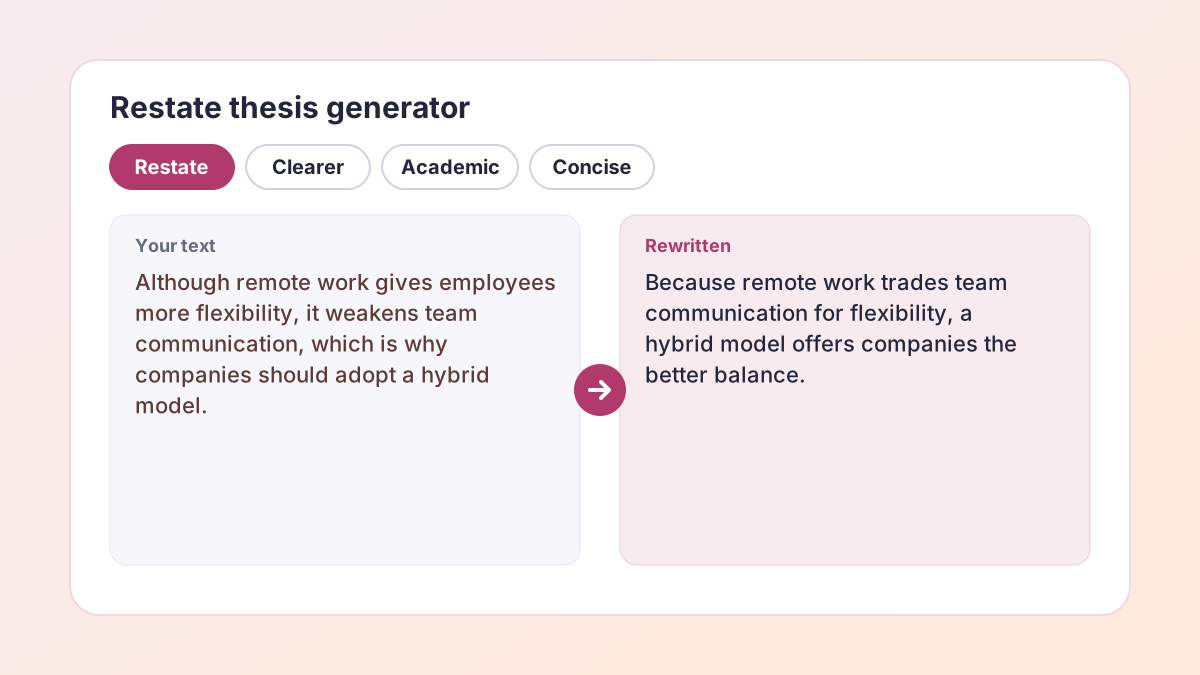
BeforeAlthough remote work gives employees more flexibility, it weakens team communication, which is why companies should adopt a hybrid model.
AfterBecause remote work trades team communication for flexibility, a hybrid model offers companies the better balance.
New structure; same position (hybrid) and same reason.
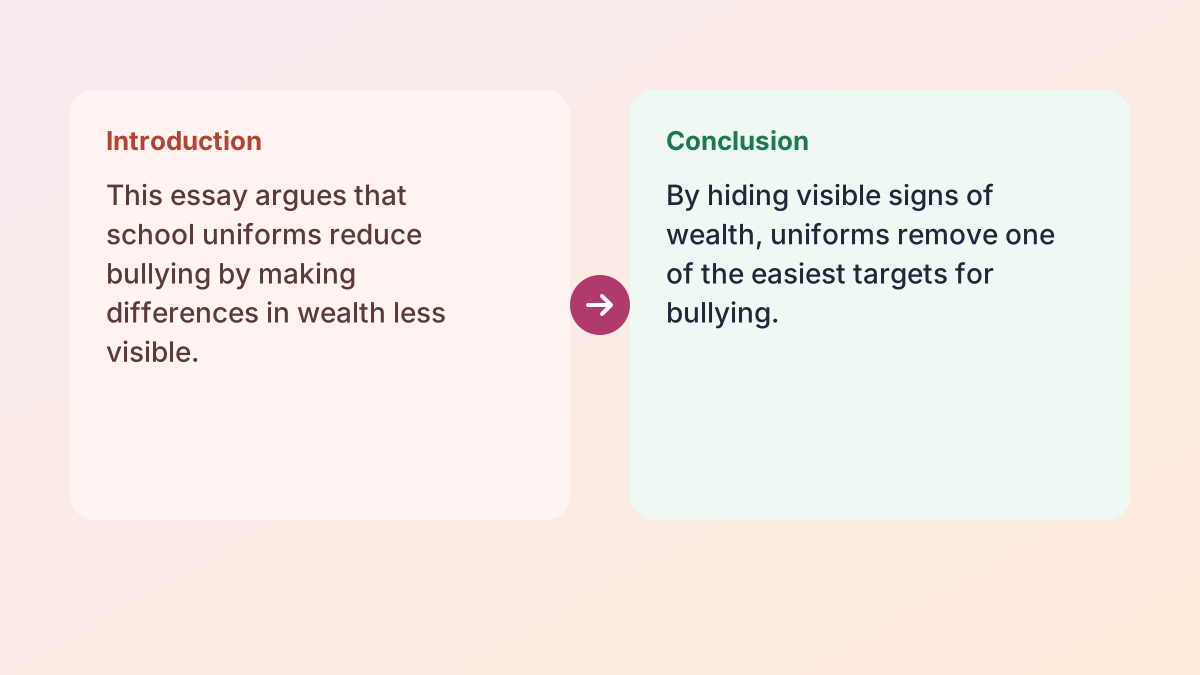
BeforeSchool uniforms reduce bullying by making differences in wealth less visible.
AfterBy hiding visible signs of wealth, uniforms remove one of the easiest targets for bullying.
The reason now comes first; the claim is unchanged.
BeforeIn Macbeth, Shakespeare presents ambition as a force that destroys those who cannot control it.
AfterShakespeare's Macbeth shows that ambition without restraint ends in self-destruction.
Shorter, and “cannot control it” becomes “without restraint”.
BeforeWhile both online and in-person classes can teach the same content, in-person classes build stronger peer relationships.
AfterOnline and in-person classes may cover the same material, but only face-to-face learning reliably builds close peer connections.
“Can” stays as “may”: the certainty is not raised.
BeforeCoral reefs are declining because of rising sea temperatures, ocean acidification and pollution.
AfterWarmer seas, more acidic water and pollution are together driving the decline of coral reefs.
All three causes are kept; the order of the sentence changes.
BeforeThis essay will argue that it is the case that social media use has an effect on the sleep of teenagers.
AfterThis essay argues that social media use affects teenagers' sleep.
Use Clearer to fix the introduction version before you restate it.
How to use the restate thesis generator
Paste the thesis from your introduction, not your conclusion draft, so the restatement starts from your real claim.
- Paste your thesis statement. Copy the thesis sentence from your introduction and paste it into the box.
- Keep Restate selected. Restate always rewords with a strong amount of change, but keeps the same claim, stance, scope and certainty.
- Restate my thesis. Select Restate my thesis. The restatement appears next to your original.
- See alternatives. Select the result and choose See alternatives for more versions, then pick the one that sounds most like the end of your essay.
- Fit it to your conclusion. Adjust it so it uses the key terms from your body paragraphs, and place it near the start of the conclusion.
What does it mean to restate a thesis?
To restate a thesis is to express your essay's main claim again, in different words, usually at the start of the conclusion. The claim stays exactly the same: the same position, the same reasons, the same scope and the same level of certainty. What changes is the wording and the sentence structure.
A restated thesis reminds the reader what the essay set out to prove, now that they have read the evidence. It signals that the argument is complete. Copying the introduction's thesis word for word does the same job badly: it reads as lazy, and it misses the chance to show how the essay has developed the idea.
Restate vs repeat
Repeating says the same sentence twice. Restating says the same claim in a way that reflects everything in between. A good restatement often sounds more confident than the original, because it can now draw on the evidence, but it never claims more than the essay showed.
What the restate thesis generator does
It rewrites your thesis with a new structure and wording while keeping the claim, then offers alternatives. You choose the version that fits your conclusion and adjust it to use your own key terms.
How to restate a thesis, step by step
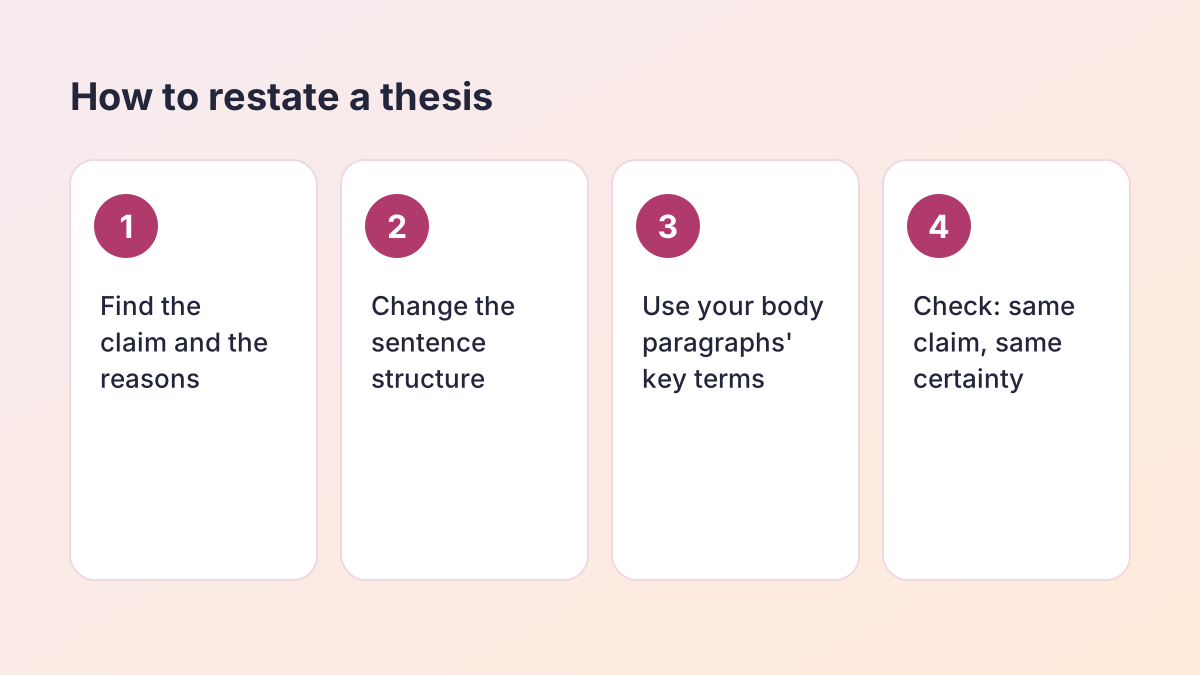
You can restate a thesis yourself in four steps. The generator follows the same rules, so the steps also tell you how to judge its suggestions.
- Find the claim and the reasons. Underline what your thesis argues and why. In “Uniforms reduce bullying by making wealth less visible”, the claim is uniforms reduce bullying and the reason is wealth is less visible.
- Change the structure. Start with the reason instead of the claim, turn a simple sentence into one with a subordinate clause, or the reverse.
- Use the essay's key terms. Bring in the words your body paragraphs developed, so the restatement sounds earned.
- Check the meaning. Same position, same reasons, same certainty. If your thesis said “should consider”, the restatement must not say “must”.
How do you restate your thesis without sounding repetitive?
Change at least two of three things: the words, the order of ideas, and the stance. Moving from “This essay argues that…” to “The evidence examined shows that…” changes the stance while keeping the claim.
How to restate a thesis in the conclusion
The restated thesis usually goes in the first or second sentence of the conclusion. A common conclusion structure is:
- Restated thesis: the claim, in new words.
- Synthesis: how your main points fit together to support it. Do not list them again; connect them.
- Closing thought: why the argument matters, what it implies, or what question it leaves open. This is sometimes called the “so what” statement.
The “so what” statement
After restating the thesis, answer the question a reader might ask: so what? Explain the wider significance: who should care, what should change, or what further research is needed. The Conclusion Paragraph Generator can help with this part.
What not to do in a conclusion
- Do not introduce new evidence or new arguments.
- Do not apologise or undercut your claim (“This is only my opinion”).
- Do not start with “In conclusion” if your course discourages it; a restated thesis already signals the conclusion.
Stanford's teaching notes on effective conclusions describe the same balance between restating and moving the reader forward.
Three ways to restate a thesis statement
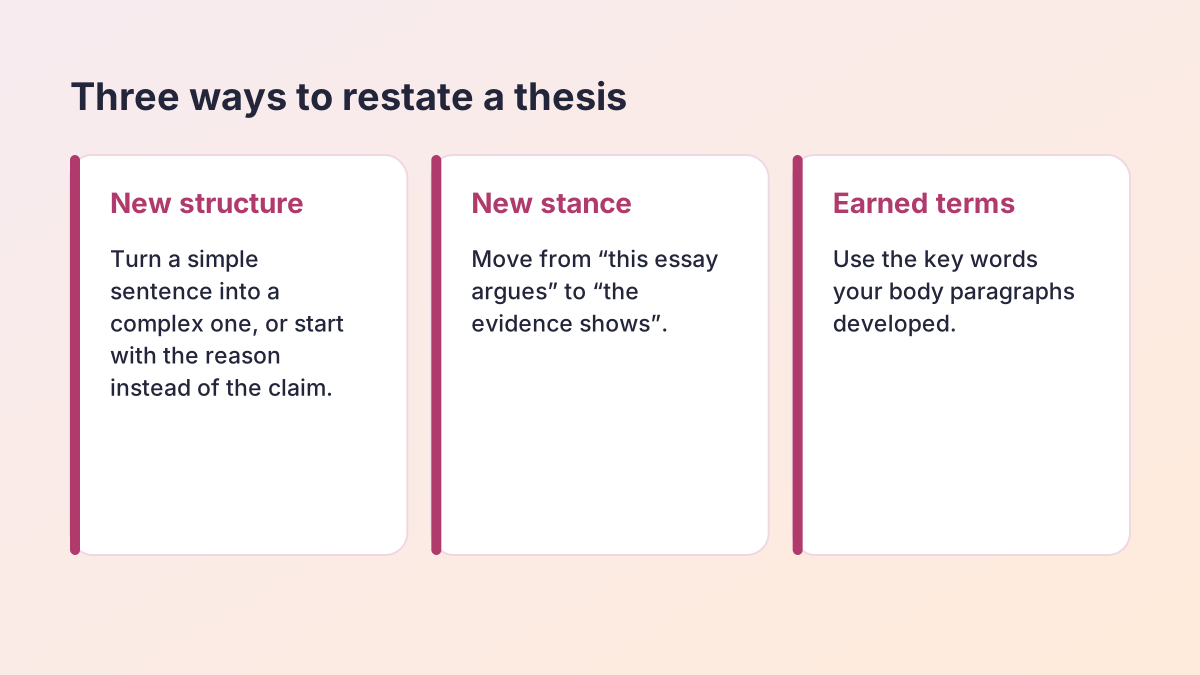
1. Change the structure
Turn the sentence around. If your thesis is “X because Y”, try “Because Y, X”. If it is one long sentence, try a short main clause with the reason after it.
- Original: Social media harms teenagers' sleep because late-night scrolling delays bedtime.
- Restated: Late-night scrolling delays bedtime, and that is how social media harms teenagers' sleep.
2. Change the stance
Move from announcing to concluding. “This essay will argue” becomes “As this essay has shown” or simply the claim stated as established by the evidence.
- Original: This essay argues that public libraries remain essential.
- Restated: The evidence shows that public libraries remain essential.
3. Use earned key terms
If your body paragraphs introduced a concept, such as digital divide or social capital, use it in the restatement. It shows the reader the argument has grown.
- Original: Libraries help people who cannot afford internet access at home.
- Restated: By narrowing the digital divide, libraries give every resident a fair chance to take part online.
How to restate a claim or a topic sentence
The same technique works for any claim, not just a thesis. In a body paragraph, the concluding sentence often restates the paragraph's claim (its topic sentence) to show the point has been made. In an argument essay, you may restate an opposing claim fairly before answering it.
To restate a claim: keep the subject, the position and the certainty; change the words and the structure. The restate thesis generator works for these too: paste the topic sentence or claim instead of a thesis.
Restating a prompt
Some exams ask you to restate the question or prompt at the start of your answer. That means turning the question into a statement in your own words. “Why did the Roman Empire decline?” becomes “The Roman Empire declined for several connected reasons.” It shows the marker you understood the question before you answer it.
Common mistakes when you restate a thesis
- Changing the claim. A conclusion that argues something different from the introduction is a structural problem, not a fresh perspective.
- Raising the certainty. “Can help” becoming “will solve” overclaims. The restatement should match what the evidence showed.
- Dropping a reason. If your thesis named three causes, the restatement should still cover all three.
- Copying word for word. Readers notice, and it suggests the essay has not moved.
- Making it vaguer. “This topic is very important” is not a restatement; it has lost the claim.
The Restate goal is instructed to avoid all five, and any sentence where a hedge or negative changed is marked for you to check. You still make the final call, because only you know exactly what your essay showed.
Need a thesis first? Thesis statement help
You can only restate a thesis you already have. If your thesis is weak or missing, fix that first; a restatement of a vague thesis is just as vague.
A strong thesis is specific, arguable and focused: it makes a claim someone could disagree with, and it signals the reasons you will give. Washington State University's Writing Center handout on thesis statements explains how to test one.
The Thesis Statement Generator can help you draft a thesis from your topic and position. Then use the Clearer goal here to tighten the introduction version, and Restate to write the conclusion version.
Sentence starters to restate thesis statements
A good opening phrase changes the stance of your restatement at once. When you restate thesis claims in a conclusion, these starters move you from announcing an argument to confirming it:
- “As this essay has shown, …” works for argumentative and analytical essays.
- “The evidence makes clear that …” works when your body paragraphs relied on data or sources.
- “Ultimately, …” works for persuasive essays that end on a firm position.
- “Taken together, these points show that …” works when you want the restatement to lead straight into synthesis.
- “What emerges from this analysis is …” works for literature and history essays.
Use a starter only if it fits your course's style. Some teachers prefer the claim stated directly with no signpost, and a plain, confident sentence is always acceptable.
Restate thesis starters to avoid
Avoid “In conclusion, I said that…” and “As I stated in my introduction…”. Both point backwards instead of showing what the essay achieved. Also avoid “I think” or “I feel” unless your assignment asks for a personal voice, because they weaken a claim the essay has already supported.
Restate thesis length
A restatement is usually one sentence, sometimes two. If your thesis was long, the restate thesis generator's Concise goal can shorten it first, so the conclusion version stays focused.
How to restate a thesis for different essay types
The basic rule never changes, but the emphasis does. In an argumentative essay, the restatement should sound settled: the counterarguments have been answered. In a compare and contrast essay, keep both sides of the comparison and the judgement you reached. In a literary analysis, name the author and text again and keep the interpretation exact. In an informative or expository essay, there is no position to defend, so restate the main idea and the categories you covered. In a research paper, restate the research question's answer and keep any limits you acknowledged.
Whichever type you write, the restate thesis generator gives you a starting point; your job is to check that it still reflects what your essay actually demonstrated.
What a restate thesis generator can and cannot do
A restate thesis generator is good at rewording: new sentence structure, fresh vocabulary, a shift in stance. It cannot know which key terms your body paragraphs developed, or whether your evidence ended up supporting the claim more or less strongly than you expected. So treat its suggestions as drafts.
Read each version against your essay and ask: is this still my claim? Does it use my terms? Is it as certain as my evidence, and no more? Then edit it into your own words. The final sentence should sound like the end of your essay, not a generic one.
The Study Corp does not store your text. It is sent to our AI providers (Groq, with Google Gemini as a backup) only to create the suggestions you see.
Restate thesis FAQ
Is the restate thesis generator free?
Yes. It is free with no account or sign-up. A fair hourly allowance per visitor keeps it fast for everyone.
What does restate thesis mean?
It means expressing your essay's main claim again in different words, usually at the start of the conclusion, without changing the claim itself.
How do you restate a thesis in a conclusion?
Put the restated thesis in the first or second sentence of the conclusion, then synthesise your main points and end with why the argument matters.
Can I just copy my thesis into the conclusion?
It is better not to. A word-for-word copy reads as repetitive and misses the chance to show how the essay developed the idea.
Will it change my argument?
It should not. The Restate goal keeps the same claim, stance, scope and certainty. Always compare the result with your original before using it.
Can I use it to improve my original thesis?
Yes. Switch the goal to Clearer, Academic tone or Concise to polish the introduction version instead of restating it.
Where does the restated thesis go?
Near the start of your conclusion, usually the first or second sentence, before you synthesise your main points.
More free rewriting tools
- AI Paraphrasing ToolParaphrase any text, and learn to paraphrase and cite well.
- AI Sentence RewriterFix an awkward sentence and choose from several better versions.
- Paragraph RewriterMake the sentences in one paragraph connect and flow.
- Rewording ToolReword any text in fresh words: emails, reports, applications and more.
- Essay RewriterRewrite a whole essay or paper, paragraph by paragraph, keeping its structure.
- Text SimplifierSimplify text to a reading level: grade 5, grade 7, grade 9 or plain English.
- Sentence ShortenerShorten text or combine it into 1, 2 or 3 sentences, keeping every key fact.
- Sentence FinisherGet five ways to finish a sentence you started.
- Say It BetterFind a better way to say a sentence or phrase, with alternatives.
- Sentence ExpanderExpand a sentence into a fuller, more detailed version without new facts.
- Poem RewriterParaphrase a poem line by line, modernise it, or polish your own poem.
See all 74 free tools for students
Related tools
Last updated by The Study Corp editorial team.