Paragraph expander examples
Short paragraphs expanded with real explanation. Nothing new is claimed: the extra words develop what the writer already said.
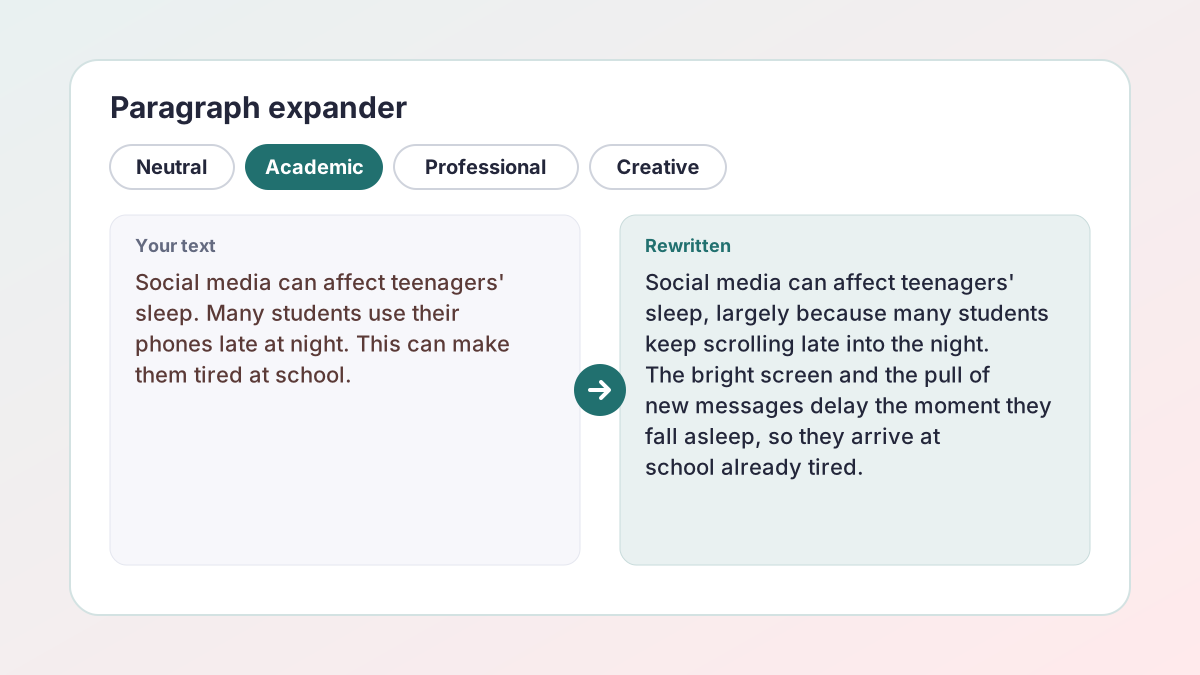
BeforeSocial media can affect teenagers' sleep. Many students use their phones late at night. This can make them tired at school.
AfterSocial media can affect teenagers' sleep, largely because many students keep using their phones late at night. Scrolling and messaging delay the moment they put the phone down, so they get less rest and often arrive at school tired and less able to concentrate.
Adds the “because” and the consequence; keeps “can” as cautious as the original.
BeforeRecycling reduces waste. It also saves resources.
AfterRecycling reduces the amount of waste that ends up in landfill, which matters because landfill space is limited and decomposing rubbish can pollute soil and water. It also saves resources: when materials such as paper, glass and aluminium are reused, fewer raw materials need to be extracted and processed to make new products.
Explains why each point matters, using only general knowledge implied by the original.
BeforeI enjoyed the school trip. The museum was interesting.
AfterI really enjoyed the school trip, mostly because the museum was so interesting. Seeing the exhibits in person made the topics we had studied in class feel much more real.
A reflective expansion: no new events are invented.
BeforeI am interested in the volunteer role. I have experience working with children.
AfterI am very interested in the volunteer role, and I believe my experience working with children has prepared me well for it. I enjoy helping young people feel confident and would be glad to bring that experience to your team.
Adds enthusiasm and connection without inventing qualifications.
BeforeRegular exercise improves mood (Smith, 2021). It also helps concentration.
AfterRegular exercise improves mood (Smith, 2021), which may in turn make it easier to stay motivated during the school day. It also helps concentration, so students who stay active may find it easier to focus in lessons.
The citation is protected and comes back exactly as written.
BeforeThe house was old. Nobody had lived there for years.
AfterThe house was old, its paint peeling in long grey strips and its windows clouded with dust. Nobody had lived there for years, and the silence inside felt heavy, as if the rooms were still waiting for someone to come home.
Description and atmosphere for a story.
How to use the paragraph expander
It works on a single paragraph or a short essay of up to 800 words.
- Paste your text. Copy the paragraph or essay you want to make longer and paste it into the box.
- Choose a tone. Academic for essays, Neutral for everyday writing, Professional for applications, Creative for stories.
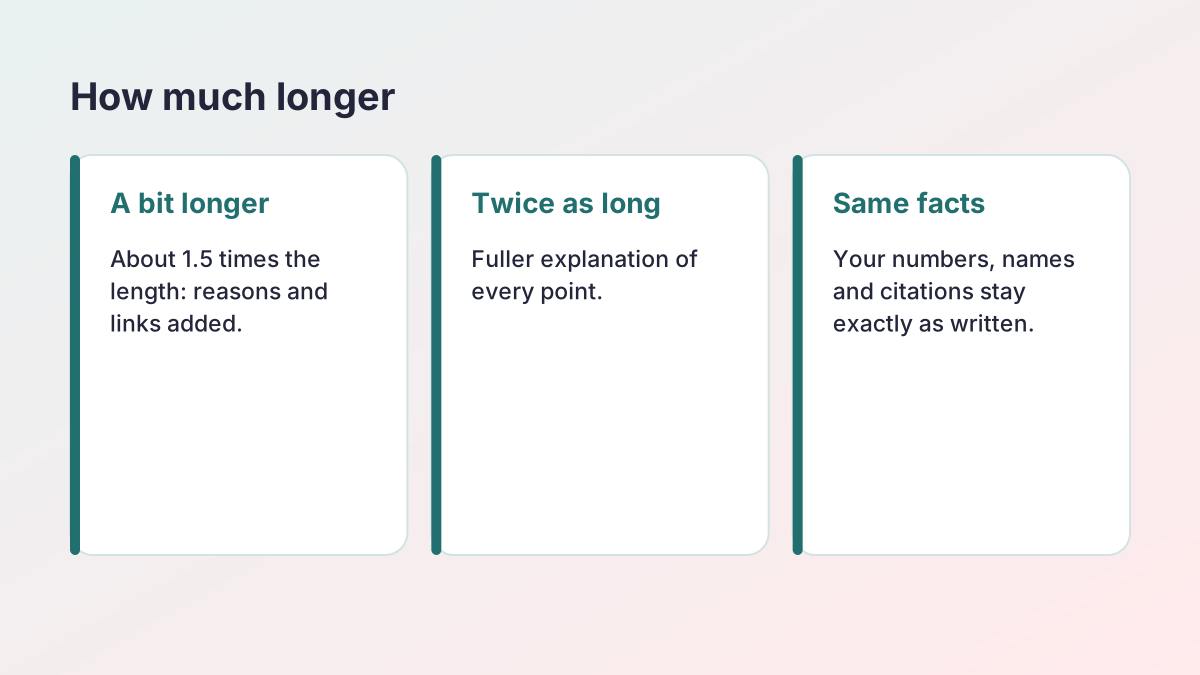
- Choose how much longer. Under More options, choose A bit longer (about 1.5 times) or About twice as long.
- Expand my paragraph. You get three expanded versions with their word counts. Any version where a number, negative or hedge changed is marked.
- Add your evidence. Pick the version that fits, then add your own examples, quotes or data where your essay needs proof.
What is a paragraph expander?
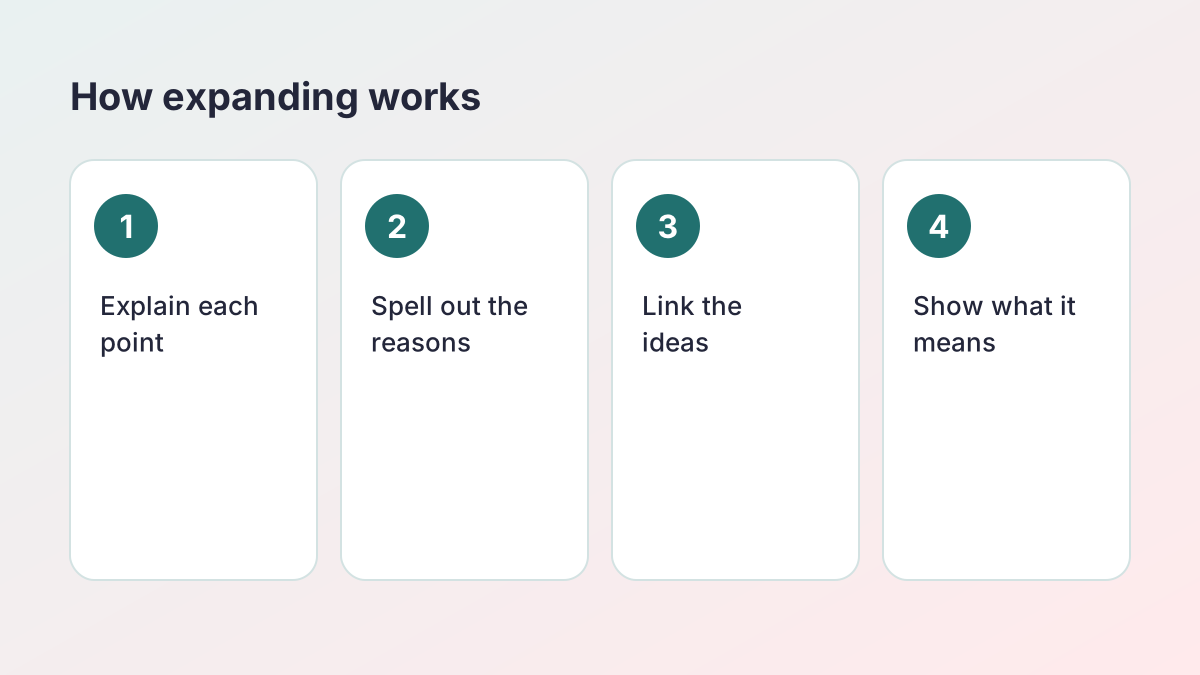
A paragraph expander is a writing tool that makes a paragraph longer by developing the ideas already in it. It explains points that were only stated, spells out the reasons behind a claim, adds transitions between sentences and describes what an idea means or leads to.
That is different from padding. Padding adds words without adding meaning: repeated points, empty phrases and long-winded wording. A marker spots padding immediately. Development adds substance, and that is what this paragraph expander is designed to do.
It never invents facts
Many AI tools “expand” text by adding confident statistics, studies or quotes that do not exist. In an essay, that can count as academic misconduct. This tool is instructed to add only explanation and connection that follow from what you wrote. Numbers, quotes, citations and names you typed are protected, and each version is checked: if a number changed, a negative disappeared or a cautious word like “may” became “will”, the version is marked for you to review.
Paragraph expander or sentence expander?
Use the Sentence Expander for one short sentence. Use the paragraph expander when you have a whole paragraph or a few paragraphs, because it keeps the ideas connected and the order of your points the same.
Make it longer: the right way to add words
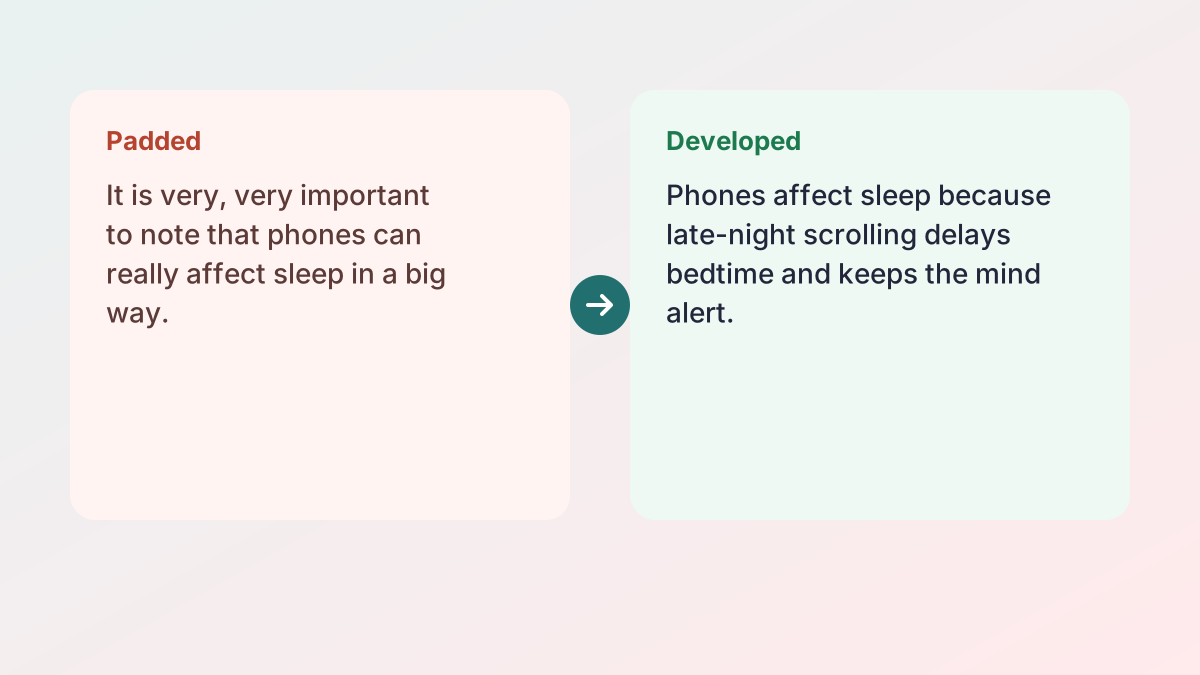
“Make it longer” is one of the most common things students need, usually because an assignment has a minimum word count. The best way to make it longer is to make it deeper. These four moves add substance:
- Explain. Every claim should be followed by what it means. “Social media affects sleep” becomes “Social media affects sleep, because scrolling delays bedtime.”
- Give reasons. Use because, since and as a result to show why something is true or what it causes.
- Link ideas. Add transitions such as however, for example, in contrast and this means that so the reader sees how each sentence connects to the next.
- Show what it means. End a point by explaining why it matters to your argument.
What not to do
- Don't repeat the same point in different words.
- Don't add empty phrases like “it is important to note that”.
- Don't swap short words for long ones just to raise the count.
- Don't add quotations without explaining them.
Markers recognise these tricks, and they make the writing weaker. Brandeis University's handout on paragraphs describes the qualities a developed paragraph needs: focus, form and flow.
Essay extender: lengthening a whole essay
When a whole essay is short, an essay extender can help, but it works best one section at a time. Paste a paragraph, expand it, check it, and move on to the next. That keeps you in control of your argument and stops the essay from drifting.
Find the thin paragraphs first
Read your essay and mark every paragraph that makes a claim without explaining it. Those are the paragraphs to expand. A paragraph with one point and four sentences of explanation is stronger than one with four points and no explanation.
A good routine
- Expand your thinnest body paragraph with A bit longer.
- Compare the result with your original and keep the additions that genuinely explain.
- Add your own evidence where the paragraph now says “for example” or makes a claim that needs support.
- Repeat for the next paragraph, then check the total in the Word Counter.
Over the limit afterwards?
If you overshoot, the Sentence Shortener can trim repetition back out while keeping the substance you added.
Expanding with a paragraph structure: PEEL
Many teachers use a structure such as PEEL to show what a developed paragraph contains. If your paragraph is short, it is usually missing one of these parts.
- Point: the claim the paragraph makes.
- Evidence: a quote, statistic or example from a source.
- Explanation: how the evidence supports the point.
- Link: how the paragraph connects back to your thesis or on to the next point.
The paragraph expander is good at the Explanation and Link parts, because those come from reasoning about what you already wrote. The Evidence has to come from your own research: the tool will not invent it.
A worked example
Original: “Uniforms may reduce bullying. Students wear the same clothes.”
Expanded (Academic, a bit longer): “Uniforms may reduce bullying, because when every student wears the same clothes, differences in family income become far less visible. This removes one of the easiest targets for teasing and can help students feel more equal.”
Your next step: add a study or survey that supports the claim, then a sentence linking back to your thesis.
What good expansion looks like in different subjects
Every subject rewards a slightly different kind of development. Knowing what your teacher looks for helps you choose the best of the three versions and decide what evidence to add yourself.
English and literature
Literature essays reward close analysis. After a quotation, explain the technique, the effect on the reader and how it connects to the theme. Bare: “The poet uses repetition.” Developed: “The poet repeats ‘never again’ at the end of each stanza, which gives the poem a sense of finality and makes the speaker's grief feel unchangeable.”
History
History rewards causes, consequences and perspectives. Explain why an event happened, who it affected and how historians interpret it. Words like “contributed to” and “partly” keep the claim balanced.
Science
Science rewards links between results and theory. Explain what a result shows and why, and keep the language cautious: “suggests”, “is consistent with”, “may indicate”. Never let an expansion turn “may” into “proves”.
Geography and social sciences
These subjects reward the effects of a trend on people and places. Bare: “Cities are growing.” Developed: “Cities are growing as people move from rural areas in search of work, which puts pressure on housing, transport and public services.”
Business and economics
Explain the mechanism: how a change in one thing leads to a change in another. “Prices rose” becomes “Prices rose because demand grew faster than supply, so sellers could charge more without losing customers.”
Reflective and personal writing
Reflection rewards honesty and specifics. Explain what you felt, what you learned and what you would do differently next time.
The common thread
In every subject, good expansion answers the question a reader would naturally ask next: why, how, so what or for example? When you compare the three versions, pick the one that answers the question your teacher would ask, then add the evidence that proves it.
Choosing a tone
The tone setting changes the vocabulary and formality of the added sentences.
- Academic: formal and careful, with cautious language like “may” and “suggests”. Best for essays, reports and lab write-ups.
- Neutral: clear, everyday English. Good for reflections, discussion posts and homework answers.
- Professional: polite and confident. Good for cover letters, applications and emails.
- Creative: vivid and descriptive. Good for stories and descriptive writing, where expansion means adding sensory detail and atmosphere.
If the rest of your essay is formal, an informal expansion will stand out, so match the tone to the piece. You can also choose US or UK spelling under More options.
Protect your key terms
If your teacher expects particular subject words, such as photosynthesis, opportunity cost or dramatic irony, list them under “Words to keep unchanged”. They will come back exactly as you wrote them in every version, so the expansion never swaps a precise term for a vaguer one. Citations, quotations and numbers are always protected automatically. That matters most in science and law, where swapping one technical word for a near-synonym can quietly change the meaning of a sentence.
Meeting a minimum word count honestly
Word counts exist because a task needs a certain depth. If you are under the count, your essay is probably missing explanation, analysis or evidence, and adding those will raise your mark as well as your word count.
Where extra words belong
- Analysis of evidence: most essays quote evidence and move on too quickly. Explain what each quote shows.
- Counterarguments: acknowledge another view and answer it.
- Examples: a specific example makes an abstract point concrete.
- Conclusions: show why your argument matters, not just what it was.
Using the tool responsibly
Expanding your own writing is ordinary editing. If you use AI tools in coursework, check your school's policy: many allow them for editing and brainstorming but not for writing graded work. Read every version, keep only what you agree with, and make sure the final text sounds like you.
Expand on this: what to add when your teacher asks for more
“Expand on this” is one of the most common comments in the margin of an essay, along with “add more to it” and “make this longer”. It rarely means more words for their own sake. It means the reader was left with a question. Work out the question first, then decide what to add. A paragraph expander can supply explanation and links between ideas; evidence and examples from your sources are your job.
Five margin comments and what they ask for
- “Expand on this” or “develop”: explain how or why. Add a because clause and a consequence.
- “Add more detail” or “be specific”: name the example: who, where, which one. Take it from your notes or sources.
- “Explain” or “analyse”: after a quotation or figure, say what it shows and why it matters.
- “So what?”: link the point back to your thesis.
- “Evidence?” or “How do you know?”: find a source and cite it. No tool can do this part for you.
A worked example: expanding paragraphs from feedback
An invented paragraph with the comment “expand on this”:
Homework helps students. It gives them practice. However, too much can be stressful.
A developed version:
Homework can help students because it gives them a chance to practise skills on their own, away from the support of the classroom. That independent practice shows both the student and the teacher which topics still need work. However, too much homework can become stressful, leaving less time for rest. [Add a study or survey on homework and stress.]
The because clause and the links between sentences are the kind of development the paragraph expander can add; for a paragraph this short, choose About twice as long under More options. A new point, such as what the teacher learns from homework, has to come from you, and so does the source in brackets: the tool is instructed never to invent one.
How to make a paragraph longer without any tool
- Underline every claim in the paragraph.
- After each claim, write one sentence starting “This means…” or “This is because…”.
- Add one specific example from your notes.
- Finish with a sentence that links the point to your thesis.
- Read it aloud and cut anything that repeats.
Five steps, and a three-sentence paragraph usually becomes six or seven sentences, all of them doing a job. Then compare your version with the paragraph expander's (up to three versions) and keep the best of each.
AI paragraph expander, paragraph extender or text expander?
Students look for this kind of tool under many names. Most of them mean the same job, but one name often refers to something quite different, and knowing which is which saves time.
Same job, different names
Paragraph extender, paragraph lengthener, essay expander, word expander and longer text generator usually describe the same thing as a paragraph expander: a tool that takes your text and returns a longer version. What differs is how they add length. Some pad with repetition or confident made-up facts. This AI paragraph expander is instructed to add only explanation and connection, and it flags any version that adds a number, adds or removes a negative, or drops your cautious wording.
Not the same: keyboard text expanders
Search for “text expander” and many results are typing shortcut apps. You type a short abbreviation and the app pastes a saved block of text, such as your address or an email sign-off. These apps save typing time, but they do not develop ideas. If your argument needs to say more, you want a paragraph expander, not a snippet app, so check what any text expander actually does before you install it.
Story expander: the Creative tone
For fiction, choose Creative. Expansion then means sensory detail and atmosphere rather than reasons. An invented example:
- Before: She opened the door. The room was dark.
- After: She eased the door open, and the hinges gave a thin, tired creak. The room beyond was dark, the kind of dark that seemed to swallow the light from the hallway behind her.
Notice that nothing new happens: no one is waiting in the room. If your story needs a plot event, write it yourself; the paragraph expander develops what is already there.
When an AI paragraph expander is the wrong tool
- The paragraph has no evidence. Research first; expanding an unsupported claim only makes it longer.
- The point itself is unclear. Rewrite it first with the Paragraph Rewriter, then expand.
- The essay is thin on analysis. Extra explanation helps, but it cannot replace your own reading and thinking.
- Your school does not allow AI tools for the task. Follow the rules for that assignment and expand by hand using the five steps above.
Is the paragraph expander free and private?
Yes. The paragraph expander is free, with no account or sign-up. A fair hourly allowance per visitor keeps it fast for everyone.
Your text is sent to our AI providers (Groq, with Google Gemini as a backup) only to create the versions you see. The Study Corp does not save it. Numbers, quotations, citations and any words you list under “Words to keep unchanged” are protected before the text leaves your browser's request and restored exactly in every version.
Paragraph expander FAQ
Is the paragraph expander free?
Yes. It is free with no account or sign-up. A fair hourly allowance per visitor keeps it fast for everyone.
How do I make my paragraph longer?
Paste it, choose a tone and how much longer, and select Expand my paragraph. You get three developed versions to choose from.
Does it add fake facts or sources?
No. It is instructed never to invent facts, figures, names or citations. Add your own evidence where your essay needs proof.
Can I use it as an essay extender?
Yes, up to 800 words at a time. For a long essay, expand one paragraph at a time and check each result.
How much longer will my text get?
Choose A bit longer for about 1.5 times the length, or About twice as long.
Will my citations stay the same?
Yes. Citations, quotations and numbers are protected and come back exactly as written.
What's the difference from the Sentence Expander?
The Sentence Expander develops one short sentence. The Paragraph Expander keeps a whole paragraph or essay connected.
What should I add when my teacher writes ‘expand on this’?
Work out the question the reader was left with: usually why, how, for example or so what. Add a sentence that answers it, plus evidence from your sources if the point needs proof. A paragraph expander can add the explanation; the evidence has to come from you.
Is a paragraph extender the same as a paragraph expander?
Yes. Both names describe the same job: making a paragraph longer. Paragraph lengthener and essay expander mean much the same. A keyboard ‘text expander’ app is different: it pastes saved snippets when you type a shortcut.
More free writing tools
- Book Title GeneratorTitle ideas for your book, chapters or series, in any genre.
- Essay Title GeneratorTen clear, catchy titles for any essay type, with notes on each.
- Story Title GeneratorOriginal titles for short stories, fan fiction and school stories.
- Poem GeneratorWrite a poem on any topic: free verse, rhyming, haiku, sonnet and more.
- Shape Poem GeneratorLay a poem out inside a heart, star, tree and more, then download it.
- Personal Statement GeneratorDraft a UCAS or college statement and check it against the word limit.
- Introduction GeneratorThree introductions that move from a hook to your thesis.
- Essay Hook GeneratorNine opening hooks for your essay, each a different technique.
- Poetry Prompt GeneratorTen fresh poem prompts on any theme, for any level.
- Acrostic Poem GeneratorA poem whose first letters spell any name or word.
- Random Paragraph GeneratorRandom paragraphs for reading, typing and handwriting practice.
- Thesis Statement GeneratorFive clear, arguable thesis statements for any essay type.
- Essay Outline GeneratorPlan your essay section by section, from thesis to conclusion.
- Topic Sentence GeneratorTopic sentences that tie each body paragraph to your thesis.
- Paragraph GeneratorWrite a clear paragraph from a topic, or turn notes into one paragraph.
- Conclusion GeneratorThree conclusions for your essay, or a concluding sentence for a paragraph.
- Poem Title GeneratorTen title ideas for your poem, from simple to striking.
- Haiku Poem GeneratorHaiku, sonnets and limericks with syllables counted on every line.
- Argumentative Essay GeneratorDraft an argumentative essay with a clear claim, counterargument and rebuttal.
- Persuasive Essay GeneratorDraft a persuasive essay aimed at a real reader, with a call to action.
- Informative Essay GeneratorDraft a clear, neutral informative (expository) essay on any topic.
- Analytical Essay GeneratorDraft an analytical essay that explains how and why, not just what.
- Compare and Contrast Essay GeneratorDraft a comparison essay, point-by-point or block, with a real judgment.
- Scholarship Essay GeneratorDraft a scholarship essay built from your own story and goals.
- Name GeneratorCharacter names for stories and games, 12 at a time, in any genre.
See all 80 free tools for students
Related tools
Last updated by The Study Corp editorial team.