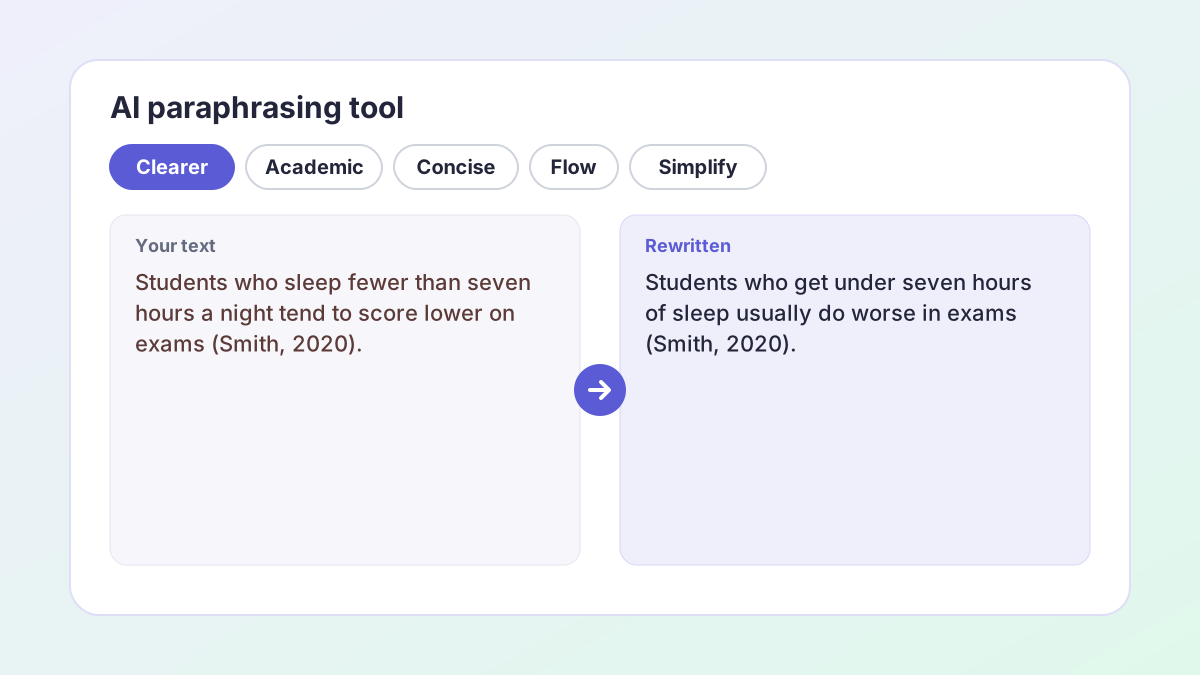
Paraphrase this: examples before and after
Each example keeps the meaning and the source and changes the wording and structure. These are the kinds of paraphrase the AI paraphrasing tool aims for, and the kind your marker expects when you paraphrase by hand.
BeforeRemote learning expanded rapidly in 2020, but students without reliable internet access were far more likely to fall behind, widening existing gaps in achievement.
AfterWhen schools moved online in 2020, students who lacked dependable internet access tended to fall further behind, which deepened inequalities that already existed (Author, Year).
An example passage written for this page. The year and the claim stay; the citation is added.
Before“I do not wish them to have power over men; but over themselves.” (Wollstonecraft, 1792)
AfterWollstonecraft (1792) argued that women should seek authority over their own lives rather than control over men.
Mary Wollstonecraft, A Vindication of the Rights of Woman (public domain). No quotation marks, but the author and year stay.
BeforeRegular exercise improves mood and reduces symptoms of anxiety in many adults.
AfterFor many adults, exercising regularly can lift their mood and ease anxiety.
“Many adults” stays: a good paraphrase never turns “many” into “all”.
How to use the AI paraphrasing tool
The AI paraphrasing tool works on your own writing, one passage at a time, and leaves every decision to you.
- Paste your text. Paste up to 1,500 words of your own writing, or select Try an example to see how it works.
- Choose a goal. Clearer untangles long sentences, Academic tone formalises wording, Concise trims filler, Improve flow smooths transitions, Simplify uses plainer words and Keep my voice makes light edits only.
- Paraphrase this. Select Paraphrase this. Every sentence comes back next to your original with the changes highlighted.
- Review each sentence. Keep your original, accept the new version or ask for alternatives. Sentences marked to check changed a negative, a hedge or a number.
- Copy and cite. Copy or download the result. If any idea came from a source, keep or add its citation.
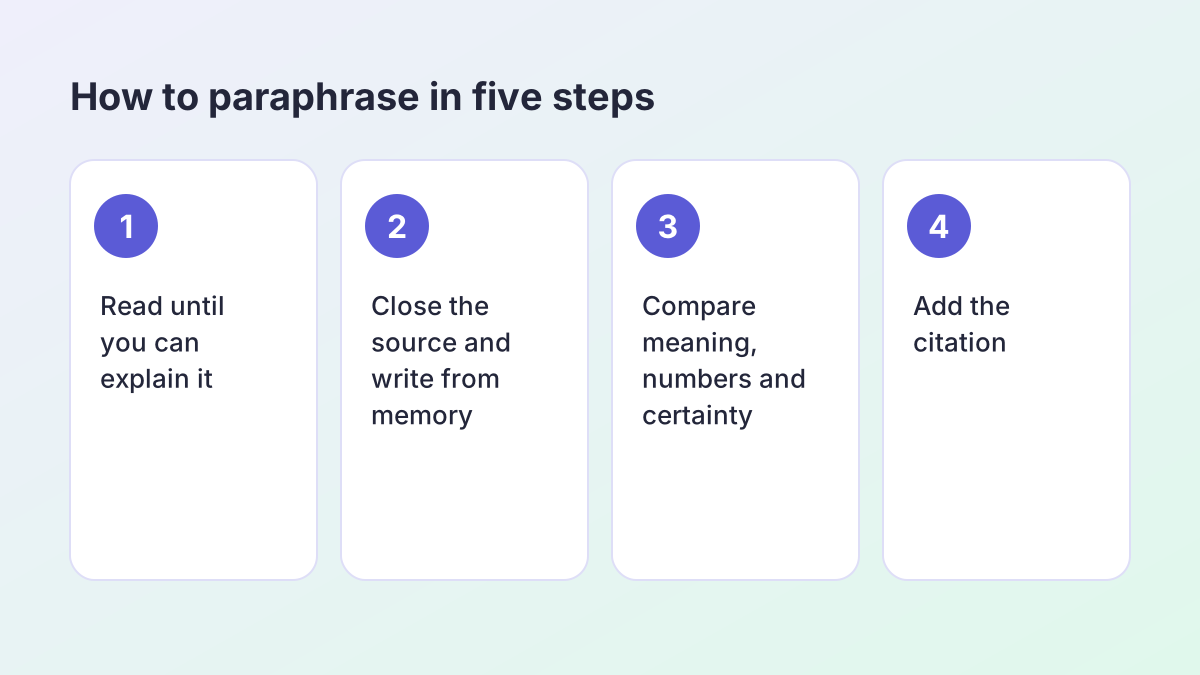
What is paraphrasing?
To paraphrase is to restate an idea or a passage in your own words while keeping its original meaning. A paraphrase is usually about as long as the original. It changes the wording and the sentence structure, but not the facts, the claim or how certain the claim is. Because the idea still belongs to its source, a paraphrase of someone else's work still needs a citation.
When you paraphrase, you do three things: read the source until you understand it, put the idea into your own sentence, and credit where it came from. Words with a similar meaning are rephrasing, rewording and restating. The opposite of paraphrasing is quoting word for word, also called quoting verbatim.
Why paraphrasing is important
- It shows your marker that you understood the source, not just found it.
- It lets you fit evidence into your own argument, in your own voice.
- It keeps an essay from turning into a chain of quotations.
- Done with a citation, it is how you use sources without plagiarising.
Purdue OWL's guide to paraphrasing describes the same idea: a paraphrase is your own rendition of someone else's material, usually about the same length, and it is always cited.
What a paraphrasing generator does differently
Most paraphrasing generators work by swapping words for synonyms. That is how “the results were significant” turns into “the outcomes were momentous”, and how in-text citations get mangled into nonsense. A synonym spinner treats every word as replaceable, so it often changes the meaning while making the sentence harder to read.
This AI paraphrasing tool works the other way round. It rewrites each sentence for a goal you choose, and it checks every rewrite before you see it:
- Citations, quotations, numbers and links are locked before the text reaches the AI, then put back exactly as written. If a rewrite drops or changes one, you get your original sentence instead.
- Hedges and negatives are watched. If “may” disappears or a “not” is added, the sentence is marked for you to check, because those words change what a claim means.
- Nothing changes without your say-so. You see every sentence next to your original and decide what to keep.
Six goals instead of a percentage slider
Old paraphrasing generators ask what percentage of words to replace. That is the wrong question: a sentence can be greatly improved by changing three words, or ruined by changing ten. The AI paraphrasing tool asks what the text needs. Choose Clearer, Academic tone, Concise, Improve flow, Simplify or Keep my voice, and set the amount of change under More options.
Which paraphrasing tool should you use?
The AI paraphrasing tool above handles any text. The tools below are tuned for one job each, with the right starting goal, examples and limits for that job.
- One awkward sentence → AI Sentence Rewriter
- A paragraph that reads like a list → Paragraph Rewriter
- A whole essay or paper → Essay Rewriter
- Text that is too hard to read → Text Simplifier
- Too long, or needs to be 2 sentences → Sentence Shortener
- Too short or thin → Sentence Expander
- Your thesis, again, for the conclusion → Restate Thesis Generator
- A poem you need to understand → Poem Rewriter
Paraphrasing vs summarizing vs quoting
All three use a source. The difference is how much of it you keep and whether you keep the author's exact words.
| Feature | Quoting | Paraphrasing | Summarizing |
|---|---|---|---|
| Wording | The author's exact words | Your own words | Your own words |
| Length | Exactly as long as the extract | About as long as the original | Much shorter: only the main ideas |
| Quotation marks | Yes | No | No |
| Citation | Yes, with a page number | Yes | Yes |
| Use it when | The exact wording matters, such as a definition | You need the detail of one point, in your voice | You need the main idea of a whole section |
What they have in common: each one credits the source. The key difference between paraphrasing and summarizing is length and detail. A paraphrase restates one passage in full; a summary keeps only the main idea. So if a question asks you to paraphrase the main idea, restate that idea in your own words; to summarize it, give the gist in a sentence or two. Purdue OWL's overview of quoting, paraphrasing and summarizing sets out the same three choices.
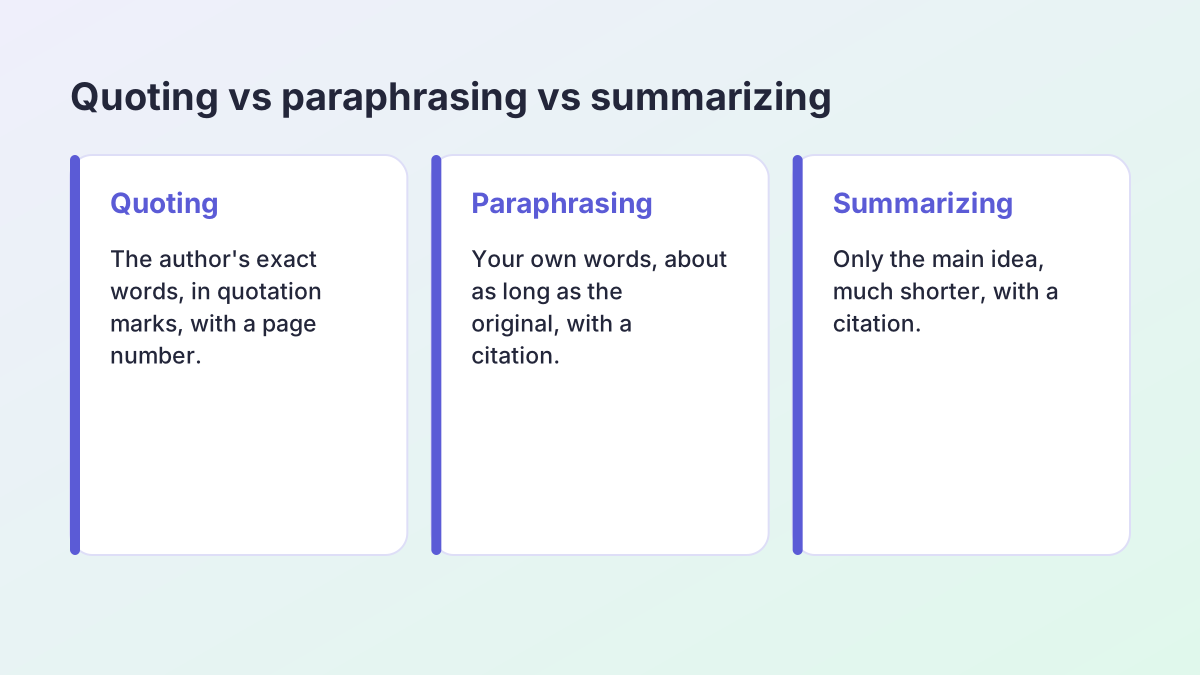
How to paraphrase by hand in five steps
An AI paraphrasing tool is quicker, but you should still know how to paraphrase without one, because exams and source-based essays expect it.
- Read the passage until you can explain it without looking at it.
- Close the source and write the idea from memory, in a sentence that fits your paragraph.
- Compare with the original. Check that the meaning, numbers and level of certainty match, and that you did not copy its structure.
- Put any distinctive phrase you kept in quotation marks.
- Add the citation in the style your course uses.
Paraphrasing techniques
- Change the sentence structure: start with a different part of the idea, or split one long sentence into two.
- Change word forms: “the analysis showed” can become “when the data were analysed”.
- Switch between active and passive voice where it reads naturally.
- Use synonyms carefully, and keep technical terms that have no true synonym.
Sentence starters for paraphrasing
According to Smith (2020), … · Smith (2020) argues that … · As Smith (2020) explains, … · Smith (2020) found that … · Research suggests that … (Smith, 2020).
How to cite a paraphrase in APA and MLA
Paraphrasing someone else's idea always needs an in-text citation and a matching entry in your reference list. It does not need quotation marks.
APA 7
- Parenthetical: Short sleep is linked to lower exam scores (Smith, 2020).
- Narrative: Smith (2020) linked short sleep to lower exam scores.
- A page or paragraph number is optional for a paraphrase, but recommended for long sources: (Smith, 2020, p. 14).
MLA 9
- Parenthetical: Short sleep is linked to lower exam scores (Smith 14).
- Narrative: Smith links short sleep to lower exam scores (14).
- MLA uses the author and page number, with no comma between them.
To cite a paraphrased quote, cite it as you would the quotation, just without the quotation marks. Build the full reference with the APA citation generator or the MLA citation generator.
Is paraphrasing plagiarism? Examples
Paraphrasing is not plagiarism when the idea is cited and the wording is genuinely yours. Two things turn it into plagiarism: leaving out the citation, and insufficient paraphrasing, also called patchwriting, where a few words are swapped for synonyms but the original sentence structure stays.
OriginalUrban green spaces lower stress levels and encourage residents to exercise more often.
Too close, even with a citationCity green areas reduce stress levels and motivate residents to work out more frequently (Author, Year).
Same structure and order with synonyms swapped in. Most universities treat this as plagiarism.
OriginalUrban green spaces lower stress levels and encourage residents to exercise more often.
Your own words and structurePeople who live near parks tend to feel less stressed, and they exercise more as a result (Author, Year).
New structure, plain wording, same meaning, and the source is still credited.
Word-for-word plagiarism copies text without quotation marks. Paraphrasing plagiarism copies the idea or the structure without credit. Both are avoided the same way: cite every source you use. Purdue OWL's page on avoiding plagiarism lists what needs a citation and what counts as common knowledge.
An AI paraphrasing tool cannot make someone else's work yours. It is built to improve your own writing, so use it on your drafts, and keep the citation whenever the idea came from a source.
Paraphrasing practice sentences
Try each sentence yourself first, then open a model answer. There is more than one good paraphrase for each.
1. Social media use has been associated with lower levels of sleep among teenagers.
Teenagers who use social media more tend to sleep less. (“Associated with” does not mean “causes”, so the paraphrase does not say it does.)
2. The committee postponed its decision because several members were unable to attend the meeting.
With several members absent, the committee put off its decision.
3. Although the treatment was effective for most patients, a small number experienced serious side effects.
The treatment worked for most patients, but a few had serious side effects.
Teachers can use these sentences as a quick paraphrasing activity: students paraphrase, compare their versions with a partner's, then run their own attempt through the AI paraphrasing tool with Keep my voice selected to see which changes a careful editor would make.
Using an AI paraphrasing tool responsibly
Paraphrasing tools are allowed on many courses for editing your own work and banned on some for assessed writing. Check your course's rules first, and when in doubt, ask your tutor how you may use AI writing tools.
Three habits keep you safe whichever tool you use:
- Start from your own draft. Paraphrase your own sentences, not a source you have not cited.
- Read every suggestion. You are responsible for what you submit, including any change in meaning.
- Keep the citation. Changing the words never changes whose idea it is.
The Study Corp does not store the text you paste. It is sent to our AI providers (Groq, with Google Gemini as a backup) only to create the paraphrase you see.
AI paraphrasing tool FAQ
Is this AI paraphrasing tool free?
Yes. It is free with no account or sign-up, up to 1,500 words at a time. A fair hourly allowance per visitor keeps it fast for everyone.
Can I just paste text and paraphrase it?
Yes. Paste the text, choose a goal and select Paraphrase this. Citations, quotations and numbers are locked, so they come back exactly as you wrote them.
What is a paraphrasing generator?
A paraphrasing generator rewrites text in different words while keeping its meaning. This one rewrites for a goal you choose and shows every sentence next to your original, so you decide what to keep.
Is this a free QuillBot alternative?
It is a free alternative built for academic writing: no sign-up, up to 1,500 words at a time, a side-by-side comparison of every sentence, and in-text citations that cannot be changed. It works in English only.
Do you need to cite when paraphrasing?
Yes. A paraphrase uses someone else's idea, so it needs an in-text citation and a reference list entry even though the words are yours. APA uses (Author, Year); MLA uses (Author Page).
Do you use quotation marks when paraphrasing?
No. Quotation marks are only for words copied exactly from the source. If you keep a distinctive phrase from the original, put just that phrase in quotation marks.
Is paraphrasing plagiarism?
Not when it is done properly: the idea is credited with a citation and the wording and structure are genuinely your own. It becomes plagiarism when there is no citation, or when only a few words are swapped.
Can AI paraphrasing be detected?
This tool is built to improve your writing, not to hide how it was written, and no tool can promise how a detector will score text. Check your course's rules on AI tools, and keep your own ideas and voice.
All paraphrasing and rewriting tools
- AI Sentence RewriterFix an awkward sentence and choose from several better versions.
- Paragraph RewriterMake the sentences in one paragraph connect and flow.
- Rewording ToolReword any text in fresh words: emails, reports, applications and more.
- Essay RewriterRewrite a whole essay or paper, paragraph by paragraph, keeping its structure.
- Restate Thesis GeneratorRestate your thesis in new words for the conclusion, keeping the same claim.
- Text SimplifierSimplify text to a reading level: grade 5, grade 7, grade 9 or plain English.
- Sentence ShortenerShorten text or combine it into 1, 2 or 3 sentences, keeping every key fact.
- Sentence FinisherGet five ways to finish a sentence you started.
- Say It BetterFind a better way to say a sentence or phrase, with alternatives.
- Sentence ExpanderExpand a sentence into a fuller, more detailed version without new facts.
- Poem RewriterParaphrase a poem line by line, modernise it, or polish your own poem.
See all 74 free tools for students
Related tools
Last updated by The Study Corp editorial team.