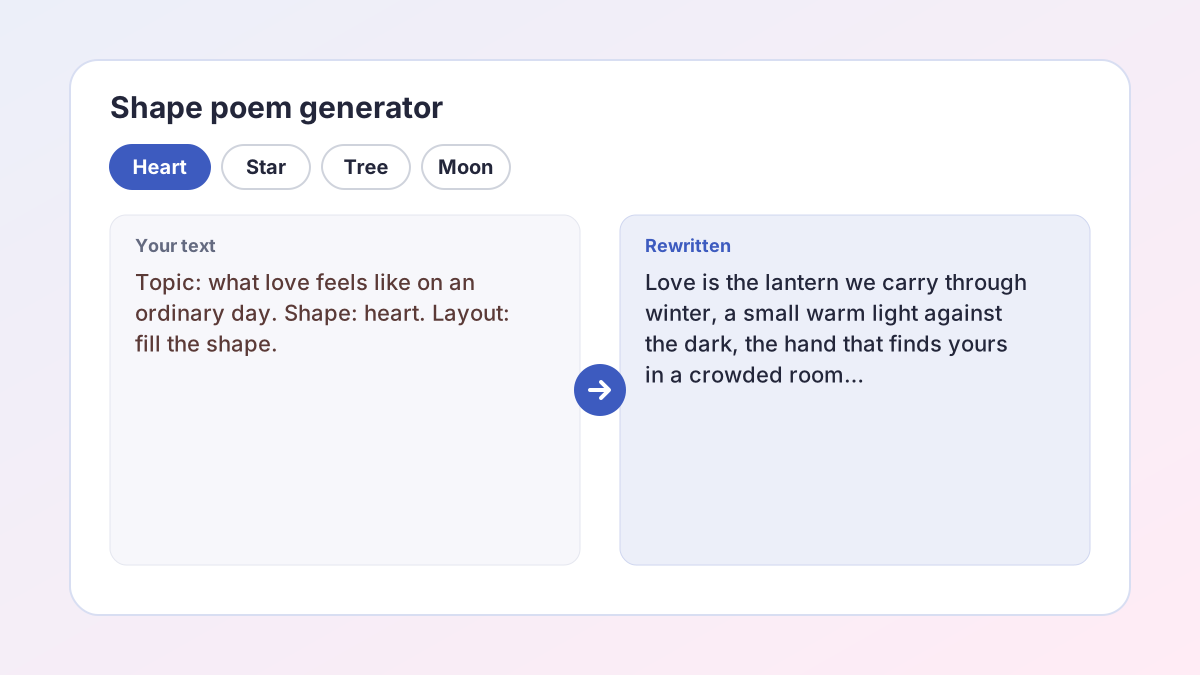
Shape poem generator examples
Topics students typed, the shape they chose, and the opening of the poem that was laid out in it.
You choseTopic: what love feels like on an ordinary day. Shape: heart.
Poem openingLove is the lantern we carry through winter, a small warm light against the dark…
Long, flowing sentences fill the heart evenly from the top curves to the point.
You choseTopic: the four seasons of the oak tree in our school yard. Shape: tree.
Poem openingIn spring the oak unfolds its small green hands; by summer it holds the whole yard in shade…
The narrow top and wide branches suit a poem that grows as it goes.
You choseTopic: falling asleep on a summer night. Shape: moon.
Poem openingHush now, the window is open, the moon is a hammock of silver light…
Tracing the crescent makes the words feel like they are drifting.
You choseTopic: the first rain after a long dry spell. Shape: raindrop.
Poem openingThe sky lets go at last, and the dust on the road drinks deeply…
The point at the top makes the poem start small and swell, like a falling drop.
You choseTopic: making a wish on my birthday. Shape: star.
Poem openingClose your eyes and count to three, hold the wish like a warm stone…
Short phrases fit the narrow arms of the star.
You choseTopic: autumn leaves on the walk to school. Shape: leaf.
Poem openingRed and gold and copper, they fall like letters nobody sent…
Tracing the leaf's edge turns the poem into the leaf's outline.
How to use the shape poem generator
You can let the tool write the poem, or use your own poem, which never leaves your browser.
- Choose a shape. Pick heart, star, tree, circle, diamond, raindrop, leaf or moon. Choose a shape that echoes your subject.
- Write or paste the poem. Under Write a poem for me, type a topic and choose a mood and length. Or choose Use my own poem and paste it in.
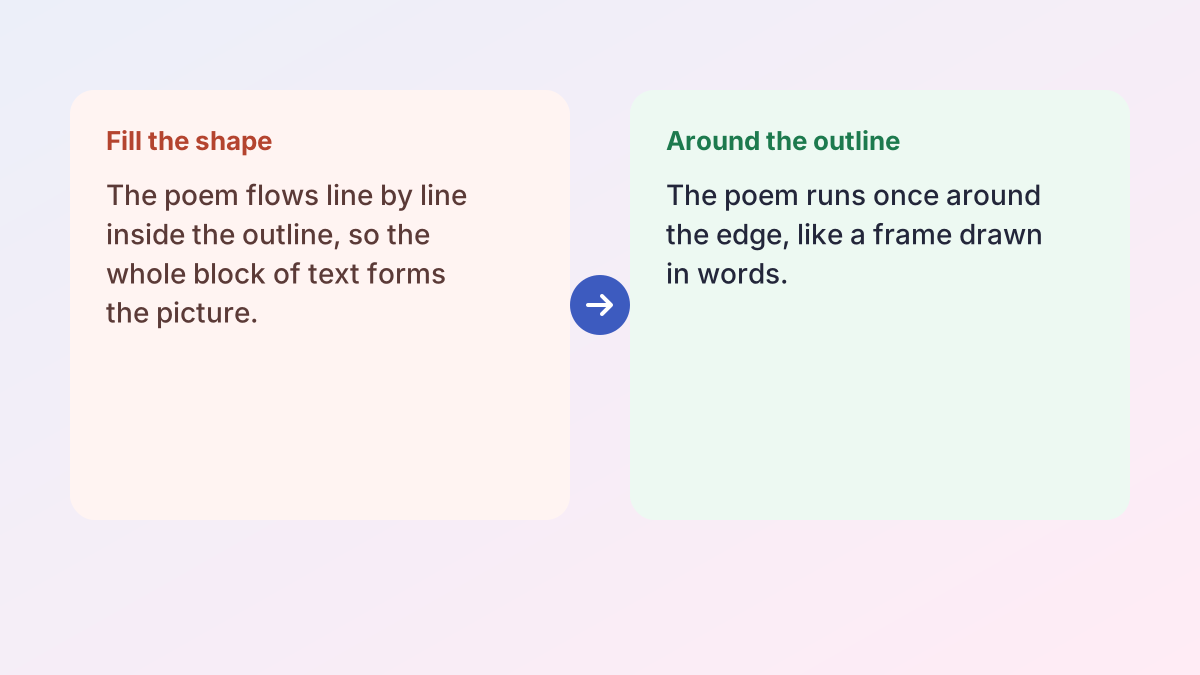
- Choose a layout. Fill the shape flows the words inside it; Around the outline runs them along the edge.
- Pick a colour. Choose an ink colour and whether to show the faint outline behind the words.
- Download it. Download a PNG to print or share, or an SVG that stays sharp at any size. You can also copy the text.
What is shape poetry?
Shape poetry is poetry in which the arrangement of the words on the page forms a picture, usually of the poem's subject. A poem about a tree is shaped like a tree; a poem about rain falls down the page in drops. The shape adds a second layer of meaning: readers see the subject before they read a word.
Shape poems are also called concrete poems, visual poems or, when the letters themselves draw the picture, calligrams. The Academy of American Poets defines a concrete poem as one that is "as much a piece of visual art made with words as it is a work of poetry", and traces the modern term to the 1950s.
A very old idea
Poets have shaped words for more than two thousand years. Ancient Greek poets wrote poems shaped like wings and altars. In the 1600s, George Herbert's "Easter Wings" was printed so the lines formed two pairs of wings. In the early 1900s, Guillaume Apollinaire made calligrams in the shape of the Eiffel Tower and falling rain.
Why teachers love shape poems
Shape poetry is one of the first forms many students learn, because it connects writing and drawing. It teaches that how a poem looks is part of what it means, a lesson that applies to line breaks and stanzas in every kind of poetry.
Concrete poem generator: two ways to lay out your words
This concrete poem generator offers the two most common layouts. Try both: the same poem feels different in each.
Fill the shape
The words flow left to right, line by line, inside the outline, and the block of text forms the picture. The tool finds the largest text size at which the whole poem fits, then spreads each full line across the width of the shape so the silhouette is clear. This works best with poems of about 40 to 150 words.
Around the outline
The poem runs once around the edge of the shape, like a frame drawn in words. If the poem is short, it repeats, separated by a small dot, so the outline is complete. If it is long, the tool keeps as much as fits and ends with an ellipsis. Short poems and single sentences work best for this layout.
Show or hide the outline
A faint outline behind the words helps the shape read clearly, especially for the fill layout. Turn it off for a cleaner look, where only the words draw the picture.
Download and print
The PNG download is 2,000 × 2,000 pixels: sharp enough to print on A4 or letter paper. The SVG is a vector file that stays sharp at any size, ideal for posters or for editing in a design app.
How to write a shape poem
You can make shape poetry with pencil and paper or with the tool. Either way, the steps are the same.
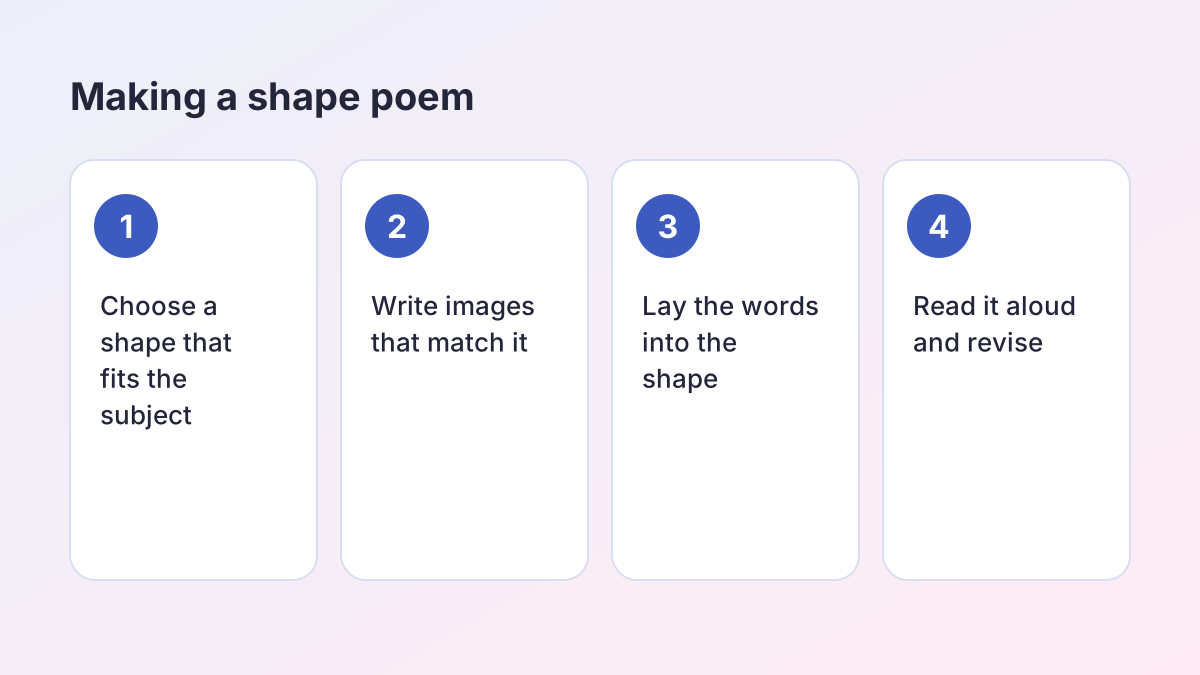
- Choose a subject with a strong shape. Objects work best: a heart, a tree, an apple, the moon, a raindrop, a star.
- Brainstorm images. List what you see, hear, smell, feel and think about the subject. A tree might give you roots, rings, birds, bark, shade.
- Write the poem first. Get the words right before you worry about the shape. Free verse is easiest, because rhyme can force awkward words.
- Match the poem to the shape. If the shape is narrow at the top, start with a short phrase. If it is wide in the middle, put your longest, richest lines there.
- Lay it out. By hand, draw the outline lightly in pencil and write inside it, then erase the outline. With the tool, paste your poem and choose the shape.
- Revise. Read it aloud. Does it still make sense as a poem without the picture? A good shape poem works both ways.
Let the shape inspire the words
In the best shape poems, the shape and the words talk to each other. A raindrop poem might start small at the point and swell as the rain gets heavier. A moon poem might drift around the curve.
Shape poem ideas for every shape
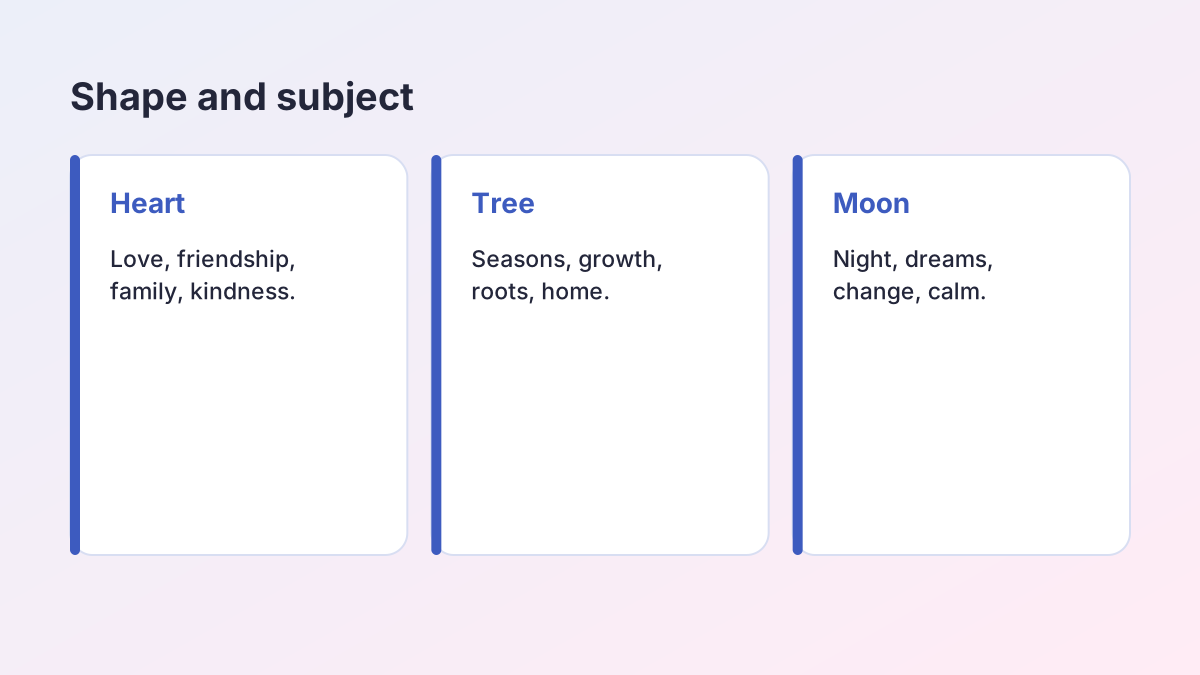
Stuck for a topic? Pair each shape with a subject that echoes it.
- Heart: love, friendship, a pet, a family member, kindness, missing someone.
- Star: wishes, dreams, birthdays, night sky, fame, hope.
- Tree: seasons, growth, family history, roots and home, a favourite tree.
- Circle: the sun, the Earth, time, cycles, a clock, friendship circles.
- Diamond: something precious, a kite, pressure turning into strength.
- Raindrop: rain, tears, the water cycle, a storm, relief after heat.
- Leaf: autumn, change, letting go, nature walks.
- Moon: night, dreams, sleep, change, tides, calm.
For younger students
Start with a list poem: write words and short phrases about the subject, one after another, and lay them in the shape. It is a fun way to practise describing words.
For older students
Try a contrast: a heart-shaped poem about heartbreak, or a star-shaped poem about feeling invisible. The tension between shape and meaning makes the poem more interesting.
Tips for a better result from the shape poem generator
The shape poem generator does the layout maths for you, but a few choices make a big difference to how the finished picture looks.
Match length to layout
For Fill the shape, aim for 40 to 150 words. Very short poems end up in huge letters with gaps; very long ones shrink until they are hard to read. For Around the outline, a single sentence or a short verse of 15 to 40 words reads best, because the reader follows it round the edge.
Write flowing sentences
Inside a shape, line breaks disappear: the words reflow to fit the outline. Poems that read as continuous sentences look smoother than lists of short, separate lines. When the shape poem generator writes a poem for you, it is told to write in this flowing style.
Choose a shape with room
Heart, circle, raindrop and moon have wide middles that hold lots of words. Star and tree have narrow points, so the text there is broken into short pieces. If a star looks crowded, try a shorter poem.
Pick a calm colour for printing
Dark ink colours print best. Lighter colours look lovely on screen but can fade on paper. If you plan to print a class display, test one page first.
Use concrete poem ideas from the subject
The strongest results come when the words describe the shape itself. A heart poem about kindness, a tree poem about seasons, a raindrop poem about a storm: the picture and the poem then reinforce each other. That is the heart of good shape poetry.
Try both layouts before you download
The same poem can feel completely different filled and traced. Switching takes one click, so compare both, and use the concrete poem generator's outline toggle to see which looks clearer for your shape.
Shape poems in the classroom
Shape poems work well for lessons on description, poetic devices and visual literacy. Here are a few activities teachers use.
Sensory word banks
Before writing, students list words for each sense about their subject. Then they use the strongest words in their poem. The tool's "Use my own poem" mode lets them see their words in the shape straight away.
Compare layouts
Students lay out the same poem in both layouts and discuss which suits the subject better and why. It is a quick way to talk about form and meaning.
Display wall
Download each student's poem as a PNG and print it for a classroom display or a class book. Different colours make a bright wall. Ask each student to add a short caption explaining why they chose their shape: the reflection is often as revealing as the poem, and it gives the display a reason for visitors to stop and read.
Privacy for students
"Use my own poem" runs entirely in the browser: the poem is laid out on the student's device and never sent anywhere. Only "Write a poem for me" sends a topic to our AI providers to write a poem.
Famous shape poems to read
Reading well-known concrete poems is the best way to see what the form can do. Look these up in an anthology or online collection:
- "Easter Wings" by George Herbert (1633): two stanzas shaped like pairs of wings, where the lines shrink and grow with the meaning.
- "The Mouse's Tale" in Alice's Adventures in Wonderland by Lewis Carroll (1865): a poem that winds down the page like a long tail.
- "Il pleut" ("It's Raining") by Guillaume Apollinaire (1916): letters falling down the page in lines of rain.
- "r-p-o-p-h-e-s-s-a-g-r" by E. E. Cummings: a grasshopper whose scrambled letters leap across the page.
The Academy of American Poets' brief guide to concrete poetry introduces more poets who work with shape and space.
How to type a shape poem, or make your own template
Sometimes you need the poem inside a document, or you want a shape the shape poem generator does not offer. Here are three ways to do it.
Option 1: download from the shape poem generator
The quickest route is to lay the poem out, select Download PNG, and insert the image into your document like any picture. Choose Download SVG instead if the page will be printed large, because it stays sharp at any size. Both have a white background.
Option 2: type it line by line
To type a shape poem yourself in a word processor:
- Pick a monospaced font, such as Courier, so every letter takes the same width.
- Centre the text. Symmetrical shapes such as a diamond, tree or heart then depend only on how long each line is.
- Plan the line lengths. A diamond goes short, longer, longest, then shorter again; a tree ends with a few very short lines for the trunk.
- Break lines by hand, changing words rather than adding spaces until the outline looks right.
- Zoom out to check the silhouette from a distance.
Option 3: make a concrete poem template
A paper template works for any shape:
- Draw or print a simple, bold outline on a sheet of paper.
- Lay a blank sheet on top, hold both against a bright window, and trace the outline lightly in pencil.
- Write the poem inside the outline or along its edge, then rub out the pencil.
One template per shape lets a whole class work from the same outline. For the eight shapes the shape poem generator does have, you can skip the template and print the download instead.
A flower shape poem
The shape poem generator has eight shapes, and a flower is not one of them. The closest built-in options are the circle, which can work as a sunflower head, and the leaf, for a single petal or leaf. For a full flower with petals and a stem, make a paper template as above, then write a short phrase inside each petal so the poem reads round the flower like a clock.
If you have already written the words, paste them into the shape poem generator's “Use my own poem” mode first: seeing them inside a circle shows whether the poem is the right length before you copy it out by hand.
Visual poem examples: how to read and analyse shape poetry
Teachers often ask students to analyse a visual poem, not only make one with a tool like the shape poem generator. Here are the main kinds, with examples, and a method for writing about them.
Four kinds of visual poem
- Shape poems: the lines form the outline of the subject. Besides “Easter Wings”, George Herbert's “The Altar” (1633) is printed in the shape of an altar.
- Calligrams: the letters themselves draw the picture. Guillaume Apollinaire collected his in Calligrammes (1918).
- Typographic poems: meaning comes from the size, spacing or position of letters rather than a full outline, such as a word like falling printed one letter per line down the page.
- Spatial poems: words spread across white space, so the gaps work like pauses. Stéphane Mallarmé's “Un coup de dés” (first published 1897) is the classic example.
The shape poem generator makes the first kind: lines that fill or trace an outline.
How to analyse a visual poem
- Describe the picture first. What does the shape show before you read a word?
- Follow the reading path. Where does the poem start and end? Is any part hard to follow on purpose?
- Connect shape and meaning. Does the shape repeat the subject, contrast with it, or change as the poem goes on? In “Easter Wings”, the lines shrink to “Most poore” and “Most thinne”, then widen again with the hope to rise.
- Imagine it as plain lines. What would be lost if it were printed normally?
- Judge the effect. Does the shape add meaning, or is it only decoration?
Sentence starters for your analysis
- The poem is shaped like …, which reflects …
- Where the shape narrows, the lines …, suggesting …
- Printed as ordinary lines, the poem would lose …
If you made your own poem with the shape poem generator, the same starters work for a short reflection on why you chose your shape.
To practise steps 3 to 5, use the comparison activity in the classroom section above.
Is the shape poem generator free and private?
Yes. The shape poem generator is free, with no account or sign-up. A fair hourly allowance per visitor applies to "Write a poem for me".
When you use your own poem, it is laid out in your browser and is never sent anywhere. When you ask the tool to write a poem, only your topic, shape, mood and length are sent to our AI providers (Groq, with Google Gemini as a backup) to write it. The Study Corp does not save your topic or your poem.
The images you download are yours to print, share and use in schoolwork. For more poem ideas, try the Poem Generator, which writes free verse, rhyming poems, haiku, limericks, sonnets and ballads.
Shape poem generator FAQ
Is the shape poem generator free?
Yes. It is free with no account or sign-up, and your own poems never leave your browser.
What is a concrete poem?
A concrete or shape poem is a poem whose words are arranged to form a picture, usually of the poem's subject.
Which shapes can I use?
Heart, star, tree, circle, diamond, raindrop, leaf and moon, in two layouts: fill the shape or around the outline.
Can I use my own poem?
Yes. Choose Use my own poem and paste it in. It is laid out instantly in your browser and is not sent anywhere.
Can I download my shape poem?
Yes. Download a 2,000-pixel PNG to print or share, or an SVG that stays sharp at any size.
How long should a shape poem be?
About 40 to 150 words works best for filling a shape. Shorter poems work well around the outline.
What is the difference between shape poetry and a calligram?
In shape poetry the lines of text form the picture; in a calligram the letters themselves are drawn to make the image.
How do you type a shape poem?
Use a monospaced font, centre the text and break each line by hand so the line lengths follow the outline. Or lay the poem out in the shape poem generator and insert the downloaded PNG or SVG into your document.
What is an example of a visual poem?
George Herbert’s “Easter Wings” (1633), printed in the shape of two pairs of wings, and Guillaume Apollinaire’s calligrams, where the letters draw the picture, are classic examples. Typographic poems that play with letter size and spacing are visual poems too. To try one yourself, the shape poem generator lays your words out in eight shapes.
More free writing tools
- Book Title GeneratorTitle ideas for your book, chapters or series, in any genre.
- Essay Title GeneratorTen clear, catchy titles for any essay type, with notes on each.
- Story Title GeneratorOriginal titles for short stories, fan fiction and school stories.
- Poem GeneratorWrite a poem on any topic: free verse, rhyming, haiku, sonnet and more.
- Paragraph ExpanderMake a paragraph or essay longer with explanation, not filler.
- Personal Statement GeneratorDraft a UCAS or college statement and check it against the word limit.
- Introduction GeneratorThree introductions that move from a hook to your thesis.
- Essay Hook GeneratorNine opening hooks for your essay, each a different technique.
- Poetry Prompt GeneratorTen fresh poem prompts on any theme, for any level.
- Acrostic Poem GeneratorA poem whose first letters spell any name or word.
- Random Paragraph GeneratorRandom paragraphs for reading, typing and handwriting practice.
- Thesis Statement GeneratorFive clear, arguable thesis statements for any essay type.
- Essay Outline GeneratorPlan your essay section by section, from thesis to conclusion.
- Topic Sentence GeneratorTopic sentences that tie each body paragraph to your thesis.
- Paragraph GeneratorWrite a clear paragraph from a topic, or turn notes into one paragraph.
- Conclusion GeneratorThree conclusions for your essay, or a concluding sentence for a paragraph.
- Poem Title GeneratorTen title ideas for your poem, from simple to striking.
- Haiku Poem GeneratorHaiku, sonnets and limericks with syllables counted on every line.
- Argumentative Essay GeneratorDraft an argumentative essay with a clear claim, counterargument and rebuttal.
- Persuasive Essay GeneratorDraft a persuasive essay aimed at a real reader, with a call to action.
- Informative Essay GeneratorDraft a clear, neutral informative (expository) essay on any topic.
- Analytical Essay GeneratorDraft an analytical essay that explains how and why, not just what.
- Compare and Contrast Essay GeneratorDraft a comparison essay, point-by-point or block, with a real judgment.
- Scholarship Essay GeneratorDraft a scholarship essay built from your own story and goals.
- Name GeneratorCharacter names for stories and games, 12 at a time, in any genre.
See all 80 free tools for students
Related tools
Last updated by The Study Corp editorial team.