Story title generator examples
Story ideas students typed and a few of the ten titles that came back. Each note explains why the title works.
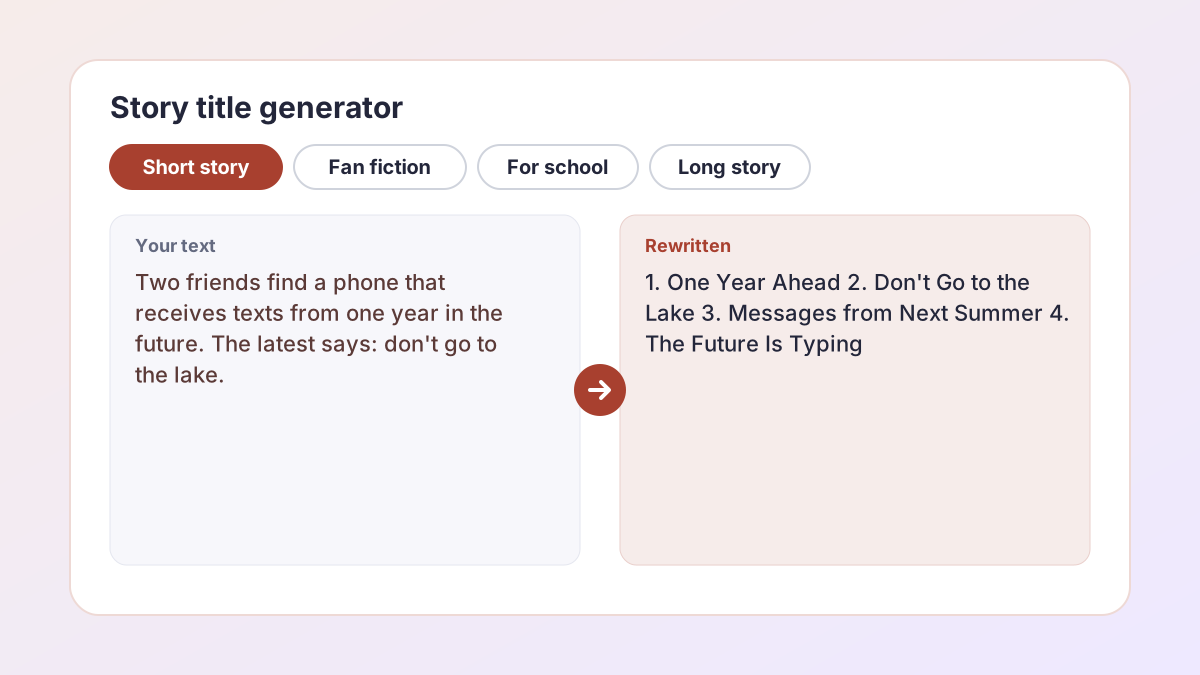
You typedTwo friends find a phone that receives texts from one year in the future. The latest says: don't go to the lake.
Title ideasThe Future Is Typing · Don't Go to the Lake · One Year Ahead
Each one raises a question the reader wants answered.
You typedA girl who is afraid of the ocean has to swim to save her younger brother during a family holiday.
Title ideasDeep End · The Distance to Shore · What the Waves Asked
Titles that hint at the theme (fear and courage) impress markers.
You typedTwo rival knights are stuck guarding the same tower through a long winter and slowly become friends.
Title ideasWinter Watch · All the Cold Nights Between Us · Two Swords, One Fire
Hints at the enemies-to-friends trope without naming the fandom.
You typedA baker discovers that the bread she makes lets people relive one memory.
Title ideasThe Memory Loaf · Warm from the Past · Yeast and Yesterday
Playful titles fit a gentle, magical story.
You typedA family moves into a house where every mirror shows the room as it was a hundred years ago.
Title ideasThe Glass Remembers · Reflections, 1925 · The Quiet Mirrors
Plain, ordinary words made strange create dread.
You typedAn old man teaches his granddaughter to fish on the last summer before he moves into care.
Title ideasThe Last Summer on the Pier · Slack Tide · What the River Keeps
Quiet, image-based titles suit reflective stories.
How to use the story title generator
A one- or two-sentence summary of what happens is enough. The more specific your details, the more specific the titles.
- Choose the kind of story. Short story, fan fiction, a story for school or a long story. This sets the tone of the titles.
- Describe what happens. Write who the main character is, what goes wrong and one striking detail, such as an object, place or line of dialogue.
- Add characters for fan fiction. Optionally add the fandom or characters. Titles will suit them without copying anyone's words.
- Pick a genre and style. Genre gives the right feel; style decides whether titles are short, mysterious, poetic, catchy or descriptive.
- Generate and choose. Select Generate story titles, copy your favourites, then generate more until one feels exactly right.
What makes a good story title?
A good story title makes someone want to read the first line. It does that by being specific, intriguing and true to the story.
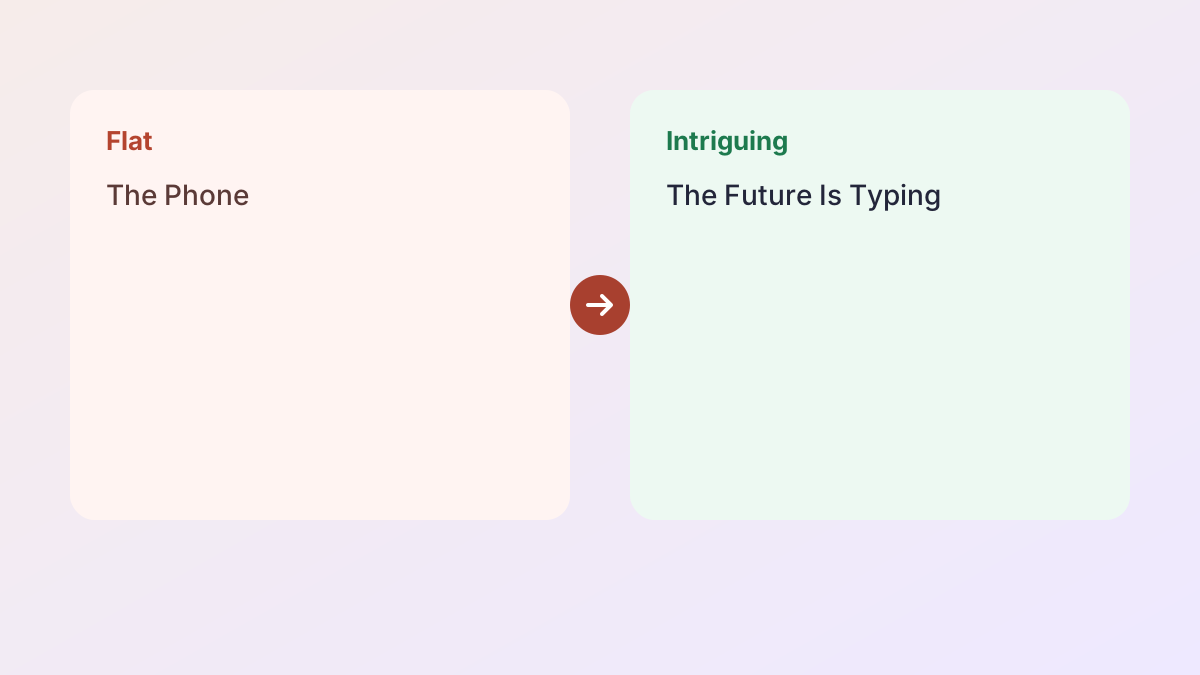
Specific means it uses concrete words: an object, a place, a person, an action. The Phone is specific but flat; The Future Is Typing is specific and surprising.
Intriguing means it raises a question. Why shouldn't they go to the lake? What does the glass remember? Readers open the story to find out.
True to the story means it fits the mood and the ending. A jokey title on a sad story, or a dramatic title on a gentle one, feels like a broken promise.
Short stories need short titles
Short stories are usually read in one sitting, often in a collection or an online feed, where the title is the only thing a reader sees. One to five words is typical. Save long, poetic titles for when the language of the story matches them.
Look for the title inside your story
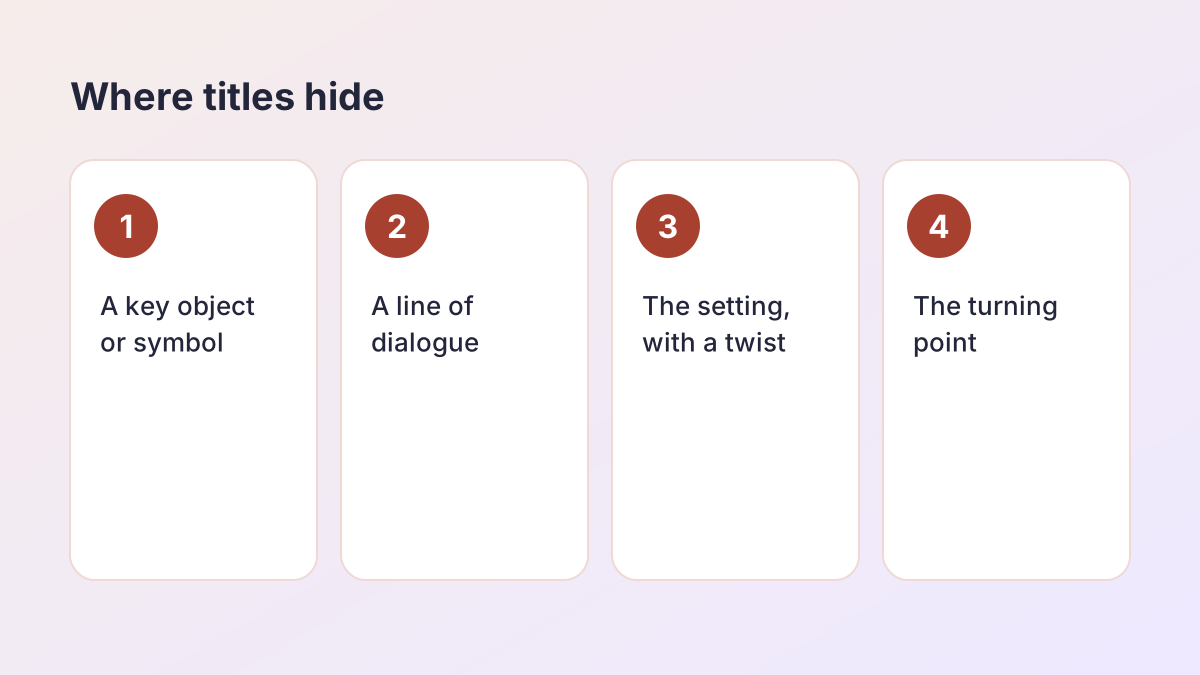
Often the best title is already in your draft: a key object, a line a character says, the place where it all happens, or the moment everything changes. The story title generator looks for the same things in your description.
Story name generator: how to get titles that fit
A story name generator gives better results when you tell it the parts of your story that matter most. You do not need to describe the whole plot; one or two sentences with the right details are enough.
What to include
- The main character in a few words: “a shy baker”, “two rival knights”.
- The problem: what goes wrong or what they want.
- One strong detail: an object, a place, a strange rule, a line of dialogue.
- The mood: cosy, eerie, hopeful, funny, sad.
Use the style setting
The style setting changes the shape of the titles. Short gives one to three words. Mysterious leans into questions and secrets. Poetic uses images and rhythm. Catchy goes for memorable phrases and wordplay. Descriptive says clearly what the story is about. Mixed gives you a bit of everything.
Run it more than once
Every run of the story name generator brings ten new ideas. Copy the ones you like and generate again, perhaps with a different style. Many writers end up combining parts of two suggestions into something completely their own.
Fanfic title generator: titles for fan fiction
Fan fiction titles have their own culture. On archives like AO3, readers scroll through long lists, so a title has to stand out in a few words and tell fans what kind of story to expect. Choose Fan fiction in the tool to use it as a fanfic title generator.
Popular fan fiction title styles
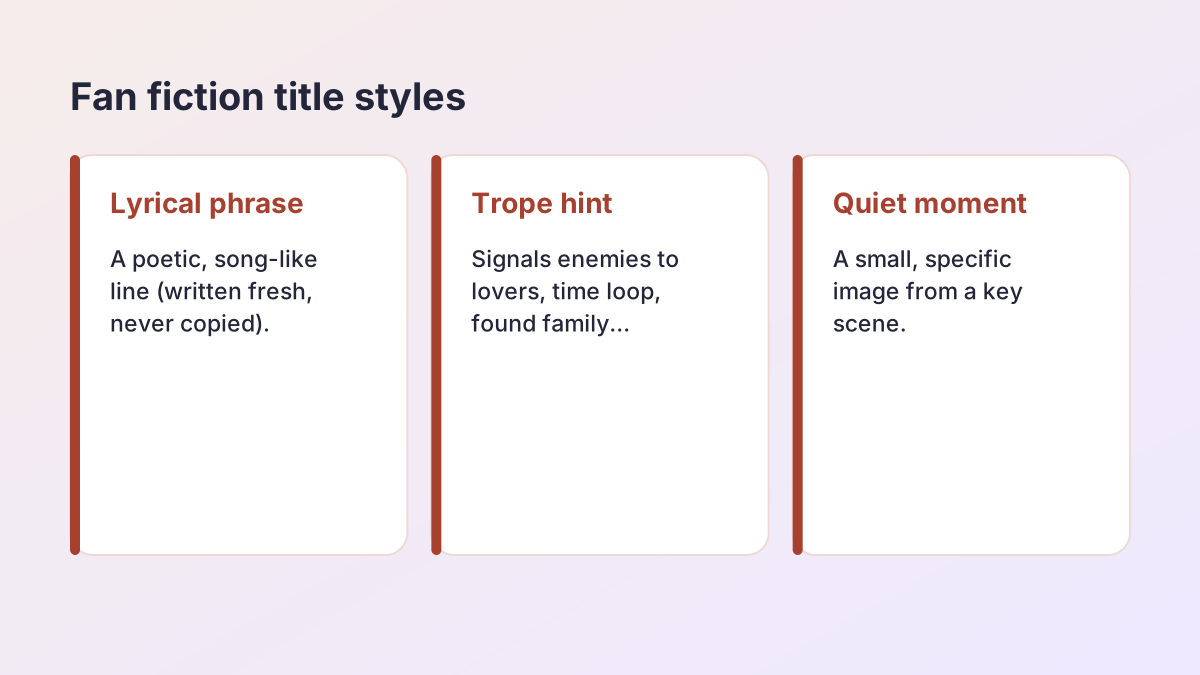
- Lyrical phrases that sound like a line from a song or poem: All the Cold Nights Between Us. The tool writes these fresh; it never quotes real song lyrics.
- Trope hints that signal the kind of story: enemies to lovers, time loop, found family, hurt and comfort.
- Quiet, specific moments from a key scene: Two Cups on the Windowsill.
- Short and punchy single words or phrases: Winter Watch.
Add your characters or fandom
Use the optional “Fandom or characters” box to tell the generator who the story is about. It will tailor the titles to the characters' world without copying existing titles or text from the original work.
Keep it suitable
The generator keeps titles suitable for a general audience. If your story is for an older audience, you can still use these titles and add your own tags and ratings on the archive.
Short story title ideas by genre
Genre shapes how a title should sound. Here is what usually works, with examples of the ideas the tool suggests.
Mystery and thriller
Create tension with a warning, a secret or a time limit: Don't Go to the Lake, Three Days Before. Short titles feel urgent.
Fantasy
Make ordinary things magical: The Memory Loaf, The Girl Who Borrowed Thunder. A small, specific magic often beats a grand one in a short story.
Science fiction
Hint at the big idea: The Future Is Typing, Signal Delay. One invented word can work if it is easy to say.
Horror
Use ordinary words made strange: The Glass Remembers, The Quiet Mirrors. Fewer words are often scarier.
Romance
Suggest the relationship and the feeling: Two Swords, One Fire, The Seat by the Window.
Realistic and literary fiction
Quiet, image-based titles fit reflective stories: Slack Tide, What the River Keeps.
Comedy
Wordplay, puns and surprising combinations: Yeast and Yesterday, My Grandmother Joined a Band.
Eight ways to title a story (with examples)
When you want to understand why some suggestions from the story title generator feel right, it helps to know the techniques behind them. You can use the same moves by hand.
- Name the key object. The Memory Loaf, The Blue Notebook. An object the story keeps returning to makes a strong anchor.
- Use a line of dialogue. Don't Go to the Lake. A phrase a character says can carry the whole story's tension.
- Name the place, with a twist. The Last Summer on the Pier. The setting plus a hint of change.
- Point to the turning point. Three Days Before. It makes readers wonder what happens on day three.
- Use a double meaning. Deep End is both the pool and the fear. Titles that mean more after the ending feel clever.
- Name the character by role. The Girl Who Borrowed Thunder. It tells readers whose story this is.
- Hint at the theme. What the River Keeps suggests memory and loss without stating them.
- Play with sound. Alliteration and rhythm make titles stick: Yeast and Yesterday.
Combine techniques
The strongest titles often use two techniques at once. The Future Is Typing names a key object (the phone's typing dots) and plays with a double meaning (the future is literally arriving). If one idea from the story title generator has the right image and another has the right rhythm, try combining them.
When none of the ideas fit
Change your description, not just the button. Add the strongest image from your draft, the last line, or the feeling you want readers to have at the end. One new detail changes every title the story name generator suggests.
Story titles for school assignments
Creative writing teachers often say the title is the first thing they read and the last thing students think about. A thoughtful title shows you understand your own story.
Tie the title to your theme
If your story is about courage, loss or belonging, a title that hints at the theme reads as more mature than one that only names the setting. Deep End works for a story about facing fear because it is both literal and figurative.
Avoid spoilers
A title like The Day My Dog Was Found gives away the ending. Missing Posters keeps the reader guessing.
Check the brief
Some assignments set a title for you, or ask for a title that includes a particular word. Use the generator's ideas as inspiration, then follow the brief.
Make it yours
Teachers can tell when a title does not match the writing. Use the suggestions as a starting point, then change a word or combine two ideas so the title sounds like you. Choose For school in the tool for titles that suit classroom stories.
How to choose between story title ideas
When you have a shortlist of three to five titles from the story title generator, try these quick tests.
The question test. Does the title make you ask a question? Don't Go to the Lake does; A Story About a Lake does not.
The match test. Read your last paragraph, then the title. Does the title still fit now that you know how it ends? The best titles gain a new meaning after the final line.
The say-it test. Say it out loud. If it is hard to say or easy to mishear, readers will struggle to remember it.
The search test. Search the title online. Titles cannot be copyrighted (the US Copyright Office lists names, titles and short phrases among works not protected by copyright), but a unique title is easier to find and remember.
The friend test. Read two titles to a friend with a one-line summary of the story. Ask which story they would rather read, and why.
How to come up with a title for a story
Knowing how to name a story is a skill you can practise. Try this ten-minute method on its own or alongside the story title generator.
1. Find the story's centre
Finish this sentence: This story is really about… Not the plot, but what sits underneath it: a first goodbye, a secret kept too long, learning to be brave. Your title should point towards that centre, and so should the description you give the story title generator.
2. Pick out your keywords
Underline five to eight words in your draft that carry the most weight: an object that returns, a place, a line of dialogue, a strange rule. These are your keywords, and the raw material for every title you try.
3. Write ten bad titles fast
Set a timer for three minutes and write ten titles without stopping. Most will be weak, and that is the point: speed stops you settling for the first safe idea. Do this before you open the story title generator, so its ideas don't crowd out yours.
4. Use the story title generator with keywords
There is no separate keyword box, so add your keywords to “What happens in your story?” after a one-sentence summary. The story title generator then builds from your own images instead of general ones. Compare its ten ideas with your three-minute list and keep the best of both.
Worked example: title suggestions for a love story
Here is the method on an invented story: two neighbours in a block of flats only ever talk by knocking on the wall between them, until one of them moves out.
- Centre: closeness without ever meeting.
- Keywords: wall, knocking, radiator, winter, the empty flat.
- What to type: “Two neighbours who only talk by knocking on a shared wall fall in love before one moves away. Keywords: wall, knocking, radiator, winter.”
- From the three-minute list: Three Knocks for Yes, The Thin Wall, Radiator Letters.
Each shortlisted title uses an image from the story, and none gives away the ending. Pasting the same text into the story title generator adds ten more angles to compare.
Give me a title for my story, fast
Short on time? In the story title generator, choose the kind of story, write two sentences about the main character and the problem, and select Generate story titles. Pick the idea that makes you most curious, then change one word so it fits your ending.
Title of a story: how to write and format it
Whether your title came from the story title generator or your own notebook, present it correctly. The rules differ slightly between the title on your own story and a story you mention in an essay.
Capitalising a story title
Most styles use title case. In MLA style, capitalise the first and last words and all principal words (nouns, pronouns, verbs, adjectives, adverbs and subordinating conjunctions), and keep articles, prepositions and coordinating conjunctions lowercase in the middle: A Letter from the Lighthouse. APA style also capitalises every word of four letters or more, so the same title becomes A Letter From the Lighthouse. Ideas from the story title generator are not always in your style guide's capitals, so check each word before you hand it in.
Quotation marks or italics?
When you mention a story in an essay, the length of the work decides. In MLA style, put the title of a short story in quotation marks and italicise a novel or a collection: Edgar Allan Poe's “The Tell-Tale Heart”, but Mary Shelley's Frankenstein. Other style guides have their own details, so follow the one your teacher sets.
On your own story, use neither. Write the title plainly in title case, centred above the first line, unless your teacher asks for a different layout.
Where the title goes on the page
For a school story, the usual layout is your name and any details your teacher asks for at the top, then your title centred, then the first paragraph. If your teacher wants a separate title page, the MLA Title Page Generator can set one out.
Short story title checklist
- Title case, checked against your style guide
- Quotation marks only when the title appears inside other writing
- The same spelling everywhere: on the story, in any reflection, on any cover sheet
- Still a good fit after your final edit
The last point matters most. If your ending changed during revision, run the story title generator again with the new ending in your description: a title that suited the first draft may not suit the last.
Is the story title generator free and private?
Yes. The story title generator is free, with no account or sign-up. A fair hourly allowance per visitor keeps it fast for everyone.
Your story description is sent to our AI providers (Groq, with Google Gemini as a backup) only to create the titles you see. The Study Corp does not save your ideas or the titles.
The titles you choose are yours to use. Because ideas are generated fresh each time, two people with similar stories will usually get different suggestions.
Tips for writing groups and classes
If you run a writing club or teach a class, try a quick title workshop. Each writer reads a one-sentence summary of their story, the group suggests titles out loud, and then everyone compares their ideas with the story name generator's. Students quickly see which titles create curiosity and which ones only describe. It is also a gentle way to practise giving feedback, because the discussion is about the title, not the whole story.
Keep a title notebook
Many writers keep a list of phrases they like: lines overheard on a bus, words from a song, an image from a dream. When you need a title, read through the list before you start. Combined with a few ideas from the story title generator, it often gives you something nobody else would think of. For a longer project, the Book Title Generator also suggests chapter titles and series names.
Story title generator FAQ
Is the story title generator free?
Yes. It is free with no account or sign-up. A fair hourly allowance per visitor keeps it fast for everyone.
Can I use it as a fanfic title generator?
Yes. Choose Fan fiction and optionally add the fandom or characters. Titles are written fresh and never copy song lyrics or existing titles.
How many titles do I get?
Ten ideas each time, each with a short note. Select Generate more for a fresh set.
Can I use the titles in a school assignment?
Yes. Choose For school, then adjust the title so it fits your story and your voice.
What should I type for the best titles?
One or two sentences with the main character, the problem and one striking detail, such as an object or a line of dialogue.
Is a story name generator different from a book title generator?
They work the same way. This one is tuned for short stories and fan fiction; the Book Title Generator also does chapter titles and series names.
Are the titles original?
They are generated fresh each time and the tool avoids well-known titles, but always search your favourite before you use it.
How do I come up with a title for my story?
Work out what the story is really about, underline five to eight keywords in your draft, and write ten quick titles without judging them. Then put a one-sentence summary and your keywords into the story title generator and keep the best ideas from both lists.
Should a short story title be in quotation marks or italics?
In MLA style, a short story title goes in quotation marks when you mention it in an essay, and a novel or collection goes in italics. On your own story, write the title plainly in title case, with neither.
More free writing tools
- Book Title GeneratorTitle ideas for your book, chapters or series, in any genre.
- Essay Title GeneratorTen clear, catchy titles for any essay type, with notes on each.
- Poem GeneratorWrite a poem on any topic: free verse, rhyming, haiku, sonnet and more.
- Shape Poem GeneratorLay a poem out inside a heart, star, tree and more, then download it.
- Paragraph ExpanderMake a paragraph or essay longer with explanation, not filler.
- Personal Statement GeneratorDraft a UCAS or college statement and check it against the word limit.
- Introduction GeneratorThree introductions that move from a hook to your thesis.
- Essay Hook GeneratorNine opening hooks for your essay, each a different technique.
- Poetry Prompt GeneratorTen fresh poem prompts on any theme, for any level.
- Acrostic Poem GeneratorA poem whose first letters spell any name or word.
- Random Paragraph GeneratorRandom paragraphs for reading, typing and handwriting practice.
- Thesis Statement GeneratorFive clear, arguable thesis statements for any essay type.
- Essay Outline GeneratorPlan your essay section by section, from thesis to conclusion.
- Topic Sentence GeneratorTopic sentences that tie each body paragraph to your thesis.
- Paragraph GeneratorWrite a clear paragraph from a topic, or turn notes into one paragraph.
- Conclusion GeneratorThree conclusions for your essay, or a concluding sentence for a paragraph.
- Poem Title GeneratorTen title ideas for your poem, from simple to striking.
- Haiku Poem GeneratorHaiku, sonnets and limericks with syllables counted on every line.
- Argumentative Essay GeneratorDraft an argumentative essay with a clear claim, counterargument and rebuttal.
- Persuasive Essay GeneratorDraft a persuasive essay aimed at a real reader, with a call to action.
- Informative Essay GeneratorDraft a clear, neutral informative (expository) essay on any topic.
- Analytical Essay GeneratorDraft an analytical essay that explains how and why, not just what.
- Compare and Contrast Essay GeneratorDraft a comparison essay, point-by-point or block, with a real judgment.
- Scholarship Essay GeneratorDraft a scholarship essay built from your own story and goals.
- Name GeneratorCharacter names for stories and games, 12 at a time, in any genre.
See all 80 free tools for students
Last updated by The Study Corp editorial team.