Introduction generator examples
Topics students typed and one of the three introductions that came back. Brackets mark facts to fill from a real source.
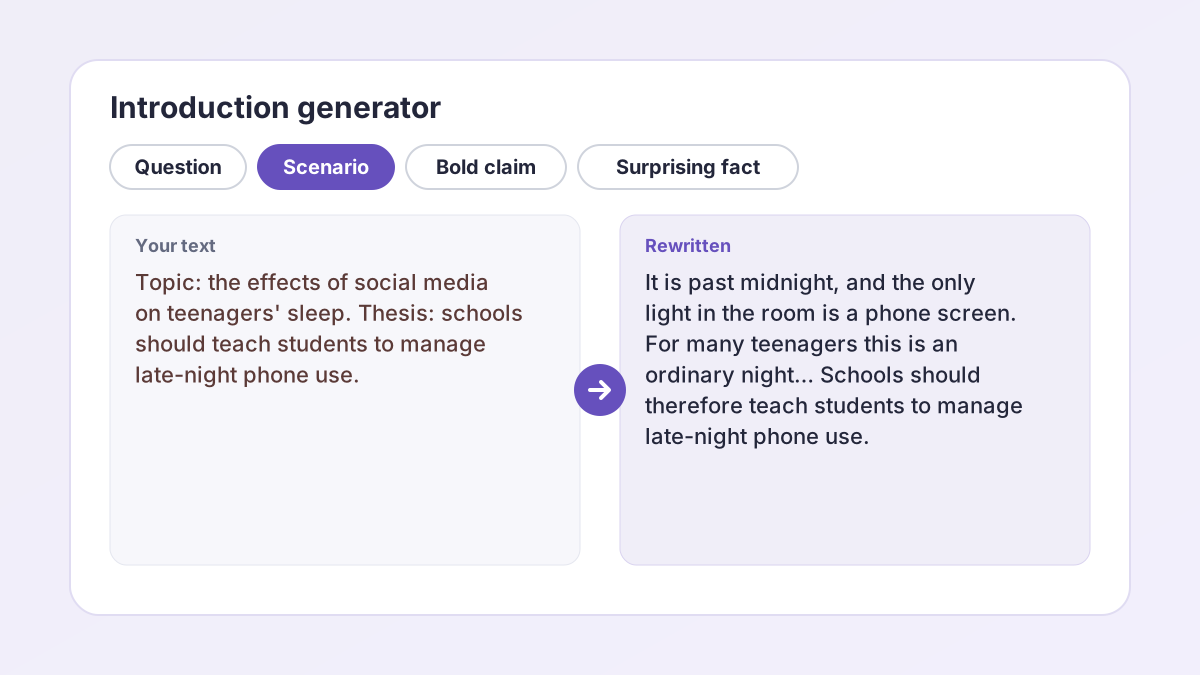
Topic and thesisSocial media and teenagers' sleep. Thesis: schools should teach students to manage late-night phone use.
IntroductionIt is past midnight, and the only light in the room is a phone screen. For many teenagers this is an ordinary night, not an exception. Late-night messaging and scrolling push back bedtimes and cut into the sleep that young people need to learn and concentrate. Because the habit forms early and is hard to break alone, schools should teach students practical ways to manage late-night phone use.
Scene, then context, then a thesis that answers the problem.
Topic and thesisHow volcanoes form.
IntroductionWhy do some mountains erupt while others stay silent for millions of years? The answer lies deep beneath the surface, where the movement of tectonic plates melts rock and builds pressure. This essay explains how volcanoes form at plate boundaries and hotspots, and why their eruptions differ so much in strength.
An expository thesis previews what the essay explains rather than arguing.
Topic and thesisAmbition in Macbeth.
IntroductionMacbeth is not destroyed by the witches, by his wife or by fate, but by his own ambition. From the first prophecy, Shakespeare shows a man who already wants the crown and only needs permission to take it. Through Macbeth's soliloquies and his growing isolation, the play presents unchecked ambition as a force that destroys both the individual and the order around him.
A bold claim sets up an analytical thesis with clear lines of argument.
Topic and thesisPlastic pollution in the oceans.
Introduction[Figure on how much plastic enters the oceans each year, from your source]. Much of it breaks down into microplastics that enter food chains and are almost impossible to remove. This paper examines the main sources of ocean plastic and evaluates which policies have most effectively reduced it.
The bracket shows exactly what kind of fact to find and cite.
Topic and thesisOnline versus classroom learning.
IntroductionOnline and classroom learning both aim to help students master the same material, but they ask very different things of learners. The classroom offers structure and immediate feedback, while online study offers flexibility and independence. This essay compares the two in terms of motivation, interaction and results, arguing that each suits different kinds of learners.
A direct opening suits compare-and-contrast essays well.
Topic and thesisThe day I learned to swim.
IntroductionI was nine, the water was freezing, and I was certain I would sink. That afternoon at the public pool taught me something that had nothing to do with swimming: that fear shrinks when you finally move towards it.
A personal essay introduction ends with the insight rather than a formal thesis.
How to use the introduction generator
The more you tell the tool about your argument, the closer the introductions will be to your essay.
- Type your essay topic. Enter the topic or question you are answering.
- Add your thesis and main points. Optional but recommended: your argument and the points your body paragraphs cover.
- Choose a hook. Mixed gives a different hook in each version; or choose question, scenario, bold claim, surprising fact or straight to the issue.
- Set the essay type and length. Argumentative, expository, literary analysis and more; short, standard or long.
- Choose, fill and rewrite. Pick the introduction you like best, fill any [bracket] from a real source and rewrite it in your own voice.
What makes a good essay introduction?
An essay introduction has two jobs: to make the reader want to keep reading, and to tell them exactly what the essay will argue or explain. A good introduction does both in one paragraph, usually 8 to 10 percent of the essay's length.
Most writing centres describe the introduction as a funnel, narrowing from a broad opening to a specific claim. The University of Texas at El Paso's Writing Center, in its guide to the parts of an essay, lists the elements of an introduction: a hook, background information and the thesis statement.
The three parts
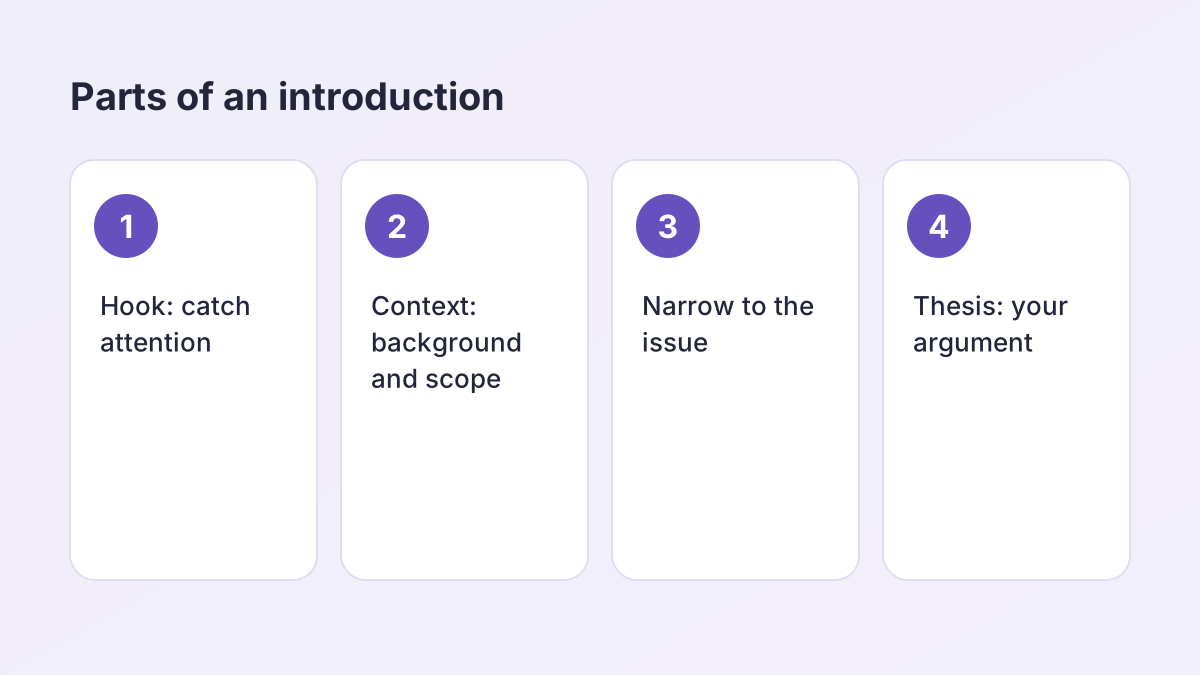
- Hook: an opening sentence that catches attention: a question, a scene, a bold claim or a striking fact.
- Context: two or three sentences of background that narrow from the wider subject to your specific issue.
- Thesis statement: one sentence, usually the last, that states your argument or the main point of the essay.
What a good introduction avoids
- Starting too broad (“Since the beginning of time…”)
- Announcing instead of arguing (“In this essay I will talk about…”)
- Giving away all the evidence before the body paragraphs
- Ending without a clear thesis
Essay starter ideas for your first sentence
The first sentence is the hardest to write, which is why so many students search for an essay starter. The introduction generator gives you three different ways to begin, but it helps to know the main options.
Question
Why do some mountains erupt while others stay silent? Use a question your essay answers, not one with an obvious yes or no.
Scenario
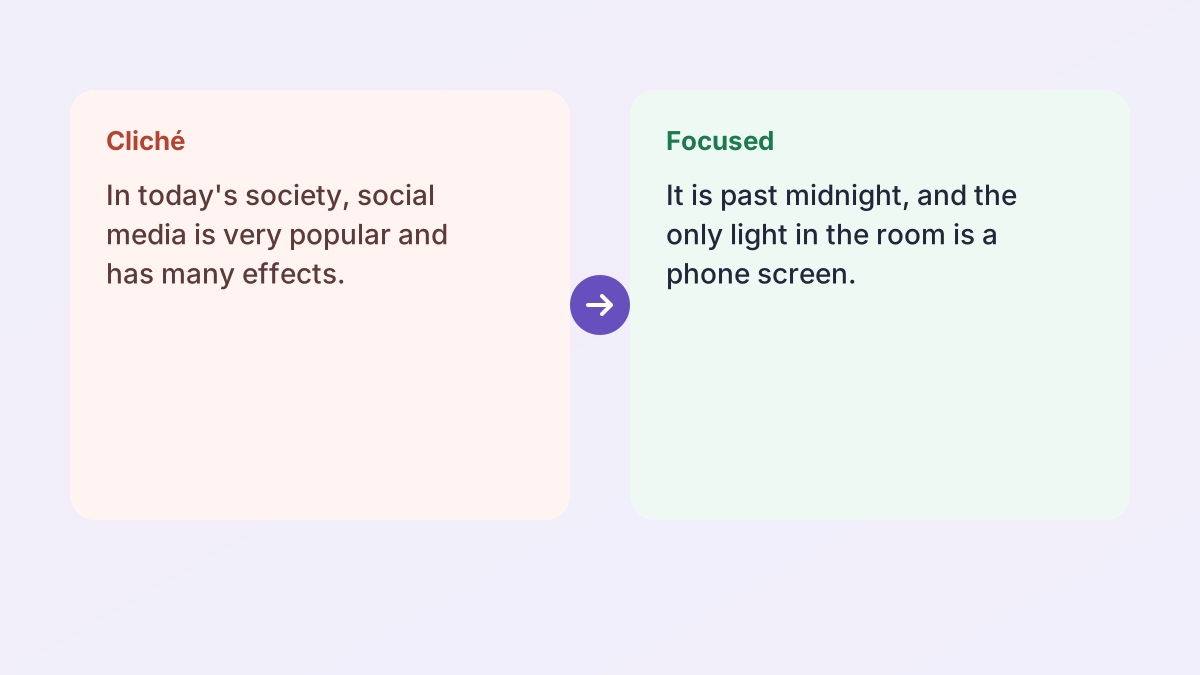
It is past midnight, and the only light in the room is a phone screen. A short scene makes an issue human and concrete.
Bold claim
Macbeth is not destroyed by the witches, but by his own ambition. A strong, arguable statement for argumentative and analytical essays.
Surprising fact
A striking figure from your research. The tool writes this as a placeholder so you add a real, cited figure.
Straight to the issue
Online and classroom learning aim at the same goal but ask very different things of learners. A direct opening is often the best essay starter for compare-and-contrast and exam answers.
Essay starters to avoid
“In today's society”, “Throughout history”, “Webster's dictionary defines” and “Have you ever wondered” are so common that markers skim past them. If you only need opening lines, the Essay Hook Generator gives you nine to compare.
Introduction maker: how each version is built
The introduction maker follows the same structure every time, so each version is a complete, usable paragraph rather than a loose collection of sentences.
Hook first
Each version opens with a different hook when you choose Mixed, so you can compare a question, a scene and a bold claim side by side. Each introduction is labelled with the kind of hook it uses.
Context that narrows
The middle sentences give background and narrow from the general subject to your specific question. If you list your main points, the introduction maker can preview them here.
A clear thesis
Each version ends with a thesis statement. If you gave one, it uses your argument in improved wording; if not, it proposes a thesis that fits your topic, which you should check and adjust to match your actual argument.
No invented facts
Statistics, dates and quotes are never invented. Where one would help, the introduction maker writes a bracketed placeholder such as [figure on teen screen time from your source], so you add a real, cited fact.
Academic register
The introductions are written in a formal register and avoid clichés. Choose US or UK spelling in the tool.
Writing the thesis statement at the end of your introduction
The thesis statement is the most important sentence in the introduction. It tells the reader your argument and gives the essay its direction.
A strong thesis is
- Specific: not “social media is bad”, but “late-night phone use harms teenagers' sleep and concentration”.
- Arguable: someone could reasonably disagree with it (for argumentative essays).
- Focused: it fits the length of the essay.
- A roadmap: it often hints at the main points the body paragraphs will cover.
Different essays, different theses
- Argumentative and persuasive: a position, often with reasons.
- Expository: a statement of what the essay explains.
- Analytical and literary: a claim about how or why something works.
- Compare and contrast: a statement of the key similarity or difference and why it matters.
If your thesis needs work, the Thesis Statement Generator writes several options for each essay type.
Introductions for different types of essay
Set the essay type in the tool and the introductions change to fit it.
Argumentative and persuasive
A hook that makes the issue feel urgent, context that shows why it is debated, and a thesis that takes a clear position.
Expository
A hook that sparks curiosity, context that defines the topic, and a thesis that previews what the essay explains.
Analytical and literary analysis
A hook about the text or subject, brief context (author, work, situation), and a thesis that makes an interpretive claim.
Compare and contrast
An opening that introduces both subjects, context on why they are worth comparing, and a thesis that states the key similarity or difference.
Narrative and personal
A scene or moment, a hint of why it mattered, and an insight instead of a formal thesis.
Research paper
A problem or finding, context from the research field, and a thesis or research question that states what the paper examines.
How long should an introduction be?
A common guideline is that the introduction should be about 10 percent of the essay. Use the length setting to match.
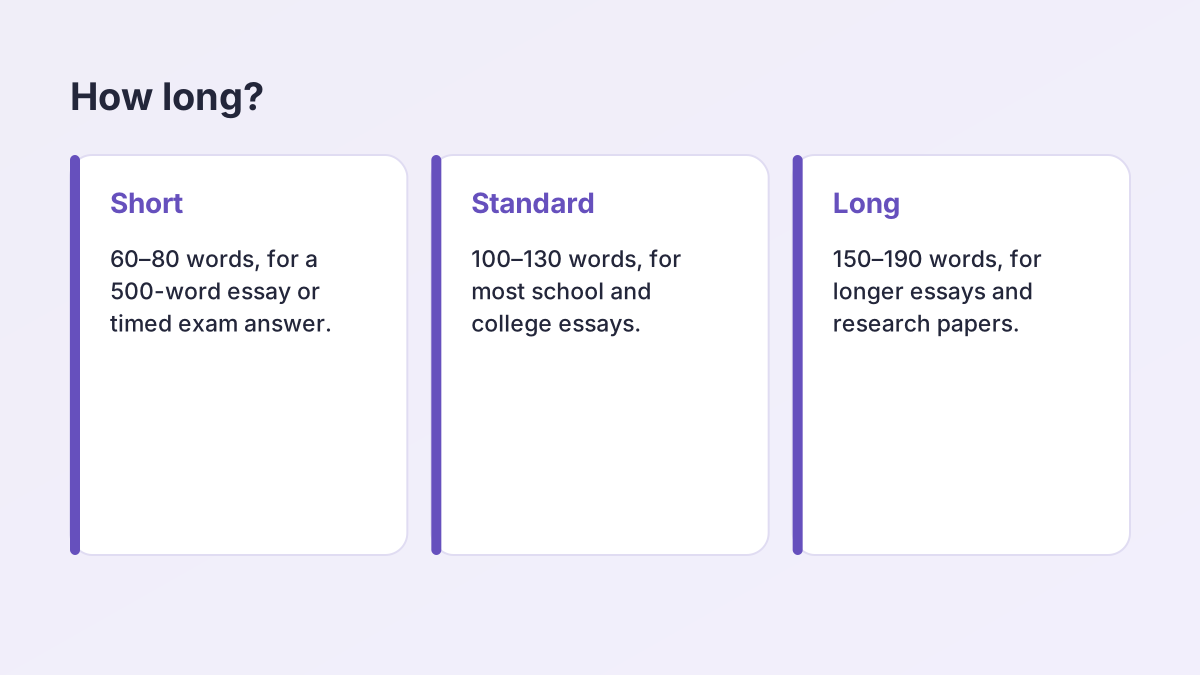
- Short (60–80 words): a 500 to 750-word essay, or a timed exam answer where you need to get to the argument quickly.
- Standard (100–130 words): most school and college essays of 1,000 to 1,500 words.
- Long (150–190 words): longer essays and research papers, where you need more context before the thesis.
For very long papers
In a dissertation or long research paper, the introduction may be several paragraphs or a whole section. Use the Research Paper Introduction Generator, which is built for research introductions with background, gap and aims.
Write it last
Many writers draft the introduction after the body paragraphs. Once you know exactly what your essay argues, the introduction is much easier to write, and you can come back to the introduction generator with a precise thesis and list of points.
How to revise an introduction
Once you have chosen a version, make it yours.
- Check the thesis matches your essay. If your body paragraphs argue something slightly different, change the thesis, not the essay.
- Fill every bracket. Replace each placeholder with a real fact from a source you will cite.
- Cut what you do not need. If a context sentence repeats the hook or the thesis, remove it.
- Use your own voice. Change any phrase that does not sound like you. Your teacher knows your writing.
- Read it with your conclusion. A strong essay often echoes the introduction's hook in the conclusion. Make sure the two fit together.
Connecting to the body
Your first body paragraph should begin with a topic sentence that picks up the first point previewed in the introduction. A Transition Sentence Maker can help you link them smoothly.
Writing introductions in timed exams
In an exam you cannot generate anything, so it pays to practise a quick, reliable method beforehand.
The two-minute introduction
- Rephrase the question in one sentence to show you understand it.
- Add one sentence of context that defines a key term or sets the scene.
- State your answer as a thesis, with your two or three main reasons.
That is enough for most exam essays. Examiners reward a clear argument far more than a clever opening.
Practise with the tool
Before the exam, type past questions into the introduction generator with the length set to Short. Compare the three versions, notice how each one reaches its thesis quickly, then write your own introduction to the same question without looking. Repeat with a new question each day.
Leave space
Some students leave a few lines blank at the start and write the introduction last, once they know exactly what their essay argues. If you do this, keep an eye on the time.
Introduction templates for five essay types
If you would rather write it yourself, a fill-in-the-blank template gets you past the empty page. These free introduction templates follow the same order as the introduction generator: hook, background, thesis. Treat them as scaffolding, and change the wording once your ideas are down. The filled-in examples are invented.
Argumentative
[Bold claim or question]. [What the debate is, and who disagrees]. [Your position] because [reason 1], [reason 2] and [reason 3].
Homework may be doing less for young children than many parents assume. Schools set it to build habits and practise skills, but critics argue it crowds out reading, play and rest. Primary schools should replace most homework with reading for pleasure, because it builds the same habits, causes less stress at home and keeps learning enjoyable.
Expository
[A question the essay answers]. [A definition or the scope]. [What the essay explains, with its main parts].
Literary analysis
[A striking detail from the text]. [Author, title and the situation]. [How the author uses a technique to create meaning].
Miss Havisham has stopped every clock in her house at the moment she was jilted. In Great Expectations, Charles Dickens surrounds Pip with people who cannot leave the past behind. Through Satis House and its frozen rooms, Dickens shows that clinging to an old injury can damage a life as surely as the injury itself.
Compare and contrast
[A contrast between the two subjects]. [Why they are worth comparing]. [The key similarity or difference, and what it shows].
Research paper
[A problem or finding, with a source]. [What is already known]. [What is still unclear]. [Your thesis or research question].
Research introductions need more background, so choose Long (150–190) in the introduction generator for these.
Templates or the introduction generator?
A template gives you the structure; the introduction generator gives you three finished versions to compare. One way to use both: fill in a template first so the thesis is yours, then put that thesis into the introduction generator and see which hook and background work best around it. If the generated hook is stronger, keep it and rewrite the rest in your own voice.
Background in an introduction: what to include and how much
Between the hook and the thesis sit two or three sentences of background. It is the part of the introduction students most often get wrong, either by skipping it or by writing half a page of history.
What background is for
Background gives the reader exactly what they need to understand your thesis, and nothing more. Ask yourself: what would a smart reader who has not studied this topic need to know before my thesis makes sense?
Four kinds of background
- Definition: a key term your essay depends on, in your own words.
- Situation: the current state of the issue, such as a new policy or the debate around it.
- Scope: what you will and will not cover, for example primary schools in England.
- Text details: for literature, the author, the title and the moment you are discussing.
Most introductions need one or two of these, not all four.
How much is enough?
In a 1,000-word essay, two or three sentences is usually plenty. If your background is longer than your hook and thesis together, move some of it to the first body paragraph. Dates, figures and quotations in the background still need a source. To see how little a short essay needs, set the introduction generator to Short (60–80 words).
Before and after
These are invented examples for an essay on teenagers' sleep and phones.
- Too much: Social media began in the late 1990s and grew quickly. Smartphones arrived later and changed how people use the internet. Today, apps are part of everyday life for people of all ages around the world…
- Focused: For many teenagers, the phone is the last thing they look at before sleep, and researchers have linked late-night screen use with shorter sleep [source].
The focused version gives the reader the one fact the thesis depends on and leads straight into it.
Background in the introduction generator
In each version from the introduction generator, the sentences between the hook and the thesis are the background. List your main points and the introduction generator can work them into the background or the thesis. If the background in a version drifts away from your thesis, cut it back to the one or two sentences your argument needs.
Is the introduction generator free?
Yes. The introduction generator is free, with no account or sign-up. A fair hourly allowance per visitor keeps it fast for everyone.
Your topic, thesis and points are sent to our AI providers (Groq, with Google Gemini as a backup) only to write the introductions you see. The Study Corp does not save them.
Using it responsibly
Many schools limit the use of AI in assessed work. Use the introductions as models and starting points, fill in real sources and rewrite in your own words. Check your teacher's or institution's policy if you are unsure.
Introduction generator FAQ
Is the introduction generator free?
Yes. It is free with no account or sign-up. A fair hourly allowance per visitor keeps it fast for everyone.
What are the parts of an introduction?
A hook to catch attention, two or three sentences of context, and a thesis statement that states your argument.
Do I need a thesis to use it?
No, but it helps. Without one, the tool proposes a thesis that fits your topic, which you should check against your essay.
Does it make up facts or quotes?
No. Where a fact would help, it writes a bracketed placeholder for you to fill from a real source and cite.
What is a good essay starter?
A question your essay answers, a short scene, a bold claim, a real surprising fact or a direct statement of the issue.
How long should an introduction be?
About 10 percent of the essay: 60 to 80 words for a short essay, 100 to 130 for most essays, more for research papers.
Is it an introduction maker for YouTube videos?
No. It writes introduction paragraphs for essays and other academic writing.
What is a good introduction template for an essay?
Hook, background, thesis: [an opening question, scene or claim]. [Two or three sentences of background that narrow to your issue]. [Your thesis, with your main points if you like]. The introduction generator follows the same order, so you can compare its three versions with your own.
How much background information should an introduction have?
Usually two or three sentences in a school or college essay: just enough for the reader to understand your thesis. A definition, the current situation or the scope of your essay is often enough. Move longer history into the first body paragraph. In the introduction generator, the sentences between the hook and the thesis are the background.
More free writing tools
- Book Title GeneratorTitle ideas for your book, chapters or series, in any genre.
- Essay Title GeneratorTen clear, catchy titles for any essay type, with notes on each.
- Story Title GeneratorOriginal titles for short stories, fan fiction and school stories.
- Poem GeneratorWrite a poem on any topic: free verse, rhyming, haiku, sonnet and more.
- Shape Poem GeneratorLay a poem out inside a heart, star, tree and more, then download it.
- Paragraph ExpanderMake a paragraph or essay longer with explanation, not filler.
- Personal Statement GeneratorDraft a UCAS or college statement and check it against the word limit.
- Essay Hook GeneratorNine opening hooks for your essay, each a different technique.
- Poetry Prompt GeneratorTen fresh poem prompts on any theme, for any level.
- Acrostic Poem GeneratorA poem whose first letters spell any name or word.
- Random Paragraph GeneratorRandom paragraphs for reading, typing and handwriting practice.
- Thesis Statement GeneratorFive clear, arguable thesis statements for any essay type.
- Essay Outline GeneratorPlan your essay section by section, from thesis to conclusion.
- Topic Sentence GeneratorTopic sentences that tie each body paragraph to your thesis.
- Paragraph GeneratorWrite a clear paragraph from a topic, or turn notes into one paragraph.
- Conclusion GeneratorThree conclusions for your essay, or a concluding sentence for a paragraph.
- Poem Title GeneratorTen title ideas for your poem, from simple to striking.
- Haiku Poem GeneratorHaiku, sonnets and limericks with syllables counted on every line.
- Argumentative Essay GeneratorDraft an argumentative essay with a clear claim, counterargument and rebuttal.
- Persuasive Essay GeneratorDraft a persuasive essay aimed at a real reader, with a call to action.
- Informative Essay GeneratorDraft a clear, neutral informative (expository) essay on any topic.
- Analytical Essay GeneratorDraft an analytical essay that explains how and why, not just what.
- Compare and Contrast Essay GeneratorDraft a comparison essay, point-by-point or block, with a real judgment.
- Scholarship Essay GeneratorDraft a scholarship essay built from your own story and goals.
- Name GeneratorCharacter names for stories and games, 12 at a time, in any genre.
See all 80 free tools for students
Free guides
Related tools
Last updated by The Study Corp editorial team.