
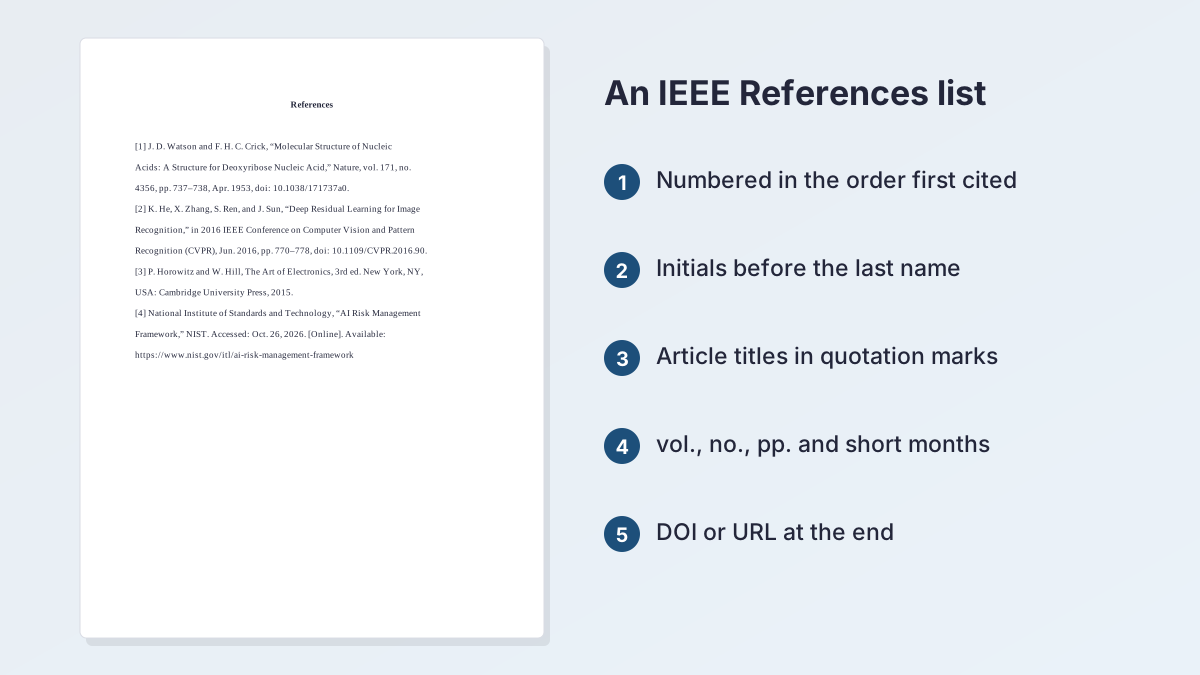
IEEE citation examples by source type
Each reference below is this IEEE citation generator's own output for a real, well-known source, shown as if it were the only source on the list. On your list, the number in brackets follows the order you add sources. In the tool, journal, proceedings and book titles are italic.
Source detailsWatson and Crick, "Molecular Structure of Nucleic Acids," Nature, vol. 171, issue 4356, pages 737–738, April 25, 1953; DOI 10.1038/171737a0
IEEE reference[1] J. D. Watson and F. H. C. Crick, “Molecular Structure of Nucleic Acids: A Structure for Deoxyribose Nucleic Acid,” Nature, vol. 171, no. 4356, pp. 737–738, Apr. 1953, doi: 10.1038/171737a0.
This is the tool's Try it with an example source. Paste the DOI and every field fills in.
Source detailsC. E. Shannon, "A Mathematical Theory of Communication," Bell System Technical Journal, vol. 27, no. 3, pp. 379–423, July 1948; DOI 10.1002/j.1538-7305.1948.tb01338.x
IEEE reference[1] C. E. Shannon, “A Mathematical Theory of Communication,” Bell System Technical Journal, vol. 27, no. 3, pp. 379–423, Jul. 1948, doi: 10.1002/j.1538-7305.1948.tb01338.x.
Months are abbreviated, and the DOI goes at the end with a lowercase "doi:".
Source detailsHe, Zhang, Ren and Sun, "Deep Residual Learning for Image Recognition," CVPR 2016, pp. 770–778; DOI 10.1109/CVPR.2016.90
IEEE reference[1] K. He, X. Zhang, S. Ren, and J. Sun, “Deep Residual Learning for Image Recognition,” in 2016 IEEE Conference on Computer Vision and Pattern Recognition (CVPR), Jun. 2016, pp. 770–778, doi: 10.1109/CVPR.2016.90.
Conference papers take "in" before the proceedings title. Add the conference location by hand if your instructor wants it.
Source detailsPaul Horowitz and Winfield Hill, The Art of Electronics, 3rd edition, Cambridge University Press, New York, NY, USA, 2015
IEEE reference[1] P. Horowitz and W. Hill, The Art of Electronics, 3rd ed. New York, NY, USA: Cambridge University Press, 2015.
Type 3 in the Edition box and the tool writes "3rd ed." IEEE uses the city, state and country.
Source detailsAuthor entered as an organization: National Institute of Standards and Technology; "AI Risk Management Framework"; site name NIST; no publication date (only a “last reviewed” date); accessed October 26, 2026
IEEE reference[1] National Institute of Standards and Technology, “AI Risk Management Framework,” NIST. Accessed: Oct. 26, 2026. [Online]. Available: https://www.nist.gov/itl/ai-risk-management-framework
The organization stands in as author. The access date and URL come last.
Source detailsJohn Noble Wilford, "Men Walk on Moon," New York Times, July 21, 1969
IEEE reference[1] J. N. Wilford, “Men Walk on Moon,” New York Times, Jul. 21, 1969.
Given names shrink to initials, including middle names.
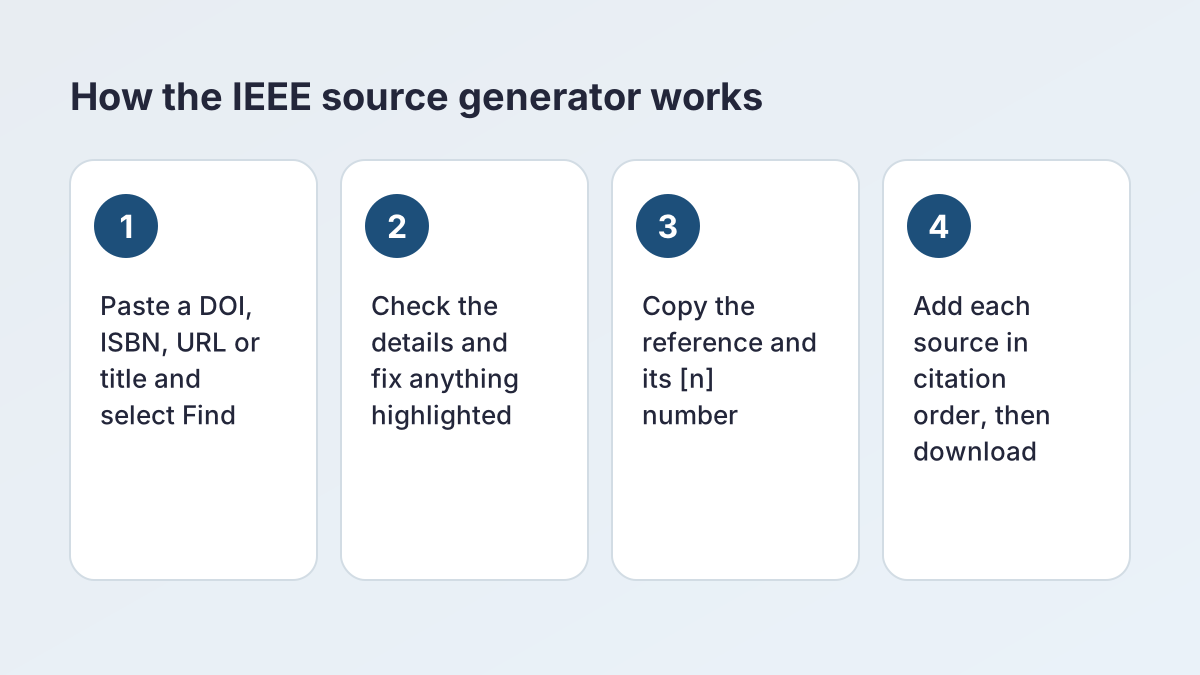
How to use the IEEE citation generator
Start with the source the paper cites first. The IEEE citation generator numbers your list in the order you add sources.
- Find your source. Paste a URL, DOI, ISBN or title into Find your source and select Find. For a title search, choose the right match. To type the details yourself, pick Website, Journal, Book or a type under More.
- Check the details. The status box says whether the details matched a database record or need review. Open Edit details and fix any highlighted field, such as a missing author or date.
- Copy the reference. The Reference tab shows the numbered entry; the In-text tab shows the bracketed number. Add a page number in the optional box to get a form like [1, p. 772].
- Add it to your reference list. Select Add to reference list. Add sources in the order you first cite them, so the numbers match your paper.
- Download or export. Select Download for Word for a .docx file, Copy all to paste the list, or open More formats for plain text, RIS or BibTeX.
How the IEEE citation generator finds your source
Paste what you have, and the hint under the box shows what the IEEE citation generator detected: "DOI detected", "ISBN detected", "Web address detected" or "We'll search by title".
DOI: the best option for engineering sources
Most journal articles and conference papers in engineering and computer science have a DOI. On IEEE Xplore it is listed on the paper's page; on a PDF it is usually on the first page. The tool asks the DOI registry (doi.org) for the record, then Crossref. The status box shows Source details matched.
ISBN
For a textbook, paste the ISBN from the back cover or copyright page. The tool checks Open Library, then Google Books. ISBN lookups don't fill in the city of publication, which IEEE uses, so type it in Edit details.
Web address
Paste a link and the tool reads the page's title, author, site name and date. If the page lists a DOI, it looks that up instead. Web details are marked Details need review, because sites label them inconsistently.
Title
Type the title, plus an author's last name if you know it. The tool searches Crossref and Open Library and lists the closest matches. If nothing matches, the IEEE reference generator never guesses; it opens a blank form for you to fill in from the source.
IEEE referencing generator: numbered references in citation order
IEEE is a numbered style. Instead of an author and year, you put a number in square brackets in your sentence, and the References section at the end lists the sources in the order you first cited them. Purdue OWL's IEEE overview notes that the style is widely used across engineering, computer science and other technical fields.
The parts of an IEEE reference
Every entry follows the same pattern of short labels and punctuation:
| Part | How IEEE writes it | Example |
|---|---|---|
| Number | In square brackets, in citation order | [1] |
| Authors | Initials, then last name; "and" before the last | J. D. Watson and F. H. C. Crick |
| Article title | In quotation marks, followed by a comma | “Molecular Structure of Nucleic Acids,” |
| Journal or book | Italic | Nature |
| Volume, issue, pages | vol., no., pp. | vol. 171, no. 4356, pp. 737–738 |
| Date | Abbreviated month and year | Apr. 1953 |
| DOI or URL | At the end | doi: 10.1038/171737a0 |
Seven or more authors
With up to six authors, the IEEE referencing generator lists every name. From seven authors on, it gives the first author followed by et al., as the 2023 IEEE Reference Guide asks.
Are IEEE references in alphabetical order?
No. IEEE lists are never alphabetized. The order is the order of first citation, which is why the IEEE referencing generator numbers your list in the order you add sources. If you also write papers in an alphabetical style such as APA or MLA, the Alphabetizer sorts a hand-typed list.
IEEE reference generator for every common source type
The IEEE reference generator's manual form changes its boxes to suit the source. Website, Journal and Book are on the main row; Book chapter, Newspaper, Magazine, Report, Thesis and Film or video are under More.
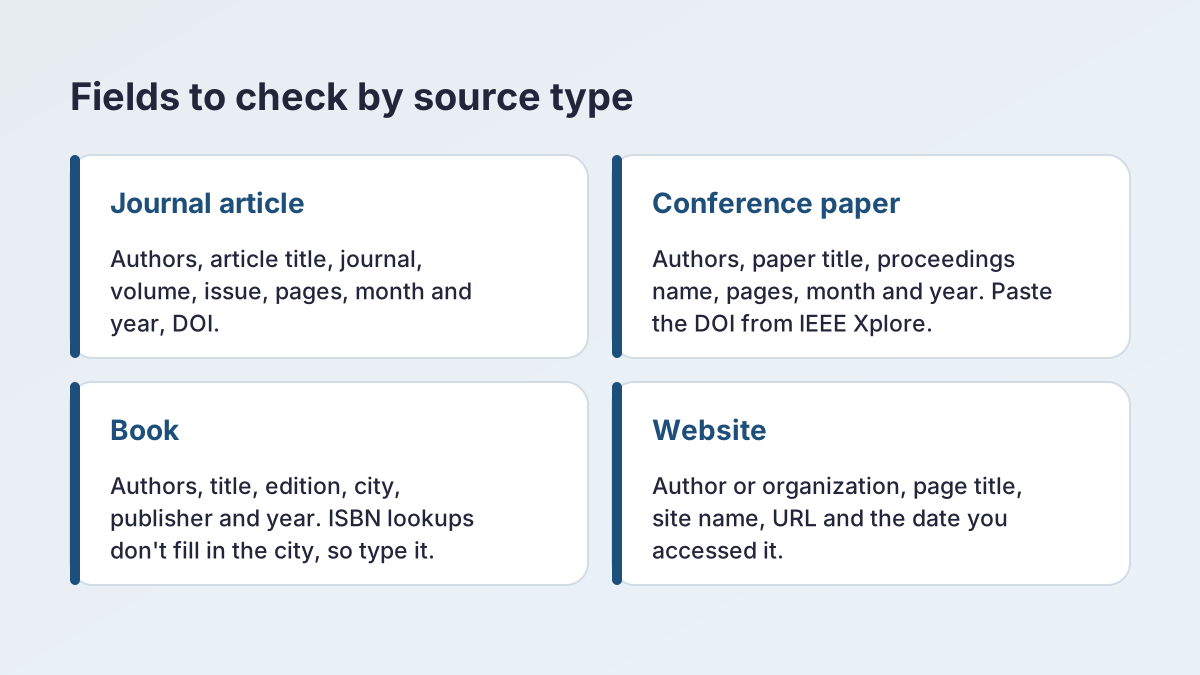
IEEE journal article citation generator
Paste the DOI. Without one, choose Journal and enter the journal name, volume, issue, pages and date, plus the article URL. Look up the journal's official abbreviation if your instructor wants abbreviated titles, such as IEEE Trans. Power Electron.; the tool uses the name as entered.
IEEE conference citation generator
The IEEE citation generator has no manual conference type, so paste the paper's DOI. The lookup recognizes proceedings papers and formats them with "in" and the proceedings title.
IEEE book citation generator
Paste the ISBN, or choose Book. Type the edition as a number (3, not "third") and add the city, such as "New York, NY, USA".
IEEE book chapter citation generator
Choose Book chapter under More. Enter the chapter author and title, the book title, any editors, the publisher and the chapter pages.
IEEE website citation generator
Paste the URL. The access date is filled in with today's date, and the organization can stand in as author if no person is named.
IEEE newspaper article citation generator
Choose Newspaper and enter the headline, the paper's name and the full date. Magazine works the same way.
IEEE video citation generator
Choose Film or video, then enter the title, the creator, the channel or platform (such as YouTube), the date and the URL. Type Video in the Format box to get [Video]. The platform isn't printed, so add it by hand if your instructor wants it.
IEEE PDF citation generator
A PDF is cited as whatever it is. A journal article PDF usually shows a DOI on its first page; a manual or white paper is a report.
IEEE source generator for standards, reports and patents
Engineering papers cite sources that general citation tools rarely handle well. Here is what this IEEE citation generator can and can't do with them.
Standards
IEEE standards have DOIs on IEEE Xplore. Paste the DOI to fetch the title and publisher, then check the year in Edit details: some standard records arrive without one.
Technical reports and datasheets
Choose Report under More for a NIST special publication, a company white paper or a datasheet. Enter the organization in the publisher box, the report number if there is one, the date and the URL.
Theses and dissertations
Choose Thesis, then enter the type (such as M.S. thesis or Ph.D. dissertation), the university and a URL or database name.
Patents and images
The tool has no patent or image type, and IEEE formats those differently from any type it offers, so write them by hand from the IEEE Reference Guide. Everything else on your list can still come from the IEEE source generator.
IEEE format generator: which edition it follows
The IEEE format generator uses the CSL style "IEEE Reference Guide version 11.29.2023", an open style file maintained by Zotero and CSL volunteers (not published by IEEE) and built from the reference guide IEEE publishes for authors. The IEEE Editorial Style Manual page on the IEEE Author Center links to that guide, the Editorial Style Manual and the list of journal title abbreviations.
Two details students often miss
The guide puts the DOI at the end of a reference as "doi:" followed by the number, and gives online sources an "Accessed:" date followed by "[Online]. Available:" and the URL. Both appear in the IEEE format generator's output, so you don't need to add them.
Your instructor's version comes first
Some courses and journals use an older template or their own variation, such as leaving out access dates or adding the conference location. Follow the course or journal instructions where they differ, and edit the copied reference to match.
IEEE also offers its own Reference Preparation Assistant for authors submitting to IEEE publications. This tool is for students: it keeps a list for each assignment and exports it for Word.
How the bracketed numbers work in your paper
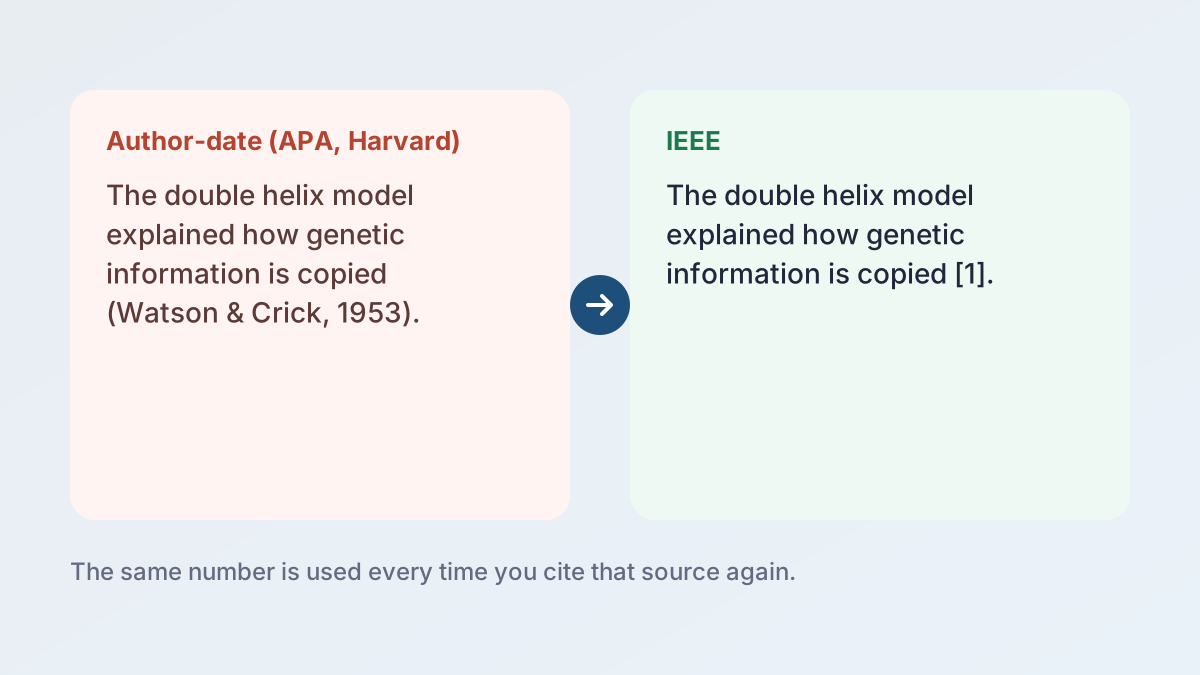
Each source gets one number, the first time you cite it, and keeps that number for the rest of the paper.
Writing the citation
- One source: the converter reduced switching losses [1].
- A page or figure: the derivation is given in [1, p. 772]. Type the page in the optional box and the In-text tab shows this form.
- Several sources: [1], [3], or a range written [2]–[5].
- With names: Watson and Crick [1] proposed a double helix.
Keeping the numbers in order
The IEEE citation generator numbers the list in the order you add sources, and there is no drag to reorder. So add each source when you first cite it. If you insert an early citation later, remove the sources after it and add them again in the right order, or renumber by hand in Word.
Free IEEE citation generator with Word and BibTeX export
Each source you add goes into a list that the IEEE citation generator numbers and formats.
Download and copy
- Download for Word builds a .docx file with the heading "References", Times New Roman 12, and each number set off with a tab and a hanging indent.
- Copy all copies the whole list with italics intact, ready for Word or Google Docs.
- More formats gives plain text, RIS for Zotero, Mendeley and EndNote, and BibTeX for LaTeX and Overleaf.
IEEE citation generator BibTeX export
The .bib file holds the raw fields (authors, title, journal, volume, pages, year, DOI), not formatted text. In LaTeX, pair it with the IEEEtran bibliography style and cite with the \cite command so LaTeX does the numbering.
Saved lists
Your sources are saved in this browser's local storage, not on our server, and there is no account. Use New list for each assignment, such as "EE 230 lab report", and Rename or Delete list to tidy up. Clearing your browsing data deletes the lists, and another device won't see them, so download a copy first.
IEEE citation maker, machine or builder: one free tool
Students search for an IEEE citation maker, an IEEE citation machine or an IEEE citation builder. They all mean the same job, and this page does it for free, without an account or a paywall.
Other styles in the same tool
The Other styles menu switches the same list to APA, MLA, Chicago, Harvard, Vancouver or Turabian. Medicine and nursing often use the numbered Vancouver Citation Generator, which looks similar but follows NLM rules. For author-date styles, try the APA Citation Machine or the Harvard Referencing Generator. Every style is on the citation machines page.
Finishing the paper
Before you submit, the Word Counter checks your length, the Abstract Generator helps draft the summary, and the Research Paper Title Generator suggests titles.
Common IEEE mistakes and how to fix them
Check your list against these before you submit.
- Full first names. IEEE uses initials: J. D. Watson, not James Dewey Watson.
- An alphabetized list. Order by first citation, not by last name.
- A new number for a repeat source. Reuse the number the source already has.
- Numbers that don't match the text. Add sources in citation order, or renumber before you submit.
- Missing access dates. Online sources need "Accessed:" and the date you viewed them.
- All-capital titles. Some records arrive in capitals. Retype them in title case.
- Missing city for books. IEEE includes the city; ISBN lookups don't fill it in.
- No DOI. If the article has one, paste it; it gives the most complete record.
What the IEEE citation generator checks
It flags missing authors, titles, journal names and dates, warns before you add a duplicate, and marks saved entries that are missing details. It can't check that the details match your copy, so compare them with the source.
Privacy: what this generator sends and what stays in your browser
Lookups need the internet, so here is exactly what happens.
What is sent
- Lookups. What you type in Find your source goes to our server, which asks doi.org, then Crossref, for DOIs; Open Library, then Google Books, for ISBNs; Crossref and Open Library for titles; or the public page you linked, for URLs. Results are cached briefly on the server so repeat lookups are fast.
- Formatting. The source details are sent to our server to be formatted, and the finished reference comes back. They are not stored.
- Fair use limits. Your IP address is used to cap lookups over a short period.
What stays with you
Saved lists are stored only in your browser's local storage. To show a list formatted, its sources' details are sent to our server each time the list is displayed or switched to another style; they are formatted, sent straight back, never stored and never linked to an account. No AI writes or changes your references.
Credits
References are formatted with citeproc-js, the open-source engine used by Zotero and Mendeley, and the Citation Style Language project's IEEE style, an open style file maintained by Zotero and CSL volunteers (not published by IEEE).
IEEE citation generator FAQ
Is this IEEE citation generator free?
Yes. The IEEE citation generator is free, with no account and no sign-up. A fair use limit only pauses lookups if very many run in a few minutes, and you can always enter details by hand.
Which version of IEEE style does it use?
The IEEE Reference Guide (2023), through the volunteer-maintained CSL style "IEEE Reference Guide version 11.29.2023". Check your course or journal template for local changes.
How do IEEE in-text citations work?
Put the source's number in square brackets, such as [1], where you use it. Reuse the same number for later citations, and add a page as [1, p. 772].
Are IEEE references in alphabetical order?
No. They are numbered in the order you first cite them. The IEEE citation generator numbers your list in the order you add sources, so add them in citation order.
Can I cite a conference paper?
Yes. Paste the paper's DOI from IEEE Xplore or the PDF. The lookup recognizes proceedings papers and formats them with "in" and the proceedings title.
How many authors does an IEEE reference list?
Up to six, all as initials and last name. With seven or more, the tool lists the first author followed by et al.
Can I export IEEE references to LaTeX or Overleaf?
Yes. Under More formats, choose BibTeX to download a .bib file, then use it with the IEEEtran bibliography style in LaTeX or Overleaf.
Where are my saved sources kept?
In your browser's local storage on this device, not in an account. To display a list formatted, its sources' details are sent to our server, formatted and sent back, never stored. Download your list before you clear your browser or switch devices.
More free citation generators
- MLA Citation MakerMLA 9 works cited entries from a URL, DOI, ISBN or title.
- APA Citation MachineAPA 7 references and in-text citations, exported to Word.
- Chicago Citation GeneratorChicago 18th edition notes, bibliography and author-date citations.
- Chicago Footnote GeneratorFirst notes, shortened notes and the bibliography entry for each source.
- Turabian Citation MachineTurabian 9 footnotes, bibliography and author-date references.
- Harvard Referencing GeneratorHarvard (Cite Them Right) references and (Author, Year) citations.
- ASA Citation GeneratorASA 7th edition references and (Author Year) citations for sociology.
- ACS Citation GeneratorNumbered ACS references for chemistry papers and lab reports.
- CSE Citation GeneratorCSE 9th edition citation-sequence, name-year and citation-name references.
- AMA Citation GeneratorAMA 11th edition references with superscript numbers for medicine and nursing.
- Vancouver Citation GeneratorNumbered Vancouver (NLM) references for medicine and nursing.
See all 80 free tools for students
Free guides
Related tools
Last updated by The Study Corp editorial team.