Poem title generator examples
Poems and descriptions students entered and a few of the ten titles that came back.
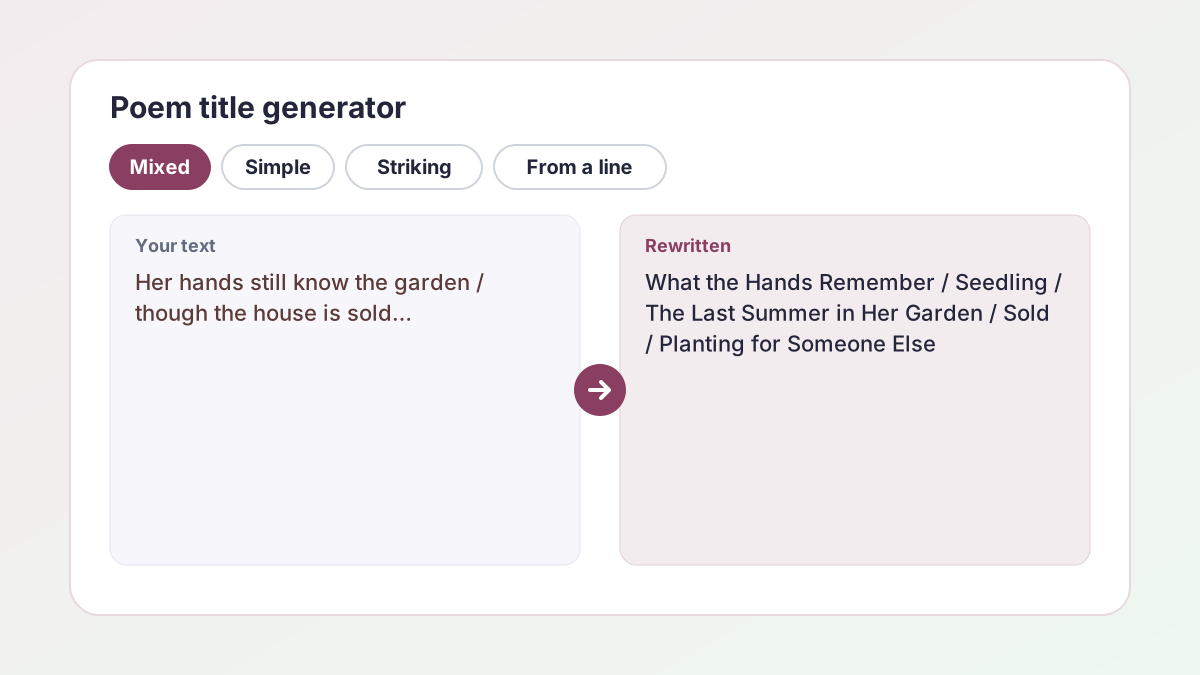
Poem or descriptionHer hands still know the garden / though the house is sold: / they press the soil around a seedling / she will never see grow tall.
Title ideasWhat the Hands Remember · Planting for Someone Else · Seedling · Sold
Mixed styles: a phrase, an idea, a single image and a single word.
Poem or descriptionA poem about the first snow in my town and my little brother trying to catch it.
Title ideasFirst Snow · My Brother and the Snow · Catching Winter
Simple titles name the subject clearly.
Poem or descriptionA poem about leaving my phone at home for a whole day.
Title ideasThe Day I Was Unreachable · Silence Has a Pocket · Offline, Somewhere Green
Striking titles surprise the reader before the poem begins.
Poem or description…and the kettle sings the only song my father knew by heart…
Title ideasThe Only Song · By Heart · What the Kettle Knows
A phrase from the poem makes the title echo when the reader reaches that line.
Poem or descriptionA poem about waiting for exam results.
Title ideasEnvelope · Threshold · Almost
A single word can hold the whole mood of a poem.
Poem or descriptionA poem about a stray cat that visits every evening.
Title ideasWhose Cat Is This? · Who Feeds the Evening? · Where Do You Sleep?
A question title invites the reader to look for the answer in the poem.
How to use the poem title generator
Pasting the whole poem gives the most fitting titles, but a description works too.
- Paste your poem or describe it. Paste the full poem, a few lines, or a sentence about what it is about.
- Choose a style. Mixed, simple, striking, from a line, one word or a question.
- Get ten titles. Select Name my poem. Each title comes with a note on what it adds to the poem.
- Try it on the poem. Read the poem with your favourite title above it. Does it change how the first line sounds?
- Adapt it. Change a word, combine two ideas, or use a title as a starting point for your own.
Why a poem's title matters
A title is the first line of a poem that nobody counts. It is read before everything else, so it shapes how the reader approaches every line that follows. A good title can set the scene, name what the poem never says outright, point to a hidden meaning, or create a small surprise.
Poets talk about titles in very different ways. In a Poetry Foundation interview, the poet Heather Christle says titles are so various, like hats: some arrive first, some last, and there is no single right way to find one.
What a title can do
- Set the scene: First Snow tells the reader when and where.
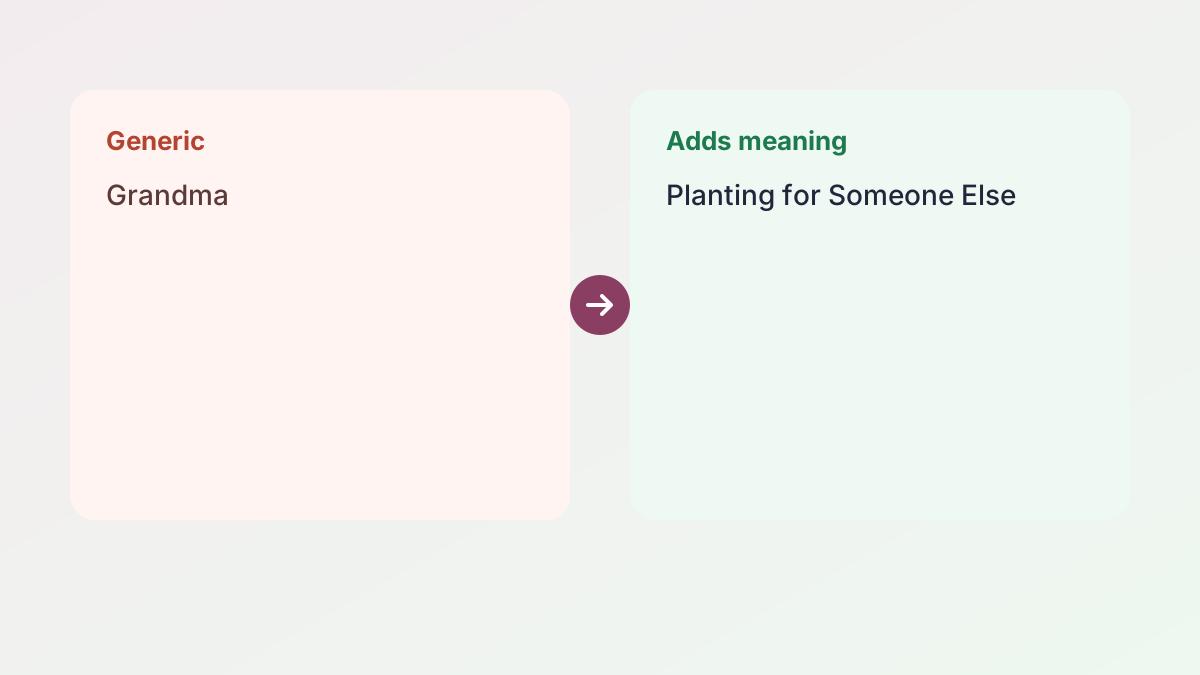
- Add meaning: Planting for Someone Else reveals the poem's real subject.
- Create tension: Sold makes a gentle garden poem feel like a loss.
- Echo a line: a phrase from the poem becomes louder when it appears again.
What to avoid
Untitled, Poem or My Poem waste the space. A title that repeats the first line word for word adds nothing either.
Name this poem: how the generator reads it
When you ask the tool to name this poem, it reads the poem for its subject, its strongest images, its mood and its turn, then suggests titles that each do something different.
Paste the whole poem
The full poem gives the best results, because the poem title generator can find phrases, images and the turn. You can paste up to 2,500 characters.
Or describe it
If you have not finished the poem, describe what it is about. Titles from a description are more general but still useful for finding direction.
Ten different directions
Each set from the poem title generator mixes approaches: a key image, a phrase from the poem, a single word, an idea the poem hints at, a question. The note under each title says what it brings, so you can see why it might work.
Your poem stays yours
The poem is treated as information only and is not saved. Titles are original and never reuse the title of a well-known poem.
Poem title maker: six styles
Choose a style chip to steer the poem title maker. Every style still gives you ten ideas, so you can compare.
Mixed
A range of approaches, best when you have no idea yet.
Simple
Clear and direct: the subject named plainly. Good for school poems and for readers who like to know where they are.
Striking
Unexpected phrases that surprise or intrigue. Good when the poem itself is quiet and needs a spark.
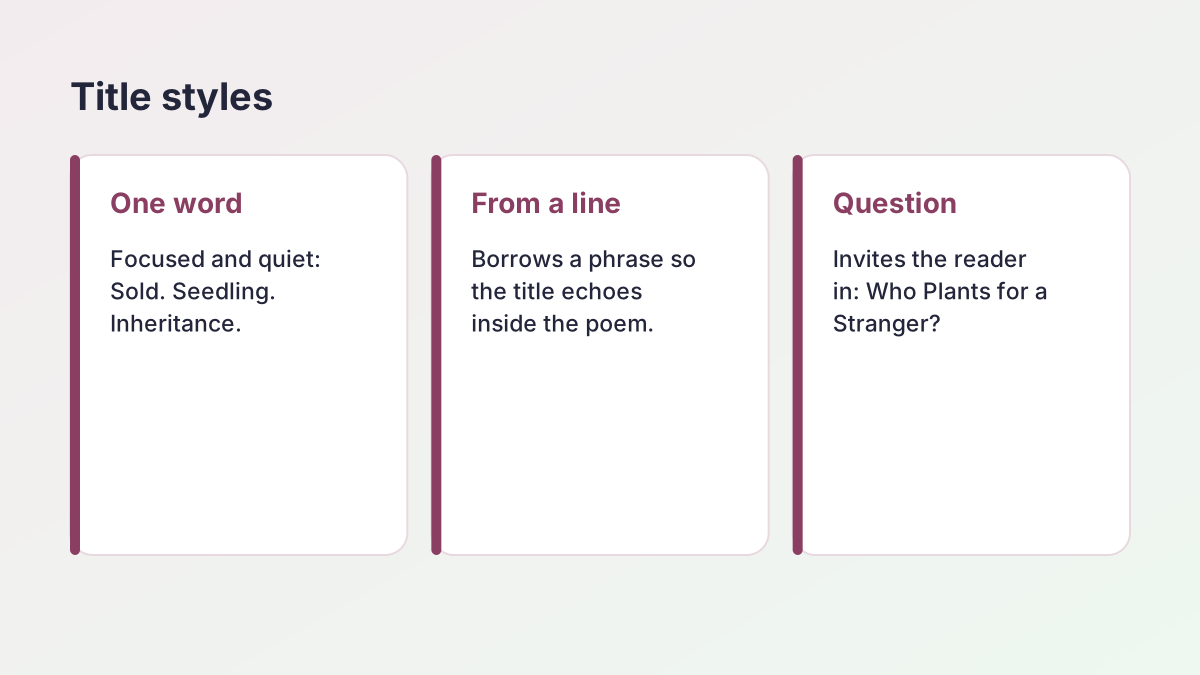
From a line
A phrase taken or adapted from the poem. When the reader meets the phrase again in the poem, it rings like a bell.
One word
A single noun, verb or adjective. One-word titles are focused and can carry a lot of weight.
Question
A question the poem answers, or refuses to answer. Questions invite the reader to lean in.
How poets find titles
There is no single method, but these are the approaches poets return to most.
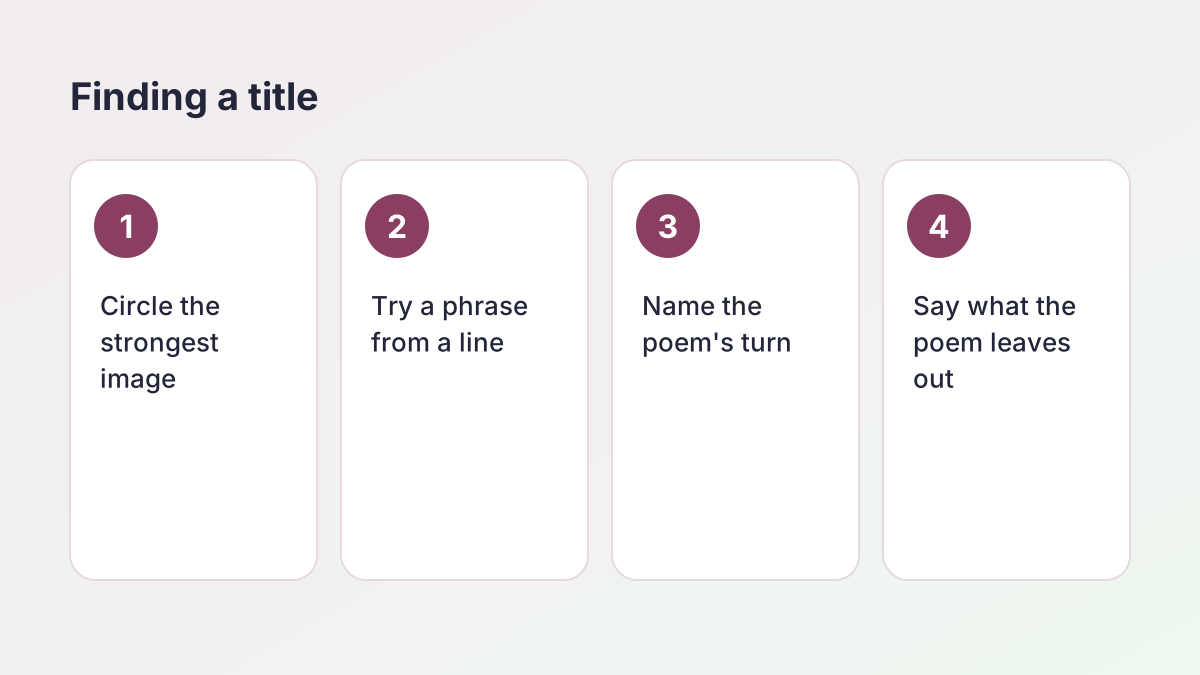
Name the central image
Find the image the poem is built around and use it: a seedling, a kettle, an envelope.
Borrow a line
Read the poem aloud and listen for a phrase that stands out. Lifting it into the title creates an echo.
Name the turn
Many poems change direction near the end. A title that hints at the turn prepares the reader without giving it away.
Say what the poem does not
If the poem is about loss but never says the word, the title might name it, or name the thing that was lost.
Add context
Sometimes a title gives the information the poem needs: a place, a date, a dedication (For My Grandmother), or an occasion.
Write the title last
Many poets finish the poem first, then choose the title. Others start with a title and write towards it. Try both.
Titles for school poems and assignments
For poetry assignments, a good title shows your teacher that you have thought about your poem as a whole.
Check the assignment
Some tasks ask for a specific title or format. Otherwise, choose a title that fits the form and mood.
Match the form
- Haiku: traditionally untitled, or a simple seasonal title.
- Sonnet: often a phrase or an image.
- Free verse: anything goes; a striking title can help.
- Acrostic: the title is usually the word the poem spells.
Explain your choice
If you are asked to annotate or reflect on your poem, explain why you chose the title and what it adds. The notes from the generator can help you put this into words.
Capitalisation
Most titles use title case: capitalise the first word and all main words, but not short words such as a, the, in or of unless they come first.
How to test a poem title
Once you have a shortlist, test each title against the poem.
- Read the title, then the first line. Does the title make the first line stronger or more surprising?
- Read the title, then the last line. Does the ending change the meaning of the title? The best titles mean more after the poem.
- Say it aloud. Is it easy to say and remember?
- Check it does not give everything away. A title that explains the whole poem leaves nothing to discover.
- Search it. If a famous poem already has the same title, choose another so readers do not confuse them.
- Sleep on it. Come back the next day; the right title often feels obvious with fresh eyes.
Finishing the poem
A title is a good moment to look at the whole poem again. If the title you love points to something the poem only half says, you may want to revise a line or two so the poem and the title work together.
- Need a new poem to title? Try the Poem Generator or the Haiku Poem Generator.
- Want to study how published poets use titles? The Poem Analysis Tool breaks down a poem's techniques.
- Want to explain or polish a line? The Poem Rewriter can help.
- Looking for a title for a book or story instead? See the Book Title Generator and Story Title Generator.
Poem title generator ideas by theme
Stuck on what kind of title fits? Here are patterns the poem title generator often suggests, grouped by theme. Use them as models for your own.
Nature
What the River Keeps · Frost, Thursday · The Oak Outside Room 12 · Late Light
Family
My Father's Kettle · Inheritance · Her Hands, Still · Sunday at Nan's
Love and friendship
The Space Beside You · Second Bench from the Left · Notes I Never Sent
Loss and change
Sold · The Last Box · After · Where the House Was
School and growing up
Exam Season · Lockers · The Year I Grew Into My Shoes
Humour
Ode to My Alarm Clock · The Cat Has Opinions · Instructions for Avoiding Homework
Patterns to notice
Many strong titles pair a concrete object with a hint of feeling (My Father's Kettle), use a single loaded word (Sold), or name a time and place (Frost, Thursday). When you use the poem title generator, notice which patterns you like best and ask for more in that style.
Formatting a poem title
Once you have chosen a title, a few conventions help it look right on the page.
On the poem itself
Put the title above the poem, centred or aligned left, with a blank line before the first line. You do not need quotation marks or italics on the poem's own page.
When you mention it in an essay
Short poems go in quotation marks: “Sold”. Long poems published as books, such as epics, go in italics.
Capitalisation
Use title case: capitalise the first and last words and all main words, but not articles, short prepositions or conjunctions in the middle (a, an, the, of, in, and).
Dedications and epigraphs
A dedication (for my grandmother) usually goes in italics on a line below the title. An epigraph, a short quotation that sets up the poem, also sits below the title. Neither replaces a title.
Untitled poems
If you truly want no title, many poets use the first line in its place. In anthologies, untitled poems are listed by their first line.
Common poem title mistakes
- Too general. Nature, Love or Life could title thousands of poems. Narrow it to this poem's image or moment.
- Giving away the ending. If the poem's last line is a surprise, do not put the surprise in the title.
- Repeating the first line. The title should add something, not echo the line beneath it.
- Too long. A title that runs longer than most lines of the poem can feel heavy, unless that is the effect you want.
- Clichés. Broken Heart, Tears of Rain and Endless Sky are hard to read freshly.
- A famous title. Using a title that a well-known poem already has invites comparison.
Try the opposite
If your poem is serious, try a plain or even playful title. If it is light, try a quieter, more serious one. The contrast can make both the title and the poem stronger. The poem title generator's Striking style is a quick way to explore this.
Poetry book title ideas: naming a collection or chapbook
A group of poems needs a title too, whether it is a class anthology, a coursework portfolio or a small chapbook you print yourself. The job is different from naming one poem: the title has to hold many poems together.
Four ways poets title a collection
- Use the title of one poem. Many collections take their name from a poem inside them, often the one that best states the theme. Langston Hughes's first book, The Weary Blues (1926), shares its title with one of its poems.
- Borrow or lift a phrase. A line that sums up the book works even if it is not a poem's title. Robert Frost's A Boy's Will (1913) takes its title from a line in Longfellow's “My Lost Youth”: “A boy's will is the wind's will”.
- Name the thread. An image, place or object that keeps returning across the poems: rivers, a kitchen table, one street.
- Name the occasion. For a class anthology, the shared task or place can work, as in the invented Poems from Room 12.
Using the poem title generator for a collection
The poem title generator is built for single poems, but it can still help. Paste two or three poems that best represent the collection, up to 2,500 characters, or describe the collection in a sentence: what the poems share, their mood and the images that keep coming back. Choose From a line to surface phrases worth lifting, or One word for a spare title. The tool's notes describe what each title brings to “the poem”, so read the poem title generator's notes as notes on your collection's thread.
Poem book name ideas: a quick check
- Does the title fit every poem, not just one?
- Would it look right on a cover and at the top of a contents page?
- Is it different from the titles of the poems inside, unless you chose a title poem on purpose?
- Is it easy to say when someone asks what your collection is called?
If a title fails the first test, try the poem title generator again with a description of the whole collection rather than its strongest poem.
Poem name generator: weak titles fixed, and how to explain your choice
Seeing a weak title beside a stronger one shows what a title can add. Each pair below is invented, with the poem title generator style chip that points in the same direction.
Five before-and-after title fixes
- Poem → Bus Stop, 7:40. A plain label becomes a time and a place. Simple.
- Sadness → The Chair Nobody Moves. An abstract word becomes an image that holds the feeling. Striking.
- My Grandad → He Still Sets Two Cups. A phrase from the last line makes the ending echo. From a line.
- The Ocean Is Big and I Felt Small Standing Next to It → Shoreline. A title that explains everything becomes one word. One word.
- Moving House → Where Do the Echoes Go? A question the poem answers, or refuses to. Question.
Test your own title the same way: what does the better version add that the poem does not already say? Used as a poem name generator, the tool gives ten options at once, so you can compare several fixes side by side instead of settling on the first instead of settling on the first.
How to explain your poem title in an assignment
Many poetry tasks ask for a short commentary or reflection, and the title is an easy place to show deliberate choices, whether it came from your notebook or the poem title generator. These sentence starters help:
- I chose the title … because it …
- The title sets up … which changes in the final stanza when …
- By taking the title from the line “…”, I wanted the reader to …
- I considered … as a title but rejected it because …
Mentioning a rejected title is worth the extra sentence: it shows you weighed options rather than taking the first one. A shortlist of three ideas from the poem title generator gives you a natural rejected option to discuss.
Let the notes help, not speak for you
The note under each idea from the poem title generator says what that title brings to the poem. It can help you find words for what your title does. Explain your own reasons, in your own words, and check your teacher's rules on using AI tools for coursework.
Is the poem title generator free?
Yes. The poem title generator is free, with no account or sign-up. A fair hourly allowance per visitor keeps it fast for everyone.
Your poem or description is sent to our AI providers (Groq, with Google Gemini as a backup) only to suggest the titles you see. The Study Corp does not save it. Titles are kept suitable for school.
Usage allowance
The poem title generator is part of The Study Corp's free writing tools. If the poem title generator is busy, wait a little and try again; the free allowance is counted per hour.
Poem title generator FAQ
Is the poem title generator free?
Yes. It is free with no account or sign-up. A fair hourly allowance per visitor keeps it fast for everyone.
Do I need to paste the whole poem?
No. The whole poem gives the most fitting titles, but a few lines or a description also work.
How many titles do I get?
Ten, each with a short note on what it brings to the poem.
Is my poem saved?
No. It is sent to our AI providers only to suggest titles and is not stored by The Study Corp.
Can it name this poem in one word?
Yes. Choose the One word style for single-word titles.
Will it copy a famous poem's title?
No. Titles are original; it avoids reusing the titles of well-known poems.
Do haiku need titles?
Traditionally haiku are untitled, but many modern haiku have short titles. Check your assignment.
How do I title a poetry collection?
Use the title of one strong poem, lift a phrase that sums up the book, or name an image or place that runs through the poems. You can paste two or three representative poems into the poem title generator and choose From a line to find phrases worth lifting.
How do I explain why I chose my poem title?
Say what the title adds: the scene it sets, the meaning it reveals, or how it changes after the last line. Mention one title you rejected and why. The note under each idea from the poem title generator can help you put this into words, but give your own reasons.
More free writing tools
- Book Title GeneratorTitle ideas for your book, chapters or series, in any genre.
- Essay Title GeneratorTen clear, catchy titles for any essay type, with notes on each.
- Story Title GeneratorOriginal titles for short stories, fan fiction and school stories.
- Poem GeneratorWrite a poem on any topic: free verse, rhyming, haiku, sonnet and more.
- Shape Poem GeneratorLay a poem out inside a heart, star, tree and more, then download it.
- Paragraph ExpanderMake a paragraph or essay longer with explanation, not filler.
- Personal Statement GeneratorDraft a UCAS or college statement and check it against the word limit.
- Introduction GeneratorThree introductions that move from a hook to your thesis.
- Essay Hook GeneratorNine opening hooks for your essay, each a different technique.
- Poetry Prompt GeneratorTen fresh poem prompts on any theme, for any level.
- Acrostic Poem GeneratorA poem whose first letters spell any name or word.
- Random Paragraph GeneratorRandom paragraphs for reading, typing and handwriting practice.
- Thesis Statement GeneratorFive clear, arguable thesis statements for any essay type.
- Essay Outline GeneratorPlan your essay section by section, from thesis to conclusion.
- Topic Sentence GeneratorTopic sentences that tie each body paragraph to your thesis.
- Paragraph GeneratorWrite a clear paragraph from a topic, or turn notes into one paragraph.
- Conclusion GeneratorThree conclusions for your essay, or a concluding sentence for a paragraph.
- Haiku Poem GeneratorHaiku, sonnets and limericks with syllables counted on every line.
- Argumentative Essay GeneratorDraft an argumentative essay with a clear claim, counterargument and rebuttal.
- Persuasive Essay GeneratorDraft a persuasive essay aimed at a real reader, with a call to action.
- Informative Essay GeneratorDraft a clear, neutral informative (expository) essay on any topic.
- Analytical Essay GeneratorDraft an analytical essay that explains how and why, not just what.
- Compare and Contrast Essay GeneratorDraft a comparison essay, point-by-point or block, with a real judgment.
- Scholarship Essay GeneratorDraft a scholarship essay built from your own story and goals.
- Name GeneratorCharacter names for stories and games, 12 at a time, in any genre.
See all 80 free tools for students
Related tools
Last updated by The Study Corp editorial team.