Personal statement generator examples
What students typed and the opening of the draft that came back. Every draft uses only the details given, so it is ready for you to rewrite in your own words.
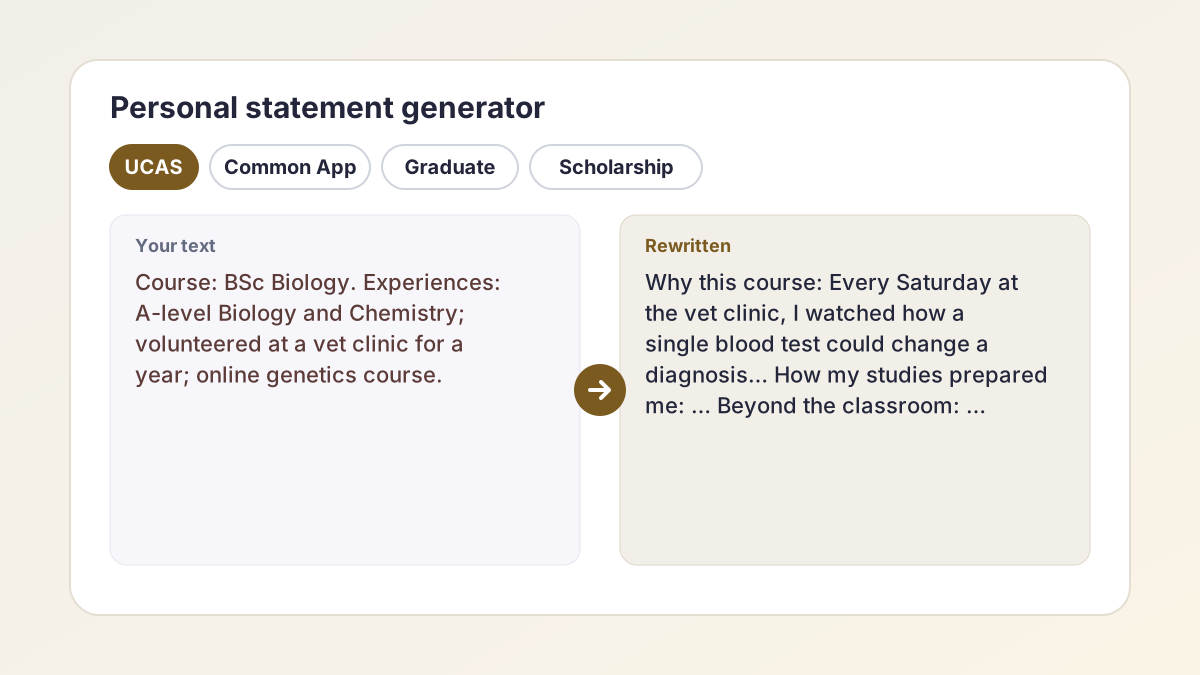
You typedBSc Biology. A-levels in Biology, Chemistry, Maths; Saturdays at a vet clinic for a year; online genetics course.
Draft openingWhy this course: Every Saturday at the vet clinic, I saw how a single blood test could change what the vet decided to do next, and I wanted to understand the biology behind those results.
UCAS drafts come as three answers, one for each question.
You typedUS colleges. Grew up translating for my parents at appointments; started a homework club at the library.
Draft openingBy the age of ten, I knew the words for “prescription”, “deposit” and “lease” in two languages, because I was the one translating them.
Common App essays are about you, not a course, so the draft opens with a moment.
You typedMSc Data Science. BSc Economics; dissertation on housing prices using regression; internship at a council analytics team.
Draft openingMy undergraduate dissertation on local housing prices began as an economics question and ended as a data problem: [number] records, missing values and a model that only became useful once I learned to clean the data properly.
Placeholders mark numbers you need to fill in accurately.
You typedEngineering scholarship. First in family to go to university; built a solar phone charger for a school project; tutor younger students.
Draft openingThe solar phone charger I built for a school project only worked on sunny days, but it taught me that engineering is about solving real problems with what you have.
Scholarship statements connect your story to the funder's goals.
You typedSoftware apprenticeship. Built a website for my uncle's bakery; taught myself Python; part-time job at a supermarket.
Draft openingI built my first website for my uncle's bakery, and the day he took his first online order I realised I wanted to write software for a living.
Job statements are shorter and focus on skills and reliability.
You typedThree pasted answers: 1,420 + 1,380 + 1,350 characters.
Draft opening4,150 / 4,000 characters · 150 over. Each answer is above the 350-character minimum.
The checker shows exactly how much to cut, and from which answer.
How to use the personal statement generator
Give the tool real details. The more specific your experiences, the more useful the draft.
- Choose what it is for. UCAS, Common App, graduate school, a scholarship or a job or apprenticeship.
- Enter the course or role. Type the subject, programme or job title you are applying for.
- List your experiences. Qualifications, projects, work, volunteering, reading, activities and achievements. Real details only.
- Add why (optional). What made you want to do this? A moment, an interest or a goal.
- Draft, then check the length. Select Draft my statement, rewrite it in your own words, then use Check my length to test it against the limit.
What is a personal statement?
A personal statement is a short piece of writing in which you explain who you are, what you want to study or do, and why you are a good fit. Universities, colleges, graduate schools, scholarship panels and employers use it to see beyond your grades.
A good personal statement is specific, honest and well organised. It shows your interest through what you have done and what you learned, rather than simply saying you are passionate.
How the personal statement generator helps
Starting is the hardest part. The personal statement generator takes the details you give it and arranges them into a first draft in the right structure for your application. It uses only your experiences, so nothing is made up, and it leaves [brackets] where a specific number or detail is needed.
A draft, not a final statement
Admissions staff read thousands of statements and want to hear your voice. Use the draft to see how your experiences fit together, then rewrite it in your own words. Most universities and UCAS check statements for similarity and expect them to be your own work.
The UCAS personal statement: three questions
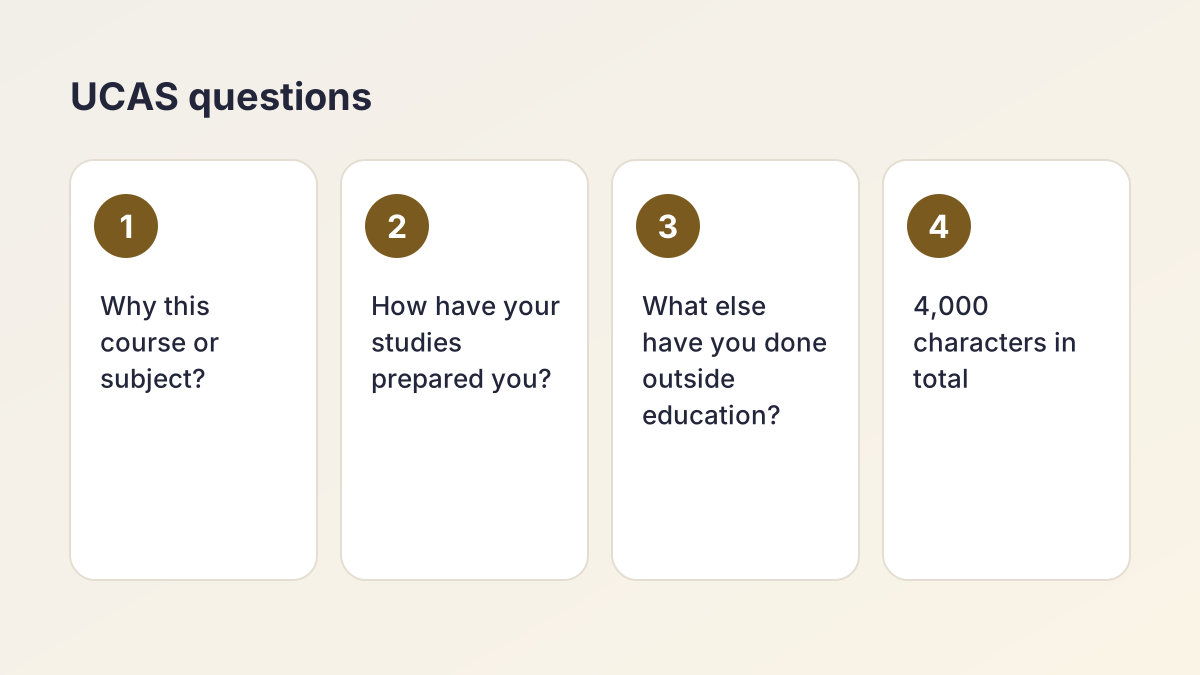
For courses starting in 2026 and later, the UCAS personal statement is no longer one free-form essay. Instead, you answer three questions:
- Why do you want to study this course or subject?
- How have your qualifications and studies helped you to prepare for this course or subject?
- What else have you done to prepare outside of education, and why are these experiences useful?
Your three answers share a total of 4,000 characters including spaces, and each answer must be at least 350 characters. The University of Cumbria's guide to the new UCAS personal statement explains the change and what each question is looking for.
How the draft is structured
Choose UCAS and the personal statement generator writes three answers, labelled Why this course, How my studies prepared me and Beyond the classroom, each sized so the three together stay under the limit.
Balancing the three answers
You do not have to split the characters evenly. Many applicants give the most space to the first question. Use the length checker to see each answer's count and the total.
Personal statement word limit for each application
Every application has its own personal statement word limit, and some count characters rather than words, so always check the personal statement word limit in the official instructions. Going over is not an option: online forms usually stop you, and a statement cut at the last minute often reads badly.
UCAS (UK undergraduate)
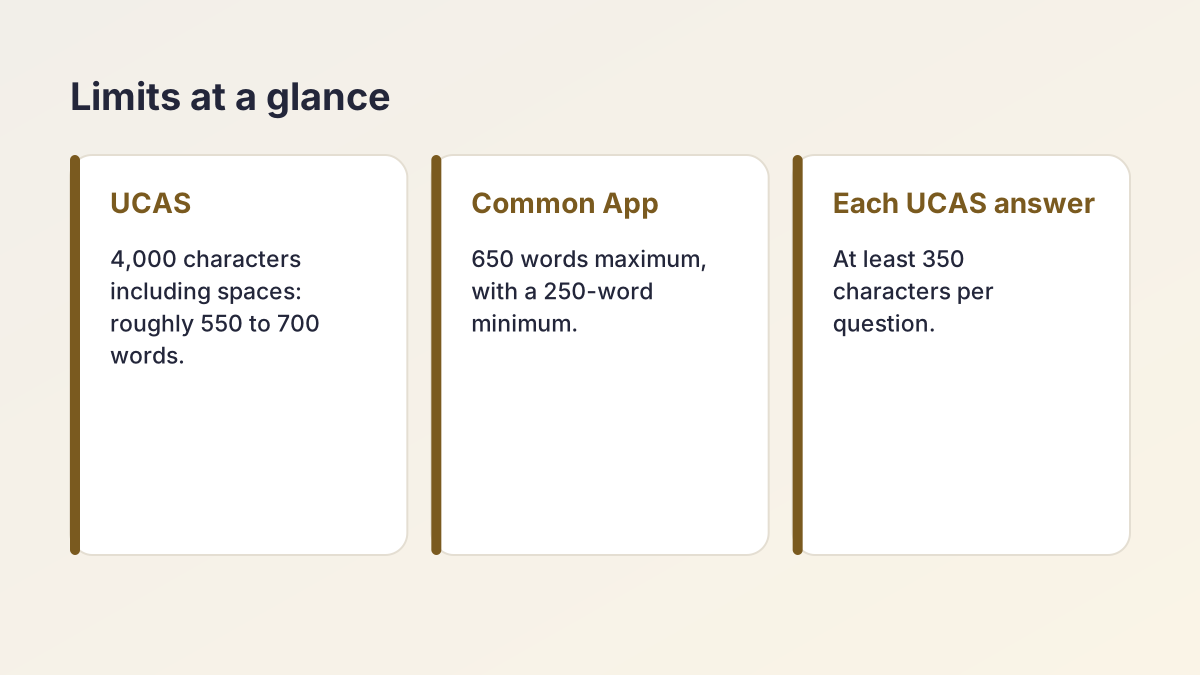
4,000 characters including spaces, across three answers, with at least 350 characters each. Characters include letters, spaces and punctuation.
Common App (US undergraduate)
The personal essay has a 650-word maximum and a 250-word minimum. You choose one of the seven prompts.
Graduate school
Limits vary by programme, often 500 to 1,000 words or one to two pages. Always check the programme's own instructions.
Scholarships
Often 250 to 500 words. Some scholarships set a character limit instead.
Jobs and apprenticeships
Usually short: a few paragraphs, or a set number of characters in an online form.
Using the checker
Switch to Check my length and choose UCAS, Common App or a custom limit in words or characters. The checker counts as you type and shows how much you have left or how far over you are. It runs in your browser, so nothing you paste is sent anywhere.
How many words is 4000 characters?
It depends on the length of your words, but 4,000 characters including spaces is usually about 550 to 700 words. For typical English writing, with an average word of about five letters plus a space, 4,000 characters comes to roughly 650 words.
Why the range is so wide
Characters count every letter, space and punctuation mark. Long words such as environmental or responsibility use far more characters than short ones like I, we or the. A statement full of technical vocabulary may fit only 550 words into 4,000 characters, while one written in plain language may fit 700.
Count characters, not words
Because UCAS sets a character limit, a word count alone can mislead you, which is why people search for how many words is 4000 characters. Paste your answers into the length checker, which shows characters with and without spaces as well as words, so you can see exactly where you stand.
Quick conversions
- 350 characters: about 50 to 60 words (the minimum for each UCAS answer)
- 1,000 characters: about 150 to 180 words
- 4,000 characters: about 550 to 700 words
- 650 words (Common App): about 3,600 to 4,000 characters
How to structure a personal statement
Whatever the application, strong personal statements share a structure.
Open with something specific
Start with a moment, an experience or a question that shows your interest, not a quotation or a general statement such as “I have always been passionate about…”.
Show, then reflect
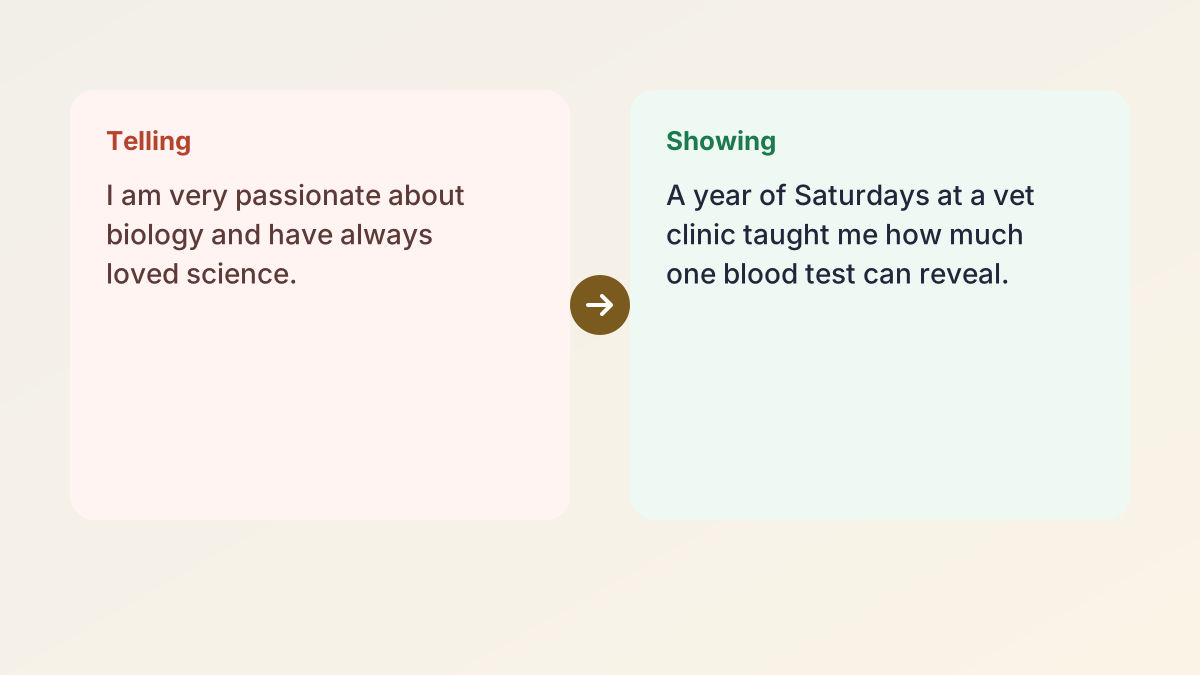
For each experience, say what you did and what you learned from it. I volunteered at a vet clinic is a fact; a year of Saturdays at a vet clinic showed me how much a single blood test can reveal is a reflection.
Connect everything to the course or role
Each paragraph should show why your experience makes you ready for this course or job. Admissions tutors want evidence of interest, preparation and potential.
Be selective
Choose two or three experiences you can discuss in depth rather than listing everything you have done.
End looking forward
Close with what you hope to learn or achieve, and why this course or role is the next step.
Common personal statement mistakes
- Starting with a quote. Admissions staff see the same quotations every year.
- Saying “passionate” without evidence. Show your interest through what you have done.
- Listing achievements. Choose fewer and reflect on them.
- Writing what you think they want to hear. Be honest and specific.
- Copying or using an unedited AI draft. UCAS and many universities check for similarity. Rewrite in your own voice.
- Inventing experiences. Interviewers may ask about anything you mention. The generator never adds experiences you did not give it, and you should not either.
- Ignoring the limit. Check characters and words before you submit.
- Spelling and grammar errors. Read it aloud, and ask a teacher or adviser to check it.
Get feedback
Show your draft to a teacher, careers adviser or someone who knows you. They can tell you whether it sounds like you and whether anything important is missing.
Making the draft your own
The draft gives you a structure and a starting point. Here is how to turn it into your statement.
- Check every fact. Make sure each experience and detail is accurate, and fill every [bracket].
- Add what only you know. A specific moment, a book that changed your thinking, a problem you solved. These details make a statement memorable.
- Rewrite sentence by sentence. Say each idea the way you would explain it to a teacher. Keep the structure, change the words.
- Cut to the limit. Use the length checker. Remove repetition and general statements first.
- Read it aloud. If a sentence does not sound like you, change it.
Need to reword a sentence?
The Rewording Tool suggests other ways to say a sentence, and the Word Counter counts words and characters in any text.
A timeline for writing your personal statement
A personal statement written in one evening rarely shows you at your best. Give yourself several weeks.
Four to six weeks before the deadline
Make a list of everything relevant you have done: subjects, projects, reading, work, volunteering, clubs and responsibilities. Put the strongest details into the personal statement generator and read the draft to see how they might fit together.
Three to four weeks before
Write your own first full draft, using the structure from the personal statement generator but your own words and examples. Do not worry about the limit yet.
Two to three weeks before
Show the draft to a teacher or adviser. Ask whether it sounds like you, whether anything important is missing, and whether any part is unclear.
One to two weeks before
Revise, then cut to the limit using the length checker. Remove general statements first, then repetition, then the weakest example.
The final week
Proofread slowly, ideally on paper and aloud. Check names of courses, universities and books. Then submit with time to spare, because online systems get busy close to deadlines. A statement drafted with the personal statement generator and then rewritten over several weeks will be far stronger than a last-minute one.
Example UCAS personal statement answers, with notes
Reading an exemplar UCAS personal statement helps you see what each of the three questions is really asking, before you write your own or try the personal statement generator. The extracts below are invented examples for a Psychology applicant, not real statements. Each is part of an answer, followed by a note on what it does well.
Question 1: Why this course?
When I volunteered at a holiday club for children with additional needs, I noticed that the same game could calm one child and overwhelm another. I wanted to understand why, and that question led me to psychology.
Why it works: it opens with a specific experience and turns it into a question the course will help answer. It never says “passionate”.
Question 2: How your studies prepared you
A-level Biology showed me how the nervous system links chemistry and behaviour. My Extended Project on screen time and sleep taught me to read research critically: I now check how a study was designed before I trust a headline about it.
Why it works: each qualification is linked to a skill or topic the course needs, with one concrete example.
Question 3: Beyond the classroom
Working weekends in a busy café has taught me to stay calm with frustrated customers and to notice how people's moods change what they need from me.
Why it works: an ordinary job counts when you reflect on what it taught you. When you list experiences like this in the personal statement generator, add what each one taught you, so the draft has something to reflect on.
A university personal statement template
Use the three questions as your template, with one or two paragraphs for each:
- Why this course: the moment or question that started your interest, then what you have explored since.
- Your studies: two or three subjects or projects, each linked to a skill or topic on the course.
- Beyond the classroom: work, volunteering, reading or responsibilities, each with what you learned.
Choose UCAS (UK) in the personal statement generator and it drafts your answers in this same three-part structure, using only the details you give it, so you can compare its draft with your own plan.
Using examples safely
Do not copy phrases from example statements, including these, and do not submit a draft from the personal statement generator unedited. UCAS checks statements for similarity. Use examples to understand the structure, then write about your own experiences.
Personal statement checker: how to rate your own statement
Students looking for a personal statement checker or rater usually want to know two things: does it fit the limit, and is it any good? The personal statement generator's built-in checker answers the first. For the second, you need a careful reader, and this self-check.
The length checker in the personal statement generator
Switch to Check my length. For UCAS, it counts the characters in each of your three answers, flags any answer under 350 characters and shows your total against 4,000. For the Common App, it counts words against 650, and a custom limit works in words or characters. It does not judge quality.
Rate my personal statement: a self-check
Score each line 0 (not yet), 1 (partly) or 2 (clearly):
- Specific opening: does it start with a moment, question or experience rather than a general claim?
- Evidence of interest: is every claim about your interest backed by something you did, read or made?
- Reflection: after each experience, do you say what you learned?
- Link to the course: could a reader tell which course you are applying for from any paragraph?
- Selection: have you explored two or three experiences in depth?
- Your voice: does it sound like you explaining yourself to a teacher?
- Accuracy: is every fact true, every [bracket] filled and every name spelled correctly?
Revise anything you scored 0 first, then the 1s. The scores are for deciding what to fix, not a prediction of an offer. Run the self-check on your rewritten statement, not on the first draft from the personal statement generator, because that draft is not yet in your voice.
Get a second reader
Ask a teacher or careers adviser to read it once and tell you what they remember. If they recall the details you most wanted to get across, it is working.
What the personal statement generator can and cannot do
The personal statement generator helps you start and the length checker keeps you within the limit, but no tool can tell you whether a statement will lead to an offer. Aim for an honest, specific statement that sounds like you.
Is the personal statement generator free and private?
Yes. The personal statement generator is free, with no account or sign-up. A fair hourly allowance per visitor keeps it fast for everyone.
The details you type into Draft with AI are sent to our AI providers (Groq, with Google Gemini as a backup) only to write the draft you see. The Study Corp does not save them. The Check my length tab works entirely in your browser: nothing you paste there is sent anywhere.
If you would like one-to-one help from a professional writer, The Study Corp also offers a paid personal statement service; this free tool is separate from it.
Usage allowance
The personal statement generator is part of The Study Corp's free writing tools. If the personal statement generator is busy, wait a little and try again; the free allowance is counted per hour.
Personal statement generator FAQ
Is the personal statement generator free?
Yes. It is free with no account or sign-up. A fair hourly allowance per visitor keeps it fast for everyone.
What is the UCAS personal statement word limit?
UCAS uses characters, not words: 4,000 characters including spaces across three answers, with at least 350 characters per answer.
How many words is 4000 characters?
Usually about 550 to 700 words, depending on word length; roughly 650 words for typical writing.
What is the Common App word limit?
The Common App personal essay has a 650-word maximum and a 250-word minimum.
Does it make up experiences?
No. It uses only the experiences you give it and leaves brackets where a specific detail or number is needed.
Can I submit the draft as it is?
No. Use it as a starting point and rewrite it in your own words. UCAS and universities expect statements to be your own work and check for similarity.
Is my text saved?
No. Drafting details are sent to our AI providers only to write the draft, and the length checker runs entirely in your browser.
Can the personal statement checker rate my statement?
No. The Check my length tab in the personal statement generator counts characters and words against the UCAS, Common App or a custom limit, and flags any UCAS answer under 350 characters, but it does not score quality. To rate your statement, check for a specific opening, reflection and clear links to the course, and ask a teacher to read it.
How should I split 4,000 characters across the three UCAS questions?
There is no required split beyond the 350-character minimum for each answer. An even split is about 1,330 characters each, but many applicants give more space to the question where they have most to say. The personal statement generator aims to keep its three UCAS answers under 4,000 characters in total; check yours with Check my length.
More free writing tools
- Book Title GeneratorTitle ideas for your book, chapters or series, in any genre.
- Essay Title GeneratorTen clear, catchy titles for any essay type, with notes on each.
- Story Title GeneratorOriginal titles for short stories, fan fiction and school stories.
- Poem GeneratorWrite a poem on any topic: free verse, rhyming, haiku, sonnet and more.
- Shape Poem GeneratorLay a poem out inside a heart, star, tree and more, then download it.
- Paragraph ExpanderMake a paragraph or essay longer with explanation, not filler.
- Introduction GeneratorThree introductions that move from a hook to your thesis.
- Essay Hook GeneratorNine opening hooks for your essay, each a different technique.
- Poetry Prompt GeneratorTen fresh poem prompts on any theme, for any level.
- Acrostic Poem GeneratorA poem whose first letters spell any name or word.
- Random Paragraph GeneratorRandom paragraphs for reading, typing and handwriting practice.
- Thesis Statement GeneratorFive clear, arguable thesis statements for any essay type.
- Essay Outline GeneratorPlan your essay section by section, from thesis to conclusion.
- Topic Sentence GeneratorTopic sentences that tie each body paragraph to your thesis.
- Paragraph GeneratorWrite a clear paragraph from a topic, or turn notes into one paragraph.
- Conclusion GeneratorThree conclusions for your essay, or a concluding sentence for a paragraph.
- Poem Title GeneratorTen title ideas for your poem, from simple to striking.
- Haiku Poem GeneratorHaiku, sonnets and limericks with syllables counted on every line.
- Argumentative Essay GeneratorDraft an argumentative essay with a clear claim, counterargument and rebuttal.
- Persuasive Essay GeneratorDraft a persuasive essay aimed at a real reader, with a call to action.
- Informative Essay GeneratorDraft a clear, neutral informative (expository) essay on any topic.
- Analytical Essay GeneratorDraft an analytical essay that explains how and why, not just what.
- Compare and Contrast Essay GeneratorDraft a comparison essay, point-by-point or block, with a real judgment.
- Scholarship Essay GeneratorDraft a scholarship essay built from your own story and goals.
- Name GeneratorCharacter names for stories and games, 12 at a time, in any genre.
See all 80 free tools for students
Related tools
Last updated by The Study Corp editorial team.