Persuasive essay generator examples
What students typed and an excerpt from the draft. Brackets mark evidence to find and cite.
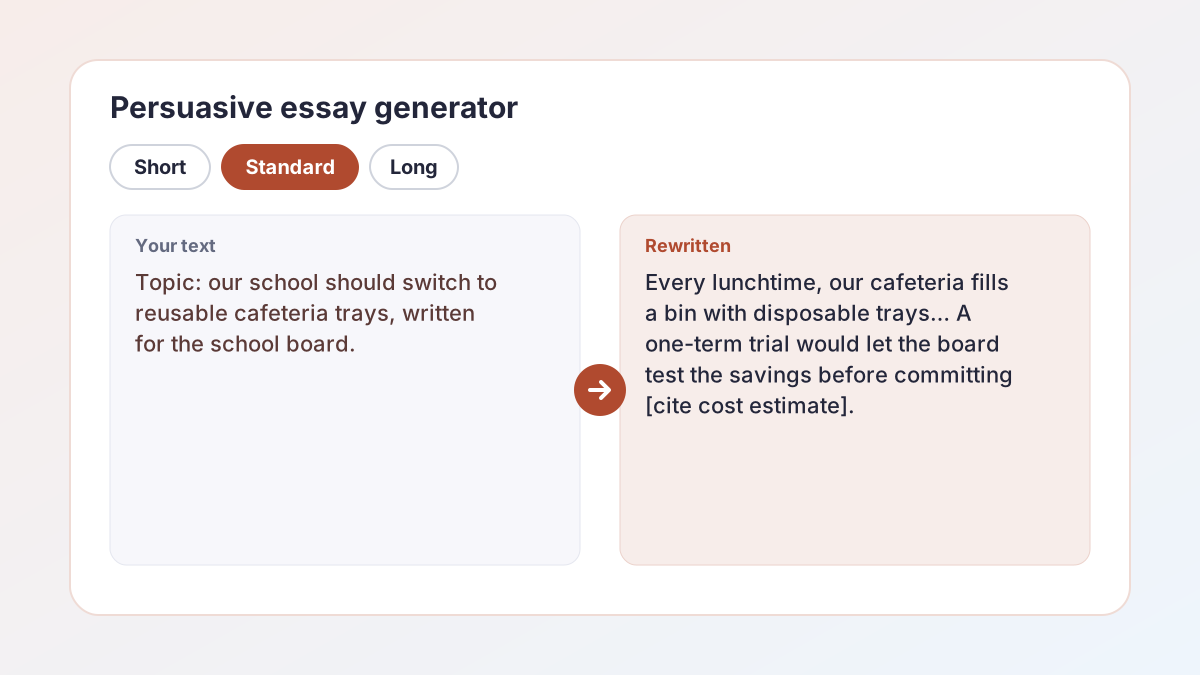
You typedOur school should switch to reusable cafeteria trays, written for the school board.
Draft excerptA one-term trial would let the board test the savings before committing, and the cost of washing equipment can be weighed against what we spend on disposables each year [cite the cafeteria budget].
For decision-makers, the draft leads with cost and ease of putting the change in place.
You typedStudents should join the library's late-night study hours trial, written for classmates.
Draft excerptYou already study late; the only question is whether you do it at a crowded kitchen table or in a quiet room with free Wi-Fi.
For peers, the draft speaks to what changes for them day to day.
You typedOur town should add a protected bike lane on Main Street, for local residents.
Draft excerptPicture your child cycling to school on a lane separated from traffic by a simple curb. That is what the council can approve next month.
A vivid picture (pathos) followed by a specific action.
You typedTeenagers should get a free public transport pass.
Draft excerptA free pass would let teenagers reach school, jobs and libraries without depending on a lift, and it would build the public transport habits cities want [source].
A short draft keeps one strong reason per paragraph.
You typedSchools should replace one exam with a project.
Draft excerptSome will say projects are easier to copy. Yet teachers can require drafts, presentations and reflection, which make a project harder to fake than a single test.
Persuasive essays still answer the most likely objection.
You typedPeople should donate blood.
Draft excerptBook a slot at this month's donation drive in the school hall; it takes under an hour, and you can bring a friend.
The ending names who should act, what to do and when.
How to use the persuasive essay generator
Persuasion works on a specific reader, so include the audience in the topic.
- Enter the topic and audience. For example, "our school should switch to reusable trays, written for the school board".
- Say what the reader should think or do. Optional but powerful: the action or belief you want, such as "approve a one-term trial".
- Add your reasons or sources. List the points or evidence you plan to use.
- Choose length and level. Short, standard or long; high school, college or graduate.
- Draft, then add evidence. Select Draft my persuasive essay, fill every [source] and rewrite the draft in your own voice.
What is a persuasive essay?
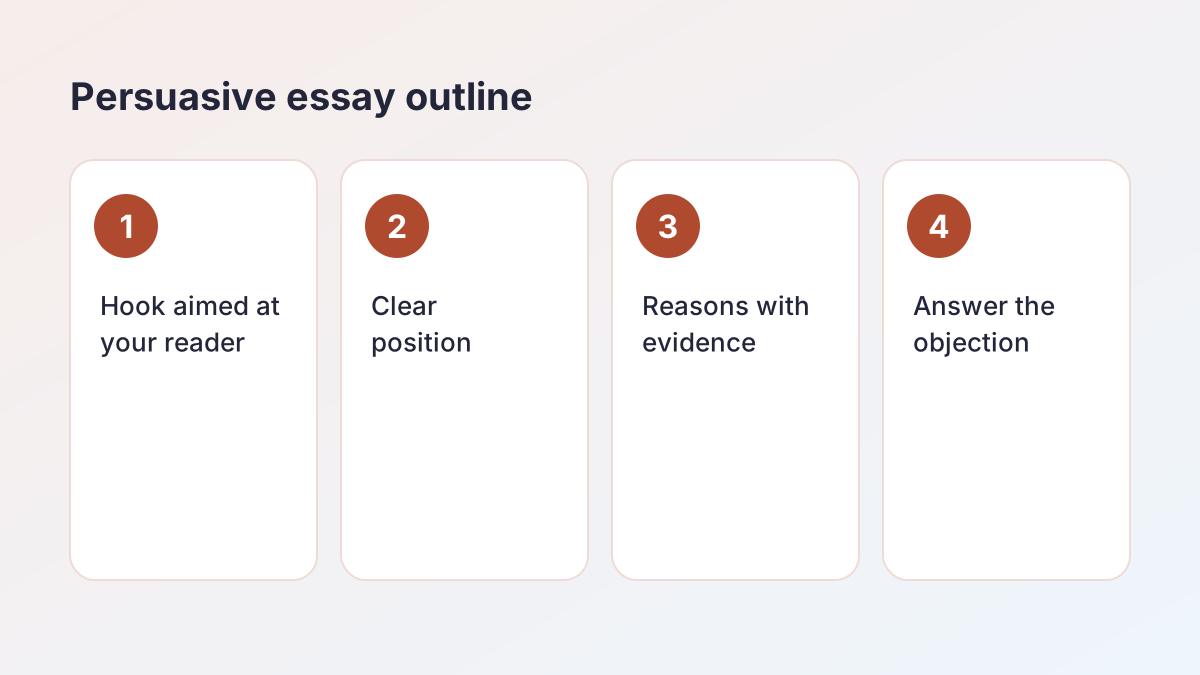
A persuasive essay tries to move a reader toward a belief, a position or an action. It combines evidence with rhetorical appeal and usually ends with a call to action. It suits opinion pieces, speeches, letters, position papers and advocacy assignments.
Hamilton College's writing center, in its guide to writing a persuasive essay, recommends a thesis that states both your position and your strategy for supporting it, and body paragraphs that each advance one step of the argument.
What the persuasive essay generator does
The persuasive essay generator drafts that structure for your topic and reader: a hook aimed at them, your position, reasons supported by evidence placeholders, a paragraph that answers the most likely objection and a specific call to action. It balances logos, ethos and pathos rather than relying on emotion alone.
Persuasive vs argumentative essay
- Persuasive: written for a specific reader, leans on appeals as well as evidence, ends with what the reader should do.
- Argumentative: weighs evidence more formally, must engage fully with counterarguments, ends with a judgment.
For a formal argument with counterarguments and rebuttals, use the Argumentative Essay Generator.
Persuasive essay outline
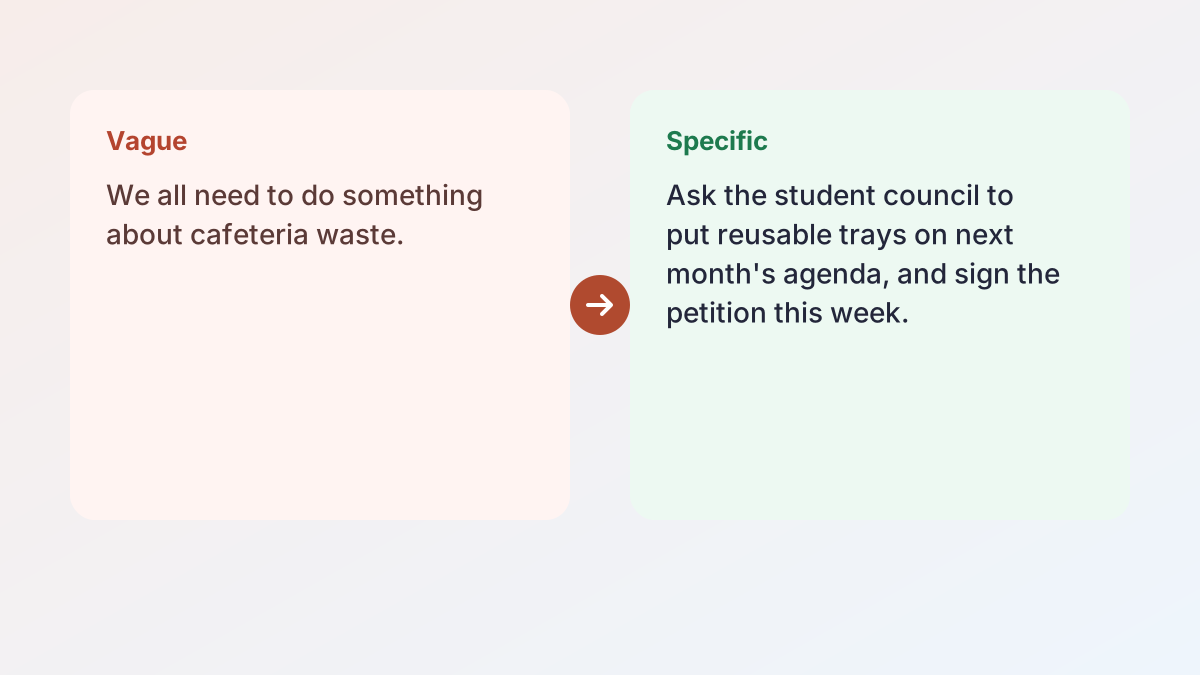
This persuasive essay outline is the structure the generator follows. Use it to plan your own essay too.
I. Introduction
- Hook aimed at your specific reader: a question, a scene or a striking fact.
- Context: why the issue matters now.
- Position: one clear sentence stating what the reader should believe or do.
II. Body paragraph 1: your strongest practical reason
Topic sentence, evidence, and why it matters to this reader.
III. Body paragraph 2: a second reason
Often an appeal to values or fairness, still backed by evidence.
IV. Body paragraph 3: the objection
State the most likely objection your reader will have and answer it.
V. Conclusion and call to action
Restate the position, sum up the reasons, and end with a specific action: who should do what, and when.
Outline example: reusable cafeteria trays (for the school board)
- Hook: Every lunchtime, our cafeteria fills a bin with disposable trays.
- Position: The board should approve a one-term trial of reusable trays.
- Reason 1: Long-term cost savings [cite budget figures].
- Reason 2: Less waste, and a lesson students see every day.
- Objection: Washing costs and staff time; answered by a trial that measures both.
- Call to action: Approve the trial at next month's meeting.
To turn an outline into more paragraphs, the Essay Outline Generator plans any essay section by section.
Persuasive essay topics
The best persuasive essay topics are ones you care about, with a clear action a reader could take. Here are 40 to start from, grouped by level. Add your audience when you type one into the tool.
Persuasive essay topics for middle school
- Students should have a longer lunch break.
- Our school should have a pet-friendly day.
- Homework should not be set over holidays.
- Every class should have a reading corner.
- School uniforms should be optional on Fridays.
- Students should help choose school library books.
- Recess should never be taken away as a punishment.
- Our town needs a skate park.
Persuasive essay topics for high school
- Teenagers should get a free public transport pass.
- Schools should replace one exam with a project.
- Students should be able to take a mental health day.
- Driving tests should include a first-aid module.
- High schools should teach personal finance.
- Schools should ban phones during lessons, not breaks.
- Every student should learn to cook a basic meal.
- The school day should start later.
- Students should vote in school budget decisions.
- Volunteer hours should count toward graduation.
Persuasive essay topics for college
- Universities should publish the true cost of textbooks before enrolment.
- Campuses should offer free period products in every restroom.
- Internships should always be paid.
- Universities should accept pass/fail for one elective a year.
- Lecture recordings should be available for every course.
- Student housing should include quiet floors by default.
Community and society
- Our town should add a protected bike lane.
- People should donate blood regularly.
- Supermarkets should donate unsold food.
- Libraries should lend tools as well as books.
- Cities should plant more street trees.
- Restaurants should list calories on menus.
- Public parks should have free drinking fountains.
- Local elections should be held at weekends.
Fun persuasive essay ideas
- Pineapple belongs on pizza.
- Cats make better study companions than dogs.
- Every school should have a nap room.
- Breakfast for dinner should be a weekly tradition.
- Board games beat video games for family nights.
- Summer holidays should be split into two shorter breaks.
- Socks with sandals deserve a comeback.
- Homework should come with a soundtrack.
Choosing a topic
Pick one of these persuasive essay topics where you know your reader. "Our school should switch to reusable trays" becomes far stronger when you decide whether you are writing for the principal, classmates or parents, because each reader needs different reasons.
Persuasive essay examples
Here is one of our short persuasive essay examples, invented and about 330 words, written for a school board. Claims that need a source are marked.
Example: approve a trial of reusable cafeteria trays
Every lunchtime, our cafeteria fills a large bin with disposable trays that are used once and thrown away. Members of the board, you can change that this term, at little risk: approve a one-term trial of reusable trays in the main cafeteria.
The first reason is cost. Disposable trays are a recurring expense that never ends, while reusable trays are bought once and last for years [cite supplier prices and the cafeteria budget]. A trial would show the board the real numbers before any long-term commitment.
The second reason is what our school teaches. Students hear about reducing waste in science lessons, then watch a bin fill with trays at lunch. A visible change in the cafeteria would match our actions to our lessons and give students a daily example of a problem being solved.
Some board members will worry about washing costs and staff time. That concern is fair, which is exactly why a trial makes sense. During one term, the cafeteria team can record washing time, water use and breakages, and the board can compare those costs with what we currently spend on disposables. If the numbers do not work, the trial ends and nothing is lost.
Other schools have already made this switch [cite an example from a nearby district]. Ours can make an informed decision based on its own figures.
Please vote to approve a one-term reusable tray trial at next month's meeting, and ask the cafeteria manager to report the results at the end of term. It is a small step that could save money and show students that their school takes waste seriously.
What the example shows
- The reader is named in the second sentence, and every reason is chosen for them.
- Logos (cost), ethos (fairness about the objection) and pathos (the bin of trays) are balanced.
- The objection is answered with a plan, not dismissed.
- The call to action says who, what and when.
Know your audience before you persuade
Persuasion only works on a specific reader. The same position needs different reasons for different audiences. Suppose you argue that your school should switch to reusable cafeteria trays:
- For the principal or school board: focus on cost over time, ease of putting the change in place, and the school's reputation.
- For classmates: focus on what changes for them day to day, and how small the effort is.
- For parents: focus on health, values and what the change teaches students.
Put the audience in the topic box: "Why our school should switch to reusable cafeteria trays, written for the school board." The more specific the topic, the more targeted the appeals in the draft. Choose one body paragraph per main reason; three is common for a standard essay.
Ethos, pathos, logos
Balance all three appeals. Logos carries academic weight: statistics, studies and logical reasoning. Pathos creates urgency: a brief, vivid example or human consequence. Ethos builds trust: acknowledging complexity, citing credible sources and treating opponents fairly. Avoid overclaiming ("everyone knows", "obviously"), which signals weak evidence.
How to start and end a persuasive essay
How to start a persuasive essay
- Speak to the reader directly: Members of the board, you can change that this term.
- Open with a picture: Every lunchtime, a bin fills with trays used once.
- Ask a question the essay answers: What would you do with an extra hour of sleep every school day?
The Essay Hook Generator gives nine openings to compare.
How to end a persuasive essay
End with a specific call to action. Vague endings are the most common weak point in persuasive drafts.
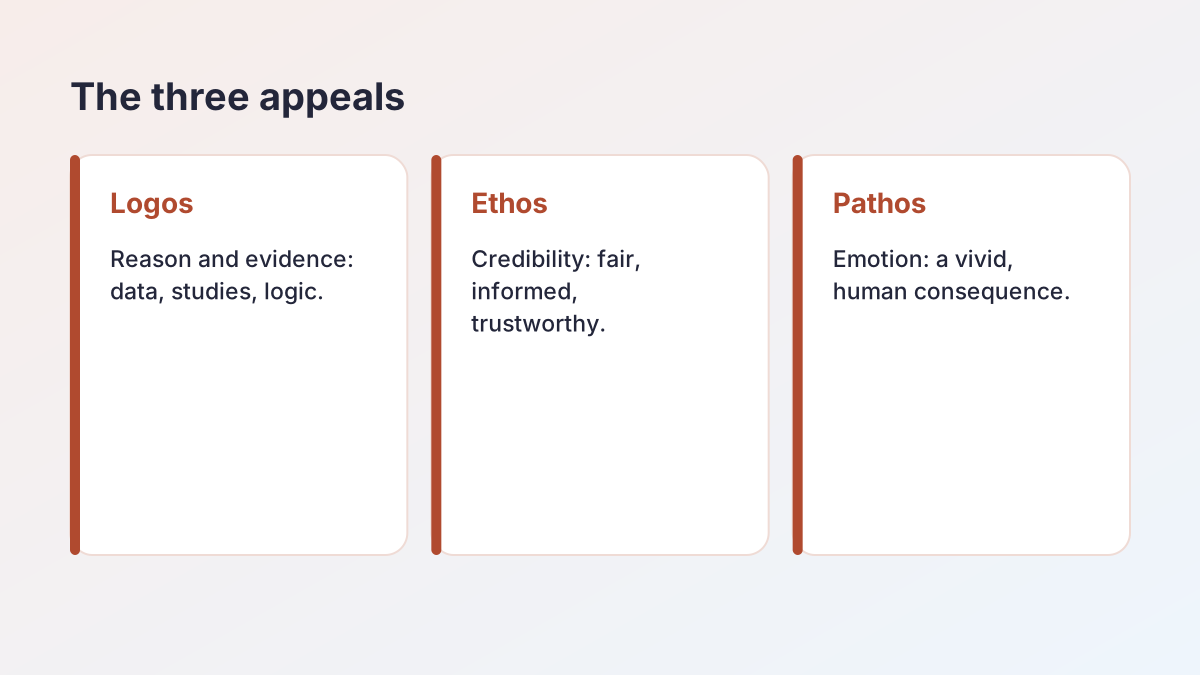
- Before: "We all need to do something about cafeteria waste."
- After: "Ask the student council to put reusable trays on the agenda for next month's meeting, and sign the petition at the library desk this week."
The revised version names who should act, what they should do and when.
Transition words for persuasive essays
- Adding force: moreover, above all, what is more
- Giving evidence: for instance, according to, consider
- Answering objections: admittedly, even so, yet
- Closing: so, therefore, that is why
Revising the draft: common persuasive mistakes
When you revise a draft from the persuasive essay generator, look for these problems:
- Too much emotion, too little evidence. One vivid example builds concern; several in a row feel manipulative. Back each emotional moment with a fact you can cite.
- Preaching to people who already agree. Add a point that answers the most common objection.
- Sweeping generalisations. "Everyone hates the current system" invites doubt. Replace it with a specific, supported claim.
- A vague call to action. Name who, what and when.
- Unfilled placeholders. Every [source] needs a real fact from a source you will cite.
Responsible use
Use the draft to plan your appeals and structure, then rewrite it in your own voice with your own evidence. Check your institution's policy on AI tools before using generated text in assessed work.
Persuasive essay themes and writing prompts
Topics, themes and prompts are not quite the same thing. A theme is the broad value or area underneath an argument, such as fairness, health or the environment. A topic is one claim within it. A prompt is the full assignment: the topic, the reader, the form and what the reader should do. Many assignments set a prompt rather than a bare topic, and the persuasive essay generator works best when you give it one.
Persuasive essay themes, each with a practice prompt
These persuasive essay writing prompts are invented for practice. Each names a reader and a form, which tells you what kind of reasons will work.
- Fairness: Write a letter persuading your principal to allow one test retake per term.
- Health: Write an article persuading the cafeteria manager to offer free fruit at breakfast.
- Environment: Write a speech persuading the town council to add recycling bins at bus stops.
- Technology: Write a blog post persuading parents to agree a screen-free hour each evening.
- Money: Write a letter persuading a local bank to run a free money-skills workshop at school.
- Community: Write a proposal persuading your library to open on Sunday afternoons.
- Rules and freedom: Write a speech persuading the student council to hold a student-designed dress-code day.
Turning a prompt into a persuasive essay generator entry
Split the prompt across the boxes. Take the library prompt as an example:
- Topic and audience: our library should open on Sunday afternoons, written for the library board.
- What should the reader think or do? Approve a three-month trial of Sunday opening.
- Points, evidence or sources to use: students with nowhere quiet to study at weekends; [opening hours of nearby libraries]; volunteers who could help.
With all three filled in, the persuasive essay generator aims its reasons at the board instead of at a general reader.
Choosing among controversial issues
Subjects for a persuasive essay do not have to be national controversies. Heated issues are hard to win in 600 words, because readers often arrive with their minds made up. A local, specific change, aimed at a reader with the power to make it, gives you a realistic goal and a concrete call to action. The persuasive essay generator will draft either kind; the difference is how much work your evidence has to do. If your teacher has a list of topics to avoid, check it before you start.
Persuasive essay template: a fill-in-the-blank graphic organizer
The outline above shows the parts of a persuasive essay. This persuasive essay template goes one step further: it gives you the planning boxes and the sentence frames to fill in. Complete it before you use the persuasive essay generator and the draft will start from your own thinking.
Persuasive essay graphic organizer
Fill in one line per box. If a box is empty, that is the part of your argument that needs work, and no persuasive essay generator can fill it for you.
- Reader: who exactly are you writing to, and what do they already believe?
- Action: what should they do, and by when?
- Reasons: three reasons this reader would care about, not just reasons you care about.
- Evidence: one source, figure or example for each reason.
- Objection: the first thing this reader will say against you, and your answer.
- Appeal: one moment of logos, one of ethos and one of pathos you could use.
Persuasive essay format: fill in the blanks
- Introduction: Every [time or place], [problem the reader can picture]. [Reader], you can change that: [action].
- Reason paragraph: The first reason to [action] is [reason]. According to [source], [evidence]. For you, this means [why it matters to this reader].
- Objection paragraph: Some [readers] may worry that [objection]. That concern is fair, which is why [answer or plan].
- Conclusion: [Restated position in new words]. Please [action] by [deadline], so that [result].
These persuasive essay sentence starters are scaffolds; replace them with your own wording once the ideas are in place.
How to make a persuasive essay from the template
- Fill in the organiser by hand or in a notes app.
- Enter boxes 1 and 2 in the persuasive essay generator, and boxes 3 to 5 as your points.
- Compare the draft with your organiser. Where they differ, decide which version is stronger.
- Rewrite each paragraph in your own voice, adding the real evidence from box 4.
- Check the final sentence names who should act, what they should do and when.
Keep the completed organiser: if you are asked to defend your essay in class, it is your argument on one page. It also makes a second run of the persuasive essay generator more useful: change one box, such as the reader, and compare how the reasons shift.
Is the persuasive essay generator free?
Yes. The persuasive essay generator is free, with no account or sign-up. A fair hourly allowance per visitor keeps it fast for everyone.
Your topic, audience and points are sent to our AI providers (Groq, with Google Gemini as a backup) only to write the draft you see. The Study Corp does not save them. For a closing that lands, try the Conclusion Generator; for other essay types, see the essay writing tools.
Persuasive essay generator FAQ
Is the persuasive essay generator free?
Yes. It is free with no account or sign-up. A fair hourly allowance per visitor keeps it fast for everyone.
What is a persuasive essay?
An essay that tries to move a specific reader to agree or act, using evidence and appeals and ending with a call to action.
How is it different from an argumentative essay?
A persuasive essay is aimed at a particular reader and ends with what they should do; an argumentative essay weighs evidence more formally and engages fully with counterarguments.
What is a good persuasive essay outline?
Hook, position, two reasons with evidence, a paragraph answering the main objection, and a conclusion with a call to action.
What are good persuasive essay topics?
Topics you care about with a clear action a reader can take, such as a free transport pass for teenagers or reusable cafeteria trays.
Does it make up evidence?
No. It writes [source] placeholders where facts belong, so you add real, cited evidence.
Can I submit the draft?
Use it as a model, then rewrite it in your own voice with your own evidence, following your institution's AI policy.
Can you use I in a persuasive essay?
Often, yes. Letters, speeches and opinion articles commonly use I and speak to the reader as you. Some teachers want formal essays in the third person, so check your assignment. Whatever the persuasive essay generator drafts, you can change the point of view when you revise.
How do you write a persuasive essay?
Choose a reader and an action, find three reasons that reader cares about, support each with evidence, answer the likeliest objection, and end with a specific call to action. The persuasive essay generator drafts that structure; you add real evidence and your own voice.
More free writing tools
- Book Title GeneratorTitle ideas for your book, chapters or series, in any genre.
- Essay Title GeneratorTen clear, catchy titles for any essay type, with notes on each.
- Story Title GeneratorOriginal titles for short stories, fan fiction and school stories.
- Poem GeneratorWrite a poem on any topic: free verse, rhyming, haiku, sonnet and more.
- Shape Poem GeneratorLay a poem out inside a heart, star, tree and more, then download it.
- Paragraph ExpanderMake a paragraph or essay longer with explanation, not filler.
- Personal Statement GeneratorDraft a UCAS or college statement and check it against the word limit.
- Introduction GeneratorThree introductions that move from a hook to your thesis.
- Essay Hook GeneratorNine opening hooks for your essay, each a different technique.
- Poetry Prompt GeneratorTen fresh poem prompts on any theme, for any level.
- Acrostic Poem GeneratorA poem whose first letters spell any name or word.
- Random Paragraph GeneratorRandom paragraphs for reading, typing and handwriting practice.
- Thesis Statement GeneratorFive clear, arguable thesis statements for any essay type.
- Essay Outline GeneratorPlan your essay section by section, from thesis to conclusion.
- Topic Sentence GeneratorTopic sentences that tie each body paragraph to your thesis.
- Paragraph GeneratorWrite a clear paragraph from a topic, or turn notes into one paragraph.
- Conclusion GeneratorThree conclusions for your essay, or a concluding sentence for a paragraph.
- Poem Title GeneratorTen title ideas for your poem, from simple to striking.
- Haiku Poem GeneratorHaiku, sonnets and limericks with syllables counted on every line.
- Argumentative Essay GeneratorDraft an argumentative essay with a clear claim, counterargument and rebuttal.
- Informative Essay GeneratorDraft a clear, neutral informative (expository) essay on any topic.
- Analytical Essay GeneratorDraft an analytical essay that explains how and why, not just what.
- Compare and Contrast Essay GeneratorDraft a comparison essay, point-by-point or block, with a real judgment.
- Scholarship Essay GeneratorDraft a scholarship essay built from your own story and goals.
- Name GeneratorCharacter names for stories and games, 12 at a time, in any genre.
See all 80 free tools for students
Free guides
Related tools
Last updated by The Study Corp editorial team.