Topic sentence generator examples
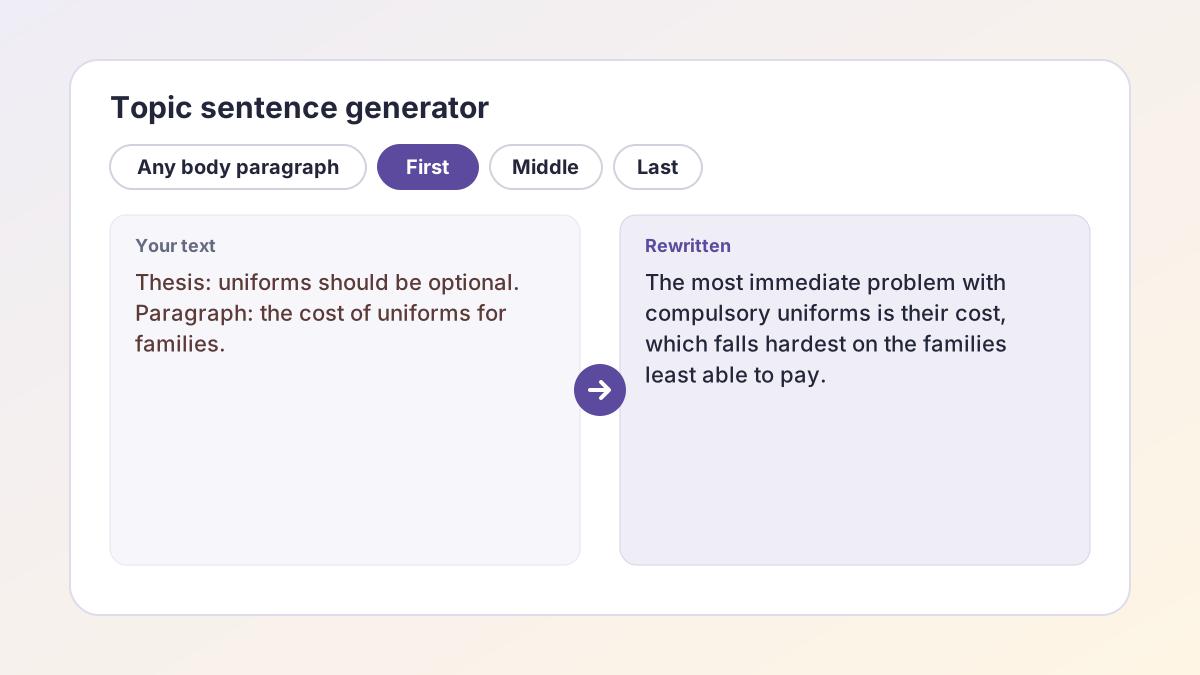
What students typed and one of the six topic sentences that came back.
Thesis and paragraphThesis: uniforms should be optional. Paragraph: cost to families.
Topic sentenceThe most immediate problem with compulsory uniforms is their cost, which falls hardest on the families least able to pay.
States the point and its link to the argument in one sentence.
Thesis and paragraphThesis: uniforms should be optional. Paragraph: self-expression.
Topic sentenceBeyond the financial cost, compulsory uniforms also limit the ways students can express who they are.
“Beyond the financial cost” links back to the previous paragraph.
Thesis and paragraphThesis: uniforms should be optional. Paragraph: evidence on behaviour.
Topic sentenceSupporters often claim that uniforms improve behaviour, yet the evidence for this benefit is surprisingly thin.
Answers the opposing view in the final body paragraph.
Thesis and paragraphThesis: Macbeth is destroyed by his own ambition. Paragraph: the first soliloquy.
Topic sentenceMacbeth's first soliloquy reveals that the murder is his idea long before Lady Macbeth urges him on.
An analytical topic sentence makes a claim about the text that the quotation will prove.
Thesis and paragraphTopic: how volcanoes form. Paragraph: hotspots.
Topic sentenceNot all volcanoes form at plate boundaries; some rise above hotspots, where unusually hot rock melts its way up through the crust.
An expository topic sentence introduces what the paragraph explains.
Thesis and paragraphOnline vs classroom learning. Paragraph: interaction.
Topic sentenceWhere classroom learning offers instant conversation with teachers and classmates, online learning relies on messages and video calls that can feel slower and more distant.
Names both subjects and the point of comparison.
How to use the topic sentence generator
Topic sentences connect paragraphs to your thesis, so start by adding it.
- Type your thesis. Your thesis or essay topic, so each topic sentence links back to your argument.
- Say what the paragraph is about. Optional: the paragraph's main point, such as “the cost of uniforms for families”.
- Add evidence. Optional: the examples or evidence the paragraph will use, for a sentence that fits exactly.
- Choose the paragraph and essay type. First, middle or last body paragraph; argumentative, analytical, expository and more.
- Pick and adapt. Select Write topic sentences, choose one, and adjust the wording to match your paragraph.
What is a topic sentence?
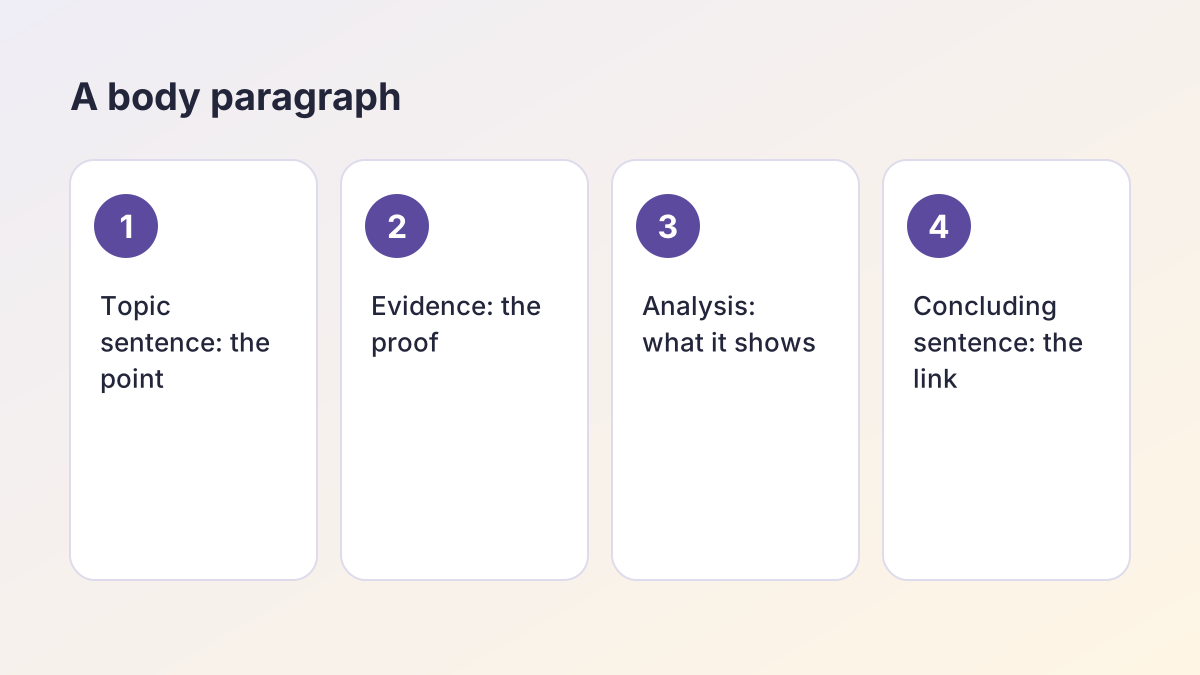
A topic sentence is the sentence, usually the first in a paragraph, that states the paragraph's main point. In an essay, it also connects that point to the thesis, so the reader always knows how each paragraph moves the argument forward.
The University of North Carolina's Writing Center, in its guide to paragraphs, explains that every paragraph should be unified around one controlling idea, usually expressed in a topic sentence.
What a topic sentence does
- States one main point that the paragraph will develop.
- Links to the thesis, showing how the paragraph supports the argument.
- Guides the reader, like a signpost at the start of each section.
- Keeps you focused, because every sentence in the paragraph should support it.
Topic sentence or thesis?
The thesis states the argument of the whole essay. A topic sentence states the point of one paragraph. Put together, your topic sentences should read like a summary of your essay.
Body paragraph topic sentence generator
Most students need topic sentences for body paragraphs, so the tool is built as a body paragraph topic sentence generator. Choose which paragraph you are writing and it adjusts.
First body paragraph
Often opens with your strongest or most basic point, stated directly. No transition from a previous paragraph is needed, because the introduction comes before it.
Middle body paragraphs
Usually begin with a transition that links to the previous point (Beyond…, Just as…, While X matters, Y…) and then state the new point.
Last body paragraph
Often handles the most complex point or answers the opposing view. A contrast or concession works well here (Supporters claim…, yet…).
Matching the evidence
If you paste the paragraph's evidence, the topic sentence will make a claim that evidence can actually support. A topic sentence that promises more than the paragraph delivers weakens your argument.
Read them in order
Generate topic sentences for every body paragraph, then read them one after another. They should form a logical chain that leads to your conclusion.
How to write a strong topic sentence
1. Start from your thesis
Ask: what part of my thesis does this paragraph prove? Your topic sentence states that part.
2. Make a claim, not an announcement
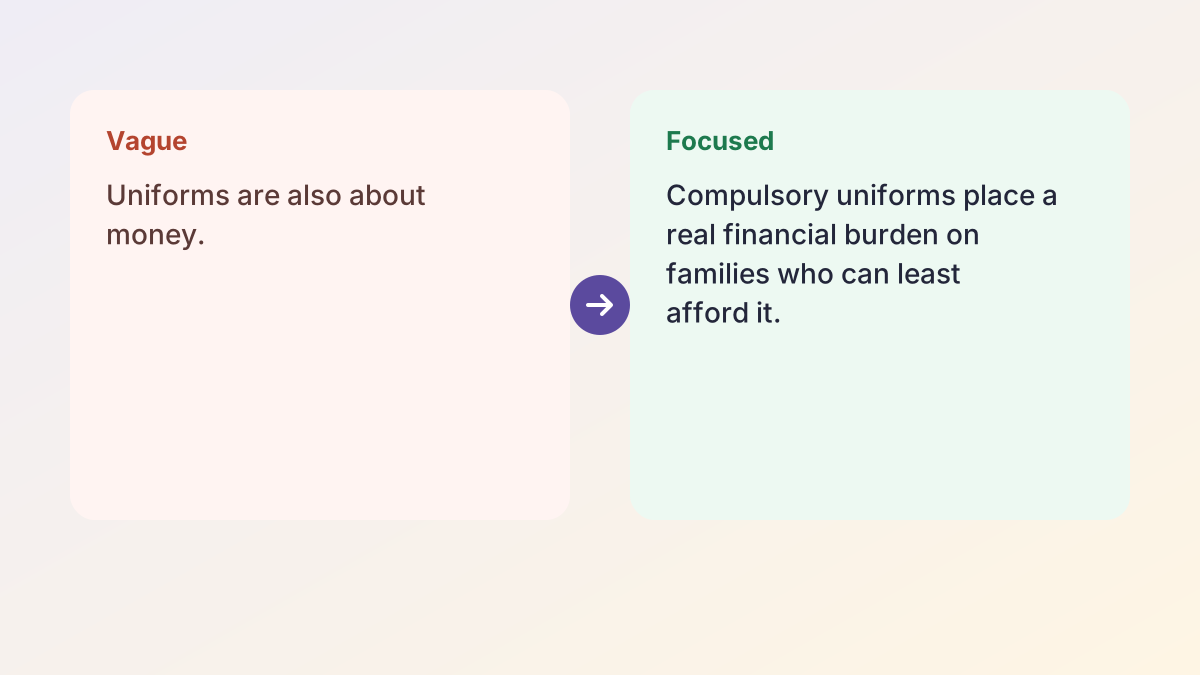
“This paragraph is about cost” announces. “Compulsory uniforms place a real financial burden on families” claims.
3. Keep it to one idea
If your topic sentence contains two points, you probably need two paragraphs.
4. Make it specific enough to prove
“Uniforms are bad for families” is too vague. Say how: cost, time, choice.
5. Do not put evidence in the topic sentence
The statistic or quotation comes next. The topic sentence states the point the evidence will support.
6. Link back or link forward
A short transition at the start shows how this paragraph connects to the one before it.
Topic sentence starters
- The most important reason… is…
- Another way [subject] [does X] is…
- Beyond [previous point], [new point]…
- While [opposing view], [your point]…
- [Author] shows [idea] through [technique]…
Restate topic sentence ideas: ending a paragraph well
Many teachers ask students to restate the topic sentence at the end of a paragraph, in a concluding sentence. The goal is to remind the reader of the point, now that the evidence has proved it, without simply repeating the opening line.
How to restate a topic sentence
- Keep the idea, change the words. Use synonyms and a different sentence structure.
- Add what the evidence showed. The restated version should feel stronger, because it is now proved.
- Link to the thesis. Show what this point means for the overall argument.
Example
- Topic sentence: Compulsory uniforms place a real financial burden on families.
- Restated: Because these costs fall hardest on those who can least afford them, a compulsory policy works against the fairness it claims to promote.
Generate concluding sentences
The Conclusion Generator has a Concluding sentence mode: paste your paragraph and it writes three ways to end it, including restating the topic sentence. To reword a single sentence, try the Sentence Rewriter.
Six approaches the generator uses
Each set of six topic sentences mixes these approaches so you can choose the one that fits your paragraph.
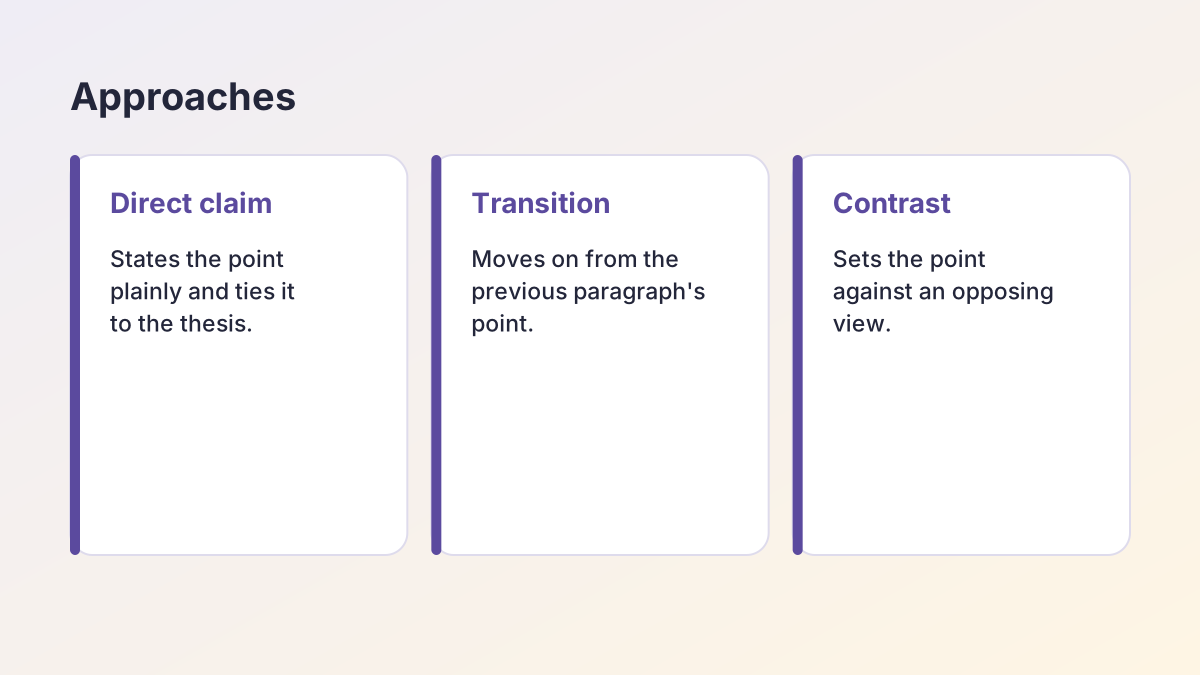
- Direct claim: states the point plainly and links to the thesis.
- Transition: connects to the previous paragraph, then states the new point.
- Contrast or concession: sets your point against an opposing view.
- Cause and effect: states that one thing leads to another.
- Question-led: raises the question the paragraph answers (use sparingly in academic writing).
- Analytical: makes an interpretive claim about a text, source or data.
Each sentence from the topic sentence generator comes with a short note naming its approach, so you learn the patterns and can write your own.
Topic sentences for different essay types
Argumentative and persuasive
Each topic sentence states one reason for your position. A final paragraph may begin by stating and then answering the opposing view.
Expository
Each topic sentence introduces one aspect of the subject the paragraph explains: a cause, a stage, a feature.
Analytical and literary analysis
Each topic sentence makes a claim about the text that the paragraph's quotations and analysis will prove. Avoid plot summary in the topic sentence.
Compare and contrast
In a point-by-point essay, each topic sentence names both subjects and the point of comparison. In a block essay, topic sentences introduce each subject's features.
Research paper
Topic sentences introduce each sub-topic or finding and its relevance to the research question.
Common topic sentence mistakes
- Starting with a quotation or statistic. Evidence supports the point; state the point first.
- Announcing. “In this paragraph I will…” Say the point instead.
- Too broad. A topic sentence that could open the whole essay is too big for one paragraph.
- Too narrow. A topic sentence that is just a fact leaves nothing to develop.
- No link to the thesis. The reader should see why this point matters to your argument.
- Repeating the same opening. Vary your transitions and structures across paragraphs.
Check your paragraphs
After drafting, read each paragraph and ask: does every sentence support the topic sentence? If one does not, move it or cut it. The Paragraph Generator shows how a full paragraph builds from a topic sentence.
Topic sentence generator for whole essays
You can use the topic sentence generator for every body paragraph in an essay, one paragraph at a time.
Step by step
- Write your thesis and list your main points, one per paragraph.
- For the first body paragraph, choose First, add its point and evidence, and generate.
- For each middle paragraph, choose Middle, so the topic sentences include a transition from the previous point.
- For the final body paragraph, choose Last, especially if it answers the opposing view.
- Copy your chosen topic sentences into a list and read them in order.
What the list should show
Read only your topic sentences, one after another. Together they should summarise your argument. If one does not fit, the paragraph may be in the wrong place, or the point may not support the thesis.
Reverse outlining
If you have already written a draft, try the opposite: write down the main point of each existing paragraph, then compare it with its topic sentence. Where they do not match, use the topic sentence generator to write a new one that states what the paragraph really says. This is one of the fastest ways to tighten a draft.
Body paragraph topic sentence generator tips
- Paste real evidence, not just the topic, for sentences that match your paragraph.
- Generate twice if none of the six fits; each set uses different approaches.
- Keep the wording you like and change the rest, so the sentence sounds like you.
Topic sentence examples by subject
English
In the final chapter, Orwell's flat, repetitive language shows how completely the Party has emptied Winston's inner life.
History
Economic hardship, more than any single event, explains why support for reform grew so quickly in the 1830s.
Science
The second stage of photosynthesis, the Calvin cycle, turns the energy captured from light into sugar the plant can store.
Geography
Unlike the gradual erosion described above, coastal landslides can remove metres of cliff in a single night.
Notice that each one states a clear point, uses precise vocabulary for its subject, and leaves the evidence for the sentences that follow. The topic sentence generator follows the same pattern for whatever subject you enter.
Quick tips for the topic sentence generator
- Give it your real thesis. The topic sentence generator links every sentence to the thesis you type, so a vague thesis gives vague topic sentences.
- One paragraph at a time. Enter one paragraph's point and evidence per run for the closest fit.
- Choose the right position. First, middle and last paragraphs open differently; the body paragraph topic sentence generator adjusts the transition for each.
- Mix approaches. Avoid starting every paragraph with the same pattern; pick a direct claim for one and a contrast for the next.
- Edit for your voice. Treat each sentence as a model and rewrite it in words you would use.
How to find the topic sentence in a paragraph
Writing topic sentences and finding them are two sides of the same skill. Reading tests often ask which sentence states a paragraph's main idea, and revising your own draft starts with the same question. The topic sentence generator writes topic sentences rather than identifying them, but the method below works on any paragraph, including your own.
Where topic sentences appear
- First: the most common place in essays and textbooks.
- Last: the paragraph builds up to its point. You will sometimes see this in persuasive writing and journalism.
- Middle: after a sentence or two of context or a transition.
- Implied: no single sentence states the point, and the reader has to work it out. This is common in stories and descriptive writing.
The one-sentence test
- Read the whole paragraph once.
- Without looking back, say in one sentence what it is about.
- Find the sentence closest to your summary. If every other sentence supports it, that is the topic sentence.
- If no sentence comes close, the topic sentence is implied.
A worked example
An invented paragraph:
The library opens at eight, but the queue starts at half past seven. By nine, every desk near a socket is taken, and latecomers sit on the floor with laptops on their knees. During exam season, the campus library is simply too small for the students who need it.
The topic sentence is the last one; the first two are evidence. In an academic essay, readers expect the point first, so a stronger version moves it to the front: During exam season, the campus library is too small for the students who need it. The queue and the crowded desks then follow as proof.
Practise on ready-made paragraphs
The Medium and Challenging library paragraphs in the Random Paragraph Generator open with a clear topic sentence. Generate one, find its topic sentence with the one-sentence test, then type the paragraph's point into the topic sentence generator to see six other ways of stating it.
When your own topic sentence is implied
In an essay, an implied topic sentence often means the paragraph has no clear point yet. Write down what the paragraph is really arguing, then put that point and your evidence into the topic sentence generator. Choose the suggestion that states the point most precisely and place it at the start of the paragraph.
From thesis statement to topic sentences: a worked example
A clear thesis already contains your topic sentences; you just have to unpack them. Here is the whole process on one invented thesis, done by hand first so you can judge what the topic sentence generator suggests.
Step 1: Split the thesis into claims
Thesis: Public libraries remain essential because they offer free internet access, quiet study space and help for people looking for work.
That thesis makes three claims, so the essay needs at least three body paragraphs, one per claim, in the same order.
Step 2: Turn each claim into a topic sentence
- First body paragraph: For many households, the public library is one of the few places to get online free of charge.
- Middle body paragraph: Beyond internet access, libraries offer something increasingly rare: a quiet place to study that costs nothing.
- Last body paragraph: Although job searching has largely moved online, libraries still help people with the skills it demands, from writing a CV to completing applications.
Notice the jobs each one does. The first states its claim directly. The second opens with a transition from the previous point. The third answers an obvious objection. The topic sentence generator mixes similar approaches, such as direct claim, transition and contrast, in its six suggestions.
Step 3: When the thesis has no list
Some theses make one focused claim without naming reasons, for example: Homework in primary schools should be limited. Before writing topic sentences, ask “why?” until you have two or three answers. Each answer becomes a topic sentence. If you are still shaping the thesis, the Thesis Statement Generator can write both kinds.
Weak to strong topic sentences
Here are the mistakes listed above, fixed:
- Announcement: “This paragraph will talk about internet access.” → “For many households, the library is one of the few places to get online free of charge.”
- A fact, not a claim: “Libraries have computers.” → “Free library computers give students without home internet a fairer chance to finish online homework.”
- Too broad: “Libraries are important to society.” → “Quiet study space is one of the library's most valuable and least noticed services.”
Check your list with the topic sentence generator
Write your own topic sentences first. Then enter the same thesis, choose First, Middle or Last, add the paragraph's point, and compare the six suggestions with yours. Keep whichever sentence states the claim most precisely, or combine the best parts of two.
Is the topic sentence generator free?
Yes. The topic sentence generator is free, with no account or sign-up. A fair hourly allowance per visitor keeps it fast for everyone.
Your thesis, paragraph point and evidence are sent to our AI providers (Groq, with Google Gemini as a backup) only to write the sentences you see. The Study Corp does not save them.
Using it responsibly
Use the topic sentence generator's suggestions as models, choose one that fits your paragraph, and adapt it to your own words. Check your school's policy on AI tools for assessed work.
Topic sentence generator FAQ
Is the topic sentence generator free?
Yes. It is free with no account or sign-up. A fair hourly allowance per visitor keeps it fast for everyone.
What is a topic sentence?
The sentence, usually first in a paragraph, that states its main point and links it to the thesis.
Can it write topic sentences for body paragraphs?
Yes. Choose first, middle or last body paragraph and it adjusts the transition and approach.
How do I restate a topic sentence?
To restate topic sentence ideas at the end of a paragraph, keep the idea, change the words and structure, add what the evidence showed, and link it to your thesis.
Should a topic sentence include evidence?
No. The topic sentence states the point; the evidence comes in the sentences after it.
How many topic sentences do I get?
Six, each using a different approach, with a note naming it.
Where did the Topic Sentence Maker go?
It moved to this page, the Topic Sentence Generator, with more options.
How do you find the topic sentence of a paragraph?
Read the paragraph, then say in one sentence what it is about. The sentence closest to your summary, which every other sentence supports, is the topic sentence. It is usually first but can come last or in the middle, and sometimes it is only implied.
Can a topic sentence generator write topic sentences from my thesis?
Yes. Type your thesis, choose first, middle or last body paragraph and add what the paragraph is about. This topic sentence generator is told to link each sentence to the thesis you give it, so a precise thesis gives precise topic sentences.
More free writing tools
- Book Title GeneratorTitle ideas for your book, chapters or series, in any genre.
- Essay Title GeneratorTen clear, catchy titles for any essay type, with notes on each.
- Story Title GeneratorOriginal titles for short stories, fan fiction and school stories.
- Poem GeneratorWrite a poem on any topic: free verse, rhyming, haiku, sonnet and more.
- Shape Poem GeneratorLay a poem out inside a heart, star, tree and more, then download it.
- Paragraph ExpanderMake a paragraph or essay longer with explanation, not filler.
- Personal Statement GeneratorDraft a UCAS or college statement and check it against the word limit.
- Introduction GeneratorThree introductions that move from a hook to your thesis.
- Essay Hook GeneratorNine opening hooks for your essay, each a different technique.
- Poetry Prompt GeneratorTen fresh poem prompts on any theme, for any level.
- Acrostic Poem GeneratorA poem whose first letters spell any name or word.
- Random Paragraph GeneratorRandom paragraphs for reading, typing and handwriting practice.
- Thesis Statement GeneratorFive clear, arguable thesis statements for any essay type.
- Essay Outline GeneratorPlan your essay section by section, from thesis to conclusion.
- Paragraph GeneratorWrite a clear paragraph from a topic, or turn notes into one paragraph.
- Conclusion GeneratorThree conclusions for your essay, or a concluding sentence for a paragraph.
- Poem Title GeneratorTen title ideas for your poem, from simple to striking.
- Haiku Poem GeneratorHaiku, sonnets and limericks with syllables counted on every line.
- Argumentative Essay GeneratorDraft an argumentative essay with a clear claim, counterargument and rebuttal.
- Persuasive Essay GeneratorDraft a persuasive essay aimed at a real reader, with a call to action.
- Informative Essay GeneratorDraft a clear, neutral informative (expository) essay on any topic.
- Analytical Essay GeneratorDraft an analytical essay that explains how and why, not just what.
- Compare and Contrast Essay GeneratorDraft a comparison essay, point-by-point or block, with a real judgment.
- Scholarship Essay GeneratorDraft a scholarship essay built from your own story and goals.
- Name GeneratorCharacter names for stories and games, 12 at a time, in any genre.
See all 80 free tools for students
Related tools
Last updated by The Study Corp editorial team.