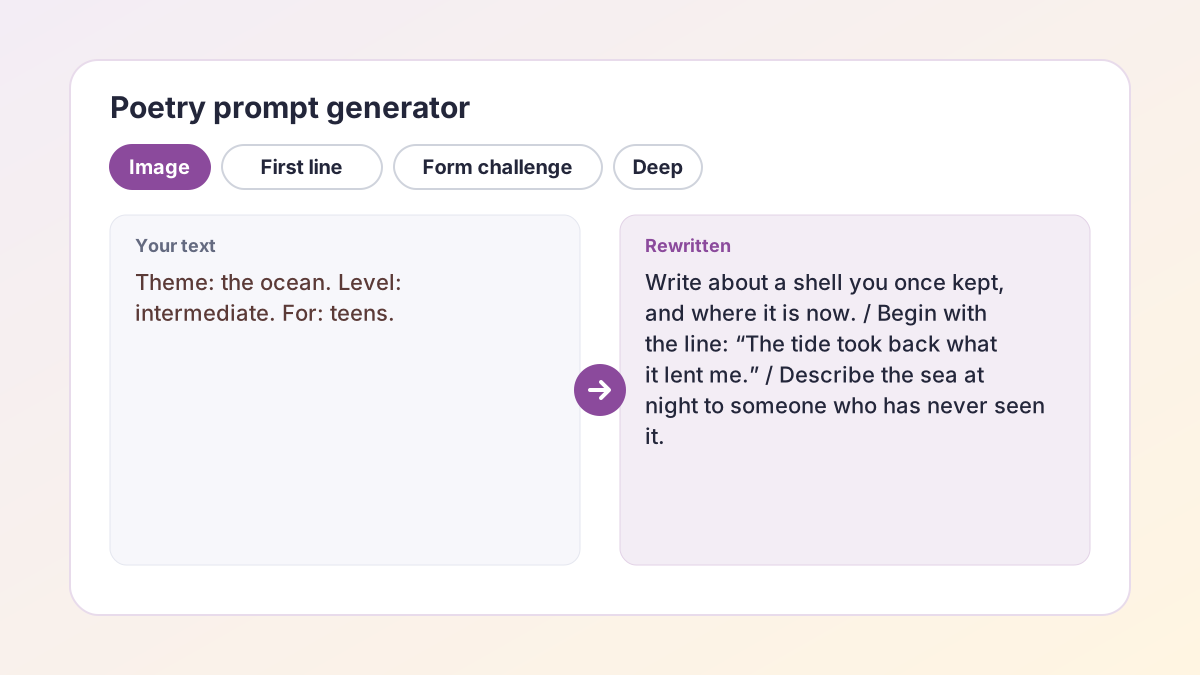
Poetry prompt generator examples
Settings students chose and a few of the ten prompts that came back. Every set is new, so you can generate as many as you like.
SettingsTheme: the ocean. Image prompts. Beginner. Kids 8–12.
Sample promptsPick up a shell and describe it as if it were a tiny house. Who lived there? / Write about the sound of waves using three words that are not “splash”.
Concrete, sensory prompts are easiest for young writers.
SettingsNo theme. First-line prompts. Intermediate. Teens.
Sample promptsBegin with: “Nobody warned me about the quiet.” / Begin with: “The last time I saw that street, it was raining.”
A first line removes the blank-page problem: you only need the second line.
SettingsTheme: school. Form challenges. Intermediate. Teens.
Sample promptsWrite a haiku about the minute before an exam begins. / Write an ode to your oldest pencil case, praising it like a hero.
Form challenges teach a form by using it on a familiar subject.
SettingsTheme: winter. Word bank. Intermediate. Adults.
Sample promptsUse these words: kettle, frost, unanswered, orange, brother. / Use these words: candle, map, salt, almost, window.
A word bank forces surprising connections between words.
SettingsTheme: home. Memory prompts. Intermediate. Teens.
Sample promptsWrite about a smell that takes you straight back to a kitchen. / Describe the view from a bedroom window you no longer sleep in.
Memory prompts draw on details only you know.
SettingsTheme: growing up. Deep prompts. Advanced. Adults.
Sample promptsWrite a letter-poem to the person you were five years ago. What would they not believe? / Write about something you lost that you are glad to have lost.
Deep prompts invite reflection on identity, change and meaning.
How to use the poetry prompt generator
No theme? Leave the box empty and you will get prompts on a wide mix of subjects.
- Choose a prompt type. Mixed, image, first line, form challenge, word bank, memory or deep poetry prompts.
- Add a theme (optional). Type a theme such as the ocean, home or friendship, or leave it blank for variety.
- Set the level and audience. Beginner prompts are simple and concrete; advanced prompts are open-ended. Choose kids, teens or adults.
- Generate ten prompts. Select Give me prompts. Each prompt comes with a suggested form or approach.
- Pick one and write. Choose the prompt that sparks something, set a timer for ten minutes and start writing.
What is a poetry prompt?
A poetry prompt is a short instruction or idea that gives you somewhere to start a poem. It might be an image to describe, a first line to continue, a form to try, a list of words to use or a question to think about. A good prompt removes the hardest part of writing, the blank page, without telling you what the poem should say.
Writing teachers use prompts because constraints help creativity. When you can write about anything, it is hard to write about something. When you are asked to “describe the sea at night to someone who has never seen it”, ideas start to arrive.
Why use a poetry prompt generator?
Lists of prompts run out, and the same prompts appear on every website. A poetry prompt generator writes new prompts each time, fits them to your theme and level, and suggests a form for each one. You can generate a set, pick one, write, and come back for more tomorrow.
Prompts are a starting point
You do not have to follow a prompt exactly. If a prompt about a shell makes you think of your grandmother's house, follow that thought. The prompt has done its job.
Poem prompts: seven types to try
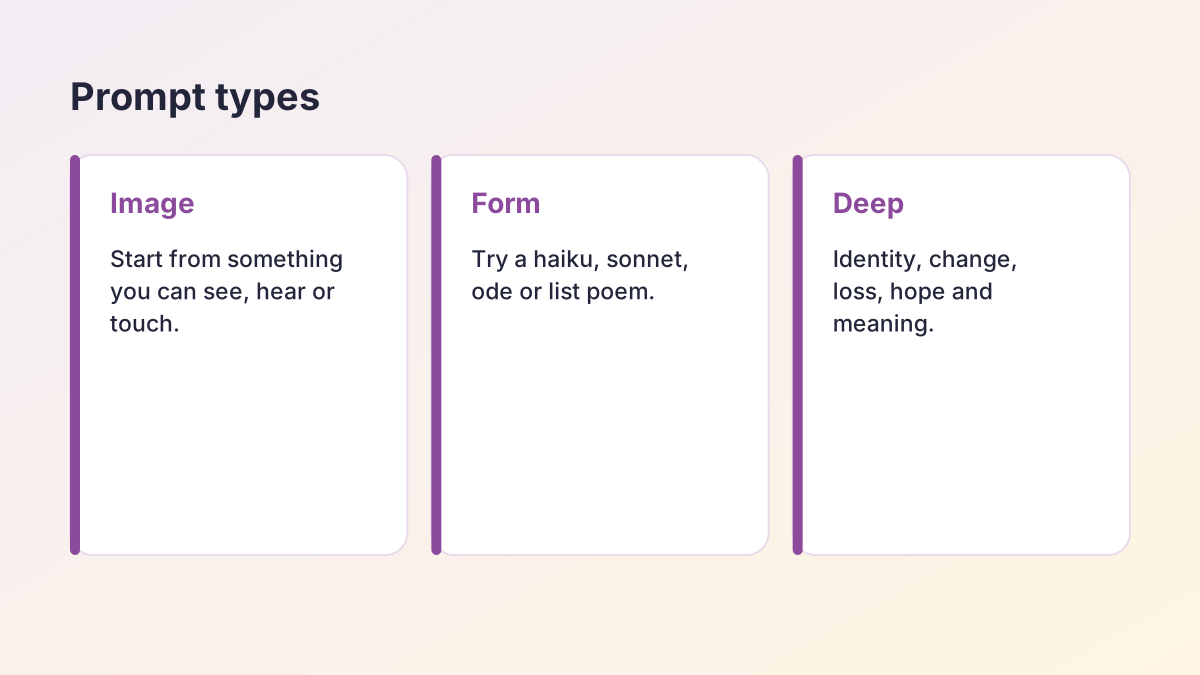
The poetry prompt generator writes seven kinds of poem prompts. Each type works a different writing muscle, so switching between them is a good way to grow as a poet.
Image and observation prompts
Start from something you can see, hear, smell, taste or touch. Describe your kitchen at 7 a.m. using only sounds. These prompts train you to notice details, which is the foundation of all good poetry.
First-line prompts
You get the opening line and write what comes next. Begin with: “Nobody warned me about the quiet.” The first line sets a voice and a mood, so the rest often flows quickly.
Form challenges
Try a specific form: a haiku, a sonnet, an ode, a list poem, an acrostic, a villanelle. Using a form on a familiar subject is the fastest way to learn its rules.
Word-bank prompts
Four or five words the poem must include, usually unrelated: kettle, frost, unanswered, orange, brother. Connecting them forces surprising images.
Memory prompts
Draw on your own experience. Write about a smell that takes you straight back to a kitchen. These prompts produce the most personal poems.
Deep poetry prompts
Reflective prompts about identity, change, loss, hope and meaning. See the section below.
Mixed
A mix of all types, best when you want to browse and see what sparks.
Deep poetry prompts for reflective writing
Deep poetry prompts ask you to explore big questions: who you are, what has changed, what you have lost and what you hope for. They suit older students and adult writers, and they often lead to the poems people are proudest of.
Here are some deep poetry prompts to get you started:
- Write a letter-poem to the person you were five years ago.
- Describe a place that no longer exists except in your memory.
- Write about something you believed as a child and no longer do.
- What would you say to someone you never got to say goodbye to?
- Write about a part of yourself you are still learning to accept.
- Describe the moment you realised you had grown up.
- Write about a small, ordinary object that holds a big feeling.
- What does home mean when you have more than one?
Making deep prompts concrete
Big subjects can lead to vague poems full of words like pain, love and soul. The trick is to approach the big idea through something small and concrete. A poem about loss becomes powerful when it is about one coat still hanging by the door.
A note on wellbeing
Reflective writing can bring up strong feelings. Write at your own pace, skip any prompt that does not feel right, and talk to someone you trust if a poem stirs up something difficult.
How to turn a prompt into a poem
A prompt gets you started; these steps get you to a finished poem.
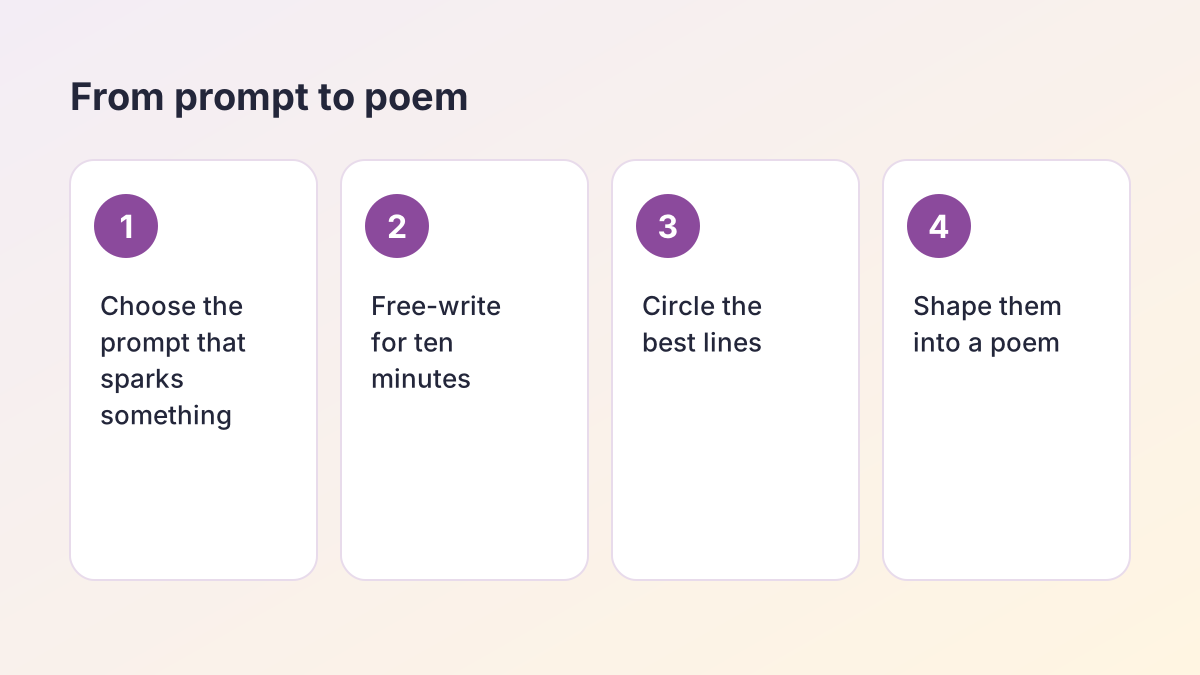
- Read all ten prompts. Notice which one makes you think of something specific straight away. That reaction is the sign of a good prompt for you.
- Free-write for ten minutes. Set a timer and write without stopping, editing or worrying about line breaks. Follow tangents.
- Circle the best lines. Read what you wrote and mark the phrases with energy: an unexpected image, a true detail, a good sound.
- Find the poem. The poem is often hiding in two or three of those lines. Put them together and cut everything else.
- Shape it. Decide on line breaks and stanzas. Try the form suggested with the prompt, or let the poem find its own shape.
- Read it aloud and revise. Change any word that sounds wrong, cut any line you would not miss.
Do it daily
Many poets write to a prompt every day for a month. National Poetry Month in April and NaPoWriMo (a poem a day in April) are popular times to try. The poetry prompt generator gives you a new set each day so you never run out.
Poetry prompts for kids and classrooms
Choose “Kids (8–12)” and “Beginner” for prompts that are simple, concrete and fun. Prompts for children work best when they start from the senses and everyday life: pets, weather, food, school, family and play.
Classroom routines
- Prompt of the day: generate a set at the start of the week and use one each morning as a five-minute warm-up.
- Choice boards: print ten prompts and let pupils choose, which increases ownership.
- Form of the week: use form challenges to introduce haiku, acrostics, list poems and shape poems one at a time.
- Theme units: add your current topic (space, the Romans, the rainforest) as the theme so poetry supports cross-curricular work.
Teaching ideas
The University of Iowa's Iowa Reading Research Center shares poetry writing prompts for teachers, built around modelling, discussion and sharing. Model a poem from a prompt yourself first, write in front of the class and talk through your choices. Children are more willing to take risks when they see an adult draft, cross out and try again.
Sharing
End with a sharing circle where volunteers read one line they like from their poem. Short, low-pressure sharing builds confidence.
Things to write poems about when you have no theme
Leave the theme box empty and the poetry prompt generator chooses a wide range of subjects. If you want to steer it, here are themes that reliably produce good poems.
Everyday life
Breakfast, the bus, a queue, an old phone, laundry day, the walk home. Ordinary subjects become surprising when you look closely.
Nature and seasons
One tree, a storm, the first warm day, a spider's web, the sea in winter. Nature poems are strongest when they focus on one specific thing.
People
A grandparent's hands, a stranger on a train, a teacher you remember, a friend who moved away.
Places
Your bedroom, a kitchen, a beach, a city at night, a place you have only seen in photos.
Feelings and ideas
Waiting, courage, boredom, jealousy, home, freedom. Approach them through a concrete image rather than naming the feeling.
Objects
Keys, a jumper, a mug, a pair of shoes, a photograph. Objects carry memories, which makes them excellent subjects.
Using poem prompts for school assignments
When a teacher asks you to “write a poem on a topic of your choice”, a prompt can help you find an angle. Enter the assignment topic as the theme and generate a set of prompts. Choose one that gives you a specific way in.
Matching the assignment
- If the task asks for a particular form, choose “Form challenge” and add the form to the theme box, for example sonnet about the environment.
- If the task asks for poetic devices, choose “Image” prompts, which naturally lead to imagery, simile and metaphor.
- If the task is personal (a poem about yourself or your family), choose “Memory” prompts.
Your words, your poem
A prompt is an idea, not a poem, so the writing you do from it is your own. If you want to see how a poem on your prompt might look, try the Poem Generator, then write your own version.
Building a writing habit with prompts
Most poets say the hardest part of writing is starting, and the second hardest is keeping going. A small daily routine solves both.
Keep it short
Ten minutes a day is enough. Pick one prompt, set a timer and write until it rings, without editing.
Keep a notebook
Write every draft in the same notebook or file. After a month you will have thirty drafts, and a few of them will be worth developing into finished poems.
Mix the prompt types
Try an image prompt on Monday, a first line on Tuesday, a form challenge on Wednesday and so on. Variety keeps the habit fresh.
Share sometimes
Read a poem to a friend, post it in a class forum or enter a school competition. Knowing someone will read your work is a strong reason to finish it.
Finish the poem: from a first-line prompt to a last line
Choose First line in the poetry prompt generator and every prompt hands you an opening. That solves the blank page, but it raises two new questions: what comes next, and where does the poem stop? Finish-the-poem prompts work best when you have a plan for both.
Three ways to write the second line
Take a first line from the examples on this page: “Nobody warned me about the quiet.” Here are three directions you could take it, each with an invented second line:
- Zoom in on an image. Even the fridge had stopped its humming.
- Ask a question. Who turns the radio off in a house like this?
- Turn against the first line. I had been warned about everything else.
Each direction leads to a different poem, and the same three moves work on any first line from the poetry prompt generator. Write all three, then keep going with the one that surprises you most.
Finish the poem between two lines
For a harder challenge, write the last line before you begin, then fill in the lines between. Knowing the destination keeps a poem focused. An invented pair to try: start with The kitchen light was still on and end with and nobody said a word. What happened in between is up to you.
Where to stop
Draft poems often run a line or two too long, usually because the writer explains what the poem has already shown. Try ending on one of these instead:
- An image: a small, concrete detail that holds the feeling.
- An action: someone doing something, with no comment.
- An echo: a word or image from the first line, now changed by everything in between.
If your last line begins “And so I learned…”, cut it and read the poem again. It is often stronger without it.
Using the poetry prompt generator for first lines
Generate a set of ten first lines and read them aloud. Pick two that seem unrelated, use one as your opening and the other as your ending, and write the poem that connects them. The friction between two lines you did not write yourself often produces the most surprising poems, and each prompt's note may suggest a form to try.
Poem topic generator: choosing a theme for sharper poem prompts
The theme box is optional, but what you type into it shapes all ten prompts. Used well, it turns the tool into a poem topic generator for your exact assignment or interest. Used vaguely, it gives prompts that are vague too.
Narrow the theme
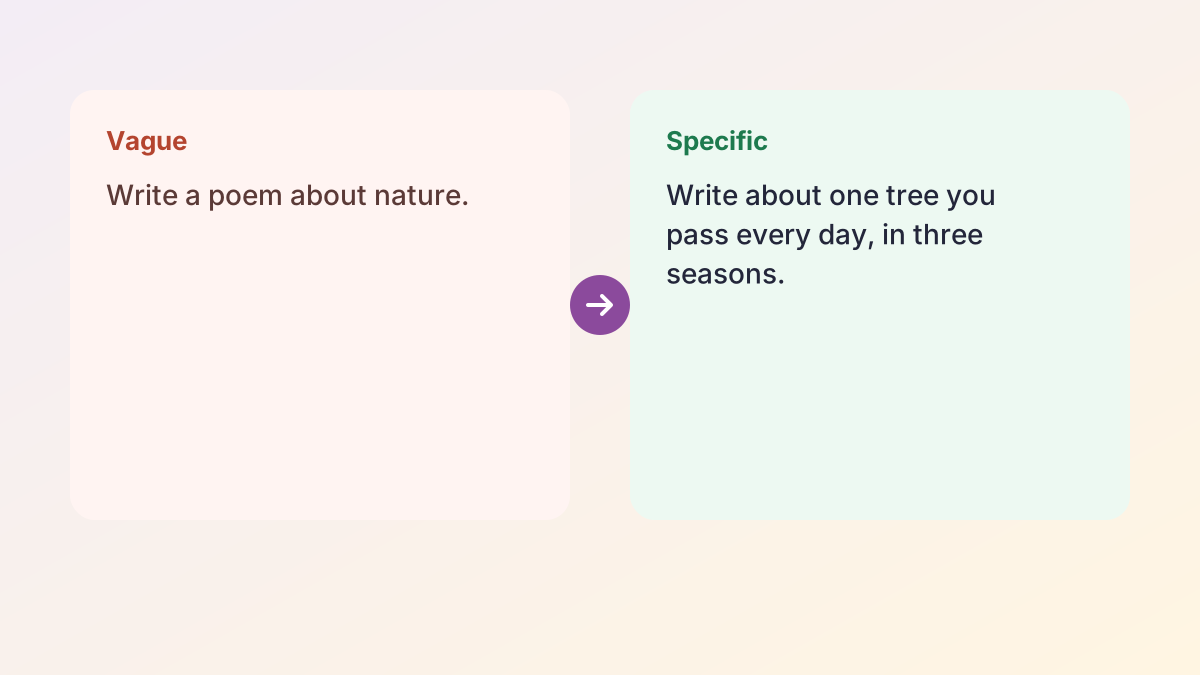
A broad theme leaves the tool guessing; a narrow one gives it something concrete to build on. These pairs are examples of how to sharpen a theme before you generate:
- Nature → the canal behind my school in November
- Family → my grandad's allotment shed
- Technology → a phone with a cracked screen
- Friendship → a friend who moved to another city
With the narrower theme, the poetry prompt generator has a place, an object or a moment to work with, so the prompts start closer to a real poem.
Combine a theme with a prompt type
The same theme gives very different poems depending on the prompt type. Keep the theme and change the chip. With the tool's own example theme, the ocean, an Image prompt might ask you to describe the sea at night, a Memory prompt might ask about a shell you once kept, and a Deep prompt might ask what the tide takes away. Generate two or three sets and compare.
Read the notes
Every prompt from the poetry prompt generator comes with a short note suggesting a form or approach. If a note suggests a list poem or an ode and you have never written one, try it: the note is a ready-made form challenge.
When none of the ten prompts fits
- Select Generate more for a fresh set.
- Change the level: Advanced for open-ended prompts, Beginner for concrete ones.
- Change For (Kids 8–12, Teens or Adults).
- Rewrite the theme as a place, object or moment rather than an abstract idea.
Poem prompt or poem topic?
A topic is what a poem is about; a poem prompt is a way in. “Winter” is a topic. “Write about the first morning you could see your breath” is a prompt. If your teacher has already set the topic, type it into the theme box and let the poetry prompt generator find ten ways in.
Is the poetry prompt generator free?
Yes. The poetry prompt generator is free, with no account or sign-up. A fair hourly allowance per visitor keeps it fast for everyone.
Your theme is sent to our AI providers (Groq, with Google Gemini as a backup) only to write the prompts you see. The Study Corp does not save it. Prompts are kept suitable for school.
When your poem is written, find a title with the Poem Title Generator or study a published poem's techniques with the Poem Analysis Tool.
Poetry prompt generator FAQ
Is the poetry prompt generator free?
Yes. It is free with no account or sign-up. A fair hourly allowance per visitor keeps it fast for everyone.
What is a poetry prompt?
A short idea or instruction that gives you a starting point for a poem: an image, a first line, a form, a word bank or a question.
Do I need a theme?
No. Leave the theme blank for prompts on a wide mix of subjects, or add one to focus all ten prompts.
What are deep poetry prompts?
Reflective prompts about identity, change, loss, hope and meaning, best approached through a small concrete detail.
Are the prompts suitable for kids?
Yes. Choose Kids (8–12) and Beginner for simple, concrete and fun prompts.
Will I get the same poem prompts twice?
Each set is written fresh, so generating again gives you new prompts.
How do I turn a prompt into a poem?
Free-write for ten minutes, circle the strongest lines, put the best two or three together, shape them and read aloud as you revise.
How do I finish a poem from a first-line prompt?
Choose a direction for the second line, such as zooming in on an image, asking a question or turning against the first line. Keep writing, and stop on a concrete image or action rather than an explanation. For a challenge, take two first lines from the poetry prompt generator and use one as the opening and the other as the ending.
What is the difference between a poem topic and a poem prompt?
A topic is the subject, such as winter or friendship. A prompt gives you a way into it, such as ‘write about the first morning you could see your breath’. Type your topic into the theme box and the poetry prompt generator turns it into ten prompts.
More free writing tools
- Book Title GeneratorTitle ideas for your book, chapters or series, in any genre.
- Essay Title GeneratorTen clear, catchy titles for any essay type, with notes on each.
- Story Title GeneratorOriginal titles for short stories, fan fiction and school stories.
- Poem GeneratorWrite a poem on any topic: free verse, rhyming, haiku, sonnet and more.
- Shape Poem GeneratorLay a poem out inside a heart, star, tree and more, then download it.
- Paragraph ExpanderMake a paragraph or essay longer with explanation, not filler.
- Personal Statement GeneratorDraft a UCAS or college statement and check it against the word limit.
- Introduction GeneratorThree introductions that move from a hook to your thesis.
- Essay Hook GeneratorNine opening hooks for your essay, each a different technique.
- Acrostic Poem GeneratorA poem whose first letters spell any name or word.
- Random Paragraph GeneratorRandom paragraphs for reading, typing and handwriting practice.
- Thesis Statement GeneratorFive clear, arguable thesis statements for any essay type.
- Essay Outline GeneratorPlan your essay section by section, from thesis to conclusion.
- Topic Sentence GeneratorTopic sentences that tie each body paragraph to your thesis.
- Paragraph GeneratorWrite a clear paragraph from a topic, or turn notes into one paragraph.
- Conclusion GeneratorThree conclusions for your essay, or a concluding sentence for a paragraph.
- Poem Title GeneratorTen title ideas for your poem, from simple to striking.
- Haiku Poem GeneratorHaiku, sonnets and limericks with syllables counted on every line.
- Argumentative Essay GeneratorDraft an argumentative essay with a clear claim, counterargument and rebuttal.
- Persuasive Essay GeneratorDraft a persuasive essay aimed at a real reader, with a call to action.
- Informative Essay GeneratorDraft a clear, neutral informative (expository) essay on any topic.
- Analytical Essay GeneratorDraft an analytical essay that explains how and why, not just what.
- Compare and Contrast Essay GeneratorDraft a comparison essay, point-by-point or block, with a real judgment.
- Scholarship Essay GeneratorDraft a scholarship essay built from your own story and goals.
- Name GeneratorCharacter names for stories and games, 12 at a time, in any genre.
See all 80 free tools for students
Related tools
Last updated by The Study Corp editorial team.