Poem generator examples
Topics students typed and an excerpt from one of the two poems that came back. Every poem is written fresh for the topic.
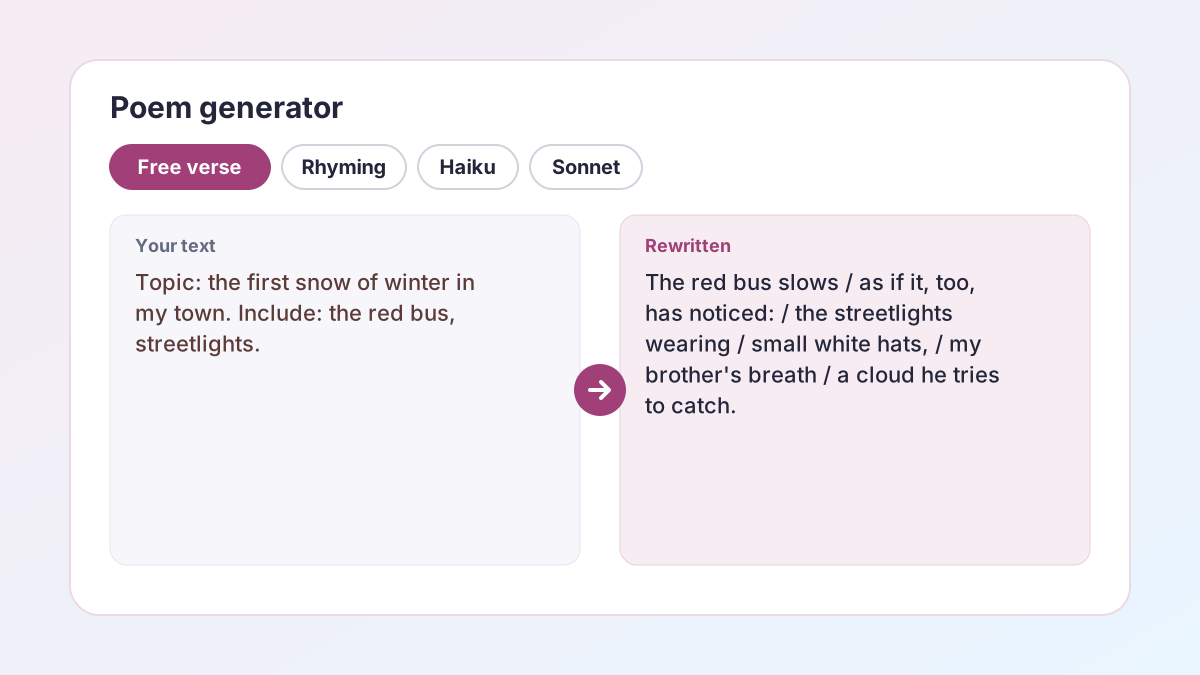
You typedThe first snow of winter in my town. Include: the red bus, streetlights, my little brother.
Poem excerptThe red bus slows / as if it, too, has noticed: / the streetlights wearing small white hats, / my brother's breath a cloud he tries to catch.
Free verse lets the images lead; there is no forced rhyme.
You typedA cat asleep in the sun on a windowsill.
Poem excerptSun on the sill warms / a small grey island of fur. / Even dreams purr here.
Three lines of 5, 7 and 5 syllables, with a gentle twist at the end.
You typedA student who forgot their homework every single day.
Poem excerptA student named Lee from Dundee / Left homework at home, said with glee: / “My dog ate it again!” / But the teacher said, “Then / Why's your dog doing algebra? Me?”
AABBA rhyme and a punchline in the last line.
You typedStarting at a new school.
Poem excerptNew hallways stretch like roads I've never known, / new faces, names I'm trying hard to learn; / but every friend was once a stranger, grown / from one small hello, waiting for its turn.
Regular beat and alternating rhyme; the last line turns worry into hope.
You typedMy grandmother's hands.
Poem excerptHer hands have kneaded bread for fifty years, / have braided hair and buttoned winter coats…
Iambic pentameter: ten syllables, five beats per line.
You typedA fisherman caught in a storm who finds his way home by a lighthouse.
Poem excerptThe sky turned black at half past four, / the waves rose wild and high, / but far away a steady light / was burning in the sky.
Ballads tell a story in four-line stanzas with an ABCB rhyme.
How to use the poem generator
A small, specific subject makes a better poem than a big abstract one: “my grandmother's hands” beats “family”.
- Type what the poem is about. Describe the subject in a few words. Specific moments, objects and places work best.
- Add details. Optionally add names, places or images you want in the poem, such as a pet's name or a colour.
- Choose a form. Free verse, rhyming, haiku, limerick, sonnet or ballad. Each one follows its form's rules.
- Pick a mood and length. Mood sets the feeling; length sets how many lines (haiku, limerick and sonnet have fixed lengths).
- Write and revise. Select Write my poem to get two poems. Copy the one you like, then change words until it sounds like you.
How can I make a poem? A simple method
Anyone can make a poem. You do not need fancy words or perfect rhymes; you need something you noticed and a way of saying it clearly. Here is a method poets use, step by step.
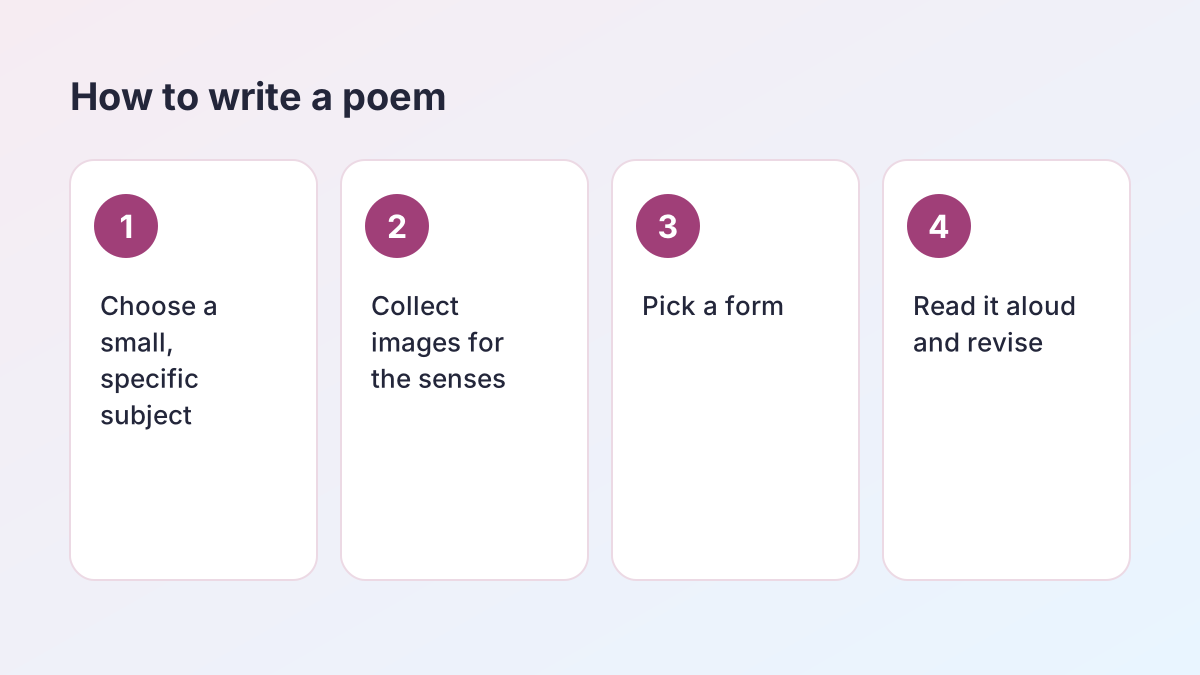
- Choose a small subject. Not “love” or “nature”, but one moment: your dog waiting at the door, the smell of rain on a hot road, the last day of summer.
- Collect images. Write down what you see, hear, smell, taste and touch. These details are the raw material of the poem.
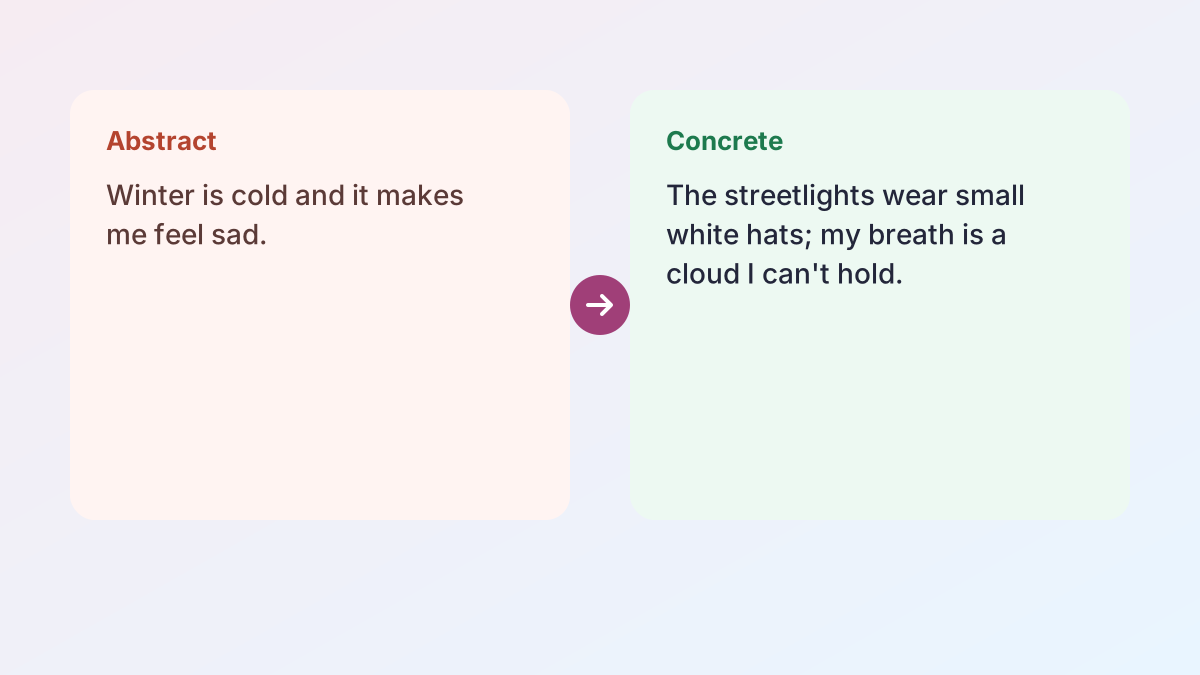
- Find a comparison. What does your subject remind you of? “Streetlights wearing small white hats” is more alive than “snow on the streetlights”.
- Choose a form. Free verse gives you freedom. A haiku forces you to focus on one moment. A rhyming poem gives you music.
- Write fast, then cut. Write more lines than you need, then keep only the strongest.
- Read it aloud. Your ear will tell you where a line stumbles or a word is wrong.
Using the tool as a starting point
When you are stuck on a blank page, the poem generator can show you how your subject might look as a poem. Read both versions, notice which images and lines you like, and use them to make a poem in your own words.
Poetic forms the poem generator can write
Poems come in fixed forms, with rules for lines, rhyme or metre, and unfixed forms like free verse. The Poetry Foundation's glossary describes fixed forms as poems with a set number of lines, rhymes or metrical arrangements. The poem generator follows the rules of each form you choose.
Free verse
No fixed rhyme or metre. The line breaks, images and rhythm of natural speech do the work. Most modern poetry is free verse, and it is the best place to start.
Rhyming poem
Lines with a regular beat and end rhymes, often in alternating (ABAB) or paired (AABB) patterns. Good for songs, cards and poems to read aloud.
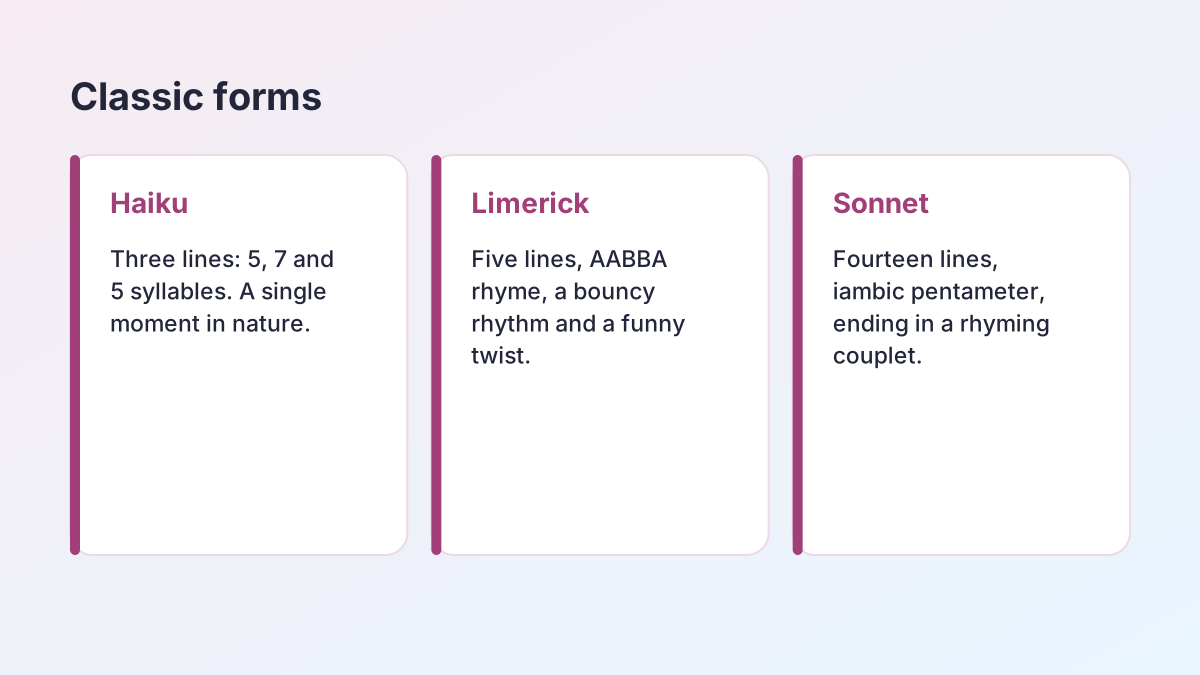
Haiku
A Japanese form of three lines with 5, 7 and 5 syllables, usually capturing one moment in nature with a small surprise.
Limerick
Five lines with an AABBA rhyme and a bouncy rhythm, almost always funny, with a punchline at the end.
Sonnet
Fourteen lines in iambic pentameter. The Shakespearean sonnet rhymes ABAB CDCD EFEF GG and ends with a couplet that turns or sums up the poem.
Ballad
A story told in four-line stanzas, usually rhyming ABCB, with a strong, song-like rhythm.
Random poem generator: ideas when you have no topic
Sometimes the hardest part is deciding what to write about. If you want a random poem generator experience, try one of these prompts in the topic box, or pick one at random by closing your eyes and pointing.
- The sound your house makes at night
- A pair of shoes you have outgrown
- The view from a bus window in the rain
- Your favourite food, described to an alien
- A conversation between the sun and the moon
- The first time you rode a bike
- An object in your bag right now
- A smell that reminds you of someone
- The last five minutes before the school bell
- A tree you pass every day
Turn the dial on mood
The same topic produces very different poems with different moods. “A pair of shoes you have outgrown” can be funny, nostalgic or hopeful. Generate it twice with different moods and compare.
Random forms
Choose a form you have never tried. Writing a limerick about a serious topic, or a sonnet about something silly, is a classic exercise that teaches you how much form shapes meaning.
Poetic devices that make a poem stronger
When you revise a poem from the generator, or write your own, these devices are worth looking for.
- Imagery: language that appeals to the senses. The streetlights wear small white hats lets the reader see the snow.
- Simile and metaphor: comparisons. A simile uses “like” or “as”; a metaphor says one thing is another.
- Personification: giving human qualities to non-human things. The red bus slows as if it, too, has noticed.
- Alliteration: repeating first sounds. Small, soft, silver snow.
- Line breaks: where a line ends changes how it is read. A break can create a pause, a surprise or a double meaning.
- Repetition: repeating a word or line builds rhythm and emphasis.
- Rhyme and rhythm: music that makes a poem memorable when read aloud.
Avoid clichés
“Roses are red”, “heart of gold”, “tears like rain”. Readers have heard them before. Replace them with something only you would notice.
How to revise a poem until it sounds like you
A first draft, whether you wrote it or a tool did, is only the beginning. Revision is where a poem becomes yours. Try these passes one at a time.
1. Cut the weakest line
Read the poem and find the line you would miss least. Remove it. Poems almost always get stronger when they get shorter, because every remaining line has to work harder.
2. Swap one general word for a specific one
Look for words like thing, beautiful, nice, sad or flower. Replace each with something precise: not flower but dandelion; not sad but the image that made you sad.
3. Check the verbs
Strong verbs carry a poem. The wind blew is flat; the wind shouldered the door open has energy. Circle every verb and ask whether a sharper one exists.
4. Look at the line breaks
Try ending a line on a strong word rather than the or and. Move a break and read it again: sometimes a new break creates a pause or a surprise that changes the whole line.
5. Read it aloud, twice
Read it once quietly and once as if to an audience. Where you stumble, the rhythm needs work. Where you rush, a line may need room to breathe.
6. Add one thing only you know
The detail that makes a poem unforgettable is usually personal: the name of the street, the colour of a coat, something someone actually said. Add one, even if it seems small. It is the line readers will remember.
7. Put it away, then come back
Leave the poem for a day. Fresh eyes see clichés and extra words that were invisible when you wrote them.
Using the poem generator for school
Poetry assignments ask you to show that you understand a form and can use poetic devices. The poem generator can help you learn, as long as the final poem is your own.
Learn a form by example
Generate a sonnet or haiku on your topic and study how it follows the rules. Count the syllables, mark the rhyme scheme, find the turn. Then write your own.
Get unstuck
If you have written half a poem and cannot find the next line, generate a poem on the same topic and see what images it uses. Borrow the idea, not the words.
Follow your school's rules
Many schools do not allow AI-written poems to be handed in as your own work. Check your teacher's policy. Using a generator to study forms and spark ideas is very different from submitting its poem.
Analysing poems
If you need to analyse a poem rather than write one, try the Poem Analysis Tool. To understand an older poem line by line, use the Poem Rewriter.
Poems for occasions
A poem makes a card, a speech or a gift feel personal. Use the details box to add names and memories so the poem could only be about the person you are writing for.
- Birthdays: choose Joyful and Rhyming, and add the person's name and one thing they love.
- Thank-you notes: a short free verse poem with one specific memory is more moving than a long one.
- Mother's Day and Father's Day: add small, real details: the way they make tea, a phrase they always say.
- Graduations: choose Hopeful and a ballad or rhyming poem that tells the story of the journey.
- Remembering someone: choose Reflective and free verse, and add a place or object connected to them.
Always read the poem aloud before you share it, and change any line that does not sound like something you would say.
Handwrite it
A poem copied out by hand, even a short one, means more than a printed one. Write it on good paper or inside the card, leave space around it, and sign it. If you want something more visual, lay the poem out inside a heart or a star and print it as a small poster. A few minutes of extra effort turns a poem into a keepsake.
Love poem generator: writing a love poem that sounds like you
A love poem fails when it could be about anyone. Your eyes are like the stars has been written countless times; you always save me the crispy corner of the lasagne could only be about one person. Here is how to make a love poem that feels personal, by hand or with the poem generator as your starting point.
Start with three true details
Before choosing a form, write down three things only you know about the person: a habit, a place you share, something they always say. Put them in the “Details, names or images to include” box. They are what make the poem sound written for one reader.
Choose the form for the occasion
- Free verse, Loving mood: the most natural choice for a private note or a card, because it sounds like speech.
- Rhyming: good for a poem read aloud, at an anniversary or a family party.
- Sonnet: the classic love form. Shakespeare's Sonnet 18 opens “Shall I compare thee to a summer's day?” Choose it for a serious declaration.
- Haiku: one shared moment in three lines, small enough for any card.
Love does not have to be romantic. The Loving mood works just as well for a poem to a parent, a grandparent, a friend or a pet.
How to create poems that rhyme without forcing them
Rhyme is where many love poems go wrong: the writer picks a word because it rhymes (heart, apart, start), not because it is true. To avoid that:
- Write the line first, then rhyme. Say what you mean in plain words, then look for a rhyme that keeps the meaning.
- Put the rhyme on a strong word. Nouns and verbs carry rhyme better than me, be or too.
- Allow near rhyme. Words that almost rhyme, such as home and alone, sound less sing-song and give you far more choices.
- Read it aloud. If a line exists only to reach a rhyme, cut it.
The poem generator's Rhyming form writes lines with a regular beat and end rhymes, so you can see how a pattern works on your subject. Then rewrite any rhyme that sounds forced, and add the detail that only you could know.
Poetry games and short poem challenges
Poetry games turn writing into play, which makes them good warm-ups for a class, a writing club or a rainy afternoon. All of these work on paper; a few use the generator as a partner.
Games for a group
- Exquisite corpse: each person writes one line, folds the paper so only the last word shows, and passes it on. Unfold and read the whole poem aloud at the end. The French Surrealists made this game famous in the 1920s.
- Five-word challenge: open a book at random and point to five words. Everyone writes a short poem that uses all five.
- Mood swap: the group picks one topic, then each person draws a mood from a hat (joyful, dark, funny, calm) and writes in it.
- Form relay: one topic, written as a haiku by one person, a limerick by the next and a ballad stanza by the third.
Challenges with the poem generator
- Beat the machine: write your own short poem on a topic first, then select Write my poem and compare. Whose images are fresher? It is a quick way to learn to spot clichés.
- Fix the weakest line: generate a poem, then each player rewrites one line to improve it. Vote for the best rewrite.
- Same images, different form: put the same three images in the details box and generate in two forms. Discuss what each form does with them.
Write a short poem: one-line and tiny forms
Short does not mean easy. A one-line poem, sometimes called a monostich, has to stand alone, like an image caught mid-air. An invented example: The kettle clicks off, and the house remembers it is morning. Try writing five one-line poems about the same object, then keep the best.
For slightly longer pieces, choose Free verse and Short (4–8 lines) in the poem generator and study how a few lines can still turn or surprise. Then write your own version on a different subject, so the poem you keep is entirely yours.
Is the poem generator free and private?
Yes. The poem generator is free, with no account or sign-up. A fair hourly allowance per visitor keeps it fast for everyone.
Your topic and details are sent to our AI providers (Groq, with Google Gemini as a backup) only to write the poems you see. The Study Corp does not save them. Each poem is written fresh, so asking again gives you new poems.
Poems are kept suitable for school: no explicit or violent content. If you want to lay your poem out in a heart, star or tree, paste it into the Shape Poem Generator.
Poem generator FAQ
Is the poem generator free?
Yes. It is free with no account or sign-up. A fair hourly allowance per visitor keeps it fast for everyone.
What kinds of poems can it write?
Free verse, rhyming poems, haiku, limericks, sonnets and ballads, in eight moods and three lengths.
How can I make a poem myself?
Choose a small subject, collect sensory details, find a comparison, pick a form, write more than you need and read it aloud as you revise.
Can it include names?
Yes. Add names, places or images in the details box and the poem will work them in naturally.
Is it a random poem generator?
It writes a fresh poem for any topic. If you have no topic, try one of the prompts on this page or ask for the same topic in a different mood.
Can I hand in a generated poem for school?
Check your school's policy. Use the generator to learn forms and find ideas, then write the final poem in your own words.
Can I make a shape poem?
Yes. Use the Shape Poem Generator to lay a poem out in a heart, star, tree and more, then download it.
Can the poem generator write a love poem?
Yes. Choose the Loving mood and a form such as free verse, rhyming or sonnet, then add names and real details in the details box. Then swap any stock phrase for a detail only you would know.
What are some fun poetry games for class?
Try exquisite corpse, where each person adds a line and folds the paper so only the last word shows, a five-word challenge, a mood swap or a form relay. Writing your own poem first and then comparing it with a generated one is a good way to learn to spot clichés.
More free writing tools
- Book Title GeneratorTitle ideas for your book, chapters or series, in any genre.
- Essay Title GeneratorTen clear, catchy titles for any essay type, with notes on each.
- Story Title GeneratorOriginal titles for short stories, fan fiction and school stories.
- Shape Poem GeneratorLay a poem out inside a heart, star, tree and more, then download it.
- Paragraph ExpanderMake a paragraph or essay longer with explanation, not filler.
- Personal Statement GeneratorDraft a UCAS or college statement and check it against the word limit.
- Introduction GeneratorThree introductions that move from a hook to your thesis.
- Essay Hook GeneratorNine opening hooks for your essay, each a different technique.
- Poetry Prompt GeneratorTen fresh poem prompts on any theme, for any level.
- Acrostic Poem GeneratorA poem whose first letters spell any name or word.
- Random Paragraph GeneratorRandom paragraphs for reading, typing and handwriting practice.
- Thesis Statement GeneratorFive clear, arguable thesis statements for any essay type.
- Essay Outline GeneratorPlan your essay section by section, from thesis to conclusion.
- Topic Sentence GeneratorTopic sentences that tie each body paragraph to your thesis.
- Paragraph GeneratorWrite a clear paragraph from a topic, or turn notes into one paragraph.
- Conclusion GeneratorThree conclusions for your essay, or a concluding sentence for a paragraph.
- Poem Title GeneratorTen title ideas for your poem, from simple to striking.
- Haiku Poem GeneratorHaiku, sonnets and limericks with syllables counted on every line.
- Argumentative Essay GeneratorDraft an argumentative essay with a clear claim, counterargument and rebuttal.
- Persuasive Essay GeneratorDraft a persuasive essay aimed at a real reader, with a call to action.
- Informative Essay GeneratorDraft a clear, neutral informative (expository) essay on any topic.
- Analytical Essay GeneratorDraft an analytical essay that explains how and why, not just what.
- Compare and Contrast Essay GeneratorDraft a comparison essay, point-by-point or block, with a real judgment.
- Scholarship Essay GeneratorDraft a scholarship essay built from your own story and goals.
- Name GeneratorCharacter names for stories and games, 12 at a time, in any genre.
See all 80 free tools for students
Related tools
Last updated by The Study Corp editorial team.