Haiku poem generator examples
Topics students typed and one poem that came back. Numbers in brackets are the syllables counted on each line.
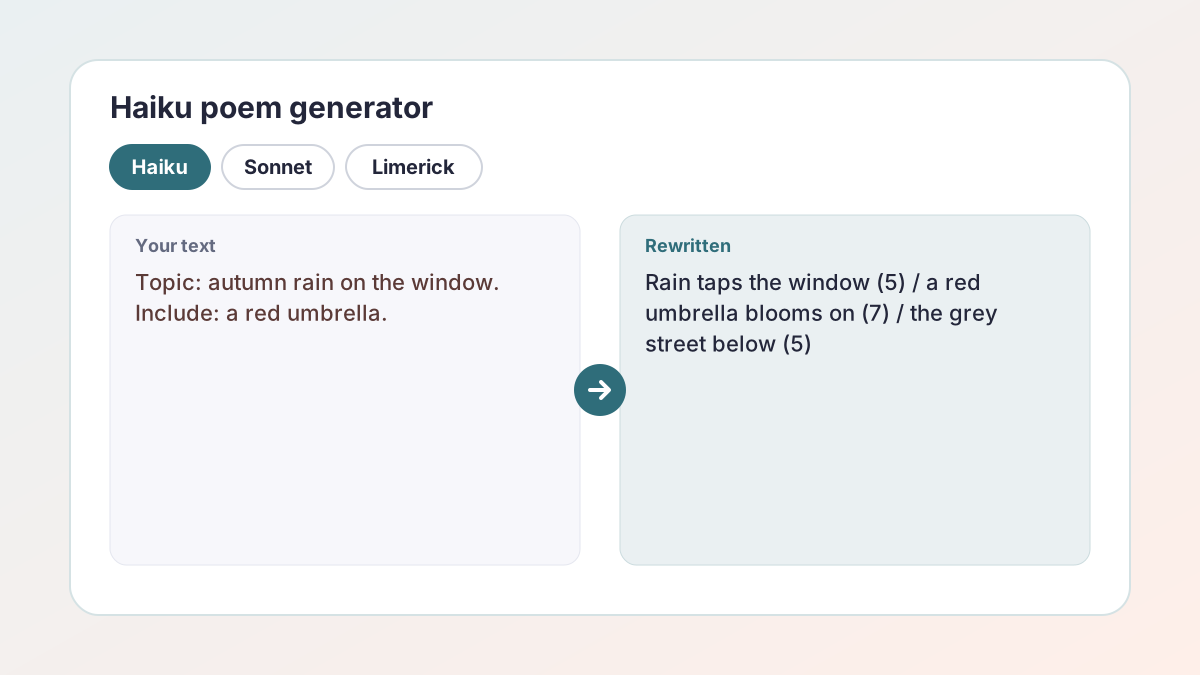
TopicAutumn rain on the window. Include: a red umbrella.
PoemRain taps the window (5) / a red umbrella blooms on (7) / the grey street below (5)
One moment, a season (autumn rain) and a small burst of colour.
TopicMy dog in the first snow.
PoemFirst snow on the lawn (5) / my dog leaps and bites the air (7) / catching winter's breath (5)
The last line turns a funny moment into an image.
TopicThe last day of school.
PoemEmpty corridors (5) / one sock forgotten in the (7) / lost property box (5)
A small, specific detail carries a big feeling.
TopicMy grandmother's kitchen.
PoemHer kitchen smelled of cinnamon and bread, / the kettle singing softly on the flame…
Ten syllables and five beats per line, rhyming ABAB.
TopicA cat who thinks it is a dog.
PoemThere once was a cat named Lou / who barked when the postman came through; / she fetched every stick, / learned a sit-and-stay trick, / and now wants a lead that is new.
AABBA rhyme with a punchline in the last line.
TopicA seed in spring.
PoemUnder the cold soil (5) / a seed is dreaming of green (7) / the sun leans closer (5)
Personification (the seed is dreaming) gives the haiku warmth.
How to use the haiku poem generator
Small, specific topics make the best haiku: “a red leaf on a puddle” beats “nature”.
- Type a topic. Describe one moment, object or scene in a few words.
- Add images (optional). Add words or images you want included, such as a colour, an animal or a place.
- Choose a form. Haiku (5-7-5), sonnet (14 lines of iambic pentameter) or limerick (5 funny, rhyming lines).
- Pick a mood. Calm, joyful, reflective, loving, funny or hopeful.
- Check and revise. Select Write my poem. The number beside each line shows its syllables, so you can check the pattern and tweak words.
What is a haiku?
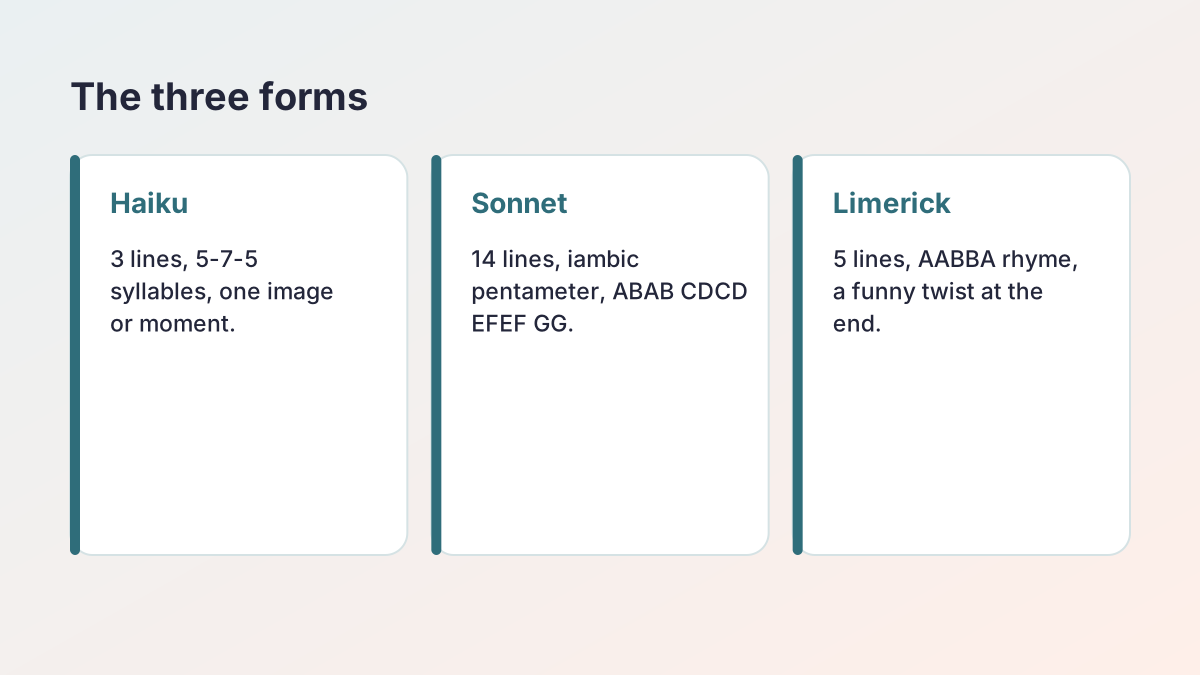
A haiku is a short poem that began in Japan. In English, it is usually taught as three lines of 5, 7 and 5 syllables, capturing a single moment, often in nature, with a small shift or surprise.
The 5-7-5 pattern is a starting point rather than a strict law. The Haiku Foundation, in its introduction new to haiku? what is haiku, notes that the schoolroom 5-7-5 description is simplified, and that many English haiku poets write fewer than seventeen syllables, focusing instead on a vivid image and a moment of insight.
Features of a haiku
- Brevity: three short lines.
- A single moment: one scene, observed closely.
- A season word (kigo): a word that hints at the time of year, such as cherry blossom, first snow or crickets.
- A cut (kireji): a pause or shift that sets two images side by side, often between the second and third lines.
- Concrete images: things you can see, hear, smell, taste or touch, rather than abstract ideas.
Why the generator counts syllables
Most school assignments ask for 5-7-5. The haiku poem generator shows the count beside every line so you can check the pattern at a glance and adjust any line that is off.
How syllables are counted
A syllable is a single beat of sound in a word. Rain has one syllable, window has two (win-dow), umbrella has three (um-brel-la).
How to count by ear
Put your hand under your chin and say the word slowly. Each time your jaw drops is one syllable. Or clap once for each beat.
How the tool counts
The number beside each line is counted automatically, using rules for English spelling plus a list of tricky words. When the tool writes haiku, it asks for more than it needs and keeps the ones that count 5-7-5, so the poems you see usually match exactly.
Words that cause trouble
Some words are counted differently by different speakers: fire (one or two), flower (one or two), every (two or three). Unusual words and names can be off by one. Always say the line aloud and trust your ear.
Fixing a line
If a line has one syllable too many, swap a two-syllable word for a one-syllable word (quiet for still). If it has too few, add a short word or choose a longer one (leaf for maple leaf).
How to write a haiku yourself
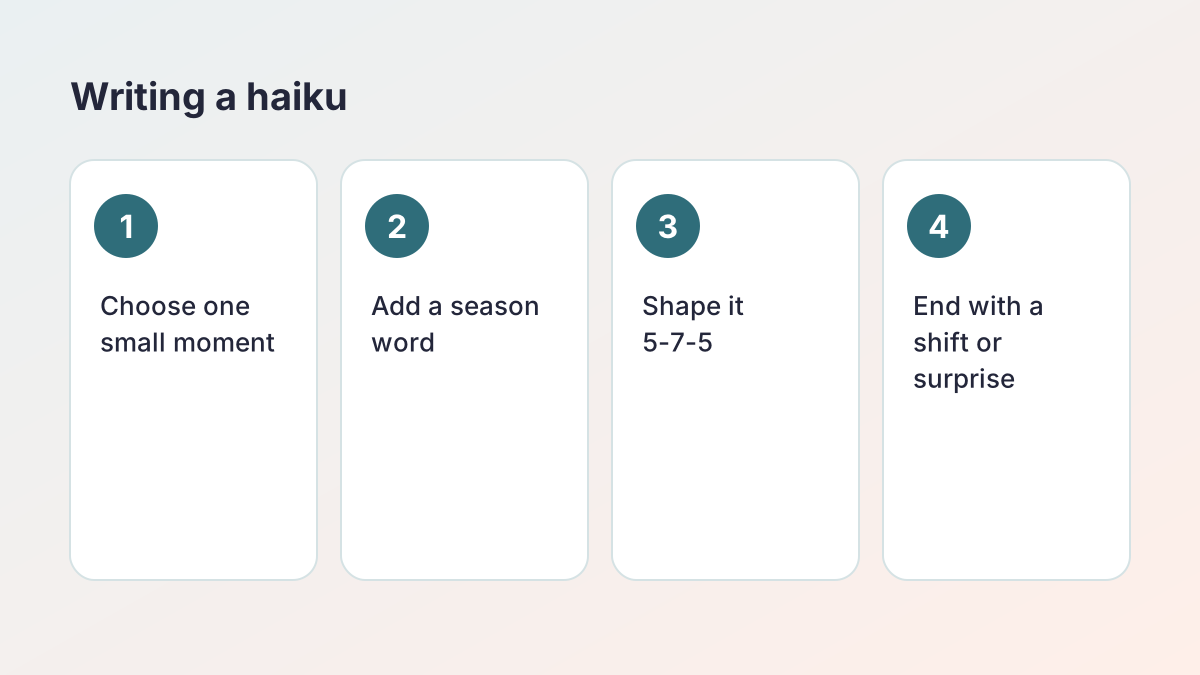
- Choose one small moment. Not “summer”, but the sound of a lawnmower on a Sunday morning.
- Write down what you notice. Use the senses. What exactly do you see, hear, smell?
- Add a season word. It places the moment in time.
- Find two images to set side by side. Often the first two lines describe a scene and the third adds a contrast or surprise.
- Shape it into 5-7-5. Count syllables and trim or add words.
- Cut every unnecessary word. Haiku have no room for very, really or the beautiful.
- Read it aloud. A haiku should feel like one breath.
Avoid
- Rhyme (haiku traditionally do not rhyme)
- Abstract words such as love, peace or sadness; show them through an image instead
- Telling the reader how to feel
Sonnet generator: fourteen lines of iambic pentameter
Switch the chip to Sonnet and the tool works as a sonnet generator. It writes a Shakespearean sonnet: fourteen lines, rhyming ABAB CDCD EFEF GG, in iambic pentameter.
Iambic pentameter
Each line has ten syllables in five pairs, each pair an unstressed syllable followed by a stressed one: da-DUM da-DUM da-DUM da-DUM da-DUM. Shakespeare's “Shall I compare thee to a summer's day?” is the famous example. The syllable count beside each line helps you check you are close to ten.
The structure
- Three quatrains (four-line groups) develop an idea, image or argument.
- The volta (turn), often at line 9 or in the final couplet, shifts direction.
- The final couplet (two rhyming lines) sums up or twists the poem.
Petrarchan sonnets
The Italian (Petrarchan) sonnet has an eight-line octave and a six-line sestet, with a turn between them. If your assignment asks for one, use the generated sonnet as a model for imagery and metre, then rearrange the rhyme scheme.
Learning the form
Generate a sonnet on your topic, mark the stressed syllables in each line, and underline the rhymes. Then write your own.
Limerick poem generator: five funny lines
Choose Limerick and the tool becomes a limerick poem generator. A limerick is a five-line comic poem with a bouncy rhythm and an AABBA rhyme scheme.
The rules
- Lines 1, 2 and 5 are longer (usually 8 or 9 syllables) and rhyme with each other.
- Lines 3 and 4 are shorter (5 or 6 syllables) and rhyme with each other.
- The rhythm gallops: da-da-DUM da-da-DUM da-da-DUM.
- The last line delivers a punchline or twist.
The classic opening
Many limericks begin “There once was a [person] from [place]”. It is a fine start, but surprising openings can be funnier.
Tips for funny limericks
- Choose a rhyme for line 1 that has plenty of rhyming partners.
- Save the joke for the last line.
- Exaggerate: the sillier the situation, the better.
- Read it aloud. If you stumble, the rhythm needs fixing.
Edward Lear made the limerick famous in the 1800s with his Book of Nonsense, and it remains one of the most popular forms for funny poems.
Haiku ideas by season
If you cannot think of a topic, try one of these, or use the Poetry Prompt Generator for more ideas.
Spring
Cherry blossom on a car roof, a bird building a nest, the first warm evening, puddles after a spring shower.
Summer
A melting ice lolly, crickets at night, a sunburnt nose, the smell of cut grass, a fan turning in a hot room.
Autumn
A red leaf on a puddle, conkers in a pocket, the first cold morning, geese flying south, fog over a field.
Winter
Breath on a cold window, footprints in fresh snow, a radiator ticking, the shortest day, a scarf that smells of home.
Any time
Your pet asleep, a bus stop at night, a cup of tea going cold, rain on a tent, the moon behind clouds.
Using the haiku poem generator for school
Haiku, sonnets and limericks are common in poetry units because each form has clear rules. The tool helps you learn them.
Learn by example
Generate several haiku on one topic and compare them. Which images work best? Where is the cut? Then write your own.
Check your own counts
Write your poem, then compare your syllable count with the counts the tool shows on its poems for similar words.
Follow your school's rules
Many schools do not allow AI-written poems to be handed in as your own work. Use the generator to study forms and get ideas, and write the final poem yourself.
Next steps
Give your poem a title with the Poem Title Generator, or lay it out in a shape with the Shape Poem Generator.
Haiku poem generator checklist
When the haiku poem generator gives you three haiku, use this checklist to choose one and make it your own.
- One moment. Does the haiku capture a single scene, not a whole day?
- Concrete images. Can you see, hear or feel what it describes?
- A season word. Is there a hint of the time of year?
- A cut. Is there a pause or shift, often before the last line?
- Fresh language. Have you avoided clichés such as “gentle breeze” or “golden sun”?
- The count. Do the numbers beside each line show 5, 7 and 5? If not, say the line aloud and adjust.
- The ending. Does the last line add a small surprise or new angle?
Make it yours
Change one image to something only you have seen: your street, your pet, your window. A haiku that started in the haiku poem generator becomes your poem the moment it holds a detail from your own life.
Haiku, sonnets and limericks: where they come from
Haiku
The haiku grew out of a longer Japanese form, the renga, a chain of linked verses written by several poets. The opening verse, the hokku, became a poem in its own right. Matsuo Bashō, writing in the 1600s, is the best-known haiku poet; his poem about an old pond and a frog jumping in is often the first haiku students meet.
Sonnet
The sonnet began in Italy in the 1200s and was made famous by Petrarch. It came to England in the 1500s, where Shakespeare wrote 154 sonnets in the form now named after him.
Limerick
The limerick is named after the Irish county of Limerick, though no one is sure exactly why. Edward Lear's nonsense verse in the 1800s made it popular.
Why learn fixed forms?
Each form gives you a set of rules, and rules are a good way to practise. Writing within a limit forces you to choose every word carefully, which is a skill that helps in all writing. That is why the haiku poem generator shows its counts: so you can see the rules at work.
Haiku poem creator: from a generated haiku to your own
A good haiku poem creator should help you write better haiku, not just hand you finished ones. This section shows how to steer the haiku poem generator towards stronger drafts, then how to revise one of its haiku until it belongs to you.
Steering the haiku poem generator
- Make the topic a moment. “Autumn” gives general poems. “A red leaf stuck to a bike saddle” gives one scene to look at.
- Use the images box for one real detail. Add a sound, colour or smell you have actually noticed; a haiku has room for one or two at most.
- Match the mood to the form. Calm and Reflective suit traditional haiku. Funny can work well, but see the note on senryu below.
- Generate more than once. Each run of the haiku poem generator gives you up to three new haiku, so compare a few sets before you choose.
Three revisions, worked through
Here is an invented first draft that counts 5-7-5 but feels generic:
A gentle breeze blows / leaves are falling from the trees / autumn has arrived
- Cut the cliché. “A gentle breeze blows” could open a thousand poems. Swap it for a specific sound: Wind rattles the gate (still five syllables).
- Make it yours. “Leaves are falling from the trees” is true everywhere. Add a detail from your own day: a leaf rides my sleeve to school (seven syllables).
- Show, don't tell. “Autumn has arrived” tells the reader the season. Let an image do it instead: first scarf of the year (five syllables).
The revised haiku:
Wind rattles the gate / a leaf rides my sleeve to school / first scarf of the year
Each change keeps the count and swaps a general phrase for something seen or felt. Try the same three moves on any poem from the haiku poem generator.
Haiku or senryu?
If you choose the Funny mood in the haiku poem generator, some poems may read more like senryu. A senryu uses the same short three-line shape as a haiku, but it focuses on human nature, often with humour or irony, rather than on nature and the seasons. The form is named after the Japanese poet Karai Senryū, who lived in the 1700s. If your assignment asks specifically for a haiku, check that your final poem includes a natural image or a season word.
Iambic pentameter generator: how to scan sonnets and limericks
In Sonnet mode, the haiku poem generator works as an iambic pentameter generator and sonnet maker: it asks for lines of about ten syllables with five beats. The number beside each line counts syllables, not stresses, so checking the beat is your job.
How to scan a line
- Say the line naturally, not in a sing-song voice.
- Mark each stressed syllable (in capitals or with a slash) and each unstressed one.
- Group the syllables in pairs. In iambic pentameter, most pairs go da-DUM.
Shakespeare's Sonnet 130 opens with a regular example: my MIS / tress' EYES / are NOTH / ing LIKE / the SUN. That is ten syllables and five iambs.
Fixing a line that limps
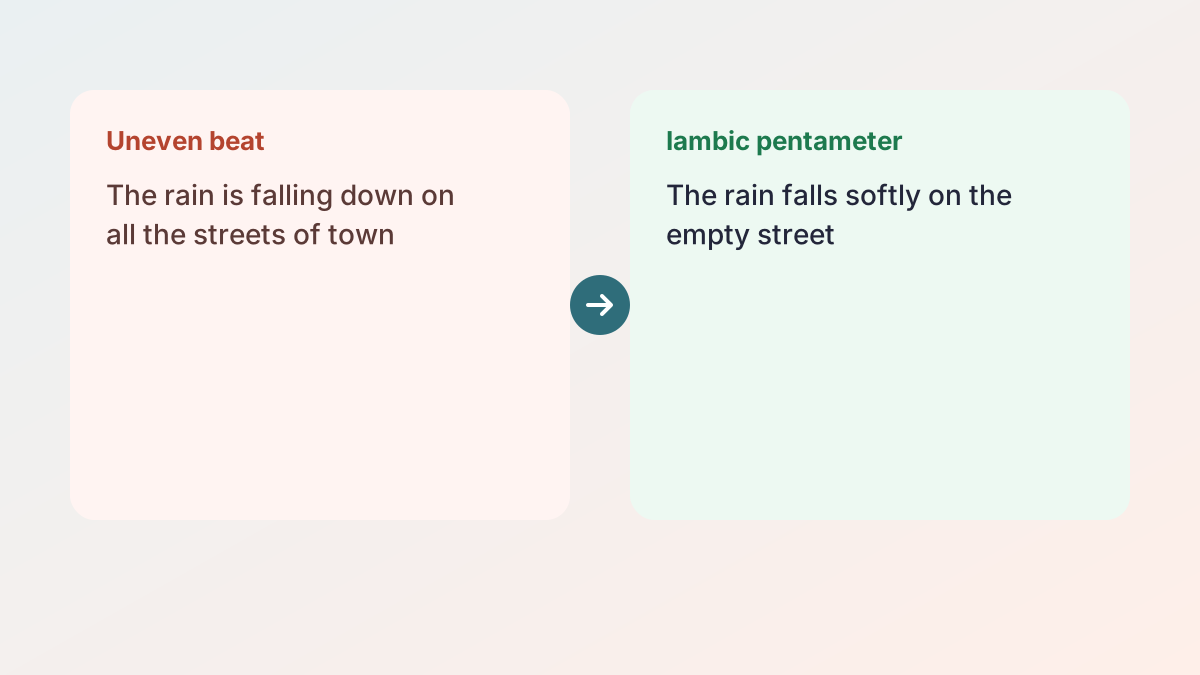
An invented line that does not scan: The kitchen was warm and full of the smell of bread (twelve syllables, with the beats in uneven places). A revision: The kitchen smelled of warm and rising bread (the KIT-chen SMELLED of WARM and RIS-ing BREAD: ten syllables, five beats).
- Cut small words such as of and the that pile up unstressed syllables.
- Change the word order so stressed syllables fall on the even beats.
- Choose a synonym with the stress in the right place: beGIN rather than START to.
The same fixes work on any sonnet line where the haiku poem generator shows a count well above ten.
Variations that are allowed
Poets bend the pattern on purpose: a count of eleven beside a line in the haiku poem generator is not automatically wrong.
- Feminine ending: an extra unstressed syllable at the end of the line, as in To be, or not to be, that is the question from Hamlet.
- Inverted first foot: a line that opens on a stress. Let me not to the marriage of true minds (Sonnet 116) is often scanned this way.
Limerick metre: three beats, then two
Choose Limerick and the tool becomes a limerick poem maker with a different beat, a galloping da-da-DUM. Lines 1, 2 and 5 have three strong beats; lines 3 and 4 have two. In this page's limerick example, there ONCE was a CAT named LOU has three beats and she FETCHED every STICK has two. Limericks often add or drop an unstressed syllable at the start of a line, so count beats rather than syllables. When a poem from the haiku poem generator feels bumpy, read it aloud and tap the beats on the desk.
Is the haiku poem generator free?
Yes. The haiku poem generator is free, with no account or sign-up. A fair hourly allowance per visitor keeps it fast for everyone.
Your topic and details are sent to our AI providers (Groq, with Google Gemini as a backup) only to write the poems you see. The Study Corp does not save them. Syllables are counted on our server and in your browser. Poems are kept suitable for school.
Usage allowance
The haiku poem generator is part of The Study Corp's free writing tools. If the haiku poem generator is busy, wait a little and try again; the free allowance is counted per hour.
Haiku poem generator FAQ
Is the haiku poem generator free?
Yes. It is free with no account or sign-up. A fair hourly allowance per visitor keeps it fast for everyone.
Does every haiku follow 5-7-5?
The tool keeps haiku that count 5-7-5 whenever it can and shows the count beside every line, so you can check. Unusual words can be off by one, so read it aloud.
Can it write a sonnet?
Yes. Choose Sonnet for fourteen lines of iambic pentameter rhyming ABAB CDCD EFEF GG.
Can it write limericks?
Yes. Choose Limerick for five lines with an AABBA rhyme and a funny twist.
Do haiku have to be about nature?
Traditionally they include a season word and a natural image, but modern haiku can be about any small moment.
Do haiku rhyme?
No. Haiku traditionally do not rhyme; they rely on images and the pause between them.
How do I count syllables?
Say the word slowly and count the beats, or put a hand under your chin and count each time your jaw drops.
Can the haiku poem generator check the metre of a sonnet?
It counts the syllables on every line, which shows whether a line is close to ten, but it does not mark stresses. To check iambic pentameter, say the line aloud and mark each stressed syllable: most pairs should go da-DUM.
What is the difference between a haiku and a senryu?
Both are short three-line poems. A haiku traditionally focuses on nature and often includes a season word, while a senryu focuses on human nature, often with humour. If your assignment asks for a haiku, keep a natural image when you revise a poem from the haiku poem generator.
More free writing tools
- Book Title GeneratorTitle ideas for your book, chapters or series, in any genre.
- Essay Title GeneratorTen clear, catchy titles for any essay type, with notes on each.
- Story Title GeneratorOriginal titles for short stories, fan fiction and school stories.
- Poem GeneratorWrite a poem on any topic: free verse, rhyming, haiku, sonnet and more.
- Shape Poem GeneratorLay a poem out inside a heart, star, tree and more, then download it.
- Paragraph ExpanderMake a paragraph or essay longer with explanation, not filler.
- Personal Statement GeneratorDraft a UCAS or college statement and check it against the word limit.
- Introduction GeneratorThree introductions that move from a hook to your thesis.
- Essay Hook GeneratorNine opening hooks for your essay, each a different technique.
- Poetry Prompt GeneratorTen fresh poem prompts on any theme, for any level.
- Acrostic Poem GeneratorA poem whose first letters spell any name or word.
- Random Paragraph GeneratorRandom paragraphs for reading, typing and handwriting practice.
- Thesis Statement GeneratorFive clear, arguable thesis statements for any essay type.
- Essay Outline GeneratorPlan your essay section by section, from thesis to conclusion.
- Topic Sentence GeneratorTopic sentences that tie each body paragraph to your thesis.
- Paragraph GeneratorWrite a clear paragraph from a topic, or turn notes into one paragraph.
- Conclusion GeneratorThree conclusions for your essay, or a concluding sentence for a paragraph.
- Poem Title GeneratorTen title ideas for your poem, from simple to striking.
- Argumentative Essay GeneratorDraft an argumentative essay with a clear claim, counterargument and rebuttal.
- Persuasive Essay GeneratorDraft a persuasive essay aimed at a real reader, with a call to action.
- Informative Essay GeneratorDraft a clear, neutral informative (expository) essay on any topic.
- Analytical Essay GeneratorDraft an analytical essay that explains how and why, not just what.
- Compare and Contrast Essay GeneratorDraft a comparison essay, point-by-point or block, with a real judgment.
- Scholarship Essay GeneratorDraft a scholarship essay built from your own story and goals.
- Name GeneratorCharacter names for stories and games, 12 at a time, in any genre.
See all 80 free tools for students
Related tools
Last updated by The Study Corp editorial team.