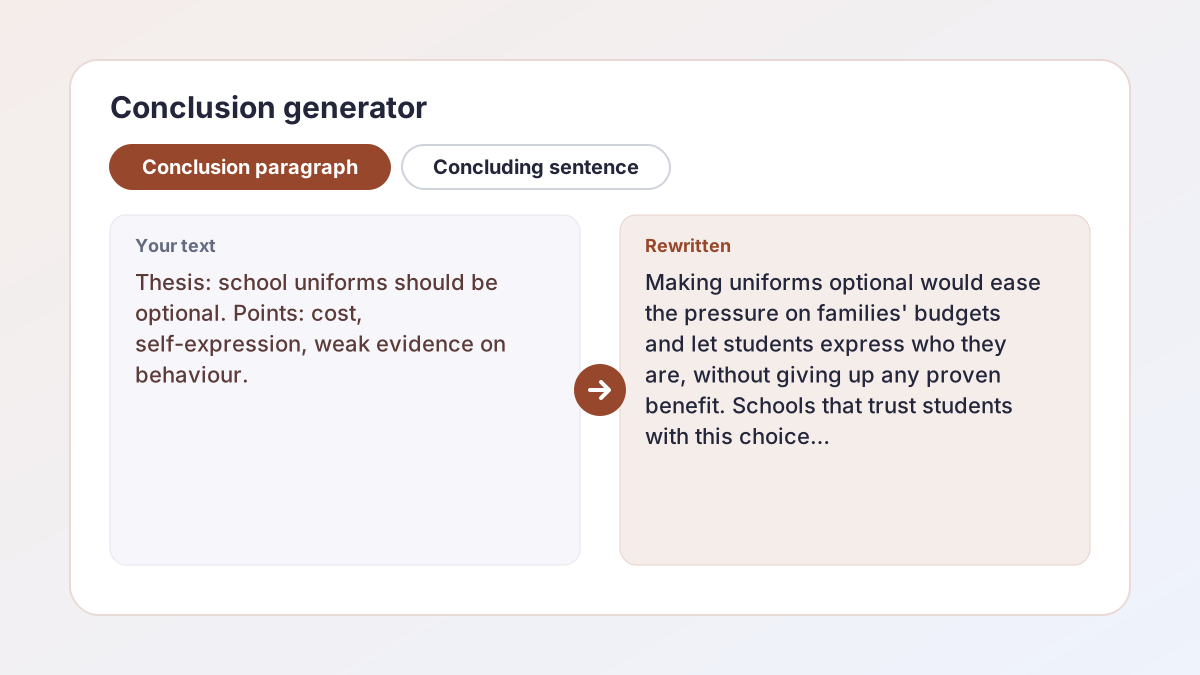
Conclusion generator examples
What students typed and one of the three results. Paragraph mode ends an essay; sentence mode ends a single body paragraph.
You typedThesis: school uniforms should be optional. Points: cost, self-expression, weak evidence on behaviour.
ResultMaking uniforms optional would ease the pressure on family budgets and give students room to express who they are, without giving up any benefit that the evidence clearly supports. Schools that trust students with this choice may find that a sense of belonging comes from far more than a blazer.
Restates the thesis in new words, draws the points together, ends with a final thought.
You typedTopic: how volcanoes form. Points: plate boundaries, hotspots, types of eruption.
ResultVolcanoes form wherever molten rock finds a way to the surface, whether at the edges of moving plates or above hotspots deep in the mantle. Understanding these processes explains not only where volcanoes appear but also why some erupt gently while others explode.
No argument to restate, so it sums up what was explained and why it matters.
You typedThesis: Macbeth is destroyed by his own ambition, not by fate.
ResultFrom the first prophecy to the final battle, Macbeth's choices, not the witches' words, drive his fall. Shakespeare leaves us with a warning that still feels current: ambition without conscience destroys the person who holds it as surely as it harms those around them.
Returns to the opening image of the prophecy.
You typedParagraph about the cost of uniforms for families.
ResultBecause these costs fall hardest on families who can least afford them, a compulsory uniform policy works against the fairness it claims to promote.
Sums up the paragraph's point and ties it to the thesis.
You typedParagraph about self-expression and uniforms.
ResultIf uniforms limit how students present themselves, the next question is whether they deliver enough benefits to justify that cost.
Prepares the reader for the next paragraph about evidence.
You typedThesis: cities should ban cars from their centres.
ResultCar-free centres are not a distant dream; cities that have tried them report quieter, safer streets [add an example from your source]. Councils should start with one street this year and let residents see the difference for themselves.
A persuasive conclusion can end with a call to action. Brackets mark a source to add.
How to use the conclusion generator
The conclusion generator works best when it knows your thesis and main points.
- Choose paragraph or sentence. Conclusion paragraph ends your essay; concluding sentence ends one body paragraph.
- Type your thesis or topic. Your thesis gives the conclusion something to restate. A topic also works.
- Add your points or paragraph. For a conclusion, list your main points. For a concluding sentence, paste the body paragraph.
- Choose the essay type and length. Argumentative, expository, literary analysis and more; short, standard or long.
- Pick and rewrite. Select Write my conclusion, choose the version you like and rewrite it in your own voice.
What does a good conclusion do?
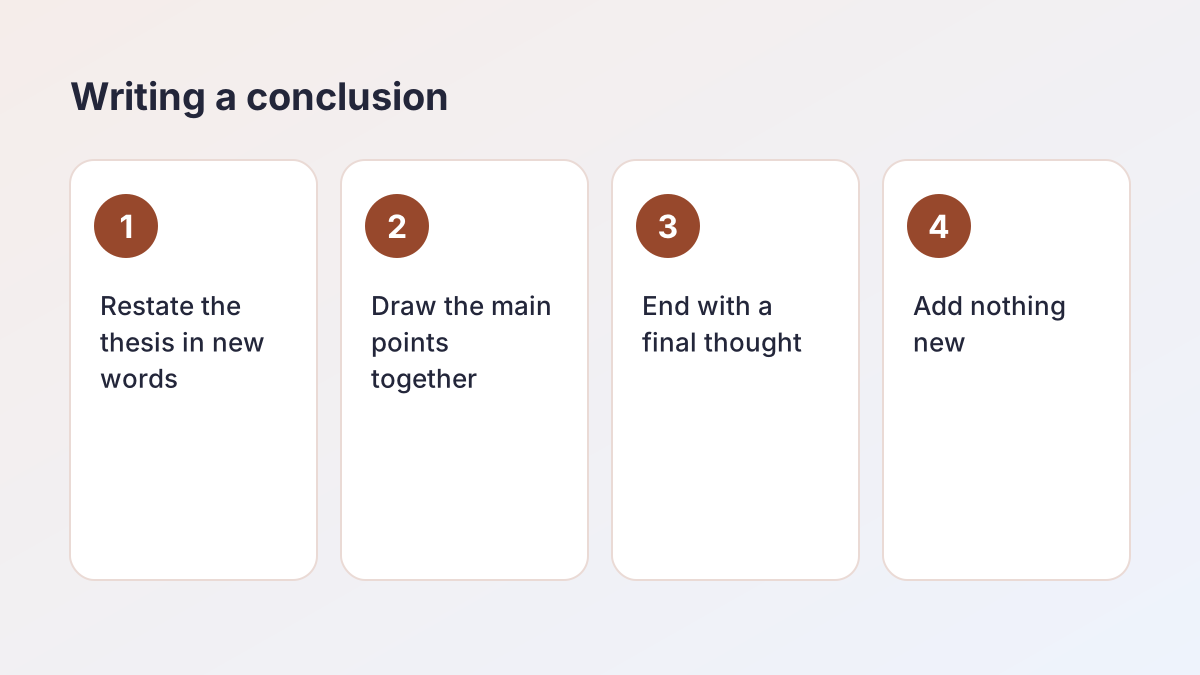
The conclusion is the last thing your reader sees, so it shapes the impression your whole essay leaves. A good conclusion does three things:
- Restates your thesis in new words, showing that the essay has proved what it set out to prove.
- Draws your main points together, showing how they add up, rather than listing them again.
- Ends with a final thought that answers the question “so what?”: why the argument matters, what it implies, or what should happen next.
The University of North Carolina's Writing Center guide to conclusions describes the conclusion as a chance to have the last word, to synthesise rather than summarise, and to push your ideas a step further.
What a conclusion should not do
- Introduce new evidence or a new argument
- Repeat the introduction word for word
- Start with a tired phrase such as “In conclusion” or “To sum up”
- Apologise or weaken your argument (“This is just one opinion”)
How to make a conclusion, step by step
If you are writing it yourself, here is how to make a conclusion that works for almost any essay.
1. Reread your introduction and thesis
Your conclusion should answer the promise your introduction made. Note the thesis and the hook.
2. Restate the thesis in new words
Say the same claim differently, now that the reader has seen your evidence. A restated thesis often sounds more confident than the original. The Restate Thesis Generator can help.
3. Synthesise, do not summarise
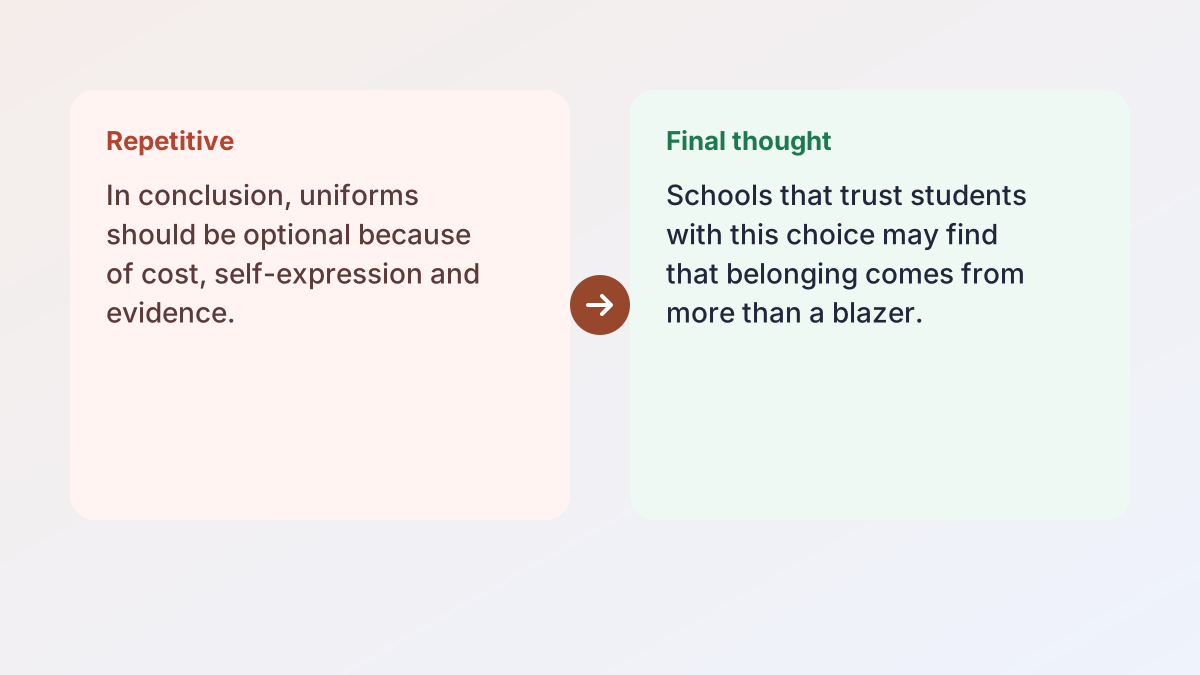
Instead of listing each point again, show how they connect. Cost, self-expression and weak evidence becomes uniforms ask a lot of families and students while promising little in return.
4. Choose a closing move
- Wider significance: why the argument matters beyond the essay.
- Call to action: what the reader or society should do.
- Full circle: return to an image or question from your introduction.
- Future question: a question your essay raises for further thought.
5. Cut anything new
If a sentence introduces a fact or argument you have not discussed, move it into a body paragraph or delete it.
6. Read the introduction and conclusion together
They should feel like a pair: the opening asks, the ending answers.
Conclusion paragraph generator: closing moves
In paragraph mode, the tool works as a conclusion paragraph generator. Each of the three versions uses a different closing move, labelled so you can compare them.
Wider significance
Ends by showing why the argument matters: for the people affected, for the subject, or for the future. Good for argumentative and analytical essays.
Call to action
Ends with what should happen next. Good for persuasive essays and essays about policy or social issues.
Full circle
Returns to the image, question or story from your introduction. Good for any essay with a strong hook.
Future question
Ends with a question the essay raises for further research or thought. Good for research papers and expository essays, as long as the question does not undermine your thesis.
Length
Choose short (50 to 70 words) for a short essay or exam answer, standard (90 to 120 words) for most essays, or long (140 to 180 words) for longer essays and research papers. A conclusion is usually about the same length as the introduction.
Concluding sentence generator for body paragraphs
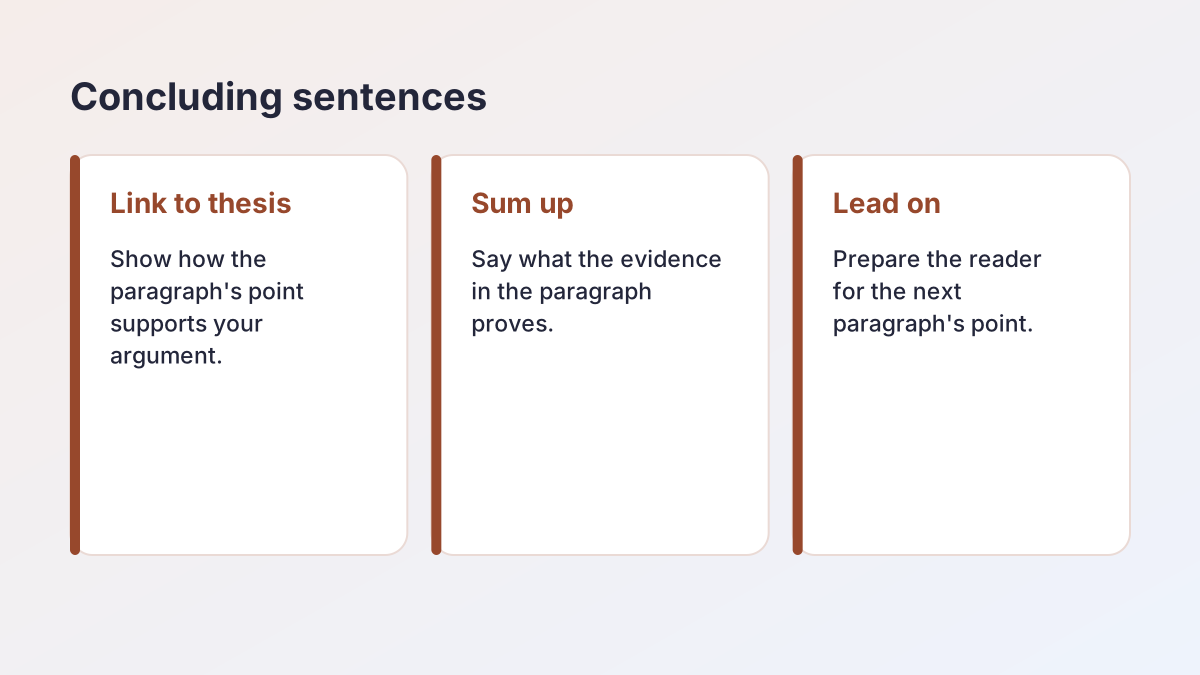
Switch the chip to Concluding sentence and the tool becomes a concluding sentence generator. It writes three ways to end one body paragraph, so the paragraph feels complete and connects to your argument.
What a concluding sentence does
A body paragraph usually ends with a sentence that sums up its point and links it back to the thesis or forward to the next paragraph. Without one, paragraphs can feel as if they stop rather than finish.
Three approaches
- Link to thesis: shows how the paragraph's point supports your overall argument.
- Sum up the evidence: states what the evidence in the paragraph proves.
- Lead to the next point: prepares the reader for what comes next.
Paste the paragraph
For the best results, paste the whole body paragraph into the second box. The concluding sentences will sum up what that paragraph actually says, rather than guessing.
Avoid
- Starting every concluding sentence with “In conclusion” or “Therefore”
- Repeating the topic sentence word for word
- Adding a new idea in the last line
Conclusions for different essay types
Set the essay type and the conclusion changes to fit it.
Argumentative and persuasive
Restate your position with confidence, show why your reasons outweigh the other side, and end with significance or a call to action.
Expository and informative
There is no argument to restate. Sum up what the essay explained and end with why it matters or what it helps us understand.
Analytical and literary analysis
Restate your interpretation and show what it reveals about the text, the author or the wider theme. End by connecting the text to a larger idea.
Compare and contrast
Restate the key similarity or difference and say what the comparison teaches us.
Narrative and personal
End with reflection: what the experience meant, what changed, or what you learned. Avoid a neat moral; a quieter insight is often stronger.
Research paper
Restate the central finding or claim, note limitations if appropriate, and suggest what further research could explore.
Conclusion starters that are not “In conclusion”
“In conclusion” is not wrong, but it is overused and tells the reader nothing. These alternatives do more work:
- Taken together, these points show that…
- Ultimately, …
- What this reveals is…
- For these reasons, …
- If [thesis], then…
- The evidence points in one direction: …
- By [doing X], [subject] [result]…
Often the best option is no signpost at all. Start with your restated thesis and let the paragraph's position at the end of the essay signal that it is the conclusion.
For concluding sentences
- This shows that…
- As a result, …
- Because of this, …
- This matters because…
- Clearly, then, … (use sparingly)
Common conclusion mistakes
- Copying the introduction. Restate the thesis in new words that reflect what the essay has shown.
- Listing every point again. Synthesise: show how the points connect.
- New evidence. If it matters, it belongs in a body paragraph.
- Overclaiming. “This proves uniforms are the worst policy ever” goes beyond your evidence.
- Undermining your argument. “But everyone has their own opinion” weakens everything before it.
- Ending abruptly. A conclusion of one sentence rarely does enough. Aim for roughly the length of your introduction.
- Clichés. “Only time will tell”, “At the end of the day” and “In today's society” add nothing.
Check your conclusion
Read only your introduction and conclusion. Together, they should give a reader a clear sense of your whole argument.
Conclusion generator examples by subject
The conclusion generator adapts to any subject. These short examples show the closing moves in different classes.
History
The printing press did not cause the Reformation on its own, but without it, Luther's ideas might have stayed within one city. Its real legacy was to make ideas impossible to contain. (Wider significance.)
Science
Coral reefs can recover from bleaching if temperatures fall in time, which makes the next few decades decisive. Protecting reefs is therefore as much about climate policy as about the ocean itself. (Implication.)
English
Scout ends the novel standing on the Radleys' porch, seeing the street as Boo saw it. Lee's final image suggests that understanding others begins with the simple act of looking from where they stand. (Full circle.)
Using these patterns
Enter your own thesis and points in the conclusion generator, compare the three closing moves it offers, and pick the one that best fits your essay and your subject.
Conclusion checklist
- Have you restated your thesis in new words?
- Have you shown how your main points connect, rather than listing them?
- Does the last sentence leave the reader with a final thought?
- Have you avoided adding new evidence or arguments?
- Is the conclusion about as long as your introduction?
- Have you avoided “In conclusion” as the first words, or at least earned it?
If you answer no to any of these, generate again with the conclusion generator or revise the version you chose.
Is this a good conclusion? A quick check with before-and-after fixes
Not sure whether your ending works? Run this conclusion quick check before you rewrite it or turn to the conclusion generator. It takes about a minute.
The conclusion quick check
- Cover the introduction. Could a reader name your thesis from the conclusion alone?
- Find the last sentence. Does it say why the argument matters, or does it just stop?
- Underline anything new. Every underlined fact or argument belongs in a body paragraph.
- Look for copied phrases. If whole phrases match your introduction, the thesis needs fresh wording.
- Read it aloud. Does it sound as confident as your body paragraphs?
Three weak conclusions, revised
Invented examples from an essay arguing that school libraries need steady funding:
The summary-only ending.
- Before: In conclusion, libraries need funding because of books, computers and staff. These are the three reasons.
- After: Books, computers and trained staff only help students when they are kept up to date, and that takes steady funding; without it, the students who rely on the library most lose the most.
What changed: the three points now add up to one consequence instead of a list.
The ending that adds new evidence.
- Before: Libraries clearly matter. Another reason is that many libraries now lend laptops to students.
- After: A well-funded library gives every student the same starting point, whatever they have at home.
What changed: the laptop point was new, so it moves to a body paragraph, with a source.
The ending that apologises.
- Before: Of course, this is just my opinion, and others may disagree.
- After: Few budget decisions help every student in a school at once, which is why the library deserves a protected place in it.
What changed: the hedge is gone, and the last line gives the reader a reason to act.
Compare with the conclusion generator
Once you have revised your version, put your thesis and main points into the conclusion generator and select Write my conclusion. If one of its three closing moves is stronger than yours, take the idea and keep your own wording.
Because it is told not to add new evidence, the conclusion generator also shows what an ending built only from your essay looks like.
How to make a conclusion longer (or shorter) without padding
Some conclusions stop after one sentence; others run to half a page. The fix is not padding but choosing what to add or cut. If you want a target, the conclusion generator's length setting offers Short (50–70 words), Standard (90–120) and Long (140–180).
How to make a conclusion longer
Add one of these, not all of them:
- A sentence that connects two points. Show how your reasons work together: the cost to families and the weak evidence on behaviour point the same way.
- The strongest objection, answered. One sentence that admits the other side and says why your argument still holds.
- A wider implication. What does your argument mean for a bigger question, a group of people or the future?
- A return to your hook. Answer the question or finish the scene you opened with.
How to make it shorter
Cut in this order: signposts such as “In conclusion”, then any sentence that lists your points again, then any second restatement of the thesis. Keep the restated thesis and the final thought: the Short setting in the conclusion generator shows how little else you need.
Turning your introduction into a conclusion
Your introduction is a good starting point, as long as you reverse its direction. The introduction moves from a hook to the thesis; the conclusion starts from the restated thesis and ends with a final thought.
- Introduction (invented example): Why do some students thrive online while others fall behind? … Online learning suits students who already manage their own time, while classroom routine supports those who are still learning how.
- Conclusion built from it: Online and classroom learning are less rivals than different tools: one rewards independence, the other builds it. The answer to the opening question, then, is that students fall behind online when they are asked to manage their time before anyone has taught them how.
To try this in the conclusion generator, put your thesis in the first box and the main points from your introduction in the second.
Lab reports and speeches
A lab report conclusion usually restates the aim, says whether the results supported the hypothesis and notes a limitation or improvement. A speech conclusion signals the end clearly and repeats the central idea, because listeners cannot reread. The conclusion generator has no setting for either, so add those parts yourself.
Is the conclusion generator free?
Yes. The conclusion generator is free, with no account or sign-up. A fair hourly allowance per visitor keeps it fast for everyone.
Your thesis, points and paragraphs are sent to our AI providers (Groq, with Google Gemini as a backup) only to write the conclusions you see. The Study Corp does not save them.
Using it responsibly
Use the conclusions as models and starting points, and rewrite the one you choose in your own words. Check your school's policy on AI tools for assessed work.
Conclusion generator FAQ
Is the conclusion generator free?
Yes. It is free with no account or sign-up. A fair hourly allowance per visitor keeps it fast for everyone.
What should a conclusion include?
Your thesis restated in new words, a synthesis of your main points, and a final thought about why the argument matters.
Can it write a concluding sentence for a paragraph?
Yes. Choose Concluding sentence and paste the body paragraph for three ways to end it.
How do I make a conclusion without repeating myself?
Restate the thesis in new words, show how your points connect instead of listing them, and end with significance, a call to action or a return to your opening.
How long should a conclusion be?
Usually about the same length as your introduction: 50 to 70 words for a short essay, 90 to 120 for most essays.
Does it add new facts?
No. A conclusion should not introduce new evidence, and the tool never invents facts. Brackets mark anything you need to source.
Where did the Concluding Sentence Generator go?
It is now the Concluding sentence mode of this conclusion generator.
How do I make my conclusion longer?
Add something that does a job instead of repeating yourself: a sentence connecting two of your points, one objection answered, a wider implication or a return to your opening hook. Do not add new evidence. In the conclusion generator, choose Long (140–180 words) to see how a fuller ending is built.
Can I turn my introduction into a conclusion?
Yes, if you reverse its direction. The introduction moves from a hook to your thesis; the conclusion starts from the restated thesis and ends with a final thought, often answering the hook. Put your thesis and your introduction's main points into the conclusion generator to see three ways to do it.
More free writing tools
- Book Title GeneratorTitle ideas for your book, chapters or series, in any genre.
- Essay Title GeneratorTen clear, catchy titles for any essay type, with notes on each.
- Story Title GeneratorOriginal titles for short stories, fan fiction and school stories.
- Poem GeneratorWrite a poem on any topic: free verse, rhyming, haiku, sonnet and more.
- Shape Poem GeneratorLay a poem out inside a heart, star, tree and more, then download it.
- Paragraph ExpanderMake a paragraph or essay longer with explanation, not filler.
- Personal Statement GeneratorDraft a UCAS or college statement and check it against the word limit.
- Introduction GeneratorThree introductions that move from a hook to your thesis.
- Essay Hook GeneratorNine opening hooks for your essay, each a different technique.
- Poetry Prompt GeneratorTen fresh poem prompts on any theme, for any level.
- Acrostic Poem GeneratorA poem whose first letters spell any name or word.
- Random Paragraph GeneratorRandom paragraphs for reading, typing and handwriting practice.
- Thesis Statement GeneratorFive clear, arguable thesis statements for any essay type.
- Essay Outline GeneratorPlan your essay section by section, from thesis to conclusion.
- Topic Sentence GeneratorTopic sentences that tie each body paragraph to your thesis.
- Paragraph GeneratorWrite a clear paragraph from a topic, or turn notes into one paragraph.
- Poem Title GeneratorTen title ideas for your poem, from simple to striking.
- Haiku Poem GeneratorHaiku, sonnets and limericks with syllables counted on every line.
- Argumentative Essay GeneratorDraft an argumentative essay with a clear claim, counterargument and rebuttal.
- Persuasive Essay GeneratorDraft a persuasive essay aimed at a real reader, with a call to action.
- Informative Essay GeneratorDraft a clear, neutral informative (expository) essay on any topic.
- Analytical Essay GeneratorDraft an analytical essay that explains how and why, not just what.
- Compare and Contrast Essay GeneratorDraft a comparison essay, point-by-point or block, with a real judgment.
- Scholarship Essay GeneratorDraft a scholarship essay built from your own story and goals.
- Name GeneratorCharacter names for stories and games, 12 at a time, in any genre.
See all 80 free tools for students
Related tools
Last updated by The Study Corp editorial team.