What the research paper title generator does with your topic
Invented inputs from US students and an excerpt of what comes back. These are illustrative: the research paper title generator writes new wording each time, and every output is a draft for you to edit.
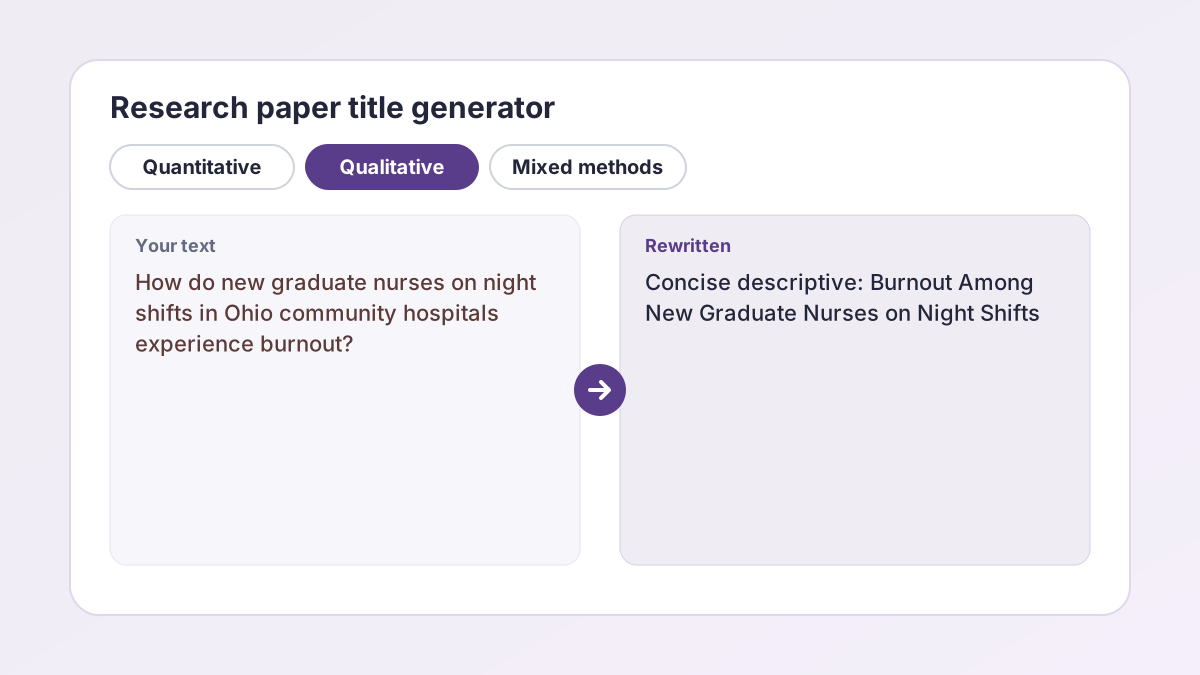
What you giveTopic: How do new graduate nurses on night shifts in Ohio community hospitals experience burnout? Research approach: Qualitative.
Title excerptConcise descriptive, 8 words: Burnout Among New Graduate Nurses on Night Shifts. Design-appropriate: Experiences of Burnout Among New Graduate Nurses on Night Shifts: An Interpretive Phenomenological Study.
Qualitative wording: experiences, not effects. The design-appropriate title is phrased the way papers of that design are usually titled.
What you giveTopic: Is there a relationship between hours of sleep and quiz scores in AP Biology? Approach: Quantitative. Population: 11th-grade AP Biology students.
Title excerptDesign-appropriate, 12 words: Association Between Sleep Duration and Quiz Scores Among 11th-Grade AP Biology Students.
A survey shows an association, so the title says association. A causal verb is only appropriate for an experiment.
What you giveTopic: Tutoring center use and course completion in developmental math. Approach: Mixed methods. Preferred length: Medium (11–16 words). Setting: a community college.
Title excerptDetailed academic, 16 words: Tutoring Center Use and Course Completion in Developmental Math: A Mixed-Methods Study at a Community College.
Medium length asks for 11 to 16 words. The colon subtitle carries the method and setting.
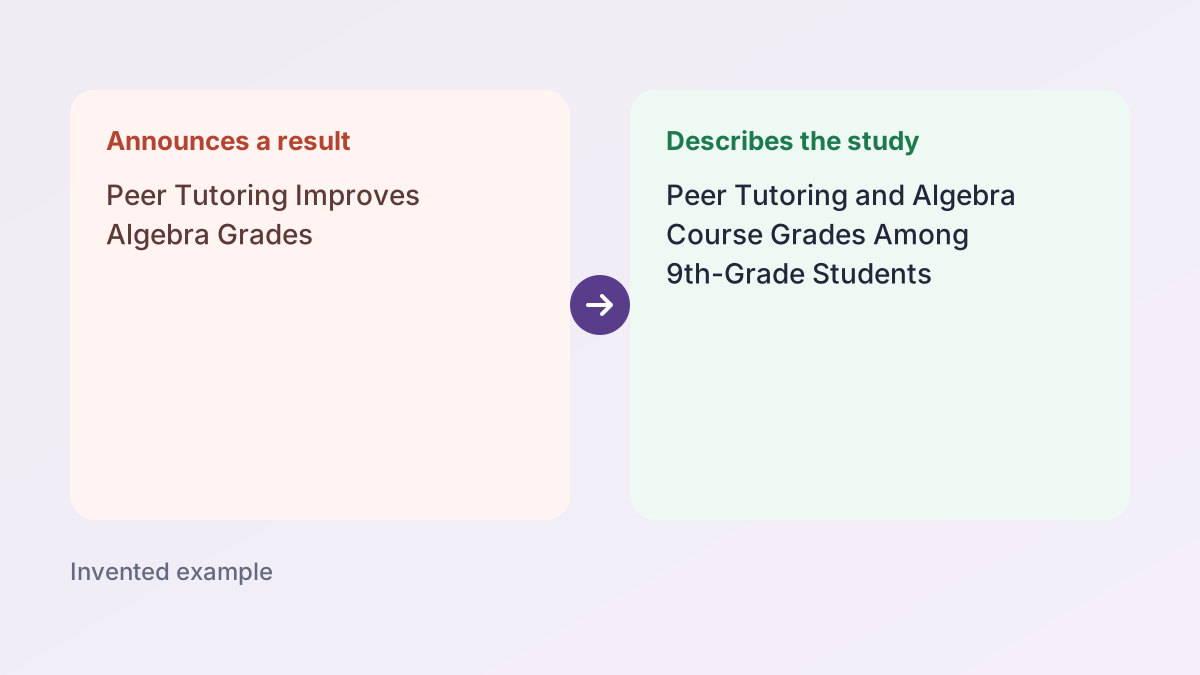
What you giveTopic: Does peer tutoring improve algebra grades in 9th grade? Approach: Not sure yet.
Title excerptConcise descriptive: Peer Tutoring and Algebra Course Grades. Method-focused: A Study of Peer Tutoring and Algebra Grades Among 9th-Grade Students.
The research title generator is told never to state or imply a result, so you get what the study examines, not a claim that tutoring works.
What you giveTopic: Nurse burnout on extended shifts. Setting or location: community hospitals in Ohio. Location in the title: Always include.
Title excerptPopulation-focused: Registered Nurses' Experiences of Burnout on Extended Shifts in Ohio Community Hospitals.
With Always include, the generator is told to put the setting you typed in every title. With Leave out, it is told not to name a country or city.
What you giveRegistered Nurses' Experiences of Burnout and Coping Strategies on Extended Shifts in Community Hospitals in Ohio (16 words).
Title excerptNurse Burnout and Coping on Extended Shifts (7 words).
Shorter aims for 10 words or fewer and keeps the population and focus. More specific, More formal, Plainer and Toggle location work the same way.
How to use the research paper title generator
A title can only be as specific as what you type, so give it the real question and, if you know them, the population and setting.
- Enter your topic or research question. Type it into Topic or research question (up to 600 characters). A saved research question from the Research Question Generator pre-fills this box.
- Open More options if you know more. Choose a Research approach (Quantitative, Qualitative, Mixed methods or Not sure yet) and an Academic level, then add a Study population and Setting or location.
- Set the length and location. Pick a Preferred length (Short, Medium or Long with a subtitle) and decide whether Location in the title is If it matters, Always include or Leave out.
- Select Generate titles. You get five titles, one per style, each labeled with its style and word count, plus a list of keywords readers would search for.
- Compare, change and edit. Use Compare side by side to see all five at once. Under Change this title, choose Shorter, More specific, More formal, Plainer or Toggle location, or Edit the wording yourself.
- Choose and copy. Select Use this title to save it on this device, then Copy title. Copy all five puts the whole set on your clipboard.
What the research paper title generator gives you
A research title has a different job from an essay title. It has to tell a stranger what you studied, in whom and roughly how, and it has to contain the words that person would type into a library database. This research paper title generator is built around that job.
Five titles, one per style
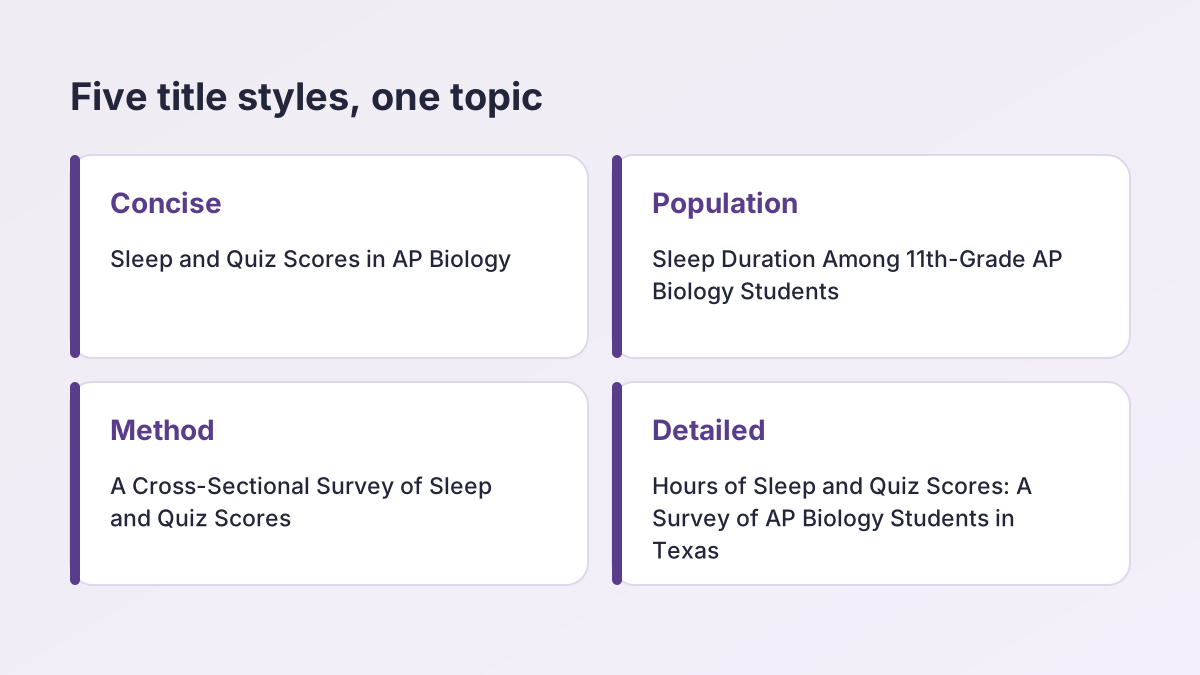
You always get exactly five titles, in the same order:
- Concise descriptive: ten words or fewer, the core topic and population.
- Population-focused: puts who the study is about up front.
- Method-focused: names the approach or data, such as a qualitative study or a cross-sectional survey.
- Detailed academic: a main title, a colon and a subtitle with setting and focus.
- Design-appropriate: phrased the way papers of your design are usually titled, for example "Experiences of…" for qualitative work or "Association between…" for a survey.
What comes with each title
Every title shows its style and word count, plus one sentence on when that style suits a journal article, thesis or conference poster. Under the five titles, the research paper title generator lists keywords a reader would search for (it is asked for four to eight). It also runs checks on the set and, if it finds a problem, tells you what to fix.
What it will not do
It is told not to announce a result, invent a country for your study, add a citation you didn't give it or insert a statistic, and automatic checks flag a title that slips. The sections below explain why each of those matters.
Research title examples by field and style
These research title examples are invented for teaching, including every population and setting. Each is the kind of title the research title generator might return, and each describes a study without announcing a finding.
Nursing (qualitative)
Experiences of Burnout Among New Graduate Nurses on Night Shifts: An Interpretive Phenomenological Study
Psychology (quantitative survey)
Association Between Social Media Use and Self-Reported Sleep Among First-Year College Students
Education (mixed methods)
Peer Tutoring and Algebra Course Grades in 9th Grade: A Mixed-Methods Study of Two Public High Schools
Business (case study)
Customer Retention at a Regional Grocery Chain: A Single-Case Study
Environmental science (lab or field)
Nitrate Concentrations at Upstream and Downstream Sites on an Iowa Creek
What these titles have in common
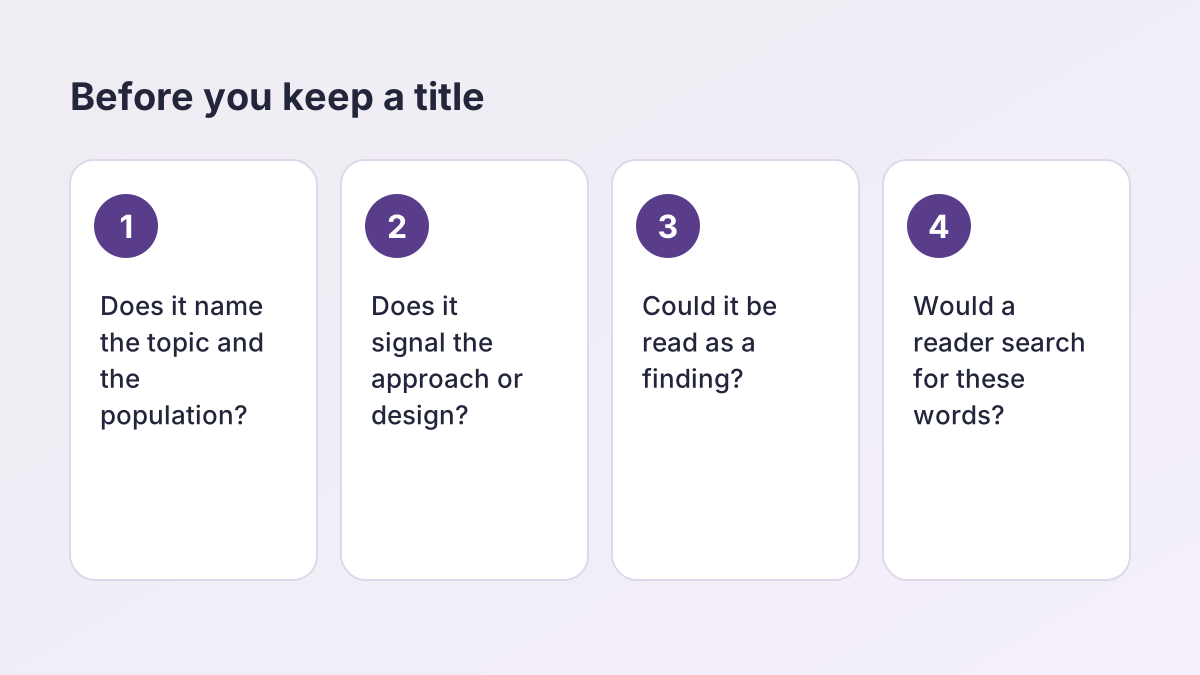
- They name the topic and the population in the first few words.
- They signal the design (study, survey, case study) when the title is long enough to carry it.
- They use neutral verbs or none at all. "Association between" and "experiences of" describe what is examined.
- They contain words a reader would search for: burnout, night shifts, sleep, retention, nitrate.
Your own title will differ, because your topic, population and design differ. Use these as a pattern, not a template to copy.
How to choose a title for research paper assignments
Which of the five styles you pick depends on where the title will live. There is no single correct style, and your instructor's or journal's instructions come first. The table is a rule of thumb, not a rule.
| Style | Often suits | Watch out for |
|---|---|---|
| Concise descriptive | Posters, slides, a short class paper, a header on a lab report | Leaving out the population or the design |
| Population-focused | Studies where the group is the point, such as first-generation students or new nurses | A title that names the group but not the topic |
| Method-focused | Journal submissions and databases where readers filter by design | Repeating the method in both title and subtitle |
| Detailed academic | Theses, capstones and longer papers that can carry a subtitle | Running past a word limit set by your school |
| Design-appropriate | Papers that follow a field convention, such as survey, trial or phenomenology | Borrowing a causal phrase for a study that cannot show cause |
A quick way to decide
- If the assignment gives a word limit, start with the concise or population-focused title.
- If your teacher or professor asks for a descriptive title with a subtitle, start with the detailed one.
- If you are submitting to a student journal or conference, read its guidelines first, then choose the style closest to titles it has published.
- If you are unsure, use Compare side by side in the research paper title generator and read all five together.
Thesis title generator for capstones and dissertations
Students also use this page as a thesis title generator. A thesis, capstone or dissertation title has more room than a class paper title, so the detailed academic and design-appropriate styles usually matter most.
Set your academic level
Under More options, Academic level offers Undergraduate, Master's and Doctoral (or Any level). It tells the research title generator the level you are writing at, so the wording can match a senior capstone or a graduate thesis. It does not change what the title is allowed to claim.
Use the long setting for a subtitle
Set Preferred length to Long (17–25 words, with subtitle) when you want a main title and a colon subtitle that names the setting and the focus. The research paper title generator is told to aim for 17 to 25 words in that case.
Keep the title in step with your proposal
Many programs expect the title to match the research question and purpose statement. If you change the question during the project, regenerate the title so the two still agree. A saved research question pre-fills the topic box, which makes that easy. Draft the question first with the Research Question Generator and the aims with the Research Objective Generator.
Research title generator: what it checks and what it won't invent
A research title generator that sounds impressive but quietly adds claims is worse than no generator. This one is built with limits you can see.
No results announced
The research title generator is told to describe what the study examines and never to state or imply a result. Words such as "improves", "reduces", "evidence that", "why X works" and "a significant association" are off limits. If a title does read as if the study is finished and found something, a check flags it and suggests wording such as "a study of", "exploring" or "the relationship between".
Wording that matches your approach
- Qualitative: titles use words like experiences, perceptions, accounts, exploring and understanding, not effect or impact.
- Quantitative: titles name the variables and the relationship being examined, such as association between, relationship between or predictors of. Causal verbs are only used if the design is experimental.
- No approach chosen: the research paper title generator infers the approach from your question and keeps all five titles consistent with it.
Your population and setting, exactly as typed
It uses the population and setting you give it and is told not to invent a country. If you leave them blank, the titles stay general rather than guessing.
No made-up numbers or citations
If a title contains a statistic, such as a percentage or a sample size, or a citation, such as an author and year, that is not in your input, a check flags it. A title rarely needs either.
Still your job
These checks catch common problems. They do not know your assignment, your instructor's preferences or your field's habits. Read each title as a reader would.
Titles that sound like findings, and how to fix them
The most common problem in student titles is a title that announces an answer before the study exists. Here are patterns to watch for, with invented examples.
Common fixes
- A causal verb for a survey: "Social Media Causes Poor Sleep" becomes "Association Between Social Media Use and Self-Reported Sleep Among College Students."
- A promise: "How Peer Tutoring Raises Grades" becomes "Peer Tutoring and Course Grades in Algebra."
- A bare topic: "Stress in Nursing" becomes "Sources of Stress Among First-Year Nursing Students During Clinical Placements: A Qualitative Study."
- A clever phrase with no information: "Waiting Game" needs a subtitle that names the setting and the topic.
Title length, colons and APA formatting
How long should a research title be?
There is no universal limit. APA's own guidance says there is no maximum length for titles, but that you should keep titles focused and include key terms (APA Style title page guidance). Your instructor, school or journal may set a word limit, so check before you finalize. The research title generator's Short, Medium and Long settings ask for 10 words or fewer, 11 to 16 words and 17 to 25 words.
The colon
A colon splits a longer title into a main title and a subtitle. The part before the colon should make sense on its own. The part after adds the population, setting or design.
Formatting the title in APA
For an APA 7 title page, the same APA page says to center the title, set it in bold, place it three to four lines down from the top, and capitalize the major words. A main title and any subtitle can go on separate double-spaced lines if you like. Your instructor's instructions come first.
Where the finished title goes
Once you have chosen a title, put it on the cover page. Our guide to the research paper title page shows what goes on that page in APA, MLA and Chicago, and the APA Title Page Generator builds an APA 7 page for you. Check the final word count with the Word Counter.
Keywords: make the title easy to find
Under the five titles, the research paper title generator lists terms a reader would search for. It is asked for four to eight, with no names or numbers.
Why keywords matter
Library databases and search engines match the words in your title and abstract. A title made only of clever or vague words is hard to find. A title that contains your topic, population and design words is easy to find.
How to use the list
- Check that your two or three most important keywords appear in the title you chose.
- Reuse the same keywords in your abstract and, if your instructor asks for keywords, in the keywords line.
- Drop terms that only describe your own course, such as an assignment number.
From title to the rest of your research paper
Most students write the title near the end, but the tools are connected, so you can use them in either order.
Earlier steps
- Shape the question with the Research Question Generator, or the PICOT Question Generator for nursing and clinical projects.
- Turn the question into aims with the Research Objective Generator.
Later steps
- Draft the opening with the Research Paper Introduction Generator.
- Summarize the finished work with the Abstract Generator.
- Format references with the APA Citation Generator.
Saved on your device
When you select Use this title, the title is saved in your browser on this device, not on our servers. When a research tool reuses something you saved, a bar above its form shows it, with a link to remove it or clear everything saved on this device.
Need an essay title instead?
Research papers and essays call for different titles. For a persuasive or literary essay, try the essay title generator.
Is the research paper title generator free and private?
Yes, it is free with no account.
What happens to your topic
What you type, plus anything you saved from other research tools, is sent to our AI providers (Groq, with Google Gemini as a backup) only to write the titles. The Study Corp does not save it. Our logs record the research title generator name and timing, never your text.
Fair use limits
Each visitor can make 20 generations and 60 refinements an hour, shared across all of our research tools. If you hit the limit, your inputs stay on the page and you can try again later.
Academic integrity
Use the titles to explore wording and to draft. Then choose, edit and rewrite the title in your own words, make sure it matches your paper, and follow your school's rules on AI tools.
Research paper title generator FAQ
Is the research paper title generator free?
Yes. It is free with no account or sign-up. A fair hourly allowance per visitor, 20 generations and 60 refinements shared across the research tools, keeps it fast for everyone.
How long should a research paper title be?
APA says there is no maximum length, but titles should stay focused and include key terms. Your instructor or journal may set a limit, so check first. The research paper title generator offers Short (10 words or fewer), Medium (11 to 16) and Long (17 to 25, with a subtitle).
Should a research title include the method?
It often helps when there is room. Phrases such as a qualitative study, a cross-sectional survey or a mixed-methods study tell readers and databases what the paper is. The method-focused and design-appropriate styles do this for you.
Can the generator write a thesis or dissertation title?
Yes. Set Academic level to Master's or Doctoral and Preferred length to Long, and the detailed academic style gives you a main title with a colon subtitle. Check your program's rules on length and format.
Will the titles claim results I don't have?
They should not. The research title generator is told never to state or imply a result, and a check flags wording that reads like a finding. Titles describe what your study examines.
Does the generator make up locations, numbers or citations?
It is told to use only the population and setting you give it, and checks flag statistics or citations that are not in your input. You are still responsible for the final title.
What are the five title styles?
Concise descriptive, population-focused, method-focused, detailed academic and design-appropriate. Each title comes with a note on when it suits a journal article, thesis or conference.
Is my topic saved or shared?
It is sent to Groq, with Google Gemini as a backup, only to generate the titles, and The Study Corp does not save it. Use this title saves the chosen title in your browser on your device only.
More free research tools
- PICOT Question GeneratorA well-formed PICOT question with each element labeled and a ready PubMed search.
- Research Question GeneratorThree to five answerable research questions from your topic.
- Abstract GeneratorA structured abstract built only from the findings you give it.
- Research Paper Introduction GeneratorA paragraph-by-paragraph introduction draft built from your question and sources.
- Research Objective GeneratorA general objective and specific objectives that match your question.
- Research Problem GeneratorA problem statement built from your topic and the evidence you have.
- Purpose Statement GeneratorA purpose statement that matches your question, design and participants.
See all 80 free tools for students
Related tools
Last updated by The Study Corp editorial team.