Acrostic poem generator examples
Names and words students typed and one of the two acrostic poems that came back. The bold first letters spell the word.
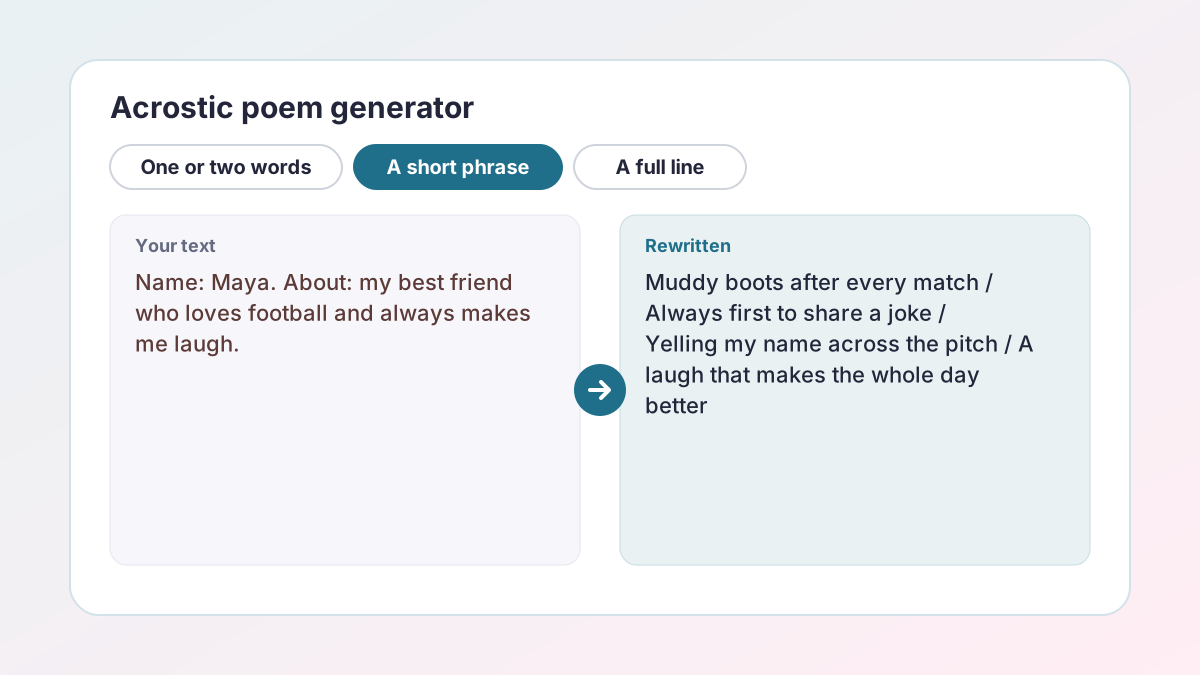
You typedMaya. My best friend who loves football and always makes me laugh.
Acrostic poemMuddy boots after every match / Always first to share a joke / Yelling my name across the pitch / A laugh that makes the whole day better
Short phrases with real details (football, jokes) make the name poem personal.
You typedSPRING
Acrostic poemSoft rain on the window / Pale green on every branch / Robins back in the garden / Insects waking in the grass / New light in the evenings / Gardens slowly coming back
Each line adds a new image, so the poem moves rather than repeating itself.
You typedKIND
Acrostic poemKnowing / Including / Noticing / Doing
One word per line works well for short words and younger writers.
You typedMATHS
Acrostic poemMy calculator is my best friend / And fractions are my enemies / There's always one more question / Homework that never seems to end / So why do I secretly like it?
A funny acrostic ends with a twist on the last letter.
You typedNANA. She grows tomatoes and tells stories about when she was young.
Acrostic poemNever too busy for one more story, / And always a tomato warm from the vine, / Nothing she won't fix with tea and a biscuit, / A garden of a person, full of sun.
Full lines read as one connected poem, with a comparison in the last line.
You typedLEO. I love drawing, I'm quiet but curious, and I want to be an architect.
Acrostic poemLines and shapes fill every notebook / Every building is a puzzle I want to solve / Only quiet on the outside, full of questions within
An acrostic about yourself is a classic first-week-of-school task.
How to use the acrostic poem generator
The more the tool knows about the name or word, the more personal the poem.
- Type the name or word. Enter a name, word or short phrase of 2 to 20 letters. Spaces, numbers and punctuation are skipped.
- Say what the poem is about. Optionally describe the person or thing: hobbies, a memory, what makes them special.
- Choose a line style. One or two words per line, a short phrase, or a full line of verse.
- Pick a mood. Joyful, loving, funny, hopeful, calm or reflective.
- Write and personalise. Select Write my acrostic to get two poems. Keep the lines you like and change the rest so it sounds like you.
What is an acrostic poem?
An acrostic poem is a poem in which the first letter of each line, read from top to bottom, spells out a word, a name or a message. The word is usually the subject of the poem, so an acrostic for SPRING describes spring and an acrostic for MAYA is about Maya.
The Poetry Foundation's glossary defines the acrostic as a poem in which the first letter of each line spells out a word, name or phrase when read vertically. Acrostics are one of the oldest word games in poetry. They appear in ancient Greek and Latin verse, in medieval manuscripts and in Victorian puzzle books.
A famous example
Lewis Carroll ended Through the Looking-Glass (1871) with the poem “A Boat beneath a Sunny Sky”. Its first letters spell ALICE PLEASANCE LIDDELL, the full name of the girl who inspired Alice's Adventures in Wonderland. Most readers never notice, which is part of the charm: a good acrostic reads well across even if you never look down.
Variations on the form
- Standard acrostic: the hidden word runs down the first letters.
- Mesostic: the word runs down the middle of the lines.
- Telestich: the word runs down the last letters.
- Double acrostic: both the first and last letters spell words.
The acrostic poem generator writes standard acrostics, the kind teachers set and people write for cards.
Acrostic poem maker: three line styles
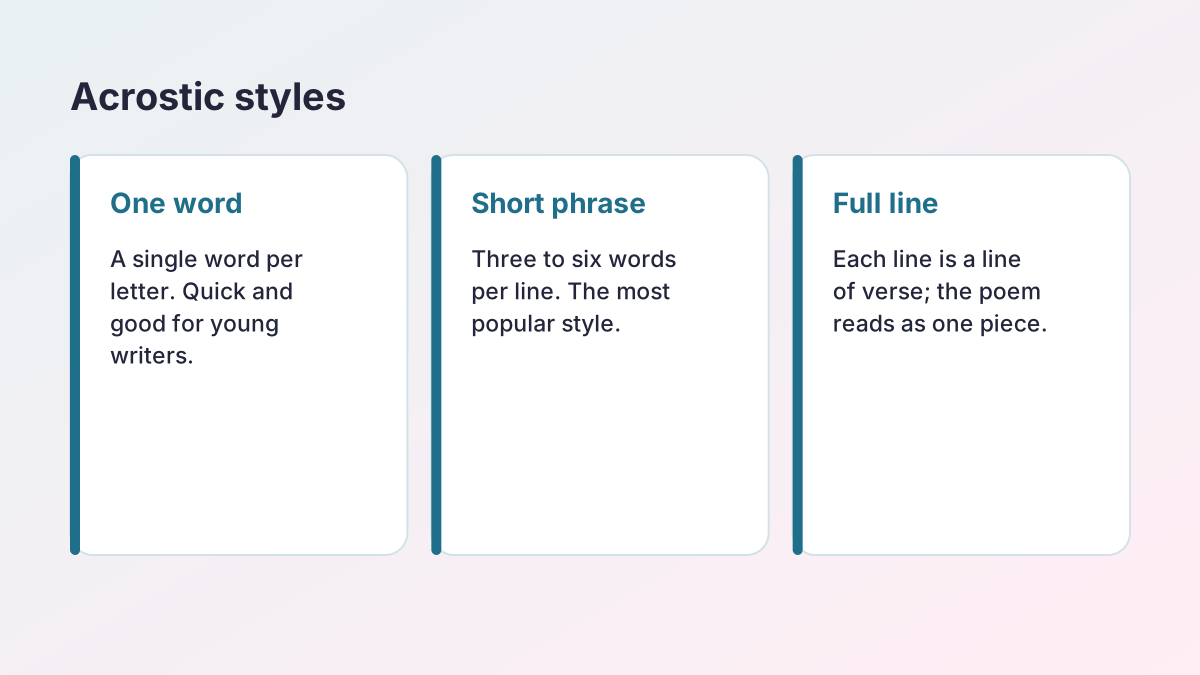
The acrostic poem maker writes in three styles. Which one you choose depends on how long the word is, who will read it and how much you want to say.
One or two words per line
The simplest style, often the first acrostic children write. Each letter starts one word or a short pair: Knowing, Including, Noticing, Doing. It suits short words and values, and it is quick to illustrate on a poster.
A short phrase per line
The most popular style. Each line is a phrase of three to six words, long enough to hold a real detail: Muddy boots after every match. This is the default in the acrostic poem maker because it balances meaning and ease.
A full line of verse
Each line is a complete line of poetry, and the lines flow together as one poem, often with a comparison or a final twist. This is the style to choose for a card, a gift or a poem you will read aloud.
Long words and names
For a long word such as FRIENDSHIP (ten letters), short phrases keep the poem readable. For a short name such as AMY, full lines give each letter more room, which is why the name poem generator lets you choose. The tool accepts up to 20 letters; for longer phrases, try a key word instead.
Name poem generator: write an acrostic for anyone
An acrostic name poem is one of the most personal things you can write for someone. The person sees their name in the poem and knows it could only be about them. Used as a name poem generator, the tool turns a name and a few details into two poems to choose from.
What to put in the details box
The best name poems are built from specific details. Instead of “she is nice”, give the tool something only she would recognise:
- Hobbies and passions: football, drawing, baking, a favourite band
- A habit: always early, always humming, always the first to help
- A memory: the trip to the beach, the day you met
- A quality you admire, shown through an action
Name poems for occasions
- Birthdays: choose Joyful and a short phrase per line, then write it inside the card.
- New babies: choose Loving and full lines, and print it for the nursery wall.
- Teachers and coaches: a thank-you acrostic with one real memory per line.
- Friends moving away: choose Reflective and end with a hopeful last line.
Names with tricky letters
Letters like X, Z and Q are hard. The name poem generator handles them by starting the line with a word such as eXtra or Zest, or by using a less common word. If a line feels forced, regenerate or swap in your own word.
How to write an acrostic poem by hand
Writing an acrostic yourself is a quick, satisfying exercise, and it is common in primary and early secondary school. Here is a method that works every time.
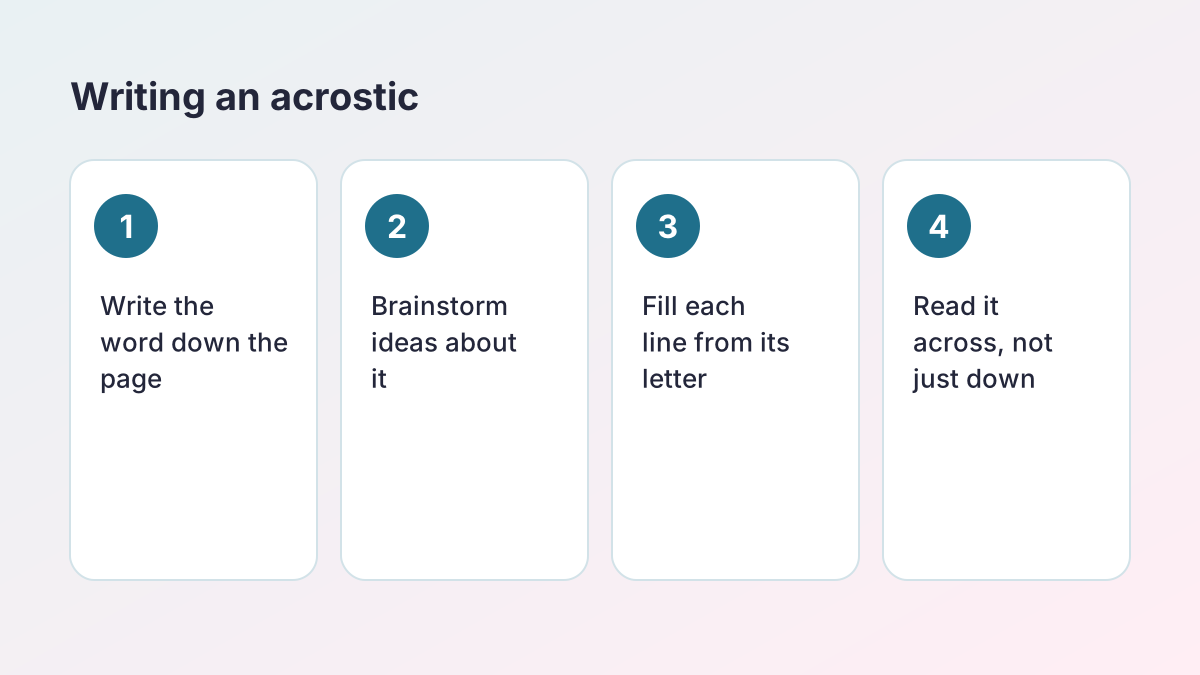
- Write the word down the left side of the page, one letter per line, in capitals.
- Brainstorm. Before filling any lines, list everything you know about the subject: words, images, memories, feelings. You will pick from this list.
- Start with the easy letters. Fill the lines whose letters match words from your list. Leave the hard letters until last.
- Solve the hard letters. Use a dictionary or thesaurus, start the line with a short word (And, Every, Under), or rephrase the idea so it begins with the letter you need.
- Read across, not just down. An acrostic should make sense as a poem, not only as a puzzle. Read it aloud and fix any line that sounds forced.
- Polish the first and last lines. Open with something vivid and end with a line that sums up or surprises.
Tips for stronger acrostics
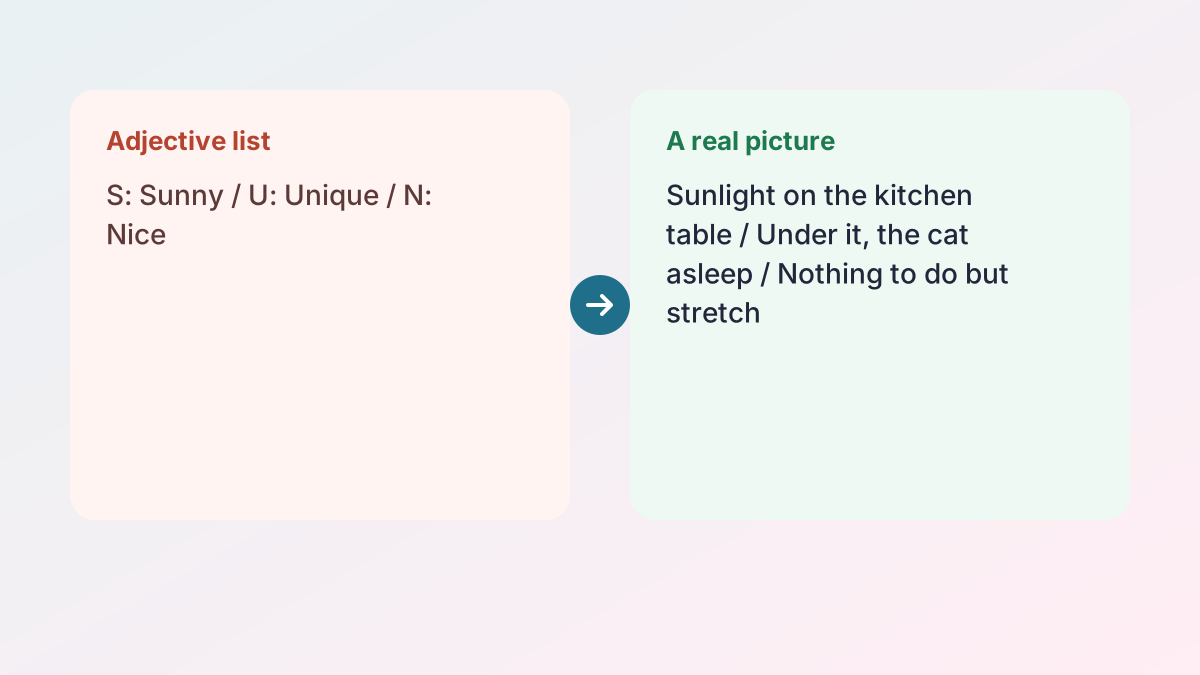
- Avoid a list of adjectives (Sunny, Unique, Nice). Images and actions are more interesting.
- Let a sentence run across two or three lines; it does not have to stop at each letter.
- Use the senses: what does the subject look, sound and feel like?
- Keep a rhythm. Lines of similar length are easier to read aloud.
Acrostic poem about yourself
“Write an acrostic poem using your name” is one of the most common first-week tasks in school, because it helps teachers and classmates get to know you. Here is how to make it good.
Choose three kinds of detail
Mix what you like (hobbies, food, music), what you are like (curious, loud, patient) and what you hope for (a goal, a dream job, a place you want to see). Lines that show all three give a fuller picture of you.
Show, don't list
Compare “Likes drawing” with “Lines and shapes fill every notebook”. The second line shows the same fact in a way people remember.
Use the generator for ideas
Type your name into the acrostic poem generator, then list a few things about yourself in the details box. Read both poems, notice which lines feel true, and rewrite the others. The final version should sound like you, not like the tool.
Adding your surname
If your first name is short, add your surname or a nickname for a longer poem. Or write two acrostics, one for each name, and display them side by side.
Acrostic poems for kids and classrooms
Acrostics are a favourite in primary classrooms because the form gives children a ready-made structure: every line has a starting letter, so the blank page is never fully blank. They work well for spelling, vocabulary and topic work.
Classroom ideas
- Topic words: write an acrostic for a science or history topic (VOLCANO, ROMANS, PLANETS) to show what pupils have learned.
- Spelling practice: an acrostic for a tricky word helps fix its letters in memory.
- Seasons and festivals: AUTUMN, WINTER, DIWALI, EID, HANUKKAH and CHRISTMAS are popular.
- Class values: RESPECT, KINDNESS and TEAMWORK posters.
- Character studies: an acrostic for a character's name, with each line showing a trait and evidence from the book.
Using the tool with younger writers
Choose “One or two words” for the youngest pupils. Generate a poem with the acrostic poem maker as a model, talk about why each word fits, then let pupils write their own. The poem generated here is a starting point; the learning happens when they make their own choices.
Differentiation
Confident writers can try full lines, a rhyme scheme or a double acrostic. Writers who find it hard can start with one word per line and add a second word later.
How the acrostic poem generator checks every line
Many tools that write acrostics get the letters wrong, so the acrostic poem maker does not trust the first draft: a line starts with the wrong letter, or the poem has one line too many. This tool checks every poem before you see it.
Letters first
The name or word is reduced to its letters. Spaces, numbers, hyphens and punctuation are skipped, and accented letters are matched to their plain form, so Zoë-Ann becomes ZOEANN.
Line by line
When the poems come back, each one is checked: it must have exactly one line per letter, and each line must begin with the correct letter. Any poem that fails is discarded, so the poems you see always spell the word.
Why you sometimes get one poem
If one of the two poems fails the check, you see only the one that passed. Select the button again for a fresh pair.
Acrostic poems for key terms: the free enterprise example
Acrostics are not only for names. In economics, history, science and social studies, teachers set them to check that you understand a key term: every line has to say something true about it. A common example is the free enterprise acrostic poem, and the acrostic poem generator can help once you have the facts.
Step 1: list the facts before the letters
Write down what the term means and what belongs to it. Free enterprise is an economic system in which private individuals and businesses own property, decide what to produce and compete for customers, with limited control from the government. Your fact list might include private property, the profit motive, competition, voluntary exchange, consumer choice, entrepreneurs and risk.
Step 2: match facts to letters
FREE ENTERPRISE has 14 letters, so you need 14 lines. Fill the letters that match words on your list first, such as P for private property. Then plan the repeats: the letter E appears five times, so give each E line a different opening (Entrepreneurs, Exchange, Every, Earning, Economic). The acrostic poem generator checks the letters for you, but only you can check the facts.
An acrostic poem for free enterprise
This invented example uses a short phrase per line:
- Freedom to start a business of your own
- Risks taken in the hope of a reward
- Entrepreneurs with new ideas
- Exchange that both sides agree to
- Every buyer free to choose
- No single company setting every price
- Trade guided by supply and demand
- Earning a profit as the motive
- Rivals competing for customers
- Property owned by people, not the state
- Rules from government kept limited
- Innovation driven by competition
- Savings invested in new businesses
- Economic choices made by individuals
Check it like a marker
- Is every line accurate? Teachers mark the content, not just the letters.
- Does each line add a new idea, rather than repeating the word in the title?
- Could you explain each line if your teacher asked?
Compare with the acrostic poem generator
Once your own version is done, type FREE ENTERPRISE (spaces are skipped), choose A short phrase, and paste your fact list into “What should the poem say?”. Check every line the acrostic poem generator writes against your notes and keep only what is accurate. The same method works for any term of up to 20 letters, such as PHOTOSYNTHESIS, DEMOCRACY or ECOSYSTEM.
Create a poem with a name: messages, two names and rhyme
Most name poems spell one first name. Here are three variations, and how to create each one with the acrostic poem generator.
Spell a message instead of a name
An acrostic can spell a short message, such as HAPPY BIRTHDAY, THANK YOU or GET WELL SOON, as long as it has 20 letters or fewer. The acrostic poem generator skips spaces, so HAPPY BIRTHDAY gives a 13-line poem. Choose A short phrase or One or two words for long messages; full lines can make the poem too long to fit inside a card.
Two names in one poem
For a couple, two friends or siblings, type both names into the acrostic poem generator together, such as SAM AND RIA, which gives nine lines. In “What should the poem say?”, describe both people and what connects them, so the lines can move between the two. If one person's lines feel thin, add another detail about them and generate again.
Rhyming acrostics
The acrostic poem generator has no rhyme setting, so rhyme is not guaranteed. To add it yourself, choose A full line, pick the version you like best, then rework the line endings in pairs (AABB). Changing the end of a line is easier than changing its start, because the first letter is fixed. Read the result aloud: if a rhyme forces an odd word, keep the meaning and drop the rhyme.
Name poem maker checklist
Before you share a name poem, check:
- The spelling. The acrostic poem generator matches the letters you type, so make sure you typed the name the way the person spells it (Ana or Anna?).
- The details. Every line should be true and kind about the person.
- The sense. Read it across, ignoring the letters. Does it still work as a poem?
- The voice. Change any line that doesn't sound like something you would say.
Whether you write it by hand or start from the acrostic poem generator, the best name poems include at least one detail only you could know.
Is the acrostic poem generator free and private?
Yes. The acrostic poem generator is free, with no account or sign-up. A fair hourly allowance per visitor keeps it fast for everyone.
The name and details you type are sent to our AI providers (Groq, with Google Gemini as a backup) only to write the poems you see. The Study Corp does not save them. Poems are kept suitable for school: kind, with no explicit or unkind content.
If you want a different kind of poem, try the Poem Generator for free verse, haiku and sonnets, or lay your acrostic out in a heart or star with the Shape Poem Generator.
Acrostic poem generator FAQ
Is the acrostic poem generator free?
Yes. It is free with no account or sign-up. A fair hourly allowance per visitor keeps it fast for everyone.
What is an acrostic poem?
A poem in which the first letters of the lines, read downwards, spell a word, name or message, usually the poem's subject.
How long can the name or word be?
From 2 to 20 letters. Spaces, numbers and punctuation are skipped, and accented letters count as their plain letter.
Does every line really start with the right letter?
Yes. Each poem is checked line by line before you see it, and any poem that does not spell the word exactly is discarded.
Can I use it as a name poem generator?
Yes. Type the person's name and add details about them for a personal acrostic name poem.
What is the easiest way to write an acrostic poem?
Write the word down the page, brainstorm ideas about it, fill the easy letters first, then solve the hard ones and read the poem across.
Can I hand in a generated acrostic for school?
Check your teacher's rules. Use the tool for ideas and models, then write the final poem in your own words.
How do I write an acrostic poem for free enterprise?
List the key ideas first: private property, profit, competition, voluntary exchange and consumer choice. FREE ENTERPRISE has 14 letters, so you need 14 lines, five of them starting with E. You can type it into the acrostic poem generator, add your list in the details box, and check every line against your notes.
Can an acrostic poem spell a message like Happy Birthday?
Yes. Any message of 2 to 20 letters works, and spaces are skipped, so HAPPY BIRTHDAY becomes a 13-line poem. In the acrostic poem generator, choose A short phrase so the poem still fits inside a card.
More free writing tools
- Book Title GeneratorTitle ideas for your book, chapters or series, in any genre.
- Essay Title GeneratorTen clear, catchy titles for any essay type, with notes on each.
- Story Title GeneratorOriginal titles for short stories, fan fiction and school stories.
- Poem GeneratorWrite a poem on any topic: free verse, rhyming, haiku, sonnet and more.
- Shape Poem GeneratorLay a poem out inside a heart, star, tree and more, then download it.
- Paragraph ExpanderMake a paragraph or essay longer with explanation, not filler.
- Personal Statement GeneratorDraft a UCAS or college statement and check it against the word limit.
- Introduction GeneratorThree introductions that move from a hook to your thesis.
- Essay Hook GeneratorNine opening hooks for your essay, each a different technique.
- Poetry Prompt GeneratorTen fresh poem prompts on any theme, for any level.
- Random Paragraph GeneratorRandom paragraphs for reading, typing and handwriting practice.
- Thesis Statement GeneratorFive clear, arguable thesis statements for any essay type.
- Essay Outline GeneratorPlan your essay section by section, from thesis to conclusion.
- Topic Sentence GeneratorTopic sentences that tie each body paragraph to your thesis.
- Paragraph GeneratorWrite a clear paragraph from a topic, or turn notes into one paragraph.
- Conclusion GeneratorThree conclusions for your essay, or a concluding sentence for a paragraph.
- Poem Title GeneratorTen title ideas for your poem, from simple to striking.
- Haiku Poem GeneratorHaiku, sonnets and limericks with syllables counted on every line.
- Argumentative Essay GeneratorDraft an argumentative essay with a clear claim, counterargument and rebuttal.
- Persuasive Essay GeneratorDraft a persuasive essay aimed at a real reader, with a call to action.
- Informative Essay GeneratorDraft a clear, neutral informative (expository) essay on any topic.
- Analytical Essay GeneratorDraft an analytical essay that explains how and why, not just what.
- Compare and Contrast Essay GeneratorDraft a comparison essay, point-by-point or block, with a real judgment.
- Scholarship Essay GeneratorDraft a scholarship essay built from your own story and goals.
- Name GeneratorCharacter names for stories and games, 12 at a time, in any genre.
See all 80 free tools for students
Last updated by The Study Corp editorial team.