Sentence expander examples
Each example shows the tone and amount chosen. The expansions develop the writer's idea; any specific evidence still has to come from your own sources.
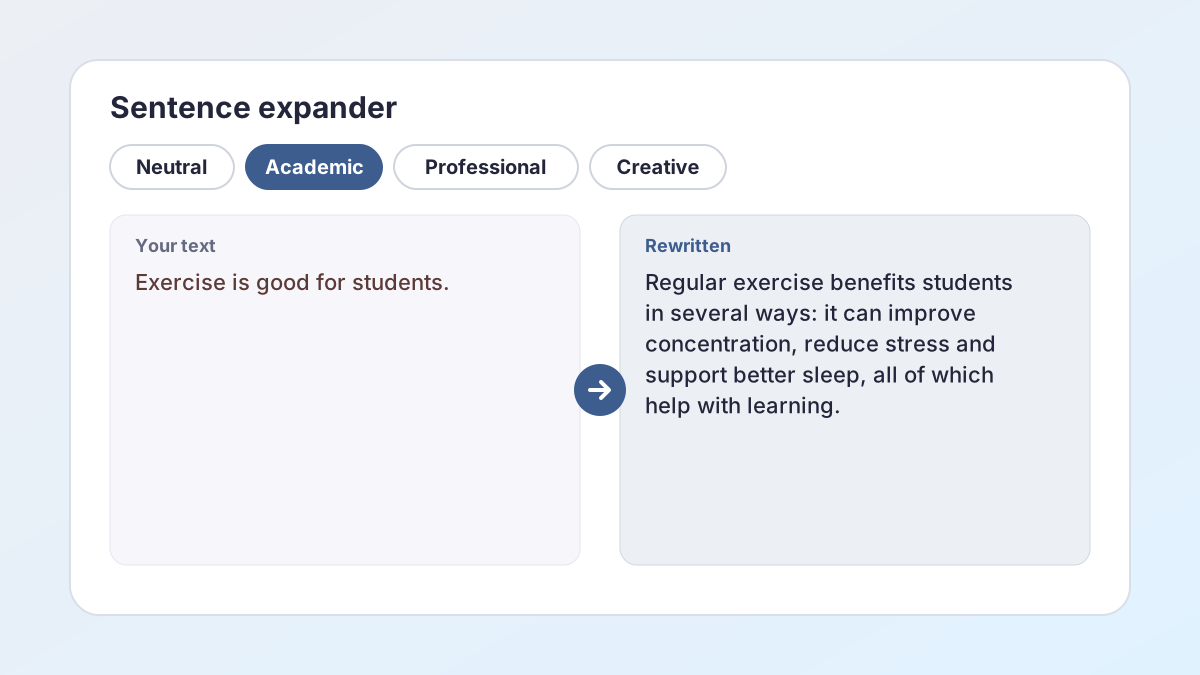
BeforeExercise is good for students.
AfterRegular exercise benefits students in several ways: it can improve concentration, reduce stress and support better sleep, all of which help with learning.
General benefits, carefully hedged with “can”; add a source for any specific claim.
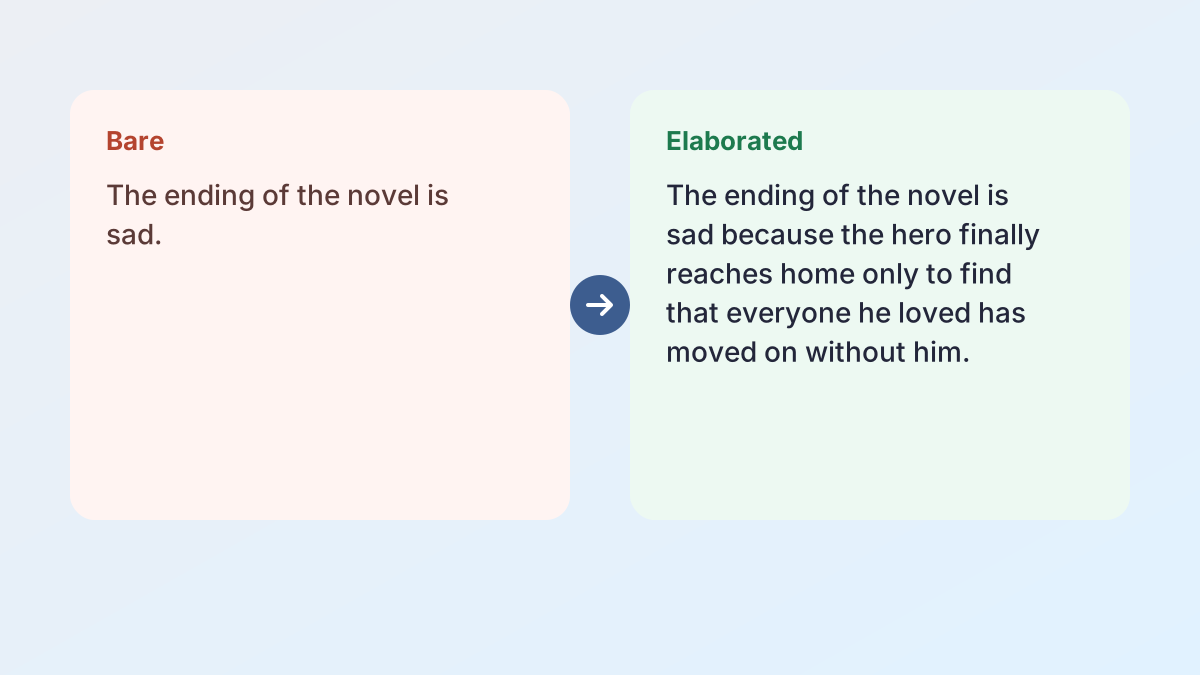
BeforeThe ending of the novel is sad.
AfterThe ending of the novel is sad, because the hero finally gets home only to find that life there has moved on without him.
Adds the “because” the reader needs; uses only what the essay already knows.
BeforeI am interested in the internship.
AfterI am very interested in the internship and would welcome the chance to learn from your team and contribute to your projects.
Adds purpose and enthusiasm without inventing experience.
BeforeThe forest was quiet.
AfterThe forest was quiet, so quiet that every snapped twig sounded like a door slamming, and even the wind seemed to hold its breath between the trees.
Sensory detail and figurative language for a story.
BeforeThe survey found that 64% of students prefer online submission.
AfterThe survey found that 64% of students prefer online submission, suggesting that most see it as more convenient than handing in paper copies.
The 64% is protected; the addition interprets it cautiously.
BeforeRecycling helps the environment.
AfterRecycling helps the environment by reducing the amount of waste sent to landfill and by cutting the need to produce new materials from scratch, which uses energy and resources.
Explains how, which is what a marker usually wants.
How to use the sentence expander
Paste up to about 400 words: a single sentence, a few bullet notes or a short paragraph.
- Paste your text. Copy the short sentence or paragraph you want to develop and paste it into the box.
- Pick a tone. Neutral for everyday writing, Academic for essays, Professional for applications, Creative for stories.
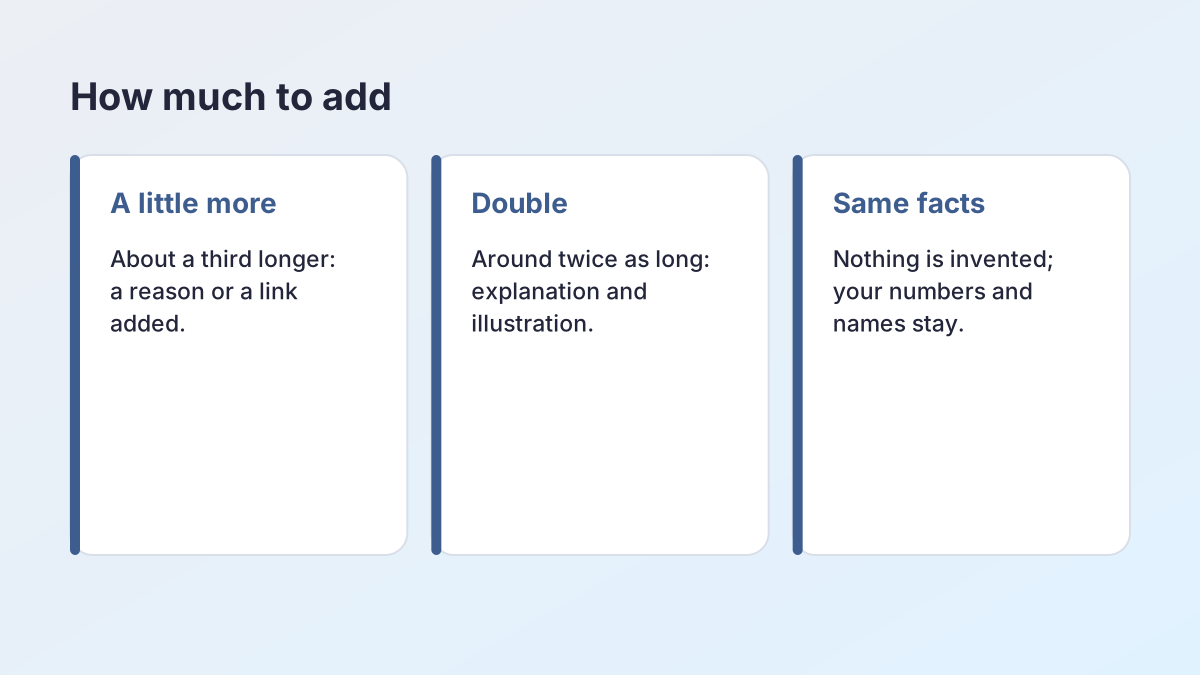
- Choose how much to add. Under More options, choose A little more for about a third longer, or Double for around twice the length.
- Select Expand it. You get several expanded versions. Any version where a number, negative or hedge changed is marked.
- Add your evidence. Pick the version that fits, then add your own examples, quotes or data where the essay needs proof.
What is a sentence expander?
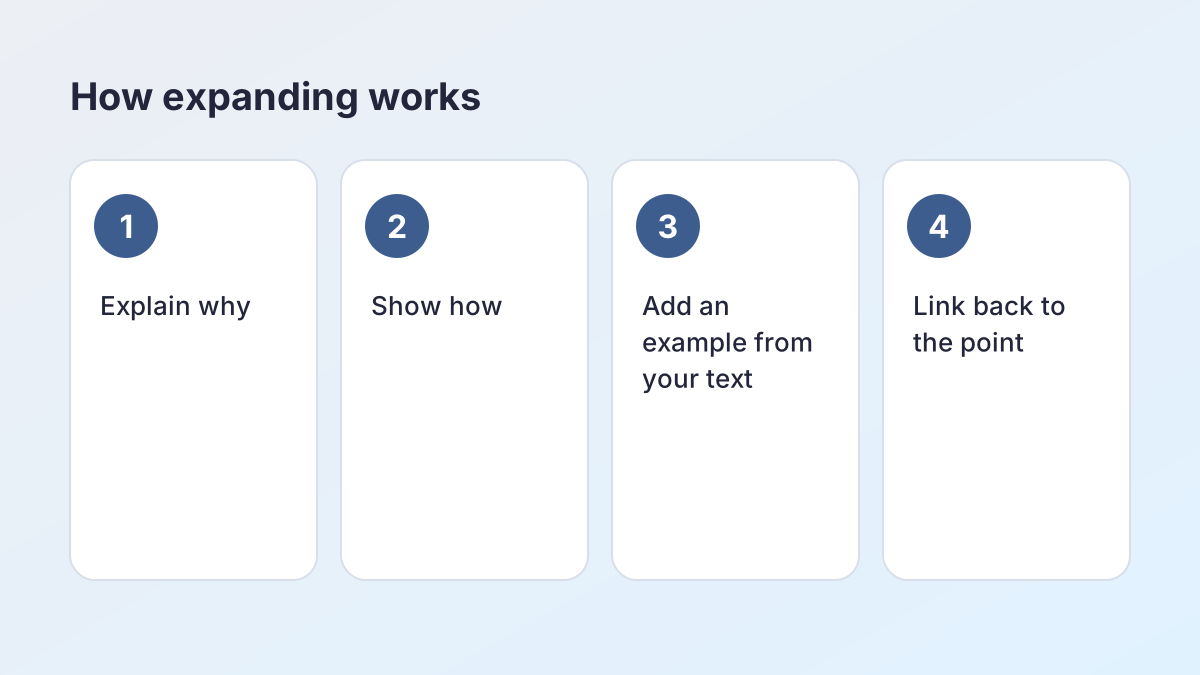
A sentence expander is a writing tool that makes short sentences longer by adding explanation, connection and detail. It takes an idea you have stated briefly and develops it: why it is true, how it works, what it means, or how it links to the next point.
Good expansion adds substance. Bad expansion adds padding: repeated ideas, empty phrases and long words that say nothing new. This sentence expander is instructed to do the first and avoid the second, and it never invents facts, statistics, quotes or sources. If your sentence needs evidence, the expanded version leaves room for you to add it.
Who uses a sentence expander?
- Students whose answers are marked “needs more detail” or “develop this point”.
- Writers turning bullet-point notes into full sentences.
- English language learners who want to write longer, more complex sentences.
- Applicants filling out a form with a minimum word count.
- Story writers who want more description in a scene.
Expanding vs padding
A teacher can always tell the difference. “Exercise is good for students” padded becomes “Exercise is really very good and beneficial for all students in school.” Expanded, it becomes “Regular exercise can improve students' concentration and reduce stress.” The second says more; the first just takes longer to say the same thing.
Elaborate the sentence: four ways to add substance
When a teacher writes “elaborate” in the margin, they mean: tell me more about this idea. When you ask a tool to elaborate the sentence, the result should do one or more of these four things.
1. Explain why
Add a reason. “The policy failed” becomes “The policy failed because it was introduced without enough funding.” Words that signal a reason: because, since, as, due to.
2. Show how
Describe the process or mechanism. “Social media affects sleep” becomes “Social media affects sleep by keeping people on their phones late into the night and exposing them to bright screens.”
3. Give an example
Make the idea concrete. “Many inventions came from accidents” becomes “Many inventions came from accidents; penicillin, for instance, was discovered when mould grew on a forgotten dish.” Use examples from your own notes or sources.
4. Link to the bigger point
Show why the sentence matters to your argument. “This shows that the character is lonely, which explains why she trusts the stranger so quickly.”
The University of Arkansas at Little Rock Writing Center's guide to transitions lists linking words that make each of these moves smooth.
Expand sentence ideas into a full paragraph
A single sentence is often the seed of a whole paragraph. If you have a one-line point, you can expand sentence by sentence into a developed paragraph using a simple structure. One popular version is PEEL:
- Point: the claim, usually your original sentence.
- Evidence: a quote, statistic or example from a source.
- Explanation: how the evidence supports the point.
- Link: how this connects back to your thesis or on to the next paragraph.
Using the tool for each step
Paste your point and choose Double to get an explained version. Then add your evidence by hand, and paste the evidence plus your point to get help with the explanation. Finally, use the Sentence Finisher to draft a linking sentence.
A worked example
Point: “School uniforms reduce bullying.”
Expanded: “School uniforms may help reduce bullying, because when everyone wears the same clothes, differences in family income are less visible.”
Evidence (yours): add a study or survey from your research.
Link: “This suggests that uniforms can support a fairer, more inclusive school environment.”
Notice that the expander made the point clearer and gave a reason, but the evidence still had to come from you.
Why the sentence expander never invents facts
Many AI writing tools “expand” text by adding confident-sounding statistics, studies or quotes that do not exist. In a school essay, that is dangerous: a made-up statistic is easy for a marker to spot, and it can be treated as academic misconduct.
This sentence expander is built to avoid that. It is instructed to add only explanation, connection and description that follow from what you wrote, never new facts, figures, names or citations. Numbers and quotes you typed are protected and come back exactly as written. After expanding, each version is checked: if a number changed or a hedge such as “may” became “will”, the version is marked for you to review.
What you still need to add
An expanded sentence is usually more general than an evidenced one. Where your essay needs proof, add it yourself from your reading. A good rule: every claim that someone could ask “how do you know?” about needs a source.
Hedging stays
If your original said “can” or “may”, the expansion keeps that level of caution. Expanding should develop an idea, not make it sound more certain than your evidence allows.
Meeting a minimum word count the right way
Minimum word counts exist because the task needs a certain depth. The best way to meet one is to add depth, not length. Use the sentence expander on your thinnest points, the ones a reader might question.
Find the thin spots
Read your draft and mark every sentence that makes a claim without explaining it. Those are the ones to expand. A paragraph with one claim and four sentences of explanation is stronger than one with four claims and no explanation.
Add, then check
After expanding, check that each new sentence earns its place. Does it explain, show, illustrate or link? If it only repeats, cut it. Then check your total in the Word Counter.
Over the limit afterwards?
If you overshoot, the Sentence Shortener can trim padding back out while keeping the substance you added.
What not to do
Avoid tricks such as long-winded phrases, needless repetition or extra quotations without analysis. Markers recognise them, and they lower the quality of the work even as they raise the word count.
Sentence expander examples by subject
What counts as useful detail depends on the subject. These short examples show the kind of development each one rewards, so you know what to look for when you choose between the sentence expander's versions.
History
Bare: “The treaty caused resentment.”
Developed: “The treaty caused resentment because many people saw its terms as a punishment imposed by the victors rather than a fair settlement.”
History markers want causes, consequences and perspectives. Add a date or a named group from your notes to make it precise.
Science
Bare: “The plant grew faster in the light.”
Developed: “The plant grew faster in the light, which is consistent with light being needed for photosynthesis to produce the energy for growth.”
Science writing rewards links between results and theory. Keep the language cautious: “consistent with”, “suggests”, “may”.
English literature
Bare: “The poet uses repetition.”
Developed: “The poet repeats the phrase ‘never again’ at the end of each stanza, which creates a sense of finality and reinforces the speaker's grief.”
Literature essays need the technique, the evidence and the effect. A sentence expander can supply the effect; the quotation should come from the text you are studying.
Geography and social sciences
Bare: “Cities are growing.”
Developed: “Cities are growing as people move from rural areas in search of work, which puts pressure on housing, transport and public services.”
Here, the useful additions are the reasons for a trend and its effects on people and places.
The common thread
In every subject, the most valuable expansion answers a question the reader would naturally ask: why, how, so what, or for example? When you compare the versions the sentence expander gives you, pick the one that answers the question your teacher would ask, then add the evidence that proves it.
Expanding sentences in creative writing
In stories and descriptive writing, expanding is about bringing a scene to life. The Creative tone adds sensory detail, figurative language and rhythm.
Use the five senses
“The kitchen was busy” becomes “The kitchen was busy: pans hissed, someone was chopping onions fast, and the air smelled of garlic and burnt toast.”
Show, don't tell
“She was nervous” becomes “She twisted the strap of her bag around her fingers and checked the clock for the third time in a minute.”
Vary the rhythm
Long, flowing sentences slow the reader down; short ones speed them up. Expand the moments you want the reader to linger on and keep action scenes short and sharp.
Keep your voice
Expanded versions are suggestions. Take the details you like, change the ones that do not fit your story, and make sure the result still sounds like you.
Writing longer sentences in English
If you are learning English, short, simple sentences are a natural starting point. Expanding them is how you build more complex grammar. Compare your sentence with the expanded version and look for the structures that were added:
- Conjunctions that join ideas: because, although, while, so that.
- Relative clauses that add information: “The book, which was published in 1949, is still popular.”
- Participle phrases: “Feeling tired, he went to bed early.”
- Prepositional phrases for time, place and manner: after the lesson, in the library, with great care.
Try writing your own expanded version first, then compare it with the tool's. Noticing the differences is a quick way to learn new patterns.
Privacy
The Study Corp does not store your text. It is sent to our AI providers (Groq, with Google Gemini as a backup) only to create the versions you see.
Related tools
- To make writing shorter instead, use the Sentence Shortener.
- To make writing easier to read without changing length, use the Text Simplifier.
- To improve a sentence that sounds awkward, use Say It Better.
- To finish a sentence you are stuck on, use the Sentence Finisher.
- To reword a whole paragraph, use the Paragraph Rewriter.
Sentence expander FAQ
Is the sentence expander free?
Yes. It is free with no account or sign-up. A fair hourly allowance per visitor keeps it fast for everyone.
How do I elaborate the sentence I wrote?
Paste it, choose a tone and how much to add, and select Expand it. You get several developed versions that explain why or how.
Does it add fake facts or sources?
No. It is instructed never to invent facts, figures, names or citations. Add your own evidence where the essay needs proof.
How much longer will my sentence get?
Choose A little more for about a third longer, or Double for roughly twice the length.
How much text can I expand?
Up to about 400 words per run, which is enough for a short paragraph or a set of notes.
Is expanding the same as padding?
No. Padding repeats ideas or adds empty words. Expanding adds explanation, examples and links that make the point stronger.
Can I use it for creative writing?
Yes. Choose the Creative tone for sensory detail and description.
More free rewriting tools
- AI Paraphrasing ToolParaphrase any text, and learn to paraphrase and cite well.
- AI Sentence RewriterFix an awkward sentence and choose from several better versions.
- Paragraph RewriterMake the sentences in one paragraph connect and flow.
- Rewording ToolReword any text in fresh words: emails, reports, applications and more.
- Essay RewriterRewrite a whole essay or paper, paragraph by paragraph, keeping its structure.
- Restate Thesis GeneratorRestate your thesis in new words for the conclusion, keeping the same claim.
- Text SimplifierSimplify text to a reading level: grade 5, grade 7, grade 9 or plain English.
- Sentence ShortenerShorten text or combine it into 1, 2 or 3 sentences, keeping every key fact.
- Sentence FinisherGet five ways to finish a sentence you started.
- Say It BetterFind a better way to say a sentence or phrase, with alternatives.
- Poem RewriterParaphrase a poem line by line, modernise it, or polish your own poem.
See all 74 free tools for students
Related tools
Last updated by The Study Corp editorial team.