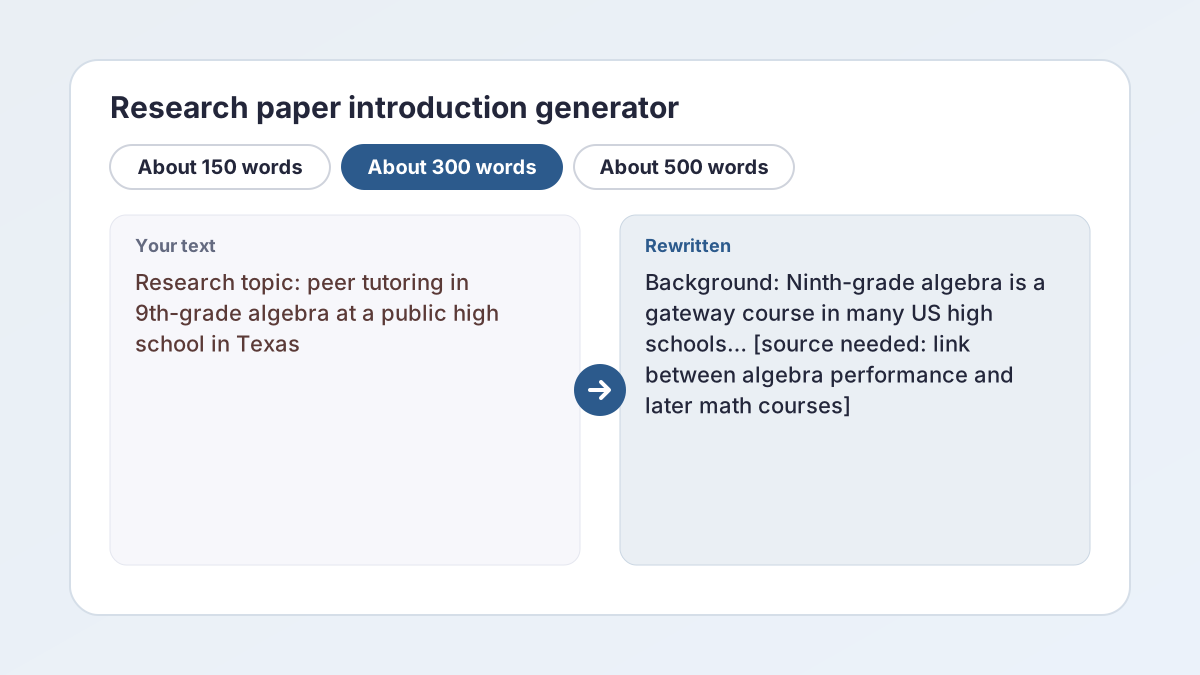
What the research paper introduction generator does with your inputs
Invented inputs from US students and an excerpt of the draft that comes back. These are illustrative: wording changes each time, and every reference, school and finding here is made up.
What you giveResearch topic: peer tutoring in 9th-grade algebra at a public high school in Texas. Target length: About 300 words. References: left empty.
Draft excerptBackground: Ninth-grade algebra is a gateway course in many US high schools. [SOURCE NEEDED: evidence linking algebra performance to later math courses] Peer tutoring is one support schools use. [SOURCE NEEDED: common formats of peer tutoring in secondary schools]
With no references, every factual sentence carries a source-needed note, and the draft says how many places need a source.
What you giveReferences: Rivera & Cho (2022): interviewed 18 teachers about tutoring schedules at two middle schools (invented reference). Research topic: peer tutoring scheduling.
Draft excerptContext: Rivera & Cho (2022) interviewed 18 teachers about tutoring schedules at two middle schools. From your sources: Rivera & Cho (2022): interviewed 18 teachers about tutoring schedules.
It is told to cite only the author and year you typed, and a check flags numbers or citations you did not supply. Anything beyond your sources still gets a source-needed note.
What you giveResearch topic: peer tutoring in 9th-grade algebra. Research question: How do 9th-grade algebra students at two public high schools in Texas experience peer tutoring? References: left empty.
Draft excerptThe gap: To the writer's knowledge, accounts from students at public high schools in Texas appear to be limited; a literature search would be needed to confirm this before it is claimed as a gap.
A gap claim is hedged unless your references establish it, because a gap is something you have to check, not assume.
What you giveResearch topic: why first-generation students at state universities leave after the first year. Target length: About 150 words (essay).
Draft excerptTwo to four short paragraphs: the specific topic, the problem and the purpose, with source-needed notes on every claim about the real world.
Short targets merge or leave out paragraphs. The word count check allows a margin around the target.
What you giveMore options: a saved Purpose statement, saved objectives (the general objective and each specific objective, one per line), Discipline: Education, Academic level: Master's.
Draft excerptPurpose: The purpose of this study is to explore how students describe their experience of peer tutoring. Objectives: This study sets out to describe, explore and understand…
The purpose and objectives paragraphs restate your own wording in prose and do not change your population, setting or approach.
What you giveA problem paragraph that starts abruptly after the background paragraph.
Draft excerptAlthough many schools offer tutoring, how students describe the experience has received less attention…
Add transition adds a one-clause link to the previous paragraph without new claims. Rewrite, Shorter, More formal and More specific are the other options.
How to use the research paper introduction generator
The draft can only use what you give it, so the more of your real material you paste, the less you will have to add afterward.
- Enter your research topic. Type it into Research topic (up to 500 characters). Add your Research question if you have one; a saved question pre-fills it.
- Paste the references you have read. Put the sources you will cite into References you have read, with what each one says. Only these can be cited. Leave it empty if you have none yet.
- Choose a target length. Pick About 150 words (essay), About 300 words (short paper), About 500 words (research paper) or About 800 words (thesis chapter opening).
- Add your own wording under More options. Fill in Problem statement, Purpose statement and Objectives if you have them, then choose a Discipline and Academic level.
- Select Draft my introduction. You get labeled paragraphs, the number of words, and a count of the places where you must add a source.
- Change, check and save. Under Change this paragraph, choose Rewrite, Shorter, More formal, Add transition or More specific, or Edit it yourself. Select Copy introduction, or Save this draft to keep it on this device.
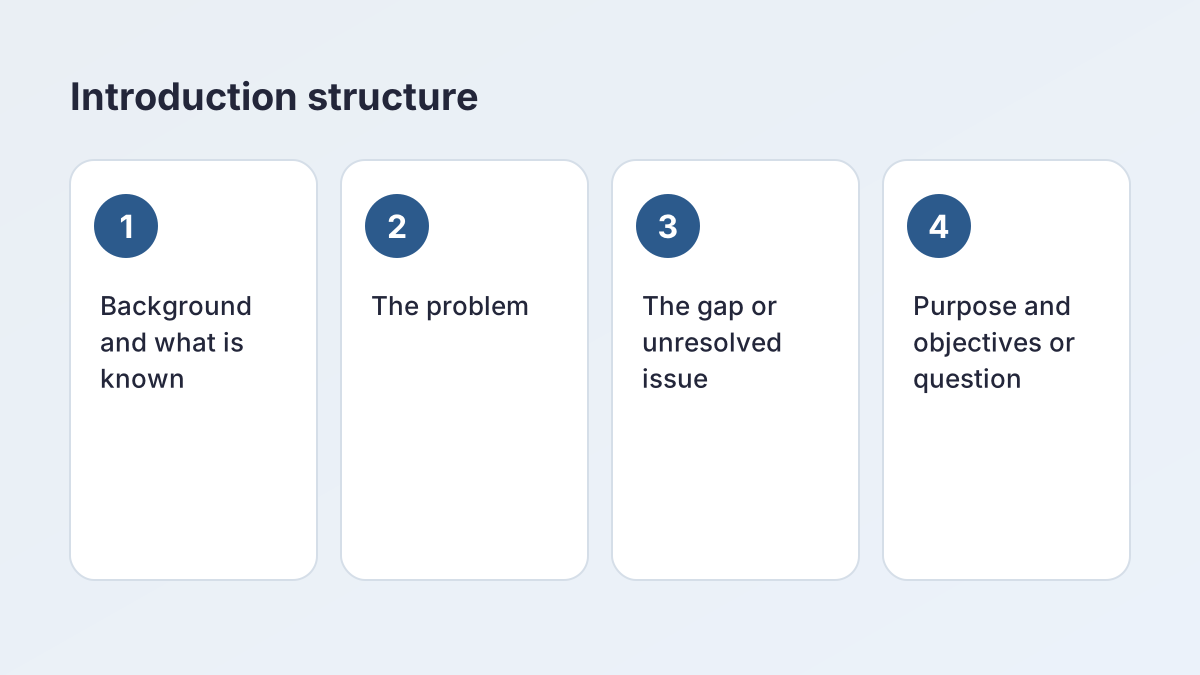
What the research paper introduction generator drafts
An introduction for a research paper sets up the territory, shows the problem, explains what is missing and then states what your study will do. This research paper introduction generator drafts those moves for you in a fixed order and labels each one.
The paragraphs
Depending on the length you pick, the draft has between two and seven paragraphs from this list:
- Background
- Context and what is established
- The problem
- The gap or unresolved issue
- Purpose of this study
- Objectives or research question
- Significance
Evidence-aware by design
The research paper introduction generator opens with your specific topic, population or setting, not with a sentence about the modern world. It is told never to invent a statistic, an author, a year or a journal name, and checks flag numbers and citations you did not supply. Where a claim needs support it leaves a highlighted source-needed note, and the result tells you how many there are.
Who it is for
High school students writing an AP Research paper or a senior project, undergraduates writing a methods paper and graduate students drafting a thesis chapter opening can all use it. For a general five-paragraph essay opening with a thesis and a hook, the introduction generator is the better fit.
Research paper introduction structure: the moves in order
A widely taught research paper introduction structure is John Swales' Creating a Research Space (CARS) model, which USC Libraries summarizes as three moves (USC Libraries on the CARS model). USC's introduction guide spells them out: establish an area, for example by highlighting why the topic matters; identify a niche, for example by revealing a gap or formulating a question; and place your research in that niche by stating the intent of your study (USC Libraries introduction guide). The generator labels each paragraph with one of these moves.
Establishing the territory
The Background and Context and what is established paragraphs say what the topic is and what is already known. This part should be brief; USC notes it should not be a full literature review, which comes next.
Establishing the niche
The Problem and Gap paragraphs show what is unresolved. A gap is a claim you must be able to defend, which is why the research introduction generator hedges it unless your references establish it.
Occupying the niche
The Purpose, Objectives or research question and Significance paragraphs say what your study will do and who might benefit. They restate your own purpose statement, research question and objectives in prose.
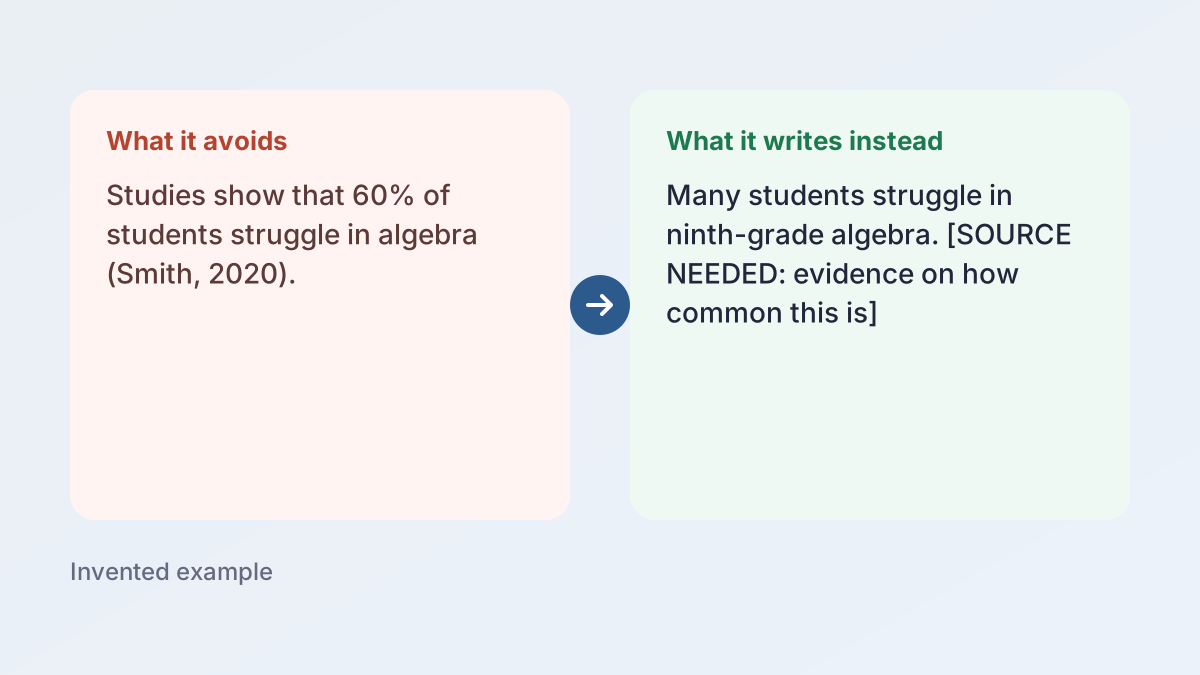
Research paper introduction example with source-needed notes
This research paper introduction example is invented for teaching, including the school, the topic and the framing. It shows the kind of draft the research paper introduction generator produces when you give it a topic and no references. The bracketed notes are what you replace with real citations.
Example draft (about 190 words)
Ninth-grade algebra is a gateway course in many US high schools, and students who struggle in it often face a harder path through later math. [SOURCE NEEDED: evidence linking ninth-grade algebra performance to later math course-taking] Schools use several supports, including peer tutoring, in which older or more advanced students help classmates during or after the school day. [SOURCE NEEDED: definition and common formats of peer tutoring in secondary schools]
Although peer tutoring is widely used, how it is organized and how students experience it varies from school to school, and a teacher choosing a program has little local detail to draw on. To the writer's knowledge, accounts from students at public high schools in Texas appear to be limited; a literature search would be needed to confirm this before it is claimed as a gap. [SOURCE NEEDED: literature search confirming the gap]
The purpose of this study is to explore how 9th-grade algebra students at two public high schools in Texas describe their experience of peer tutoring. Findings could help teachers decide how to organize tutoring time, although any benefit depends on what the study finds.
What to notice
- The opening names the course and the setting, not "since the dawn of time".
- Every claim about the real world has a note, and none has a made-up number.
- The gap is hedged, so you know to check it.
- The significance is conditional, because the study has not been run.
What you do next
Read each note, find a real source you have read, and replace the note with a citation in your style. Paste those sources into the research introduction generator and regenerate, and it will cite only what you gave it.
Research introduction generator: with and without references
The biggest choice on the form is whether to paste references. The research paper introduction generator behaves differently in each case, and both are honest.
When you paste references
- It cites only the sources you pasted, using the author and year exactly as you wrote them.
- Each point taken from a source is listed under From your sources in its paragraph.
- When you supplied references, a message above the draft lists the ones it used, so you can check that nothing extra slipped in.
- Any claim that goes beyond what your sources say still gets a source-needed note.
When you paste nothing
- It cites no one.
- Every sentence that states a fact about the world, such as prevalence, trends, earlier findings or policy, carries a note saying what the citation must show.
- A message above the draft reminds you that nothing has been cited for you.
Writing the reference notes well
Give each source a line that says what it found, not just its name. For example: Rivera & Cho (2022): interviewed 18 teachers about tutoring schedules at two middle schools (an invented source). The more precisely you describe it, the more accurately the research introduction generator can use it.
Introduction paragraph generator for research paper sections
You rarely keep a first draft whole. Treat this as an introduction paragraph generator for research paper work: each paragraph can be changed on its own without losing the rest.
Change this paragraph
Open Change this paragraph under any paragraph and choose:
- Rewrite: different sentence structure, same content, same markers and same sources.
- Shorter: about a third shorter, keeping every source-needed note and source-based point.
- More formal: formal academic prose with no new claims.
- Add transition: a one-clause link from the previous paragraph's idea.
- More specific: general statements replaced with specific ones about your population and setting. Any new factual claim gets its own note.
You can also Edit the text yourself or Copy one paragraph.
Edit the whole thing
Select Copy introduction to put the paragraphs on your clipboard, then paste them into your document and make them yours. Select Save this draft to keep a copy in your browser on this device.
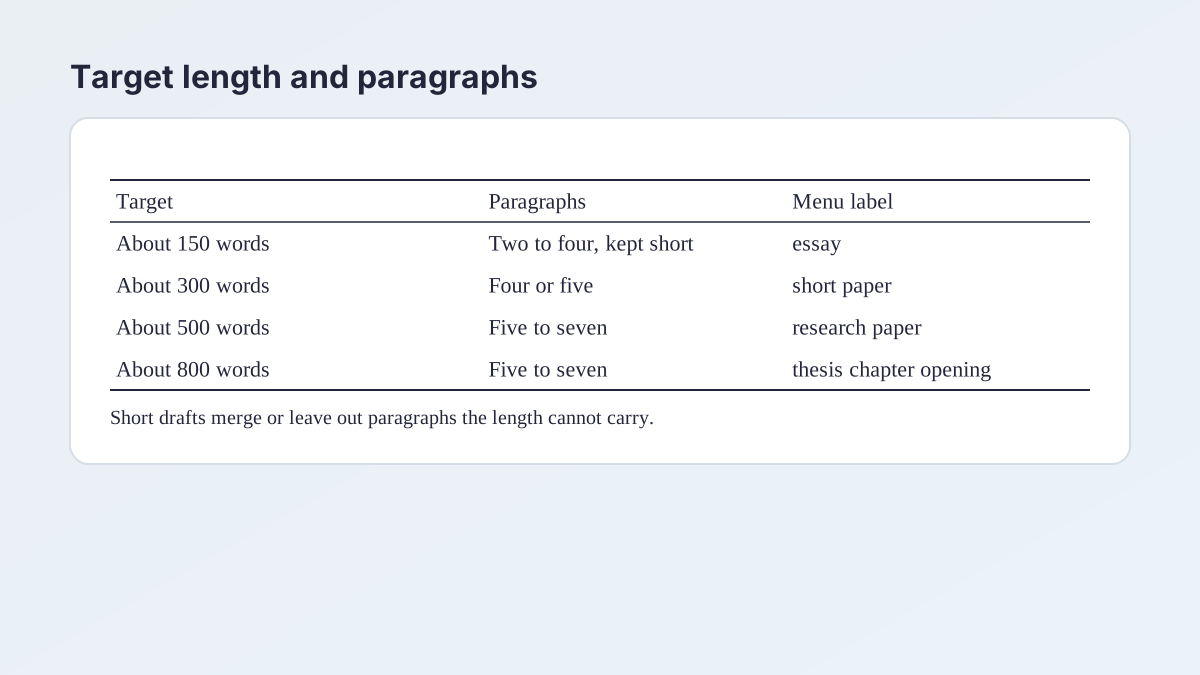
Choosing a length: 150, 300, 500 or 800 words
The Target length menu sets how many words and paragraphs you get. The research paper introduction generator aims for the target, and a check flags a draft that lands well outside it.
| Target length | Paragraphs | Often suits |
|---|---|---|
| About 150 words | Two to four, kept short | A short essay or a lab report opening |
| About 300 words | Four or five | A short research paper or class assignment |
| About 500 words | Five to seven | A longer research paper or journal-style article |
| About 800 words | Five to seven | The opening of a thesis or capstone chapter |
Matching your assignment
Check your rubric or word limit first. Use the Word Counter to check the final count after you edit.
What happens to the extra paragraphs
At shorter lengths the research introduction generator merges or leaves out paragraphs the length cannot carry. A 150-word introduction, for example, may merge the background and problem or leave out a separate significance paragraph.
Gap statements and the checks the research paper introduction generator runs
A weak gap claim is the most common problem in student introductions. "No one has studied this" is rarely true, and when it is wrong it undermines the whole paper.
How the research introduction generator treats the gap
The gap paragraph is hedged unless your references establish it, with phrases such as "appears to be", "to the writer's knowledge" or "would need to be confirmed". A check flags any sentence that states a gap as fact when you have supplied little or no source material.
The other checks
After drafting, the research paper introduction generator runs plain-language checks on the whole draft:
- Generic openers: flags openings such as "in today's society" or "throughout history".
- Numbers you did not supply: flags percentages, counts and similar figures that are not in your input.
- Citation patterns you did not supply: flags an author-year citation that you never gave it.
- Effectiveness claims: flags wording that says something works before evidence has been reviewed.
- Missing source notes: warns if you gave no references and the draft still has no source-needed notes.
- Word count: notes if the draft is well outside your target.
What these do not do
They catch common problems. They cannot judge whether your sources are good or whether your gap is real. That part is research, and it is yours.
Write the introduction last, then revise it
It is normal to draft the introduction early and rewrite it once the paper is finished. The University of North Carolina Writing Center recommends trying to write your introduction last, because your argument may change as you write, and says you will need to revise the introduction so it matches your argument, evidence and conclusion (UNC Writing Center on introductions). USC's guide likewise suggests reviewing the introduction late in the writing process.
A practical routine
- Draft the research question and objectives first.
- Use the generator for a working introduction, with source notes left in.
- Do your reading and replace each note with a real citation.
- Finish the body of the paper.
- Return to the introduction and check that it promises only what the paper delivers.
Not sure where to start?
Our guide on how to write an introduction walks through hooks, background and thesis statements for essays and papers, and explains how an introduction differs from an abstract.
From question to introduction to the rest of your paper
The introduction sits between your question and your findings, so it is easier when those pieces are ready.
Earlier steps
- Shape your question with the Research Question Generator.
- Turn it into aims with the Research Objective Generator. Saved objectives pre-fill the Objectives box here: the general objective first, then each specific objective, one per line.
- State the problem with the Research Problem Generator and your aim with the Purpose Statement Generator.
Later steps
- Pick a title with the Research Paper Title Generator.
- Summarize the finished paper with the Abstract Generator.
- Format references with the APA Citation Generator.
Saved on your device
Select Save this draft and the introduction is saved in your browser on this device only, not on our servers. When this page reuses something you saved, a bar above the form shows it and lets you remove it.
Is the research paper introduction generator free and private?
Yes, it is free with no account.
What happens to your text
What you type or paste, including your references, plus anything saved from other research tools, is sent to our AI providers (Groq, with Google Gemini as a backup) only to write the draft. The Study Corp does not save it. Our logs record the research introduction generator name and timing, never your text.
Fair use limits
Each visitor can make 20 generations and 60 refinements an hour, shared across all of our research tools. If you reach the limit, your inputs stay on the page.
Academic integrity
Use the draft to study how an introduction is built and to get started. Then write in your own words, replace every source-needed note with a source you have actually read, and follow your school's rules on AI tools.
Research paper introduction generator FAQ
Is the research paper introduction generator free?
Yes. It is free with no account or sign-up. A fair hourly allowance per visitor, 20 generations and 60 refinements shared across the research tools, keeps it fast for everyone.
Will it make up citations or statistics?
It is built not to. It is told to cite only the references you paste, using your author and year, and a check flags any number or citation you did not supply. Without references, it marks each factual claim with a source-needed note.
What does the source-needed note mean?
It marks a sentence that states a fact about the world and needs a citation from a source you have read. Replace it with a real citation, or delete the sentence if you cannot support it.
How long should a research paper introduction be?
It depends on your assignment, so check the rubric first. The research paper introduction generator offers about 150, 300, 500 or 800 words, which give two to four, four or five, or five to seven paragraphs.
Can I use it for a thesis or capstone?
Yes. Choose About 800 words (thesis chapter opening) and set Academic level to Master's or Doctoral. Check your program's template, because many have their own.
Can I edit one paragraph without redoing everything?
Yes. Under Change this paragraph you can Rewrite, make it Shorter or More formal, Add transition or make it More specific, or you can Edit it by hand.
Does it include a research gap?
It includes a gap paragraph when the length allows, hedged unless your references establish it. You should confirm any gap with a literature search before relying on it.
Is my topic or draft saved?
It is sent to Groq, with Google Gemini as a backup, only to write the draft, and The Study Corp does not save it. Save this draft keeps a copy in your browser on your device only.
More free research tools
- PICOT Question GeneratorA well-formed PICOT question with each element labeled and a ready PubMed search.
- Research Question GeneratorThree to five answerable research questions from your topic.
- Abstract GeneratorA structured abstract built only from the findings you give it.
- Research Paper Title GeneratorFive accurate titles for your paper from its question and method.
- Research Objective GeneratorA general objective and specific objectives that match your question.
- Research Problem GeneratorA problem statement built from your topic and the evidence you have.
- Purpose Statement GeneratorA purpose statement that matches your question, design and participants.
See all 80 free tools for students
Related tools
Last updated by The Study Corp editorial team.