Introduction Examples: Weak Openings and Stronger Versions
Each pair shows a common first-draft problem and a repaired version. All of the sentences are invented for this guide. Use them as models of how to write an introduction for your own topic and your own research.
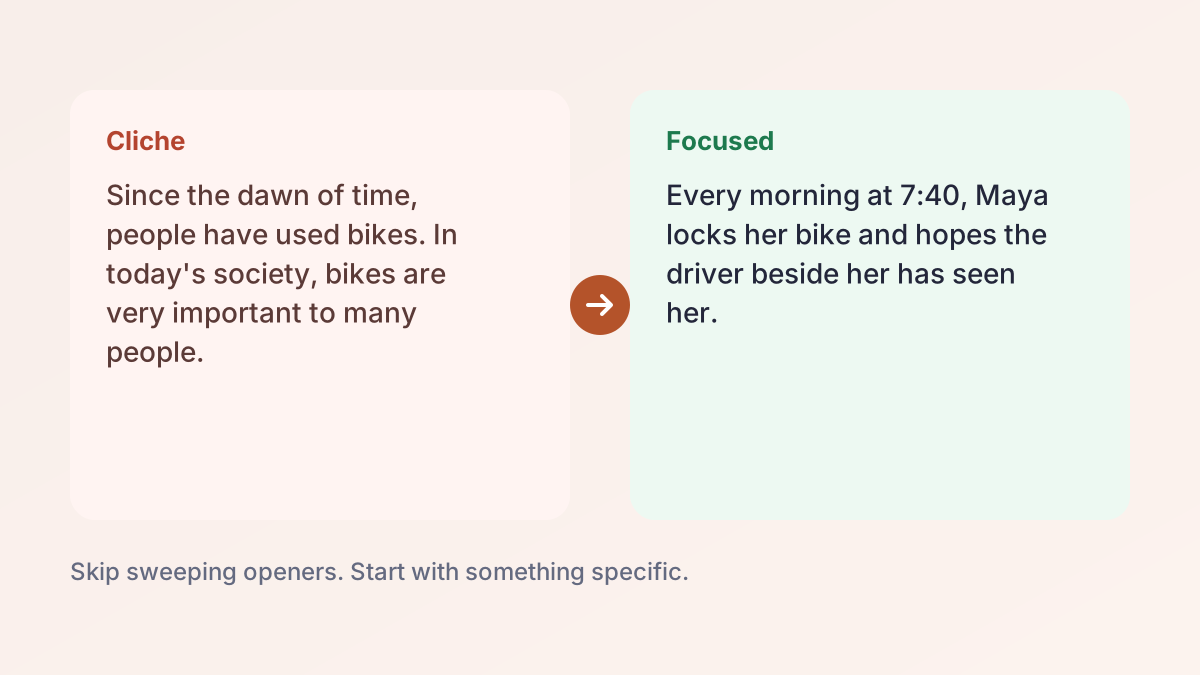
Common problemWebster's dictionary defines education as the process of teaching.
Stronger versionMost students remember a teacher who changed how they saw a subject, and that effect is hard to measure on a test.
A definition rarely says anything about your argument.
Common problemThroughout history, people have always loved music.
Stronger versionWhen a school cuts its music program, the first thing students lose is not a class but a community.
Be specific from the first sentence.
Common problemIn this essay, I am going to discuss school lunches.
Stronger versionSchool lunches should include more fresh food, because students who eat well concentrate better in the afternoon.
Make the claim instead of announcing it.
Common problemThe question asks whether social media is good or bad for teenagers.
Stronger versionSocial media can help teenagers stay connected, but it works against them when it replaces sleep.
Answer the question, don't repeat it.
Common problemPizza is the most popular food in America. Schools should start later.
Stronger versionAt 7:30 a.m., half the room is asleep. Schools should start later, because teenagers need the extra rest to learn.
The hook has to lead to the claim.
Common problemSchools should start later. Many students walk to class. The weather is cold in winter.
Stronger versionMany students walk to class in the dark and the cold. Schools should start later, so that no student crosses town before sunrise.
The thesis normally closes the introduction.
Common problemTechnology is a big part of life. There are many opinions about it.
Stronger versionSmartphones now fit in every pocket in the classroom. Teachers should treat them as tools to manage, not threats to ban.
Say something that could only belong to this essay.
How to Write an Introduction in 5 Easy Steps
These five steps show how to write an introduction for most school essays. You can draft a rough version first and then rewrite it once your body paragraphs are done.
- Know your thesis. Write your main claim in one sentence before you draft the opening. Everything in the introduction leads to it.
- Pick a hook. Choose a question, a scene, a fact, a bold claim, a quotation or a short anecdote that fits your topic and tone.
- Add background. Give two or three sentences of context that explain the topic and why it matters, narrowing toward your claim.
- Place the thesis. End with the thesis statement, so the reader knows the argument that the essay will prove.
- Revise it last. Reread the introduction after you finish the draft and make sure it promises what the essay delivers.
How to Write an Introduction: What It Has to Do
The introduction has three jobs: to attract attention, to give context, and to state your main claim. If you know those three jobs, you know how to write an introduction for almost any assignment. The UNC Writing Center's handout on introductions adds that an introduction should tell the reader what your topic is, why it is important, and how you plan to proceed with your discussion.
Many teachers explain how to write an introduction with the image of a funnel: it begins broad and narrows to your thesis. If you'd like a draft to react to, the free introduction generator writes three versions from your topic and thesis, with a choice of hook and length, and you can rework them in your own voice.
How to write a good introduction for an essay
A good introduction for an essay is short and specific. It doesn't summarize the whole paper, and it doesn't wander. For a five-paragraph essay, most teachers expect something like four to six sentences in the introduction paragraph. For a longer paper, the introduction can run a full paragraph or two. These lengths are conventions, so check your assignment sheet.
Write it last, or at least revise it last
Learning how to write an introduction includes learning when to write it. The UNC handout suggests writing your introduction last, because your argument may shift while you draft. If you need a tentative opening to get started, write one, then replace it once the body is finished. To test a draft, give the opening to a friend and ask what they expect the paper to cover. If they guess right, the introduction works.
How to Write an Essay Introduction: The Funnel
Here is how to write an introduction for an essay in the order the reader meets it. Think of it as three layers, each narrower than the last.
The hook
The first sentence sets the tone. It should say something useful in an interesting way, which is harder than it sounds. A hook can be a scene, a question, a surprising fact or a short quotation, and the next section shows each type in action. Whichever you choose, make sure it points toward your topic.
Intro background
The next two or three sentences give the background a reader needs. Think of zooming a map: move from the wide view toward the exact issue your essay covers. The UNC handout warns against openings that are too broad to connect to the assignment, such as sweeping claims about all of human history. Add only the context a reader needs, and save the evidence for the body.
The thesis statement
End the paragraph with the thesis, the sentence that states your main argument. A strong thesis is specific and debatable, and it often includes a reason. If your wording feels loose, work it out with our thesis statement generator before you finish the opening.
A roadmap sentence
In longer essays, you can add a sentence that previews the order of your points. Skip it in a short essay, where the thesis already does the job. For a model of how the body then unfolds, see what an argumentative essay is.
Hooks and Hook Sentence Starters
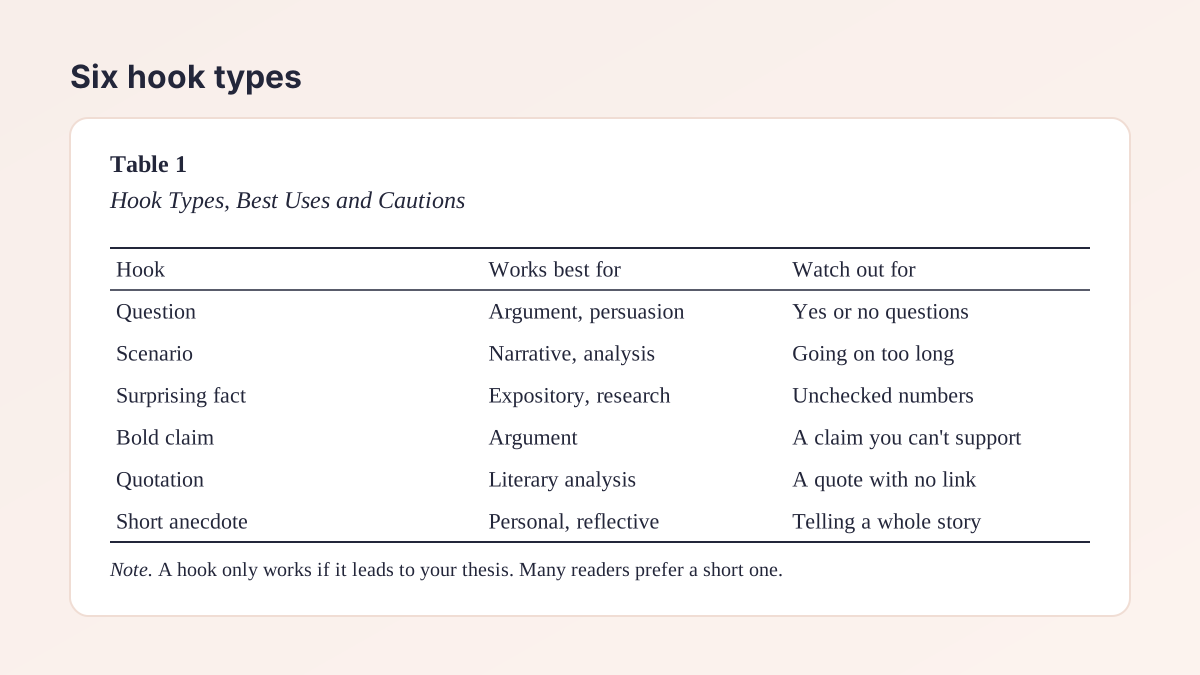
Choosing a hook is often the hardest part of learning how to write an introduction. The hook is the sentence or two that makes a reader want to continue. Some teachers call it a grabber or an attention getter, and all three words mean the same thing: an opening that draws readers in. The table below compares six types. The examples that follow were written for this guide and use different topics so you can see how each hook works. If you want more ideas, the essay hook generator offers hooks by type for your own topic.
| Hook | Sentence starters | Example opening |
|---|---|---|
| Question | What if... / Why do... / How would you... | What if the school day began when students are awake? |
| Scenario | Picture... / It is... / Every morning... | Every morning at 7:40, Maya locks her bike and hopes drivers see her. |
| Surprising fact | Few people know... / Despite... / Surprisingly... | An octopus has three hearts, and the main one stops beating when it swims. |
| Bold claim | Nobody... / The truth is... / It is time to... | Homework as we know it has outlived its usefulness. |
| Quotation | As ___ wrote... / In the words of... | Use a short quote you have checked and can tie to your thesis. |
| Short anecdote | Last year... / When I was... | Last spring, my little brother taught himself to code from videos. |
Hook sentence starters you can adapt
Hook sentence starters give you a way in when the page is blank. Try "Picture a..." or "Every morning..." for a scenario, "What if..." for a question, and "Despite..." for a fact that surprises. They work as scaffolding. In the final draft, delete any starter that sounds stiff and keep only the sentence it helped you write.
Question hooks
A question hook invites the reader into the argument. Avoid questions with a plain yes or no answer, because a reader can answer them and stop. "What would change if every student started the day well rested?" is better than "Do students need sleep?" A question hook can work best in an argumentative or persuasive essay.
Scenario and anecdotal hooks
An anecdotal hook is a very short story, often from the writer's own life or from a scene that illustrates the issue. Keep it to two sentences. If the anecdote needs more room, move it into a body paragraph and start the introduction with something shorter. A scenario hook works well in personal and reflective writing, and in essays about people.
Fact, claim and quotation hooks
A surprising fact works when it is true and checked, so cite the source in your draft. Never invent a statistic. A bold claim grabs attention but has to be defensible, because the rest of the essay must prove it. A quotation helps in literary analysis when the words really matter. In all three cases, connect the hook to your thesis within a sentence or two.
Hooks to avoid
When you study how to write an introduction, the weak openers matter as much as the strong ones. The UNC handout lists several weaker openers: a vague placeholder, a restated question, a dictionary definition, a "dawn of man" generalization, and a book-report opener that lists title, author and basic facts. Cut them from your draft.
How to Write an Introduction Paragraph, Sentence by Sentence
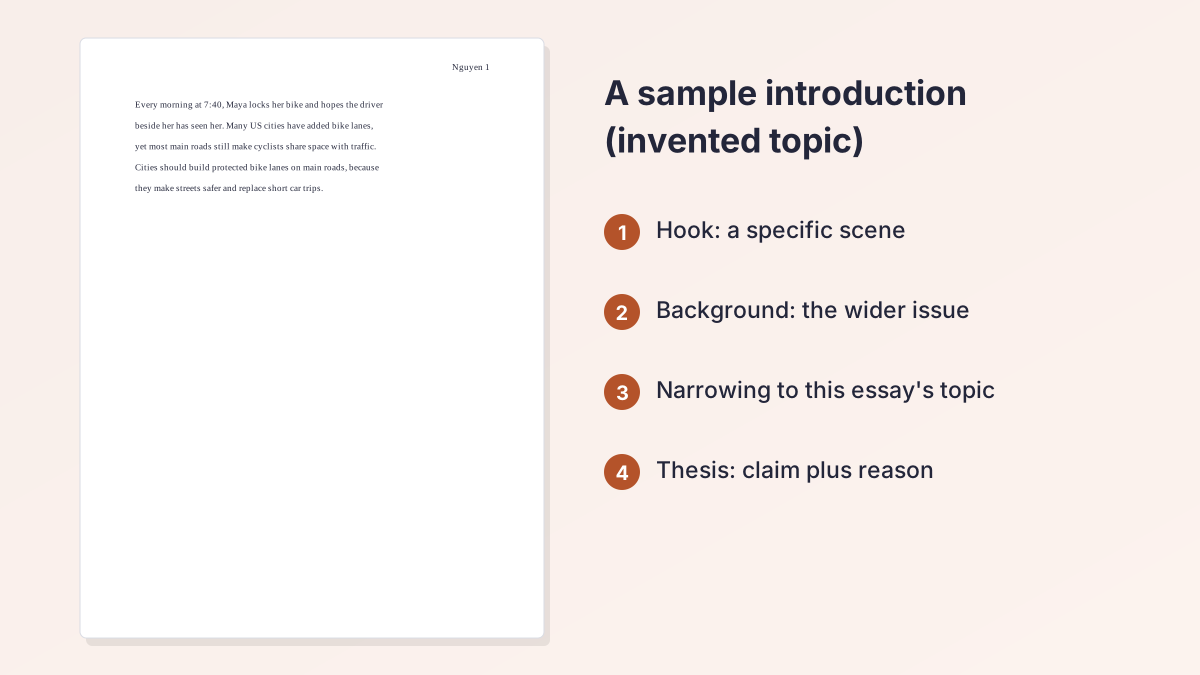
For a sentence-level view of how to write an introduction, here is a paragraph of about five sentences. Treat it as a pattern, not a formula.
Sentence by sentence
Use this order when you want a clear plan.
- Hook. A scene, question or fact that points toward the topic.
- Background. What the reader needs to know about the issue.
- Narrowing. A sentence that moves from the general issue to the specific question.
- Thesis. Your claim and, ideally, one reason.
- Roadmap (optional). A preview of the order of your points.
A complete sample
Here is a sample paragraph on the same topic as the page shown above, written for this guide: Every morning at 7:40, Maya locks her bike and hopes the driver beside her has seen her. Many US cities have added bike lanes, yet most main roads still make cyclists share space with traffic. That gap puts the safest option out of reach for the people who most want to use it. Cities should build protected bike lanes on main roads, because they make streets safer and replace short car trips.
Introduction templates
A template can get you started if you adapt it: "[Hook about a specific scene or question]. [Background on the issue and why it matters]. [Narrowing sentence that points to the problem]. [Thesis: claim because reason]." Fill in each bracket in your own words, then read the result aloud and cut anything that sounds like filler.
Intro ideas for different essay types
In an argumentative essay, a question or bold claim works well. In a narrative, begin with a scene. In an expository essay, a surprising fact or a plain framing of the topic often does more than a dramatic hook. Part of knowing how to write an introduction is matching the opening to the genre, so be wary of copying one that worked elsewhere.
How to Write an Introduction for a Research Paper
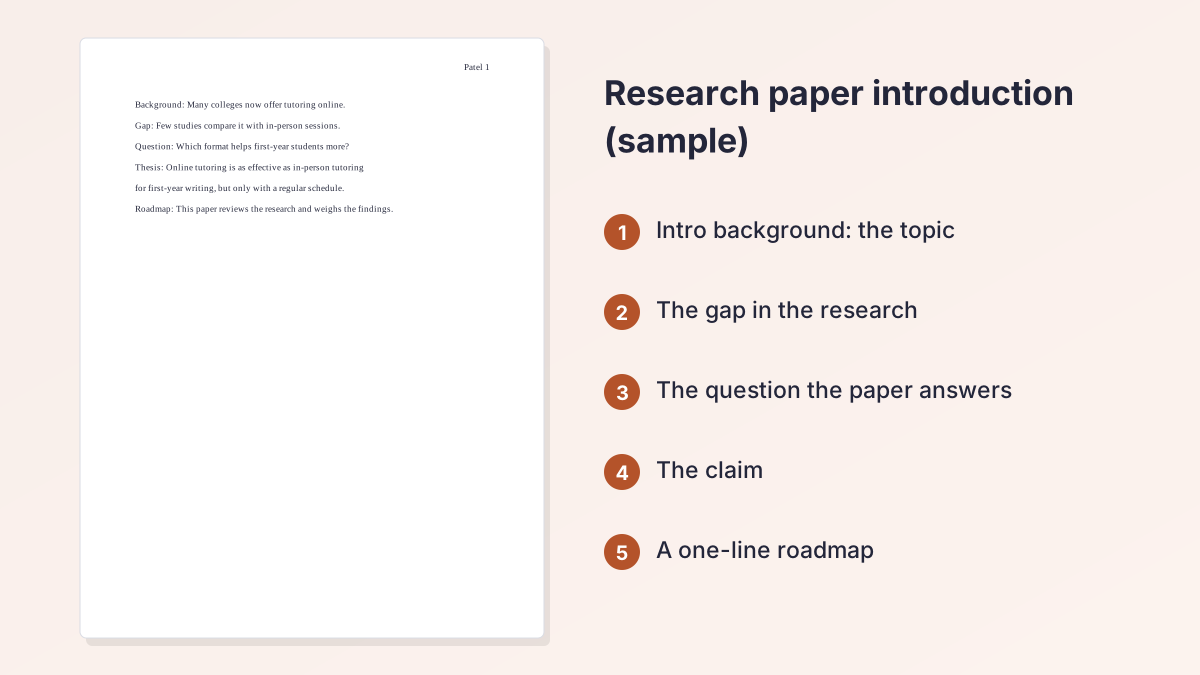
Knowing how to write an introduction for a research paper takes a slight shift in aim, because the reader expects background and a question more than a dramatic hook. A strong research paper introduction usually makes four moves, shown on the sample page.
The four moves
First, background gives the topic and why it matters. Second, a gap or problem explains what is unknown, disputed or unresolved. Third, a research question or purpose says what your paper sets out to answer. Fourth, the thesis states your answer. A short roadmap often follows in longer papers. The UCLA Undergraduate Writing Center's handout on research paper introductions describes the same path, from the broad issue and existing research to the gap and your research question. Expectations still vary by field, so check the guidelines for your course.
Intro background for a research paper
Background is usually the longest move, and it is where learning how to write an introduction for a research paper differs most from a school essay. It should show that you know the conversation. Name the topic, cite one or two key sources and make clear why the question matters. Our guides to MLA in-text citation and APA format guidelines show how to cite those sources. For a first draft, the research paper introduction generator can lay out the pieces.
How to write an introduction for a lab report
The UNC Writing Center's scientific reports handout says a lab report introduction states the purpose of the experiment, reviews the relevant scientific literature and gives your hypothesis, with the reasons it seemed likely. Formats still vary by course, so follow your lab manual or syllabus. Keep the introduction short and move from the general idea to your specific question.
A hook in a research paper
You can still open a research paper with a hook, but make it quieter: a striking finding, a concrete case or a brief example. If your discipline prefers a plain opening, state the topic and its importance directly. Ask your instructor, or look at a published article in your field, to see which tone fits.
Introduction Transition Words and Intro Transitions
Connectors are a small but real part of learning how to write an introduction that flows. An introduction has to move from one layer to the next without jolts. Intro transitions are the small words and phrases that make the hook, background and thesis feel like one thought rather than three separate sentences.
Introduction transition words that work
Between the hook and the background, try "In fact," "Today," or "Across the country." To narrow the focus, use "Yet," "Still," "However," or "Even so." To lead into the thesis, try "Therefore," "For this reason," or "As a result." Use only one or two, because a transition at the start of every sentence feels mechanical.
Going deeper
Our transition words for paragraphs page sorts openers by where a paragraph sits in an essay, and the transition words tool groups connectors by purpose. For a longer list with examples, see our guide to transition words for essays.
Common Introduction Mistakes
Most weak openings come from the same few slips, so check your draft against this list. Even students who know how to write an introduction make them on a first try. The earlier table of problems and fixes shows several of them in action.
Too long or too broad
An introduction that takes a full page to reach the topic loses the reader. Cut anything that doesn't lead to the thesis. If your first sentence could begin any essay on any topic, rewrite it.
No clear thesis
If a reader finishes the introduction and can't say what you will argue, the thesis is missing or buried. Rewrite it so that it states a claim.
Promising what the essay doesn't deliver
If your thesis announces three reasons and the body proves two, change one or the other. This is the main reason to revise the introduction after the draft is done. The same applies in the other direction: your conclusion (see how to write a conclusion) should answer the question your opening raised.
Forgetting the body paragraphs
Knowing how to write an introduction only gets you started. Our guide to how to write a paragraph covers the body, where the evidence lives. When your introduction is in place, the introduction generator is a quick way to compare your version against three others, and you can browse more student writing guides for the rest of the essay.
Questions About Writing an Introduction
How do you write an introduction for an essay?
Open with a hook, add two or three sentences of background, and end with a thesis statement that makes your main claim.
How do you write an introduction paragraph?
Use about five sentences: a hook, background, a sentence that narrows the topic, the thesis and, if needed, a brief roadmap.
How do you write an introduction for a research paper?
State the background, identify the gap in what is known, give your research question and then state the thesis.
What are good hook sentence starters?
Try "Picture a..." or "Every morning..." for scenes, "What if..." for questions and "Despite..." for surprising facts.
How long should an introduction be?
In a five-paragraph essay, many teachers expect four to six sentences. Longer papers use a full paragraph or two. Check your assignment.
How do you write an introduction when you don't have a thesis yet?
Write a rough working claim, draft the body, then come back and rewrite the opening around the thesis your draft supports.
Should I write the introduction first or last?
Many writing centers suggest writing it last, or revising it last, because your argument often changes as you draft.
What are intro transitions?
Words and phrases such as however, in fact and therefore that connect the hook, background and thesis.
How do you write an introduction for a lab report?
State the purpose of the experiment, review the relevant background science and give your hypothesis. Follow your lab manual.
What is the best way to learn how to write an introduction?
Study a few strong examples, then practice the funnel of hook, background and thesis. Revise your draft once the body paragraphs are done.
What is a grabber in an essay?
Another name for a hook: the opening sentence or two that draws the reader in.
More free guides
- MLA In-Text CitationsAuthor-page citations for every kind of source, with examples.
- How to Cite a Website in MLAWorks Cited entries and in-text citations for web pages.
- MLA Works Cited PageFormat, order and hanging indents, with a full example page.
- MLA Annotated BibliographyFormat, annotation types and a complete example.
- APA Table FormatNumber, title, body and notes for APA 7 tables, with templates.
- MLA HeadingThe four-line first-page heading and the page header, with Word and Google Docs steps.
See all 80 free tools for students
Related tools
Last updated by The Study Corp editorial team.