Transition sentence generator examples
Illustrative examples of what students typed and the kind of sentences the tool gives. The tool writes six sentences each time and a short note on each. Your results will differ.
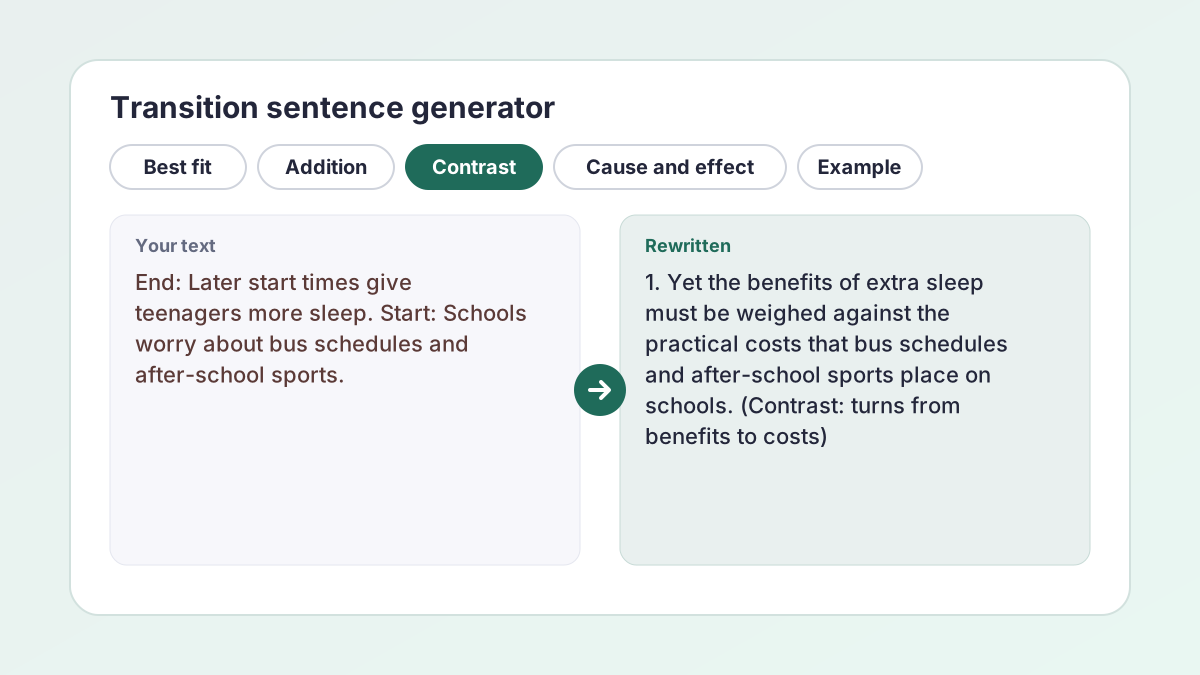
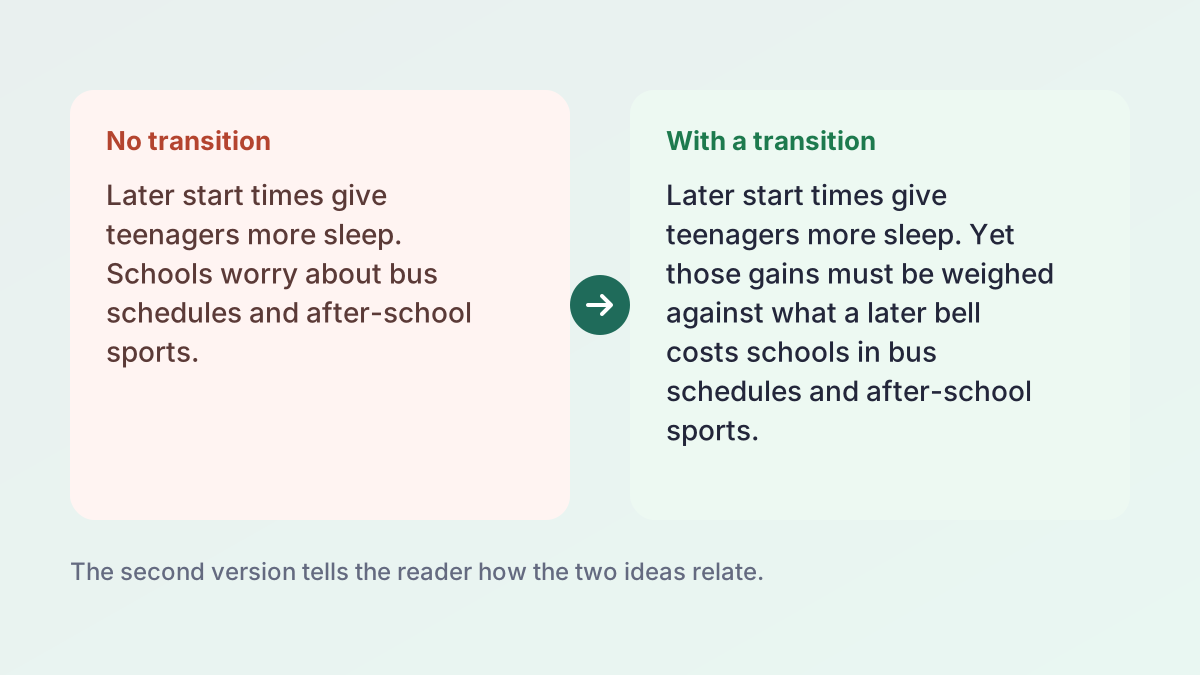
You typedFirst paragraph: Later school start times give teenagers more sleep. Next paragraph: Schools worry about bus schedules and after-school sports.
Result (one of six)Yet the benefits of extra sleep must be weighed against the practical costs that bus schedules and after-school sports place on schools.
Contrast: turns from benefits to costs.
You typedFirst paragraph: Our school library cut its hours to save money. Next paragraph: Test scores in reading dropped.
Result (one of six)With fewer open hours, fewer students could borrow books, and that change may help explain why reading scores began to fall.
Cause and effect: links shorter hours to lower scores. Check the claim against real data before you use it.
You typedFirst paragraph: Community gardens give neighbors fresh vegetables. Next paragraph: They also give students a place to learn about science.
Result (one of six)Fresh produce is only one benefit; community gardens also work as outdoor classrooms where students can test what they learn in biology.
Addition: builds on the previous point.
You typedFirst paragraph: Technology can help students who learn differently. Next paragraph: A student with dyslexia uses audio books.
Result (one of six)The value of that support is clearest in a single case, such as a student with dyslexia who uses audio books to keep up with the class reading.
Example: moves from a general point to a specific case. This case is invented for illustration; use a real one from your source.
You typedFirst paragraph: The Civil Rights Act of 1964 banned discrimination in public accommodations such as hotels and restaurants. Next paragraph: Congress passed the Voting Rights Act the next year.
Result (one of six)The next year, Congress turned to a different barrier and passed the Voting Rights Act of 1965, which outlawed discriminatory voting practices such as literacy tests.
Sequence: moves forward in time. Always confirm dates in your textbook.
You typedFirst paragraph: Homework teaches responsibility. Next paragraph: Too much homework hurts sleep and family time.
Result (one of six)Homework has earned its place in the backpack, but a backpack that weighs more than the student who carries it is another story.
Concession: admits the first point, then turns. Creative tone is vivid, so use it only where your teacher expects it.
How to use the transition sentence maker
The transition sentence maker needs only the two places where your paragraphs meet.
- Paste the end of the first paragraph. In End of the first paragraph (or its main idea), paste the last sentence or two, or sum up the point in your own words.
- Paste the start of the next paragraph. In Start of the next paragraph (or its main idea), paste the first sentence or sum up the next point. Each box takes up to 1,200 characters.
- Choose the relationship. Under Relationship, select Best fit, Addition, Contrast, Cause and effect, Example, Sequence or Concession.
- Choose the tone. Under Tone, select Academic, Neutral or Creative.
- Write and pick. Select Write transitions, read the six sentences and their notes, copy one and rewrite it to fit your own paragraphs. Select Generate more for six new ones.
What the transition sentence generator writes
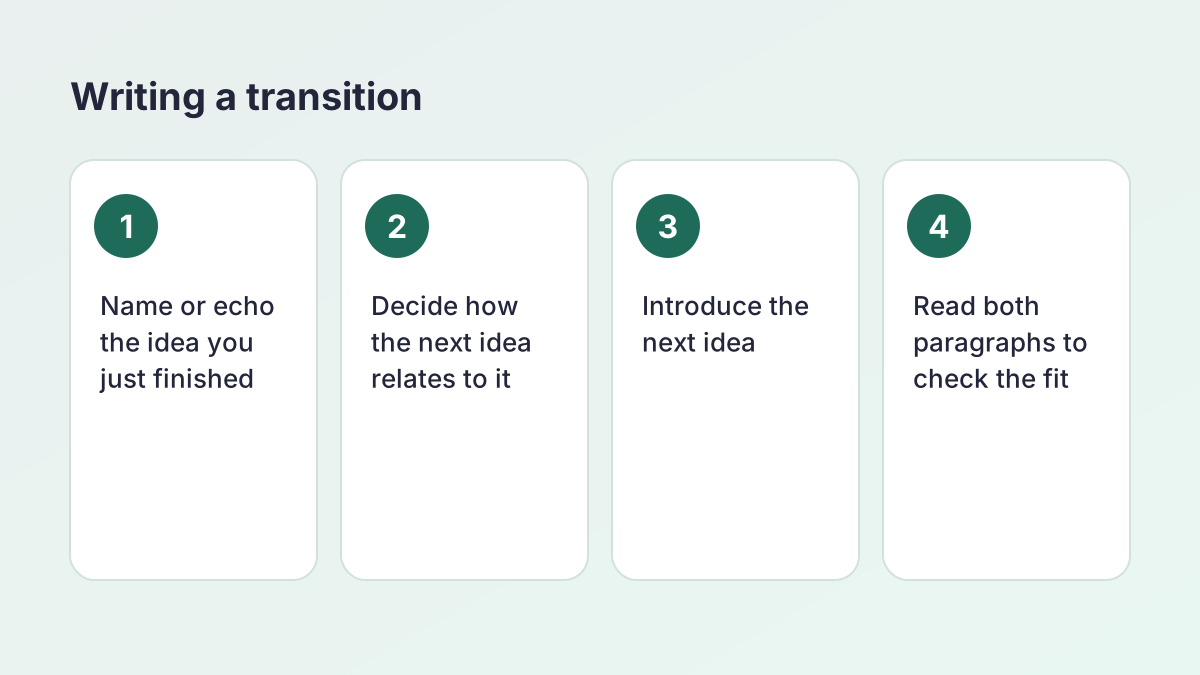
Each time you select Write transitions, you get six numbered sentences. The tool is told to keep each one to a single sentence of 12 to 35 words, and each comes with a short note naming the relationship it signals, such as “Contrast: turns from benefits to costs.”
How the sentences are built
- They name or echo the idea you just finished, so the reader remembers where they have been.
- They introduce the next idea, so the reader knows where they are going.
- They vary in structure. The tool is told not to start every sentence with the same transition word, so you get real options.
What it does not do
It is told not to invent facts, statistics, studies or names. It only links the two ideas you give it. Use Copy to take one sentence, or Copy all to take all six into a document and choose later.
Transition sentence maker: the two boxes explained
A transition sentence maker needs to see both sides of the gap, so this transition sentence generator has two boxes, and both are required.
End of the first paragraph (or its main idea)
Paste the last sentence or two of the paragraph you just wrote. If the paragraph is long, sum up its point in your own words instead. The tool needs the idea, not the whole paragraph.
Start of the next paragraph (or its main idea)
Paste your topic sentence for the next paragraph, or describe what it will argue. If you have not written it yet, a short summary works.
Why both are required
A transition is a connection, and a connection needs two ends. With only one end, any sentence would be generic. With both, the tool can echo the first idea and lead into the second.
Length limits
Each box takes up to 1,200 characters, which is plenty for a few sentences. Pasting an entire page will not make the result better.
Seven relationship choices and when to use each
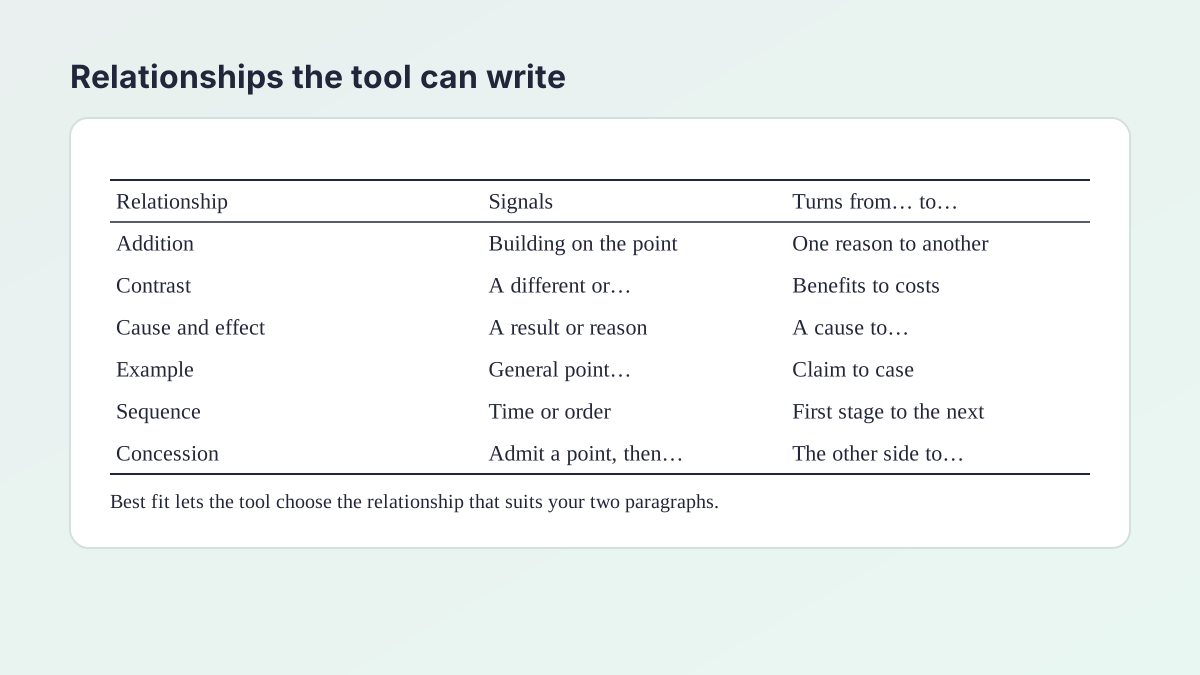
The Relationship chips tell the tool how your two ideas connect. If you are unsure, leave it on Best fit.
- Best fit: the tool chooses whatever relationship suits the two ideas.
- Addition: the next paragraph builds on the previous point.
- Contrast: the next paragraph turns to a different or opposing point.
- Cause and effect: one idea leads to or explains the other.
- Example: you move from a general point to a specific case.
- Sequence: the ideas follow in time or in order.
- Concession: you admit a point, then move on to your own view.
How to choose
Ask what the reader should think when they cross the gap. “And there is more” means addition. “But there is another side” means contrast. “That is why” means cause and effect. If two relationships are possible, generate both and compare.
Match the relationship to your evidence
The relationship has to be true. If your paragraphs do not show cause and effect, choosing it will not make it so. A transition can highlight a relationship, but it cannot create one.
Transition sentences between paragraphs: where they go
The University of North Carolina's Writing Center handout on transitions explains that a transition between paragraphs can be a word or two, a phrase or a sentence, and that it can sit at the end of the first paragraph, the beginning of the second, or both places.
At the end of the first paragraph
A closing sentence that points ahead: These gains, however, come with costs that schools cannot ignore. The next paragraph then opens with its own topic sentence.
At the start of the second paragraph
An opening sentence that looks back and forward: Yet those costs are real, and they begin with the bus schedule.
In both places
Use this sparingly, for a major turn in the essay.
What the handout says transitions do
The handout says that when your paragraphs are in a logical order, a transition highlights a relationship that already exists by summarizing the previous paragraph and suggesting something of what follows. That is the job of every sentence the tool writes, so use whichever of the six reads most naturally in your essay.
Paragraph transition sentence: how to build one by hand
You do not always need a tool. Knowing how to write a paragraph transition sentence helps you edit what the tool gives you.
1. Name the idea you just finished
Use a short phrase from the first paragraph, such as “the benefits of extra sleep.”
2. Decide how the next idea relates to it
Is it an addition, a contrast, an effect, an example, a next step or a concession?
3. Introduce the next idea
Name the topic of your next paragraph so the reader is prepared: “the practical costs for schools.”
4. Put them in one sentence
Although the benefits of extra sleep are clear, the practical costs for schools deserve equal attention.
5. Read both paragraphs together
If the sentence feels forced, the problem may be the order of your paragraphs, not the wording. For help with paragraph structure, see our guide on how to write a paragraph.
Transition sentence examples by relationship
These transition sentence examples are invented for an essay on later school start times. Use them as models, not as text to copy. The transition sentence maker produces the same kinds of sentence for your own paragraphs.
Addition
Better sleep is not the only reason schools are looking at later start times; the effect on attendance deserves attention too.
Contrast
Yet the case for later start times must be weighed against what they cost in bus routes and practice schedules.
Cause and effect
Because the first bell comes so early, many students arrive tired, and that fatigue shapes how first period goes.
Example
A single school's experience shows how this works in practice: [add a real example from your source].
Sequence
Once the school board had heard the concerns, the next step was a one-semester trial.
Concession
Opponents are right that a later bell complicates bus routes; even so, the complication does not outweigh the benefit to students.
Making them your own
Replace the bracket with a real example and change the wording to match your voice. Then run your own paragraphs through the transition sentence maker to compare.
Academic, neutral or creative: choosing a tone
The Tone setting changes how the sentences sound, not what they connect.
Academic
A formal tone for essays, research papers and most college writing. This is the default, and it suits argumentative, analytical and literary essays.
Neutral
A clear, plain tone for reports, explanations and writing for a general reader. Choose it if Academic feels stiff for your assignment.
Creative
A vivid tone for personal essays, narratives and blog-style writing. Be careful in formal assignments: a playful transition can be out of place in a lab report or a legal analysis.
Matching your voice
Read your paragraphs aloud, then read the transition. If it sounds like a different writer, switch tone or adjust the wording. A good transition usually does its job without drawing attention to itself.
When a single word is enough and when to use a full sentence
Not every gap needs a full sentence. The UNC Writing Center handout notes that transitions within paragraphs tend to be single words or short phrases, while a transition between paragraphs can be a word or two, a phrase or a sentence.
Use a word or a phrase when
- The two ideas are closely related.
- The paragraphs are short.
- You are moving between sentences inside a paragraph.
For a list of options, try the transition words finder, or read our guide to transition words for essays. If you are looking at the start of a body paragraph in particular, see transition words for paragraphs.
Use a full sentence when
- The essay makes a major turn, such as from evidence to counterargument.
- The two paragraphs are about different subjects.
- A single word would leave the reader asking how the paragraphs connect.
Do you have a topic sentence yet?
A good topic sentence often does the transition work for you. Our topic sentence generator can help if the next paragraph has no clear opening.
Common transition mistakes and how to fix them
- Starting every paragraph with “However” or “Moreover.” Vary your approach, or use none when the connection is obvious.
- A transition that does not match the relationship. “Therefore” promises cause and effect, so do not use it for a simple addition.
- A transition that adds a new idea. It should link two ideas, not argue a third one.
- Vague phrases. “Another thing” tells the reader nothing. Name the idea.
- Transitions that repeat your paragraphs. Sum up the earlier point in a few words instead of restating it.
- Piling them on. If every sentence has a signpost, none of them stands out.
A before-and-after
Before: Another thing about school start times is that schools have other concerns.
After: Yet schools must also weigh the cost of changing bus routes and practice times.
The second version names the contrast and the topic of the next paragraph.
Using transitions across a whole essay
Transitions work best when your structure is clear. Plan the order of your points with the essay outline generator, write each paragraph, then add the links.
A simple method
- List your paragraph topics in order.
- Beside each gap, write the relationship: addition, contrast, effect, example, sequence or concession.
- Use the tool for the gaps that feel hardest.
- Read the essay aloud and fix any gap that sounds abrupt.
Beginnings and endings
Your first and last paragraphs need links too. A strong ending can call back to your introduction, and the conclusion generator can help with that final connection.
Revising a draft
A transition sentence maker is most useful in revision. If a teacher has said your essay “jumps around,” compare each paragraph's last sentence with the next one's first. Where the two do not meet, a transition sentence, or a change of order, will help. A paragraph rewriter can help reshape the paragraph itself if the problem is deeper than the link.
Getting better results from the transition sentence generator
The quality of a transition depends on what you paste in. These habits make the six sentences more useful.
Be specific about the idea
“Later start times give teenagers more sleep” gives the tool something to echo. “My first point” does not. Use the real idea in a few words.
Paste real sentences when you can
The actual last sentence of one paragraph and first sentence of the next let the transition sentence generator match your vocabulary, so the link sounds like your essay.
Try two relationships
If you are not sure whether your paragraphs contrast or concede, generate once for each and compare the notes. The note under each sentence names the relationship it signals.
Pick, then trim
Choose the sentence that reads most naturally, then cut any word that adds nothing. A shorter transition is often easier to follow than one near the 35-word limit.
Keep your evidence in the paragraphs
The sentences link ideas. Facts, quotations and sources belong in your body paragraphs, with citations. If you need to format them, the Citation Maker for MLA can help.
Check the order
If none of the six sentences fits, your paragraphs may be in the wrong order. Move one and try again.
Is the transition sentence generator free and private?
Yes, the transition sentence generator is free, with no account or sign-up. To keep it fast for everyone, each visitor can make up to 30 requests an hour.
Your paragraphs are sent to our AI providers (Groq, with Google Gemini as a backup) only to write the sentences you see. The Study Corp does not save them.
Using it responsibly
Use the sentences to study and to draft. Then write in your own words and follow your school's AI policy. A transition should sound like your essay, so adjust the wording until it does.
Transition sentence maker FAQ
Is the transition sentence generator free?
Yes. It is free with no account or sign-up. Each visitor can make up to 30 requests an hour.
What is a transition sentence?
A sentence that links one idea to the next. Between paragraphs, it echoes the idea you just finished and introduces the one that follows.
How do I write a transition between paragraphs?
Name the idea you just finished, decide how the next idea relates to it, then introduce the next idea in the same sentence. Or paste both paragraphs into the transition sentence generator and choose from six options.
How many transition sentences do I get?
The transition sentence maker gives six each time, with a short note on the relationship each one signals. Select Generate more for six new ones.
What do the relationship chips do?
They tell the tool how your two ideas connect: Best fit, Addition, Contrast, Cause and effect, Example, Sequence or Concession.
Where should a transition sentence go?
At the end of the first paragraph, at the start of the second, or both. The UNC Writing Center handout on transitions describes all three placements, and one place is usually enough.
Can I paste a whole paragraph?
You can paste up to 1,200 characters in each box. The last sentence or two of the first paragraph and the first sentence of the next usually work best.
Will it make up facts?
It is built to link the two ideas you give it, and it is told not to invent facts, statistics, studies or names. Check each sentence anyway, because AI can still make mistakes.
Can I use the sentences in my essay?
Use them to study and to draft, then rewrite in your own words and follow your school's AI policy.
More free transition tools
- Transition Words FinderTransition words by purpose, with punctuation and examples, plus AI that adds them to your paragraph.
- Transition Words for ParagraphsOpeners for each body paragraph, the counterclaim and the conclusion.
See all 80 free tools for students
Last updated by The Study Corp editorial team.