Poem rewriter examples
Public-domain poems and a student draft, rewritten with each goal. Paraphrases explain meaning; they are not a replacement for reading the poem.
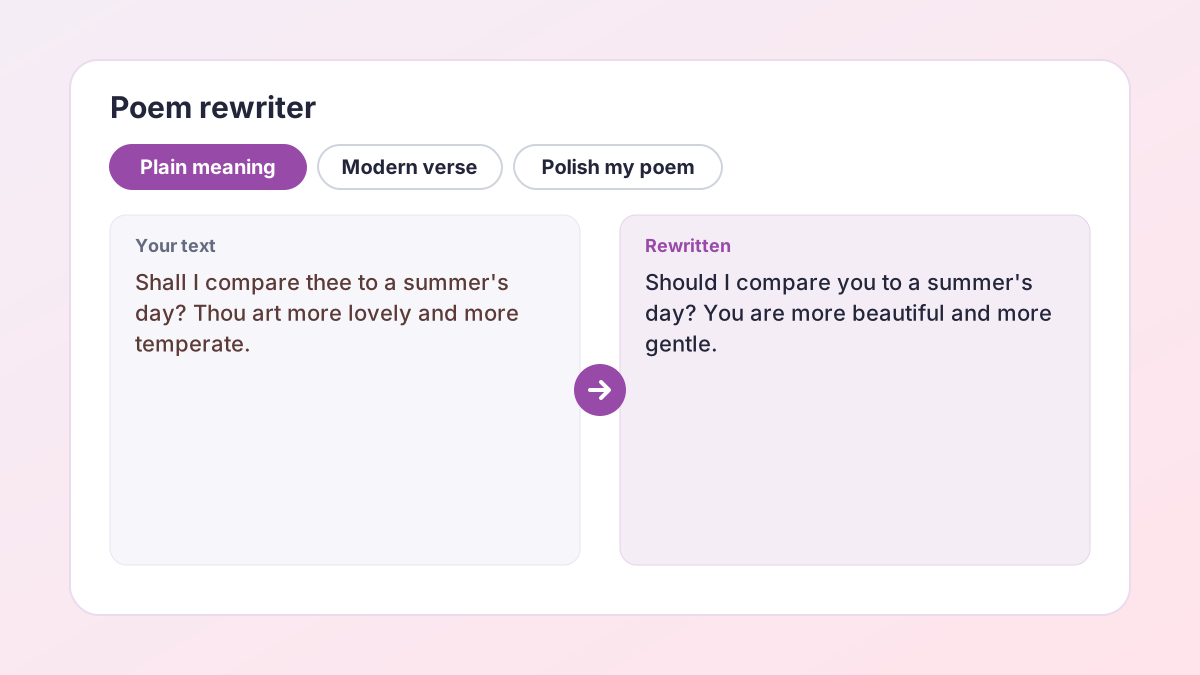
BeforeShall I compare thee to a summer's day? / Thou art more lovely and more temperate: / Rough winds do shake the darling buds of May, / And summer's lease hath all too short a date.
AfterShould I compare you to a summer's day? You are more beautiful and more gentle. Strong winds shake the delicate flower buds in May, and summer never lasts long.
Shakespeare, Sonnet 18. “Summer's lease” is explained as summer's short time.
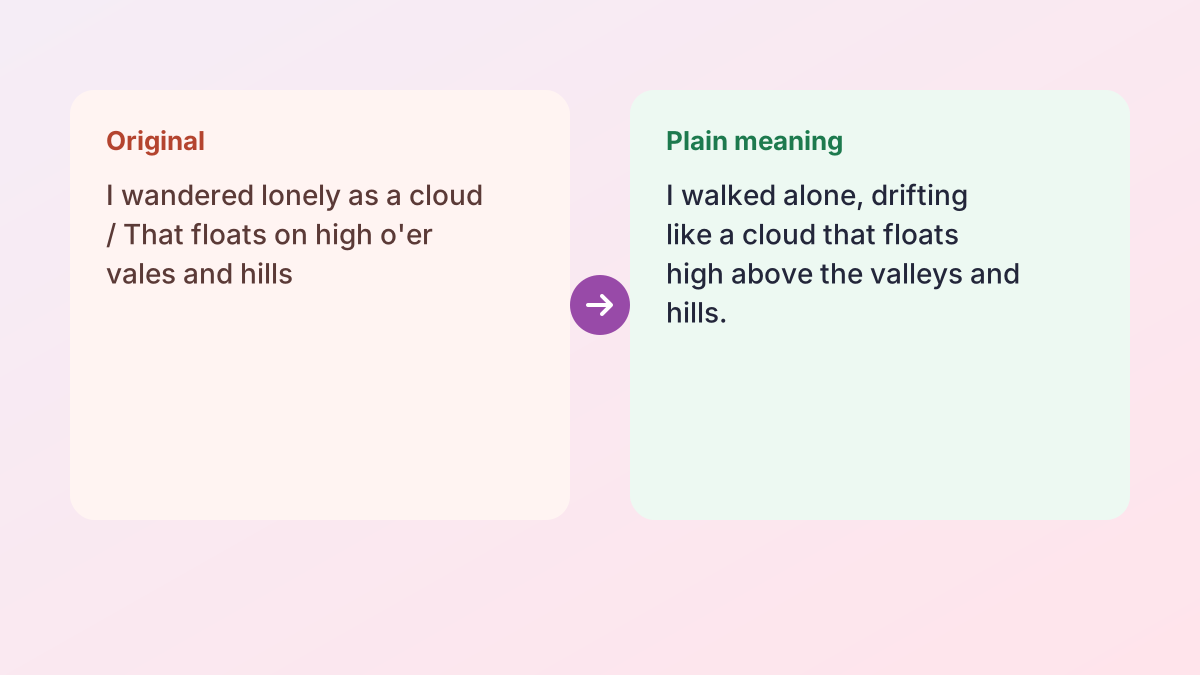
BeforeI wandered lonely as a cloud / That floats on high o'er vales and hills, / When all at once I saw a crowd, / A host, of golden daffodils.
AfterI was walking alone, drifting like a cloud high above the valleys and hills, when suddenly I saw a huge crowd of golden daffodils.
Wordsworth. The simile “lonely as a cloud” is kept because it carries the meaning.
BeforeBecause I could not stop for Death – / He kindly stopped for me – / The Carriage held but just Ourselves – / And Immortality.
AfterI was too busy to stop for Death, / so Death was kind and stopped for me. / The carriage carried only us, / and the promise of eternity.
Emily Dickinson. Still a poem, with the line breaks kept.
BeforeTwo roads diverged in a yellow wood, / And sorry I could not travel both / And be one traveler, long I stood
AfterTwo paths split apart in an autumn forest. I was sorry I could not take both, since I was only one person, so I stood there for a long time.
Robert Frost, 1916. “Yellow wood” is explained as an autumn forest.
BeforeThe rain was falling down on the street / And I was feeling very sad and blue / The lights were shining on my feet / And I didn't know what to do
AfterRain was falling on the street, / and I was sad and feeling blue. / The streetlights pooled around my feet; / I didn't know what I should do.
A student draft: the rhymes and the mood stay; filler words go.
BeforeTyger Tyger, burning bright, / In the forests of the night; / What immortal hand or eye, / Could frame thy fearful symmetry?
AfterTiger, tiger, burning bright / in the forests of the night, / what everlasting hand or eye / could shape your terrifying beauty?
William Blake. The famous first lines are left almost untouched.
How to use the poem rewriter
Paste up to about 1,500 words. Keep the line breaks: the poem rewriter works line by line.
- Paste the poem. Copy the poem, or the stanza you are studying, and paste it with its line breaks.
- Choose a goal. Plain meaning to understand it, Modern verse to retell old poetry as a modern poem, or Polish my poem for your own writing.
- Select Rewrite poem. The rewritten version appears line by line next to the original.
- Compare line by line. Read each pair. Look at what the rewrite had to explain; that is often where the poem's richest language is.
- See alternatives. Select a line and choose See alternatives for other readings of a difficult phrase.
What is a poem rewriter?
A poem rewriter is a tool that rewrites poetry for a purpose: to explain its meaning, to update its language or to improve a draft. Unlike a general paraphrasing tool, it understands that poems are built from lines, images and sound, and it works line by line so you can see exactly how each part was rewritten.
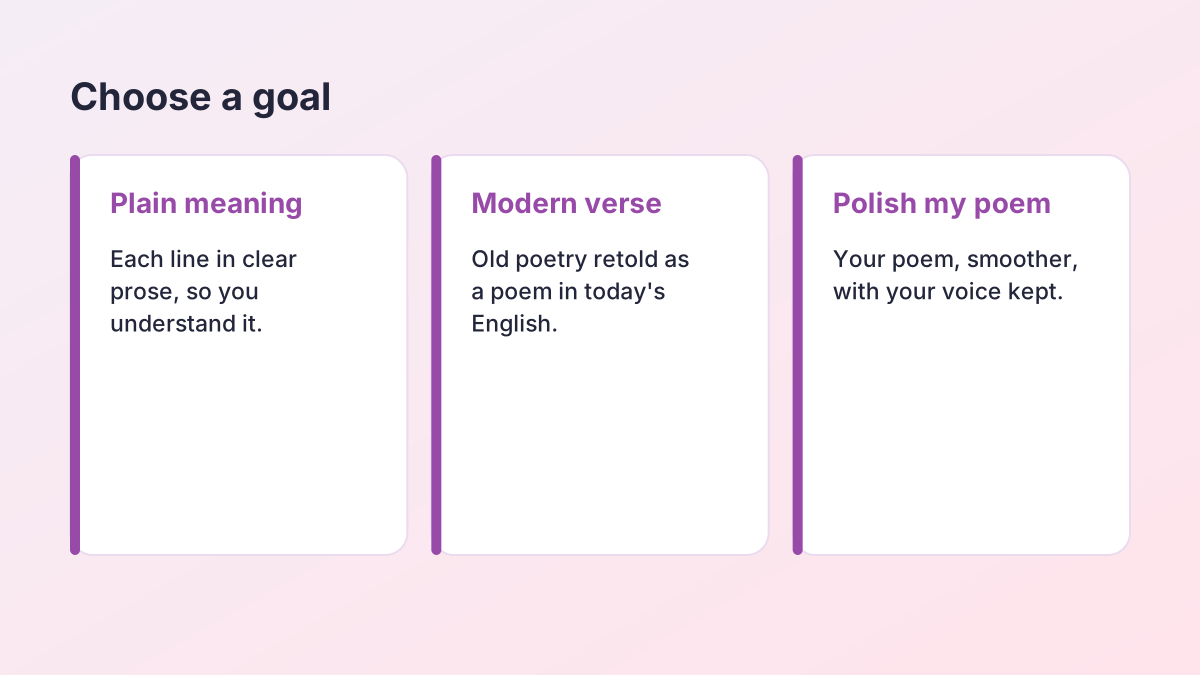
This poem rewriter has three goals:
- Plain meaning turns each line into clear, modern prose. It is the fastest way to understand a hard poem before you analyse it.
- Modern verse retells an older poem as a poem in today's English, keeping the line structure and, where possible, the rhythm.
- Polish my poem is a poem editor for your own work. It smooths awkward phrasing, tightens filler words and keeps your rhymes, images and voice.
Why line by line matters
In a poem, where a line breaks is part of the meaning. Rewriting the whole poem as one block loses that. Working line by line keeps the structure visible, so you can match every phrase in the rewrite to the original.
How to paraphrase a poem
To paraphrase a poem is to restate what it says, line by line or stanza by stanza, in plain words. It is usually the first step of poetry analysis: you cannot discuss how a poem creates meaning until you know what it means.
Step by step
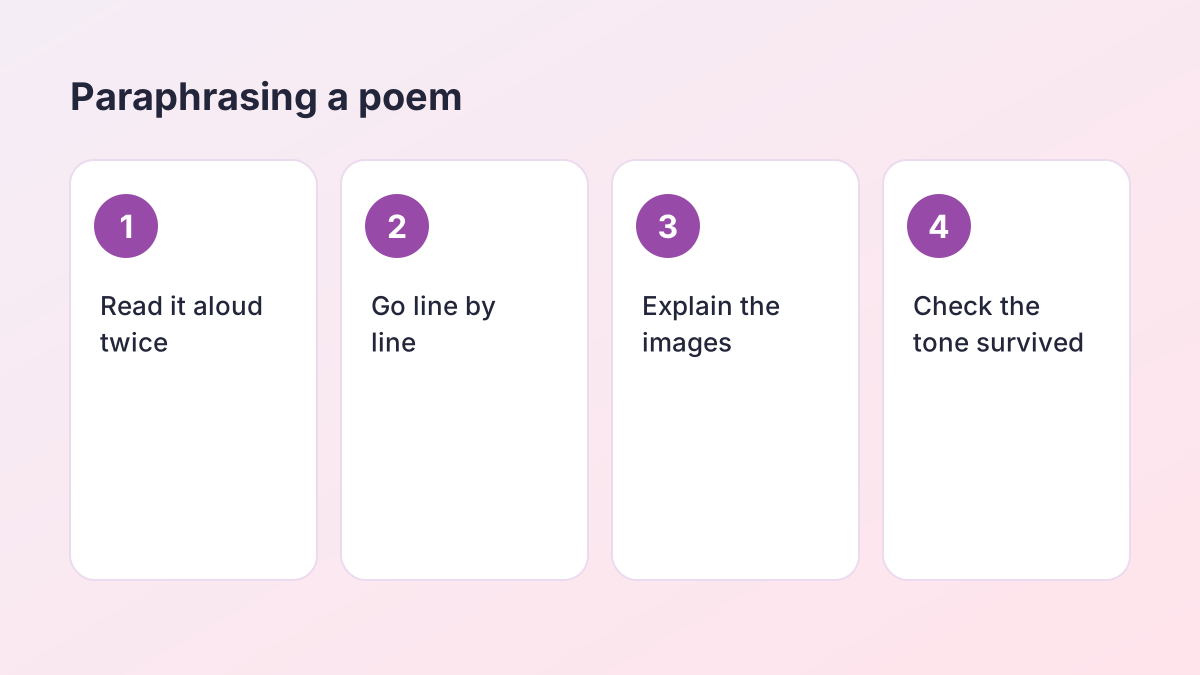
- Read it aloud twice. Hearing the poem shows where sentences really end, which is often not at the end of a line.
- Find the sentences. Follow the punctuation, not the line breaks. A sentence may run across several lines.
- Rewrite each sentence in plain words. Put words in normal order, replace old or unusual words, and spell out what pronouns refer to.
- Explain the images. “Summer's lease hath all too short a date” becomes “summer does not last long”. Note the image, then give its meaning.
- Check the tone. Is your paraphrase as sad, angry or playful as the original? If not, adjust your word choice.
Paraphrase is not analysis
A paraphrase says what the poem means. Analysis explains how the poem creates that meaning, through imagery, sound, form and structure. Use the poem rewriter's Plain meaning to get the paraphrase, then do the analysis yourself. The University of North Carolina Writing Center's handout on poetry explications explains how to move from one to the other.
What gets lost
Every paraphrase loses something: the rhyme, the rhythm, the double meanings. That loss is useful. Whatever the paraphrase could not capture is usually what makes the poem worth studying, and a great place to focus your essay.
Shakespeare and old poetry in modern English
Older poetry uses words and grammar that have changed: thee, thou, hath, doth, unusual word order and words whose meaning has shifted. The poem rewriter handles these for you.
Common old forms
- Thee / thou / thy / thine: you / you / your / yours.
- Art, hath, doth: are, has, does.
- 'Tis, 'twas, o'er, e'er: it is, it was, over, ever.
- Wherefore: why (not “where”).
- Inverted word order: “Rough winds do shake the darling buds” means “Rough winds shake the delicate buds”.
Plain meaning or Modern verse?
Choose Plain meaning when you are studying a poem and need to understand every line. Choose Modern verse when you want to read the poem as a poem, for example in a creative task that asks you to update a classic, or to perform it aloud.
Words that changed meaning
Some words look modern but meant something else. In Shakespeare, “nice” often meant foolish or precise, and “silly” could mean innocent. The poem rewriter reads these in context, but if a line seems odd, check a glossary or your class notes.
Poem editor: polish your own poem
Polish my poem works as a gentle poem editor for your own writing. It is designed to improve a draft without taking it over.
What it changes
- Filler words used to make a line fit, such as “very”, “really” or “so”, are trimmed.
- Awkward word order forced by a rhyme is smoothed where possible.
- Clichés like “sad and blue” or “heart of gold” may be freshened, if a better image keeps your meaning.
- Rhythm is evened out so lines read more naturally aloud.
What it keeps
- Your rhymes, where they work.
- Your images and metaphors.
- Your line and stanza structure.
- Your voice: it should still sound like your poem.
Use it as feedback
Compare each line with your original. Where the editor changed something, ask why. Sometimes you will prefer your version, and that is fine; it is your poem. The value is in seeing an alternative and making a deliberate choice.
Poem fixer for rhyme and rhythm
If a line feels clunky but you cannot say why, read it aloud and count the stressed syllables. Lines that have very different numbers of stresses next to each other often feel uneven. The poem rewriter suggests alternatives with a steadier beat.
Poetry terms to know when you rewrite a poem
Knowing a few technical terms helps you notice what changes between the original and the rewrite, and gives you the vocabulary to write about it.
- Stanza: a group of lines, like a paragraph in prose. Rewrites keep stanza breaks so you can match sections.
- Enjambment: when a sentence runs over a line break without punctuation. Paraphrases join these lines into one sentence, which is often the first step to understanding them.
- Caesura: a pause in the middle of a line, usually marked by punctuation. It often signals a shift in thought.
- Metre: the pattern of stressed and unstressed syllables. Shakespeare's sonnets use iambic pentameter: ten syllables, five beats, “da-DUM” repeated.
- Rhyme scheme: the pattern of rhymes, written with letters such as ABAB. Plain meaning drops rhyme; Modern verse and polishing try to keep it.
- Imagery: language that appeals to the senses. A paraphrase usually explains an image rather than copying it.
- Metaphor and simile: comparisons, direct (“life is a journey”) or with “like” or “as” (“lonely as a cloud”).
- Personification: giving human qualities to something non-human, as when Dickinson's Death “kindly stopped”.
- Tone: the speaker's attitude, such as hopeful, bitter or playful. Checking that the rewrite keeps the tone is one of the most important steps.
Using the terms in an essay
When you compare an original line with its plain version, you can name what was lost. For example: “The paraphrase ‘summer never lasts long’ captures the meaning, but loses the legal metaphor of a ‘lease’, which suggests that beauty is only borrowed.” That single sentence is real analysis, and it came directly from comparing the two versions side by side.
Using a poem rewriter for school
Before class
Paste the poem you will study and read the Plain meaning version first. You will understand the discussion faster, and you can spend class time on analysis rather than decoding.
Unseen poetry practice
Exams often include a poem you have never seen. Practise by reading a new poem, writing your own paraphrase, and then comparing it with the poem rewriter's version. Over time, your own first reading will get faster and more accurate.
Writing about a poem
Do not quote the paraphrase in your essay. Quote the original lines and analyse them in your own words. The paraphrase is for your understanding, not for your answer.
Creative tasks
Some assignments ask you to rewrite a poem in a modern setting or a different voice. Modern verse gives you a starting point, but the creative choices should be yours.
Responsible use
Handing in a rewritten poem as your own original work is plagiarism. If you rewrite a published poem for a creative task, say which poem you based it on.
How accurate is the poem rewriter?
Poems are open to interpretation, so no paraphrase is the only correct one. The poem rewriter gives a careful, mainstream reading of each line and keeps names, quotes and numbers exactly as written. Where a line has several possible meanings, use See alternatives to compare readings.
Check difficult lines against your teacher's notes or a reliable study guide, especially for poems with strong historical or religious references. If the rewrite of a line seems to say the opposite of the original, for example if a “not” disappeared, the line is marked for you to check.
Copyright
You can paste any poem to study it. When sharing a rewrite, remember that many modern poems are still under copyright. Classic poems published before 1929, such as those by Shakespeare, Wordsworth, Dickinson and Blake, are in the public domain in the United States.
Privacy
The Study Corp does not store your text. It is sent to our AI providers (Groq, with Google Gemini as a backup) only to create the version you see.
More tools for poetry and literature
- To analyse a poem's techniques, use the Poem Analysis Tool.
- To explain the meaning of a quotation, use the Quote Analysis tool.
- To rewrite prose rather than poetry, use the AI Paraphrasing Tool.
- To make any hard text easier to read, use the Text Simplifier.
Poem rewriter FAQ
Is the poem rewriter free?
Yes. It is free with no account or sign-up. A fair hourly allowance per visitor keeps it fast for everyone.
How do I paraphrase a poem?
Paste the poem with its line breaks, choose Plain meaning and select Rewrite poem. Each line is explained in clear, modern English.
Can it translate Shakespeare into modern English?
Yes. Plain meaning explains each line in prose, and Modern verse retells it as a poem in today's English.
Can I use it as a poem editor for my own poem?
Yes. Choose Polish my poem. It smooths phrasing and rhythm while keeping your rhymes, images and voice.
Does it keep the line breaks?
Yes. It works line by line, so the structure of the poem is kept.
Can I quote the paraphrase in my essay?
No. Quote the original poem and analyse it in your own words. The paraphrase is to help you understand it.
How long a poem can I paste?
Up to about 1,500 words, which covers most poems. For very long poems, rewrite a section at a time.
More free rewriting tools
- AI Paraphrasing ToolParaphrase any text, and learn to paraphrase and cite well.
- AI Sentence RewriterFix an awkward sentence and choose from several better versions.
- Paragraph RewriterMake the sentences in one paragraph connect and flow.
- Rewording ToolReword any text in fresh words: emails, reports, applications and more.
- Essay RewriterRewrite a whole essay or paper, paragraph by paragraph, keeping its structure.
- Restate Thesis GeneratorRestate your thesis in new words for the conclusion, keeping the same claim.
- Text SimplifierSimplify text to a reading level: grade 5, grade 7, grade 9 or plain English.
- Sentence ShortenerShorten text or combine it into 1, 2 or 3 sentences, keeping every key fact.
- Sentence FinisherGet five ways to finish a sentence you started.
- Say It BetterFind a better way to say a sentence or phrase, with alternatives.
- Sentence ExpanderExpand a sentence into a fuller, more detailed version without new facts.
See all 74 free tools for students
Related tools
Last updated by The Study Corp editorial team.