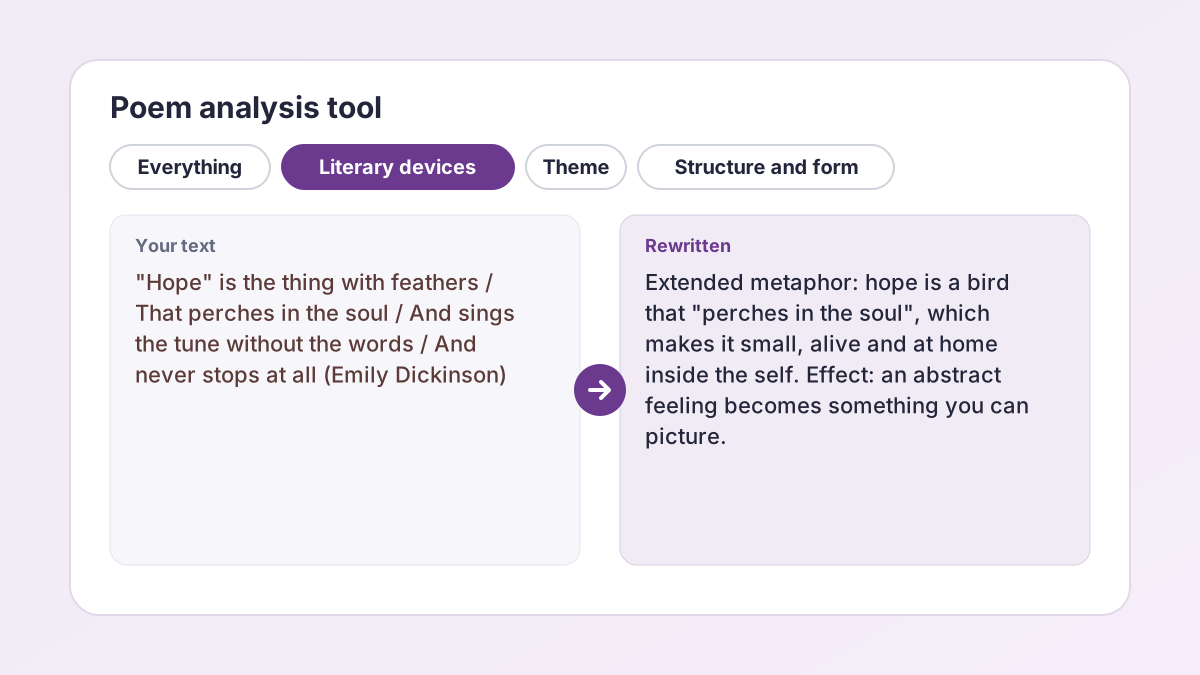
Poem analysis tool examples
The poem analysis tool works on any poem you paste. These examples use Emily Dickinson's "Hope" is the thing with feathers (public domain) and one short invented poem, and show the kind of output each focus gives. Yours will differ.
You choseAnalyze: Everything. Poem: Dickinson's "Hope" is the thing with feathers. Level: High school.
Result (part of it)Theme: hope is steady and asks for nothing. The poem ends with "Yet never, in extremity, / It asked a crumb of me", so the speaker has been supported in the worst conditions without paying for it. Speaker and tone: a grateful, quiet voice. "I've heard it in the chillest land" sounds like personal experience, not a lecture.
Every claim is tied to a short quotation.
You choseAnalyze: Literary devices.
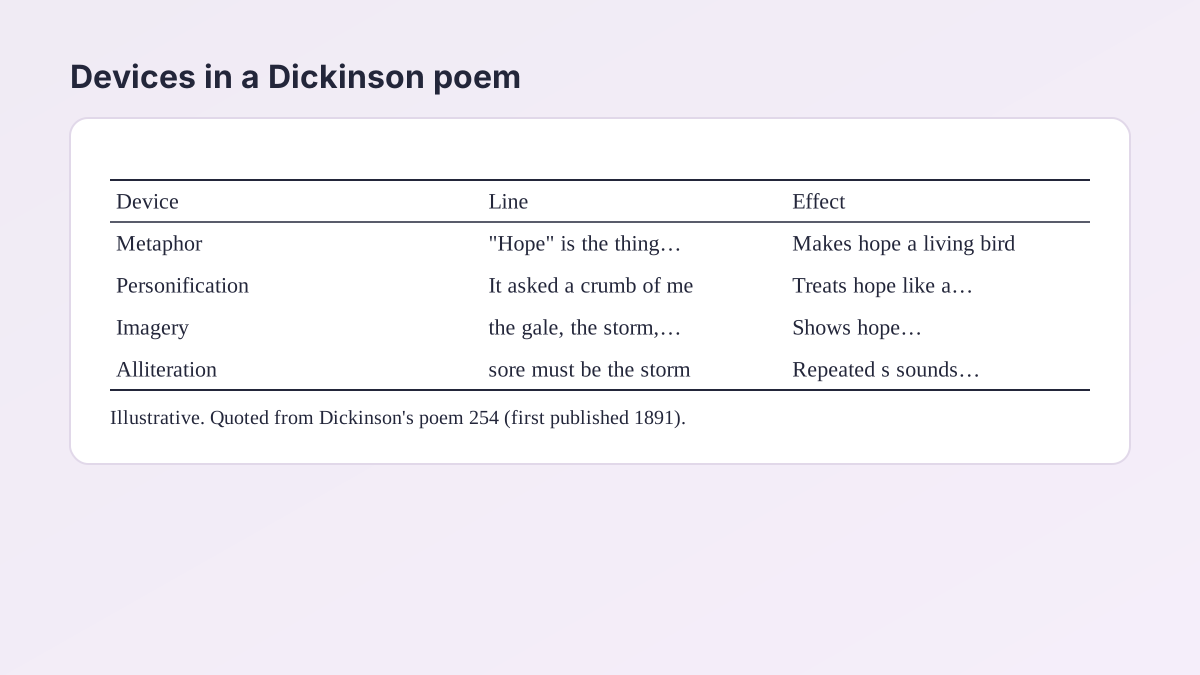
Result (part of it)Metaphor: hope is "the thing with feathers", a bird. Personification: only a storm that "could abash the little bird" would quiet it, and it never "asked a crumb of me", human traits that make it feel like a companion. Imagery: "the gale", "the storm" and "the chillest land" place the bird in severe weather. Effect: hope seems small but hard to defeat.
Each device has its effect, and only devices that are really in the lines are named.
You choseAnalyze: Theme.
Result (part of it)Theme: hope keeps going without conditions. The third stanza turns from the bird's song to the speaker's own life, with "Yet never, in extremity" and "It asked a crumb of me". The theme builds as the poem moves from a calm opening to storms and extreme conditions.
A theme is explained as a claim about life and then followed through the poem.
You choseAnalyze: Structure and form.
Result (part of it)Structure and form: three four-line stanzas (quatrains). The second and fourth lines of each stanza pair up: "sea" and "me" rhyme fully, while "soul" and "all" and "storm" and "warm" are near rhymes. In the second stanza, "heard" and "bird" also rhyme. Longer and shorter lines alternate, which keeps the voice simple and steady.
Rhyme and meter are described only as far as the lines show them.
You choseAny focus: the last result is always a sample paragraph.
Result (part of it)Sample analysis paragraph: Dickinson turns hope into a bird that "perches in the soul", a metaphor that makes an abstract feeling small, living and close. Because the bird "never stops at all", hope seems constant, and the final lines show that it asks for nothing in return. The comparison suggests that hope is quiet but dependable.
120 to 170 words that introduce evidence and explain it. Rewrite it in your own voice.
You chosePoem (invented for this page): "The bus is late again. / I count the puddles / like small coins. / One day I will own the weather."
Result (part of it)Structure and form: free verse in four lines, with no regular rhyme or meter, so the tool says so instead of forcing a pattern. The simile "like small coins" turns puddles into money, and the last line shifts from waiting to ambition.
It does not invent rhyme or meter that is not there.
How to use the poem analysis tool
Paste the poem with its line breaks, because the line and stanza breaks are part of the evidence.
- Choose what to analyze. Under Analyze, select Everything, Literary devices, Theme or Structure and form.
- Paste the poem. Put it in The poem box with its line breaks. It needs at least 40 characters and accepts up to 8,000.
- Add the title and poet. Optional. Fill in Title and poet if you want them used. The tool adds no biography or history you did not provide.
- Set the level. Pick High school, College, Middle school or Graduate, and US or UK spelling.
- Select Analyze the poem. Read each part, copy what you need, and check any quotation flagged by the quote check.
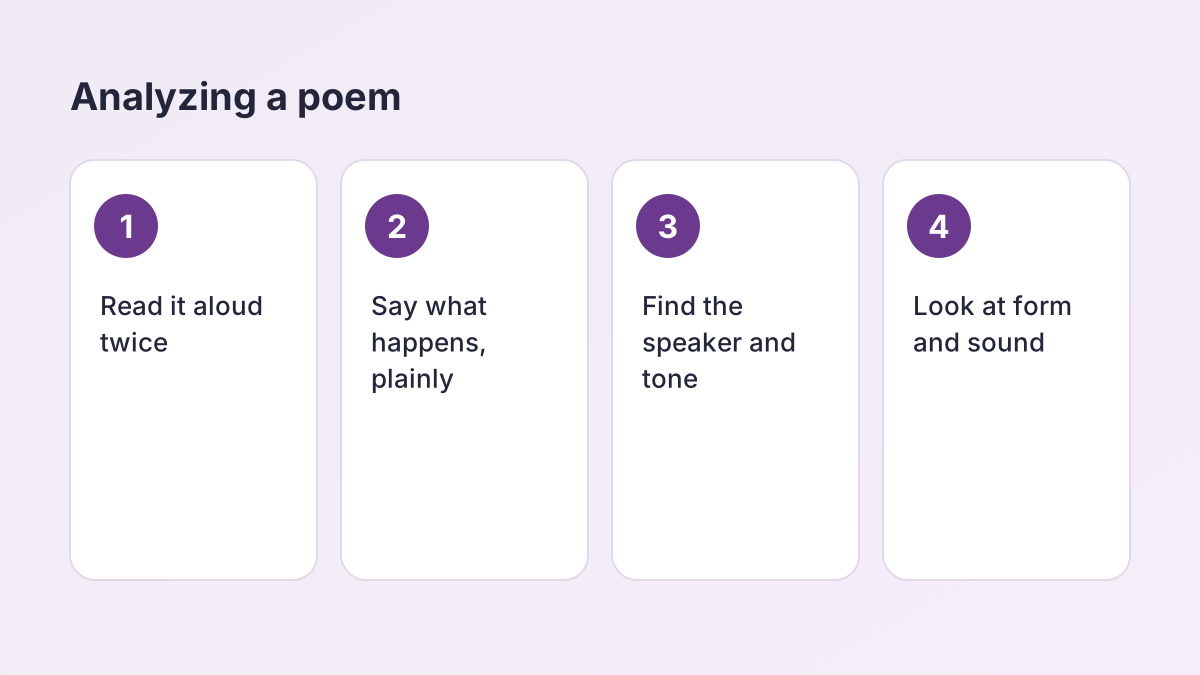
What the poem analysis tool returns
The tool reads your poem and writes one labeled part for each thing you asked it to cover, then a final sample analysis paragraph. The parts depend on the focus you choose.
Everything
Everything mode covers a Summary, the Theme, Speaker and tone, Structure and form, and Literary devices. It is the best starting point when you are meeting a poem for the first time.
Literary devices
This focus lists the devices in the poem and the effect of each one.
Theme
This focus explains the theme and how the poem develops it from beginning to end.
Structure and form
This focus covers structure, form, rhyme and meter, and says so plainly when a poem is free verse.
The sample paragraph
Every result ends with a Sample analysis paragraph of 120 to 170 words. It is a model of how to introduce a line, quote it and explain it.
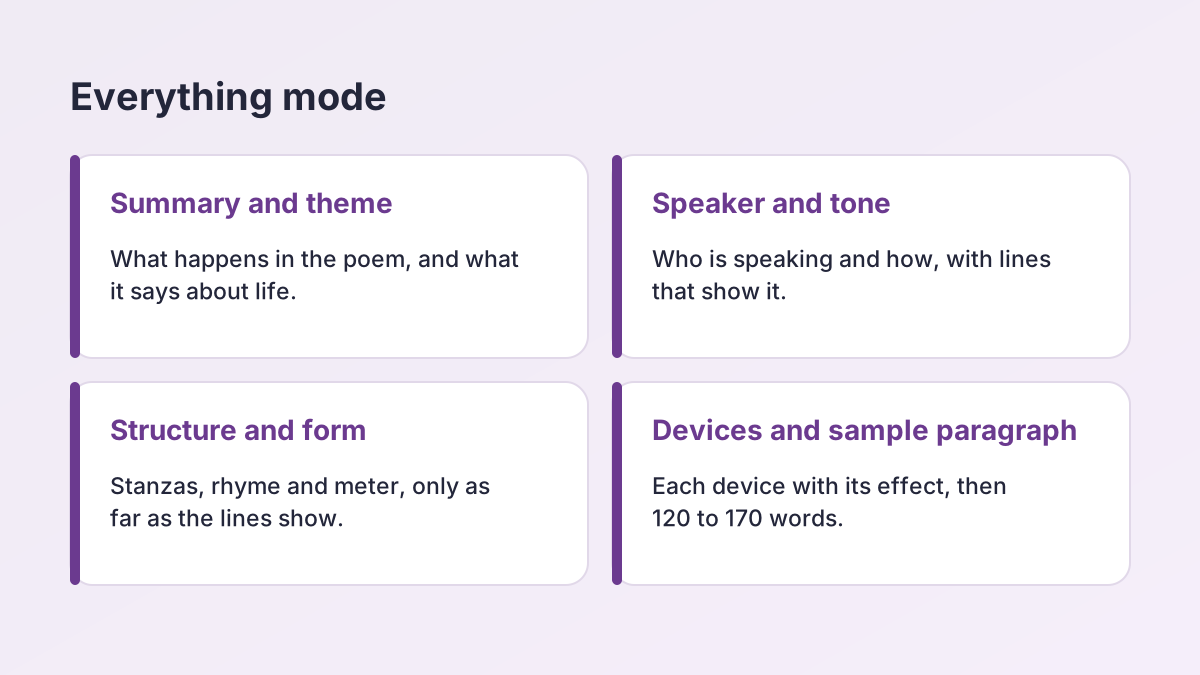
How to analyze a poem: a five-step routine
You can analyze a poem on your own with this routine, and you will read the tool's results better after trying it.
1. Read it aloud, twice
Poems are made of sound. Reading aloud shows you where the lines pause, speed up or rhyme.
2. Say what happens in plain words
Write one or two sentences, as if you were explaining it to a friend. Do not mention devices yet.
3. Find the speaker and the tone
Who is speaking, to whom, and with what attitude? Look for words that show feeling.
4. Look at form and sound
Count the stanzas and lines, notice any rhyme, and see whether the lines are long or short.
5. Connect devices to the theme
Pick the devices that matter and ask what each one adds to the theme. If you cannot say, leave it out.
The Academy of American Poets' poetry glossary is a handy reference for terms such as stanza, quatrain, rhyme and simile.
How the poem analyzer reads your lines
As a poem analyzer, the tool follows rules built into its instructions. Knowing them helps you judge the results.
Every point has a quotation
Each claim should rest on a short quotation from the poem, and the explanation says what the choice does, not just what it is.
Devices only when they are really there
The tool is told to name a device only if it appears in the lines. If you think it missed one, point it out yourself and ask your teacher.
Rhyme and meter only as far as the lines show
It describes meter and rhyme from what it can see in your text. For free verse, it says so.
No outside biography
It uses the title and poet only if you provide them, and it does not add biography or historical background. If your assignment needs context about the poet or the period, look it up in a reliable source and add it yourself.
Level
The Level menu tells the AI who it is writing for, so a middle school result should be simpler than a graduate one.
Poetry analysis generator: theme, tone and structure
Used as a poetry analysis generator, the tool gives you the three things most poetry assignments ask about.
Theme
A theme is a claim about life, not a topic. "Hope" is a topic. "Hope persists without asking for anything in return" is a theme. The Theme focus phrases it as a claim and then shows where the poem builds it.
Speaker and tone
The speaker is the voice in the poem, which is not always the poet. Tone is the speaker's attitude. Good analysis names the tone and points to the words that create it.
Structure and form
Structure covers how the poem is built: stanzas, line lengths, rhyme and any turn in the poem. Form is the named pattern, such as a sonnet or a free-verse poem.
Putting them together
The best analysis shows how structure and sound support the theme. For example, short, even lines can make a calm voice feel steady.
Literary devices finder: what it looks for
The Literary devices focus works as a literary devices finder. These are common devices you may see it name, with the effect each tends to have.
- Metaphor and simile: compare unlike things to make an idea vivid.
- Personification: gives human traits to an object or idea.
- Imagery: words that appeal to the senses.
- Alliteration and assonance: repeated sounds that link words.
- Repetition: stresses an idea or builds rhythm.
- Enjambment: carries a sentence over a line break.
- Contrast: sets two ideas against each other.
- Symbolism: an object that stands for a larger idea.
Effects matter more than names
A device with no effect is only a label. Always ask what the device makes the reader see, hear or feel.
Do not force devices
Not every poem uses every device. A good result is short when the poem is plain.
Reading structure, rhyme and meter without guessing
Structure is the part students most often guess at, so the tool is careful with it.
What it will describe
- The number and length of stanzas.
- Rhyme, where the lines show it. It may also point out near rhymes.
- A regular pattern of stresses, if the lines clearly follow one.
- Sometimes a shift in tone or subject, often called a turn.
What it will not do
It will not claim a rhyme scheme or meter that is not in the lines. When a poem has no regular pattern, it calls it free verse.
Check it by reading aloud
Meter is easiest to hear. Read the lines aloud and tap the stresses, then compare with the result. If they disagree, trust your ear and ask your teacher.
Useful vocabulary
A pair of rhyming lines is usually called a couplet, four lines make a quatrain, and a fourteen-line poem in a set pattern is a sonnet.
The quote check: keeping quoted lines honest
Poem analysis falls apart if a quoted line is wrong. After the AI writes its answer, the site checks each quotation of four or more words against the poem you pasted, ignoring case, punctuation and spacing. A quotation it cannot find gets the note [check this quote against your text].
What to do
- Compare the flagged words with the poem.
- Fix the quotation or cut it.
- Keep quotations short. The tool is told to keep each one under 25 words.
Limits
The check compares the result with what you pasted, not with a published edition. Paste from a reliable source, because editions of the same poem sometimes differ in punctuation. Quotations of three words or fewer are not checked, so look at them yourself.
Which poems to paste into the poem analysis tool
The poem analysis tool works best on poems you have been assigned or want to understand better. Some practical points:
Short and medium poems
A poem of a few stanzas gives the tool plenty to quote. The box accepts up to 8,000 characters, so a long poem fits, but a very long one gets thinner analysis for each part.
Poems with the line breaks kept
Paste the poem the way it is printed. The poem analysis tool reads line and stanza breaks as part of the evidence, so a poem pasted as one block loses information about form.
Public-domain and modern poems alike
You can paste a classic from your anthology or a contemporary poem from class. For poems still under copyright, paste only what your assignment needs, and keep your citation ready.
Your own poems
The poem analysis tool can also read a poem you wrote. Seeing which devices it finds, and which it does not, can show you what to revise.
When a poem is a song
Song lyrics can be read as poems. The tool analyzes only the words, so mention in the Title and poet box that it is a song.
Common poem analysis mistakes
- Paraphrasing only. Retelling the poem is not analysis. Explain how it is built.
- Finding hidden meanings everywhere. Start with what the poem says, and support every reading with lines.
- Confusing speaker and poet. Say "the speaker" unless your teacher wants you to discuss the poet.
- Naming devices without effects. "This is alliteration" needs a second sentence.
- Ignoring form. Line breaks and stanzas are choices too.
- Inventing a rhyme scheme. If you cannot hear it, check again.
- Quoting whole stanzas. Quote the words you analyze.
Moving to an essay
When your notes become an essay, the analytical essay generator helps plan it, and the quote analysis tool can go deeper on a single line.
Is the poem analysis tool free, and is my poem saved?
The tool is free, with no account or sign-up. Each visitor can make 30 requests an hour.
The poem and details you enter are sent to our AI providers (Groq, with Google Gemini as a backup) only to generate the analysis. The Study Corp does not save them.
Using it with integrity
Use the output to study and to draft: see how evidence supports an interpretation, then write your own analysis in your own words. Follow your school's AI policy and ask your teacher if you are not sure what is allowed.
Need a poem to write about?
Our guide to poem prompts has ideas for writing your own, and the word counter keeps your essay within its limit.
Poem analysis tool FAQ
Is the poem analysis tool free?
Yes. There is no sign-up, and each visitor can make 30 requests an hour.
How do I analyze a poem for school?
Read it aloud, say what happens, find the speaker and tone, look at form and sound, then link the devices to the theme. The tool's Everything focus covers the same ground.
What can I choose to analyze?
Everything, Literary devices, Theme, or Structure and form. Each result ends with a sample analysis paragraph.
Does it find literary devices correctly?
It is told to name a device only when it is in the lines, and to explain each effect. Check its choices against the poem, as it can still be wrong.
Can it tell me the rhyme scheme and meter?
It describes rhyme and meter only as far as it can see them in the lines, and calls a poem free verse when there is no pattern.
How long can the poem be?
From 40 to 8,000 characters, with line breaks kept.
Why does a result say to check a quote?
A quotation of four or more words that is not in your pasted poem gets a note to check it. Compare it with your poem before using it.
What kind of poem works in the poem analysis tool?
Any poem with at least 40 characters, kept with its line breaks. Short and medium poems from your anthology work best, and you can paste your own poem too.
Is my poem saved?
No. The text goes to Groq, with Google Gemini as a backup, only to create the result, and The Study Corp does not save it.
Can I use the sample paragraph in my essay?
No. Use it as a model, write your own paragraph in your own words, and follow your school's AI policy.
More free study tools
- Essay Summary GeneratorA summary in your chosen length, plus a one-sentence version, using only what the text says.
- Key Points GeneratorThe main idea and the 3 to 10 most important points of any text, ranked.
- Study Notes GeneratorOutline, Cornell, bullet or flashcard notes from your class material.
- Question GeneratorQuiz and study questions from any text, with an answer key.
- Case Study Analysis GeneratorA structured analysis of your case: general, SWOT, PESTLE, clinical or ethics.
- Quote Analysis ToolMeaning, key words, devices and significance, plus a ready analysis paragraph.
- Rhetorical Analysis GeneratorSOAPSTone, appeals and rhetorical choices with exact quotes, or two AP-style body paragraphs.
- Debate Argument GeneratorDefinitions, contentions with claim, warrant and impact, rebuttals and a closing.
- Speech GeneratorA timed speech for class, a campaign, graduation or a special occasion, with speaking notes.
See all 80 free tools for students
Related tools
Last updated by The Study Corp editorial team.