Paragraph openers: before and after
The first sentence of a body paragraph, as students often draft it, then the same sentence with one of the transition words for paragraphs from the finder, linking it to the paragraph before. All examples are invented.
BeforeMany seniors sign a lease, a phone contract or a student loan within a year of graduation.
With a transitionTo begin with, many seniors sign a lease, a phone contract or a student loan within a year of graduation.
"To begin with" signals the first reason without the stiff "Firstly".
BeforeThe class also strengthens the math students already learn.
With a transitionBeyond preparing students for those decisions, the class strengthens the math they already learn.
The opener sums up paragraph one in a few words, then turns to the new point.
BeforeAdding the course would cost the school very little.
With a transitionMost importantly, adding the course would cost the school very little.
An emphasis opener tells the reader this is the strongest reason.
BeforeThe schedule is already full, and another requirement would crowd out electives.
With a transitionSome may argue that the schedule is already full and that another requirement would crowd out electives.
The frame makes clear this is the other side's view, not yours.
BeforeThe course could replace one semester of the current health class.
With a transitionHowever, the course could replace one semester of the current health class, so no elective would be lost.
"However" turns the paragraph back to your argument.
BeforeIn conclusion, the clinical rotation changed how I think about patient care.
With a transitionLooking back, the clinical rotation at St. Mary's changed how I think about patient care.
A reflective opener replaces "In conclusion" in a personal or narrative piece.
How to find transition words for paragraphs
This page opens the finder on By place in the essay. The AI box below it is set to Between paragraphs.
- Pick the spot. Choose First body paragraph, Second body paragraph, Third or last body paragraph, Counterclaim and rebuttal, Evidence and quotes, or Conclusion paragraph.
- Read the tip. The first group shows openers for that spot and a one-line tip; the groups under it show related transitions.
- Tap an opener. Each opener shows how to punctuate it and, for many, an example sentence. Select Copy, or Copy this list for the whole set.
- Paste your paragraphs. In the AI box, paste up to 600 words with a blank line between paragraphs. Between paragraphs is already selected; change the tone under More options.
- Choose a version. Select Add transitions. You get up to three versions with the added words highlighted. Copy the one that fits.
How transition words for paragraphs work
Inside a paragraph, transitions link sentences. Transition words for paragraphs link whole ideas, so they have a bigger job: they tell the reader how the new paragraph relates to your thesis and to the paragraph just before it.
The UNC Writing Center's handout on transitions notes that a transition between paragraphs can be a word, a phrase or a full sentence, and it can sit at the end of the first paragraph, the start of the second, or both. The Purdue OWL guide to transitions and transitional devices adds a useful test: a strong transition repeats key phrases from the previous paragraph, so it could only connect those two paragraphs.
Words or sentences?
- A transition word or phrase (In addition, However, Most importantly) is enough when the link is obvious.
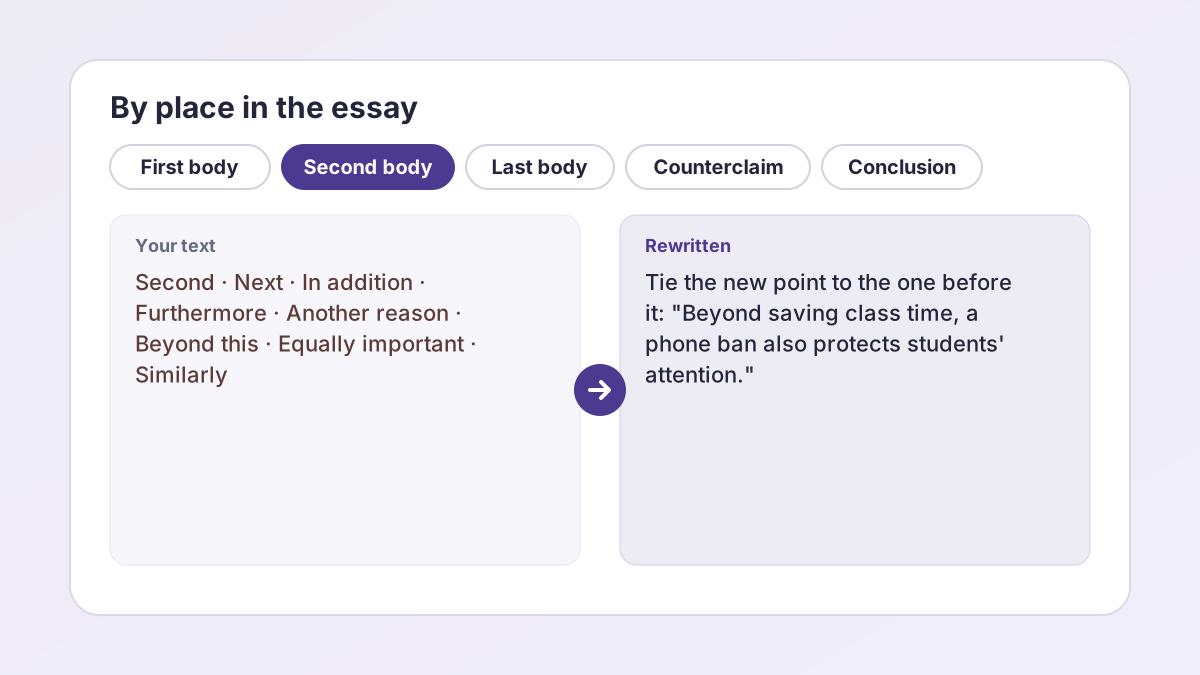
- A transition sentence names both ideas: "Beyond saving class time, a phone ban also protects students' attention."
By position or by purpose?
This page sorts transition words for paragraphs by where a paragraph sits. For full lists by job (addition, contrast, cause and effect, evidence), see the Transition Words Finder.
Transition words to begin a paragraph
Before you choose an opener, ask one question: what does this paragraph do to the one before it? The answer decides the word. These transition words to begin a paragraph are sorted by that relationship.
| The new paragraph… | Openers | Sample first sentence |
|---|---|---|
| Adds another reason | In addition, Furthermore, Another reason, Beyond this | Another reason to keep the library open late is that many students work after school. |
| Goes deeper on the same point | More specifically, In particular, Building on this | Building on this, the survey shows which students use the library most. |
| Turns to a different side | However, On the other hand, In contrast | On the other hand, the cost of staffing the library until 9 p.m. is real. |
| Shows what happened next | As a result, Consequently, Because of this | As a result of the new hours, the line for printers shrank. |
| Moves forward in time | Next, Later, By the 1870s, Meanwhile | By the 1870s, Reconstruction had begun to unravel. |
| Gives the strongest point | Most importantly, Above all, Perhaps most significantly | Above all, longer hours give every student a quiet place to work. |
Starting a paragraph without a transition word
Not every paragraph needs a single connecting word. A topic sentence that echoes the last paragraph can do the job alone: "That quiet space matters most during finals week." Mix transition words to begin a paragraph with echo sentences like this, so your essay does not read like a checklist.
First body paragraph transition words
The first body paragraph comes straight after your thesis in the introduction, so its opener has one job: signal that the first reason is starting. First body paragraph transition words that work well:
- To begin with
- First (many US teachers prefer it to Firstly)
- First of all (a little casual; fine in middle school)
- One reason / The most obvious reason
- Initially (best for events in time order)
- To start
First body paragraph transition words in use
- Argumentative: "To begin with, a later start time gives teenagers the sleep they need."
- Literary analysis: "From the opening chapter, Fitzgerald presents Gatsby as a man built on a dream."
- History: "The first cause of the Revolution was economic: Parliament's new taxes."
- Compare and contrast: "The most obvious difference between the two candidates is their view of taxes."
Can you skip it?
Yes. If your thesis lists three reasons, a first body paragraph that opens with the first reason's key words is already clear. A transition helps most when the essay is long or the reasons are not listed in the thesis.
Second, third and last body paragraph transitions
The middle and final body paragraphs need different transition words for paragraphs. The second one should link back; the last one should signal that this is the final, often strongest point.
Second body paragraph
Openers in the finder: Second, Next, In addition, Furthermore, Another reason, Beyond this, Equally important, Similarly. Instead of Secondly, try a link that sums up paragraph one:
- "Beyond saving money, the program improves attendance."
- "Just as important as cost is the effect on attendance."
- "In addition to the time it saves, the policy reduces stress."
Third body paragraph
Writing a five-paragraph essay? Your third body paragraph is also your last. If you have four body paragraphs, use an addition opener for the third (Furthermore, Equally important) and save the final-point words for the fourth.
Last body paragraph
Openers in the finder: Finally, Lastly, Third, Most importantly, Above all, The strongest reason, Perhaps most significantly.
- Finally and Lastly say "this is the end of the list".
- Most importantly and Above all say "this is the best reason", which is why many writers put their strongest point last.
A quick check: if you could swap your second and third paragraphs without changing the openers, the transitions are not doing much work.
Counterclaim transition words and rebuttals
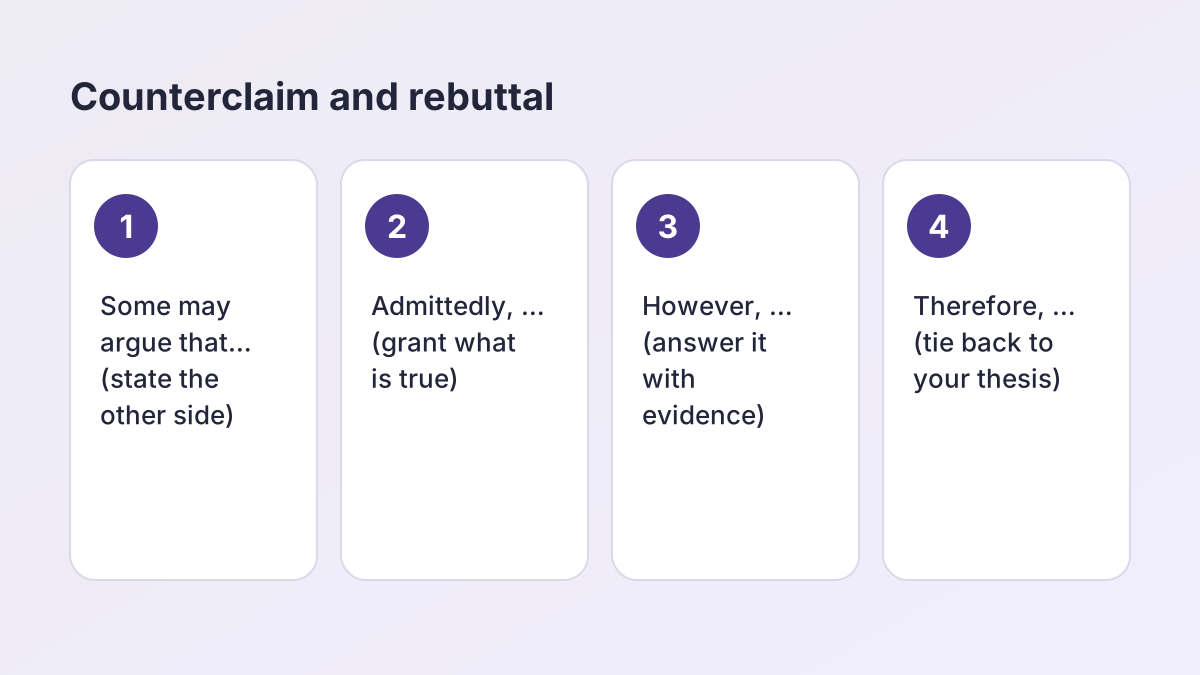
A counterclaim paragraph has two halves: you state the other side fairly, then you answer it. Counterclaim transition words open the first half; rebuttal words mark the turn. Many argumentative essay rubrics ask for both, so check your assignment.
| Move | Transitions | Example |
|---|---|---|
| Introduce the other side | Some may argue that, Critics claim that, Opponents believe that | Some may argue that uniforms limit students' self-expression. |
| Grant what is true | Admittedly, Granted, It is true that, Of course | Admittedly, uniforms cost families money up front. |
| Turn to your answer | However, Even so, Nevertheless, Still | However, a uniform replaces several outfits a year. |
| Show the flaw | This argument overlooks, Yet the evidence shows, In reality | This argument overlooks the cost of replacing worn-out clothing. |
| Return to your thesis | Therefore, For this reason, Ultimately | Therefore, uniforms are still the more affordable choice. |
Where the counterclaim goes
Teachers differ. Some want a separate paragraph just before the conclusion; others want the counterclaim and rebuttal folded into a body paragraph. In the finder, select Counterclaim and rebuttal to get both lists together.
A template using counterclaim transition words
"Some may argue that [opposing view]. Admittedly, [the part that is true]. However, [your evidence]. Therefore, [link back to your thesis]." To draft a whole argument with a counterclaim built in, try the Argumentative Essay Generator.
Transition words for a conclusion paragraph
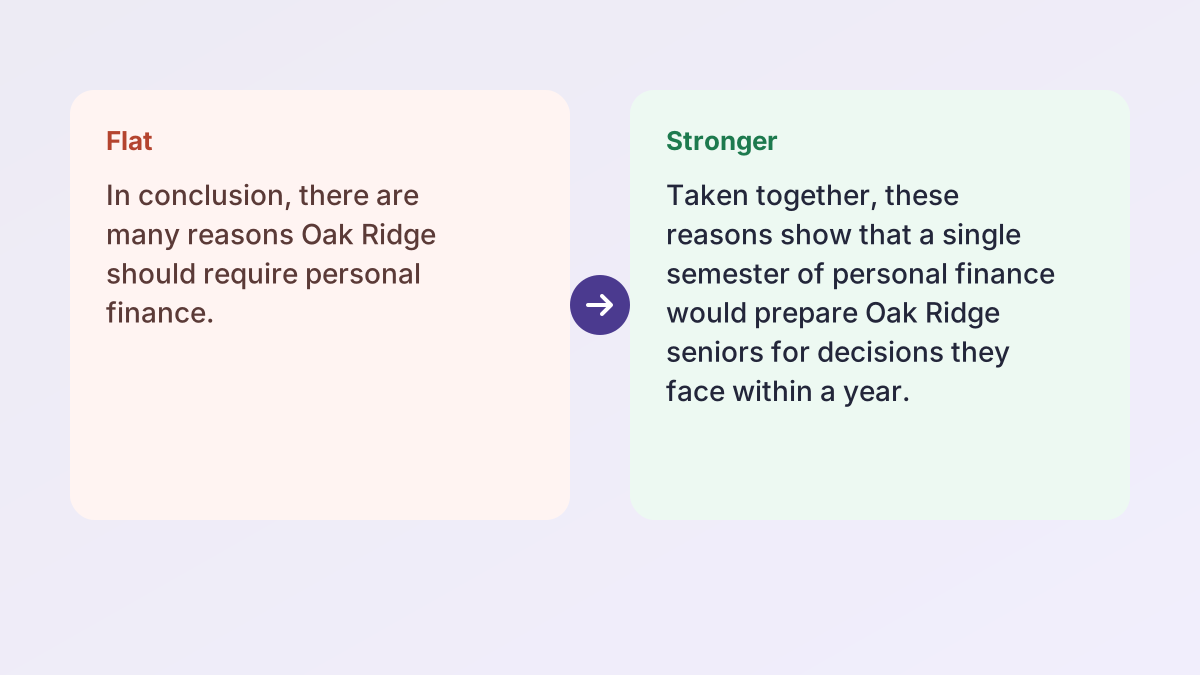
"In conclusion" is correct, but many teachers ask for something fresher because it is the most predictable opener in school writing. These transition words for a conclusion paragraph sound more confident:
- Ultimately: for a final judgment. "Ultimately, the evidence favors a later start."
- Taken together: when several reasons add up. "Taken together, these changes would cost little."
- For these reasons: points back to your body paragraphs.
- Overall: a neutral summary.
- In the end: good for narratives and history.
- All things considered: after you have weighed both sides.
- Looking back: for a personal or reflective essay.
Alternatives to "finally" and "lastly"
Save Finally for your last body paragraph, not the conclusion. In the conclusion, Ultimately or In the end signals the wrap-up without sounding like another item on the list.
Or use no transition
Transition words for a conclusion paragraph are optional. A conclusion can open by restating your thesis in new words: "A semester of personal finance is a small change with a large payoff." Readers know they have reached the end. The Conclusion Generator and the Restate Thesis Generator can help you draft that sentence.
Transition sentences between paragraphs
When a single word is not enough, write a transition sentence. It names the idea you just finished and the idea you are starting, in one line.
The echo technique
- Find the key phrase of the last paragraph: saves class time.
- Find the key phrase of the new paragraph: protects attention.
- Join them with a transition: "Beyond saving class time, a phone ban also protects students' attention."
More transition sentence patterns
- "While [last point] matters, [new point] matters even more."
- "[Last point] is only part of the story; [new point] is just as important."
- "If [last point] is true, then [new point] follows."
- "Not only does [last point], but [new point] as well."
The Transition Sentence Maker writes full linking sentences like these from the end of one paragraph and the start of the next. For a clear first line after the transition, try the Topic Sentence Generator.
Five-paragraph essay worked example
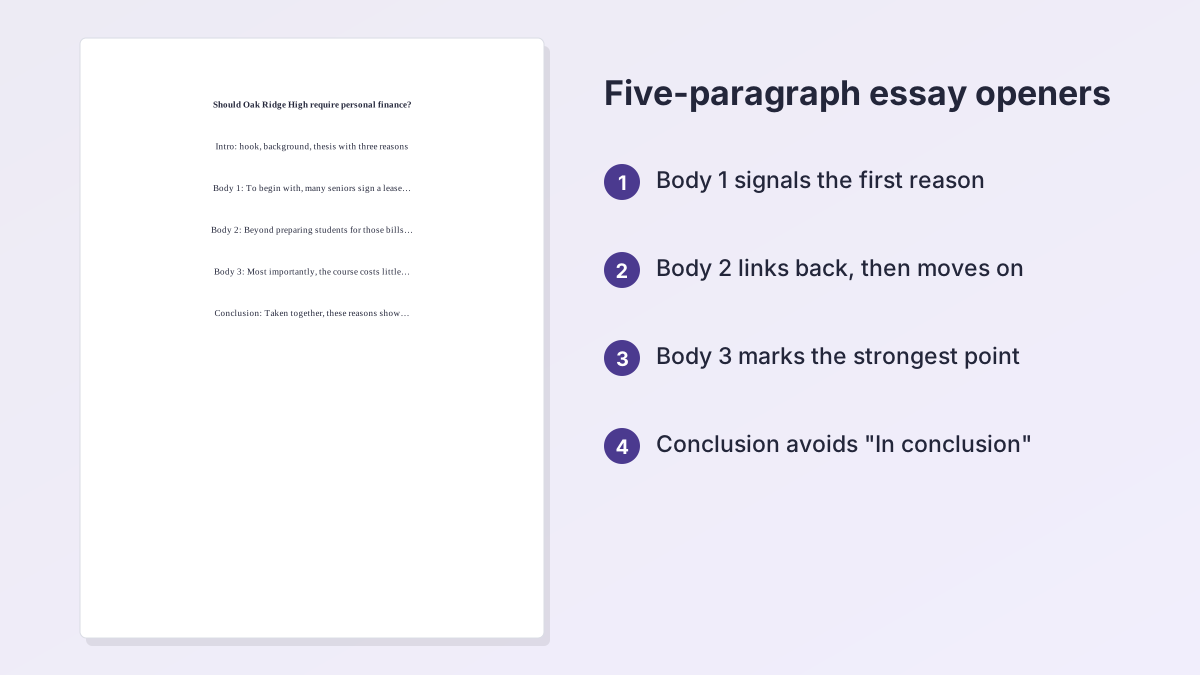
Here is an invented argumentative essay, cut down to the first sentence or two of each paragraph, so you can see how transition words for paragraphs move the reader through it.
Introduction (ends with the thesis): "Oak Ridge High School should require one semester of personal finance because students face money decisions right after graduation, the class builds practical math skills, and it costs the school little to add."
Body paragraph 1: "To begin with, many seniors sign a lease, a phone contract or a student loan within a year of graduation." Signals reason one.
Body paragraph 2: "Beyond preparing students for those decisions, the class strengthens the math they already learn." Echoes paragraph one, then turns.
Body paragraph 3: "Most importantly, the course would cost the school very little." Marks the strongest point. Partway through: "Some may argue that the schedule is already full. However, the course could replace one semester of the current health class." Counterclaim and rebuttal.
Conclusion: "Taken together, these reasons show that a single semester of personal finance would prepare Oak Ridge seniors for decisions they will face within a year." Restates the thesis without "In conclusion".
What to notice
- No two paragraphs open with the same kind of word.
- The second opener repeats a phrase from the first paragraph (those decisions).
- The counterclaim uses its own frame, so the reader never mistakes it for your view.
To plan an essay like this from scratch, start with the Essay Outline Generator.
Mistakes with paragraph transitions
Most problems with transition words for paragraphs come from habit, not grammar.
- The countdown. First… Second… Third… In conclusion is clear, but it is the pattern teachers see most. Swap at least two of the four.
- The wrong logic. However at the start of a paragraph that adds another reason confuses the reader. Match the word to the relationship.
- Firstly, secondly, lastly. Not wrong, but many US teachers prefer First, Second and Finally.
- Transitions doing the work of organization. If you cannot find any word that links two paragraphs, the order may be the problem. Try moving the paragraph instead.
- Casual openers. Plus, So and Also at the start of a body paragraph read as informal. The finder's Formal essay words only box hides the casual ones.
- Repeating one word. Three paragraphs that open with Furthermore sound mechanical, even if each is correct.
- Forgetting the comma. Most openers (However, In addition, Most importantly) take a comma after them. Frames such as Some may argue that do not.
Is this paragraph transitions tool free and private?
Yes. The finder of transition words for paragraphs is free, needs no account and runs in your browser, so browsing and copying openers sends nothing anywhere and uses no AI.
The Add transitions box sends your paragraphs to our AI providers (Groq, with Google Gemini as a backup) only to generate the versions you see. The Study Corp does not save them. Citations, quotations and numbers are always kept exactly, and the AI is told to keep your paragraph breaks.
Next steps
Polish a whole paragraph with the Paragraph Rewriter, then check your length with the Word Counter.
Transition words for paragraphs FAQ
What are good transition words to begin a paragraph?
For the first body paragraph: To begin with, First or One reason. For the second: In addition, Furthermore or Beyond this. For the last: Finally, Most importantly or Above all. Match the word to what the paragraph does.
What can I say instead of secondly?
Second, Next, In addition, Furthermore, Another reason, or a phrase that sums up the last paragraph: "Beyond saving money, the plan…"
What is a good transition word for the third body paragraph?
In a five-paragraph essay it is also the last body paragraph, so use Finally, Most importantly or Above all. If more paragraphs follow, use an addition word such as Furthermore or Equally important.
What can I use instead of in conclusion?
Good transition words for a conclusion paragraph include Ultimately, Taken together, For these reasons, Overall, In the end or All things considered. You can also skip the transition and open by restating your thesis in new words.
What are counterclaim transition words?
Some may argue that, Critics claim that, Opponents believe that, Admittedly and It is true that introduce the other side. However, Even so and This argument overlooks turn to your rebuttal.
Do I need a transition at the start of every paragraph?
No. Transition words for paragraphs help most where the link is not obvious. A topic sentence that repeats a key idea from the last paragraph can connect them without a transition word.
Where do transition words for paragraphs go?
Usually at the start of the new paragraph, but not always. The UNC Writing Center notes that a transition between paragraphs can sit at the end of the first, the start of the second, or both. Most school essays put it at the start.
Does the AI rewrite my paragraphs?
It is told to keep your sentences, their order and your paragraph breaks, and to add a transition at the start of each paragraph after the first. Added words are highlighted so you can check every change.
More free transition tools
- Transition Words FinderTransition words by purpose, with punctuation and examples, plus AI that adds them to your paragraph.
- Transition Sentence GeneratorA full sentence that links one paragraph to the next.
See all 80 free tools for students
Related tools
Last updated by The Study Corp editorial team.