Persuasive Claims, Openers and Endings: Weak vs. Strong
Each pair shows a common first-draft problem and a repaired version. Every sentence is invented for this guide, so use the pairs as models for your own topic and wording.
Common problemMany students are tired in the morning.
Stronger versionOur high school should start classes at 8:30 a.m., because rested students learn more.
A claim must be something a reader could accept or reject.
Common problemI am going to persuade you that recess matters.
Stronger versionPicture an eight-year-old after six hours at a desk, still holding a pencil and still waiting to move.
Show the reader a scene instead of announcing a goal.
Common problemRecycling is good.
Stronger versionOur city council should add curbside recycling for apartment buildings.
Persuasion needs someone who can say yes.
Common problemEveryone knows that animal shelters are heartbreaking.
Stronger versionOur county shelter is full by June each year [cite], and each extra volunteer shift frees a dog for a walk.
Pair feeling with a fact you can cite.
Common problemNobody could possibly disagree.
Stronger versionSome will say a later start hurts after-school sports. A schedule shift of thirty minutes can keep practices on time.
Answering the likeliest objection builds trust.
Common problemIn conclusion, school lunches should improve.
Stronger versionSign the petition at the front office this week and ask the board to review the menu at its next meeting.
End with a clear, doable step.
How to Make a Persuasive Essay in 6 Steps
Follow these steps in order and the essay almost organizes itself. Most of the work happens before the first paragraph.
- Choose a claim and a reader. Pick a position you can defend and name the person or group who can act on it, so the persuasive essay format has a target.
- Gather your evidence. Collect facts, data and expert statements from reliable sources, and note the best objection.
- Plan with an organizer. Use a persuasive essay graphic organizer to fill in a hook, the claim, two or three reasons, an objection with an answer and a call to action.
- Draft the introduction. Open with a hook, add context and state the claim in one clear sentence.
- Draft the body and ending. Give each reason a paragraph, answer the objection fairly and close with a specific request.
- Revise for your reader. Cut anything that wouldn't move your reader, check each fact and cite every source.
What Is a Persuasive Essay? The Basics
If you're asking what is a persuasive essay, here's a short persuasive essay definition: it's an essay that tries to convince a specific reader to share your view or take a step you propose. It uses logic, evidence and, often, emotion. Many teachers treat it as a close cousin of argument, which is why the persuasive essay format and the argumentative one look so alike. Purdue OWL's essay writing overview lists the genre as "Argumentative (Persuasive) essays," and our guide to what an argumentative essay is covers the overlap. If you want a draft to react to, the free persuasive essay generator builds one around your reader and marks where your own evidence goes.
Persuasive vs. argumentative
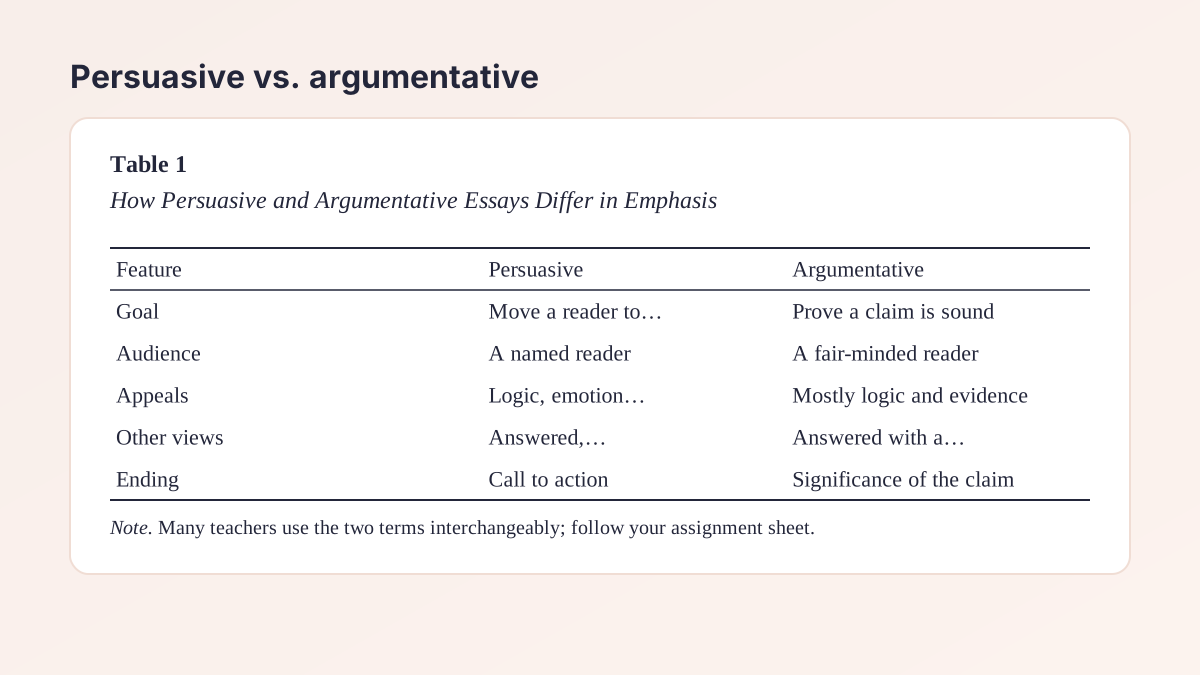
In many classes, an argumentative essay leans on logic and evidence and wants a fair-minded reader to agree the claim is sound, while a persuasive essay aims at a particular reader and often asks for action. The table below shows the usual contrast. Treat it as a convention, since some teachers use the two words as synonyms.
The three appeals
Persuasion has long been taught through three appeals from Aristotle's Rhetoric: ethos, which builds the writer's credibility; logos, which uses logic and evidence; and pathos, which speaks to the reader's feelings and values. A strong persuasive essay uses all three, with logos doing the heavy lifting. Debate builds the same skill out loud; if you need a practice motion, pick one from these debate topics and argue both sides.
Persuasive Essay Format: The Five Parts
The persuasive essay format below is the one most middle school, high school and first-year college assignments expect. It's a convention, not a law, but if you can write these parts in order you can adapt the persuasive essay format to almost any prompt.
| Part | What it does | Typical length |
|---|---|---|
| Introduction | Hooks the reader and states the claim | 1 paragraph |
| Reasons with evidence | Give the reader grounds to agree | 2 to 3 paragraphs |
| Objection and answer | Names the likeliest doubt and answers it | 1 paragraph or part of one |
| Appeals | Blend logic, credibility and feeling throughout | Across the essay |
| Conclusion with a call to action | Restates the claim and asks for a step | 1 paragraph |
Persuasive essay structure in five paragraphs
The classic version is an introduction, three body paragraphs and a conclusion. In the persuasive essay structure, put your strongest reason last in the body, or first if you want to hook a skeptical reader early. Many assignments let you fold the objection into the final body paragraph. Longer papers keep the same logic with several paragraphs per reason.
Format on the page
Layout is separate from structure. For the persuasive essay format on the page, most teachers expect a title, double spacing, a 12-point font and one-inch margins, plus a heading in your class's style. See our guides to the MLA heading and APA format guidelines if your class uses one of those. When a general rule and the assignment sheet disagree, follow the sheet.
A fill-in plan you can reuse
Introduction: hook, context, claim. Body 1 and 2: topic sentence naming a reason, evidence, appeal, link to the claim. Body 3: objection, fair answer, return to the claim. Conclusion: restated claim, short summary, call to action. A persuasive essay template like this helps only when you fill it with your own reader and research. If you want a ready-made plan, the persuasive essay outline on our tool page gives you one to edit.
Persuasive Essay Graphic Organizer
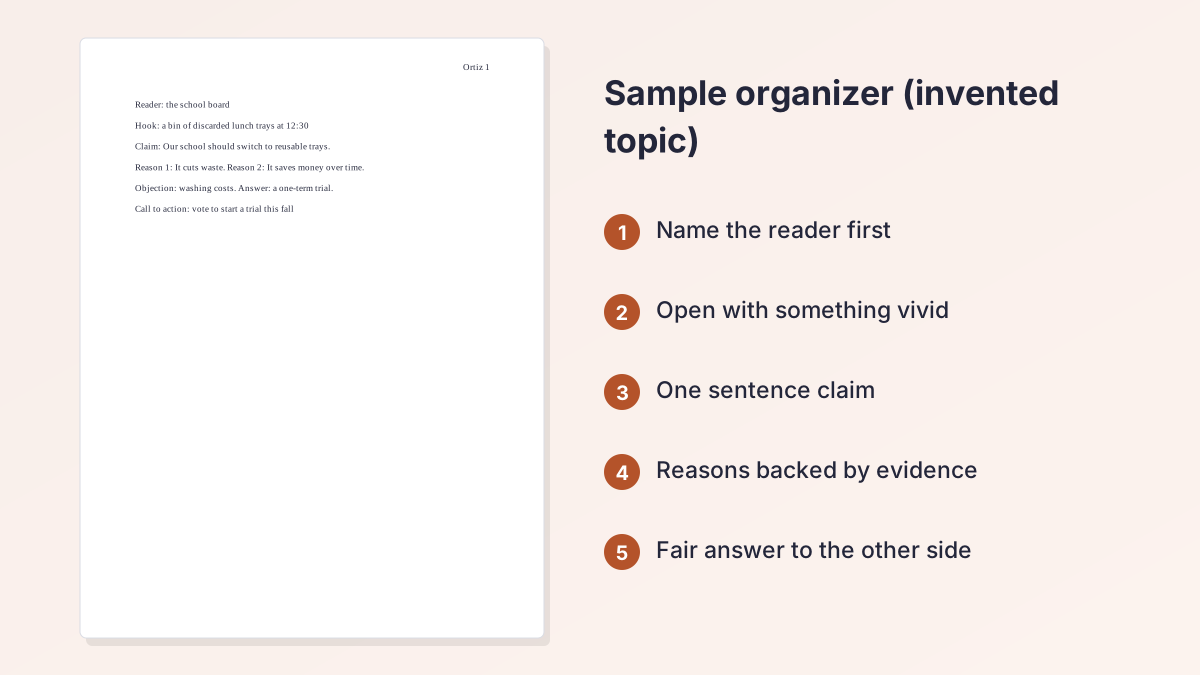
A persuasive essay graphic organizer is a one-page chart you fill in before drafting, and it's the quickest way to find a weak spot. Some teachers call a poster version an anchor chart. The page above shows a finished one. Use it like this.
What goes in each box
When you make a persuasive essay plan, start with the reader box, since every other choice depends on it. Next, write the hook and the claim. Then fill two or three reason boxes, each with a note on the evidence you'll cite. Add a box for the likeliest objection and your answer. Finish with a call to action naming who should do what. If any box is empty, you've found the research left to do.
Organizer or outline?
An organizer shows relationships at a glance, while a list-style outline shows order. Use whichever you think in. The essay outline generator can turn your organizer into a labeled outline if you want both. Either one beats starting a draft with nothing, because a persuasive essay structure with a missing piece shows in the writing.
Check the organizer against the prompt
Read the assignment again once the boxes are full. If it asks for a particular number of sources or paragraphs, adjust now rather than after drafting.
How to Start a Persuasive Essay
Learning how to start a persuasive essay is mostly learning to open with the reader in mind, and a good start shapes the whole persuasive essay structure. Skip announcements such as "I will persuade you" and skip dictionary definitions. The persuasive essay intro has three jobs: get attention, give context and state the claim. Try one of these openers, each shown with a sample line written for this guide.
Five hooks that work
- A vivid scene. "At 12:30, the cafeteria bin holds more foam trays than the school has students."
- A question to the reader. "What would you do with an extra hour of sleep every school day?"
- A surprising fact. "A foam lunch tray is used for about twenty minutes, then thrown away for good." Check any fact or statistic against a source before using it.
- A short story. "Last spring, a volunteer at our shelter walked the same dog for three months before anyone took it home."
- A bold claim. "Our town can have a safer crosswalk by next fall, and it will cost less than a single bus ad."
State the claim plainly
After the hook, add a few sentences of context, then end with the claim. "Our school should switch to reusable trays" says exactly what you want. If you need help with wording, the thesis statement generator can sharpen it. Our guide to how to write an introduction covers hooks in more depth, and the essay hook generator can draft a few to compare.
How Do You Write a Persuasive Essay Body?
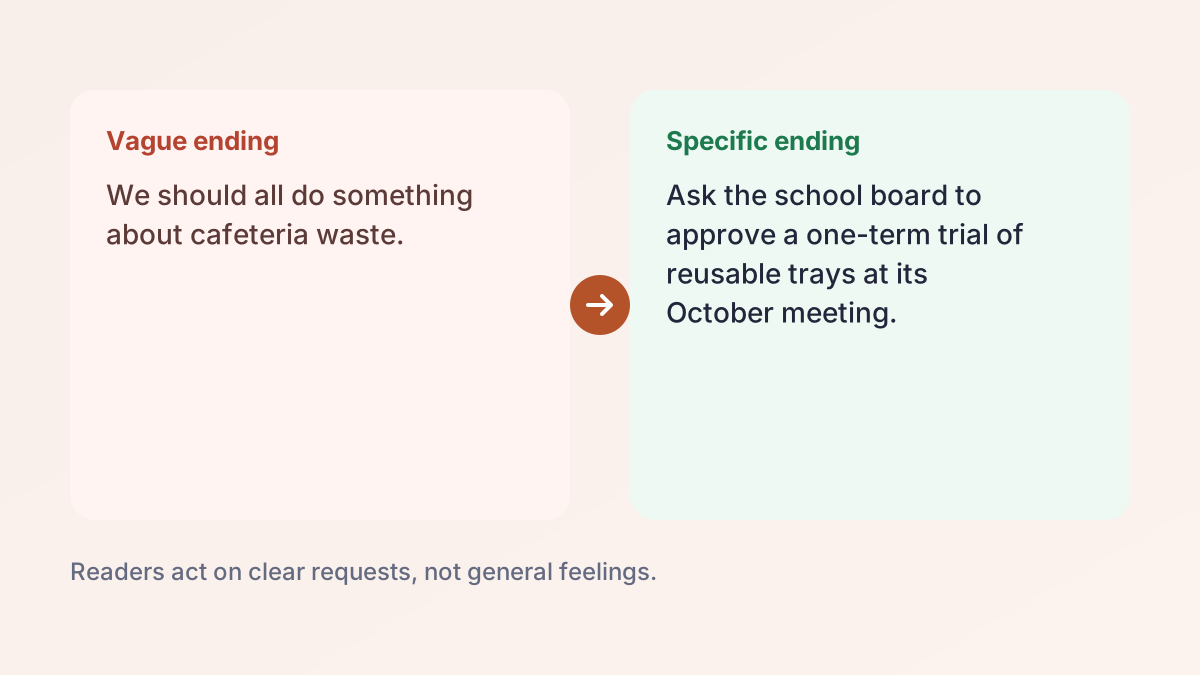
People often ask how to make a persuasive essay that actually moves a reader. The answer is in the body. Each paragraph gives one reason, in this order: a topic sentence that names the reason, evidence, a sentence that explains why it matters and a link back to the claim. The sample paragraph above follows it. Purdue OWL's paragraph guide advises keeping one idea to one paragraph, which suits persuasion well.
Choose evidence your reader trusts
A school board may respond to cost figures and local data. A parent group may respond to safety records. Match the kind of proof to the person. Use facts you can cite and see our guides to MLA in-text citation and how to cite a quote in APA.
Answer the other side fairly
Name the strongest objection in its best form, then respond with evidence or a compromise. Waving it away makes you less believable, while a fair answer builds credibility.
Persuasive essay transition words
Transitions guide the reader through your reasons. Use "first," "another reason" and "most important" to order them, "for example" and "according to" to bring in evidence, "although" and "some argue" for the objection and "therefore" for the call to action. Don't stack them in every sentence. Our guide to transition words for essays sorts them by purpose, which helps when you need persuasive essay transition words for a specific job.
How to End a Persuasive Essay
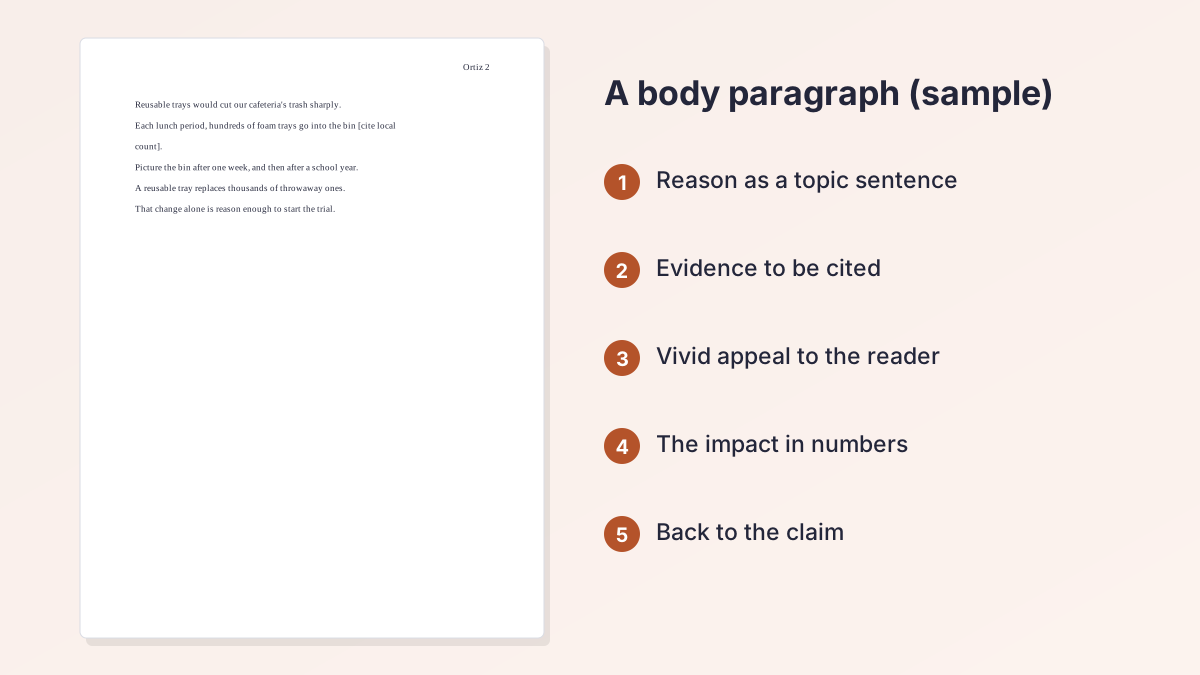
The ending is where persuasion becomes action, and it finishes the persuasive essay format. Restate the claim in new words, gather your reasons in one sentence and then tell the reader exactly what to do. A call to action should name a person or group, a concrete step and, if possible, a time.
A simple pattern
Claim in new words, then summary of reasons, then the request. For example: "Reusable trays would cut waste and save money. Ask the board to approve a one-term trial at its October meeting." This sample was written for this guide.
What to avoid
Don't open with "In conclusion," don't add a new reason and don't apologize. A threat or guilt trip usually backfires. See how to write a conclusion for more patterns.
A Short Sample in Persuasive Essay Format
Seeing the persuasive essay format in miniature helps more than another list of rules. The sample below is invented for this guide and labeled as such. It shows only the introduction and the conclusion, which are the two paragraphs readers remember most. Notice how the first names a reader and a claim and the last returns to them with a request.
Introduction (sample, invented for this guide)
At 12:30 every school day, our cafeteria bin holds more foam trays than our school has students. Each one is used for about twenty minutes and then sits in a landfill for far longer. Our school should switch to reusable trays, because the change would cut waste, save money over time and teach students a habit they can take home.
Conclusion (sample, invented for this guide)
Reusable trays would shrink our trash and stretch our budget. The only cost is a little washing, and a one-term trial would show whether it works. Ask the school board to approve that trial at its October meeting, and let this cafeteria become the first place our school takes waste seriously.
What this sample does well
The introduction opens with a scene, states the claim in its last sentence and previews three reasons. The conclusion restates the claim in new words, answers the washing objection in one sentence and ends with a specific request. A persuasive essay structure that does these things in the right places is easy for a reader to follow and hard to ignore.
Using samples without copying them
Samples teach shape, not wording. Your persuasive essay format should rest on your own reader, research and voice. If you need ideas for a claim, browse the persuasive essay topics on our tool page and narrow one to a position you can defend with evidence.
Common Persuasive Essay Mistakes
Most weak drafts fail in a handful of predictable ways, whatever the persuasive essay format. Check your own against this list.
Writing for no one
If you can't name your reader, you can't choose evidence or a request. Pick a reader first.
Relying on feeling alone
In a persuasive essay, emotion gets attention, but evidence earns agreement. Pair every appeal with a fact.
Ignoring the other side
In any persuasive essay structure, readers who see no mention of a real objection assume you haven't thought about it. Answer it.
Overstating
Words like "always," "never" and "everyone" invite easy rebuttals. Use precise claims.
Skipping the revision
Read the claim, then read only the topic sentences. They should add up to your case. For a draft to compare against yours, try the free persuasive essay tool and see how it pairs each reason with a place for a source. Then browse all of our student writing and citation guides.
Questions About Persuasive Essays
What is the format of a persuasive essay?
An introduction with a hook and a claim, body paragraphs that each give a reason with evidence, a paragraph that answers an objection and a conclusion with a call to action.
How do you write a persuasive essay?
Choose a claim and a reader, gather evidence, plan with an organizer, draft the introduction, body and ending, then revise for your reader.
How do you start a persuasive essay?
To start a persuasive essay, open with a vivid scene, a question, a surprising fact or a short story, add context and finish the paragraph with a clear claim.
How do you make a persuasive essay stronger?
Name a specific reader, back every reason with cited evidence, answer the best objection fairly and end with a concrete request.
What is a persuasive essay graphic organizer?
A one-page chart with boxes for the reader, hook, claim, reasons, evidence, objection and call to action.
What is persuasive essay structure?
Introduction, two or three reasons, an objection with an answer and a conclusion that asks for action.
What are good transition words for persuasive essays?
First and most important for order, for example for evidence, although for objections and therefore for the call to action.
How do you end a persuasive essay?
Restate the claim in new words, gather your reasons and name a specific action for a specific reader.
Is a persuasive essay the same as an argumentative essay?
They overlap. Many teachers use the terms interchangeably, while others say persuasion aims at action and argument at proof.
More free guides
- MLA In-Text CitationsAuthor-page citations for every kind of source, with examples.
- How to Cite a Website in MLAWorks Cited entries and in-text citations for web pages.
- MLA Works Cited PageFormat, order and hanging indents, with a full example page.
- MLA Annotated BibliographyFormat, annotation types and a complete example.
- APA Table FormatNumber, title, body and notes for APA 7 tables, with templates.
- MLA HeadingThe four-line first-page heading and the page header, with Word and Google Docs steps.
See all 80 free tools for students
Related tools
Last updated by The Study Corp editorial team.