MLA Works Cited Examples for Every Source Type
Each example pairs the details you would collect with the finished entry for your list. They were formatted in MLA 9 by our citation engine, with one hand adjustment: three hyphens for a repeated author; titles that are italic in your paper show as plain text here.
Source detailsWilliam Shakespeare, The Tragedy of Hamlet, Prince of Denmark, edited by Barbara A. Mowat and Paul Werstine, Simon & Schuster Paperbacks, 2012
Works Cited entryShakespeare, William. The Tragedy of Hamlet, Prince of Denmark. Edited by Barbara A. Mowat and Paul Werstine, Simon & Schuster Paperbacks, 2012.
Copy the title exactly as the title page prints it, and name the editors of the edition you used.
Source detailsHarold Bloom, Shakespeare: The Invention of the Human, Riverhead Books, New York, 1998
Works Cited entryBloom, Harold. Shakespeare: The Invention of the Human. Riverhead Books, 1998.
MLA 9 leaves out the city of publication.
Source detailsStephen Greenblatt, Will in the World: How Shakespeare Became Shakespeare, W. W. Norton, 2004 (listed after his Hamlet in Purgatory)
Works Cited entry---. Will in the World: How Shakespeare Became Shakespeare. W. W. Norton, 2004.
Three hyphens and a period replace the name. Hand-adjusted: our engine prints three dashes.
Source detailsErnest Jones, "The Oedipus-Complex as an Explanation of Hamlet's Mystery: A Study in Motive," The American Journal of Psychology, vol. 21, no. 1, 1910, pp. 72-113, DOI 10.2307/1412950
Works Cited entryJones, Ernest. “The Oedipus-Complex as an Explanation of Hamlet’s Mystery: A Study in Motive.” The American Journal of Psychology, vol. 21, no. 1, 1910, pp. 72–113, https://doi.org/10.2307/1412950.
The article title goes in quotation marks; the journal is the italic container.
Source detailsPam A. Mueller and Daniel M. Oppenheimer, "The Pen Is Mightier Than the Keyboard," Psychological Science, vol. 25, no. 6, 2014, pp. 1159-1168
Works Cited entryMueller, Pam A., and Daniel M. Oppenheimer. “The Pen Is Mightier Than the Keyboard: Advantages of Longhand over Laptop Note Taking.” Psychological Science, vol. 25, no. 6, 2014, pp. 1159–68, https://doi.org/10.1177/0956797614524581.
Reverse only the first name; the second author stays first name first.
Source detailsFaria Sana, Tina Weston and Nicholas J. Cepeda, Computers & Education, vol. 62, March 2013, pp. 24-31
Works Cited entrySana, Faria, et al. “Laptop Multitasking Hinders Classroom Learning for Both Users and Nearby Peers.” Computers & Education, vol. 62, Mar. 2013, pp. 24–31, https://doi.org/10.1016/j.compedu.2012.10.003.
List the first author, then et al.
Source details"About Sleep," Centers for Disease Control and Prevention, 15 May 2024, cdc.gov
Works Cited entry“About Sleep.” Centers for Disease Control and Prevention, 15 May 2024, https://www.cdc.gov/sleep/about/index.html.
The organization is both author and publisher, so the entry starts with the title and sorts under A.
Source detailsHamlet, directed by Kenneth Branagh, Columbia Pictures, 1996
Works Cited entryHamlet. Directed by Kenneth Branagh, Columbia Pictures, 1996.
A film starts with its title, so it sorts under H, not under the director.
How to Make an MLA Works Cited Page, Step by Step
Build the list as you research, then format the MLA works cited page once at the end.
- Start a new page. Insert a page break after your last paragraph. Keep the same one-inch margins, font and running header (your last name and the page number) as the rest of the paper.
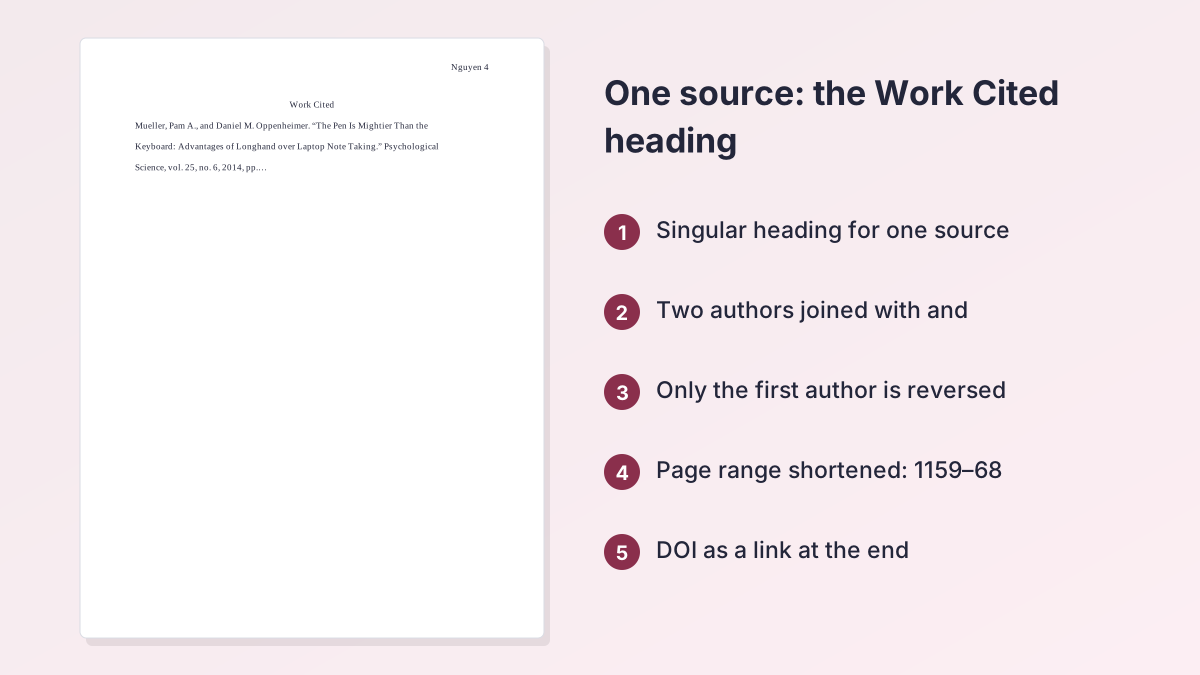
- Center the title. Type Works Cited on the first line and center it. Don't bold, underline, italicize or enlarge it. Use Work Cited if you cite only one source.
- Add one entry per source. Write an entry for every source you quoted, paraphrased or summarized, and nothing you only skimmed. Align entries with the left margin.
- Sort the entries. Alphabetize by the first word of each entry, usually the author's last name, or the title when there is no author.
- Double-space everything. Double-space the title and entries with no extra blank lines between entries. Set spacing before and after to 0 pt.
- Apply a hanging indent. Select the entries and set a 0.5-inch hanging indent, so each entry's first line is flush left and the rest are indented.
- Match your citations. Check that every citation in your text points to an entry on the list, and every entry is cited in the text.
MLA Works Cited Format: The Page Setup Rules
The MLA works cited format is set by the MLA Handbook, 9th edition (2021), and it is the same for a two-page response in Ms. Rodriguez's AP Literature class and a 15-page research paper for ENGL 1302. Paste a source into the citation maker above to get a correctly punctuated entry, then lay out the page with these rules.
| Element | MLA 9 rule | Tip |
|---|---|---|
| Placement | A new page at the end of the paper, after any endnotes | Use a page break, not repeated Enter presses |
| Title | Works Cited, centered, plain text | Work Cited if there is only one source |
| Header | Your last name and the page number, top right | Same running header as the rest of the paper |
| Font and margins | Same as the paper: a readable font such as Times New Roman 12, one-inch margins | Follow your instructor if they name a font |
| Spacing | Double-spaced throughout, no extra lines between entries | Set spacing before and after to 0 pt |
| Alignment | Entries flush left; second and later lines indented 0.5 inch | This is the hanging indent |
| Order | Alphabetical by the first word of each entry | Ignore A, An and The at the start of a title |
| Ending | Every entry ends with a period | Including entries that end with a URL or DOI |
Is the Works Cited title bold?
No. MLA treats the title like the rest of the paper's text: centered, in the same font and size, with no bold, italics, underlining or quotation marks. Teachers mark a bold title as a formatting error more often than you'd think.
Work Cited or Works Cited?
Use Works Cited when you list two or more sources. MLA's own guidance switches to the singular, Work Cited, when the list has only one entry, which happens with short literary responses that analyze a single novel or poem.
Which sources belong on the list
Include every source you quote, paraphrase or summarize, and only those. Purdue OWL's guide to the MLA Works Cited page basic format is a reliable second check on these rules, and our MLA Citation Maker builds each entry in the right order for you.
How to Make a Hanging Indent in Word and Google Docs
A hanging indent is the reverse of a normal paragraph indent: the first line of each entry starts at the left margin, and every line after it is pushed in 0.5 inch. It lets a reader scan the left edge for the word each entry is sorted by. Don't fake it with Tab or spaces; the lines break wrongly as soon as you edit.
Hanging indent in Microsoft Word
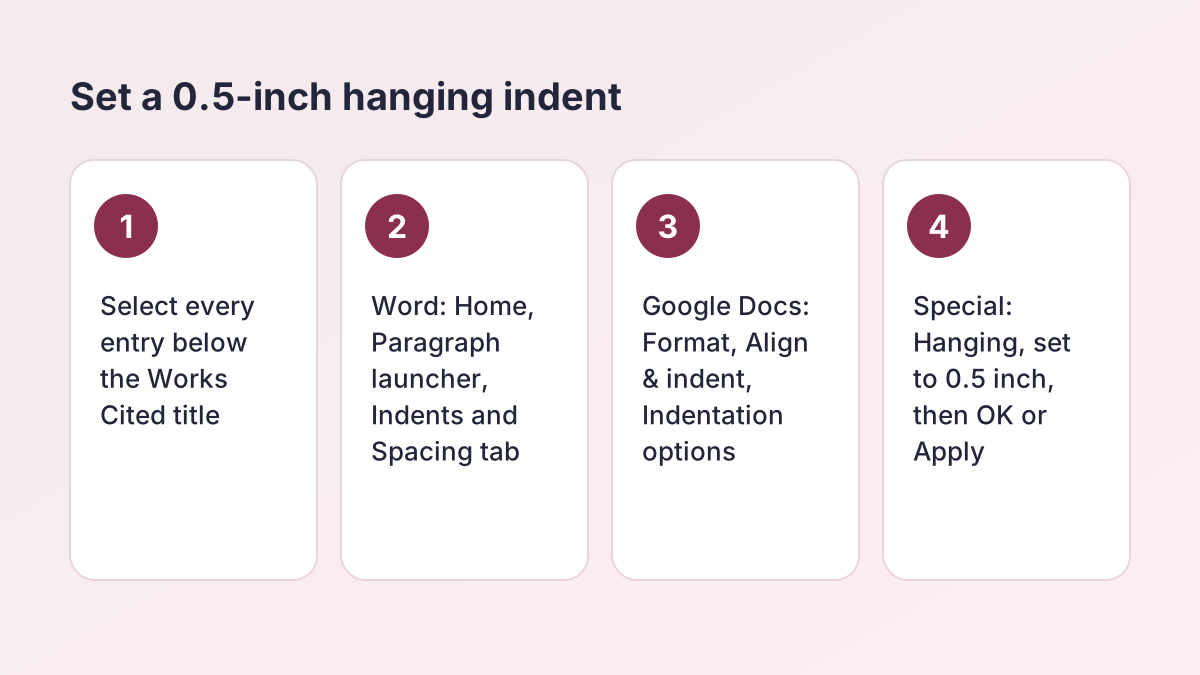
- Select every entry below the Works Cited title (not the title itself).
- On the Home tab, open the Paragraph settings dialog with the small arrow in the corner of the Paragraph group.
- On the Indents and Spacing tab, under Special, choose Hanging, and set By to 0.5".
- While you're there, set Line spacing to Double and Before and After to 0 pt, then select OK.
Hanging indent in Google Docs
- Highlight the entries.
- Open Format, then Align & indent, then Indentation options.
- Under Special indent, choose Hanging and enter 0.5 inches.
- Select Apply. Set double spacing under Format, then Line & paragraph spacing.
Checking the indentation
Zoom out and scan the left edge. Any entry whose first line is indented missed the setting, so apply it again. If you paste entries from the MLA citation generator, paste first and indent after.
How to Alphabetize a Works Cited Page
You alphabetize by whatever comes first in each entry: usually the author's last name, or the title when there's no author. Here is how to alphabetize a works cited page when the easy rule runs out.
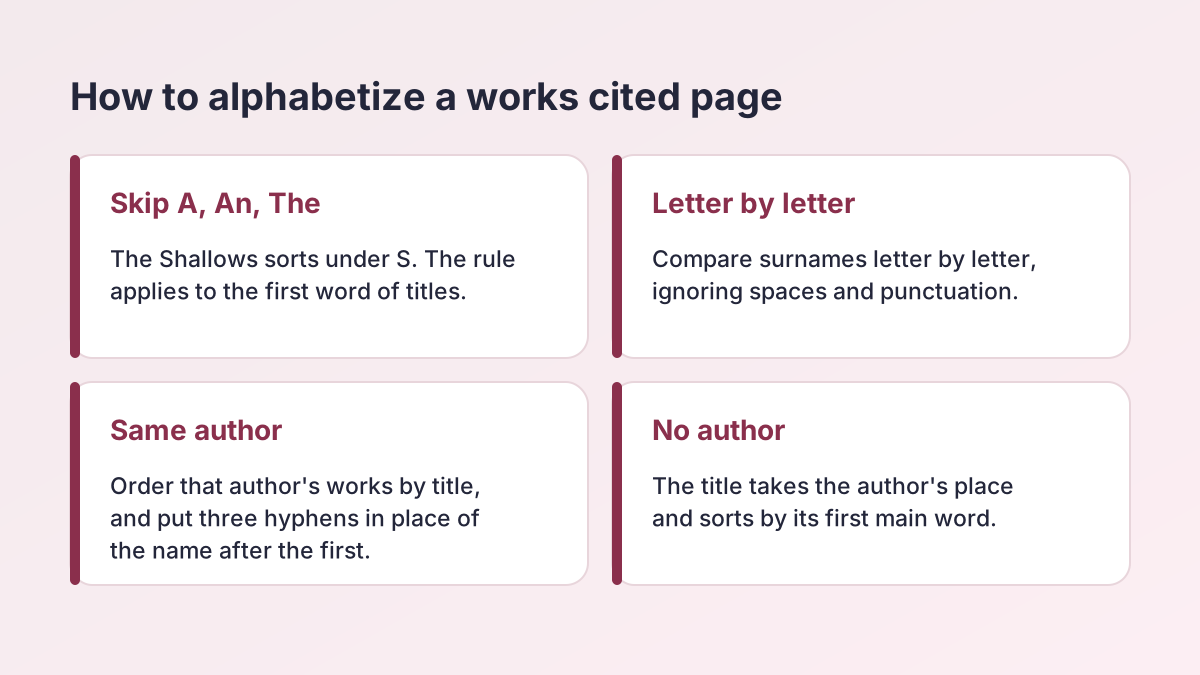
Ignore A, An and The
When an entry starts with a title, skip an opening A, An or The and sort by the next word. The Shallows goes under S, and "A Modest Proposal" goes under M. Keep the article in the entry itself; you only skip it when deciding the order.
Letter by letter
Compare names letter by letter, ignoring spaces and punctuation. A numeral starting a title sorts as if spelled out.
The same author more than once
List that author's works alphabetically by title. Give the name in the first entry only; in every entry after it, type three hyphens followed by a period in place of the name. In the sample page below, Greenblatt's Hamlet in Purgatory comes before Will in the World, and the second entry begins with "---."
One author alone and with coauthors
When someone appears as a sole author and also as the first of two or more authors, the solo works come first. Coauthored works then follow, sorted by the coauthors' last names.
Let a tool do the sorting
If you type your list by hand, paste it into the Alphabetizer to put it in order, then check the A, An and The cases yourself. Entries saved in the free MLA citation maker sort themselves as you add them.
What Each Entry Needs, by Source Type
Every entry follows MLA's core elements in a fixed order: author, title of source, title of container, other contributors, version, number, publisher, publication date and location. You include the elements your source has and skip the rest. These are the source types students cite most.
Works cited entries for books
A book needs the author, the italic title, the publisher and the year. MLA 9 drops the city of publication and shortens "University Press" to "UP," as in Princeton UP.
Works cited entries for websites
A web page needs the author if one is named, the page title in quotation marks, the italic website name, the publisher when it differs from the website name, the date, and the URL. When an organization is both author and publisher, start with the title. For no-date pages, access dates and social media, see our full guide on how to cite a website in MLA.
Two authors and three or more
Two authors appear in the source's order, joined by "and," with only the first name reversed. Three or more become the first author plus "et al."
Hamlet, Macbeth and other plays
Cite the edition you actually read, with its editors: the sample page below cites the Folger edition of Hamlet edited by Barbara A. Mowat and Paul Werstine. A Macbeth essay works the same way with your class's edition. If you watched a production, cite the film or performance as a separate entry.
The Bible
Start with the version's title as printed, in italics, then the publisher and the year from your copy's copyright page: The Holy Bible: English Standard Version. Crossway, [year].
When you're unsure which elements apply, let the MLA citation maker format it: fill in the details your source shows and it puts them in MLA 9 order.
MLA Works Cited Example: A Full Sample Page
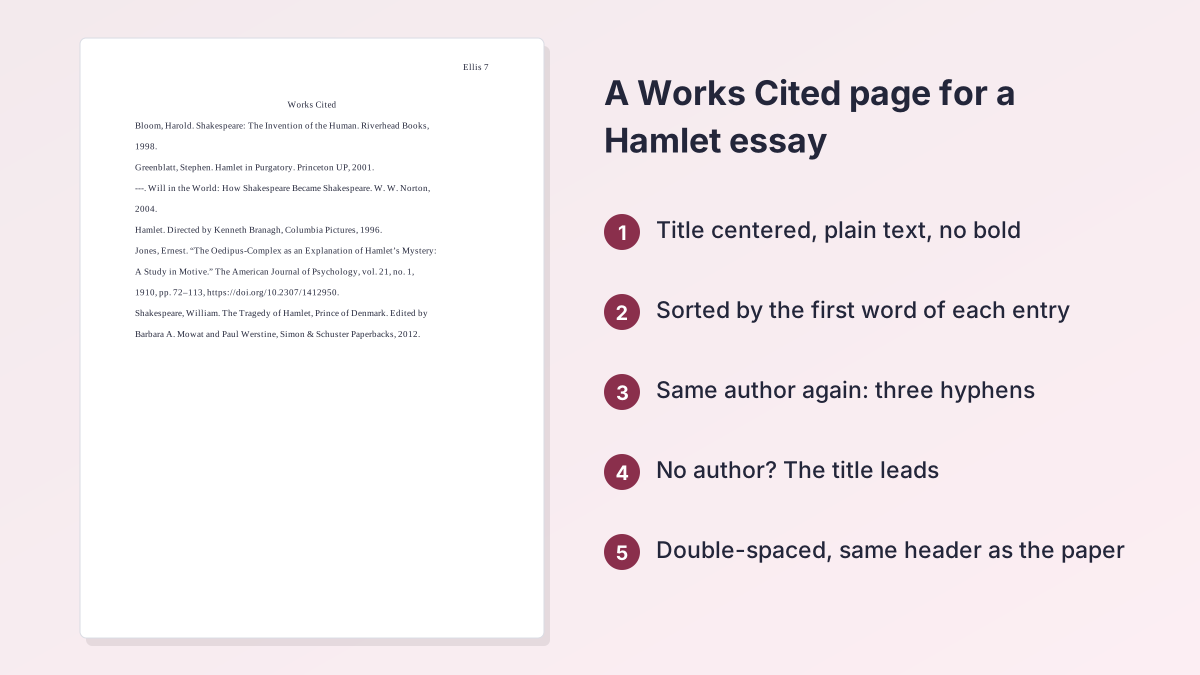
Here is a full MLA works cited example for a student essay on Hamlet written for an AP Literature class. Below, each entry has the 0.5-inch hanging indent it would have in your document.
Works Cited
Bloom, Harold. Shakespeare: The Invention of the Human. Riverhead Books, 1998.
Greenblatt, Stephen. Hamlet in Purgatory. Princeton UP, 2001.
---. Will in the World: How Shakespeare Became Shakespeare. W. W. Norton, 2004.
Hamlet. Directed by Kenneth Branagh, Columbia Pictures, 1996.
Jones, Ernest. “The Oedipus-Complex as an Explanation of Hamlet’s Mystery: A Study in Motive.” The American Journal of Psychology, vol. 21, no. 1, 1910, pp. 72–113, https://doi.org/10.2307/1412950.
Shakespeare, William. The Tragedy of Hamlet, Prince of Denmark. Edited by Barbara A. Mowat and Paul Werstine, Simon & Schuster Paperbacks, 2012.
Why the entries are in this order
Bloom comes first under B. Greenblatt's two books follow, ordered by title (H before W), with three hyphens replacing his name in the second. The film has no author in the first position, so it sorts by its title under H, after Greenblatt. Jones and Shakespeare finish the list. If the essay focused on Branagh's choices as a director, MLA also allows starting the film's entry with "Branagh, Kenneth, director."
What the citations in the essay look like
Each entry matches a short citation in the text, such as (Bloom 409), or (Greenblatt, Will in the World 45) to tell his two books apart. The play is cited by act, scene and line: (Ham. 3.1.64). These numbers are placeholders showing the form.
Works Cited vs. Bibliography vs. Works Consulted
These names get used interchangeably, but the right title depends on what the list contains and which style your class uses.
| List title | What it contains | Where you'll see it |
|---|---|---|
| Works Cited | Only the sources you cite in the paper | MLA, the default for English and humanities classes |
| Works Consulted | Sources you cite plus sources you read for background | MLA papers, when an instructor asks for it |
| Bibliography | A full list of sources, cited or not | Chicago style; some teachers use the word loosely for any list |
| Annotated Bibliography | Entries each followed by a short summary or evaluation | A stand-alone assignment, often before a research paper |
| References | Only the sources you cite | APA style, used in psychology, nursing and education |
Is a works cited page MLA or APA?
"Works Cited" is MLA's term. APA style calls the same list "References" and formats it differently: author initials instead of first names, the year right after the author, and sentence-case titles. If your syllabus asks for APA, the APA Citation Machine formats that list instead.
When the list gets annotations
If an assignment asks you to summarize and evaluate each source under its entry, you're writing an annotated bibliography, which has its own layout. Our guide to the MLA annotated bibliography covers it with three complete examples.
How Your Citations Point to the List
The list and your in-text citations work as a pair. Each citation in your sentences gives just enough for a reader to find the right entry: usually the author's last name and a page number, such as (Bloom 409). The first word of the citation must match the first word of the entry, which is why a source with no author is cited by a shortened title, such as ("About Sleep").
If a citation names an author who isn't on the list, a source was probably cut from the draft; if an entry has no citation, it doesn't belong on the list.
Our guide to MLA in-text citation covers signal phrases, page numbers, et al. and sources with no page numbers in detail.
Common Works Cited Mistakes and How to Fix Them
These are the errors instructors circle most often on an MLA works cited page, and each one takes a minute to fix.
| Mistake | Why it's wrong | Fix |
|---|---|---|
| Bold or enlarged title | MLA uses the paper's normal text for the title | Plain, centered Works Cited |
| Blank line between entries | The list is evenly double-spaced | Set spacing after to 0 pt |
| First-line indent | The indent is reversed in MLA | Use a 0.5-inch hanging indent |
| Sorting by "The" | Articles are ignored when sorting titles | Sort by the next word |
| City and "Print" at the end | Habits from MLA 7 | Drop both in MLA 9 |
| Sources you didn't cite | Works Cited means cited | Cut them, or title the list Works Consulted |
A final check before you submit
Read the list against your paper: same names, same titles, every entry ending in a period. If a single entry looks wrong, rebuild it with the free MLA citation maker and paste it back in. For more help with citations and formatting, browse all our student guides.
MLA Works Cited Page FAQ
How do you do a works cited page in MLA format?
Start a new page at the end of your paper, center the title Works Cited, list every source you cited in alphabetical order, double-space the list, and give each entry a 0.5-inch hanging indent.
Is works cited bolded in MLA?
No. The title is centered in the same plain font and size as your paper, with no bold, italics, underlining or quotation marks.
Is works cited MLA or APA?
Works Cited is the MLA term. APA calls its list References and formats entries differently, with the year after the author's name.
How do you indent an MLA works cited page?
Use a hanging indent: the first line of each entry sits at the left margin and later lines are indented 0.5 inch. In Word it's under Paragraph, Special, Hanging; in Google Docs under Format, Align & indent, Indentation options.
What does an MLA works cited page look like?
A centered title, then double-spaced, alphabetical entries with hanging indents, under the paper's usual header. See the MLA works cited example for a Hamlet essay above.
Is it work cited or works cited?
Works Cited when you list two or more sources; Work Cited when there is only one.
How do I list a website on a works cited page?
Give the author if named, the page title in quotation marks, the italic website name, the date and the URL. With no author, start with the title and sort it by its first main word.
How do you cite two authors in MLA works cited?
List them in the source's order, reverse only the first name, and join them with and: Mueller, Pam A., and Daniel M. Oppenheimer.
More free guides
- MLA In-Text CitationsAuthor-page citations for every kind of source, with examples.
- How to Cite a Website in MLAWorks Cited entries and in-text citations for web pages.
- MLA Annotated BibliographyFormat, annotation types and a complete example.
- MLA Block QuotesWhen a quotation needs a block, how to indent it and where the citation goes.
- How to Cite Multiple Authors in MLATwo authors, three or more, et al., editors and the same author twice.
- How to Cite a YouTube Video in MLAYouTube videos, movies, TV episodes and streaming, with time stamps.
See all 80 free tools for students
Related tools
Last updated by The Study Corp editorial team.