Weak vs. Strong: Thesis, Counterclaim and Conclusion Fixes
Each pair below shows a common first-draft problem and a repaired version. Every sentence is invented for this guide, so use them as models for your own wording and your own research, not as text to copy.
Common problemMany students use phones in class.
Stronger versionSchools should let students keep phones in class for learning tasks, because supervised use teaches self-control better than bans do.
No one can disagree with a fact, so there is nothing to argue.
Common problemIn this essay I will talk about school uniforms.
Stronger versionPublic schools should not require uniforms, because the cost falls hardest on families who can least afford it.
Skip the announcement; state the claim and the reason.
Common problemSocial media is bad.
Stronger versionSocial media companies should verify users' ages, because younger teens are the group most exposed to harmful content.
A narrow claim can be proved in a few pages.
Common problemSome people disagree, but they are wrong.
Stronger versionCritics worry about cost, and that worry is reasonable. Still, the one-time expense is small next to the yearly savings.
Fair treatment of the other side makes you more believable.
Common problemA 2020 survey found that most teens sleep too little.
Stronger versionA 2020 survey found that most teens sleep too little, which shows why a 7:30 start time works against how teenagers actually rest.
Always tell the reader what the evidence proves.
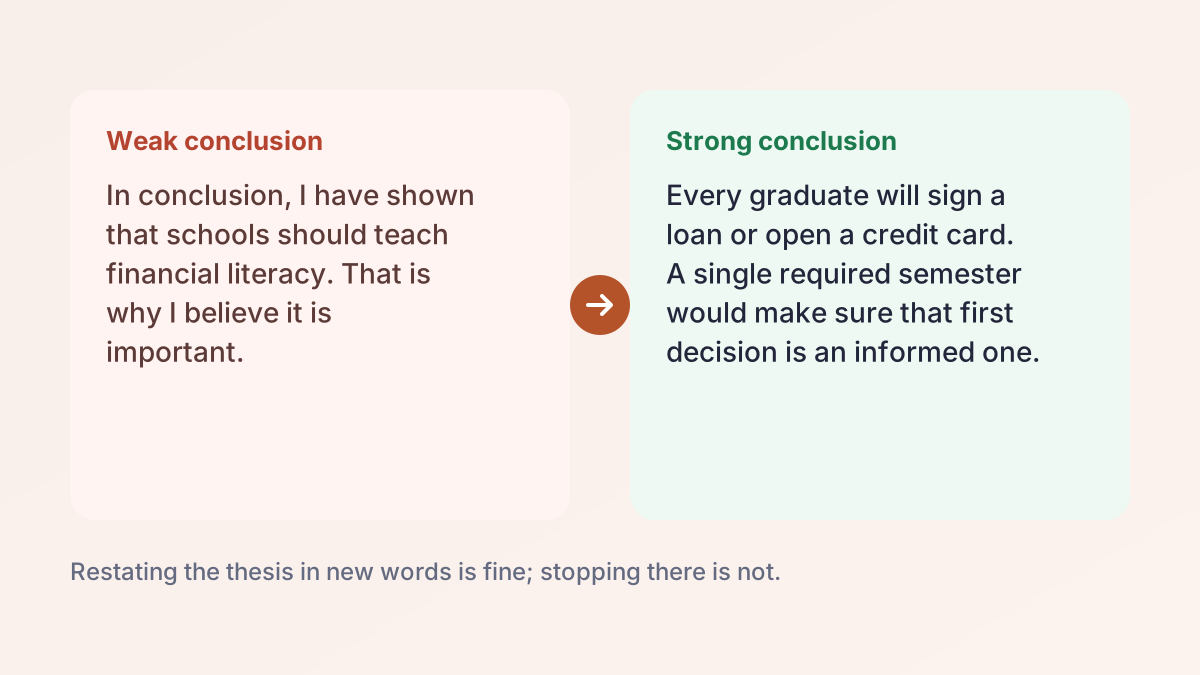
Common problemTo sum up, schools should start later.
Stronger versionIf districts wait, another class of students will graduate underslept. Starting later is a low-cost change with lasting results.
Say what is at stake or what should happen next.
How to Write an Argumentative Essay in 6 Steps
Follow these steps in order and the essay almost organizes itself. Most of the work happens before you write the first paragraph.
- Pick a debatable question. Choose an issue where informed people disagree, and narrow it until you can prove a position in your page limit.
- Research both sides. Collect facts, data and expert views, and write down the best case against your position.
- Draft a working thesis. State your claim and your main reason in one sentence, and expect to revise it after drafting.
- Outline your reasons. Give each reason its own paragraph, put the strongest one last, and place the counterclaim where it fits.
- Draft with evidence. Open each paragraph with a claim, add evidence, then explain how the evidence supports your thesis.
- Revise and cite. Check that every paragraph proves the thesis, sharpen the conclusion and cite every source in the style your teacher requires.
What Is an Argumentative Essay? A Plain Definition
So what is an argumentative essay at its core? It is a piece of writing that proves a claim. You choose a position on a debatable issue, investigate the evidence, and write an essay that convinces a fair-minded reader that your position is the better one. According to Purdue OWL's guide to argumentative essays, the genre asks you to investigate a topic, weigh the evidence and establish a position on it in a concise manner. If you want a first draft to react to, the free argumentative essay generator builds one around your position and marks where your own sources belong.
Argument essay basics
An argument essay, as many teachers shorten the name, has three requirements: a claim someone could reasonably dispute, reasons that support the claim, and evidence that backs each reason. Everything else, including the counterclaim and the conclusion, serves those three.
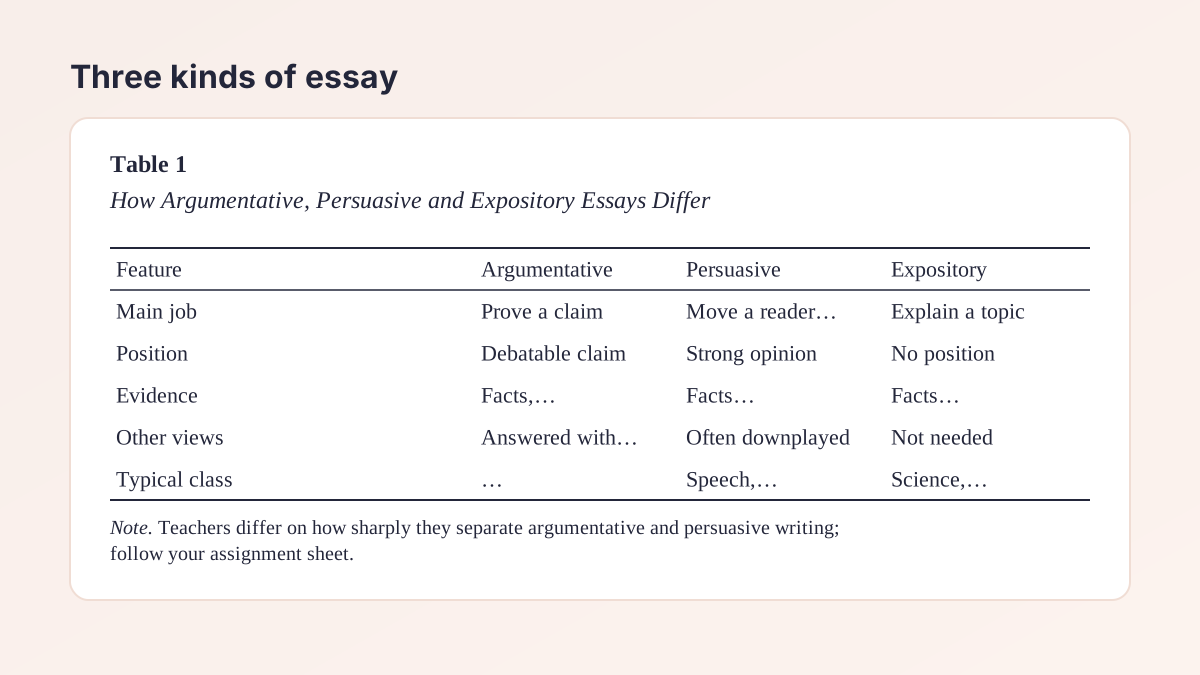
Argumentative vs. persuasive vs. expository
The three types blur in daily speech, and some teachers use "argument" and "persuasion" interchangeably. In many classes, though, an argument leans on logic and evidence, while persuasion leans harder on emotion and a call to action. An expository essay explains a topic without taking a side. Purdue OWL adds that an argumentative essay differs from an expository one in the amount of research and invention involved.
The Parts of an Argumentative Essay
Every strong argument, whether it runs one page or ten, is built from the same five parts. Learn them once and you can read any prompt and know what to produce. The same parts drive the argumentative essay structure, the argumentative essay format and the argument essay outline that follow.
| Part | What it does | Where it usually goes |
|---|---|---|
| Claim (thesis) | States your debatable position | End of the introduction |
| Reasons | Explain why the claim is true | Topic sentences of the body |
| Evidence | Facts, data, examples and expert views that prove each reason | Inside each body paragraph |
| Counterclaim and rebuttal | Names the best opposing view and answers it | After the reasons, or before the last one |
| Conclusion | Shows why the argument matters | Final paragraph |
Claim, reasons and evidence
The claim is the thesis. A reason is a "because" attached to it. Evidence is what makes the reason believable: a statistic from a government report, a finding from a study, a historical example or an expert's explanation. Evidence never speaks for itself, so add a sentence or two of your own explaining how it supports the point.
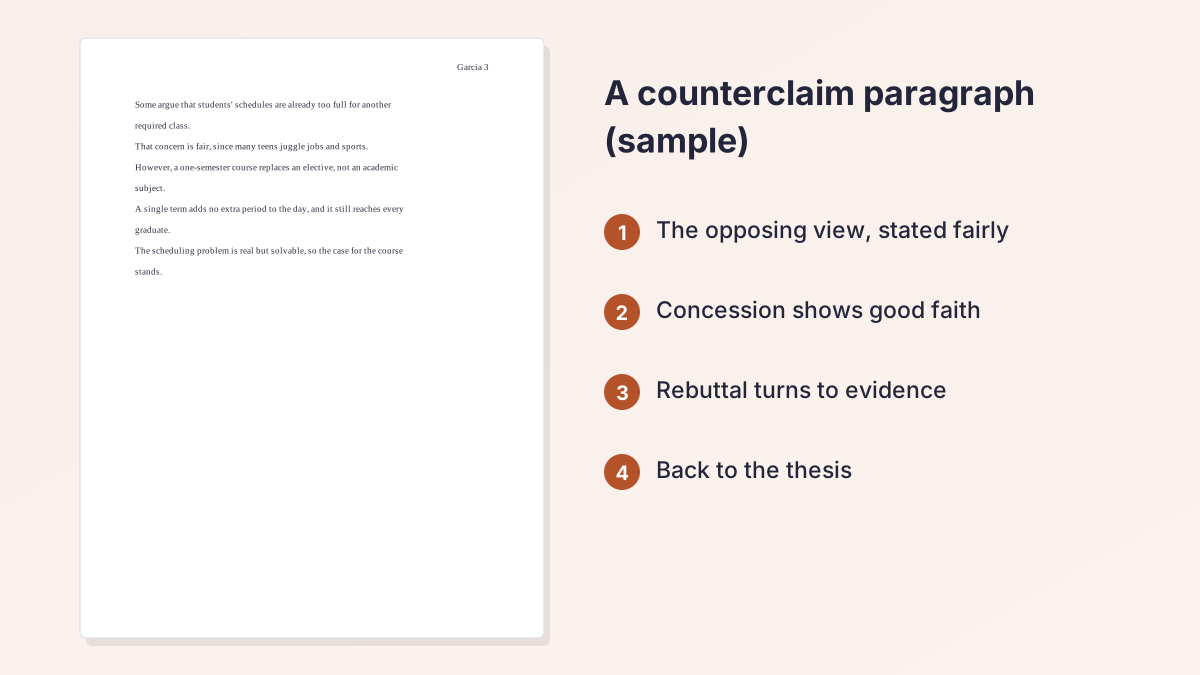
What is a counterclaim in an argumentative essay?
A counterclaim is the strongest objection a thoughtful reader could raise against your position. Naming it shows you've considered the issue fairly. Many writers call it the counterargument, and the two words usually mean the same thing in a classroom.
What is a rebuttal in an argumentative essay?
A rebuttal is your answer to the counterclaim. A good rebuttal does one of three things: shows the objection is based on a mistake, shows it matters less than it seems, or shows your position still wins even if the objection is partly right.
Argumentative Essay Format: Five Paragraphs and Longer Papers
The classic argumentative essay format is the five-paragraph essay: an introduction, three body paragraphs and a conclusion. It's a teaching tool, and plenty of high school assignments and timed tests still expect this argumentative essay structure. College papers and research arguments are longer and rarely count paragraphs. The same parts simply stretch over more space, with several paragraphs for each reason.
Format for an argumentative essay on the page
The visual argumentative essay format is separate from its structure. Most teachers expect a standard school layout: a heading and a title, double spacing, a readable 12-point font and one-inch margins. Which style to use varies by class. If yours calls for one, see our guides to the MLA heading and APA format guidelines. When an assignment sheet and a general rule disagree, follow the assignment sheet.
Can my argumentative essay have 4 paragraphs?
Yes, unless the assignment fixes a number. The paragraph count matters less than whether each part of the argumentative essay structure is present. In a short essay, you can fold the counterclaim into one body paragraph, while a long one can give it a full page.
Argumentative essay structure in longer papers
For a research paper of 1,500 words or more, one reason may take two or three paragraphs. A common pattern runs: introduction, background, reason one, reason two, counterclaim and rebuttal, reason three, conclusion. Whatever the order, keep your strongest material for the end, where readers remember it best.
Argument Essay Outline: A Full Sample
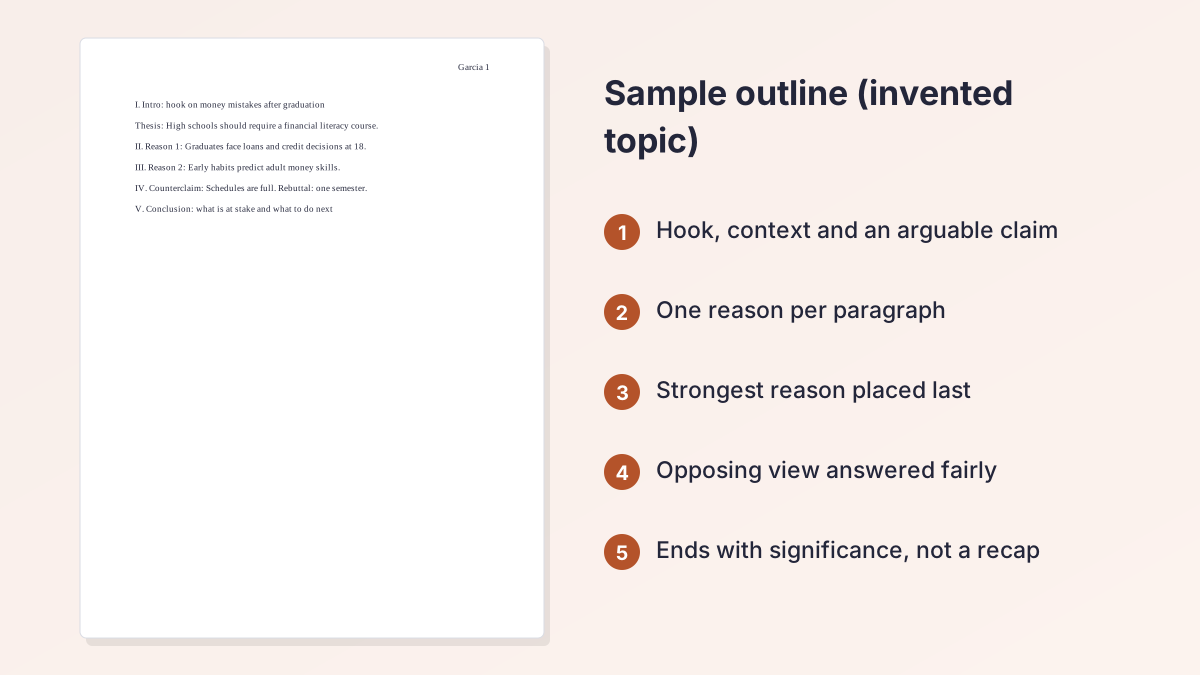
An argument essay outline is the cheapest place to fix an argument. If a reason has no evidence in a one-line outline, it won't have any in a page of prose either. The sample below uses an invented topic, whether high schools should require a financial literacy course, and was written for this guide. It matches the page shown above, so you can compare an argument essay outline in list form with the same plan on paper. Answering what is an argumentative essay before you draft saves rewriting.
Argumentative essay graphic organizer
Many classrooms use a graphic organizer for the argument essay outline: a chart with a box for the claim, three boxes for reasons, a box for the counterclaim and a box for the conclusion. An argument essay outline does the same job in a straight line. Use whichever helps you see gaps faster.
Sample outline: financial literacy course
- Introduction. Hook: a graduate opens a credit card without understanding interest. Background: most states set their own graduation requirements. Thesis: High schools should require a one-semester financial literacy course, because it prepares every graduate for decisions that begin at 18.
- Body 1, reason one. Graduates face loans, credit and taxes almost immediately. Evidence: a report on average student loan balances, from a source such as the US Department of Education.
- Body 2, reason two. Money habits form early. Evidence: a study on financial education and later saving behavior.
- Body 3, counterclaim and rebuttal. Objection: schedules are already full. Rebuttal: the course replaces an elective and runs one term.
- Conclusion. Restate the claim in new words, then explain what is at stake and what schools should do next. This is the argumentative essay conclusion in miniature.
Because this outline is built from a sample, treat each evidence note above as a placeholder. Find and cite your own sources before you rely on any of them. To expand an outline into a draft, the argumentative essay generator accepts your points and returns a draft with places marked for your citations.
How to Write the Thesis and Introduction
Your introduction has three jobs: get attention, give context and state the claim. The thesis, usually the last sentence, is the most important line in the essay because every paragraph that follows must prove it.
What makes a strong thesis
A strong thesis is debatable, specific and supported by a reason. "Schools should require financial literacy" is a claim. "Schools should require financial literacy, because graduates make major money decisions at 18" is a claim with a reason, and it tells the reader what the body will cover. Work through your own wording with the thesis statement generator if you're stuck. Write the thesis before the introduction, and revise it once the draft is done.
Argumentative essay introduction and hook
A hook can be a short story, a surprising fact from a reliable source, a question or a vivid scene. Keep it to a sentence or two and make sure it leads to the claim. Skip dictionary definitions and openers such as "Since the dawn of time." Then add two or three sentences of background so a reader who doesn't know the issue can follow.
Sentence starters for the claim
Phrases such as "This essay argues that," "The evidence shows that" and "Although critics say otherwise, the stronger position is" give you a way in. Replace them with plain, direct sentences in the final draft.
Body Paragraphs, Counterclaims and Transitions
Each body paragraph in the argumentative essay structure proves one reason. Open with a topic sentence that states the reason, add evidence, explain it, and end with a sentence that points back to the thesis. A paragraph that tries to prove two reasons is hard to follow, so split it.
Where to put the counterclaim
Three placements are common in an argumentative essay structure. Put it right after the introduction if the objection is well known, which clears the way for your reasons. Put it just before the conclusion, which lets your reasons build first. Or answer a small objection inside each body paragraph. Any works if the rebuttal follows immediately, and none alters the overall argumentative essay format.
Transition words for argumentative essays
Transitions show how ideas connect. Use "first," "second" and "finally" to order the reasons in your argument essay outline. Use "for example" and "according to" to bring in evidence. Use "however," "although" and "even so" for the counterclaim, and "therefore" and "as a result" to return to your claim. Choose them for meaning, since stacking them in every sentence reads as filler.
Do you need quotations in an argumentative essay?
Not always. Evidence can be a statistic, a summary of a study, a historical fact or a short quotation. Quotations help when an author's exact wording matters or when you're analyzing a text. If you borrow words, ideas or numbers, cite them, and see our guides to MLA in-text citation and how to cite a quote in APA. If your assignment says "use at least three sources," read that as a requirement for cited evidence.
Toulmin and Rogerian Models, Briefly
Two classic models appear in many college writing courses. They're optional frameworks for the same parts.
The Toulmin model
Stephen Toulmin's model breaks an argument into a claim, the grounds (evidence) for it, and a warrant, the assumption that links the grounds to the claim. It adds backing for the warrant, a qualifier such as "usually" or "in most cases," and a rebuttal. It helps you check whether your reasoning has a hidden gap. If you've ever written evidence and then thought "so what?", you were missing the warrant.
The Rogerian model
The Rogerian approach draws on psychologist Carl Rogers's ideas about communication. It suits topics where readers are deeply divided. You describe the opposing view so fairly that its holders would agree you've understood it, find common ground, and then propose a position that respects both sides. It's gentler than a classic argument and is often a good fit for a skeptical audience.
How to Write an Argumentative Essay Conclusion
The argumentative essay conclusion is where a reader decides whether your case mattered. If you've ever asked, "What is an argumentative essay really for?" this paragraph answers it. Purdue OWL advises that the conclusion shouldn't simply repeat the thesis; it should readdress the thesis in light of the evidence you've presented.
How to end an argumentative essay
To write a strong argumentative essay conclusion, try this order. First, restate the claim in fresh words, not a copy. Next, pull your reasons together in one sentence of the argumentative essay conclusion. Then answer the question "so what?" by saying what is at stake, who is affected or what should change. End your argumentative essay conclusion with a strong final sentence, such as a call to action, a look ahead or a return to your hook.
What to avoid
Don't open with "In conclusion," and don't add a brand-new reason, which belongs in the body. Don't apologize with "I may be wrong." A weak argumentative essay conclusion repeats; a strong one finishes the argument.
Common Mistakes in an Argumentative Essay
Most weak drafts fail in a handful of predictable ways, whatever the argumentative essay format. Check your own draft against this list before you submit it.
Arguing a fact or a feeling
"The sky is blue" isn't arguable, and "I like pizza" is only a taste. Pick a claim that needs reasons and evidence.
Ignoring or mocking the other side
A strawman, which is a weak, distorted version of the opposing view, is easy to knock down and easy for a reader to spot. State the objection in its strongest form.
Evidence without explanation
A quote or statistic dropped in with no comment leaves the reader to guess your point. Add a sentence that starts "This shows" or "This matters because."
Fallacies
Watch for attacking the person instead of the point, slippery-slope leaps and appeals to popularity. If your reasoning needs one of them, the reasoning needs work.
Skipping the revision
Read the thesis, then read only the topic sentences to test the argumentative essay structure. If they don't add up to the thesis, rearrange or rewrite. When you want a model to compare your draft against, try the argumentative essay generator and notice how its draft pairs every claim with a place for evidence. Then browse all of our student writing and citation guides. Taking an AP exam? See how the same skills are scored in our AP Lang argument essay guide, and for the analysis question see what a rhetorical analysis is.
Questions About Argumentative Essays
What is an argumentative essay in simple terms?
An essay that takes a debatable position and proves it with reasons and evidence, while answering the strongest opposing view.
What is an argument essay?
It's another name for an argumentative essay: a piece of writing that defends a claim with logic and evidence.
What are the parts of an argumentative essay?
Five: a claim or thesis, reasons, evidence, a counterclaim with a rebuttal, and a conclusion.
What is the format for an argumentative essay?
Most classes expect an introduction with a thesis, body paragraphs for each reason, a counterclaim and rebuttal, and a conclusion. Page layout depends on your class's citation style.
Can my argumentative essay have 4 paragraphs?
Yes, unless the assignment sets a number. Make sure the introduction, reasons, counterclaim and conclusion are all there.
What is a counterclaim in an argumentative essay?
The strongest objection to your position. You state it fairly and then answer it with a rebuttal.
Do you need a quotation for an argumentative essay?
Not always. You need evidence, which can be data or a paraphrased finding. Quote when exact wording matters, and cite everything you borrow.
How do you end an argumentative essay?
Restate your claim in new words, pull your reasons together, then explain what's at stake or what should happen next.
What are good transition words for argumentative essays?
Use first, second and finally for order; for example for evidence; however and although for counterclaims; therefore for conclusions.
More free guides
- AP Lang Argument EssayHow the AP English Language argument essay is scored, with prompts and a sample essay.
- MLA In-Text CitationsAuthor-page citations for every kind of source, with examples.
- How to Cite a Website in MLAWorks Cited entries and in-text citations for web pages.
- MLA Works Cited PageFormat, order and hanging indents, with a full example page.
- MLA Annotated BibliographyFormat, annotation types and a complete example.
- APA Table FormatNumber, title, body and notes for APA 7 tables, with templates.
See all 80 free tools for students
Related tools
Last updated by The Study Corp editorial team.