MLA In-Text Citation Examples for Every Source Type
Each example shows a source and the MLA in-text citation you would put in your paper. Works Cited entries and basic author-page forms come from our citation engine; short titles, qtd. in, line numbers and time stamps were added by hand following MLA 9. Page, line and time numbers show the format; use the location of the passage you actually quote or paraphrase.
Source and situationYu, Charles. Interior Chinatown. Pantheon Books, 2020. You paraphrase a passage on page 45.
MLA in-text citationMuch of the novel is written as a screenplay (Yu 45).
Last name, a space, the page. No comma and no “p.”
Source and situationKahneman, Daniel, and Amos Tversky. “Prospect Theory: An Analysis of Decision under Risk.” Econometrica, vol. 47, no. 2, 1979, pp. 263–91.
MLA in-text citation“Losses loom larger than gains” (Kahneman and Tversky 279).
Join two last names with “and”, in the order the source lists them.
Source and situationBooth, Wayne C., et al. The Craft of Research. 4th ed., U of Chicago P, 2016.
MLA in-text citationA good topic becomes a question worth answering (Booth et al. 45).
Five authors, so the first author's name plus “et al.”, with no comma before it.
Source and situation“About Sleep.” Centers for Disease Control and Prevention, 15 May 2024, https://www.cdc.gov/sleep/about/index.html.
MLA in-text citationAdults need seven or more hours of sleep a night (“About Sleep”).
The entry starts with the title, so the citation does too, in quotation marks. No page to add.
Source and situationGladwell, Malcolm. Outliers: The Story of Success. Little, Brown, 2008. (A second Gladwell book is also on the list.)
MLA in-text citationPractice matters more than talent alone (Gladwell, Outliers 40).
Add a short title, in italics for a book, after a comma.
Source and situationRobinson, Ken. “Do Schools Kill Creativity?” TED, Feb. 2006, https://www.ted.com/talks/sir_ken_robinson_do_schools_kill_creativity.
MLA in-text citationRobinson argues that schools teach students to fear being wrong (00:03:10–25).
Give the time range as the player shows it, instead of a page.
Source and situationYou read Herbert Simon's words in Kahneman, Daniel. Thinking, Fast and Slow. Farrar, Straus and Giroux, 2011.
MLA in-text citationSimon calls intuition “nothing more and nothing less than recognition” (qtd. in Kahneman 11).
Cite the book you read; only Kahneman goes on the Works Cited page.
Source and situationRobert Frost's “The Road Not Taken,” quoting the last two lines.
MLA in-text citation“I took the one less traveled by, / And that has made all the difference” (Frost, lines 19–20).
Line numbers replace pages; use a slash between quoted lines.
How to Do In-Text Citations in MLA, Step by Step
Every MLA in-text citation follows the same few decisions. Work through them for each quote, paraphrase or summary.
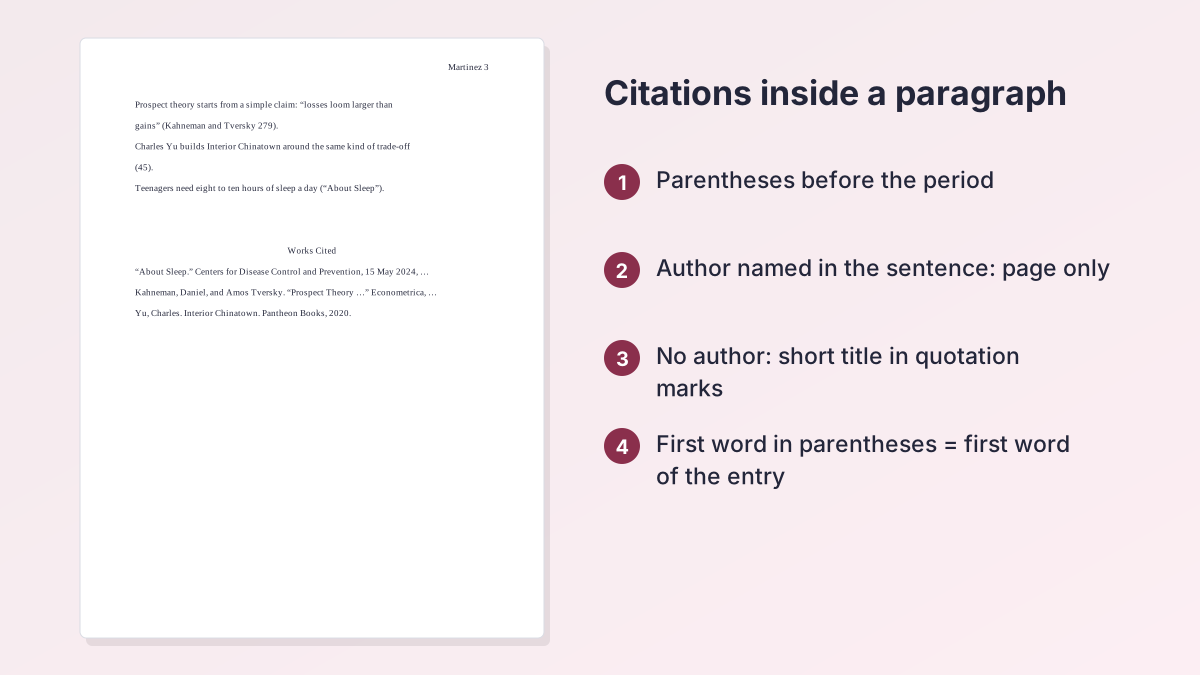
- Find the first word. Look at the source's Works Cited entry. Its first word, usually the author's last name or else the title, is what goes in your MLA in-text citation.
- Choose signal phrase or parentheses. Name the author in your sentence (“Yu shows…”) or put the name in parentheses at the end of the sentence. Don't do both.
- Add the location. Give the page number with no “p.”. If there are no pages, use a time stamp, line numbers or numbered paragraphs, or leave the location out.
- Place the punctuation. Put the parentheses after the closing quotation mark and before the period. In a block quotation, put them after the final period.
- Check the Works Cited entry. Make sure every citation has a matching entry and that the first words agree exactly.
MLA Parenthetical Citation vs. Signal Phrase
MLA uses an author-page system. Whenever you quote, paraphrase or summarize a source, you show where the idea came from with an MLA in-text citation: the first word of the source's Works Cited entry and the location you used. You can put both in parentheses, or name the author in your sentence. The MLA Citation Maker gives you both forms for any source.
The author-page citation
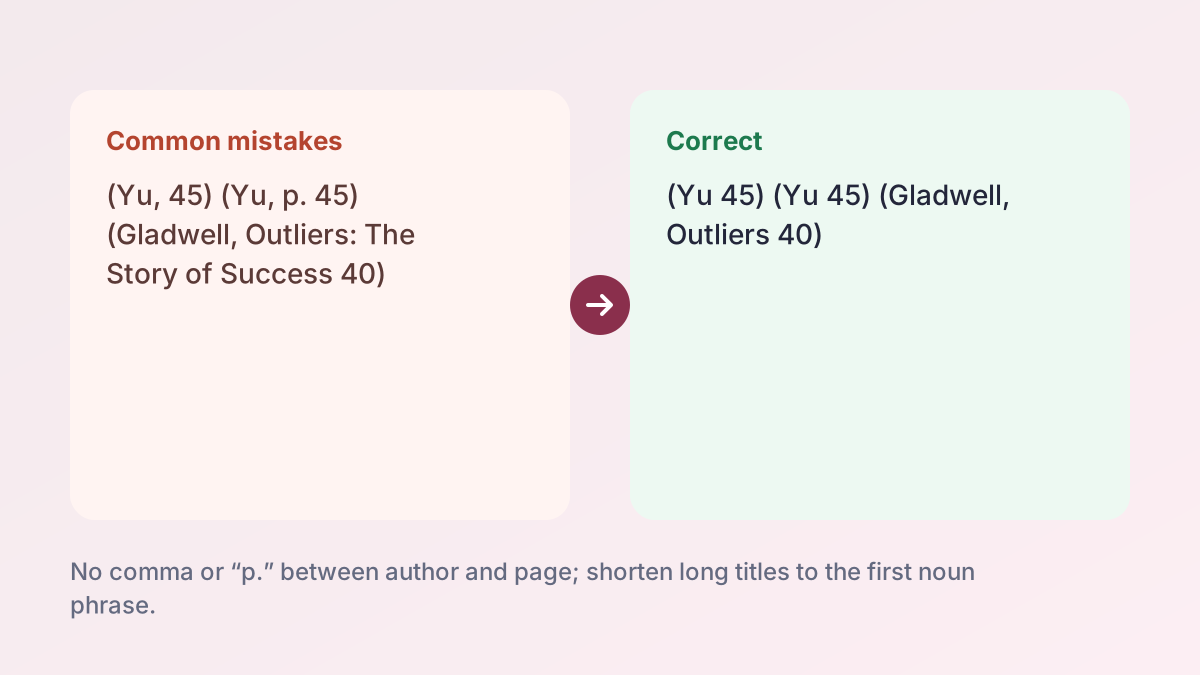
An MLA parenthetical citation goes at the end of the sentence, before the period: (Yu 45). There's no comma between the name and the page, and no "p." or "pg." The rule is the same in MLA 8 and the MLA 9 in-text citation rules published in 2021.
The signal phrase
A signal phrase names the author in your sentence, so the parentheses hold only the page: Charles Yu writes much of Interior Chinatown as a screenplay (45). Use the full name the first time, such as "Charles Yu," and the last name after that. Verbs like argues, notes, claims and explains tell readers how the author uses the idea.
Which should you use?
Both are correct, and most good papers mix them. A signal phrase is better when the author's authority matters or when you discuss the author's argument. A parenthetical citation keeps the focus on the idea itself. Don't name the author in both places, as in "Yu says the novel… (Yu 45)." The MLA Style Center's page on in-text citations stresses this point: keep every citation as short as it can be.
Paste a source above to get both forms
Paste a link, DOI or title into the citation maker above, and the In-text tab shows the parenthetical form while Narrative shows the signal-phrase version. Add a page number and both update.
Two Authors, Three or More, Corporate Authors and No Author
The first word of an MLA in-text citation must match the first word of the Works Cited entry. That rule decides what to do with any number of authors, including none.
| Authors | Parenthetical form | Signal phrase form |
|---|---|---|
| One author | (Yu 45) | Yu writes … (45). |
| Two authors | (Kahneman and Tversky 279) | Kahneman and Tversky argue … (279). |
| Three or more | (Booth et al. 45) | Booth and his colleagues (or Booth and others) … (45). |
| Organization as author | (National Research Council 24) | The National Research Council reports … (24). |
| No author | (“About Sleep”) | The CDC page “About Sleep” notes … |
Two authors
For an in-text citation with two authors in MLA, give both last names joined by "and," in the order they appear on the source: (Kahneman and Tversky 279). Don't use an ampersand (&); that's APA.
MLA in-text citation with multiple authors: et al.
With three or more authors, give the first author's last name and "et al." (Latin for "and others"): (Booth et al. 45). There's no comma before "et al.," and the period after "al" is required. The Works Cited entry uses "et al." too, so the two still match.
Corporate authors
When an organization wrote the work and someone else published it, the organization is the author: (National Research Council 24). In parentheses, you may shorten a long name by abbreviating common words. When the organization is also the publisher, MLA starts the entry with the title instead, so the citation uses the title.
In-text citation with no author in MLA
If there's no author, the entry begins with the title, and the citation uses a shortened title. Put the titles of articles and web pages in quotation marks and the titles of books and websites in italics: ("About Sleep"). Shorten long titles to the first noun phrase, so How People Learn: Brain, Mind, Experience, and School becomes How People Learn. Never write "Anonymous."
MLA In-Text Citation with No Page Number
Many sources have no page numbers: web pages, videos, podcasts and most ebooks. Don't count pages or paragraphs yourself, and don't use the page numbers from a print preview. Use a location the source itself provides, or give the author or title alone.
Web pages and articles online
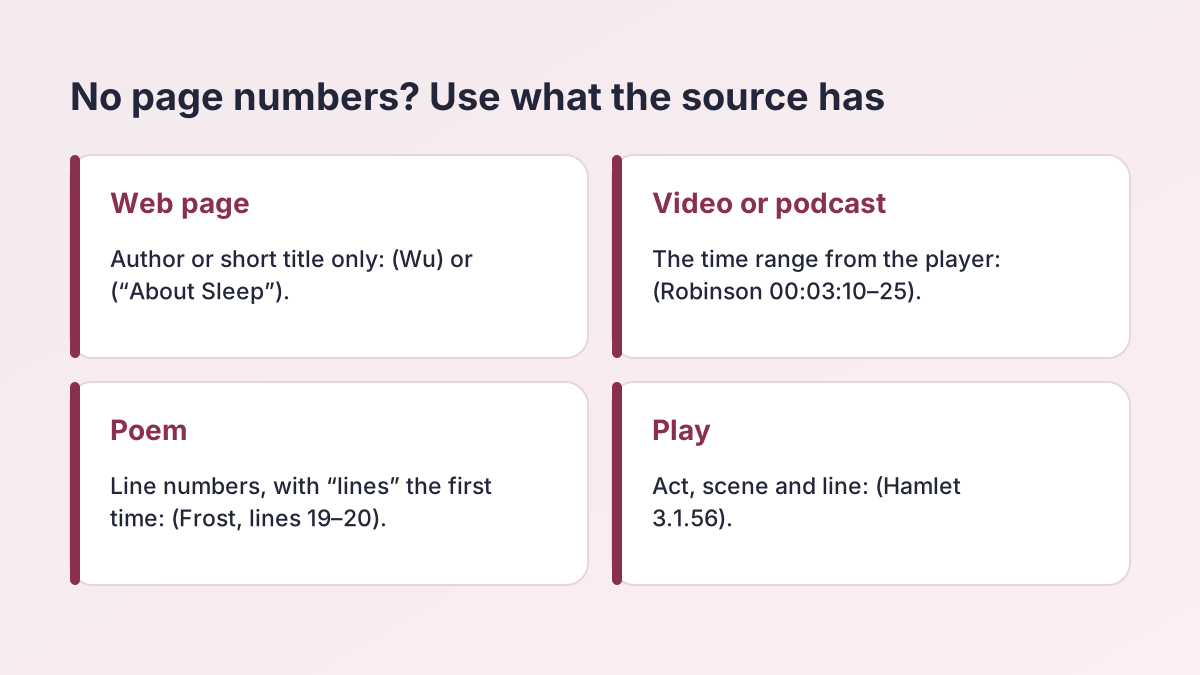
A web page usually gets an MLA in-text citation with just the author or the short title: (Wu) or ("About Sleep"). If you name the author in your sentence, you need no parentheses at all. The guide on how to cite a website in MLA covers the matching Works Cited entry.
Videos, films and podcasts
For time-based media, give the time range shown in the player, in hours, minutes and seconds: (Robinson 00:03:10–25). That's how to in-text cite a video in MLA, and the same format works for a film or a podcast episode.
Numbered paragraphs and sections
If the source numbers its paragraphs or sections, cite them with "par." or "sec." after a comma: (Chan, par. 41). Only do this when the numbers appear in the source.
Poems and plays
For an MLA in-text citation of a poem, use line numbers. Write "line" or "lines" the first time, then the numbers alone: (Frost, lines 19–20), then (Frost 3). For a verse play, give act, scene and line separated by periods: (Hamlet 3.1.56). Line numbers differ between editions, so cite the edition on your Works Cited page.
Ebooks and textbooks
For an MLA in-text citation of a textbook, use the printed page number if the ebook or textbook shows one. If it doesn't, use chapter numbers with "ch." after a comma, or the author alone. Don't cite the location number from an e-reader app, since it changes with font size.
Multiple Pages, Multiple Works and Multiple Sources
An MLA in-text citation sometimes needs one more piece of information to stay clear, especially in a long research paper.
How to cite multiple pages in text in MLA
Join a page range with a hyphen or an en dash, and drop repeated hundreds after the first number: (Kahneman and Tversky 263–91). For pages that aren't next to each other, separate them with commas: (Yu 45, 112).
Two or more works by the same author
When your Works Cited page lists two works by one author, add a shortened title after a comma: (Gladwell, Outliers 40) and (Gladwell, Tipping Point 12). If you name the author in your sentence, the short title goes in the parentheses with the page: Gladwell argues in Outliers that… (40).
Two authors with the same last name
Add first initials to tell them apart, as in (R. Miller 12) and (A. Miller 46). Use full first names if the initials match too.
More than one source for one idea
To credit several sources for one point, put them in one set of parentheses separated by semicolons: (Booth et al. 45; Yu 112). Order them however reads best; alphabetical is common.
Indirect Sources: How to Use qtd. in
Sometimes you find a quotation from one person inside another writer's book or article. You read Herbert Simon's definition of intuition in Daniel Kahneman's Thinking, Fast and Slow, not in Simon's own work. That's an indirect source.
The qtd. in format
Name the original speaker in your sentence, then cite the source you actually read, with "qtd. in" ("quoted in") before it:
Herbert Simon calls intuition "nothing more and nothing less than recognition" (qtd. in Kahneman 11).
Only Kahneman's book goes on your Works Cited page, because that's the source you consulted.
When to find the original
MLA and most instructors prefer the original when you can get it. Use "qtd. in" when the original is out of print, unpublished, or a spoken remark reported by a journalist. Interviews quoted in a news article are the classic case for a high school or college paper.
MLA In-Text Citation Punctuation: Quotes and Block Quotes
Where the parentheses go matters as much as what's inside them. For an MLA in-text citation with a quote, the order is: closing quotation mark, citation, period.
Short quotations
"Losses loom larger than gains" (Kahneman and Tversky 279).
The period moves after the parentheses, not inside the quotation marks. If the quote ends with a question mark or exclamation point, keep it inside the quotation marks and still add a period after the citation, so the sentence ends with the pattern "…?" (Author 12).
Mid-sentence citations
When a sentence uses two sources, put each citation right after the idea it supports, at a natural pause: Some researchers stress loss aversion (Kahneman and Tversky 279), while others focus on habits (Gladwell, Outliers 40).
Block quotations
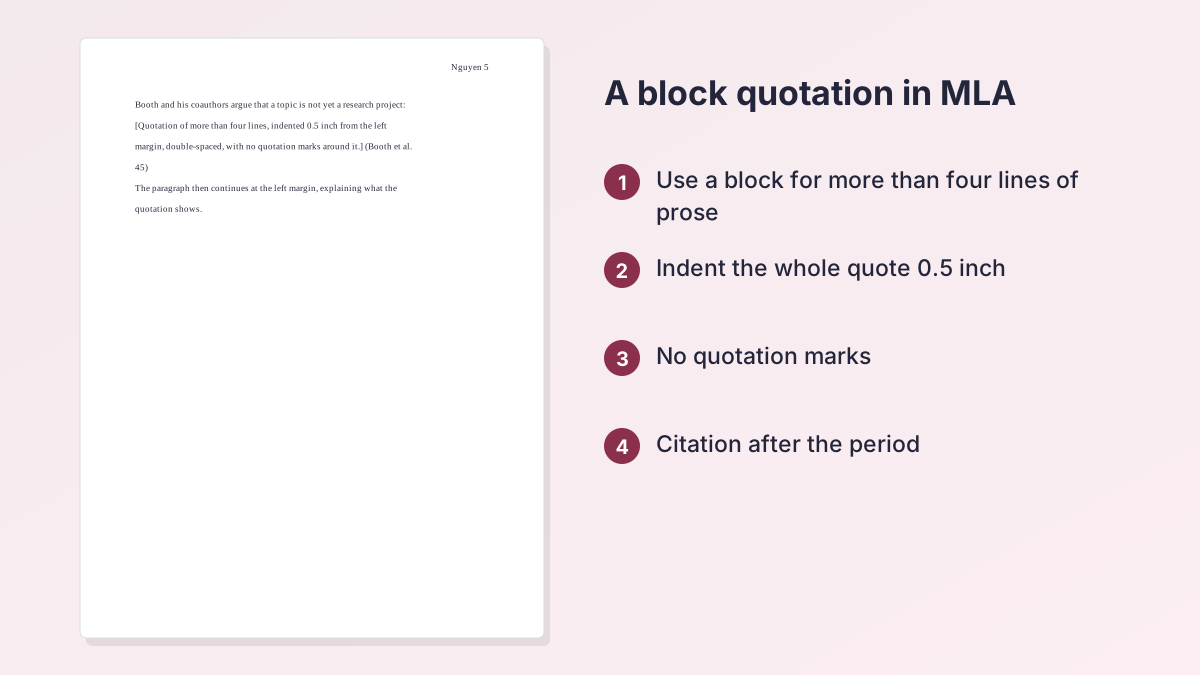
Quote more than four lines of prose, or more than three lines of poetry, as a block. Indent the whole quotation 0.5 inch from the left margin, keep it double-spaced, and leave out the quotation marks. The citation goes after the final period: … a question worth answering. (Booth et al. 45). Block quotes have their own rules for introductions and line breaks; use them sparingly in a short essay.
Citing the Same Source Twice in a Row
MLA has no "ibid." If you cite the same source several times in a paragraph with no other source in between, you can give the full MLA in-text citation once and then only the page number for the next ones, as long as it's clear which source you mean.
Example in a paragraph
In Ms. Rodriguez's AP Literature class, a student writing about Interior Chinatown might write: The novel opens like a script (Yu 3). Its narrator lists the roles he is allowed to play (7), and later he steps out of them (112).
When to repeat the full citation
Give the author again when you start a new paragraph, after you cite a different source, or whenever a reader might lose track. Some instructors want the author every time; if your syllabus or rubric says so, follow it.
Common Parenthetical Citation Mistakes and How to Fix Them
Most lost points come from a handful of habits. Each MLA in-text citation example below shows what teachers mark most, with the MLA 9 fix.
| Mistake | Example | Correct form |
|---|---|---|
| Comma between author and page | (Yu, 45) | (Yu 45) |
| “p.” or “pg.” before the page | (Yu p. 45) | (Yu 45) |
| Period inside the quote | “…than gains.” (Kahneman and Tversky 279) | “…than gains” (Kahneman and Tversky 279). |
| Author in sentence and parentheses | Yu shows … (Yu 45). | Yu shows … (45). |
| Full title for a work with no author | (“About Sleep | Sleep | CDC”) | (“About Sleep”) |
| Ampersand for two authors | (Kahneman & Tversky 279) | (Kahneman and Tversky 279) |
| Citing the website instead of the page | (CDC.gov) | (“About Sleep”) |
Which in-text citation is formatted correctly in MLA style?
Quiz questions often show four versions of one citation. The correct one has the first word of the Works Cited entry, a space, and the location, with nothing between: (Booth et al. 45). Rule out any choice with a comma before the page, "p.," the year (that's APA), or a period before the parentheses.
A quick self-check
Before you hand in an essay, pick three citations and find each one's entry on the Works Cited page. If the first words match and every quote has a page or other location, your citations are in good shape. If you'd rather not build the list by hand, the free MLA citation maker formats each entry and its citation together.
Matching Every Citation to the Works Cited Page
An MLA in-text citation is only half of the system. Every source you cite must appear on the Works Cited page, and every entry there should be cited at least once in the paper.
Use the same first word
If the entry starts with "Kahneman, Daniel, and Amos Tversky," the citation is (Kahneman and Tversky). If the entry starts with a title, the citation uses that title, shortened. Readers should be able to scan the list alphabetically and find the source in seconds.
Build the page
The guide to the MLA Works Cited page covers the heading, double spacing, the hanging indent and alphabetical order. For an assignment that asks you to summarize each source, see the MLA annotated bibliography guide. Every guide is listed on the student citation guides page.
Let the tool do the formatting
When a source is a database article or a long web address, let the MLA citation maker format it: paste the link into the MLA citation generator, copy the entry, and use the in-text form it shows beside it. Check the author and title against the source, then add the page number you used.
MLA In-Text Citation FAQ
What is an MLA in-text citation?
It's a brief reference in your sentence, usually the author's last name and a page number in parentheses, such as (Yu 45). It points readers to the full entry on your Works Cited page.
How do you do an MLA in-text citation with two authors?
Give both last names joined by "and," in the source's order, followed by the page: (Kahneman and Tversky 279). Don't use an ampersand.
How do you cite three or more authors in text in MLA?
Use the first author's last name and "et al." with no comma, then the page: (Booth et al. 45).
How do you write an MLA in-text citation with no page number?
Give the author or short title alone, such as (Wu). For videos use a time stamp, for poems line numbers, and for sources with numbered paragraphs use "par." Never count pages yourself.
How do you write an MLA in-text citation with no author?
Use a shortened title, the same title that starts the Works Cited entry. Put article and web page titles in quotation marks and book titles in italics: ("About Sleep").
Does the period go before or after an MLA in-text citation?
After it. Close the quotation, add the parentheses, then the period: "…than gains" (Kahneman and Tversky 279). In a block quotation the citation goes after the final period.
Is there a comma between the author and page in MLA?
No. Write (Yu 45), not (Yu, 45). A comma appears only before a short title or a label such as "lines" or "par."
How do you cite a quote from another source in MLA?
Cite the source you read, with "qtd. in" before it: (qtd. in Kahneman 11). Only that source goes on the Works Cited page.
More free guides
- How to Cite a Website in MLAWorks Cited entries and in-text citations for web pages.
- MLA Works Cited PageFormat, order and hanging indents, with a full example page.
- MLA Annotated BibliographyFormat, annotation types and a complete example.
- MLA Block QuotesWhen a quotation needs a block, how to indent it and where the citation goes.
- How to Cite Multiple Authors in MLATwo authors, three or more, et al., editors and the same author twice.
- How to Cite a YouTube Video in MLAYouTube videos, movies, TV episodes and streaming, with time stamps.
See all 80 free tools for students
Related tools
Last updated by The Study Corp editorial team.