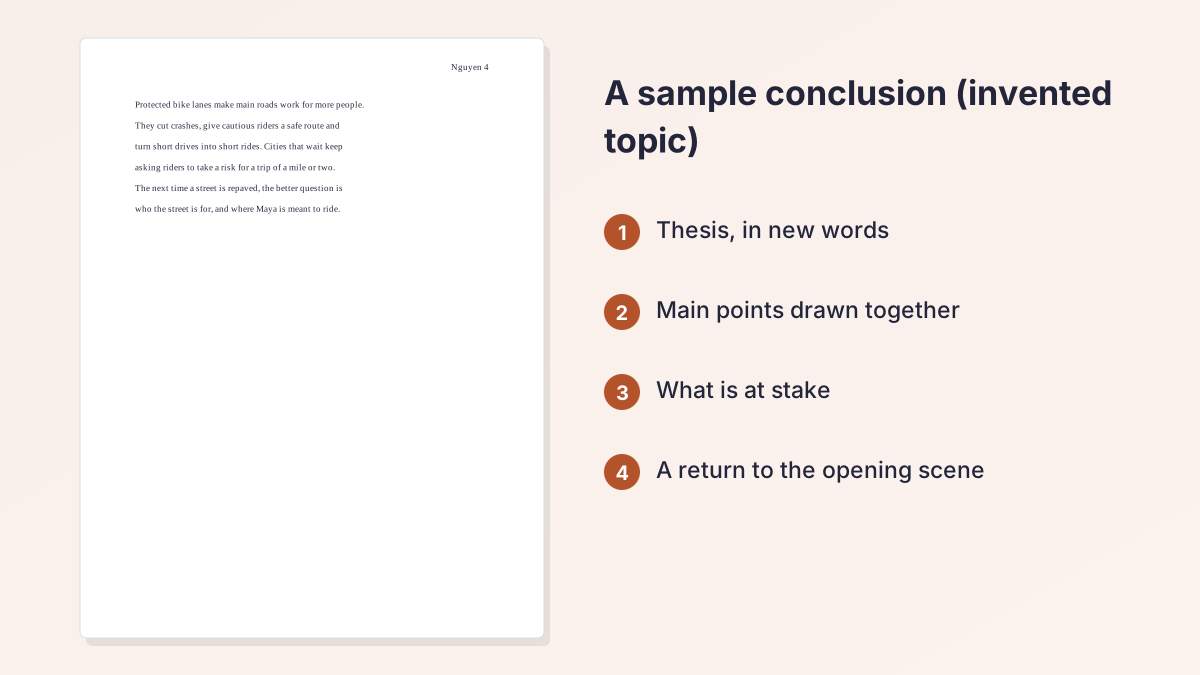
Conclusion Examples: Weak Endings and Stronger Versions
Each pair shows a common first-draft problem and a repaired version. Every sentence is invented for this guide. Use the pairs as models of how to write a conclusion for your own topic, in your own wording.
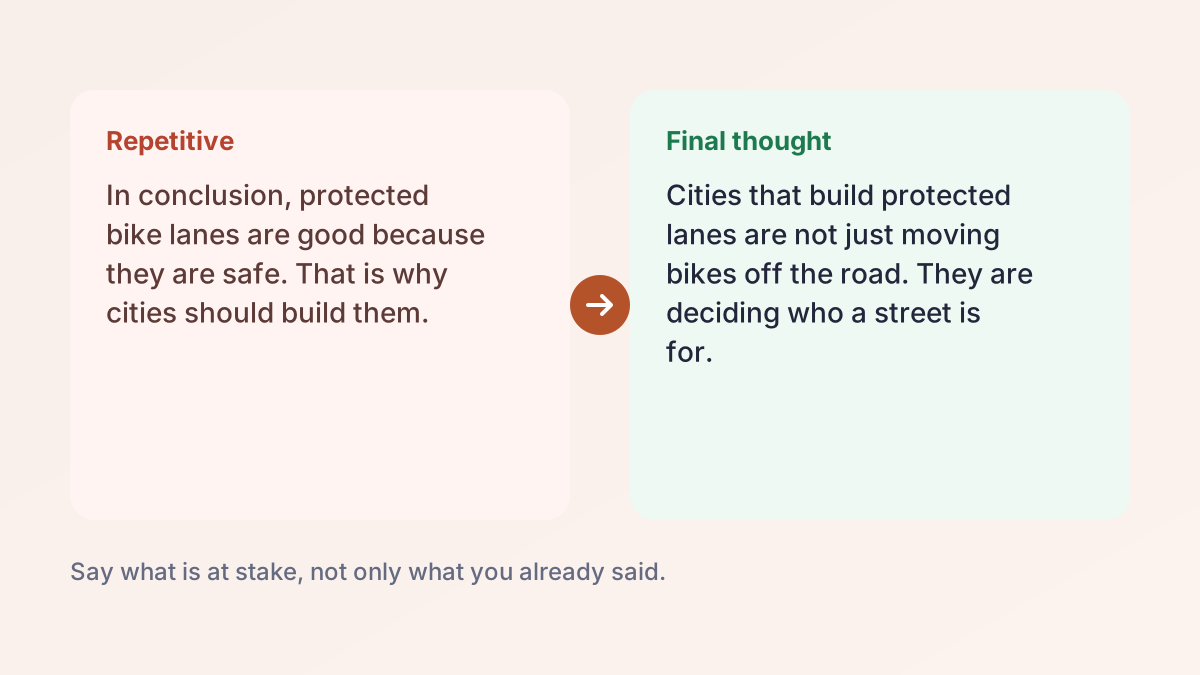
Common problemIn conclusion, schools should start later.
Stronger versionSchools that start later are not giving up learning time. They are making it count.
Start with the idea instead of a signal phrase.
Common problemSchools should start later because teenagers need more sleep.
Stronger versionTeenagers learn better when their school day fits how they rest, so a later bell is a small change with a large payoff.
Restate the claim in new words and add a step forward.
Common problemAlso, later starts would reduce tardiness, which I haven't mentioned yet.
Stronger versionEach reason points the same way: a later start supports sleep, attention and attendance.
A new reason belongs in a body paragraph.
Common problemI may not be right, but I think schools should consider later start times.
Stronger versionThe evidence supports a later start, and districts that test the change can see the results for themselves.
Confidence reads better than hedging.
Common problemI talked about sleep, grades and safety, and I also talked about buses.
Stronger versionSleep, grades and safety all depend on one choice: when the day begins.
Show how the points connect.
Common problemIf schools change, the whole world will be better.
Stronger versionIf one district shows that a later bell works, others will have a model to follow.
Keep the stakes in proportion to the essay.
Common problemThat's about it for later school start times.
Stronger versionThe question for school boards is no longer whether students are tired. It is whether the schedule will change.
End with a sentence that gives the reader something to carry away.
How to Write a Conclusion in 5 Easy Steps
These five steps show how to write a conclusion once your body paragraphs are done. The whole conclusion often fits in four to six sentences.
- Reread your thesis. Look at your thesis and your topic sentences, and decide what your essay actually proved.
- Restate in new words. Say the claim again with fresh wording, as something the evidence has shown.
- Pull points together. Show how your main points connect in one or two sentences, without listing them all.
- Answer so what. Say why the argument matters, who it affects or what should happen next.
- End with a final thought. Close on a striking idea, a return to your opening or a next step, and add no new evidence.
How to Write a Conclusion: What It Has to Do
A conclusion is the last thing your reader sees, so it is worth learning how to write a conclusion well. It shapes how the whole essay is remembered. The UNC Writing Center's handout on conclusions suggests testing your claims with the questions "So what?" and "Why should anybody care?" and then answering them in the ending. That is the core of how to write a conclusion: don't just stop, and don't just repeat. Explain what the argument adds up to.
If you want a draft to react to, the free conclusion generator writes three conclusion paragraphs from your thesis and main points, or a closing sentence for a single body paragraph. You can adapt the best parts into your own wording.
What a conclusion is not
Before you learn how to write a conclusion, learn what to leave out. A conclusion is not a copy of your introduction, not a second summary of every paragraph and not the place for fresh evidence. (Summarizing is a separate skill with its own steps; our guide on how to summarize covers it.) UNC's advice lists the common traps: opening with "in conclusion," introducing your main argument for the first time, adding a new idea or subtopic, restating the thesis with no meaningful change, using emotional appeals that clash with an analytical paper, and adding evidence that belongs in the body.
How long should a conclusion be?
Most teachers expect a conclusion to be shorter than the introduction, often four to six sentences in a five-paragraph essay. In a longer paper it may take a full paragraph or two. These lengths are conventions, so check your assignment sheet.
How to Write a Conclusion Paragraph, Step by Step
Here is how to write a conclusion paragraph in the order a reader meets it. The pattern works for most essays, and you can adapt it to fit your assignment.
Start with your thesis, in new words
The first move is to return to your claim. Don't copy the sentence from your introduction. By now the reader has seen your evidence, so you can state the claim with more confidence and more detail. Instead of "Schools should start later because teenagers need more sleep," try "The evidence shows that a later bell fits how teenagers actually learn." For more help, try the restate thesis tool, which rewrites a thesis for the end of an essay.
Draw your points together
Next, show how your main points fit. The UNC handout calls this synthesis: recap briefly, then show how the points connect. Instead of listing sleep, grades and safety again, say what they have in common. One sentence is often enough.
Answer "so what?"
This is the step that separates a good ending from a flat one. Say why the argument matters. Who is affected? What is at stake? What would change if readers agreed with you? If you can't answer, your essay may need a clearer purpose.
Close with a final thought
Finish with a sentence the reader will remember. You might return to a scene from your introduction, suggest a next step or leave the reader with a question worth considering. Keep it in proportion to the paper, so a short school essay shouldn't promise to change the world.
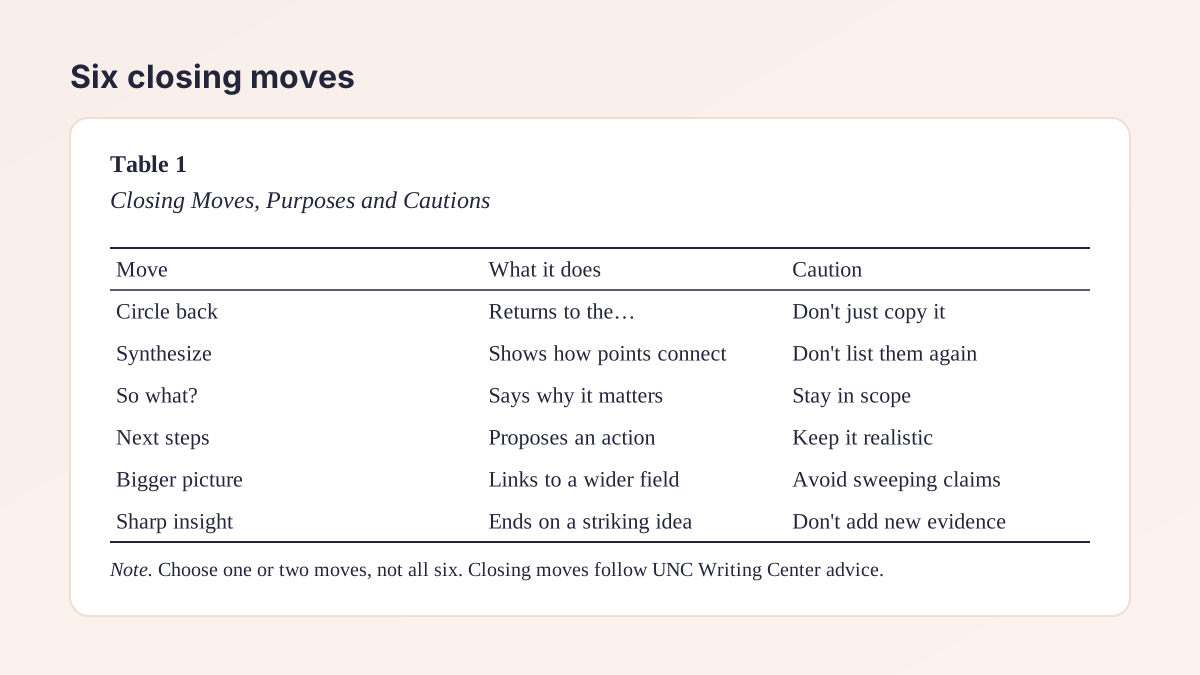
How to Write a Good Conclusion: Six Closing Moves
If you are wondering how to write a good conclusion, the secret is picking one or two closing moves instead of trying to do everything. The table lists six of them, adapted from the UNC Writing Center's suggestions, with a caution for each. The examples after the table were written for this guide.
| Move | What it does | Example |
|---|---|---|
| Circle back | Returns to the image or scene in your opening | Maya still locks her bike every morning, but now the lane is there. |
| Synthesize | Shows how the points connect | Safety, cost and convenience all depend on the same street design. |
| So what? | Says why the claim matters | Every street built for cars alone is a choice about who gets to move. |
| Next steps | Proposes an action or a question | City councils can start with the five busiest roads. |
| Bigger picture | Links the topic to a wider issue | How we build streets shapes how we live in a city. |
| Sharp insight | Closes on a striking idea | A street is a statement about who belongs. |
How to write a great conclusion without repeating yourself
The difference between a great ending and a repetitive one is movement. A weak conclusion ends where the introduction began. A great one ends further along, with the reader seeing the topic in a new light. Each time you draft, ask what the reader knows now that they didn't know at the start, and say it.
How to write a strong conclusion for an argument
In an argumentative or persuasive essay, a strong ending restates the claim, notes that you have answered the main objection and ends with what should be done. Compare our guide to what an argumentative essay is, which shows the counterclaim and conclusion working together.
How to write a proper conclusion in a narrative essay
A narrative conclusion often skips the thesis restatement and instead reflects on what the experience taught. It might return to the opening scene and show how the writer or the situation has changed.
How to write a conclusion for a term paper
A term paper has more material to bring together, so the conclusion may run longer than a school essay. Even so, it should synthesize rather than summarize, and it should respect the shape of your assignment. Check the guidelines from your instructor.
Conclusion Sentence Starters That Don't Sound Stiff
Conclusion sentence starters give you a way in, but "in conclusion" and "in summary" are the ones to avoid. The UNC Writing Center calls phrases such as "in conclusion," "in summary" and "in closing" wooden and trite in writing, even though they can work in a speech. Better options let the ideas do the signaling.
Starters that restate
Good conclusion sentence starters restate the claim without sounding stiff. Try "The evidence points to..." or "Taken together, these points show..." to restate a claim with confidence. "Ultimately," and "Overall," also work if you use them once, not in every paragraph.
Starters that look ahead
Some conclusion sentence starters point to action. To suggest what comes next, try "The next step is..." or "Cities, schools and families can begin by..." or "What remains is to decide whether...". For research papers, "Future research should examine..." is a common move.
Starters that widen the lens
Other conclusion sentence starters widen the view. When you want to show the bigger picture, try "This question matters beyond..." or "At stake is more than..." or "If this is true, then...". Keep the claim in proportion to your evidence.
Starters for the last sentence
For the final line, try a return to the introduction ("Maya's ride looks different now") or a short, direct statement of the main idea. Avoid ending with a quotation you haven't discussed.
Concluding sentences for body paragraphs
A body paragraph also ends with its own closing sentence that wraps up one idea or leads into the next. For help with that, the conclusion generator has a sentence mode for a single paragraph, and our guide to how to write a paragraph explains where the closing sentence fits.
How to Write a Conclusion for a Research Paper
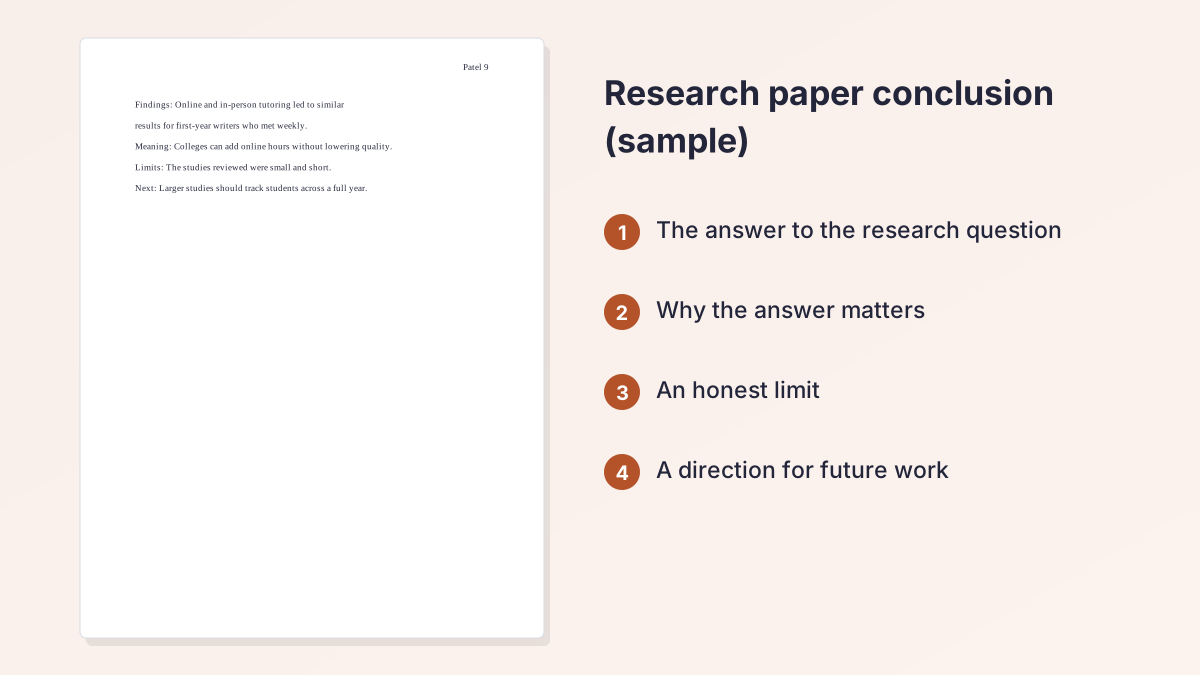
Learning how to write a conclusion for a research paper means adjusting the pattern. Readers expect a clear answer to your research question, an explanation of what it means and an honest note about its limits. The sample page above shows the four parts.
The four moves
How to write a conclusion for a research paper comes down to four moves. State your findings in one or two sentences. Explain their meaning or significance for the field or for readers. Acknowledge limits, such as a small sample or a narrow scope. Suggest next steps for future work. This matches the UNC advice to propose a course of action or questions for further study.
Don't add new evidence
A research paper conclusion is not the place for a new source or statistic. If a piece of evidence matters, move it to the body. Cite sources the way your class requires. Our guides to MLA in-text citation and APA format guidelines can help.
How to write a scientific conclusion and a lab report conclusion
In a lab report, the closing section (often called the Discussion, and in some formats Conclusions) says whether the data supported the hypothesis, what they suggest and what limits the experimental design placed on them, according to the UNC Writing Center's scientific reports handout. The handout recommends cautious verbs such as "supported" or "suggested" rather than "proved." Expectations vary by instructor and discipline, so follow your lab manual or syllabus and look at a published article in your field to see the usual tone.
Link back to your introduction
A good research paper conclusion answers the question you posed at the start. If you followed how to write an introduction with a gap and a question, the ending should say how far you filled the gap.
Words That Signal the Ending
You don't need a signal word at the start of a conclusion, but a short connector can help the reader see that you are pulling things together. Use "Ultimately," "Overall," "Taken together," or "As a result" once, early in the paragraph, and then let the ideas carry the rest.
Choosing the right connector
The connector should match what you are doing. "As a result" suits a cause-and-effect argument. "Overall" suits a summary. "Still" suits an ending that admits a limit. Our transition words for paragraphs page lists openers by position, including the conclusion, and our guide to transition words for essays goes into more detail.
Common Conclusion Mistakes
Most weak endings fail in a handful of predictable ways, even for writers who know how to write a conclusion, and almost all of them break one of the rules in the UNC handout. Check your draft against this list.
Copying the introduction
A conclusion that repeats the opening paragraph with a few words changed tells the reader nothing new. Aim for movement from where you started.
Too long
A conclusion that runs on for a page often hides a second essay. Cut it to the moves above and stop. If it's longer than your introduction, check whether it holds new evidence.
Starting a new argument
If an idea is big enough to argue, it belongs in the body. If it isn't, cut it. The same goes for new quotations.
Forgetting the "so what?"
A good conclusion always answers it. If your last paragraph only recaps, ask the question again. Add one sentence about significance and the ending improves right away.
Starting with a stiff signal
Replace "In conclusion" with the first idea of the paragraph. Then run your conclusion through the conclusion generator to compare its endings with yours, and browse our other student writing guides. For the opening of the same essay, see how to write an introduction.
Questions About Writing a Conclusion
How do you write a conclusion for an essay?
Restate your thesis in new words, pull your main points together, answer so what, and end with a final thought. Add no new evidence.
How do you write a conclusion paragraph?
Use four to six sentences: a restated thesis, a synthesis of your points, a statement of significance and a closing line.
How do you write a good conclusion?
Choose one or two closing moves, such as circling back, answering so what or suggesting a next step, and avoid repeating your introduction.
How do you write a conclusion for a research paper?
State your findings, explain what they mean, note the limits and suggest what future research could do.
What is the hardest part of how to write a conclusion?
Often it is answering so what. Restating the thesis is fairly easy, but saying why it matters takes more thought.
What are some conclusion sentence starters?
Try "Taken together," "The evidence points to," "Ultimately," or "The next step is," and avoid "in conclusion."
Should I start a conclusion with "in conclusion"?
It's better not to in an essay. The UNC Writing Center calls it wooden and trite in writing. Start with the idea itself.
How long should a conclusion be?
Many teachers expect four to six sentences in a five-paragraph essay and a paragraph or two in a longer paper. Check your assignment.
How do you write a conclusion without adding new information?
Keep new evidence and new subtopics in the body. The conclusion should explain what the evidence you already gave means.
How do you write a conclusion for a lab report?
Say whether the data supported the hypothesis, what they suggest and what limited the experiment. Follow your instructor's lab manual.
More free guides
- MLA In-Text CitationsAuthor-page citations for every kind of source, with examples.
- How to Cite a Website in MLAWorks Cited entries and in-text citations for web pages.
- MLA Works Cited PageFormat, order and hanging indents, with a full example page.
- MLA Annotated BibliographyFormat, annotation types and a complete example.
- APA Table FormatNumber, title, body and notes for APA 7 tables, with templates.
- MLA HeadingThe four-line first-page heading and the page header, with Word and Google Docs steps.
See all 80 free tools for students
Related tools
Last updated by The Study Corp editorial team.