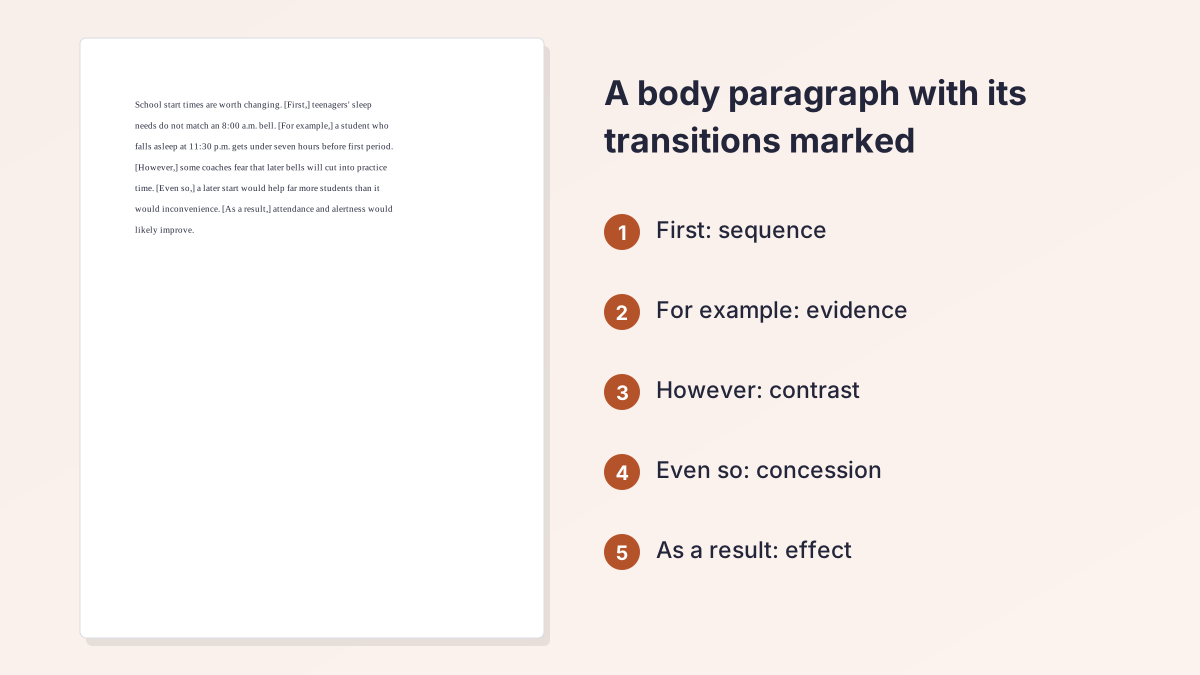
Transition Words for Essays: Examples in Real Sentences
Each pair shows a choppy pair of sentences and the same pair joined by a transition. The sentences were written for this guide; they are samples, not quotations.
Without a transitionRecycling cuts waste. It saves energy.
With a transitionRecycling cuts waste. Additionally, it saves energy.
Additionally, furthermore and moreover all add a related point.
Without a transitionOnline classes are flexible. Some students lose focus.
With a transitionOnline classes are flexible; however, some students lose focus.
A semicolon, then however and a comma, joins two full sentences.
Without a transitionThe library cut its hours. Fewer students used it.
With a transitionThe library cut its hours. As a result, fewer students used it.
Therefore and consequently do the same job.
Without a transitionSleep affects grades. A survey of juniors showed it.
With a transitionSleep affects grades. For example, a survey of juniors showed a gap of half a letter grade.
The survey here is invented; in your essay, name a real source and cite it.
Without a transitionClean the data set. Run the test. Report the result.
With a transitionFirst, clean the data set. Next, run the test. Finally, report the result.
Use sequence words for steps, not for ideas that have no order.
Without a transitionThe policy failed. It hurt the students it was meant to help.
With a transitionThe policy failed. In fact, it hurt the students it was meant to help.
Use emphasis words sparingly; they lose force when repeated.
Without a transitionHomework builds habits. Too much of it harms sleep.
With a transitionHomework builds habits. Even so, too much of it harms sleep.
Even so and still concede a point and then push back.
Without a transitionSchools should start later. Students need the sleep.
With a transitionOverall, schools should start later because students need the sleep.
Overall and in short work in an ending; avoid announcing 'in conclusion' in a very short essay.
How to Add Transitions to an Essay, Step by Step
Add transition words for essays after the draft, when you can see how your ideas relate. Work through the essay once, paragraph by paragraph.
- Check your order first. Write a one-line summary of each paragraph in the margin. If you can't say how paragraph two follows paragraph one, fix the structure before reaching for transition words.
- Name the relationship. Between each pair of sentences, ask what the second does for the first: adds, contrasts, gives a reason, gives an example or shows a result.
- Pick a matching word. Choose from the group that fits that relationship. Words in the same group are not always interchangeable, so check the meaning when you are unsure.
- Place and punctuate it. Put it at the start of the sentence with a comma, or after a semicolon, or inside the sentence set off by commas. Read the sentence aloud to check the rhythm.
- Link your paragraphs. Open each body paragraph with a phrase that points back to the last paragraph's idea and forward to the new one. Reuse a key term rather than a stock word.
- Cut the extras. Delete any transition that repeats the same word or adds nothing. A paragraph of five different transitions usually has two too many.
What Transition Words Do in an Essay
Transitions are the signposts of an essay, and transition words for essays are the simplest ones to add. The University of North Carolina's Writing Center describes transitions as the words that "glue our ideas and our essays together": they tell readers how to read the sentence in front of them in light of the last one. Without them, a draft can feel choppy even when every sentence is sound.
Words, phrases and sentences
Most people mean single words and short phrases, such as moreover or on the other hand. These sentence transition words work inside a paragraph. Between paragraphs, a whole sentence can do the job, usually by referring to the previous idea and then announcing the new one.
Where to find the right one
The lists of transition words for essays below are organized by purpose, so you can find a word by what it does. If you would rather search, the free transition words finder sorts more than a hundred words by purpose and explains the punctuation for each.
Transition Words in Writing, Sorted by Purpose
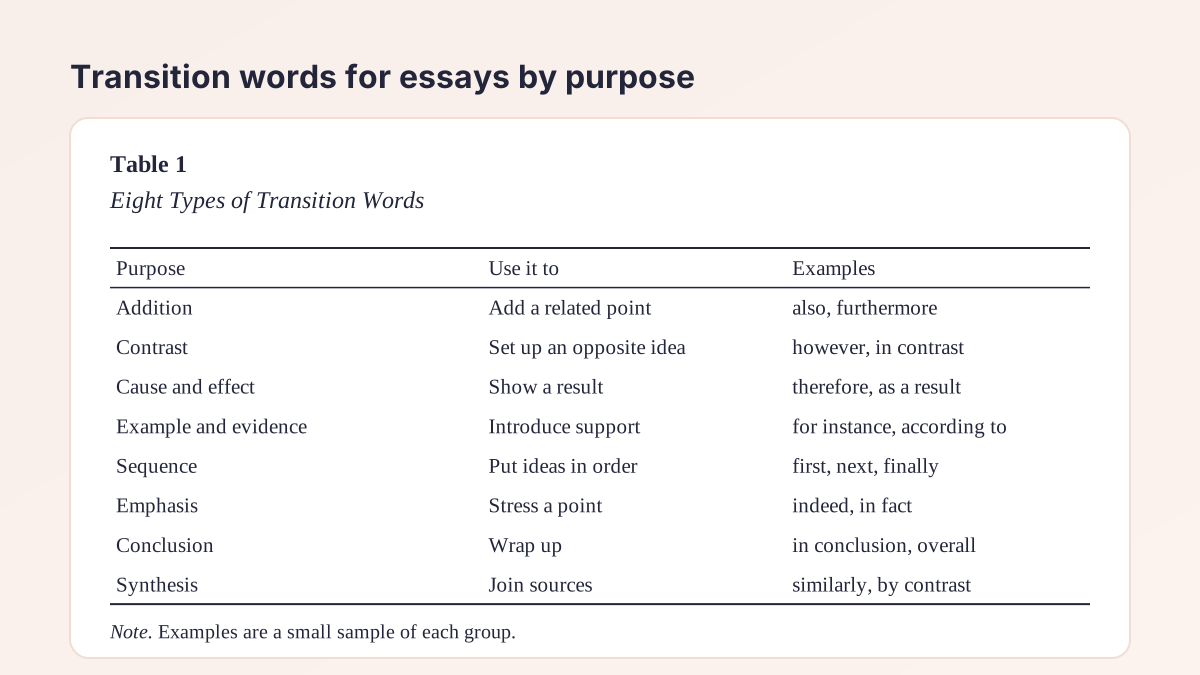
The most useful way to learn words of transition is by job. Table 1 above names eight jobs for transition words for essays. The sections that follow give examples of each, and the table below adds a few more words you can swap in.
| Purpose | Words and phrases | Sample use |
|---|---|---|
| Addition | also, in addition, furthermore, moreover, besides | Moreover, the program is free. |
| Contrast | but, yet, however, on the other hand, in contrast | Yet few students use it. |
| Cause and effect | so, thus, therefore, consequently, as a result | Thus, enrollment fell. |
| Example and evidence | for example, for instance, specifically, according to | According to the registrar, 40 percent dropped out. |
| Sequence | first, second, next, then, finally, afterward | Next, the committee voted. |
| Emphasis | indeed, in fact, above all, clearly | Above all, cost mattered. |
| Conclusion | in conclusion, in short, overall, to sum up | In short, the plan worked. |
Addition Transition Words
Use these addition transition words to stack a related point on the last one: also, in addition, furthermore, moreover, additionally, besides. Furthermore and moreover carry more weight than also, so save them for points that really build on each other. If you find yourself adding a fourth point with another additionally, restructure the paragraph instead.
Words That Show Contrast
Use however, but, yet, on the other hand, in contrast, nevertheless to set up an opposing idea. However is the most common of the however transition words, and it is usually set off by commas. When it joins two full sentences, put a semicolon before it and a comma after it. A plain but is fine at the start of a sentence in most classes, though some teachers prefer you avoid it.
Words That Show Cause and Effect
Use therefore, thus, consequently, as a result, accordingly, because to link a reason to its result. Check that the first sentence actually causes the second; these words promise logic. Because and since introduce the reason, while therefore and as a result introduce the result.
Evidence Transition Words and Example Phrases
Evidence transition words tell the reader that proof is coming and how to weigh it. Good choices include for example, for instance, specifically, in particular, to illustrate, according to and as [source] shows. Use for example when the support is one case among many, and specifically when it is the exact detail that proves the claim.
Introduce the quotation, then explain it
Never drop a quotation or statistic in with no lead-in; evidence transition words give it one. A signal phrase such as "According to the CDC," or "As the report points out," tells the reader who is speaking. After the evidence, add a link to your own point with this shows, this suggests or in other words. The UNC Writing Center also warns that similar transitions can carry different meanings, so match the lead-in to what the evidence actually does.
Quote with care
When the evidence is a direct quotation, see our guides to MLA in-text citation and how to cite a quote in APA for the citation that follows it.
Sequence and Emphasis Words
Among transition words for essays, sequence words show order: first, second, third, next, then, after that, finally, meanwhile, afterward. Use them for steps, stages or a ranked list of reasons. In an argument, vary them, because "first, second, third" for every body paragraph can read like a template.
Emphasis words
Indeed, in fact, above all, clearly, certainly and most importantly stress a point. Strong transition words for essays like these only work if you use them rarely. If every sentence is "in fact," none of them is.
Time words for narrative
For stories, later, soon, at that moment, until then and shortly after keep events in order. Purdue OWL's transitions page calls a link like shortly after chronological. The Purdue OWL transition guide also warns against vague signposts such as "another important thing to note," which disconnect the next idea from the last one.
Transition Words for the Second Body Paragraph
The second body paragraph has a particular job, and transition words for the second body paragraph carry it: it must connect back to the first paragraph's idea while introducing a new one. Useful openers include In addition to [first reason], …, Beyond [first reason], …, A second reason is… and Building on this point, …. For contrast with the first point, try Yet [first idea] is only part of the story.
The third body paragraph
The same transition words for the second body paragraph work for the third, with a new opener. Lead with Finally, …, Most important, … or Perhaps the strongest reason is… and echo a key term from the paragraph before. Reusing a term is often better than adding another stock word, as Purdue OWL's advice to link specific paragraphs suggests.
More help by position
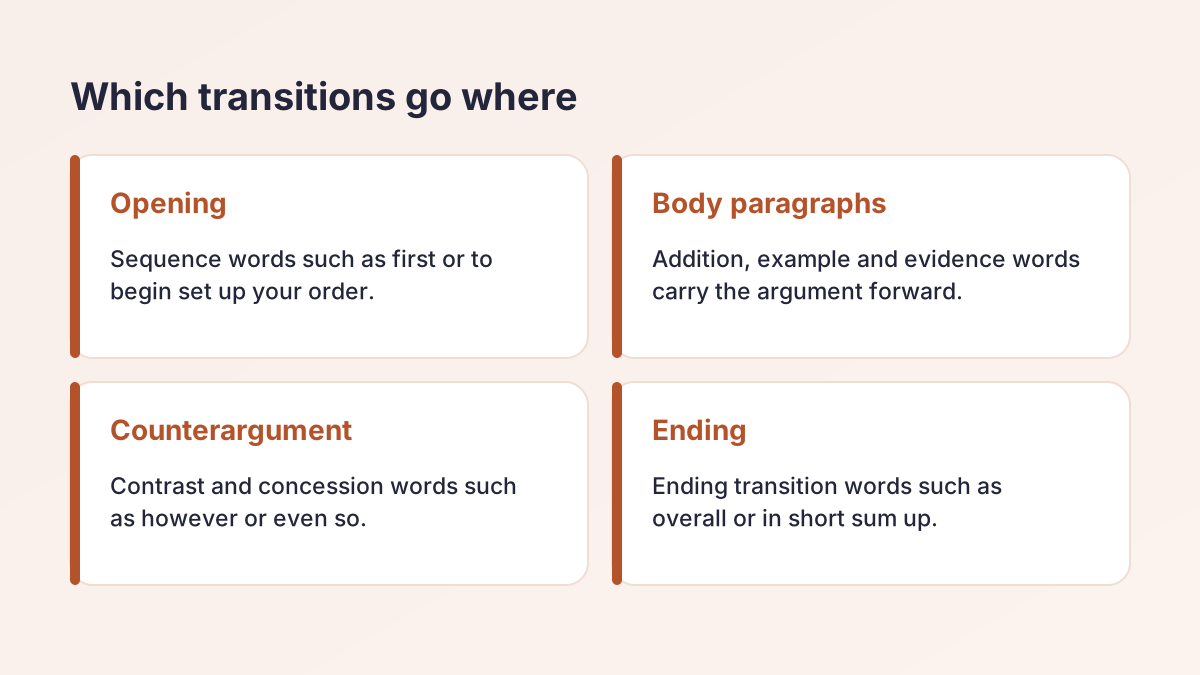
Where transition words for essays sit in a paragraph or essay is its own topic. Our guide to transition words for paragraphs lists openers by position: the first body paragraph, the middle, counterarguments and the closing paragraph. Our compare and contrast outline guide shows the same connectors in a two-subject essay.
Ending Transition Words and Closing Phrases
Ending transition words signal that the paper is wrapping up: overall, in short, in brief, to sum up, all in all, ultimately, in the end. Among ending transition words, many teachers dislike a flat "In conclusion," in a short essay because the reader can already see the last paragraph coming. Ultimately and overall tend to read as more natural ending transition words.
Transition words to end a paragraph
Ending a body paragraph is a separate job. Close with a sentence that states why the evidence matters, using so, as a result, this means that or for this reason. Then let the next paragraph's opener pick up the thread.
Make the conclusion do more than repeat
Ending transition words should lead into a sentence that adds something: the larger stakes, the next question or the limits of your claim. For a full treatment, read our guide on how to write a conclusion.
Transition Words for a Literature Review
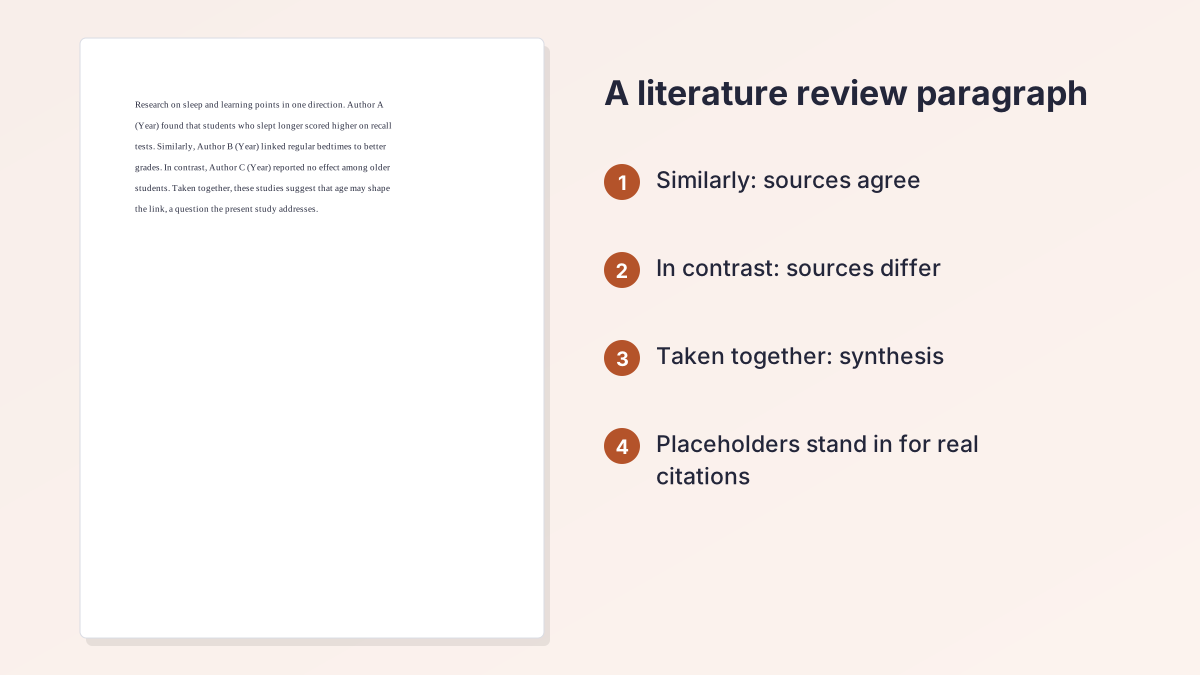
A literature review does not list sources one after another, so transition words for a literature review matter. It groups them by what they say, so its transitions mostly show agreement, disagreement and development. These transition words for a literature review work best when each one links two named studies.
Words that show agreement
Similarly, likewise, in the same vein, consistent with this, in line with and building on show that sources support each other. With these transition words for a literature review, follow with the second author's finding, not just a name.
Words that show disagreement
In contrast, by contrast, conversely, however, whereas and unlike show sources that differ. Say why they might differ, such as a different sample or method.
Words that synthesize
Taken together, collectively, overall, as a whole and these findings suggest pull several studies into one claim. The last illustration above shows a paragraph that uses all three groups. If you have a format question, the APA format guidelines cover the paper's layout.
How to Choose and Punctuate Transition Words
Words in the same group are not always interchangeable, even among transition words for essays. Although, whereas and however all signal contrast, but they are not punctuated the same way: although and whereas start a clause inside a sentence, while however usually links two full sentences. A reliable rule is to decide whether you are joining a full sentence or a clause.
Punctuation patterns
At the start of a sentence, put a comma after the transition: However, the data differ. After a semicolon, put a comma after the transition: The data differ; however, the trend is clear. In the middle of a clause, set it off with commas: The trend, however, is clear. With a word such as because, no comma is needed when the reason comes second.
Match the tone
Academic essays that use transition words for essays favor furthermore, consequently and nevertheless. Informal writing can use also, so and but. The digital SAT's Reading and Writing section includes transition questions that test the same relationships, so learning the groups by purpose helps on the test too.
Try a tool when you are stuck
If you can't find a fit, the transition words finder lets you search by purpose, gives a punctuation rule for each word and adds an example sentence for many of them.
Common Mistakes With Transition Words
Most problems with transition words for essays come from overuse or from a word that promises a relationship the sentences don't have. Check your draft against this list.
| Mistake | Fix |
|---|---|
| A transition at the start of every sentence | Keep them for real shifts; vary the sentence openings |
| However used to mean also | Use however only for contrast |
| Therefore with no cause | Check that the first idea really leads to the second |
| Comma splice with however | Use a semicolon before it, or start a new sentence |
| In conclusion in a one-page essay | Use overall, or simply start the last paragraph |
| Same transition three times in a row | Swap in another word from the same group |
| Transition words used to hide weak order | Reorder the paragraphs first |
A final read-through
Read the essay aloud and listen for places where you naturally pause. Those are the spots that need a link. Every guide in our student writing guides is built on the same idea: say what the reader needs, then say it clearly. For one last pass, the free transition words finder can suggest alternatives for any word you've used too often.
Transition Words for Essays FAQ
What are transition words for essays?
They are words and phrases such as however, for example and as a result that show how one sentence or paragraph relates to the one before. They are grouped by purpose: addition, contrast, cause and effect, example, sequence, emphasis and conclusion.
How do you start a paragraph with a transition?
Try first, in addition, however, for example, as a result or beyond this. Choose the one that matches how the new paragraph relates to the last one.
What are evidence transition words?
They introduce support for a claim: for example, for instance, specifically, according to and to illustrate. Follow them with a quotation, statistic or case, then explain it.
What transition words can I use for the second body paragraph?
Beyond this, in addition to, a second reason is and building on this point work well. Echo a key term from the first paragraph so the link is specific.
What are ending transition words?
Overall, in short, to sum up, all in all and ultimately. Many teachers prefer these to a plain 'In conclusion' in a short essay.
What transition words should I use for a literature review?
Use similarly and likewise for agreement, in contrast and whereas for disagreement, and taken together or overall to synthesize several sources.
What transition words can I use to end a paragraph?
Close with so, as a result, this means that or for this reason, followed by a sentence stating why the evidence matters.
How many transition words should an essay have?
There's no fixed number. Use one wherever the relationship between ideas isn't obvious, and cut any that repeat or add nothing.
Do you put a comma after however?
Yes, when it opens a sentence or follows a semicolon: However, the data differ. In the middle of a sentence, set it off with commas on both sides.
More free guides
- MLA In-Text CitationsAuthor-page citations for every kind of source, with examples.
- How to Cite a Website in MLAWorks Cited entries and in-text citations for web pages.
- MLA Works Cited PageFormat, order and hanging indents, with a full example page.
- MLA Annotated BibliographyFormat, annotation types and a complete example.
- APA Table FormatNumber, title, body and notes for APA 7 tables, with templates.
- MLA HeadingThe four-line first-page heading and the page header, with Word and Google Docs steps.
See all 80 free tools for students
Related tools
Last updated by The Study Corp editorial team.