MLA Website Citation Examples for Every Kind of Page
Each MLA website citation example uses a real page and shows the details you'd copy from it and the Works Cited entry, rendered by our citation engine. Italics don't show in this box: the website name is italic in your paper.
Details from the pageKatherine J. Wu, “Smithsonian Curators Remember Katherine Johnson, NASA Mathematician Highlighted in ‘Hidden Figures,’ Who Died at 101,” Smithsonian Magazine, 24 Feb. 2020
MLA website citation exampleWu, Katherine J. “Smithsonian Curators Remember Katherine Johnson, NASA Mathematician Highlighted in ‘Hidden Figures,’ Who Died at 101.” Smithsonian Magazine, 24 Feb. 2020, https://www.smithsonianmag.com/smart-news/smithsonian-curators-remember-katherine-johnson-nasa-mathematician-dies-101-180974262/.
A title inside the title takes single quotation marks. In the text: (Wu).
Details from the page“About Sleep,” Centers for Disease Control and Prevention, 15 May 2024
MLA website citation example“About Sleep.” Centers for Disease Control and Prevention, 15 May 2024, https://www.cdc.gov/sleep/about/index.html.
The title moves to the front, and the CDC appears once, as the website. In the text: (“About Sleep”).
Details from the page“Wolves in Yellowstone,” Yellowstone National Park website, National Park Service, no date shown, read 26 Oct. 2026
MLA website citation example“Wolves in Yellowstone.” Yellowstone National Park, National Park Service, https://www.nps.gov/yell/learn/nature/wolves.htm. Accessed 26 Oct. 2026.
No date, so the access date goes at the end.
Details from the page“Media Advisory: Irregular Sleep and Late Bedtimes Associated with Worse Grades for High School Students,” NICHD website, National Institutes of Health, 2 Apr. 2024
MLA website citation example“Media Advisory: Irregular Sleep and Late Bedtimes Associated with Worse Grades for High School Students.” Eunice Kennedy Shriver National Institute of Child Health and Human Development, National Institutes of Health, 2 Apr. 2024, https://www.nichd.nih.gov/newsroom/news/040224-teen-sleep.
The website name and the publisher differ, so both appear. In the text: (“Media Advisory”).
Details from the pagePurdue Online Writing Lab, run by Purdue University, no single publication date, read 26 Oct. 2026
MLA website citation examplePurdue Online Writing Lab. Purdue University, https://owl.purdue.edu. Accessed 26 Oct. 2026.
A whole site's name goes in italics, with no quotation marks.
Details from the pageKen Robinson, “Do Schools Kill Creativity?,” TED, Feb. 2006
MLA website citation exampleRobinson, Ken. “Do Schools Kill Creativity?” TED, Feb. 2006, https://www.ted.com/talks/sir_ken_robinson_do_schools_kill_creativity.
A title ending in a question mark needs no extra period. In the text, cite a time range: (Robinson 00:03:10–25).
How to Cite a Website in MLA in 6 Steps
Here's how to cite a website in MLA: open the page you used, find each detail on it, then build the entry in this order.
- Find the author. Look for a byline at the top or bottom of the page. Write it last name first. If no person or group is named, or the organization is also the website, skip the author.
- Copy the page title. Use the headline of the page itself, not the site's name, in title case and quotation marks.
- Name the website. Write the site's name in italics, such as Smithsonian Magazine, followed by a comma.
- Add publisher and date. Add the publisher only if it differs from the website name. Then give the date as day, abbreviated month and year.
- Paste the URL. Copy the address from your browser bar and end it with a period. If there's no date, add Accessed and the day you read it.
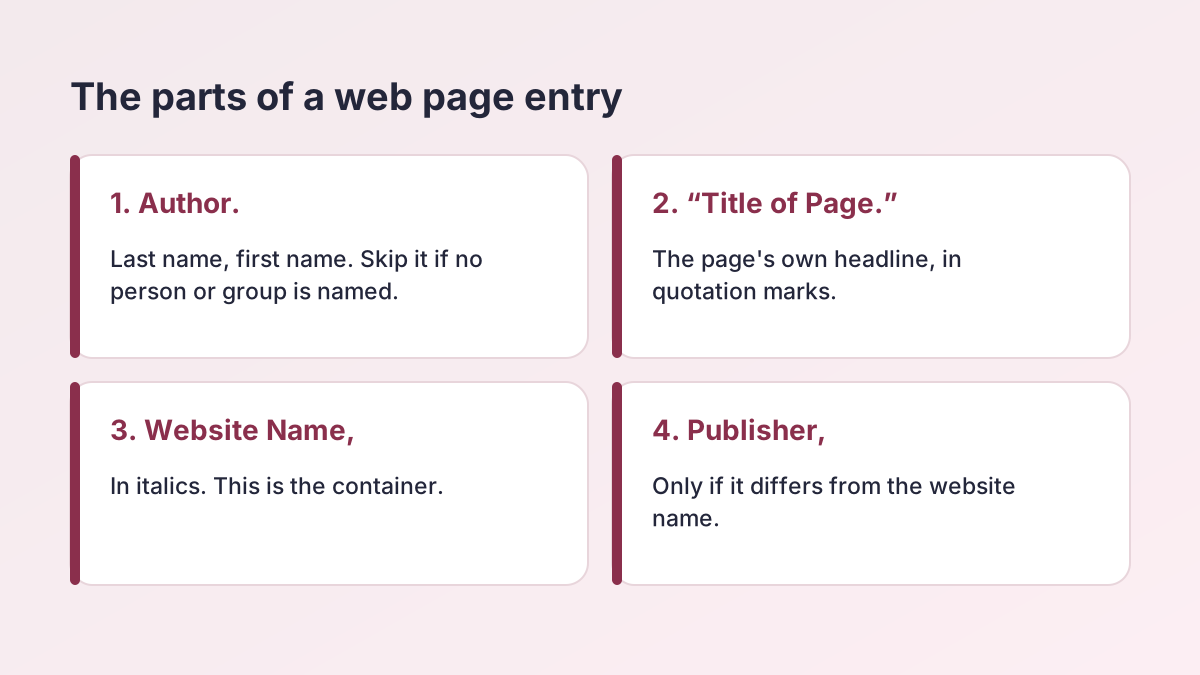
- Cite it in your paper. Use the first word of the entry, usually the author's last name, in parentheses: (Wu). Add a page number only if the page has one. That's the MLA in-text citation for a website.
The MLA Website Citation Format
MLA doesn't have a separate rule for each kind of source. Every Works Cited entry uses the same core elements in the same order, and you leave out the ones your source doesn't have. For a web page, the MLA website citation format uses six of them. If you'd rather not assemble it by hand, the MLA Citation Maker builds the entry from a URL. Once you know the order, how to cite a website in MLA comes down to finding each detail on the page.
| Element | What to write | Ends with |
|---|---|---|
| Author | Wu, Katherine J. | Period |
| Title of source | “Smithsonian Curators Remember Katherine Johnson …” (quotation marks) | Period |
| Title of container | Smithsonian Magazine (italics) | Comma |
| Publisher | Only if different from the website name | Comma |
| Publication date | 24 Feb. 2020 | Comma |
| Location | The URL | Period |
The MLA website citation format as a template
Author's Last Name, First Name. "Title of Page." Name of Website, Publisher, Day Month Year, URL.
What makes a website a container
In MLA, a container is the larger work that holds your source. The article is the source, so its title goes in quotation marks. The website holds it, so the website's name goes in italics. That's why the MLA 9th edition website citation format looks like a journal article entry: both have a source inside a container. The MLA Style Center's quick guide to works cited explains containers in more depth.
MLA 8 vs. MLA 9
The website entry didn't change between MLA 8 (2016) and MLA 9 (2021). If your syllabus says "MLA 8," the same entries work. Older MLA 7 entries included the medium "Web." and an access date every time; MLA 9 uses neither by default.
Author, Title, Website and URL: Each Element Explained
Most mistakes in the MLA website citation format come from copying the wrong detail from the page. Here's where to look for each element and how to write it.
Author
Write one author last name first: Wu, Katherine J. For two authors, reverse only the first name: Smith, Ana, and Luis Ortiz. For three or more, give the first author and "et al." An organization can be the author when it wrote the page and someone else published it.
Title of the page
Use the headline of the specific page or article, in title case and quotation marks. Don't use the text in the browser tab if it adds the site's name, as in "About Sleep | Sleep | CDC."
Website name and publisher
The website name goes in italics. MLA leaves out the publisher when it's essentially the same as the website name, so Smithsonian Magazine needs no separate publisher. Add one when it differs, as with the National Park Service behind the Yellowstone National Park site. Platforms that host content they didn't create, such as YouTube, are not publishers.
Date
Use the most specific date the page shows, written day month year, with months longer than four letters abbreviated: 24 Feb. 2020, 2 Apr. 2024, 15 May 2024. If the page shows "updated," cite the date of the version you read.
URL
Copy the URL from your browser. MLA allows you to drop "https://"; many instructors prefer the full address so it stays clickable, so follow your syllabus. If the page lists a DOI or a permalink, use that instead, since it won't break.
How to Cite a Website with No Author in MLA
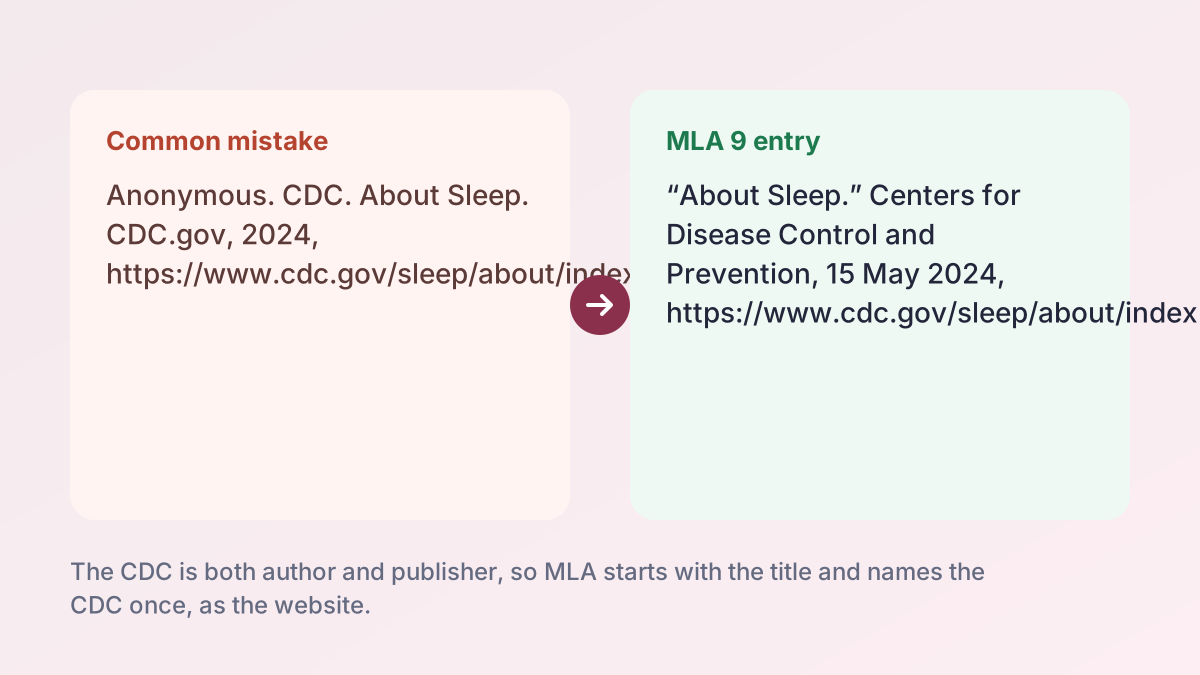
Many web pages have no byline, so knowing how to cite a website with no author in MLA is essential. A missing byline doesn't make a page anonymous in MLA terms: you simply start the entry with the title.
Start with the title
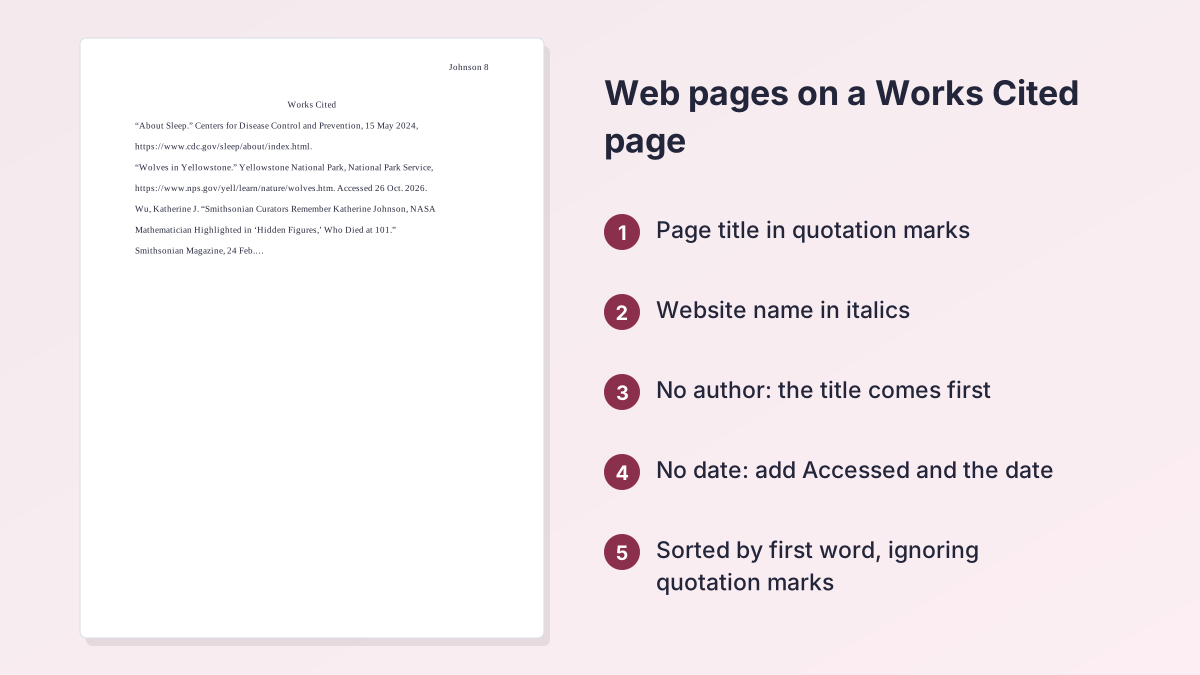
"About Sleep." Centers for Disease Control and Prevention, 15 May 2024, https://www.cdc.gov/sleep/about/index.html.
Never write "Anonymous" or "n.a." in the author slot. When you alphabetize, the entry goes under its first word, ignoring "A," "An" and "The."
When an organization wrote it
If a government agency, company or nonprofit wrote the page and also runs the website, MLA starts with the title and names the organization once, as the website or publisher. That's why the CDC page above doesn't list the CDC as author. If the organization wrote the page but someone else published it, put the organization in the author slot.
Check the bottom of the page
Before you decide there's no author, scroll to the end. News sites and blogs often place the byline below the article, and some university pages list a writer or a reviewer in the footer. A reviewer isn't an author, so leave a "medically reviewed by" name out.
No Date on the Page? Add the Access Date
Plenty of web pages, especially government and organization pages, show no publication date. Leave the date out of the entry rather than guessing, and don't write "n.d." (that's APA). The MLA website citation format simply skips the date.
When to include an access date
MLA 9 treats the access date as optional. Add it when the page has no publication date, as in the National Park Service example, or when the page is likely to change or vanish: a wiki page, a social media post, a product page or a live news update. Write it at the end: Accessed 26 Oct. 2026.
When to leave it out
If the page shows a publication or update date, you don't need an access date. Some instructors want one on every web source anyway. If Mr. Johnson's ENGL 1301 syllabus says to include access dates, add them to all your web entries.
Copyright dates
A copyright line in the footer, such as "© 2026," usually applies to the whole site, not the page. Don't use it as the page's date unless it's the only date and it clearly covers the page.
A Page on a Website vs. the Whole Website
Most of the time you cite one page, because your quote or fact came from that page. Citing a whole website is rare and only makes sense when you refer to the site in general.
One page or article
Cite the page in the standard MLA website citation format: its title in quotation marks, then the website in italics. This is also how to cite an article on a website in MLA, such as a magazine or newspaper story you read online.
A whole website
Put the site's name in italics as the title, with no quotation marks, then the publisher, date if there is one, and URL:
Purdue Online Writing Lab. Purdue University, https://owl.purdue.edu. Accessed 26 Oct. 2026.
How to cite a government website in MLA
Government pages follow the same pattern. Use the agency's site name as the website, and add the parent agency as publisher when it differs, as with the NICHD page published by the National Institutes of Health. Leave out the author when the agency is both author and publisher.
Online newspapers, magazines and journals
A newspaper or magazine article online is cited like any web page, with the publication as the website. A scholarly journal article you found online keeps its volume, issue and page numbers, plus a DOI if it has one.
Social Media Posts and Online Videos
Social media and video platforms follow the MLA website citation format, with a few extra details. These templates show the order; fill in only what the post shows.
Social media posts
Account Name or @handle. "Full text of a short post, or a description of an untitled image." Platform Name, Day Month Year, time if helpful, URL.
Use the account's display name if it's a real name, and the handle if that's all there is. For a short post, the whole text serves as the title. Social media posts change and disappear, so an access date is a good idea.
YouTube and other video sites
If the person or channel that made the video also uploaded it, put that name in the author slot. If someone else uploaded it, put the creator first and add "uploaded by" and the uploader's name after the platform. Give the video's title in quotation marks, the platform in italics, the upload date and the URL. YouTube is not the publisher, because it didn't make the video.
Comments
Begin with the commenter's name or username, then "Comment on" and the title of the page in quotation marks, the website, the date and time, and the URL.
MLA In-Text Citation for a Website
The MLA in-text citation for a website points to the Works Cited entry, so it uses the entry's first word. For a website, that means the author's last name or a short title, and usually nothing else.
No page numbers
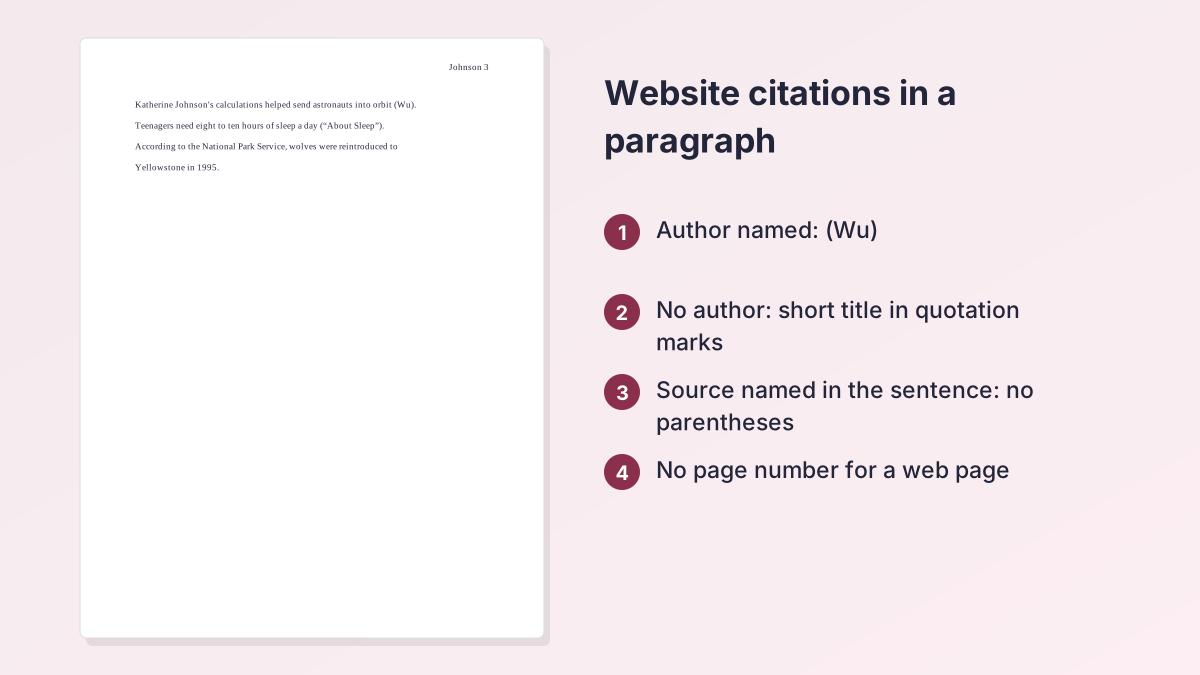
Web pages have no page numbers, so a website citation usually ends with the name: (Wu). Don't count paragraphs or screens. If the page numbers its paragraphs or sections, you can cite them: (Wu, par. 4).
No author
Use a shortened title in quotation marks, starting with the first word of the entry: ("About Sleep") or ("Media Advisory"). This is the MLA in-text citation for a website with no author, and the most common one for organization pages.
Signal phrases
Name the author or organization in your sentence, and you may not need parentheses at all: According to the National Park Service, wolves returned to Yellowstone in 1995. For quoting a website in MLA, put the citation after the closing quotation mark and before the period. The full rules are in our guide to the MLA in-text citation, including videos with time stamps.
Common Mistakes When Citing Web Pages
Teachers see the same website errors in nearly every research paper. Each MLA website citation example below pairs an error with its fix.
| Mistake | Example | Fix |
|---|---|---|
| Website name as the title | “CDC.” CDC, 2024 … | Use the page headline: “About Sleep.” |
| Writing “Anonymous” | Anonymous. “About Sleep.” … | Start with the title |
| Site name not in italics | Smithsonian Magazine in plain text | Italicize the website name |
| Publisher repeats the site | Smithsonian Magazine, Smithsonian Magazine, … | Give the name once |
| Copyright year as page date | … © 2026, https://… . | Use the page date, or Accessed and a date |
| Search or shortened URL | https://www.google.com/search?q=… | Copy the page's own URL |
| Citation with the URL | (www.cdc.gov) | (“About Sleep”) |
Is the site worth citing?
Formatting can't fix a weak source. For a research paper, prefer pages from government agencies, universities, established publications and professional organizations, and check who wrote the page and when. If you can't tell who's responsible for a page, look for a better source.
Let the tool do the commas
Paste the URL into the citation maker above to get a draft entry with the page's metadata filled in. It marks missing details for review, because many pages hide their author or date. Check the fields against the page, then copy the result. The web page form has no publisher field, so when the publisher differs from the website (such as the National Park Service), add it after the website name in the copied entry. Or open the full MLA citation generator to keep a saved list.
Adding Website Entries to Your Works Cited Page
Once you know how to cite a website in MLA, remember that every website you cite in a research paper gets its own entry on the Works Cited page, mixed in alphabetically with your books and articles. Web sources aren't grouped separately.
Order and layout
Sort entries by their first word: author's last name, or the title when there's no author. Ignore opening quotation marks and the words "A," "An" and "The." Double-space everything and use a 0.5-inch hanging indent. The MLA Works Cited page guide walks through the setup in Word and Google Docs, and the Alphabetizer sorts a typed list for you.
Annotated lists
If your assignment asks for a summary of each website, see the guide to the MLA annotated bibliography. More guides are on the citation guides hub.
Build the list as you research
Instead of formatting each page by hand, use the free MLA citation maker: paste a link, check the author, title and date, and add the entry to a saved list that sorts itself and downloads as a Word file.
Citing Websites in MLA: FAQ
How to cite a website in MLA format?
The MLA website citation format is: Author. "Title of Page." Website Name, Publisher (if different), Day Month Year, URL. Put the page title in quotation marks and the website name in italics, and skip any element the page doesn't have.
How to cite a website with no author in MLA?
Start the entry with the page title in quotation marks. In your paper, use a short version of that title in parentheses, such as ("About Sleep"). Don't write "Anonymous."
Do you need an access date in MLA 9?
It's optional for dated pages. MLA recommends one when the page has no publication date, and it's a good idea when the page is likely to change. Include it every time if your instructor asks.
Should I include https:// in an MLA citation?
MLA lets you drop http:// or https://, but you may keep it, and many instructors prefer full, clickable links. Be consistent across your list.
What is the MLA in-text citation for a website?
Use the first word of the entry, usually the author's last name, with no page number: (Wu). With no author, use a short title in quotation marks.
How do you cite a government website in MLA?
Start with the page title if no person is named, then the agency's website in italics, the parent agency as publisher if different, the date and the URL.
What if a website has no date in MLA?
Leave the date out and add an access date at the end, such as Accessed 26 Oct. 2026. Don't use n.d. or the site's copyright year.
How do you cite a whole website instead of one page?
Put the website's name in italics as the title, then the publisher, the date if available and the URL. Most of the time, though, you should cite the specific page.
More free guides
- MLA In-Text CitationsAuthor-page citations for every kind of source, with examples.
- MLA Works Cited PageFormat, order and hanging indents, with a full example page.
- MLA Annotated BibliographyFormat, annotation types and a complete example.
- MLA Block QuotesWhen a quotation needs a block, how to indent it and where the citation goes.
- How to Cite Multiple Authors in MLATwo authors, three or more, et al., editors and the same author twice.
- How to Cite a YouTube Video in MLAYouTube videos, movies, TV episodes and streaming, with time stamps.
See all 80 free tools for students
Related tools
Last updated by The Study Corp editorial team.