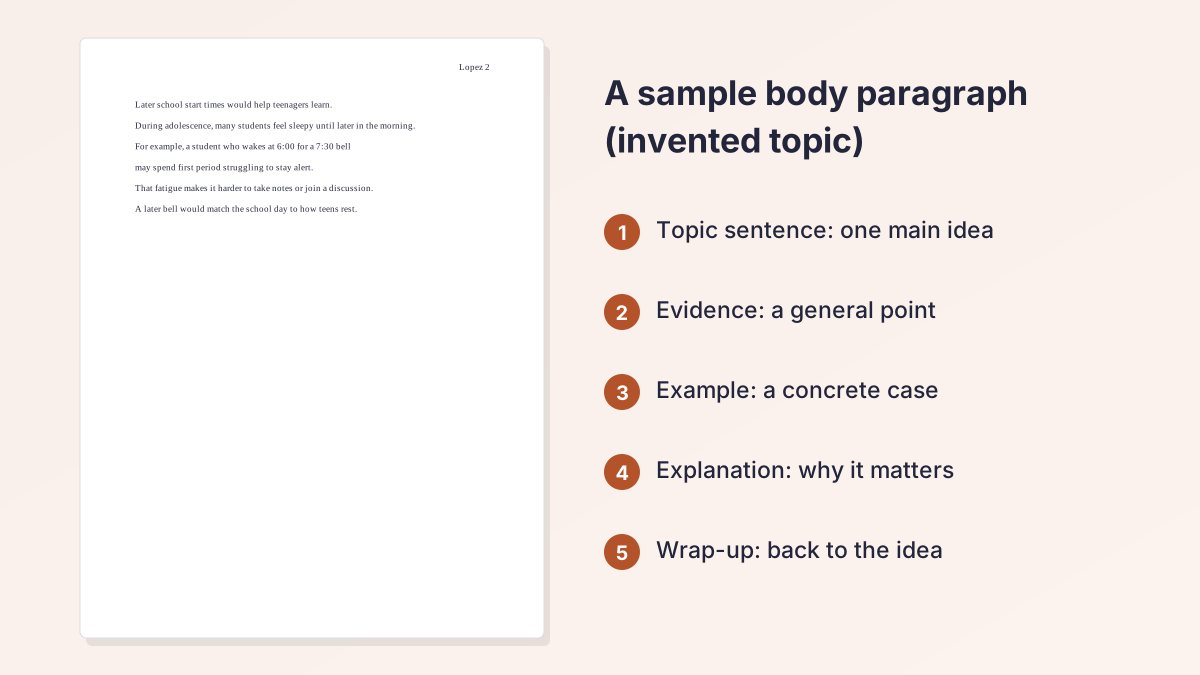
Paragraph Examples: Weak Drafts and Stronger Versions
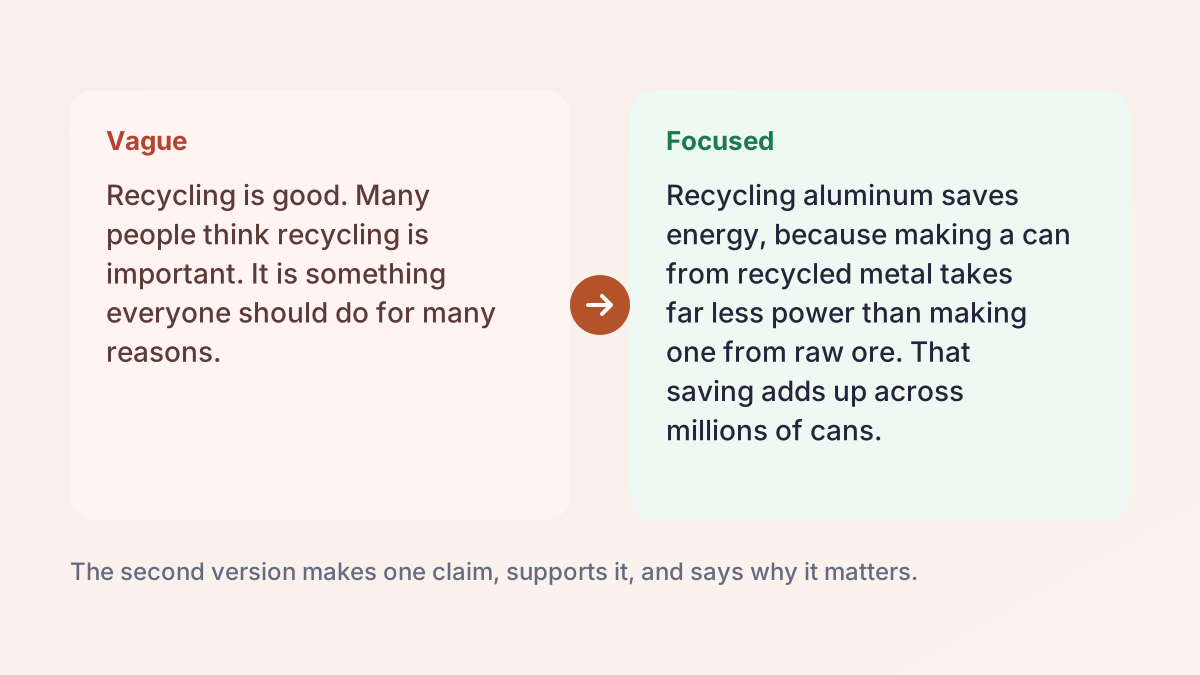
Each pair shows a common problem and a repaired version. All of the sentences are invented for this guide. Treat them as models of how to write a paragraph on your own topic, with your own evidence.
Common problemMany schools start before 8:00 a.m.
Stronger versionSchools should start after 8:30 a.m., because teenagers learn best when they have slept enough.
A topic sentence needs an idea the paragraph can develop.
Common problemIn this paragraph I will talk about homework.
Stronger versionHomework works best when it is short, specific and tied to what students learned that day.
State the idea instead of announcing it.
Common problemA class survey found that most students finish homework after 9 p.m.
Stronger versionA class survey found that most students finish homework after 9 p.m., so late assignments cut directly into sleep.
Tell the reader what the evidence proves.
Common problemReading is important. Reading matters a lot. It is important to read.
Stronger versionReading builds vocabulary, because every new book exposes a student to words the student would rarely hear in conversation.
Each sentence should add something new.
Common problemPublic libraries offer free books. Libraries also struggle with budgets, and many have cut their hours.
Stronger versionPublic libraries offer free books to anyone with a card. (New paragraph) Budget cuts, however, have forced many to shorten their hours.
A new main idea earns a new paragraph.
Common problemBike lanes cut traffic injuries. Cities with lanes report fewer crashes.
Stronger versionBike lanes cut traffic injuries. Cities with lanes report fewer crashes, which makes the lanes a safety measure as well as a convenience.
End by tying the evidence back to the idea.
Common problemVolunteering is useful.
Stronger versionVolunteering is useful because it teaches job skills. A student who staffs a food bank, for example, learns to manage a schedule and work with a team.
One sentence is rarely enough to develop an idea.
How to Write a Paragraph in 5 Easy Steps
These five steps show how to write a paragraph of almost any kind, from a short response to a college essay.
- Choose one idea. Decide the single point this paragraph will prove, and make sure it connects to your thesis.
- Write the topic sentence. State the idea in one clear sentence that tells the reader what the paragraph will show.
- Add evidence or examples. Support the idea with a fact, a quotation, a statistic or a specific example from your reading or research.
- Explain the evidence. Say how the evidence proves your point. Never leave a quote or number to speak for itself.
- Close and connect. End with a sentence that wraps up the idea or leads into the next paragraph, then read the whole thing aloud.
How to Write a Paragraph: A Plain Definition
Before you work out how to write a paragraph, it helps to know what one is. The UNC Writing Center defines a paragraph as a group of sentences, or a single sentence, that forms a unit, and it calls the one main idea of that unit the controlling idea. The handout adds that length and appearance don't determine whether a section is a paragraph. A paragraph is a unit of thought, and the indent or blank line simply tells your reader that the thought has changed.
That is good news if you are stuck, because a good paragraph comes down to holding one idea steady. You don't need to hit a magic sentence count. You need one idea, enough support to make it believable, and a clear link back to your main point. If you'd like a draft to react to, the free paragraph generator writes a paragraph on any topic, with a topic sentence, supporting sentences and a closing line, and you can revise it into your own voice.
Why paragraphs matter
Readers use paragraph breaks as signposts. A new paragraph says "here comes a new point." When a writer ignores this signal, the essay turns into a wall of text, and when a writer breaks too often, the ideas feel thin.
One idea per paragraph
The first rule of paragraph structure is unity: every sentence in the paragraph should relate to its one controlling idea. If a sentence belongs to a different idea, move it or give it a paragraph of its own. We come back to this in the section on long paragraphs.
The Parts of a Paragraph
Most academic paragraphs share the same building blocks. Once you can name them, the question of how to write a paragraph becomes a checklist you can run on any draft. The table lists the parts of a paragraph in the order they usually appear, what each does and roughly how much room it needs.
| Part | What it does | Typical size |
|---|---|---|
| Topic sentence | States the one idea the paragraph will develop | One sentence |
| Supporting detail | Gives evidence, examples or reasons | Two to four sentences |
| Explanation | Shows how the evidence proves the idea | One to three sentences |
| Closing sentence | Wraps up the idea or leads to the next paragraph | One sentence |
Topic sentence
The topic sentence is the paragraph's promise. It usually comes first, though the UNC handout points out that the controlling idea can also sit in the middle or at the end, as long as readers can find it and see how it relates to the thesis. For school essays, put it first. It makes drafting easier and helps your reader follow along. If you want ideas for wording, the topic sentence generator offers several versions for a single body point.
Evidence and examples
Evidence is whatever makes your idea believable: a statistic, a short quotation, a definition, a scene from a book, or a specific example from your own experience when the assignment allows it. Pick the most relevant piece, not the most impressive one. Two well-chosen pieces beat five loosely connected ones.
Explanation
The explanation is the part many students skip. It answers the reader's silent question, "So what?" The UNC five-step pattern is blunt about this point: no example should go unexplained. If you quote a source, follow it with a sentence that begins "This shows" or "This matters because."
Closing sentence
The last of the parts of a paragraph either wraps up the idea or hands the reader to the next paragraph. It should add a small insight, not repeat the topic sentence word for word.
Paragraph Structure: Three Patterns Teachers Use
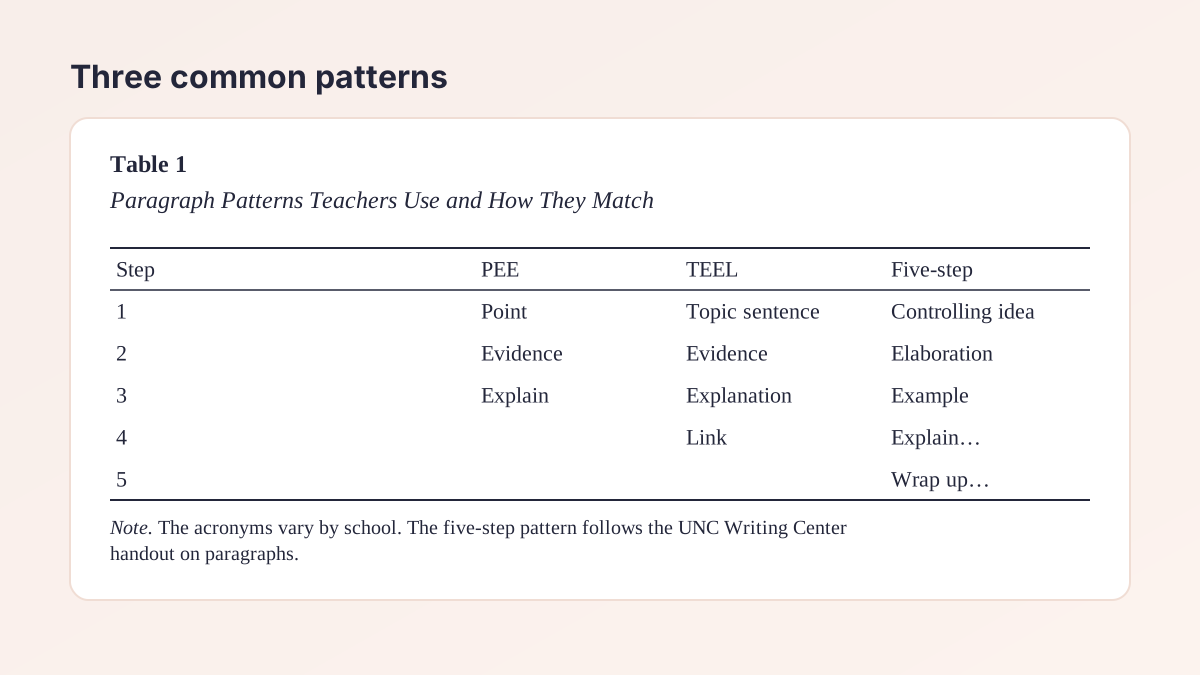
Paragraph structure is the order in which the parts appear. Teachers give it different acronyms, but the patterns overlap, as the table below shows. Pick the one your class uses, or use the five-step version if your teacher hasn't named one.
PEE and PIE
PEE stands for point, evidence, explain. Many US classes use PIE instead, usually expanded as point, information (or illustration), explanation. Either way, you state the point, back it with evidence or an illustration, and explain it. It is the fastest paragraph structure for timed writing, because you can say the whole plan in three words.
TEEL
TEEL, the usual label in Australian and New Zealand schools, adds a final link: topic sentence, evidence, explanation, link. The UK version, PEEL, swaps point for topic sentence. The link sentence ties the paragraph back to the thesis or sets up the next paragraph. It suits essays where each body paragraph proves part of one argument.
The five-step pattern
The UNC Writing Center handout lays out a five-step approach for illustration paragraphs: state the controlling idea, elaborate on it, give examples, explain each example, then wrap up or transition. It notes that the example-and-explanation steps can repeat. Use this paragraph structure when your idea needs more than one example.
Other ways to organize
Narration, description, process and classification are other patterns the handout mentions. A paragraph that tells what happened in order, or describes a scene, may not follow PEE at all. Match the paragraph structure to the job the paragraph needs to do.
How to Write a Body Paragraph for an Essay
Body paragraphs sit in the middle of an essay, and most of your points live there. A body paragraph does one job: it proves one part of your thesis. If your thesis says schools should start later because teenagers need more sleep, one body paragraph might prove the sleep claim and another might answer the objection about bus schedules.
Start from your thesis
Read your thesis and ask which part this paragraph supports. Write that part as the topic sentence in plain language. If you can't connect the paragraph to the thesis in one sentence, the paragraph probably belongs in a different essay.
Build the middle
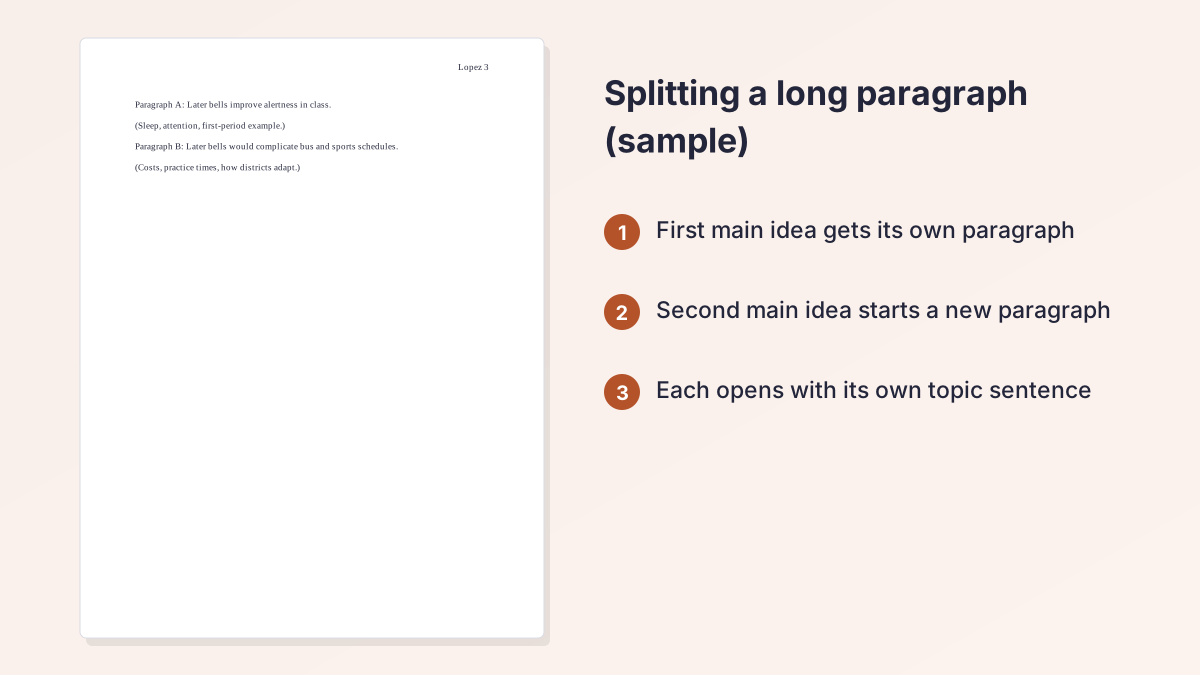
Add your evidence next, then explain it. For example, a paragraph on later start times might give a general point about adolescent sleep, add a concrete scene such as a student fighting to stay awake in first period, and explain why that fatigue harms learning. The sample page above shows the pieces in order.
Link to the next idea
Finish by pointing forward. A sentence such as "Sleep is only part of the picture, since the schedule also affects families" prepares the reader for the next paragraph. For a longer menu of linking words, see our guide to transition words for essays, or try the transition words tool to find a connector that fits your sentence.
Body paragraphs in a five-paragraph essay
In the classic five-paragraph essay, the three body paragraphs each prove one reason. In longer papers, one reason may take two or three paragraphs, each with its own topic sentence. For a full example of how body paragraphs fit into an argument, see what an argumentative essay is.
How Long Is a Paragraph? Sentences, Words and Pages
There is no fixed answer to how long a paragraph should be, and learning how to write a paragraph of the right length starts with the idea, not a count. The UNC handout gives no word count and says length does not define a paragraph. Still, teachers have conventions, and they are useful to know.
How long is a paragraph in a school essay?
Many teachers expect a body paragraph in a school essay to run about four to eight sentences, which is often 100 to 200 words. That is a convention, not a rule. A paragraph shorter than three sentences often lacks explanation. One that runs past a page often holds two ideas. Check your assignment sheet for your instructor's limits.
Short paragraphs on purpose
News writing and web writing often use single-sentence paragraphs because readers skim. In academic writing, a one-sentence paragraph can work as a deliberate emphasis, but use it rarely. Most of the time, a one-sentence paragraph means an idea needs development.
Paragraphs in different assignments
A short-answer response may be one paragraph of five or six sentences. Paragraphs in a college research paper often run longer, because their ideas need more support. A lab report or a reflection may be shorter or longer, so follow your instructor's model. The guide on how to write an introduction and the one on how to write a conclusion cover the two paragraphs that usually run differently from the body.
How to add more to a paragraph that is too thin
If your draft feels short, don't pad it with filler. Add to a paragraph by asking questions: What is an example? Why does this matter? What would a skeptic say? Each answer can become a sentence. The paragraph expander can suggest places to add detail.
Long Paragraphs, Unreadable Paragraphs and How to Fix Them
A very long paragraph is a warning sign, and knowing how to write a paragraph includes knowing when to stop. When a reader meets a long paragraph that runs half a page without a break, attention drops and the main idea gets lost. An unreadable paragraph is usually one where the idea, the evidence and a second idea have all been poured into one block.
Test for two ideas
Underline the topic sentence and then read each later sentence. If a sentence starts a new claim, start a new paragraph there. The UNC handout calls this unity: when a paragraph holds more than one main idea, either cut the extra sentences or split the paragraph so each new one has a single main idea.
Try a reverse outline
After you finish a draft, write one phrase in the margin beside each paragraph that says what it does. If a margin note needs "and," the paragraph probably holds two ideas. If two paragraphs get the same note, merge them. This is also a simple paragraph organizer.
Cut repetition and wordiness
Long paragraphs often hide repeated points. Delete any sentence that says the same thing as an earlier one in different words. Then replace vague words such as "things" and "very" with specific nouns and verbs.
When a long paragraph is fine
In a close reading or a complex analysis, a paragraph can run long if every sentence supports one idea and the sentences are well connected. The test is not the length but whether a reader can follow the thread from the first sentence to the last.
Making Sentences Flow: Coherence and Transitions
Good paragraph structure needs more than a topic sentence, because a paragraph can have a perfect one and still read like a list. The cure is coherence, which the UNC handout describes as sentences that follow a logical order with a clear plan of development. You get coherence by ordering sentences on purpose and by using connectors that show how each sentence relates to the last.
Order your sentences
Arrange sentences by time, by importance, or from general to specific. In an argument, many writers put the strongest evidence last. In a description, you might move across a scene from left to right. Pick one order and keep it.
Use connectors sparingly
Words such as "for example," "however," "as a result" and "in addition" show relationships. Use them where the relationship is real. A transition at the start of every sentence reads as mechanical. Our transition words for paragraphs page sorts openers by where a paragraph sits in an essay, from the first body paragraph to the conclusion. For lists grouped by purpose, such as addition, contrast and cause and effect, use the transition words tool.
Introduction and Conclusion Paragraphs, Briefly
The first and last paragraphs follow a different paragraph structure from the body, so each has its own guide. An introduction moves from a hook, through background, to a thesis. Our guide to how to write an introduction paragraph walks through that funnel with examples of each hook type. A conclusion does the reverse, widening from the thesis to the larger meaning, and the guide on how to write a conclusion shows how to finish without repeating yourself.
When you're deciding where an idea belongs, remember that the introduction promises, the body proves and the conclusion explains why it mattered. For a head start on the opening, try the introduction generator, and use the conclusion generator when you reach the end.
Common Paragraph Mistakes
Most weak paragraphs fail in the same few ways, and each is a lapse in paragraph structure. Check your draft against this list before you submit it, and remember that a complete paragraph is one the reader can summarize in a single sentence.
Topic sentence and support don't match
If the topic sentence promises one idea and the evidence proves another, change one of them. Revise the topic sentence to fit what you actually proved, or find evidence that supports the promise.
Dropped quotations
A quotation without a lead-in or comment leaves the reader guessing. Introduce it, quote it, then explain it. Our guides to MLA in-text citation and how to cite a quote in APA show how to cite it once it is in place.
Turning notes into a paragraph
If your notes are in bullet points, don't paste them together. Choose the point that matters most, write it as a topic sentence, and attach the notes as evidence. A tool such as the paragraph generator can combine notes into one paragraph in its combine mode, and you can compare its draft against your own to see how the pieces connect. Browse the rest of our writing and citation guides for help with the whole essay.
Questions About Writing a Paragraph
How do you write a paragraph step by step?
Choose one idea, write a topic sentence, add evidence or examples, explain how the evidence supports the idea, and close with a sentence that wraps up or leads on.
What are the parts of a paragraph?
A topic sentence, supporting details such as evidence and examples, an explanation, and a closing sentence.
How long is a paragraph?
Many teachers expect about four to eight sentences, often 100 to 200 words, but a paragraph's length depends on its idea. Check your assignment sheet.
How do you write a body paragraph?
Open with a topic sentence that supports part of your thesis, add evidence, explain it, and end with a sentence that links to the next idea.
What is paragraph structure?
The order of a paragraph's parts. Common patterns are point, evidence, explain; topic, evidence, explanation, link; and the five-step pattern.
How do I fix a very long paragraph?
Look for a second main idea. Split the paragraph there, give each new paragraph its own topic sentence, and cut repeated sentences.
How can I add more to a paragraph?
Ask for an example, a reason or an objection. Each answer can become a sentence of evidence or explanation.
Can a paragraph be one sentence?
Yes, occasionally, for emphasis or in news-style writing. In school essays, a one-sentence paragraph usually needs more development.
What is the easiest way to practice how to write a paragraph?
Use one pattern, such as the five steps above, on short topics you know well, then compare each draft with a model paragraph.
How do I turn notes into one paragraph?
Pick your most important point as the topic sentence, then place the other notes as evidence in a logical order and connect them with transitions.
More free guides
- MLA In-Text CitationsAuthor-page citations for every kind of source, with examples.
- How to Cite a Website in MLAWorks Cited entries and in-text citations for web pages.
- MLA Works Cited PageFormat, order and hanging indents, with a full example page.
- MLA Annotated BibliographyFormat, annotation types and a complete example.
- APA Table FormatNumber, title, body and notes for APA 7 tables, with templates.
- MLA HeadingThe four-line first-page heading and the page header, with Word and Google Docs steps.
See all 80 free tools for students
Related tools
Last updated by The Study Corp editorial team.