How to Summarize: Weak Sentences Turned Into Strong Ones
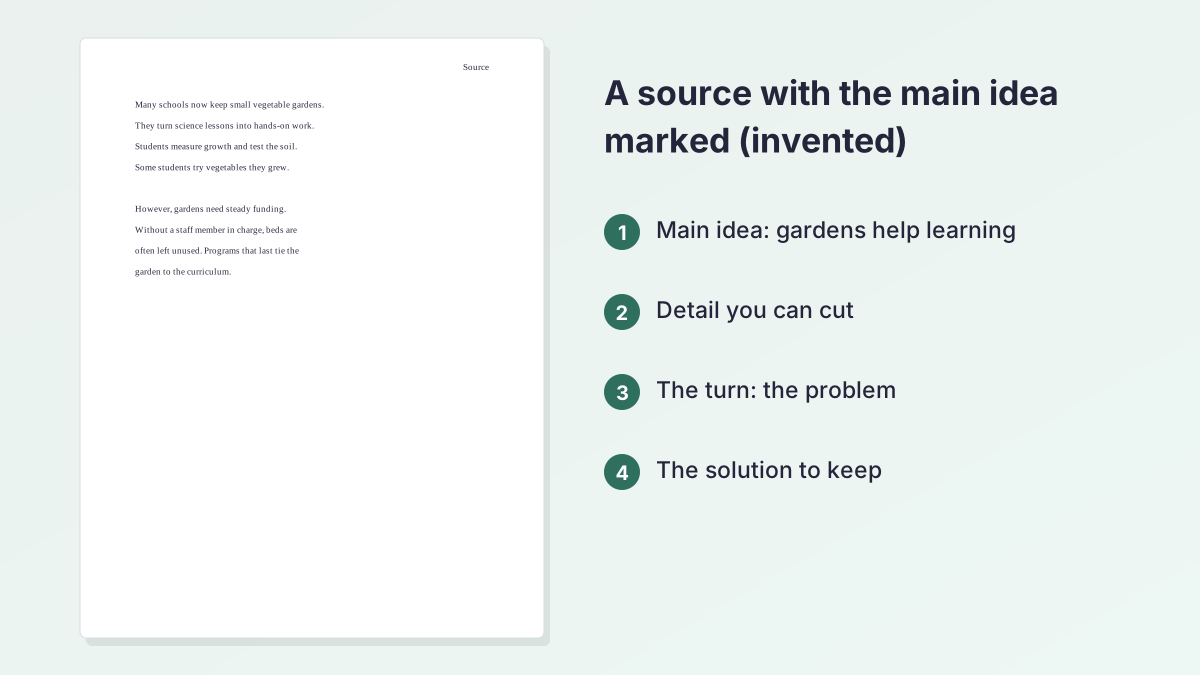
Most weak summaries share a handful of habits. Each pair below shows one habit and a fix. All of the sentences are invented for this guide and refer to the made-up garden passage in the first illustration.
Weak summary sentenceMany schools now keep small vegetable gardens that turn science lessons into hands-on work.
Stronger versionSchool gardens give students a practical way to learn science.
Change the words and the sentence shape, not only a few terms.
Weak summary sentenceThe article says gardens have plants and soil and students measure things and eat vegetables.
Stronger versionThe article argues that gardens improve learning but need steady support.
State the idea that connects the details.
Weak summary sentenceThe article is right that gardens are great, and every school should have one.
Stronger versionThe article claims that gardens help students learn.
A summary reports the author's view, and your opinion belongs elsewhere.
Weak summary sentenceHowever, gardens need steady funding.
Stronger versionAccording to the article, school gardens help students but depend on steady funding.
Name the source and the main idea first.
Weak summary sentenceThe article is about gardens.
Stronger versionThe article explains why school gardens help science learning and why many fail.
A topic is not a main idea.
Weak summary sentenceSchool gardens help students learn science and eat vegetables.
Stronger versionSchool gardens help students learn, but without funding and staff they often go unused.
Keep the author's key qualification.
Weak summary sentenceThe article begins by describing gardens, then it explains the science, then it describes the food and then it talks about money and staff.
Stronger versionGardens help students, but they need money and a staff member to last.
Cut the roadmap and keep the point.
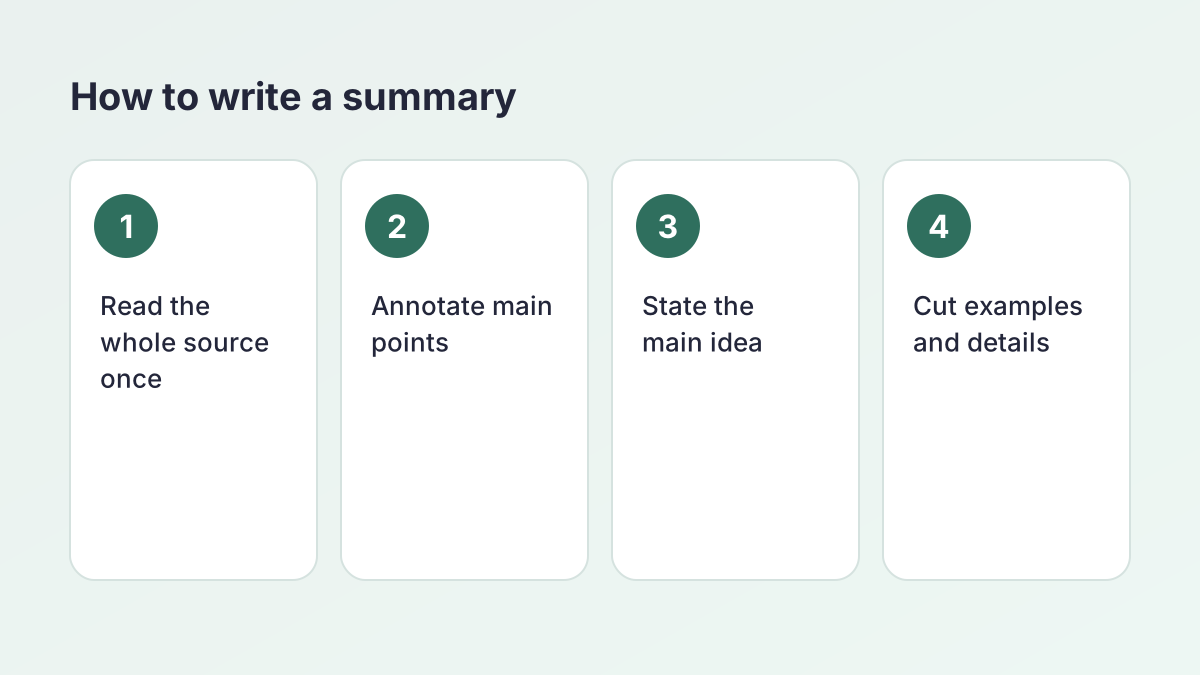
How to Summarize in 6 Easy Steps
These six steps show how to summarize an article, a chapter or an essay. The whole job usually takes less time than the reading.
- Read the whole source. Read once for the general idea before you mark anything or write a word.
- Annotate main points. Underline the thesis, topic sentences and conclusion, and note the structure in the margin.
- State the main idea. Write one sentence that says what the whole source is about and what it claims.
- Cut the details. Drop examples, statistics, quotations and repeated points unless the main idea depends on them.
- Use your own words. Write from your notes, not from the page, and check that your sentences read differently.
- Cite the source. Name the author in the text and add a citation in the style your class requires.
What Does Summarize Mean?
To summarize means to put the main ideas of a source into your own words and keep only what matters. The Purdue Online Writing Lab says summarizing involves putting the main idea or ideas into your own words, including only the main points. Reading Rockets describes it as telling the most important parts of a text, in your own words, in a much shorter way. That is the whole idea behind summarizing means: shorter, accurate and in your voice.
If you want a draft to compare with your own, the free essay summary generator condenses pasted text into a set number of sentences. Treat its output as a model to check against the source, not as a replacement for reading.
Definition of summarizing, in plain words
In practice, a summary answers one question: what is this source saying? It leaves out most examples, quotations and side points. It stays neutral, so it reports the author's claims without adding praise or criticism.
The difference between paraphrasing and summarizing
Paraphrasing and summarizing both use your own words, but they work at different sizes. Purdue's guide explains that a paraphrase puts one passage into your own words, while a summary keeps only the main point or points of a source and is much shorter. Analysis goes a step further and evaluates the source. The table in the next section compares the three.
Summarizing and paraphrasing both need a citation. Purdue states that paraphrased and summarized ideas must be attributed to the original source.
Summarize vs Paraphrase vs Analyze
Use this table to decide what summarize means in your assignment and which move your assignment is asking for. If a prompt says "summarize," give the main points. If it says "analyze," your own judgment is the point.
| Move | What it does | Length | Your opinion? |
|---|---|---|---|
| Summarize | Reports the main ideas of a whole source | Much shorter than the source | No |
| Paraphrase | Restates one passage in detail | Close to the passage, often a bit shorter | No |
| Analyze | Explains how and why a source works or what it means | Depends on the task | Yes, supported by evidence |
| Quote | Repeats the exact words | As short as possible | No |
Another word for summarize
When you need variety, another word for summarize can help. Synonyms for summarize include condense, sum up, outline, recap, abridge and boil down. These are not always exact swaps. In an essay, "the author argues" and "the article explains" usually read better than a repeated "the author summarizes."
Summarise or summarize?
Summarize is the standard US spelling and summarise is the British one. Use summarize for US classes. Both words mean the same thing.
Summarization in Reading Class and Beyond
In reading class, summarization is a comprehension skill. Reading Rockets says that summarizing helps students find key ideas, drop unneeded details and connect central points, and that it can improve memory and let a reader check their understanding. A student who has learned how to summarize a chapter has probably understood it, and summarization practice builds that skill. A student who cannot may need to reread.
Where you will use summarization
Summarization shows up in English essays, history readings, lab reports, discussion posts and research papers. A literature review is mostly summary of sources, grouped by theme. A lecture note is a live summary. Learning the skill once saves time across subjects.
What about AI summarization?
AI summarization tools can condense text quickly, but they can leave out the main point or add a claim the source never made. If you use one, check the result against the original, follow your teacher's policy and cite the source yourself.
How to Write a Summary, Step by Step
Here is how to write a summary in the order you will do it, and it is also how to summarize any text. The steps match the list above, with detail on the parts that trip students up.
Read, then annotate
Read the source straight through once, then reread with a pencil. Underline the thesis, mark the topic sentence of each paragraph and circle the conclusion. Reading Rockets suggests asking three questions: what are the main ideas, which details are crucial to support them and which information is unnecessary.
Find the main idea
Write one sentence that says what the source is about and what it claims. If you cannot, you have not found it yet. The main idea is rarely a single quotation. It is usually what the thesis and the conclusion have in common.
Cut details, then write
Cross out examples, statistics, quotations and repeated points. Then close the source and write from your notes. Start with the author and title, state the main idea, add the two or three supporting points that matter most and stop. Then reread the source to check that nothing is wrong.
Summarize in 3 sentences or in bullet points
Some assignments set a form. To summarize in 3 sentences, give one sentence for the main idea and one for each of two key supports. To summarize in bullet points, keep each bullet to one idea in parallel wording, with no sub-bullets. Our free key points generator turns text into bullet points, which is handy for checking whether you missed one.
Summary Length: Common Conventions
There is no universal rule. Your teacher or assignment sets the length, and these ranges are conventions you can use when nothing is stated. A common rule of thumb is that a summary should be much shorter than the source, often a quarter of its length or less.
- A paragraph: one to two sentences.
- A short article: one paragraph of three to five sentences.
- A chapter or long article: one to two paragraphs.
- A book or full research paper: a page or less, unless the assignment says otherwise.
If your summary is as long as the original, you are paraphrasing. If it is a single vague sentence, you are naming the topic. The free word counter can help you stay near a limit.
How to Summarize Different Kinds of Sources
Knowing how to summarize one kind of source helps with the rest. The six steps stay the same, but each type of source puts the main idea in a different place. Here is where to look.
How to summarize an article
Check the headline, the first paragraph and the last paragraph, since the main claim often appears in one of them. In a news article, the who, what, when, where and why usually come first. In an opinion piece, the thesis is the claim the author argues for. Your summary should say who wrote it, where it appeared and what it argues.
Summarizing a story
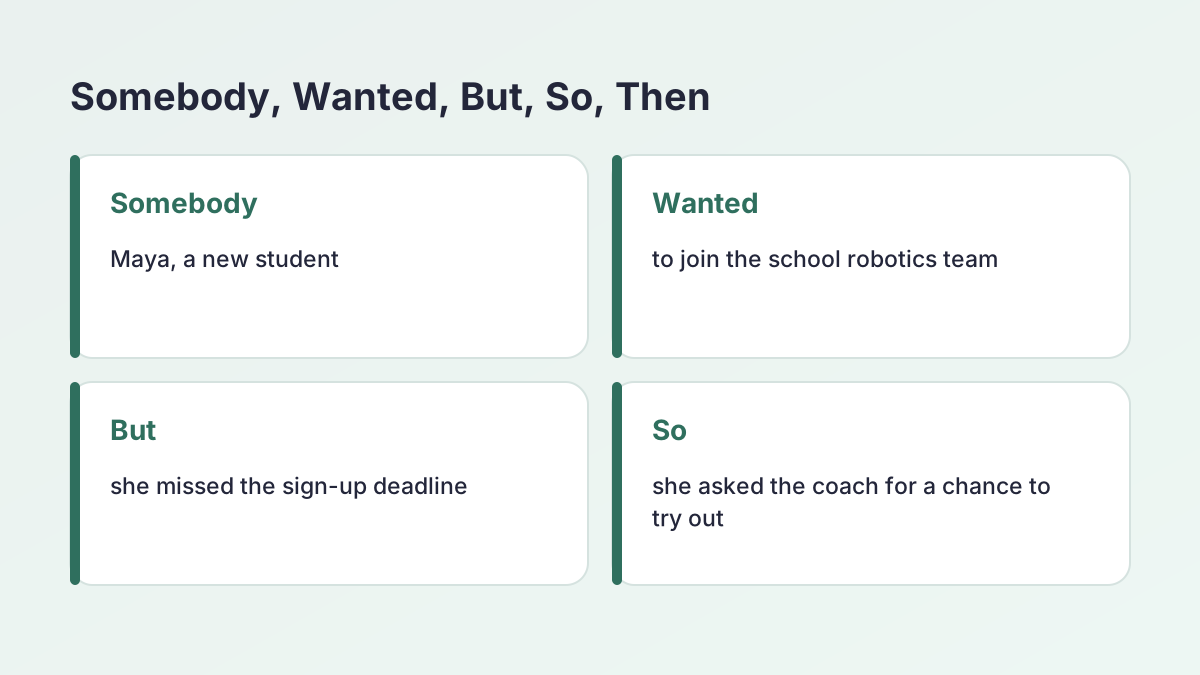
Stories are built on a character, a goal, a problem and an outcome, which is why classrooms use the Somebody-Wanted-But-So-Then framework. The OU K20 Center lists it as a reading strategy that helps students summarize by identifying the main points without retelling every detail: who the story is about, what they wanted, what got in the way, what they did and how it ended. Reading Rockets lists the same routine as Someone Wanted But So Then. Fill in each blank, then join the answers into two or three sentences.
How to summarize a chapter
Use the headings, the first sentence of each section and any chapter summary or review questions as guides. Write one sentence per major section, then combine them into the main idea of the chapter. Skip the examples unless the chapter depends on them.
How to summarize a research paper or abstract
Start with the abstract, which is the authors' own summary, but don't copy it. Read the introduction for the question, the methods for how it was studied, the results for what was found and the discussion for what it means. Then write two to four sentences: question, method, finding and significance.
How to summarize a video or lecture
Take notes with time stamps as you watch. Pause after each section and write the key point in a few words. Then write the summary from your notes. Citing a video usually requires a time stamp, which our guide to MLA in-text citation explains.
Summarizing Anchor Chart Ideas
A summarizing anchor chart is a poster or notebook page that reminds students of the steps. The illustration above shows one for stories. Here are a few other ideas you can copy for a classroom wall or your own notes.
- Somebody-Wanted-But-So-Then: best for stories, with one column for each word.
- The five Ws: who, what, when, where and why, a quick frame for news articles.
- Main idea and details: draw a funnel with details at the top and the main idea at the bottom to show the narrowing.
- Keep, cut, combine: three columns where students sort ideas to keep, details to cut and sentences to merge.
- The six steps: a numbered chart of read, annotate, find the main idea, cut, rewrite and cite.
For a summarizing graphic organizer, leave blanks for the main idea and three supports so students fill in short phrases first and sentences later.
Summary Sentence Starters
A strong opening names the source and says what it claims. These starters keep the verb neutral. Choose one, then fill in the main idea in your own words.
To open the summary
- "In [title], [author] argues that..."
- "According to [author], ..."
- "This article explains how..."
- "The author's main point is that..."
To add supporting points
- "The author also notes that..."
- "To support this claim, the article points to..."
- "Another key idea is..."
To show a turn or the end
- "However, the author cautions that..."
- "The article concludes that..."
- "Overall, the source suggests..."
Use verbs that match the source: argues, explains, describes, reports, suggests and claims. Avoid verbs that signal a judgment, such as proves or admits, unless the source really does that.
A Sample Source and a Sample Summary
This is how to write a summary in practice. Both texts below were invented for this guide. They are not from a real publication, and they match the page in the first illustration.
Sample source (invented): "Many schools now keep small vegetable gardens on unused land. Teachers say gardens turn abstract science lessons into hands-on work, since students can measure growth, test soil and track weather. Gardens can also change what students eat, and some cafeteria staff report that students try vegetables they grew themselves. However, gardens need steady funding. When a volunteer moves away or a teacher leaves, the beds often go unused. Programs that last tend to tie the garden to the curriculum and assign a staff member to care for it all year."
Sample summary (invented): "According to the passage, school gardens give students hands-on science practice and may encourage them to try new vegetables, but many fail without steady funding and a staff member in charge. Programs that last connect the garden to classroom lessons."
Why this summary works
It names the source in the first phrase, states the main idea and keeps the author's turn, the "but." It drops the specific activities, the cafeteria detail and the volunteer story. It also uses new wording, so it could not be mistaken for the original. At 40 words, it is a little under half the length of this 90-word source, and a summary of a longer text would be a smaller fraction.
For another model, run a pasted passage through the summary generator for essays and compare its main idea with yours. If the two differ, reread the source to see which one is closer.
How to Cite a Summary
A summary uses the author's ideas, so it needs a citation even without quotation marks. Purdue's guide says it is necessary to attribute summarized ideas to the original source. The format depends on your style.
- MLA: put the author and, when you summarize a specific passage with page numbers, the page in parentheses, for example (Author 12). See our guide to MLA in-text citation.
- APA: use the author and year, for instance (Author, 2024). APA encourages but does not require a page or range for paraphrased or summarized material, so follow your instructor. See our APA format guidelines.
- Signal phrase: you can also name the author in the sentence, such as "According to Author," and put the citation at the end.
Add the source to your Works Cited or References list too. If your summary mixes in a direct quotation, put that phrase in quotation marks and cite it separately. Our guide on how to cite a quote in APA shows how.
Common Summarizing Mistakes
Most students who struggle with how to summarize break a small number of rules. Check your draft against this list, and use the essay summary tool to compare against a model.
Copying phrases from the source
Changing a few words isn't a summary. Close the source and write from memory and notes, then check for accidental matches.
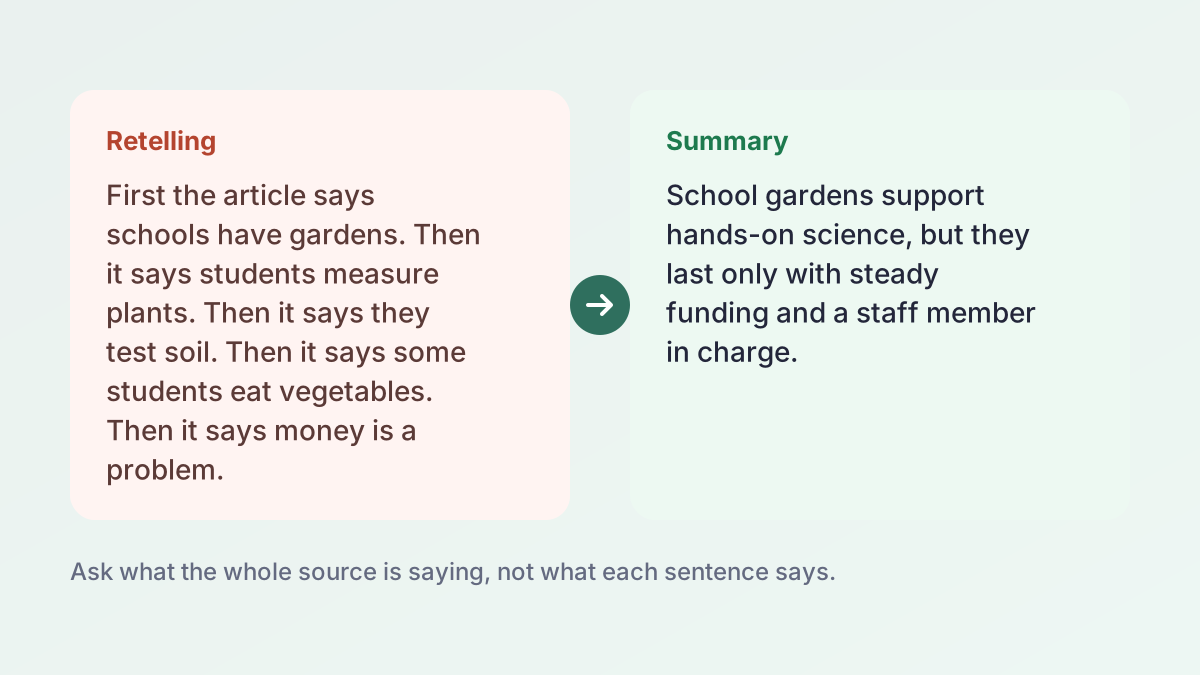
Retelling instead of condensing
If your summary follows the source sentence by sentence, it is too long. Group ideas and report the whole.
Mixing in your opinion
A summary reports. Save agreement, disagreement and evaluation for a separate paragraph or an analysis.
Missing the main idea
Details are easier to notice than the point. Ask what the author wants the reader to believe or do, and make sure your first sentence says it.
Forgetting the citation
A summary without a citation can still count as plagiarism. Add one every time, even when you wrote the words yourself. For more help, browse our other study guides.
Questions About How to Summarize
How do you summarize an article?
Read it once, mark the thesis and topic sentences, write the main idea in one sentence, cut details and rewrite in your own words. Then cite the author.
What does summarize mean?
To summarize means to restate the main ideas of a source in your own words, in a much shorter form.
How do you write a summary?
Name the source, state the main idea, add the two or three most important supports and stop. Check it against the original.
What is the difference between paraphrasing and summarizing?
A paraphrase restates a passage in detail, while a summary keeps only the main ideas and is much shorter. Both need a citation.
How many sentences is a summary of a short article?
Your assignment decides. For a short article, three to five sentences is a common convention. As a rule of thumb, it is much shorter than the source, often a quarter of its length or less.
How do you summarize a story?
Use Somebody, Wanted, But, So, Then: who it is about, what they wanted, the problem, what they did and the outcome.
What is a summarizing anchor chart?
It is a poster or notebook page that lists the steps or a framework for summarizing, such as Somebody-Wanted-But-So-Then.
Do you need to cite a summary?
Yes. A summary uses someone else's ideas, so cite the source in the style your class requires, even without quotation marks.
Is it summarize or summarise?
Summarize is the US spelling. Summarise is the British spelling. Both mean the same thing.
More free guides
- MLA In-Text CitationsAuthor-page citations for every kind of source, with examples.
- How to Cite a Website in MLAWorks Cited entries and in-text citations for web pages.
- MLA Works Cited PageFormat, order and hanging indents, with a full example page.
- MLA Annotated BibliographyFormat, annotation types and a complete example.
- APA Table FormatNumber, title, body and notes for APA 7 tables, with templates.
- MLA HeadingThe four-line first-page heading and the page header, with Word and Google Docs steps.
See all 80 free tools for students
Related tools
Last updated by The Study Corp editorial team.