Poem Prompts With Sample First Lines
Each pair shows a prompt and the opening lines a student might write from it. All of the lines are invented for this guide, so use them to see how a prompt turns into an image, not as text to copy.
PromptDescribe the last room you walked through today.
Sample opening linesThe hallway kept its coats on. Four hooks, one empty, and a smell of rain that had nowhere else to go.
Start with objects in the room, not your feelings about it.
PromptWrite about something your grandparent always said.
Sample opening lines"Eat first, then argue." She said it over rice, over bad news, over the phone from another time zone.
A spoken line gives the poem a voice right away.
PromptShow nervousness without using the word.
Sample opening linesI read the same sentence nine times. My pen clicks like a small clock, counting down to my name.
Let the body and the objects carry the emotion.
PromptGive a voice to something in your backpack.
Sample opening linesI am the highlighter, dry at the tip. I was yellow once. I marked everything and finished nothing.
Speaking as the object makes an ordinary thing strange.
PromptWhat if the moon were closer to the ground?
Sample opening linesWe would climb it with ladders from hardware stores and bring sandwiches, and argue about who got the window.
Treat the impossible with ordinary details.
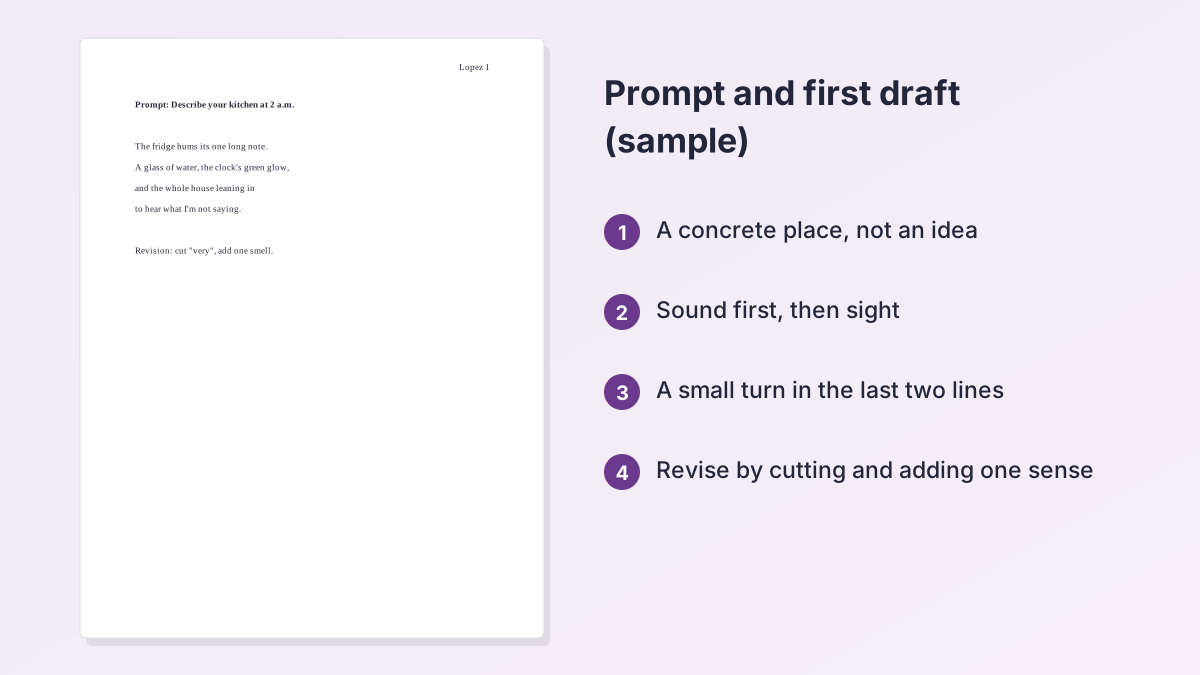
PromptWrite a three-line poem about breakfast.
Sample opening linesToast pops, the cat leaps, / butter finds its melting place. / Morning has arrived.
A tight limit forces strong word choices.
PromptWhat do you know now that you did not know a year ago?
Sample opening linesThat quiet is not the same as empty. That a friend can be a seat saved and never mentioned.
Answer with two or three small, true statements.
How Can I Make a Poem From Scratch? Six Steps
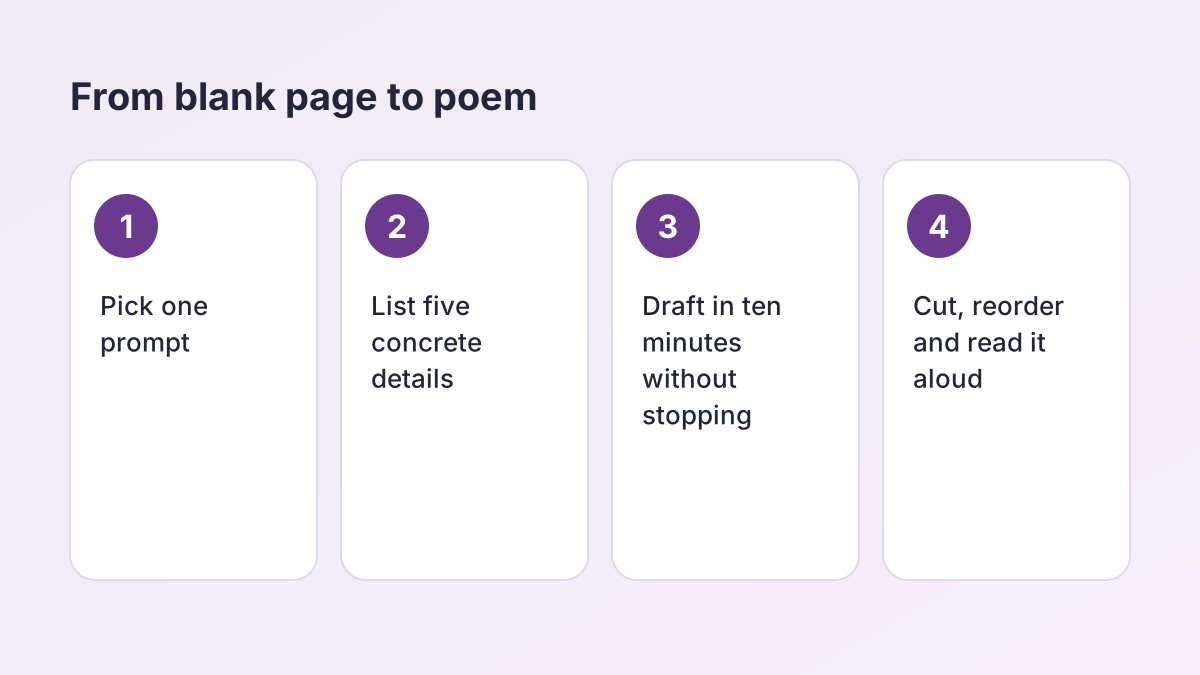
If you have ever asked, "How can I make a poem when I have nothing to say?" start with a prompt, because a prompt turns a huge task into a small one. These six steps take about thirty minutes.
- Choose one prompt. Pick a prompt from the lists below that gives you a picture right away, and ignore the rest.
- List concrete details. Write five things you could see, hear, smell, touch or taste in that moment, using real nouns.
- Pick a form. Decide on free verse, haiku, acrostic or another form, because a limit like a line count helps.
- Draft without stopping. Write for ten minutes and do not edit; you can fix the poem once it exists.
- Cut and reorder. Delete every line that explains and move your strongest image to the end.
- Read it aloud. Listen for lines that stumble, and fix the rhythm and word choice until it sounds right.
What Makes Good Poem Prompts Work
Good poem prompts share three traits: they point to something you can picture, they ask a question with more than one answer, and they leave room for your own voice. "Write about love" is a topic. "Describe the last text message you saved and why" is one of the better poem prompts, because it hands you a scene. A broad topic invites clichés, while a specific prompt invites a detail only you could write.
If you want a fresh prompt without scrolling a list, the free poetry prompt generator gives you ten specific prompts at a time, with an optional theme. For a full first draft to react to, the poem generator writes two original poems in the form you pick: free verse, rhyming, haiku, limerick, sonnet or ballad. Use a draft as a model to learn from, then write your own, since your teacher wants your voice.
Poetry prompts for beginners
If you are new to writing poems, start with prompts that ask you to describe, not to explain. Poetry prompts built around the five senses work well, because every reader can follow a smell or a sound. Keep the first poem short, since four to eight lines is enough to practice an image, a rhythm and an ending.
25 Poem Prompts by Theme
Here are 25 poem prompts in five groups. Try one in ten minutes, then switch to another if it stalls. A prompt that fails is still useful, since it shows you what you do not want to write about.
Memory and family
- Write about a smell that returns you to a specific kitchen.
- Describe a family object that nobody is allowed to throw away.
- Write a poem from the viewpoint of your childhood bedroom.
- Recall a phrase an adult repeated until you finally understood it.
- Write about the last time you were carried or picked up.
Nature and place
- Describe the sky at the exact moment you leave home.
- Write about a street or field you pass every day but have never really seen.
- Give a voice to the weather during your hardest week.
- Write about a plant or animal that does not belong where it is living.
- Describe the first sign of a new season in your town.
Feelings and ideas
- Write about a time you stayed quiet and what the silence held.
- Show jealousy without naming it.
- Describe what courage looks like at 7 a.m. on a school day.
- Write a poem that begins with "I used to think" and ends with what changed.
- Write about a promise, kept or broken.
Objects and people
- Describe a stranger on a bus using only what their hands are doing.
- Give a speech to your phone, your shoes or your alarm clock.
- Write about an object in a lost-and-found box and who it might belong to.
- Describe your favorite meal as a landscape.
- Write a poem in the form of a note left on a table.
What-if and surprise
- What if you woke up able to hear what plants are saying?
- What if every building in your city had one hidden door?
- Write a weather forecast for your mood next week.
- Imagine a map of a place that only exists in your memory.
- Write the poem you would leave for someone opening a time capsule.
Deep poetry prompts
Some assignments ask for deeper work. Deep poetry prompts ask for risk, so choose one that makes you slightly uneasy: a regret you still carry, a belief you have changed, or a place you cannot go back to. Keep the language plain. A plain sentence about something true lands harder than a showy metaphor about nothing.
Poetry Prompts for Every Poem Form
A form is a set of limits, and limits make starting easier. These poetry prompts pair a form with a plan. Definitions here follow the Poetry Foundation's glossary of poetic terms and the Academy of American Poets' glossary, and the invented poems are labeled as samples.
Haiku examples and prompts
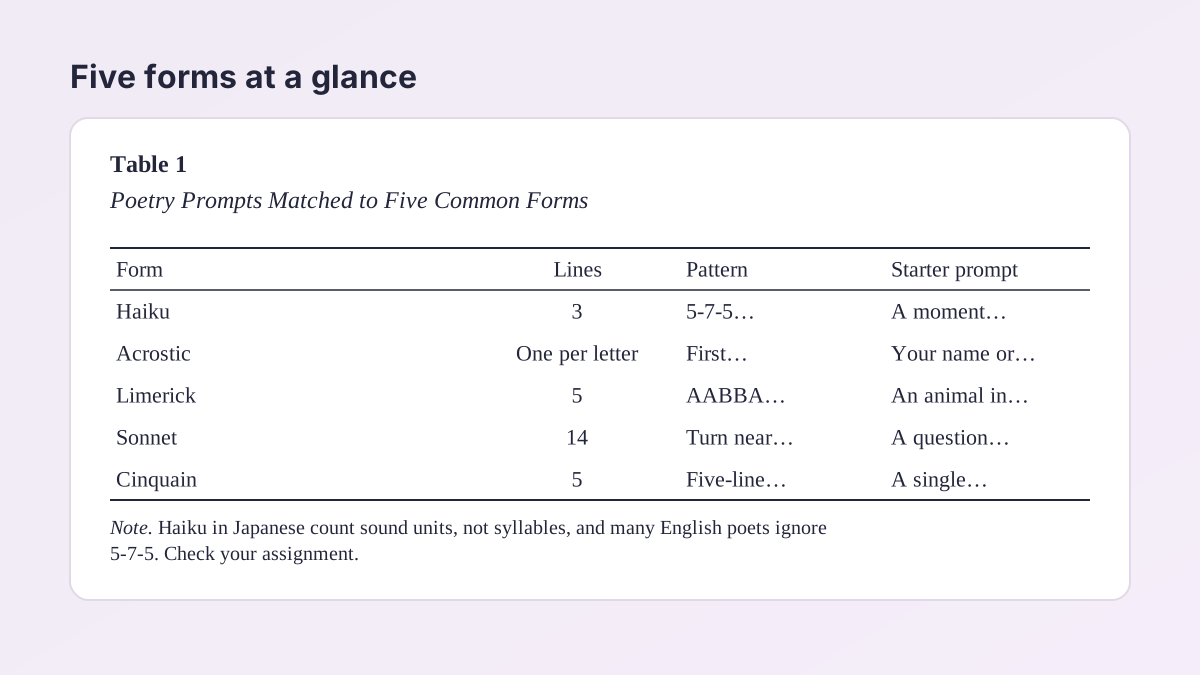
In English-language classrooms, a haiku is usually three unrhymed lines of five, seven and five syllables, built around a moment or an image. That is a convention rather than a rule. The Poetry Foundation notes that Japanese haiku are often built on 17 sound units called mora, which have no exact English equivalent, and that some American poets, such as Jack Kerouac, moved away from the 5-7-5 count. Ask your teacher which version they want. Here are three haiku examples written for this guide.
Rain taps the window / while the kettle starts to sing. / Monday feels softer.
Bus pulls from the curb. / A sleeping child's breath fogs glass. / The city blurs by.
Last year's leaves, still wet. / A green shoot pushes through them. / Spring has no manners.
Haiku prompts: write about a moment that lasted less than a minute; name a season without using its name; or pair two images that touch, such as steam and a cold window.
Acrostic poem prompts
An acrostic spells a word with the first letter of each line, and the Academy of American Poets defines it as a form in which names or words are spelled out through the first letter of each line. Pick a word with real meaning, such as your name, a place or a quality you admire, then write one image per letter. If you only want a quick shell, the acrostic poem generator writes two short poems that spell out a name or word. Here is a sample for HOME, invented for this guide.
Hallway light left on. / Open window, supper smells. / Mom humming off-key. / Everyone, finally, here.
Limerick prompts
The Poetry Foundation calls the limerick a light-verse form of five lines, generally anapestic, that rhyme AABBA, and it is traditionally irreverent or funny. Prompt idea: an animal in the wrong place, or a very small disaster. A sample, invented for this guide:
There once was a cat named Lou, / who sat on my poem, it's true. / The ink on his tail / left a smudged, inky trail, / and the poem was better, too.
Sonnet and cinquain prompts
A sonnet has 14 lines and usually explores a single idea, with a turn of thought in its final lines. Rhyme schemes vary by type, from the English (Shakespearean) form to the Italian (Petrarchan) one. Try a question you cannot settle, and let the last two lines change your mind. A cinquain is a poem or stanza of five lines. For a form-aware draft to study, the haiku, sonnet and limerick generator counts the syllables in every line of a haiku.
Concrete Poem Examples and Shape Prompts
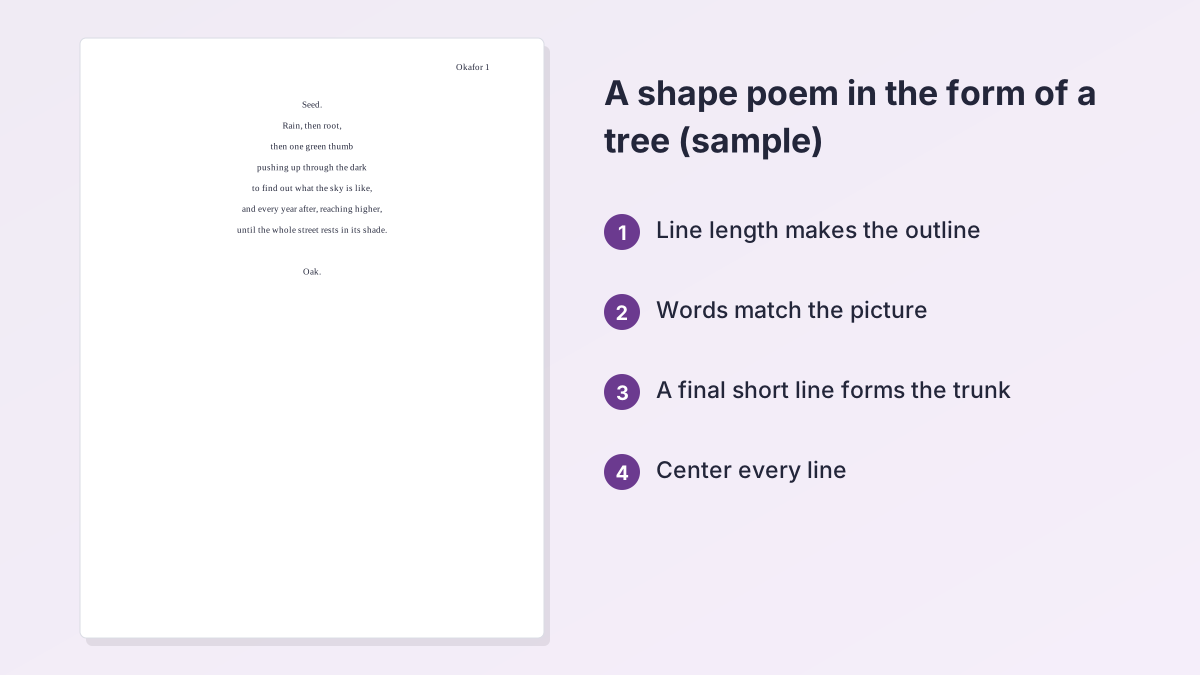
A concrete poem, also called a shape poem or pattern poem, uses the arrangement of words and white space to make a picture. The Poetry Foundation describes it as a form in which the layout of words and space creates a meaningful shape or image. A calligram poem is a closely related idea: words arranged into the outline of their subject. Guillaume Apollinaire published a collection titled Calligrammes in 1918, and George Herbert's "Easter Wings," published in 1633, is often taught as an early example of a poem shaped on the page.
Concrete poem examples to try
The tree on the page above is one of the simplest concrete poem examples: short lines at the top and longer lines below make a triangle, and a one-word trunk finishes the picture. Other beginner shapes are a heart, a star, a raindrop, a staircase and a wave. Write the poem first, then fit the words to the outline, or the shape will push out the meaning.
How to lay out a shape poem
- Choose a shape with a simple outline.
- Sketch it on paper and decide where each line begins and ends.
- Write short phrases that match the width of each row.
- Keep the subject of the poem the same as the shape.
- Center the lines, or fill the shape, and read it as a poem before you read it as a picture.
Typing every line by hand is slow. The free shape poem generator lays out your own poem, or one it writes, inside a heart, star, tree or moon, and lets you download the result. People also search for poems into shapes, shaped poetry and visual poem ideas; they all point to the same craft. A visual poem works when the picture and the words say the same thing, and fails when the shape is decoration.
Random Poem Prompts and Poetry Games
When you cannot choose, let chance choose. A random poem is one built from a surprise, and a few quick poetry games make surprises easy. Try these with a friend or a class.
Roll-a-poem
Make three lists of six items: a place, an object and a feeling. Roll a die three times, combine the results, and write a short poem that includes all three. A rolled poem might join "a bus stop," "a cracked mug" and "relief."
Finish the line
Pass a paper around a group. Each person writes a line, folds the paper to show only that line, and passes it on. Unfold it at the end and read the poem aloud. It is a classic way to produce a random poem that is often funny and sometimes moving.
Borrow a first line
Take a first line from a poem you love, write it at the top of your page, and then write a completely different poem. Cross out the borrowed line before you turn it in, and credit the source if you keep it. This is one of the most reliable poem prompts for a stuck writer.
How to Check and Revise Your Poem
A first draft is raw material. Before you hand it in, run a quick poem checker routine of your own, because most problems show up on a slow read.
A poem checker checklist
- Does every line add a picture, a sound or a turn?
- Can you cut the first two lines without losing anything?
- Are there abstract words, such as "beauty," "freedom" or "pain," that a concrete image could replace?
- Do the line breaks fall where you want a pause?
- If you chose a form, did you follow its count, and did you keep the sense while doing it?
- Does the last line surprise or settle the reader instead of explaining the poem?
Write a short poem, then expand
If an assignment asks you to write a short poem, treat a few lines as a strength. If it asks for more length, add a second image, not more explanation. Do the opposite when a poem rambles: cut it down until only the strongest images remain.
How to Title and Format Your Poem
Titles matter more in poems than in most writing, since they can add a layer the poem does not state. A title can set the scene, name the speaker, or contradict the poem. Avoid "Untitled" unless the form calls for it, and avoid a title that gives the ending away.
Chicago style poem title and quotation marks
In MLA, and in Chicago style, titles of shorter poems go in quotation marks, while a long or book-length poem is italicized. Purdue OWL says short works such as short poems take quotation marks, while longer works that contain smaller sections take italics. The same rule means that when you cite a poem in an essay, you write "The Raven," in quotation marks, and a book such as The Great Gatsby in italics. For the paper itself, see our guide to the MLA heading and the Chicago style paper format.
If a title will not come, finish the poem first, underline the single strongest image, and consider using it as a title. The poem title maker can suggest names for a poem you paste in, which is a handy way to hear what the poem seems to be about. When you are stuck on a name for a story, our guide to book title ideas covers titles for stories as well.
Common Mistakes With Poem Prompts
Most weak poems fail in a few predictable ways.
Forcing a rhyme
A rhyme that bends the meaning usually hurts more than it helps. If "moon" needs "June" and the sense suffers, rewrite the line. Free verse is a perfectly good choice.
Explaining the feeling
Telling the reader "I was sad" ends the poem. Show the cold tea, the unread message, the coat left on the chair.
Writing the first idea only
The first image is usually the most common one. Write three, and keep the one that surprised you.
Ignoring the prompt's limit
If the prompt says three lines, do not write thirty. Limits are the point. When you want more help with ideas, return to the full set of student writing guides and keep going. If you would like a model draft before your own, the poem generator is a good place to start, as long as you rewrite the result in your own words.
Questions About Poem Prompts
What are some good poem prompts?
Good prompts point to something you can picture, such as the last room you walked through, a smell that returns you to a kitchen, or an object in a lost-and-found box.
How can I make a poem if I have no ideas?
Pick one prompt, list five concrete details, draft for ten minutes without editing, then cut every line that explains and read the poem aloud.
What are good poetry prompts for beginners?
Start with the five senses: describe a sound, smell or texture in a specific place. Keep the poem to four to eight lines.
What are some haiku examples?
A common classroom haiku has three lines of five, seven and five syllables, such as: Rain taps the window / while the kettle starts to sing. / Monday feels softer.
Do haiku have to be 5-7-5?
Not always. 5-7-5 is the usual English classroom convention, but Japanese haiku count sound units and many English poets write shorter. Follow your assignment.
What are concrete poem examples?
A concrete poem arranges words into a picture of its subject, such as a tree, a heart or a raindrop. George Herbert's Easter Wings is a classic shaped poem.
What are some deep poetry prompts?
Write about a belief you changed, a regret you still carry, or a place you cannot go back to. Use plain language and concrete details.
How do I write a short poem?
Choose one image, write four to eight lines about it, and cut any line that explains the image instead of showing it.
How do I format a poem title?
Put the title of a short poem in quotation marks, and italicize the title of a book-length poem or a collection.
More free guides
- MLA In-Text CitationsAuthor-page citations for every kind of source, with examples.
- How to Cite a Website in MLAWorks Cited entries and in-text citations for web pages.
- MLA Works Cited PageFormat, order and hanging indents, with a full example page.
- MLA Annotated BibliographyFormat, annotation types and a complete example.
- APA Table FormatNumber, title, body and notes for APA 7 tables, with templates.
- MLA HeadingThe four-line first-page heading and the page header, with Word and Google Docs steps.
See all 80 free tools for students
Related tools
Last updated by The Study Corp editorial team.