Story Title Ideas: From a Summary to a Title
Each pair shows a one-line story summary and three title ideas that might come from it. The summaries and titles are invented for this guide. Notice that each title picks one angle: a character, an object or a mood.
Story summaryA baker discovers that her sourdough starter can predict storms.
Title ideasThe Weather in the Crust / A Rising Sky / Starter
One title uses an image, one a phrase and one a single word.
Story summaryA librarian finds a returned book with a map to a missing person.
Title ideasOverdue / The Margin Notes / No Fine for the Dead
A pun or a tone can promise a mystery.
Story summaryA shy sophomore starts a podcast that the whole school secretly listens to.
Title ideasQuiet on the Air / Everyone Is Listening / Episode Nine
Match the title to the reader's age and voice.
Story summaryA crew on a slow ship learns that the planet they left has already forgotten them.
Title ideasThe Slow Ones / Forgotten at Light Speed / A Long Way From Anyone
Contrast between time and distance gives a hook.
Story summaryA daughter of immigrants remembers translating at her parents' appointments.
Title ideasBetween Two Languages / The Words in My Pocket / Say It Again, Slowly
Use an image from the book, not a summary of it.
Story summaryA boy hides his lost tooth from a tooth fairy he no longer believes in.
Title ideasThe Last Tooth / Fairy Business / Small Change
Short story titles can be quiet and one image long.
Story summaryA very small dog wants to be the loudest one in the park.
Title ideasBiscuit Roars / The Big Bark Plan / Loud Little Biscuit
Repeated sounds and a name read well aloud.
How to Come Up With a Book Title in 6 Steps
If you are wondering how to come up with a book title, work from the story outward and keep a long list. Many writers find their title well past the first try.
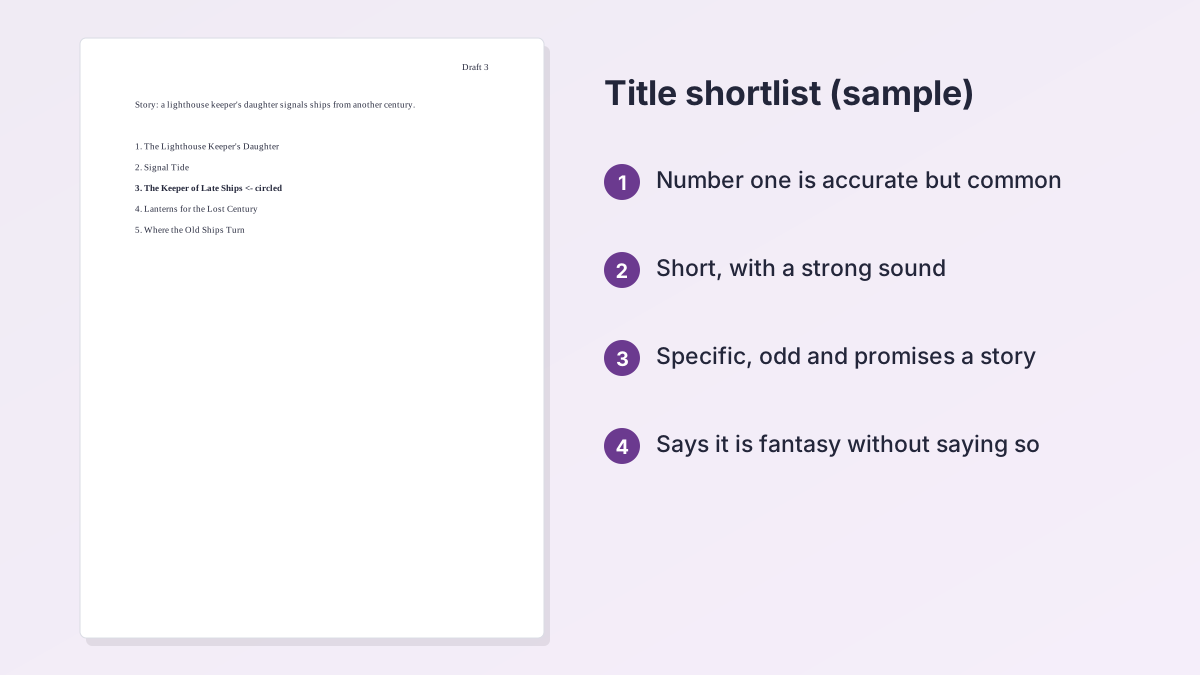
- Write the story in a sentence. Summarize the book in one sentence so you know what the title has to promise.
- List key words. Collect images, places, objects, names and emotions from the book, and circle the most unusual ones.
- Try the formulas. Apply each formula below to your list and write at least twenty candidates without judging them.
- Say them aloud. Read each title in a sentence, such as 'I just finished ...', and drop any that stumble or sound common.
- Check for duplicates. Search a library catalog and a bookstore site to see how many books already use the title.
- Test with readers. Show three or four people the title and the genre, and ask what they expect the book to be about.
What a Good Book Title Does
What is a good title for a book? In practice, a good title does four jobs. It sounds right in your mouth, it hints at the genre, it raises a question the reader wants answered, and it is easy to remember and spell. Most book title ideas fail the last test of all: a long title or a clever pun is hard to recall when someone asks, "What was that book called?"
Working titles change often. F. Scott Fitzgerald considered several names for The Great Gatsby (1925), including Trimalchio in West Egg, before settling on the one we know. Jane Austen's Pride and Prejudice (1813) was earlier titled First Impressions, and John Steinbeck took the title of Of Mice and Men (1937) from a Robert Burns poem, "To a Mouse," after first calling it Something That Happened. A first idea is only a start, so keep a running file of story title ideas and book name ideas as you draft, and revisit it when the manuscript is done.
If you want a fast set of options to react to, the free book title generator suggests ten titles from a short description of your story, each with a note on why it works.
Name for book: titles, subtitles and series
Writers searching for a name for a book often mean three different things. A title is the main name. A subtitle, common in nonfiction, explains the promise, as in a punchy title followed by a clarifying line. A series name ties several books together. Decide which one you need first, then work on the others.
Book Name Ideas: 8 Formulas That Work
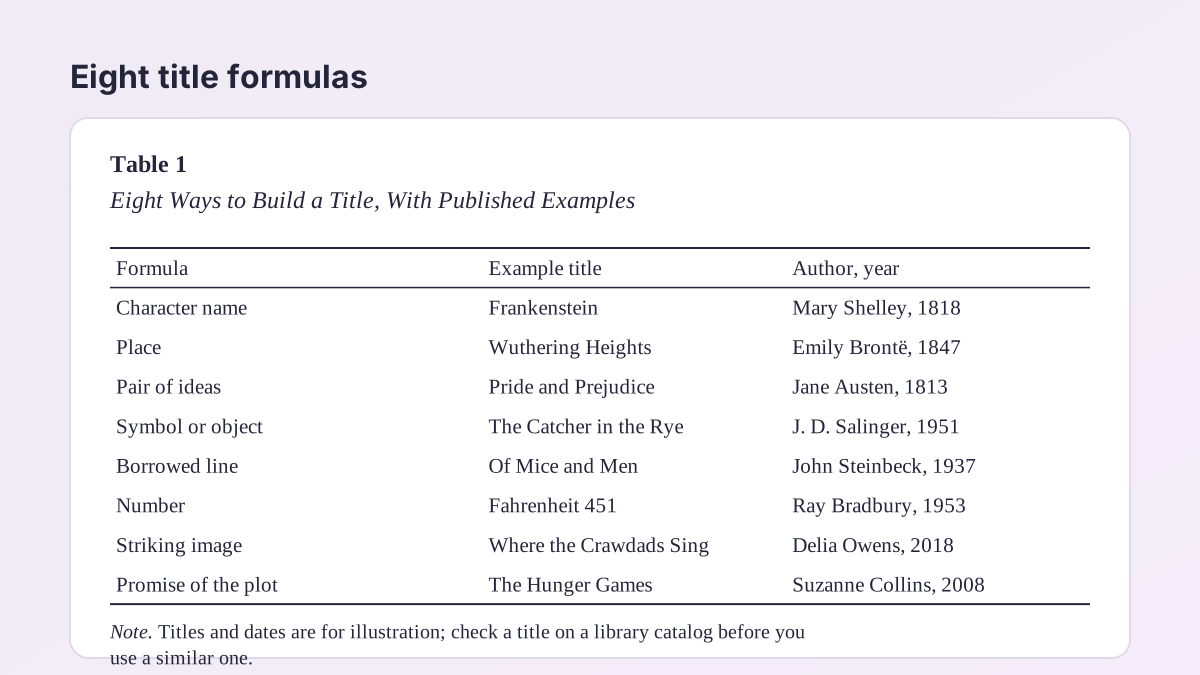
When you run out of book name ideas, borrow a structure rather than a title. The eight formulas in the table above appear again and again in published books, which is a sign that they work. Here is how to use each one.
Character name, place and pair formulas
A character name is direct: Frankenstein (Mary Shelley, 1818) tells you whom the book is about. A place gives a setting a personality, as Wuthering Heights (Emily Brontë, 1847) does. A pair of ideas, such as Pride and Prejudice, sets two forces against each other and promises conflict.
Symbol, borrowed line and number formulas
A symbol or object makes the reader curious about why it matters: The Catcher in the Rye (J. D. Salinger, 1951). A borrowed line connects your book to another work. Chinua Achebe took Things Fall Apart (1958) from a line in W. B. Yeats's poem "The Second Coming," and Steinbeck's title comes from Burns. A number, as in Fahrenheit 451 (Ray Bradbury, 1953) or 1984 (George Orwell, 1949), is compact and concrete.
Striking image and plot-promise formulas
A striking image, as in Where the Crawdads Sing (Delia Owens, 2018), asks to be explained. A promise of the plot, as in The Hunger Games (Suzanne Collins, 2008), tells the reader what kind of ride to expect. Pick the formula that suits your genre, then change the words until the title sounds like your book. Whenever you add to your list of book title ideas, label each one with the formula it came from, so you can see which structures give you the most options.
Fantasy to Memoir: 30 Book Title Ideas
Here are 30 book title ideas in six genres. All are invented for this guide, so check that a title is not already in heavy use before you choose a similar one. Use them as models for rhythm and specificity, not as final titles.
Fantasy book names
Fantasy titles often pair an unusual noun with an old or magical setting. Fantasy book names tend to work best when they are specific enough to be a place or a thing, not a general quest.
- The Keeper of Late Ships
- Salt and Ember Crown
- A Map for the Unnamed Stars
- The Orchard at the Edge of Winter
- Ninth Door, Last Key
Romance
- Three Letters Past Midnight
- The Wrong Kind of Right
- Summer at Harbor Street
- Almost Never Yours
- What the Tide Returned
Mystery and thriller
- The Quiet Tenant
- Nobody Saw the Lamp Go Out
- Eleven Minutes to Nowhere
- The Cartographer's Alibi
- After the Fire Drill
Science fiction
- The Last Signal From Orbit Nine
- Gravity Is a Habit
- Seven Seasons on Kepler Road
- The Garden Under Glass
- We Were the Slow Ones
Young adult
- Everything Loud at 4 p.m.
- How to Disappear in Homeroom
- The Summer of Borrowed Names
- Not Your Average Apocalypse
- Girls Who Bring Maps
Memoir and nonfiction
- Rice, Rain and Other Inheritances
- A Year of Small Mornings
- What My Father's Hands Knew
- Between Two Kitchens
- The Long Way to Ordinary
Novel names and subtitles
Novel names that work as a single noun phrase are easy to remember, but they are also easy to duplicate. If your first choice is common, add a distinctive word or a subtitle. In nonfiction, a subtitle does the explaining so the main title can stay short and strange.
Short Story Titles and How to Name a Story
Short story titles have less room to explain, so they lean on a single image or a hint of the ending. Compare four published examples: "The Lottery" by Shirley Jackson (1948) sounds harmless and becomes chilling; "The Yellow Wallpaper" by Charlotte Perkins Gilman (1892) names the object at the center of the story; "The Tell-Tale Heart" by Edgar Allan Poe (1843) points to the sound that gives the narrator away; and "Hills Like White Elephants" by Ernest Hemingway (1927) offers a comparison that seems casual and is not. "The Gift of the Magi" by O. Henry (1905) uses an irony the ending pays off.
How to name a story
To name a story, ask what image the reader should carry out of the last paragraph. Then try three kinds of title: an object from the story, a phrase a character says, and a contrast between what the title promises and what the story delivers. Pick the one that would still make sense after someone has read the story, not only before.
Great story names and good story names
Great story names are rarely the first idea. Good story names tend to share traits: they are short, they use a concrete noun or verb, and they leave a question open. Avoid titles that state the theme outright, such as "The Importance of Friendship."
Title of story: format in your paper
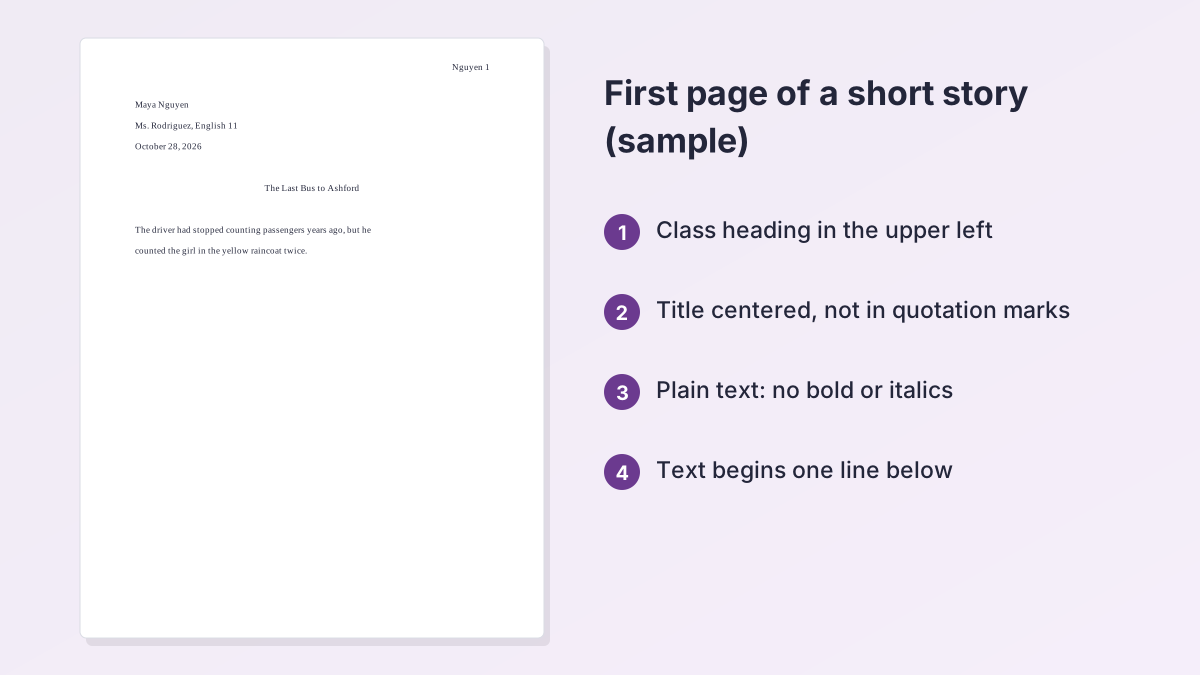
For a class, format your own story's title as plain centered text, as in the page above. When you write about a published story, put its title in quotation marks, and italicize the title of a whole book. Purdue OWL explains that short works such as short stories and essays take quotation marks, while longer works take italics. See our guides on the MLA heading and essay title ideas for the title of an analysis paper. If you want ideas for a story, not a book, the story title generator also suggests names for stories and fan fiction.
Story Title Ideas for a Class or Portfolio
Teachers rarely grade the title, but a good title makes a reader lean in before the first sentence. These story title ideas work for a class assignment or a creative writing portfolio, and they follow the same patterns as the book title ideas above.
Four quick story title ideas by method
- Name the object. If a story turns on a key, a coat or a phone, use it: "The Borrowed Coat."
- Quote a line. Pick a phrase a character says, such as "Nobody Told the Bus."
- Use a time or place. "Tuesday, Last Period" sets a scene in four words.
- Promise a contrast. "The Loudest Quiet Boy" makes the reader wonder how both can be true.
Short story titles that avoid the obvious
Many short story titles start with "The" and a noun, and that pattern is fine, but try one version without it. Drop the article, swap a general noun for a specific one, or add a surprising adjective. "The Dog" becomes "Hector, Unleashed," and "The Test" becomes "Seventeen Minutes Left." The goal is a title that could belong to only one story.
A fast way to make a list of book name ideas and story names
Set a timer for five minutes and write every title you can, good or bad. Then circle the three with the strongest verbs or images, and combine their best words. This quick method works for book name ideas as well as story names, because it moves you past the first, obvious attempt. It is also the easiest answer to how to come up with a book title when you feel stuck: write more titles than you think you need.
Chapter Titles and Series Names
Chapter titles are small versions of the book's title, and they do a different job: they keep a reader moving. Good chapter titles name an event, an object or a turn in the story. Some authors skip titles and number the chapters, which is also fine. Pick one approach and keep it consistent. Chapter titles follow many of the same book title ideas: an object, a place, a name or a line of dialogue.
Chapter titles that pull a reader forward
A chapter title can hint at the next surprise without spoiling it. "The Letter in the Wall" suggests a discovery; "What the Dog Knew" adds a point of view. Keep chapter titles short, and avoid repeating the book's title.
Series names
A series name needs a pattern that can stretch across several books, such as a shared word, a place, a number or a character. Try to write the name of the series and the name of book one together, and check that the pair still sounds right for book four. For all three at once, the book title generator can switch between book titles, chapter titles and series names.
Before You Commit: Testing a Title
Once you have a shortlist, test it. These checks catch most problems.
Say it, spell it and search it
Say the title aloud in a sentence. Ask a friend to spell it after hearing it once. Then search for the title in a library catalog or on a bookstore site. Many titles are used by several books, and the same title is not a legal problem by itself, since the US Copyright Office states that copyright does not protect names, titles, slogans or short phrases. Trademark law can apply to a title used as a series name or brand, so check before you build a brand around one.
The shelf test
Imagine the title on a spine in a row of books. Does it fit the genre? A soft, romantic title on a thriller sets the wrong expectation. Show the title and genre to a few readers and ask what they think the book is about. If their guesses surprise you, adjust.
Avoid common traps
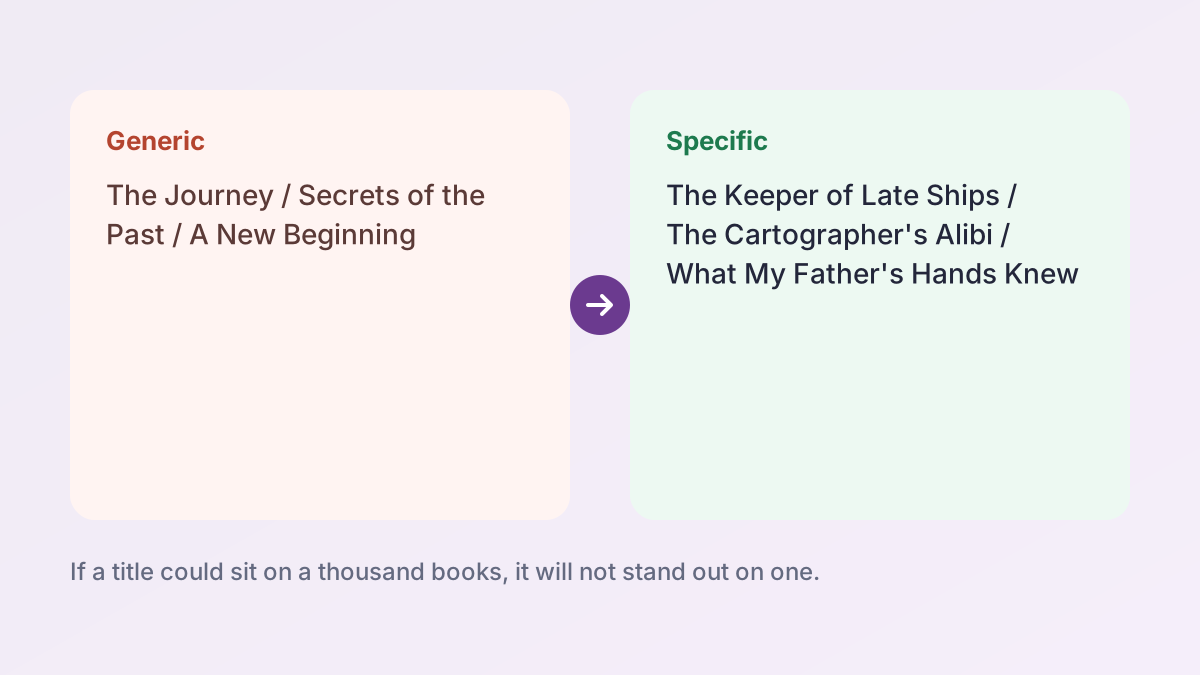
Skip titles that are generic ("The Journey"), overly long, or full of spoilers. The same rule holds for short story titles, where a single vague word wastes your best chance to catch a reader. Avoid a title you cannot say with a straight face. And if your story is for a school assignment, ask your teacher whether the title needs to follow a format. When you want more help with titles, return to the full set of student writing guides or try our guide to poem prompts for ideas in verse. Then use the book title generator one more time to compare your favorites with a fresh list.
Questions About Book Titles and Story Titles
How do I come up with a book title?
Summarize the story in a sentence, list its strongest images and names, try title formulas to write twenty candidates, then say them aloud and test the top few with readers.
What is a good title for a book?
One that is short, specific, easy to remember and hints at the genre while raising a question the reader wants answered.
What are good book name ideas for fantasy?
Pair a concrete noun with a setting or an old-world word, such as The Keeper of Late Ships or Salt and Ember Crown. Check that the name is not already widely used.
How do I name a story?
Ask what image the reader should carry out of the last paragraph, then try an object from the story, a phrase a character says and a contrast with the plot.
What are some short story titles to learn from?
The Lottery (Shirley Jackson, 1948), The Yellow Wallpaper (Charlotte Perkins Gilman, 1892) and The Tell-Tale Heart (Edgar Allan Poe, 1843) each use one striking image or phrase.
Can two books have the same title?
Yes. The US Copyright Office says copyright does not protect titles, though trademark law may apply to a title used as a brand or series name.
Should a book title be in quotation marks?
In writing about books, a book title is italicized, while the title of a short story, poem or essay goes in quotation marks. On your own cover or manuscript, use plain text.
How long should a title be?
There is no set length, but many memorable titles are one to six words. A longer subtitle can explain the book, especially in nonfiction.
More free guides
- MLA In-Text CitationsAuthor-page citations for every kind of source, with examples.
- How to Cite a Website in MLAWorks Cited entries and in-text citations for web pages.
- MLA Works Cited PageFormat, order and hanging indents, with a full example page.
- MLA Annotated BibliographyFormat, annotation types and a complete example.
- APA Table FormatNumber, title, body and notes for APA 7 tables, with templates.
- MLA HeadingThe four-line first-page heading and the page header, with Word and Google Docs steps.
See all 80 free tools for students
Related tools
Last updated by The Study Corp editorial team.