Debate Topics: Weak Ideas Turned Into Strong Resolutions
Many first ideas fail because they are questions, facts or opinions with one obvious answer. These pairs show the fix. Every topic here is invented for this guide, so adapt them to your class.
Weak topicIs bullying bad?
Debatable resolutionResolved: Schools should discipline students for bullying that happens online outside school hours.
Nobody defends bullying, so the real argument is about what schools should do.
Weak topicTechnology is good or bad.
Debatable resolutionThis house would ban smartphones in classrooms.
A narrow action gives both teams something to prove.
Weak topicThe moon landing happened in 1969.
Debatable resolutionResolved: The United States should spend more on human space exploration.
A fact can be checked, not debated. A policy can be argued.
Weak topicShould homework exist?
Debatable resolutionResolved: Middle schools should not assign homework on weekends.
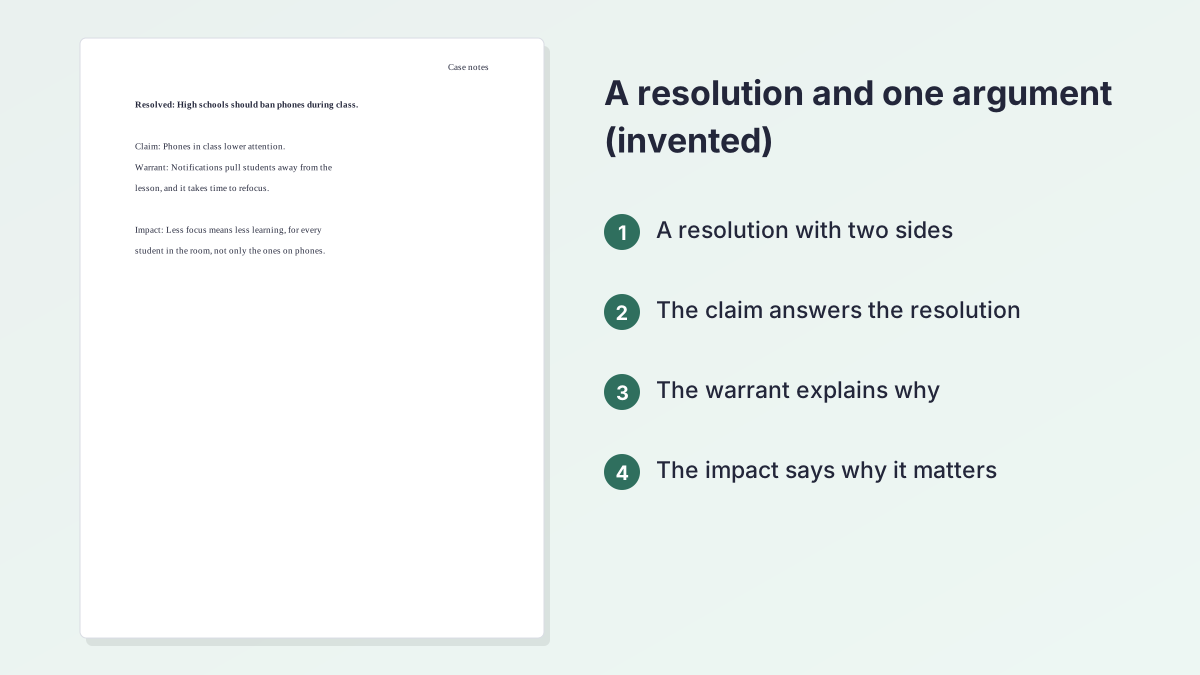
A resolution is a statement one team supports and the other opposes.
Weak topicResolved: Money is bad.
Debatable resolutionResolved: Public colleges should be tuition-free.
A specific policy is something a team can research in a week.
Weak topicResolved: Lazy students deserve to fail.
Debatable resolutionResolved: Schools should allow retakes on major tests.
Neutral wording keeps the round about ideas, not insults.
Weak topicResolved: Kindness is nice.
Debatable resolutionResolved: High schools should require community service to graduate.
If the other side has nothing to say, the topic won't make a debate.
How to Build a Debate Case in 5 Steps
Once you have a resolution, these five steps turn it into a case you can deliver. Keep your notes short enough to use at the podium.
- Pick your resolution. Choose a statement with two defensible sides, and learn which side you have been assigned.
- Define the key terms. Say what the important words mean so both teams argue about the same thing.
- Write two or three claims. State each main claim in one sentence that answers the resolution directly.
- Add warrant and impact. Explain why each claim is true, then why it matters, with evidence you can name.
- Plan your rebuttals. List the strongest replies the other side could give and prepare an answer to each.
What Makes Good Debate Topics?
The good ones share one trait: both sides can win. A strong resolution is a clear statement that a team can support or oppose with reasons and evidence, and that a judge could not decide by looking up a single fact. Use these checks before you commit to a topic.
- Two defensible sides. If everyone agrees, there is no debate.
- A specific action or claim. "Schools should ban phones in class" is easier to debate than "technology."
- Researchable evidence. You should be able to find studies, examples or expert opinions for both sides.
- Right for the room. Pick topics that fit the age of the debaters and your teacher's rules.
- Neutral wording. The words should not tell the audience which side is correct.
If you want help seeing the other side of a motion, the free debate argument generator builds a structured case for or against any resolution, with likely counterarguments and rebuttals. Treat it as a starting draft and add your own sources.
Debate vs argument: what is the difference?
People often use the words interchangeably, but in school a debate is a structured, timed contest on an assigned resolution, usually with a judge. An argument is the reasoning inside it: a claim supported by reasons. So you can have an argument anywhere, but a debate has rules, sides and a winner. That is why arguments in a debate are built carefully and answered one at a time.
Debate Topics for High School and Younger Students
The lists below are sorted by group. All 100 topics were written for this guide, and each one is phrased so a team could take either side. Pick one, then flip a coin for your side if your teacher has not assigned one.
Debate topics for high school students
These work for classroom debates and practice rounds. Each is a statement for one team to support and another to oppose.
- High schools should start no earlier than 8:30 a.m.
- Students should be allowed to use phones at lunch.
- Schools should replace final exams with projects.
- Standardized tests should not be required for college admission.
- Students should be allowed to retake any test once.
- High schools should require a personal finance course.
- School uniforms should be mandatory.
- Schools should teach a second language starting in elementary grades.
- Community service should be a graduation requirement.
- Students should choose some of their own classes every year.
- Grades should be replaced with written feedback.
- Schools should offer a four-day week.
- Students should be allowed to grade their teachers.
- School lunch should be free for every student.
- Honors and AP classes should be open to all students.
- High school sports should get less funding than academic programs.
- Schools should have a no-homework policy on weekends.
- Teenagers should be allowed to vote in local elections at 16.
- Students should be allowed to wear hats and hoodies in class.
- Schools should offer vocational training as an equal path to college prep.
Middle school debate topics
For younger debaters, keep topics concrete and close to daily life. These suit junior high and younger kids too, with simple evidence to find.
- Recess should be longer.
- Students should have less homework.
- Every student should learn to code.
- Cell phones should be allowed in middle school.
- Lunch periods should be longer.
- Students should be able to pick their own seats.
- Cursive should still be taught.
- School should be year-round.
- Students should be allowed to dye their hair any color.
- Kids should be allowed to have social media accounts.
- Schools should teach cooking.
- Video games can be good for learning.
- Gym class should be required every day.
- Students should have a say in school rules.
- Pets should be allowed in schools.
Debate topics for college students
College debaters can handle bigger policy questions and more evidence. These suit seminars and clubs.
- Public colleges should be tuition-free.
- Student loan debt should be partly forgiven.
- Colleges should drop legacy admissions.
- Athletes at big universities should be paid.
- Colleges should require a first-year writing course.
- Online degrees should carry the same status as in-person degrees.
- Universities should limit the use of AI tools on assignments.
- Colleges should make textbooks free.
- Campus speakers should never be disinvited.
- Colleges should guarantee housing for all four years.
- Community college should be free for everyone.
- Colleges should offer more three-year bachelor's degrees.
- Students should be able to change majors at no cost.
- Colleges should publish graduate salary data.
- Attendance should not count toward a grade.
Fun Debate Topics and Funny Debate Topics
Fun debate topics are a good way to learn the skills without the pressure. Funny ones still need two sides: the humor comes from the subject, but the structure of claim, warrant and impact is the same. These twenty are silly, weird or lighthearted, and they work for icebreakers, friends and younger groups.
- Pineapple belongs on pizza.
- Cereal is a soup.
- A hot dog is a sandwich.
- Cats make better pets than dogs.
- Summer is better than winter.
- Mornings are better than nights.
- Breakfast is the best meal of the day.
- It is better to be able to fly than to be invisible.
- Pancakes are better than waffles.
- Water should be free at every restaurant.
- Homework should be graded on effort, not correctness.
- Everyone should have a theme song.
- The sequel is never better than the original.
- Books are better than movies.
- School mascots should be chosen by students.
- Socks with sandals are acceptable.
- Superheroes are better than villains.
- Dessert should come before dinner.
- A week should have four days of school and three days off.
- Robots should do all the chores.
Controversial Debate Topics, Handled Responsibly
Heated subjects can teach students to disagree without being cruel, but they need ground rules. These ten are widely debated, and each is worded neutrally so neither side is assumed to be right. We do not take a side on any of them.
- Voting should be mandatory in national elections.
- The death penalty should be abolished.
- Social media companies should be responsible for what users post.
- Zoos should be phased out.
- The minimum wage should be raised.
- Schools should be allowed to search student lockers without notice.
- Recreational drugs should be decriminalized.
- Animals should not be used for medical testing.
- Nuclear power should play a larger role in energy policy.
- Governments should limit how much wealth one person can hold.
Ground rules for hot topics
Before you debate sensitive subjects, check them with your teacher or coach. Ask students to argue the strongest version of the other side, ban personal attacks and remind everyone that the assigned side may not match their own opinion. Many debate programs assign sides so students practice understanding views they do not hold.
Current Issues and Sports Debate Topics
Current events give debaters fresh material, but facts change quickly, so check recent sources before you build a case. The first list covers current issues and the second covers sports debate topics, a favorite with students who like a clear scoreboard.
Current issues to debate
- Schools should teach students how to use artificial intelligence.
- Social media should have a minimum age of 16.
- Cities should ban cars from downtown areas.
- Companies should be required to let employees work from home.
- Plastic bags should be banned nationwide.
- Electric vehicles should replace gas cars by a set date.
- Schools should ban phones in class.
- Delivery drones should be allowed in residential areas.
- Cities should provide free public transit.
- Streaming platforms should be regulated like broadcasters.
Sports debate topics
- Youth tackle football should have a minimum age.
- Professional athletes earn too much.
- The Olympics should only include amateur athletes.
- Youth sports have become too competitive.
- Instant replay has improved professional sports.
- Schools should require physical education for all four years.
- Esports should count as a school sport.
- Players should be allowed to protest during the national anthem.
- Team mascots should be retired if they offend a community.
- Student athletes should be required to keep a minimum GPA.
If you want to compare these with a broader list, browse our other student writing guides for ideas that also work as essay prompts.
How to Phrase a Resolution for Debate Topics
A resolution is the statement the two sides argue about. Most school and club formats word it as a proposal, and the conventions below are the ones you will see most often. Check which style your league or teacher uses.
"Resolved:" statements
The classic wording starts with the word Resolved, followed by a colon and a statement, such as "Resolved: High schools should require a personal finance course." Lincoln-Douglas, Public Forum and Policy debaters all work from resolutions that open this way, though the subjects differ by format.
"This house would" motions
Parliamentary-style debate often phrases the motion as "This house would..." followed by an action, for example "This house would ban smartphones in classrooms." The word house refers to the legislature or the debating body, so the wording sounds like a proposal to be passed.
Debate Formats: Lincoln-Douglas, Public Forum and Policy
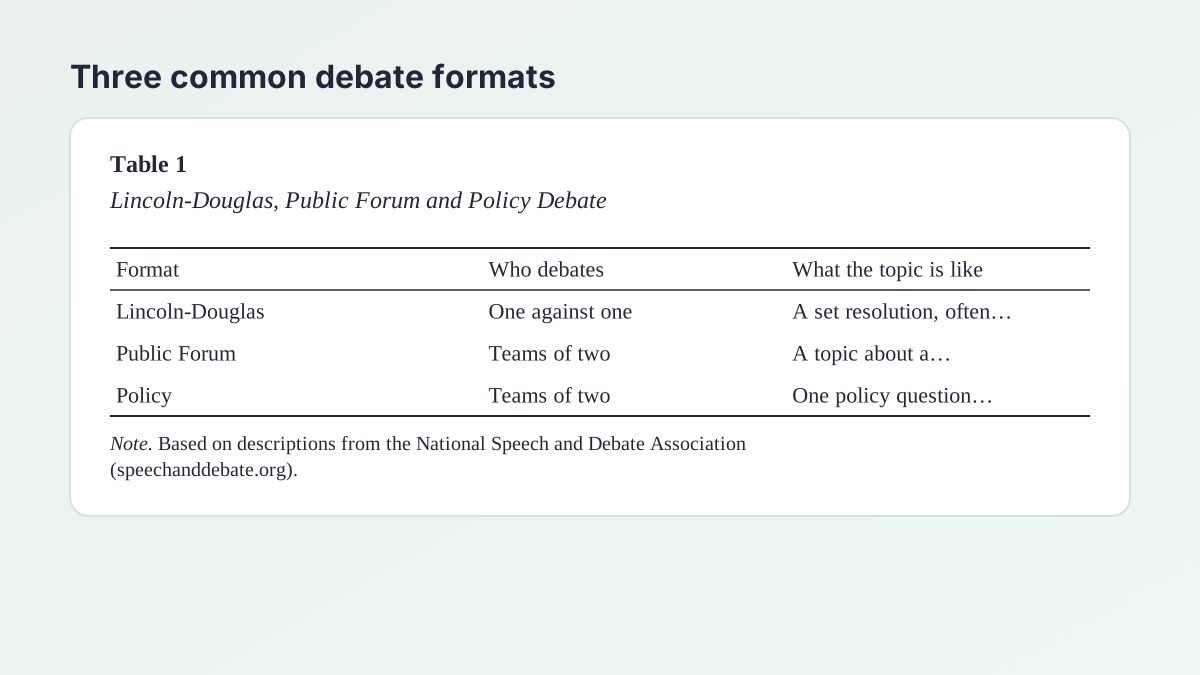
Your format changes what a good topic looks like. The National Speech and Debate Association describes Lincoln-Douglas as a one-on-one contest in which students debate a topic provided by the association, often called a values debate because questions of morality and justice are commonly examined. It describes Public Forum as opposing teams of two debating a topic concerning a current event, and Policy as a two-on-two debate focused on one policy question for the academic year.
Lincoln-Douglas debate topics
These are usually questions of value, such as justice, liberty or fairness. A resolution tends to ask whether something is morally right or just, so the best arguments weigh competing values. Because the association assigns the resolution, you rarely choose it yourself.
Public Forum debate topics
These come from current events, so they change often. Teams of two question each other in a crossfire period. Always get the current resolution from your coach or from the association's site, since topics are replaced throughout the season.
Policy debate topics
Policy topics ask whether a government or institution should take an action. The affirmative team proposes a plan and the negative team argues against it. The same policy question is used for the whole academic year, so the research is deep. The topics in this guide are classroom ideas, not official league resolutions.
What Is a Dropped Argument in Debate?
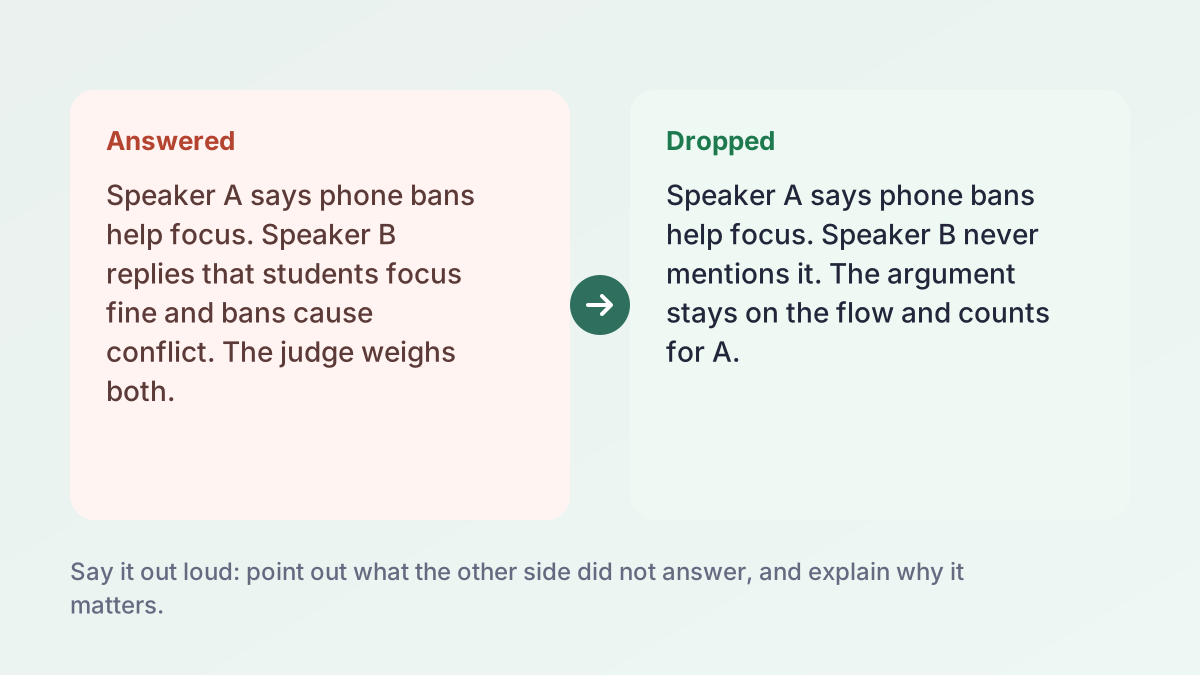
A dropped argument is one the other side never answers. According to Ethos Debate, an argument that goes unanswered is marked as dropped on the flow, the notes judges and debaters keep of the round, and it stands and counts for the side that made it. Many judges treat it as conceded, but you should still explain why it matters.
Why dropped arguments matter
Judges decide a round by weighing what was said, so an unanswered point can decide it. If your opponent says phone bans cause conflict and you never respond, that point may stand even if you disagree.
How to use a dropped argument
If your opponent drops one of your claims, say so clearly: name the argument, remind the judge that it was not answered and explain what it means for the resolution. Raise it only when it matters to the result. Minor points rarely deserve your limited speech time, and you should check your notes first to make sure it was truly dropped.
How to avoid dropping arguments
Keep a flow sheet with one column for each speech. Group their points, answer the strongest first, and use a short signpost such as "On their second argument" so the judge can follow your replies.
How to Research and Build a Debate Case
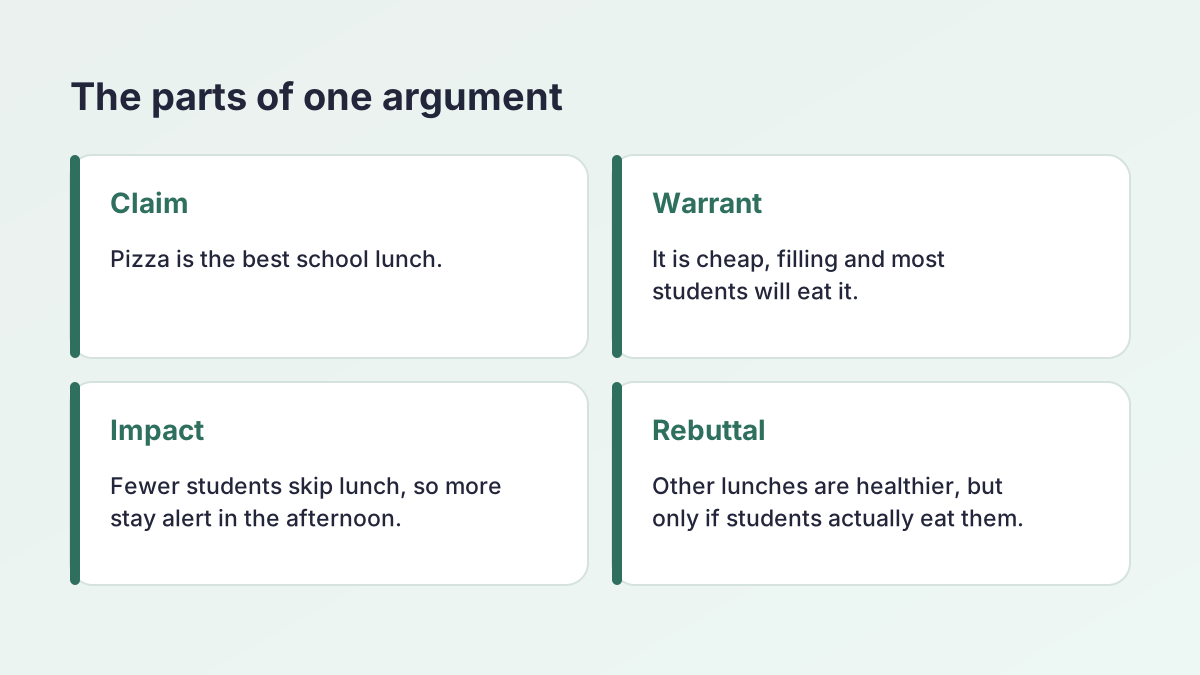
Once you have chosen a resolution, build your case in layers. A strong case is a small number of arguments, each with a claim, a warrant and an impact, backed by evidence you can name if challenged.
Claim, warrant, impact
A claim is what you say is true. A warrant is the reason it is true. An impact is why it matters, who it affects and how much. "Phones lower attention" is a claim, "notifications interrupt thinking" is a warrant and "students learn less" is an impact. The cards above show a lighter version of the same pattern.
Research for both sides
Look for statistics, expert opinions, news reports and real examples, and write down where each came from. Research the other side too, because you will have to answer it. A quick way to test your case is to let the free debate argument builder argue against you, then write a reply to each point it raises.
Turning claims into a speech
Open with the resolution and your definitions. Give each argument its own signpost, state the claim, explain the warrant, give evidence and end with the impact. Close by weighing why your side matters more than theirs. If you need a one-sentence statement of your overall position, the thesis statement generator can give you wording to react to.
Common Mistakes With Debate Topics
Most weak rounds fail before the first speech, for reasons that are easy to fix. Check your preparation against this list.
Picking a topic with only one side
If everyone agrees, the round has no tension. Test the topic by writing one argument for each side. If you cannot, choose another.
Arguing with opinion and no evidence
A claim with no warrant or source is just an opinion. Judges reward reasons, examples and facts you can cite.
Ignoring the other side
Prepare for the strongest reply, not the weakest. Unanswered points can be dropped, and a dropped argument can lose a round.
Making it personal
Attack ideas, not people. A good debater can describe the other side's view fairly before answering it. When you are ready to practice, try the debate argument generator on a few of the lists above, then browse more guides for students.
Questions About Debate Topics
What are good debate topics for students?
Good topics have two defensible sides, a specific claim and evidence on both sides. Examples include phone bans in class, later school start times and tuition-free public colleges.
What are the best debate topics?
The best ones fit your audience and age group and can be researched on both sides. Pick a resolution you can argue from either side with real evidence.
What are fun debate topics?
Fun ones are lighthearted questions such as whether a hot dog is a sandwich, whether pineapple belongs on pizza or whether cats are better than dogs.
What are some debate topics for high school?
Try school start times, uniforms, standardized testing, community service requirements or a personal finance course. Each can be argued for or against.
What are some funny debate topics?
Cereal as soup, pineapple on pizza, books versus movies and socks with sandals are popular picks. Each still needs a claim and a reason.
What are some controversial debate topics?
Voting rules, the death penalty and social media regulation are widely debated. Word them neutrally and check them with your teacher first.
What are good debate topics for middle school?
Choose concrete questions such as longer recess, pets in schools, cell phones in school or whether cursive should still be taught.
What is a dropped argument in debate?
A dropped argument is one the other side never answers. It usually stands in the round and counts for the side that made it.
What is the difference between a debate and an argument?
A debate is a structured, timed contest on a resolution, often with a judge. An argument is the reasoning, a claim with reasons, inside it.
More free guides
- MLA In-Text CitationsAuthor-page citations for every kind of source, with examples.
- How to Cite a Website in MLAWorks Cited entries and in-text citations for web pages.
- MLA Works Cited PageFormat, order and hanging indents, with a full example page.
- MLA Annotated BibliographyFormat, annotation types and a complete example.
- APA Table FormatNumber, title, body and notes for APA 7 tables, with templates.
- MLA HeadingThe four-line first-page heading and the page header, with Word and Google Docs steps.
See all 80 free tools for students
Related tools
Last updated by The Study Corp editorial team.