Examples of Problem Statements: Weak Drafts and Stronger Versions
Each pair shows a common first-draft weakness next to a stronger version. Every sentence, school and figure is invented for this guide, so use the pairs as models of structure, not as facts about any real school or company.
Weak draftStudents at my school are bad at reading.
Stronger versionAt a hypothetical rural high school, about a third of ninth graders read below grade level at the end of the fall term, which limits their access to every content-area course.
Replace a verdict with a measurable gap and the people affected.
Weak draftThere are too many falls in the hospital.
Stronger versionOn an invented medical-surgical unit, most patient falls over six months happened during unassisted trips to the bathroom, raising injury risk and length of stay.
Name the setting, the pattern and the consequence.
Weak draftOur company needs better shipping.
Stronger versionAn invented online bike shop promises delivery in three days but averages six, and its repeat-purchase rate has dropped since the delays began.
Give the promise, the reality and the cost to the business.
Weak draftThe drain near the engineering building is a problem.
Stronger versionWater pools near the entrance of an invented campus lab building after moderate rain, because the existing drain was sized for lighter runoff than the surrounding pavement now sends to it.
State the technical cause, not only the symptom.
Weak draftThe app is confusing.
Stronger versionStudents who open the library app between classes cannot book a study room quickly, because the booking link sits three menus deep.
Say who is stuck, doing what, and why.
Weak draftThe problem is that our town has no tutoring center.
Stronger versionMiddle school students in the town lack after-school math help, and teachers report that homework gaps widen by spring.
A missing solution is not a problem. Describe the harm the absence causes.
Weak draftThe problem is that I have to write a paper on climate change.
Stronger versionCoastal towns plan seawalls with little guidance on how rising seas will change flood risk over the next 30 years.
An assignment is not a problem. Find the gap in what people know or do.
How to Write a Problem Statement, Step by Step
These five steps take you from a rough topic to a finished draft. Expect to revise the wording after you read more sources.
- Pick a specific problem. Narrow your topic to one condition, difficulty or question that someone could investigate.
- Describe the ideal. Say what should happen or what experts and policies expect, citing a source where you can.
- Show the reality and gap. Describe what happens now, with evidence, and name the distance between the two.
- Explain who is affected. State the consequences for real people, so the reader sees why the gap matters.
- Propose your approach. End with one sentence on what your project, study or design will do about it.
What Is a Problem Statement? A Plain Definition
It tells readers what problem your work addresses and why it deserves attention. It turns a broad interest, such as school attendance or hospital safety, into a specific difficulty that someone could investigate or fix. Students write one for research papers, proposals, capstones, theses, lab projects and design briefs.
If you would like a draft to react to, the free research problem generator takes your topic, plus any notes from sources you have read, and returns a draft you can edit. It marks claims that need evidence, so check each one against your sources.
What Is the Statement of the Problem in Research?
Research handbooks often head this passage "Statement of the Problem." Different schools use different labels, so you may also see "research problem," "problem definition" or "problem background." The USC Libraries research guide defines a research problem as a definite, clear expression about an area of concern, such as a condition to be improved or a difficulty to be removed. It also separates a topic, which is something to be understood, from a problem, which is something to be investigated.
Research Problem Statement Examples Start With a Gap
What is the statement of the problem really doing? It points to a gap: something people do not know, do not do well or cannot yet fix. The USC guide suggests pointing to a knowledge void or a lack of clarity about the topic, which your literature review should reveal. Most good examples therefore contain evidence, such as a source or a measurement, and not only an opinion.
The Five Parts of a Problem Statement
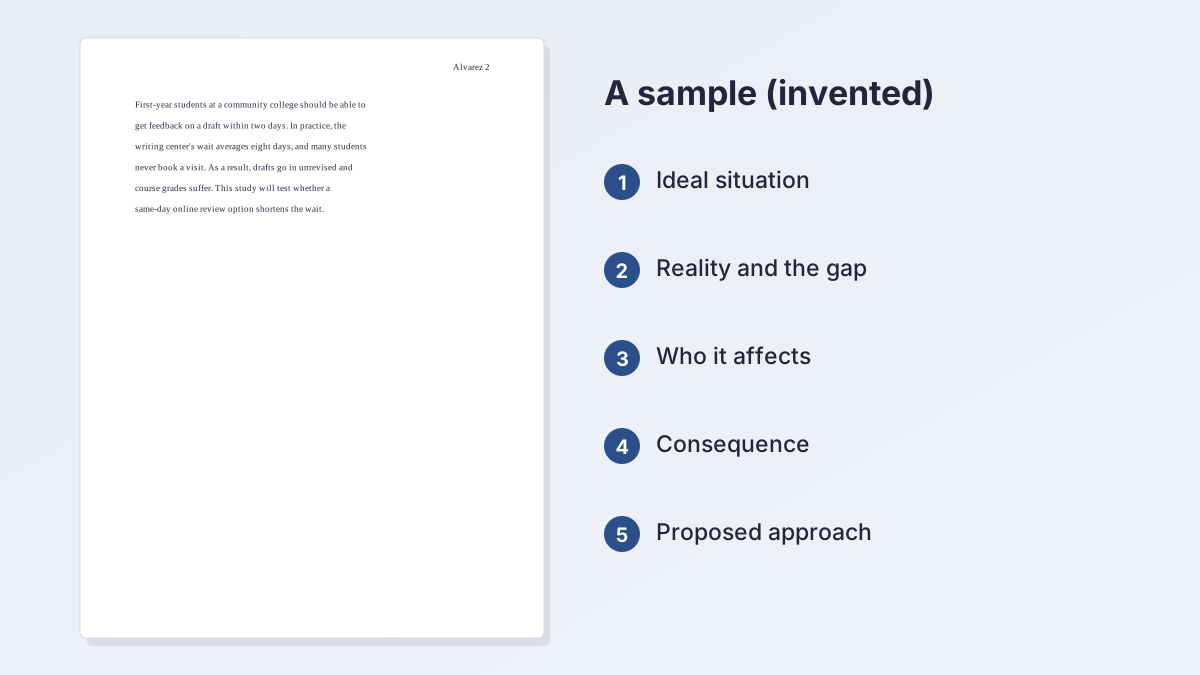
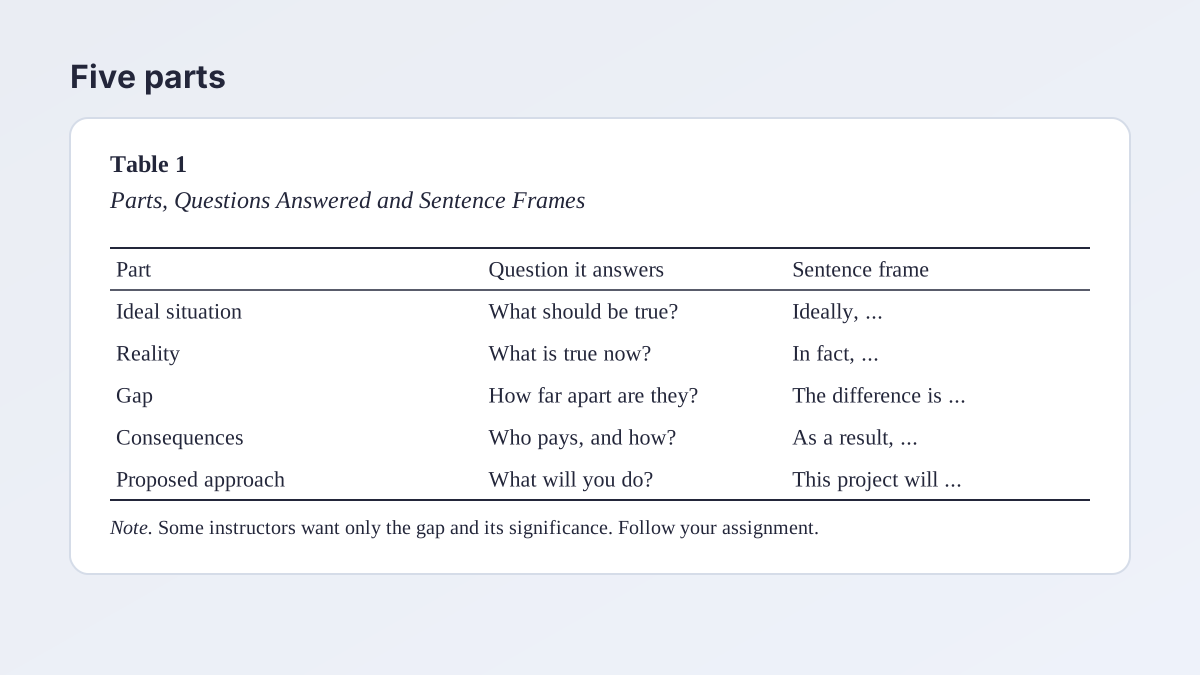
A well-built one usually moves through five parts. This structure is common in capstone, business and project courses, and Table 1 above summarizes it. It is a framework, not a universal rule. A thesis committee may want only the gap and its significance, so check your template.
| Part | What to include | Invented example |
|---|---|---|
| Ideal situation | The standard, goal or expected outcome | Patients should be able to walk to the bathroom safely. |
| Reality | Current evidence, with a source or measurement | Most falls on the unit happen during unassisted trips. |
| Gap | The distance between the ideal and the reality | The unit is not meeting its own safety goal. |
| Consequences | Who is harmed and what it costs | Injuries, longer stays and higher costs. |
| Proposed approach | What your project or study will do | This project will test scheduled bathroom rounds. |
Ideal situation and reality
Start with what should be true, then say what is true. Both halves need support. An ideal can come from a policy, a professional standard or a published goal, and the reality should come from data or a source you can cite. A claim such as "everyone knows students are stressed" will not hold up.
Gap, consequences and approach
The gap is the heart of the passage, because it shows what is missing. Consequences answer the "so what?" question that the USC guide recommends revisiting throughout a paper. The approach is one sentence that points toward your methods, without describing them in full.
Problem Statement Template You Can Copy
Fill in the blanks below, then smooth the sentences so they sound like you. This template works for most research papers, capstones and project proposals. Delete any part your instructor does not want.
Ideally, [group] should be able to [expected outcome], according to [source or standard]. In fact, [current situation], as shown by [evidence]. The gap is [difference between the two]. As a result, [who is affected] experience [consequence]. This [study/project] will [approach] in order to [intended contribution].
A Shorter Version for a First Draft
Short on time? Use three sentences. First, "[Group] needs [goal], but [obstacle]." Second, "This matters because [consequence]." Third, "This project will [approach]." You can expand each sentence into a paragraph later.
Customer and client versions
Business classes sometimes ask for a customer or client version on a slide. These follow the same logic in fewer words: who the customer is, what they are trying to do, what stops them and what it costs. Put the finished wording on one slide, with a source line for your evidence.
Format of a problem statement in a paper
For a paper, the usual format is plain paragraph prose with no heading of its own, or a short heading such as "Statement of the Problem" if your template calls for one. Most writers use the present tense and their discipline's formal voice. Cite sources in the style your class requires; see our guides to APA format guidelines and MLA headings for layout.
Research Problem Statement Examples by Field
The five full samples below show the parts in action. They are written for this guide. The schools, units, companies and figures are invented, and they are not evidence about the real world, so you should never cite them.
Education sample
"Students in ninth-grade English should be able to read grade-level texts independently by the end of the fall term. At an invented rural high school of 600 students, about a third of ninth graders read below that level in December, which limits their access to science, history and math texts. Without earlier support, these students are more likely to fall behind in every course. This study will test whether a daily twenty-minute reading block improves fall-term reading scores."
Nursing or health sample
"Hospital policy aims to prevent patient falls, yet an invented 28-bed medical-surgical unit recorded nine falls in six months, six of them during unassisted trips to the bathroom. Falls can cause injury, longer stays and higher costs. This quality-improvement project will pilot hourly purposeful rounding that offers toileting help, and will compare fall counts before and after."
Business sample
"Brightline Bikes, an invented online retailer, advertises three-day delivery but averages six. Customer service tickets about late orders have doubled since spring, and fewer first-time buyers place a second order. This case study will analyze whether adding a regional warehouse would close the delivery gap at a reasonable cost."
Engineering sample
"After moderate rain, water pools near the entrance of an invented campus lab building, creating a slip hazard and blocking access for wheelchair users. The existing drain was sized for the earlier layout, and newer paved areas now send more runoff to it. This design project will evaluate permeable paving and a larger inlet as ways to reduce ponding to a safe level."
UX sample
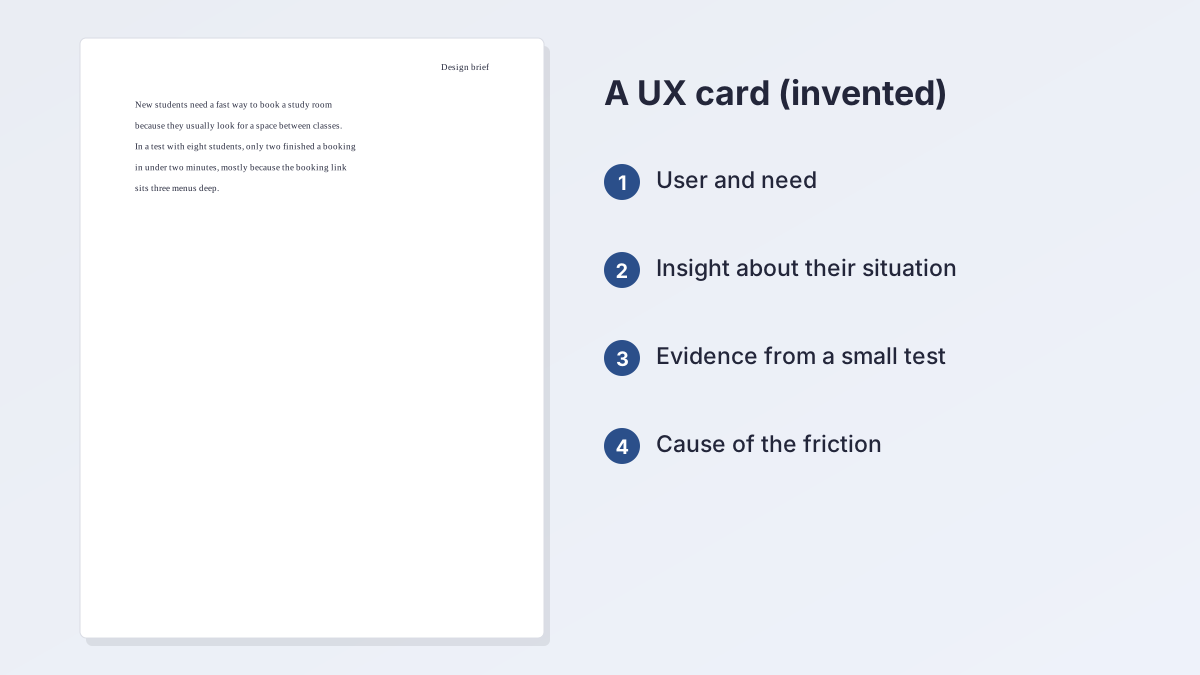
"New students need to book a study room between classes, but in an invented usability test with eight students, only two finished a booking in under two minutes because the link sits three menus deep. Slow booking leaves rooms empty and students without a quiet place to work. This project will redesign the navigation and test whether booking time drops."
An ordinary UX version is often one sentence of user, need and insight, as in the sample card above. Capstone courses usually expect the longer paragraph form.
How Long Should a Problem Statement Be?
Length depends on your assignment, so treat what follows as a convention. For most student papers, it runs one paragraph, often five to eight sentences. The USC guide says the research problem is usually described in a short paragraph that defines and contextualizes the problem, and that it is not a one- or two-sentence thesis statement. Proposals and dissertations may give it a full page or a section.
How Long Is It in a Project or on a Slide?
In design and business courses, a UX or client version may be a single sentence or a short card, and a slide version often fits in two or three lines. When your syllabus gives a word limit, use it. Otherwise, write the shortest version that still shows the gap, the people affected and the stakes.
Where does a problem statement go in a paper?
In a research paper, it belongs in the introduction. The USC guide treats it as part of the introduction, between its sections on background information and the theoretical framework, and it usually leads into your research questions. A capstone or thesis may put it in Chapter 1, often under the heading "Statement of the Problem." If you need help with the surrounding paragraphs, see our guide to how to write an introduction and how to write a paragraph.
Problem Statement vs Research Question vs Purpose Statement
These three pieces work together, and students often mix them up. The problem statement says what is wrong or unknown. A research question asks what you want to find out about it. A purpose statement says what your study will do. They also sit in different places in your introduction, usually in that order.
How does it differ from a research question?
The statement describes a situation, while the question is something you can answer. If the gap is that nobody knows whether notification limits help students finish homework, the question might ask whether they do. Our guide on how to formulate a research question shows how to narrow a problem into a question, and the research question generator can draft options for you to edit.
How does it differ from a purpose statement?
A purpose statement is a sentence that begins "The purpose of this study is to..." and names the design, the variables or concept, and the participants. It answers "what will this study do?" while the problem statement answers "why is it needed?" See our guide to purpose statement examples for scripts and samples.
What is the difference between a research problem and a hypothesis?
A research problem is the gap you are investigating. A hypothesis is a testable prediction about it, such as "students with notification limits will turn in more assignments on time." Not every project has one. Many qualitative studies use open questions instead.
5W1H and SMART Methods for Writing Yours
Two checklists come up often in project courses, especially in business, engineering and design. Both help you test a draft, and neither replaces the five parts above.
The 5W1H method
5W1H stands for who, what, where, when, why and how. Answer each in a line before you write: who is affected, what the problem is, where it happens, when it started or how often it occurs, why it matters, and how you plan to address it. If you cannot answer one, your problem may still be too vague.
A SMART problem statement
SMART is an acronym for specific, measurable, achievable, relevant and time-bound. Versions differ: some use "attainable" for the A and "realistic" for the R. A SMART version names a specific issue, points to something you can measure, stays within what the project can change, matters to a real audience and fits a time frame. For example, "reduce late deliveries" is vague. "Cut average delivery time from six days to four by the end of spring" is measurable and time-bound, but it is a goal, so keep it in your approach rather than in the description of the problem itself. Some courses use SMART as a rubric, so ask your instructor.
Which method should you use?
Use 5W1H when you are still exploring, because it forces you to gather the facts. Use SMART once your project has a target. For a research paper, the five parts plus the USC "so what?" test are usually enough.
Common Problem Statement Mistakes
Most weak drafts fail in a few predictable ways. The USC guide warns against circular problems, vague intensifiers and value-laden words. The rest are common in student work. Check yours against this list, and run your topic through the research problem generator to get a second draft to compare with yours.
Hiding a solution inside the problem
"The problem is that we lack a tutoring center" is circular, because it defines the problem as the absence of a solution. The USC guide warns against this pattern. Describe the harm instead, such as students falling behind in math.
Being too broad or too vague
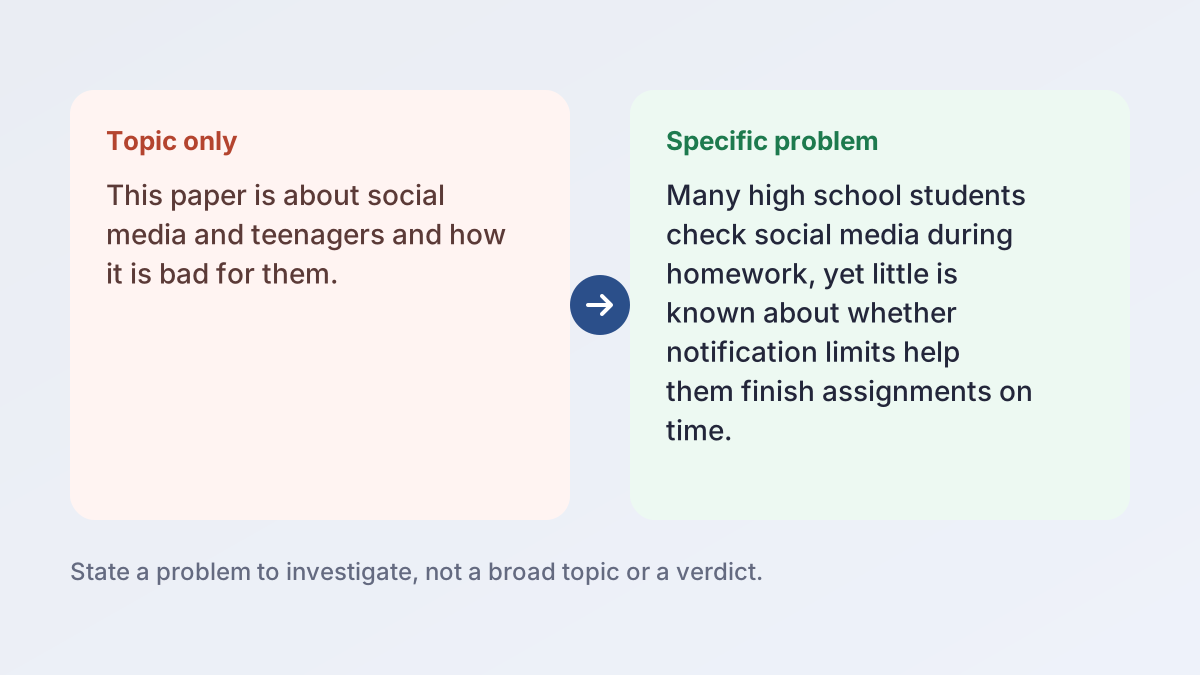
"Social media is bad" cannot be investigated. Narrow it by group, setting and outcome. Avoid intensifiers such as "very," value-laden words and unexplained jargon, as the USC guide advises for the first two.
Skipping the evidence
A claim with no source reads as opinion. Add a statistic, report or observation, and cite it. Never invent a number to make the gap look larger.
Forgetting the "so what?"
If a reader can shrug and say "so what?", add the consequence. Personal curiosity alone does not make a problem important.
Writing a long background instead
It is not a literature review. Keep it to the key facts, and put the detailed background in its own section. When you are done, browse our other student writing guides for help with the rest of your paper.
Questions About Writing Yours
What is a problem statement?
It is a short passage that names a specific problem, shows the gap between the ideal and the reality, explains who is affected and sets up your project.
What is the statement of the problem in research?
It is the part of a proposal, thesis or paper that defines the research problem and explains why it matters. Many handbooks give it its own heading.
How do you write a good problem statement?
Pick a specific problem, describe the ideal and the reality with evidence, name the gap, explain who is affected and end with your approach.
How long should a problem statement be?
Most student papers use one paragraph, often five to eight sentences. A slide or UX version can be one to three lines. Check your assignment.
What is the format of a problem statement?
Plain paragraph prose, sometimes under a heading such as Statement of the Problem. A common order is ideal, reality, gap, consequences and approach.
What is a SMART problem statement?
It is a draft checked against five criteria: specific, measurable, achievable, relevant and time-bound. Some versions say attainable or realistic instead. Some courses use it as a rubric.
What is a UX problem statement?
It is a short statement of a user, their need and an insight about why they struggle, often written as a single sentence or card.
Where does the problem statement go in a research paper?
In the introduction, after the background and before the research questions. A thesis may place it in Chapter 1.
What is the difference between a research problem and a hypothesis?
The research problem is the gap you are investigating. A hypothesis is a testable prediction about that gap.
More free guides
- MLA In-Text CitationsAuthor-page citations for every kind of source, with examples.
- How to Cite a Website in MLAWorks Cited entries and in-text citations for web pages.
- MLA Works Cited PageFormat, order and hanging indents, with a full example page.
- MLA Annotated BibliographyFormat, annotation types and a complete example.
- APA Table FormatNumber, title, body and notes for APA 7 tables, with templates.
- MLA HeadingThe four-line first-page heading and the page header, with Word and Google Docs steps.
See all 80 free tools for students
Related tools
Last updated by The Study Corp editorial team.