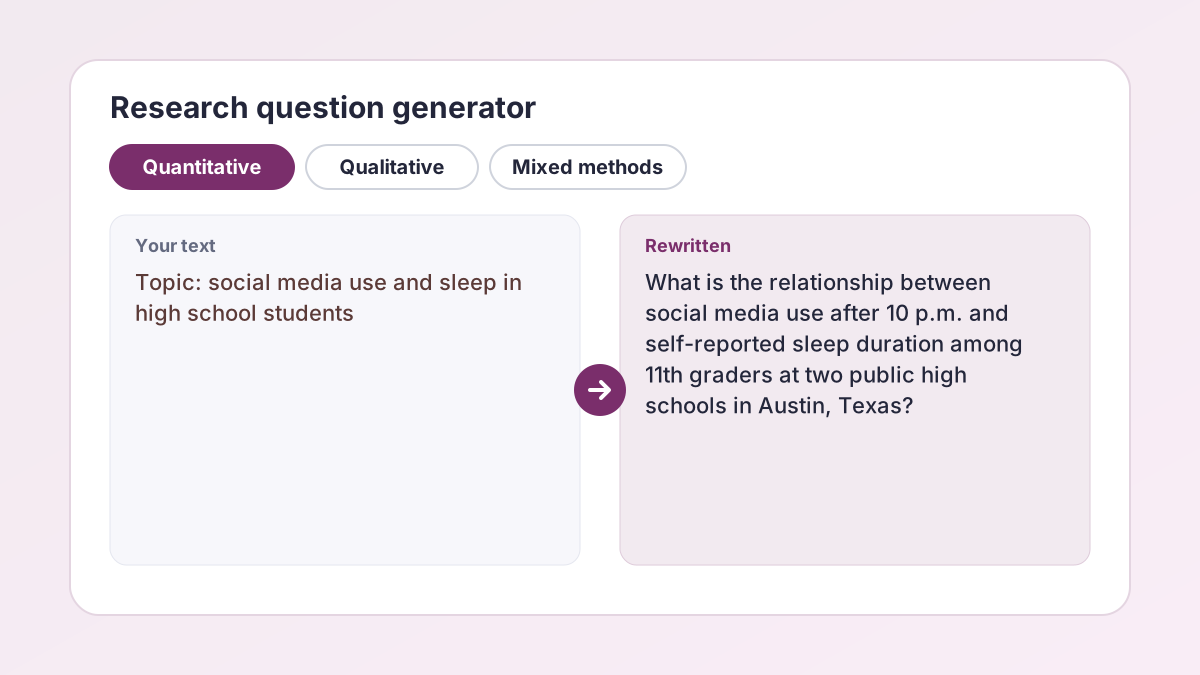
Research question generator examples
Invented topics a US student might type, with one question of the kind the tool returns. Wording changes on every run, and you always get three to five options.
Topic typedNurse burnout and extended working hours
One question backWhat is the relationship between weekly overtime hours and self-reported burnout scores among registered nurses at public hospitals in Cook County, Illinois?
Two measurable variables (overtime hours, burnout score), a population and a setting. It asks about a relationship, not a cause.
Topic typedImposter syndrome in first-gen college students
One question backHow do first-generation students at a public university in California describe feelings of being an imposter during their first semester?
A qualitative question explores experiences, so it starts with How and avoids words like effect or impact.
Topic typedPhone bans in high school classrooms
One question backTo what extent is a bell-to-bell phone policy associated with changes in office referrals at three public high schools in North Carolina over one school year?
A time frame (one school year) and a countable outcome (office referrals) make it answerable with school data.
Topic typedWhy Gen Z shoppers stay loyal to small brands
One question backHow do repeat purchase rates differ between Gen Z and millennial customers of an online thrift store, and how do Gen Z customers explain their loyalty?
One measured part and one explaining part: typical of a mixed-methods question.
Topic typedWomen workers in WWII shipyards
One question backHow did local newspapers in Richmond, California, portray women shipyard workers between 1942 and 1945?
History questions are usually answered from sources, so the question names the sources, the place and the years.
Topic typedFarm runoff and water quality
One question backHow does nitrate concentration differ between upstream and downstream sampling sites on a creek bordering farmland in central Iowa during spring planting?
Feasible for a class project: a few sites, one season and one measurable variable.
How to use the research question generator
One sentence is enough. The more you tell it about who and where, the more usable the questions are.
- Describe your topic. Type your topic, area of interest or rough idea into What would you like to research? (up to 500 characters), or select Try an example.
- Add details (optional). Open More options to set your academic level, research approach, discipline, study population and setting or location.
- Generate research questions. Select Generate research questions. You get three to five questions, each tagged quantitative, qualitative or mixed, with Researchable because, Still to decide and To tighten it notes.
- Refine one question. Use Narrow it, Broaden it, Change population, Change setting, Switch approach or Plainer wording, or select Edit to change it yourself. Check any notes under Things to check.
- Use this question. Select Use this question to save it on this device, then continue to the objective, problem or PICOT tool. Or select Copy.
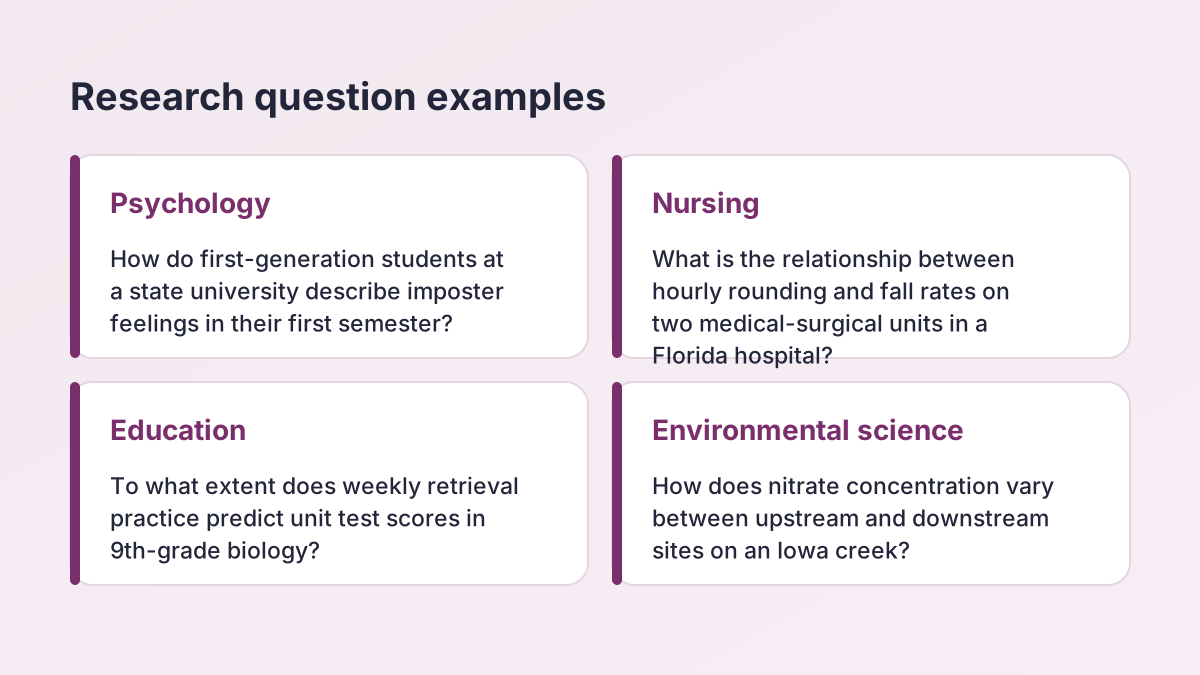
Research question examples by discipline
Every example below is invented to show the shape of a good question. Each one names a population, a setting and a focus, and none can be answered with yes or no. Use these research question examples as models, not as questions to hand in.
Psychology
- Quantitative: What is the relationship between hours of part-time work and perceived stress among juniors at a public high school in Ohio?
- Qualitative: How do student athletes at a Division II university describe the mental health support offered by their athletic department?
Nursing
- Quantitative: What is the difference in catheter-associated urinary tract infection rates before and after a nurse-driven catheter removal protocol on two ICUs in a Texas teaching hospital?
- Qualitative: How do new graduate nurses in their first year at a rural Georgia hospital experience night-shift work?
For clinical questions with an intervention and a comparison, the PICOT Question Generator structures the question element by element.
Education
- Quantitative: To what extent does weekly retrieval practice predict unit test scores in 9th-grade biology classes at one suburban district in Illinois?
- Qualitative: How do community college students in Arizona decide whether to take developmental math online or in person?
Business
- Quantitative: How does offering free shipping thresholds relate to average order value for small online retailers on a single e-commerce platform?
- Qualitative: What do restaurant owners in New Orleans identify as the main reasons servers leave within six months?
History
- Qualitative (source-based): How did African American newspapers in Chicago frame the Great Migration between 1916 and 1925?
- Comparative: How did New Deal relief programs in Oklahoma and Kansas differ in who they reached during the Dust Bowl years?
Environmental science
- Quantitative: How does tree canopy cover relate to summer surface temperatures across neighborhoods in Phoenix?
- Qualitative: How do residents of a Louisiana coastal parish describe their decisions about whether to relocate after repeated flooding?
How to write a research question in five steps
Learning how to write a research question is mostly learning how to narrow. George Mason University's Writing Center suggests choosing a topic, doing preliminary reading, considering your audience, asking open-ended "how" and "why" questions, and then checking that the question is clear, focused, concise, complex and arguable; its guide on how to write a research question walks through examples. Here is the same process applied to one invented topic.
1. Start with a broad topic
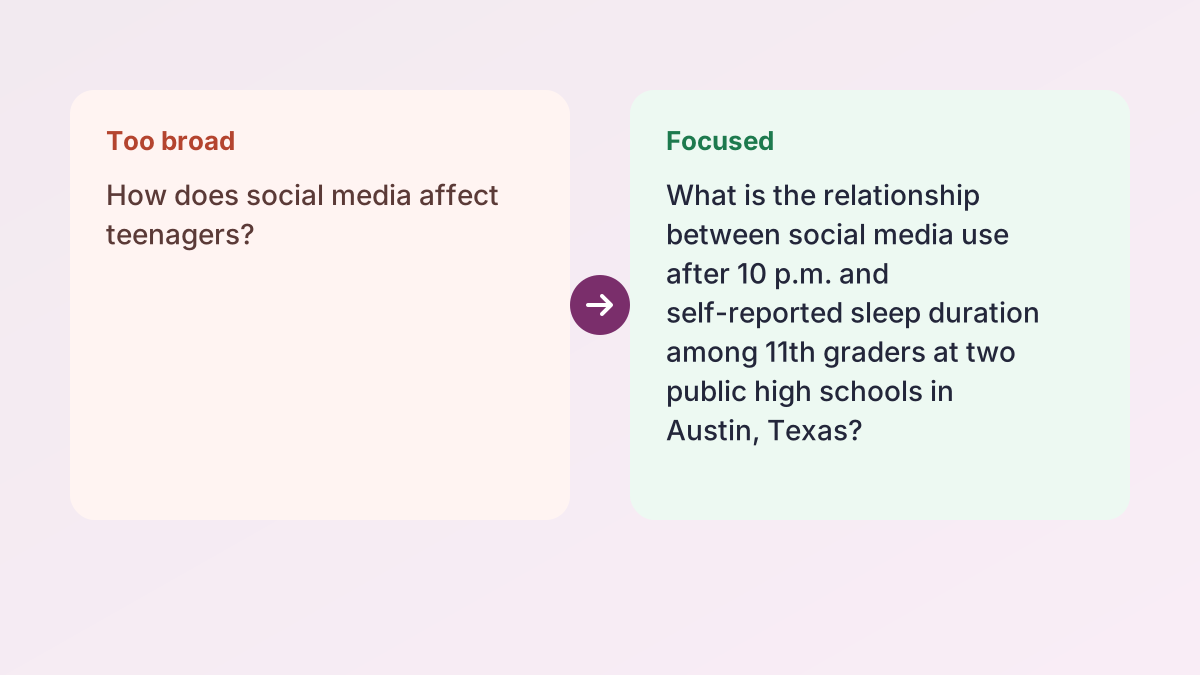
Social media and teenagers. Fine as a starting point, far too big to answer.
2. Read what's already known
Skim a few recent articles or your textbook. You might notice that sleep comes up again and again. Now the topic is social media and sleep in teenagers.
3. Name who and where
Pick a population you could actually reach and a setting: 11th graders at two public high schools in Austin, Texas.
4. Choose what to measure or explore
Quantitative: social media use after 10 p.m. and self-reported sleep duration. Qualitative: how students describe their bedtime phone habits.
5. Turn it into an open question
"What is the relationship between social media use after 10 p.m. and self-reported sleep duration among 11th graders at two public high schools in Austin, Texas?"
Then test it. Can you get the data in the time you have? Would anyone outside your class care about the answer? If not, narrow or adjust again. The research question generator does steps 3 to 5 for you, and Narrow it and Broaden it repeat step 3 until the scope fits.
Qualitative research question vs quantitative research question
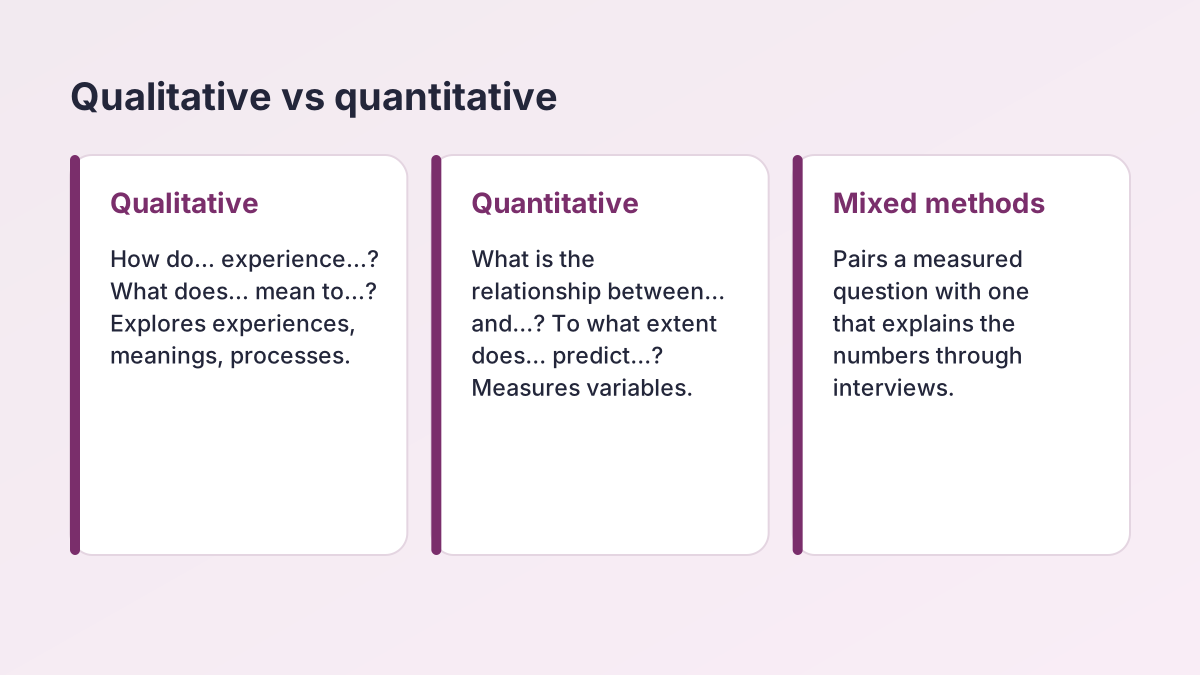
The approach decides the wording. A quantitative research question names variables you can count, measure or compare. A qualitative research question explores experiences, meanings, perceptions or processes, usually through interviews, focus groups or documents. A mixed-methods question does both.
| Quantitative | Qualitative | |
|---|---|---|
| Asks about | Relationships, differences, predictions, trends | Experiences, meanings, perceptions, processes |
| Typical stems | What is the relationship between…? How does… differ between…? To what extent does… predict…? | How do… experience…? What does… mean to…? How do… describe…? |
| Data | Surveys with scales, test scores, records, measurements | Interviews, focus groups, observation, documents |
| Sample | Larger, often chosen to represent a group | Smaller, chosen for rich information |
| Words to avoid | Effect or impact, unless the design is an experiment | Effect, impact, cause, prove |
Quantitative research question examples
- What is the relationship between screen time and GPA among sophomores at a community college in Washington?
- How do fall rates differ between units that use bed alarms and units that do not at one Michigan hospital?
Qualitative research question examples
- How do parents of English learners in a Texas elementary school experience parent-teacher conferences?
- What does "being ready for college" mean to seniors in a rural Kentucky high school?
Switching between the two
In the research question generator, Switch approach rewrites a question for the other approach and updates its tag. If you choose Quantitative or Qualitative under More options, at least three questions follow it (Mixed methods guarantees at least one mixed-methods question), and the tool may add one in another approach if that fits the topic better, saying why. If you leave it on Not sure yet, you get at least one qualitative and one quantitative question.
Is it a good research question? The FINER criteria
Many research methods courses, especially in health sciences, test questions against the acronym FINER: Feasible, Interesting, Novel, Ethical and Relevant. East Tennessee State University's medical library lists FINER (and the longer FINERMAPS) in its guide to formulating a strong research question. Your course may use a different checklist, so follow your rubric.
What each letter asks
- Feasible: Can you reach enough participants or sources, in the time you have, with the skills and money you have?
- Interesting: Do you, your instructor and your field want the answer?
- Novel: Does it add something, even if only a new population or setting?
- Ethical: Could it be done without harm, and would an institutional review board (IRB) approve it? Studies with people, especially minors, usually need approval.
- Relevant: Would the answer matter to practice, policy or future research?
How the tool uses FINER
Each question's Researchable because note looks at it through a FINER lens. It does not claim the question is novel or feasible; it can't search the literature or know your access. Check novelty with a library database search, and check feasibility with your instructor.
Research question vs thesis vs hypothesis
Students often mix these up because they come at different stages of the same project.
| Research question | Hypothesis | Thesis statement | |
|---|---|---|---|
| Form | A question | A testable prediction | A claim you argue |
| When | Before you collect evidence | Before a quantitative study | After research, at the top of the paper |
| Example | What is the relationship between after-school jobs and GPA among juniors in Ohio? | Juniors who work more than 15 hours a week will have lower GPAs than those who work fewer. | After-school jobs over 15 hours a week hurt grades, so schools should help students cap their hours. |
| Used in | Every kind of research | Mainly experimental and correlational studies | Argumentative and analytical essays |
Do you need a hypothesis?
Usually only for quantitative studies that test a prediction. A qualitative research question normally has no hypothesis, because the study explores rather than tests. Ask your instructor if the assignment is unclear.
From question to thesis
In a research essay, the answer you reach becomes your thesis. Once you have it, the Thesis Statement Generator helps you phrase it, and the Essay Outline Generator organizes the paper around it.
How the research question generator checks each question
Every question comes with three notes, and automated checks flag common problems under Things to check.
The three notes
- Researchable because: why the question could be answered with evidence a student can collect or access.
- Still to decide: what is missing, such as sample access, ethics approval, time or definitions.
- To tighten it: one concrete way to make it more specific.
The automated checks
- Yes/no questions. "Does homework help students?" is flagged, with a suggestion to ask how, what, to what extent or in what ways.
- Too broad. A question that reads as too big for one study gets a nudge to add a population, setting, time frame or one variable.
- No population. If the question doesn't say who it is about, the tool asks you to add a group or say that it is deliberately broad.
- Causal wording. "Effect" or "impact" in a qualitative or non-experimental question is flagged, because those designs can't show cause.
- Claims that something works. A question that assumes its own answer (such as "…is effective…" or "…significantly improves…") is flagged so you can phrase it as what the study will compare.
These checks help you spot problems; they don't replace your instructor, supervisor or an ethics review. Under Decisions that would sharpen these, the tool may also list choices you could make, such as which state or age group.
Research questions for high school, college and graduate school
Under More options, Academic level offers Any level, Undergraduate, Master's and Doctoral. The level changes the ambition of the questions, not just the vocabulary.
High school
Leave the level on Any level and describe your class in the topic, for example "AP Research project on school start times". Keep the scope small: one school, one grade, data you can collect with a survey or from public records. Studies that survey other students may need approval from your teacher or school.
Undergraduate
Narrow and feasible with modest data. Typical for a psychology methods course, a nursing evidence-based practice project or a capstone: one population, one setting, a semester's timeline.
Master's and doctoral
More complex designs and an expectation of an original contribution. The tool still can't judge novelty, so a literature review comes first.
Setting your discipline
Discipline includes Nursing & health sciences, Psychology, Education, Business & management, Social sciences, Humanities & arts and more. It shapes the conventions and terms the research question generator uses.
Common research question mistakes and fixes
These are invented, but they are the patterns instructors see most.
Too broad
- Weak: How does social media affect mental health?
- Better: How do 10th graders at one Minnesota high school describe the role of Instagram in their friendships?
Answerable with yes or no
- Weak: Do later school start times improve grades?
- Better: What is the relationship between a district's switch to an 8:30 a.m. start and first-period attendance at its two high schools?
Already answered by a quick search
- Weak: What percentage of nurses work 12-hour shifts?
- Better: How do nurses on 12-hour shifts at one Florida hospital describe their recovery between shifts?
Assumes the answer
- Weak: Why is online learning worse than in-person classes?
- Better: How do final exam scores in an online and an in-person section of the same college algebra course compare?
Two questions in one
- Weak: How does sleep affect grades and what can schools do about it?
- Better: Split it into a measured question about sleep and grades and a separate qualitative research question about school policies.
Next steps after you choose a question
Select Use this question and the tool saves the question, its approach and its population and setting on your device. The next research tools can then pre-fill from it.
- Research Objective Generator: one general objective and three to five specific objectives that match your question.
- Research Problem Generator: a problem statement explaining why the question matters.
- PICOT Question Generator: for nursing and clinical questions that compare an intervention with an alternative.
- Research Paper Title Generator: titles built from your question and method.
- Research Paper Introduction Generator and Abstract Generator: later, when you write up.
Put titles into the right capitalization with the Case Converter, and keep an eye on length with the Word Counter.
Is the research question generator free and private?
Yes. The research question generator is free, with no account or sign-up.
Your topic and any details you add, plus anything you saved from other research tools, are sent to our AI providers (Groq, with Google Gemini as a backup) only to generate your questions. The Study Corp does not save them. When you select Use this question, it is stored in your own browser so the next tools can pre-fill. When a research tool uses something you saved, it shows it at the top of the form with a remove link and a Clear everything saved on this device option.
Drafts, not final answers
The questions are drafts to refine. Check them with your instructor, and follow your school's policy on AI tools.
Research question generator FAQ
Is the research question generator free?
Yes. It is free, with no account or sign-up.
How many research questions do I get?
Three to five per run, chosen to differ in scope, population, approach or angle rather than reword one idea. Generate again for a fresh set.
What makes a good research question?
It is clear, focused enough to answer in one study, open-ended rather than yes/no, and names who and where. Many courses also check it against FINER: feasible, interesting, novel, ethical and relevant.
What is the difference between a qualitative and a quantitative research question?
A quantitative research question asks about measurable variables, such as the relationship between screen time and GPA. A qualitative research question explores experiences or meanings, such as how students describe their study habits.
Can a research question be a yes or no question?
It shouldn't be. Yes/no questions invite a one-word answer. Ask how, what, to what extent or in what ways instead. The tool flags yes/no questions automatically.
What is the difference between a research question and a PICOT question?
A PICOT question is a structured clinical research question with a population, intervention, comparison, outcome and time. Use the PICOT Question Generator for nursing and clinical comparisons, and the research question generator for everything else.
Do I need a hypothesis as well as a research question?
Usually only for quantitative studies that test a prediction. Qualitative studies normally have research questions but no hypothesis.
Can I use it for a high school project?
Yes. Leave Academic level on Any level and describe your class in the topic, such as an AP Research or science fair project, then narrow to data you can actually collect.
Is my topic saved?
The Study Corp does not save it. It is sent to our AI providers only to generate the questions. A question you choose with Use this question is kept in your own browser.
More free research tools
- PICOT Question GeneratorA well-formed PICOT question with each element labeled and a ready PubMed search.
- Abstract GeneratorA structured abstract built only from the findings you give it.
- Research Paper Title GeneratorTitles for your paper from its question and method.
- Research Objective GeneratorA general objective and specific objectives that match your question.
- Research Problem GeneratorA problem statement built from the evidence you have.
- Research Paper Introduction GeneratorA paragraph-by-paragraph introduction draft.
See all 80 free tools for students
Related tools
Last updated by The Study Corp editorial team.