Weak and Strong Research Questions, Side by Side
Most first drafts fail in the same few ways. Each pair below takes a weak draft and repairs it. Every question is invented for this guide, so adapt the pattern to your own topic and course.
Weak draftWhat are the effects of social media?
Stronger versionHow does time spent on Instagram relate to self-reported anxiety among college sophomores at a large public university?
Name the platform, the group and the outcome.
Weak draftIs homework bad for students?
Stronger versionHow does weekly homework time relate to sleep hours among 9th graders in two suburban Georgia districts?
Replace a yes-or-no frame with a relationship or a how.
Weak draftWhen did the Dust Bowl begin?
Stronger versionHow did federal relief programs change migration decisions of Oklahoma farm families during the 1930s?
A dictionary or encyclopedia can answer the first one. The second needs analysis.
Weak draftWhy is online school so much worse than classroom learning?
Stronger versionHow do course completion rates compare between online and in-person sections of College Algebra at one community college?
Remove the opinion, keep the comparison.
Weak draftWhat did my school cafeteria serve on March 3?
Stronger versionHow have vegetable servings in a school cafeteria changed since the district adopted new nutrition guidelines?
Look for a pattern, not a single data point.
Weak draftWhy do teens use TikTok and does it hurt grades?
Stronger versionDoes daily TikTok use predict lower semester GPA among juniors at one Florida high school?
Pick one question per study. Save the other for later.
Weak draftHow many nurses feel stressed?
Stronger versionHow do new nurses on night shift describe their first six months on a hospital unit?
Match the wording to what you want to learn.
How to Formulate a Research Question in 5 Steps
Use these five steps to formulate a research question that is focused enough to finish and open enough to be worth asking.
- Choose a topic. Pick a subject from your course that you can stay interested in for weeks.
- Read and note gaps. Skim a few scholarly sources and mark what is disputed, missing or unclear.
- Narrow the topic. Limit it by population, place, time and angle until it fits your page count.
- Draft the question. Phrase one open question that begins with how, why, what or to what extent.
- Test and revise. Check it against FINER, ask your instructor, and tighten the wording.
How to Formulate a Research Question From a Topic
A topic is a subject area, such as sleep, climate migration or nursing burnout. A research question is a single sentence that points a study at one piece of that subject. Most students get stuck because they try to jump straight from the first to the second. Once you know how to formulate a research question in stages, the sentence is much easier to write.
If you want a draft to react to, the free research question generator turns a broad topic into three to five focused questions, each tagged by approach. It is a starting point, so adjust the wording to your class and your instructor's rules.
Topic, narrow, question
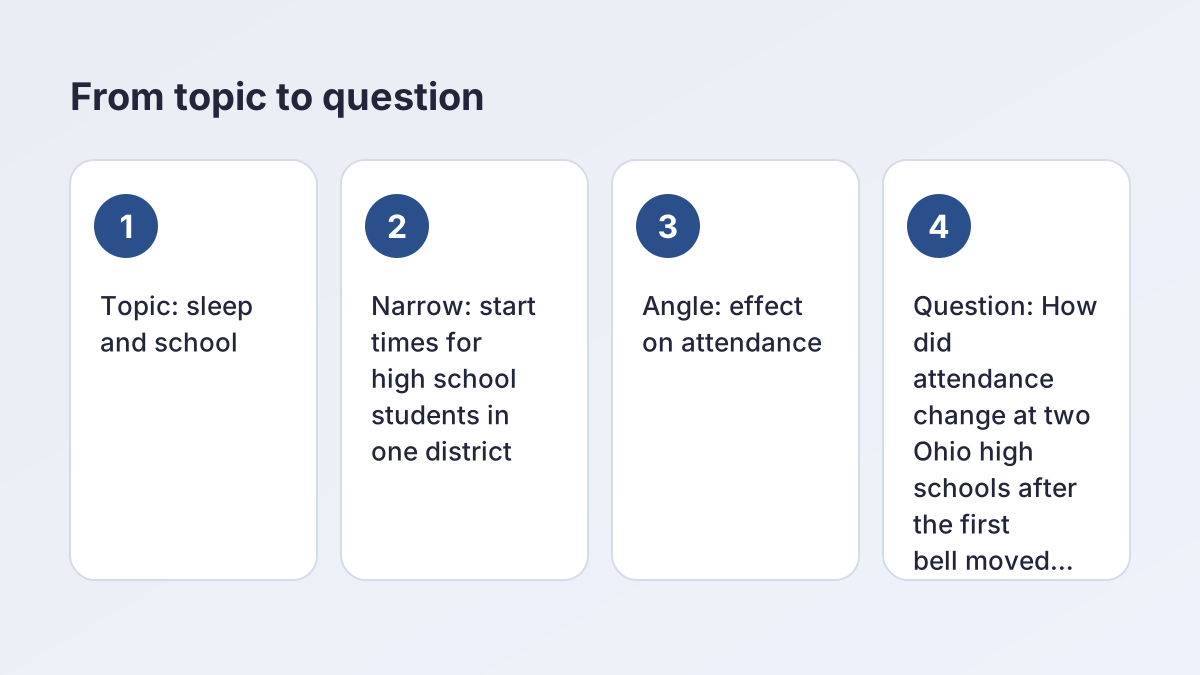
Think of a funnel. At the top is your topic. In the middle you narrow it by who, where, when and which angle. At the bottom is a question you can answer with evidence. The first illustration shows the path for a school start time project. If you are still working out how to formulate a research question and have nothing yet, or you are wondering how to come up with a research question at all, begin with the reading step below. A gap in the sources is often where a good question lives.
What a research question does
A good question tells the reader what you will investigate and what kind of evidence will count. It drives your search terms and your method, and it tells you when to stop.
Steps for Writing a Research Question You Can Finish
These steps expand the five-step list above. They are the core of how to formulate a research question for any class, so work through them in order and expect to loop back at least once.
Step 1: Start with a topic you can sustain
Choose something that fits the assignment and holds your interest. If your instructor assigned a broad theme, such as public health, pick a corner of it that connects to something you have seen or read.
Step 2: Read before you narrow
Spend an hour in a library database or Google Scholar and skim abstracts. Look for debates and for phrases such as "little is known about" or "further research should." Those phrases mark gaps. Keep a short list of the three most promising ones.
Step 3: Narrow in four directions
Limit the topic by population (who), place (where), time (when) and angle (which aspect). "Sleep and school" becomes "sleep and attendance at two Ohio high schools after a start time change." Each limit cuts the amount of research you have to do, so a longer paper can use fewer limits and a short one needs more.
Step 4: Draft the question as an open sentence
Begin with how, why, what or to what extent. Avoid starting with "is," "does" or "should" unless you plan a clear comparison, because a yes-or-no answer ends the inquiry in one word. A reader should be able to picture the kinds of sources you will use.
Step 5: Test, share and revise
Run the draft through the FINER checklist in the next section, then show it to your instructor, a writing center tutor or a librarian. Expect to revise the wording two or three times.
How to Formulate a Good Research Question: The FINER Test
A widely taught checklist for how to formulate a good research question is FINER, described in Hulley and colleagues' textbook Designing Clinical Research (2007). It was written for clinical research, but the five tests are useful in most fields. Adler University's library page recommends the same criteria for evaluating possible research questions. The table below adapts them for student projects.
| Letter | Test | Ask yourself |
|---|---|---|
| F: Feasible | Can you really do it? | Do I have the time, access, sources and skills, and is the scope manageable? |
| I: Interesting | Does anyone care? | Will the answer interest me, my instructor and other readers in the field? |
| N: Novel | Does it add something? | Will it confirm, challenge or extend what earlier work found? |
| E: Ethical | Is it fair to participants? | Could a review board approve the method, and does my school require approval? |
| R: Relevant | Does it matter? | Is it tied to a real problem, to policy, practice or later research? |
Using FINER on a real draft
Take the draft "How does social media affect teens?" It fails F, because no one can survey all teens, and it fails N, because hundreds of studies already cover it. After narrowing, "How do 10th graders at one San Diego high school describe the role of Snapchat in their friendships?" passes F for a short project.
Other quick checks
Many writing centers add three informal tests. Is it arguable, so reasonable people could answer differently? Is it researchable, so evidence exists? Is it specific, so a stranger would know what you mean?
What Is the Research Question in Qualitative Research?
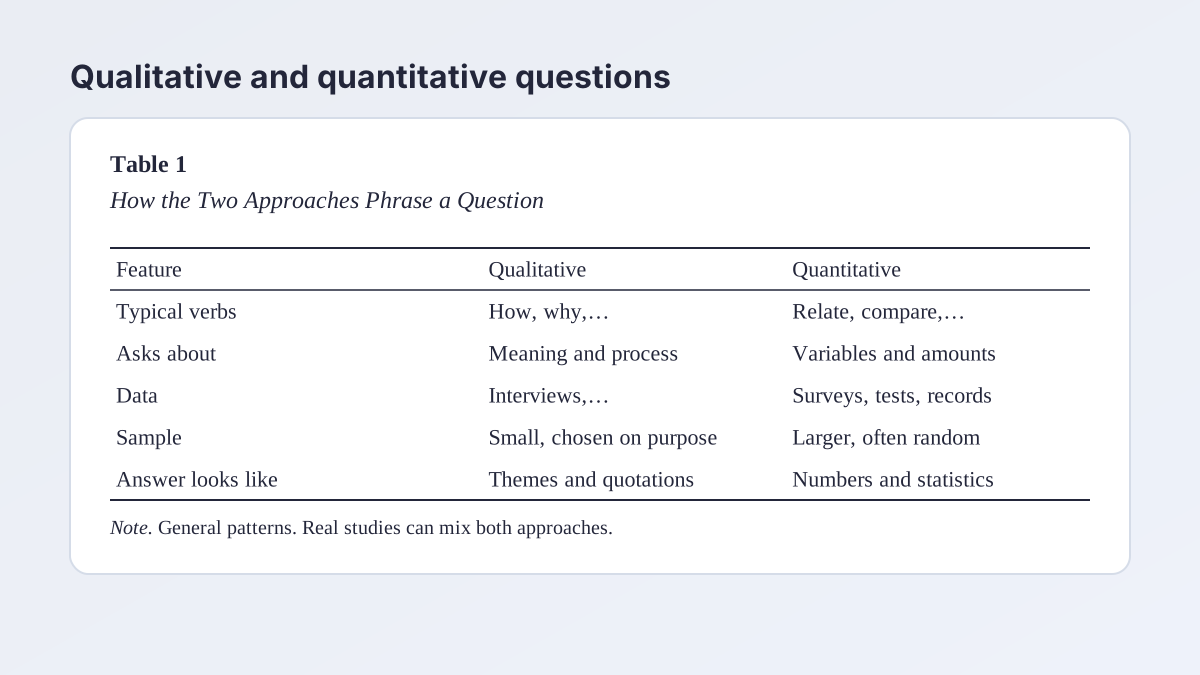
What is the research question in qualitative research asking, in plain terms? It is an open question that asks how or why something happens, or what an experience means to the people living it, and it is answered with words, observations and documents instead of statistics. If you are asking how first-generation students describe their first semester, you are working in this tradition.
The research question generator labels each draft by approach, which can help you decide which tradition fits. Here is how a question for qualitative study projects usually differs from a numeric one, and how to formulate a research question that fits either.
What is the research question in qualitative research made of?
In short, what is the research question in qualitative research made of? Usually three parts: an open verb such as describe or explore, a specific group of people and a setting. The next section looks at each feature.
Features of a question for qualitative study
Qualitative questions tend to use verbs such as describe, explore, understand and experience. They name a specific group and setting. They do not predict an answer in advance, and they allow the data to surprise you. They often begin with "how" because "how" invites a process and a story.
A central question and sub-questions
Many qualitative projects state one central question and two or three sub-questions. If the central question is "How do rural high school students in Montana experience dual-enrollment courses?" the sub-questions might ask about motivation, barriers and support.
Avoid words that imply cause
Avoid "effect," "impact" and "cause" unless your method can support them. Say "describe the role of" or "understand how."
Research Question for Quantitative Research: Variables and Comparisons
A research question for quantitative research asks about variables, which are things you can measure, and about how they relate or differ. The answer is a number, such as a correlation, a difference between group averages or a percentage. Your wording tells the reader which statistic you will probably use.
Our quantitative research question tool tags drafts in this category and highlights the variables. If you prefer to work by hand, ask which type of research question for quantitative research you need. There are three common ones.
Descriptive questions
A descriptive question asks how much or how often: "What percentage of seniors at one Illinois high school work 15 or more hours a week?"
Comparative questions
A comparative question sets groups side by side: "Do students who use flashcards score differently on Spanish vocabulary quizzes than students who reread notes?"
Relationship questions
A relationship question asks whether two variables move together: "Is there a relationship between weekly hours of sleep and GPA among first-year students?" Say "relationship," not "cause," unless you run an experiment.
Define each variable in your research question for quantitative research
"Stress" is vague. "Score on the 10-item Perceived Stress Scale" is clear. A reader should know what you will count or score before you collect any data.
Research Question vs Hypothesis: What Is the Difference?
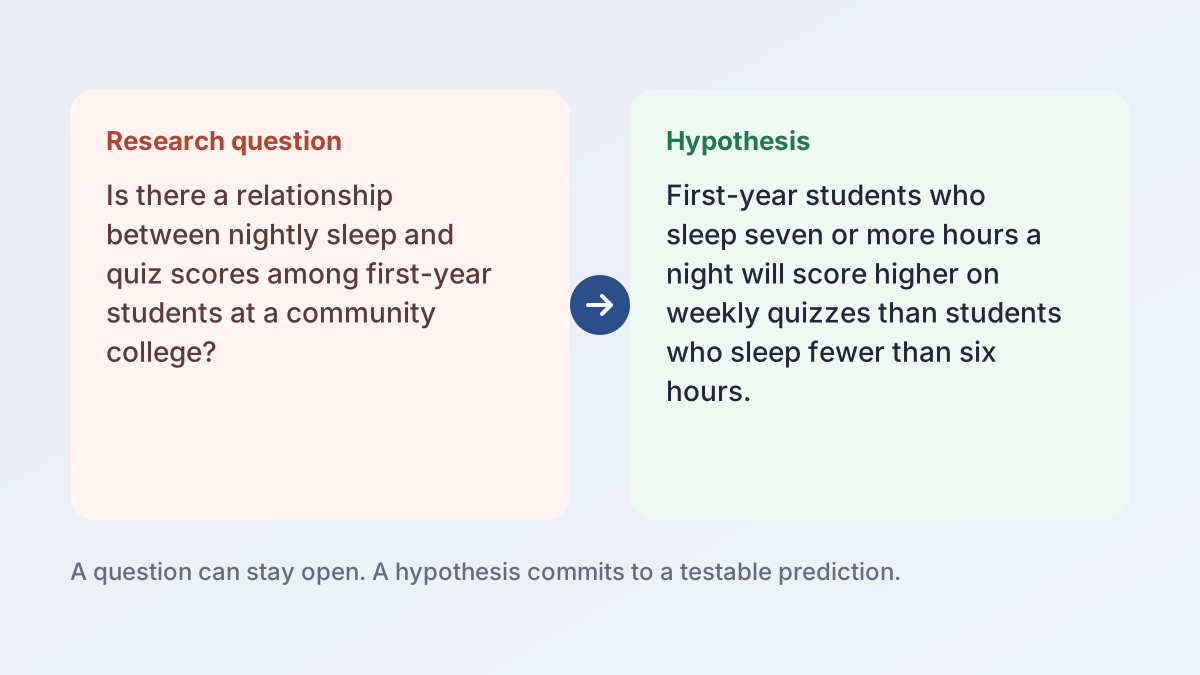
Research question vs hypothesis is a common point of confusion, and the research question vs hypothesis choice shapes your method section. In the research question vs hypothesis comparison, a research question asks what you want to find out. A hypothesis is a testable prediction of the answer, written before you collect data. The question comes first, and a hypothesis, if you need one, follows from it.
Side by side
Take the question "Is there a relationship between nightly sleep and quiz scores?" The matching hypothesis is "Students who sleep seven or more hours will score higher than students who sleep fewer than six." The question is open. The hypothesis takes a position that data can support or fail to support. The second illustration shows the pair.
The difference between a research question and a hypothesis
The difference between research question and hypothesis comes down to three points. A question can be exploratory, while a hypothesis predicts. A hypothesis needs a variable you can test, while a question may not. And a hypothesis can be supported or not, but a question is simply answered. Experiments, surveys and other quantitative studies usually state both. Qualitative studies and many humanities papers state only the question.
Research question vs hypothesis in a humanities paper
On the research question vs hypothesis divide, history and literature work differently. The counterpart of a hypothesis is usually a thesis statement, which is the claim your paper argues in answer to your question. If you are moving from one to the other, our thesis statement generator can help turn a finished question into a claim. See also what an argumentative essay is.
Many instructors ask for a question only, so check your assignment.
Synonyms for Research Question and Related Terms
Different courses and journals use different words for the same job, so a list of synonyms for research question can save you confusion. This list of synonyms for research question groups them by how close they are. The terms below are close, but a few are not exact matches, and it helps to know which.
Close synonyms
- Guiding question or driving question: the central question that organizes a project, common in K-12 project-based learning.
- Inquiry question or line of inquiry: the same idea in inquiry-based courses.
- Central question: the main question in qualitative designs, often followed by sub-questions.
- Focus question: a narrower question that frames one section or one lesson.
- Study question: a question the study is built to answer.
Related terms that are not the same
A research problem is the issue or gap that makes the question worth asking. A problem statement explains that problem in a paragraph. A purpose statement says what the study will do. An objective is a specific task that helps answer the question. Treat these as partners, not substitutes.
Research question statement and synonyms for research question in a proposal
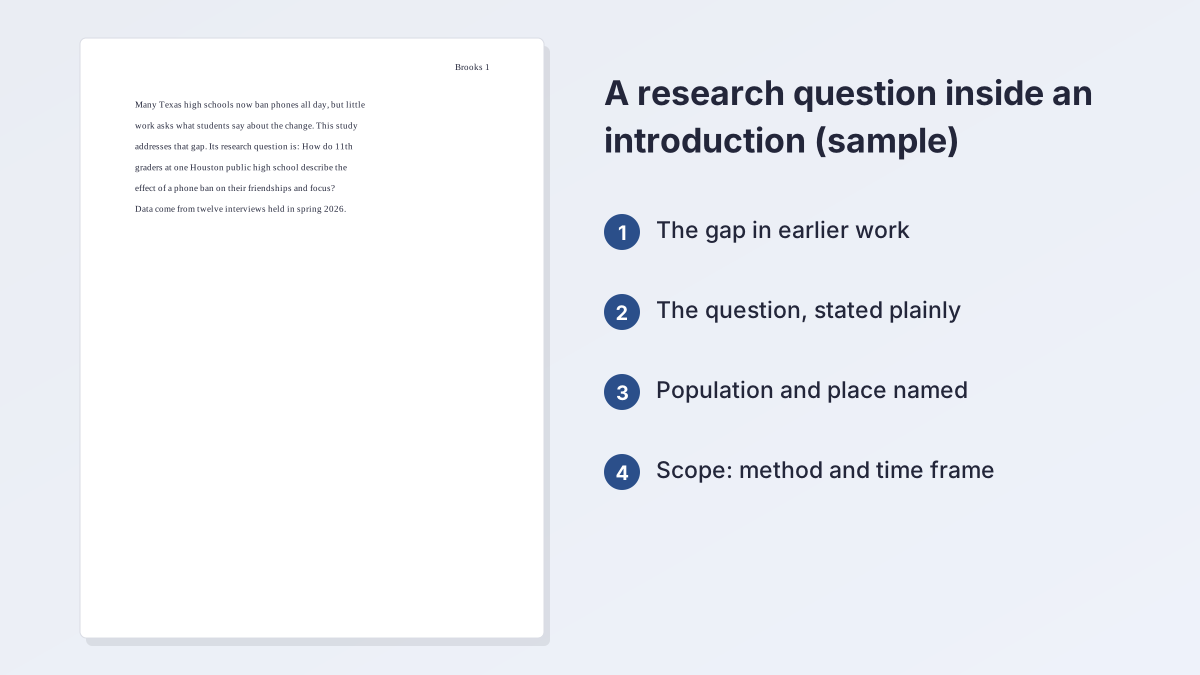
A research question statement is just the question written as a sentence in your introduction, usually after the gap. Readers expect to find it in the last lines of the introduction, as in the fourth illustration. Some instructors call this the statement of research question, so use the term on your assignment sheet, and check it against the synonyms for research question above. For the paragraph that leads up to it, see our guide to how to write an introduction.
PICO and PICOT for Clinical Topics
Nursing, medicine and other health programs often use PICO to formulate a question. PICO stands for Patient or Population (sometimes Problem), Intervention, Comparison and Outcome, and PICOT adds Time, the period over which the outcome is measured. A clinical question fills those slots: in adults with type 2 diabetes, does a weekly telehealth call, compared with usual care, change A1C levels over six months?
You do not need PICO for a humanities paper. Use it when the topic is a treatment or nursing practice and your instructor asks for evidence-based practice. The PICOT question generator assembles the parts into one sentence and suggests a search for PubMed.
The Extended Essay Research Question
The International Baccalaureate Diploma Programme asks every student to write an extended essay, an independent research paper of up to 4,000 words. The essay is built around a focused question, so the extended essay research question carries real weight, and everything on this page about how to formulate a research question applies.
Narrow the topic until the question fits the word limit, and check that sources exist before you commit. The IB has introduced a new extended essay guide, with first assessment in 2027, so take the current wording of the requirements and criteria from your coordinator and supervisor rather than from older handouts.
Common Mistakes When You Formulate a Research Question
Most weak attempts at how to formulate a research question break one of a handful of rules. Check your draft against this list, and use the paired samples earlier on the page as a reference.
Too broad or too narrow
If you could write a book on it, the question is too broad. If one source answers it, it is too narrow. Adjust by adding or removing a limit on population, place or time.
Built-in answers
A question such as "Why is online school worse?" assumes the conclusion. Rewrite it neutrally so evidence can point either way.
Writing a topic, not a question
"Climate change in Florida" is a topic. A question has a verb and a focus, and it ends with a question mark.
Changing the question too late
Refine the question as you read, but settle it by the first third of the project. Changing it the night before a deadline means redoing the research.
When you are ready for a draft or fresh options, the research question examples tool shows tagged samples for your own topic, and you can browse more student writing guides for the next step in your paper.
Questions About Formulating a Research Question
How do you formulate a research question?
Choose a topic, read to find a gap, narrow it by population, place, time and angle, then phrase one open question and test it with FINER.
How do you formulate a good research question?
Make it focused, arguable, researchable and feasible. Check it against FINER: feasible, interesting, novel, ethical and relevant.
What is the research question in qualitative research?
It is an open how or why question about experience or meaning, answered with interviews, observation or documents instead of statistics.
What is a research question for quantitative research?
It asks how measurable variables relate or differ, so the answer is a number such as a correlation or a difference between group averages.
What is the difference between a research question and a hypothesis?
A research question asks what you want to find out. A hypothesis predicts the answer in a testable statement, and it follows from the question.
What are synonyms for research question?
Close synonyms are guiding question, inquiry question, central question, focus question and study question. A research problem is related but different.
How do you come up with a research question?
Read abstracts in your course area, mark gaps and debates, then narrow one of them by who, where and when until you can phrase a question.
What is a research question statement?
It is the question written as a sentence, usually in the last lines of the introduction, after you have described the gap it addresses.
How long should a research question be?
There is no official length. By convention it is one clear sentence that names the population, the setting and the focus, and leaves the answer out.
More free guides
- MLA In-Text CitationsAuthor-page citations for every kind of source, with examples.
- How to Cite a Website in MLAWorks Cited entries and in-text citations for web pages.
- MLA Works Cited PageFormat, order and hanging indents, with a full example page.
- MLA Annotated BibliographyFormat, annotation types and a complete example.
- APA Table FormatNumber, title, body and notes for APA 7 tables, with templates.
- MLA HeadingThe four-line first-page heading and the page header, with Word and Google Docs steps.
See all 80 free tools for students
Related tools
Last updated by The Study Corp editorial team.