Purpose Statement Examples: Weak Drafts and Stronger Versions
Each pair shows a common first-draft problem next to a stronger version. Every sentence is invented for this guide. Swap in your own topic, participants and setting, and follow your program's wording.
Weak draftThis paper is about nursing students and stress.
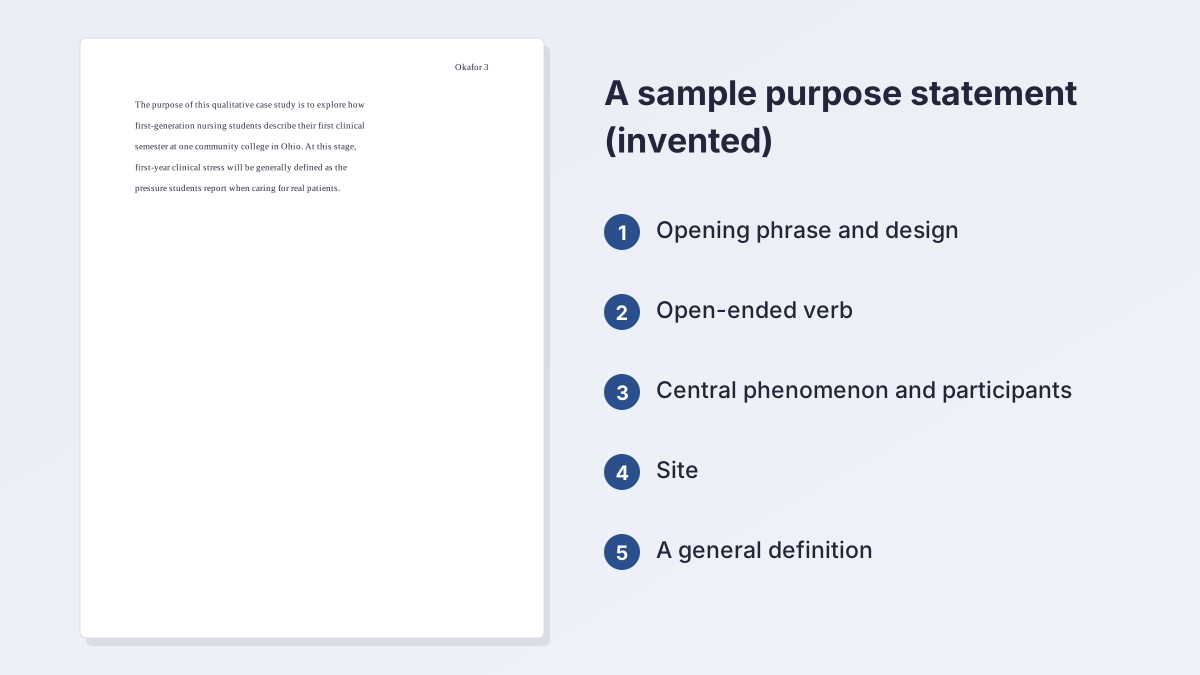
Stronger versionThe purpose of this qualitative case study is to explore how first-generation nursing students describe their first clinical semester at one community college.
Name the design, an open-ended verb, the participants and the site.
Weak draftI want to prove that sleep matters for grades.
Stronger versionThe purpose of this quantitative survey study is to test the relationship between nightly sleep hours and semester GPA among sophomores at one state university.
Name the variables and the participants. Avoid "prove" as a goal.
Weak draftI will use surveys and interviews about tutoring.
Stronger versionThe purpose of this mixed methods study is to measure how often students use tutoring and then interview a sample of them to explain the survey results.
Say why you combine the two kinds of data.
Weak draftMy speech is about the moon.
Stronger versionTo inform my classmates about how the moon's phases follow its orbit around Earth.
A specific purpose names the audience and one narrow aim.
Weak draftTo talk about recycling.
Stronger versionTo persuade my classmates to separate recyclables in the residence halls this semester.
Use an action verb and an action for the audience to take.
Weak draftI want to be successful.
Stronger versionI want to finish a nursing degree and work in a rural clinic, so I put my study time into anatomy and clinical practice first.
A personal purpose is specific enough to guide a choice.
Weak draftTo learn about social media.
Stronger versionTo identify the three social platforms that students in one dorm use most for course questions.
An objective starts with a verb that points to evidence.
Weak draftThe purpose of this paper is to discuss school uniforms.
Stronger versionSchool uniforms should be optional, because the evidence on their benefits is weak and they limit students' self-expression.
A thesis makes a claim. Keep the purpose sentence for what the paper does.
Creating a Purpose Statement in 5 Steps
These five steps work for a research paper, a thesis or a proposal. Follow your handbook if it gives an exact wording.
- Start with your problem. Reread your problem statement so the purpose answers the problem you described.
- Choose the opening script. Begin with "The purpose of this study is to," and add the word qualitative, quantitative or mixed methods.
- Pick a matching verb. Use an open-ended verb for qualitative work and a testing verb for quantitative work.
- Add participants and site. Name who you will study or survey and where, in one short phrase.
- Trim to one or two sentences. Cut extra background, then read it aloud to check that it matches your question.
What Is a Purpose Statement? Three Common Meanings
A purpose statement says what you intend to do and, usually, why. The phrase covers three common assignments, so check which one your teacher means. In a research paper or thesis, it is a sentence that announces the aim of the study. In a speech class, the specific purpose statement is a planning sentence for your talk. In a personal essay or goal-setting exercise, it describes what you want your work or your life to accomplish.
If you want a draft to react to, the free research purpose statement generator takes your research question, design and participants and returns a purpose statement you can edit. Use it as a starting point and check the wording against your handbook.
What Is a Purpose Statement in Research?
A purpose statement in research is one or two sentences, usually in the introduction, that state the main aim of a study. According to the National University research resources page, it should flow directly from the problem statement, identify the method and design, and name the variables, the population and the setting. The problem statement explains why the study matters. The purpose statement explains what kind of study will address it. Our guide to the problem statement covers the first half.
Purpose Statement Examples Follow a Script
Most purpose statement examples in research follow a script, so you do not start from a blank page. The National University page attributes its qualitative and quantitative scripts to John Creswell's 2003 book on research design and summarizes them. The next section shows how they work.
Qualitative, Quantitative and Mixed Methods Purpose Statement Scripts
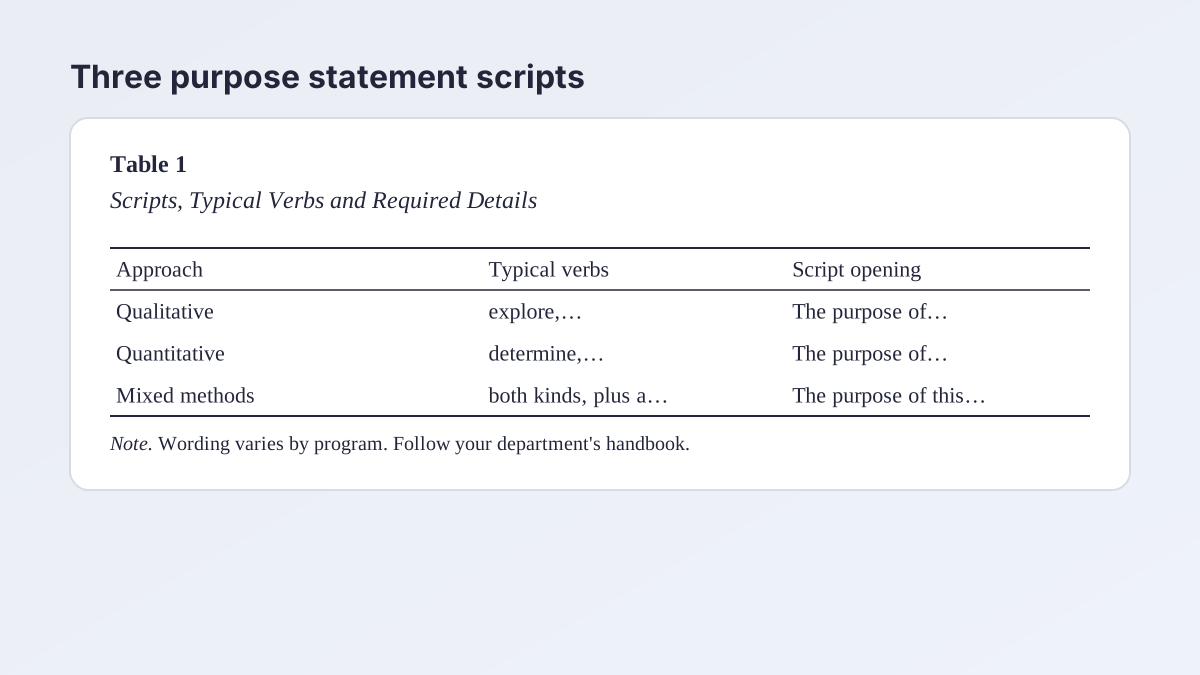
Table 1 above lists the three approaches, and the purpose statement examples in the table below are invented. A script is a fill-in sentence, so the structure stays the same and only your details change. This guide describes the pattern in its own words, and the exact wording in the books and in your program's handbook may differ.
| Approach | Fill-in pattern | Invented example |
|---|---|---|
| Qualitative | The purpose of this qualitative [design] study is to [explore] [central phenomenon] for [participants] at [site]. | The purpose of this qualitative phenomenological study is to describe how transfer students experience their first year at a four-year college. |
| Quantitative | The purpose of this [survey or experimental] study is to test [theory] by relating [independent variable] to [dependent variable] for [participants] at [site]. | The purpose of this quantitative survey study is to test whether weekly tutoring hours predict course grades among first-year students at one university. |
| Mixed methods | The purpose of this [design] mixed methods study is to [collect and analyze both kinds of data] in order to [reason for combining]. | The purpose of this explanatory sequential mixed methods study is to measure library use with a survey and then interview students to explain why some never visit. |
Qualitative purpose statement
A qualitative purpose statement uses the opening words "The purpose of this qualitative study is to." Then it names the approach, such as a case study, an ethnography or a phenomenology. It uses an open-ended verb, such as explore, describe, understand or discover, and it names the central idea, the participants and the site. It also gives a general definition of the central idea. The National University page warns that a purpose statement should not advocate for a particular outcome, and open-ended verbs help with that.
Quantitative purpose statement
A quantitative purpose statement opens with "The purpose of this" plus a design, such as an experiment or a survey, so you might write "The purpose of this survey study is to." It usually names the theory being tested, the independent and dependent variables, any control variables, the participants and the site. Verbs such as determine, measure, compare and correlate fit here. The verbs here are closed-ended because the study measures specific things.
Mixed methods purpose statement
A mixed methods purpose statement tells the reader that you collect both numbers and narratives, and it explains why. Later editions of Creswell's book describe it as naming the design (for example, convergent or explanatory sequential), both kinds of data and the reason for mixing them. Without the reason, it reads like two studies stapled together. The National University page does not give a separate mixed methods script, so ask your advisor whether your program expects a particular pattern.
Purpose of a Thesis Statement and How It Differs From a Purpose Statement
Students often ask what the purpose of a thesis statement is and whether it is the same as a purpose statement. They are different, although they work together. A thesis statement makes a claim you can argue. A purpose statement says what a paper or study will do.
What Is the Purpose of a Thesis Statement?
The Cleveland State University Writing Center describes the thesis as the most important sentence in an essay, because it links the subject of the essay with a controlling idea and makes clear the writer's stand on the subject. The Cleveland State thesis page says it should be narrow and usually appears at or near the end of the introduction. So the purpose of a thesis statement is to tell the reader what you will argue and to hold the paper together. If you need help drafting one, see the thesis statement generator and our guide to how to write an introduction.
Thesis statement and purpose statement side by side
A thesis says, "School uniforms should be optional." A purpose statement says, "The purpose of this paper is to examine the evidence on school uniforms." The first can be right or wrong. The second only describes the plan. Argument papers need the thesis. Research proposals often need both, with the purpose statement near the opening and the thesis or hypothesis later. Our guide to what an argumentative essay is shows a thesis at work.
Specific Purpose Statement for a Speech
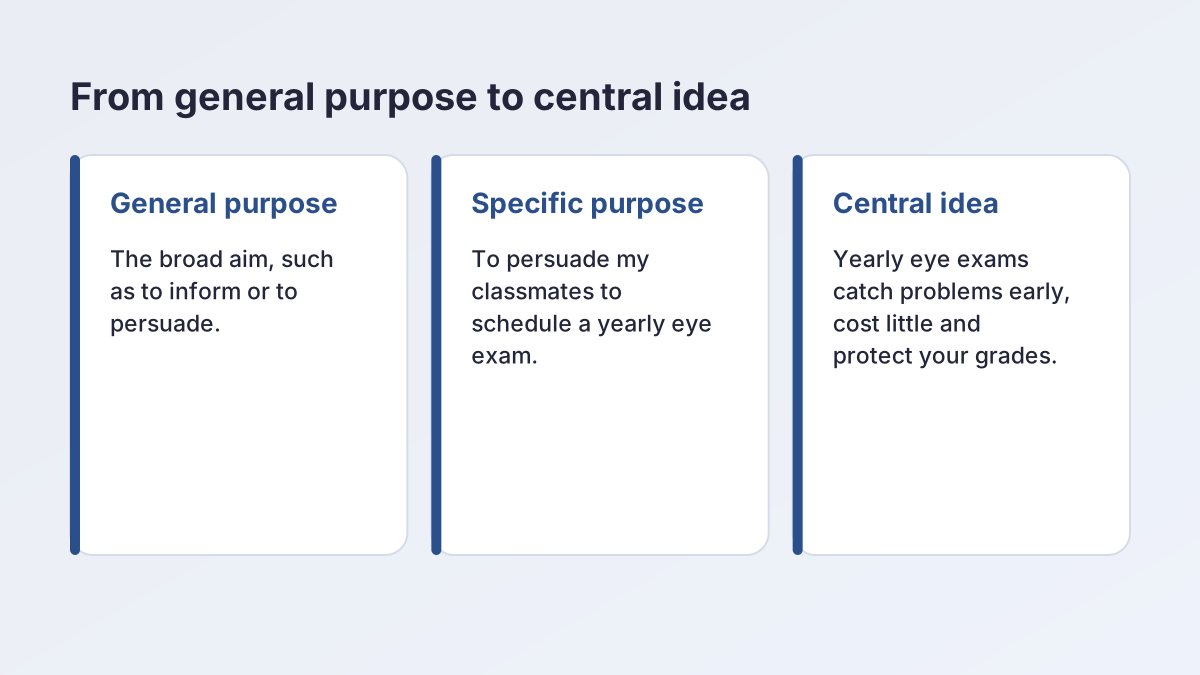
In a public speaking course, a specific purpose statement is a planning sentence for you, not a line you read aloud. Open public speaking textbooks teach it in two layers. The general purpose is the broad aim, such as to inform or to persuade. The specific purpose narrows it to your audience and your topic. Many textbooks list a third general purpose, to entertain, and some use a special-occasion purpose instead, such as to celebrate or commemorate. The Maricopa text cited below uses only inform and persuade in its examples, so check your syllabus.
What Is a Specific Purpose Statement?
The Public Speaking text on the Maricopa Community Colleges open library recommends a single sentence that combines the general purpose, the audience and a short phrase about the topic. Its example is "To persuade a group of college students to make the switch from Microsoft Office to the open-source office suite OpenOffice." The page adds that you do not state the specific purpose aloud. It guides your preparation and helps you write the thesis, which you do say aloud. Many courses call that thesis the central idea.
Specific purpose statement example sentences
These speech purpose statement examples are invented for this guide. "To inform my classmates about how the moon's phases follow its orbit around Earth." "To persuade my classmates to separate recyclables in the residence halls this semester." "To inform the club about three ways to avoid plagiarism when paraphrasing." Each begins with "to," uses one verb and names the audience.
General purpose statement vs specific purpose
A general purpose statement is the same for many speeches ("to inform"). The specific purpose is unique to this speech. If your sentence would fit any topic, it is still too general. Our guide on how to summarize can help you condense research into a central idea.
Personal Purpose Statement Examples, Briefly
A personal purpose statement states what you want to accomplish and what values guide you. Scholarship, leadership and career-planning courses sometimes ask for one. It is not a research tool, and no standard format exists, so follow the prompt you were given.
A simple pattern
Try one sentence for what you do, who it helps and why. Here is an invented sample: "I study nursing so that rural families in my home county can see a nurse who speaks their language, and I protect my study time for anatomy and clinical practice first." It names a goal, a group and a choice.
How long is it?
Most are one to three sentences. A longer personal essay is a different assignment, so see our guide to how to write an introduction if you are building one.
Research Objectives Examples: General and Specific
Many proposals pair the purpose statement with research objectives. An objective is a short statement of something the study will do, and it usually starts with a verb. Objectives turn a broad aim into steps you can check at the end.
What Are the Research Objectives?
The research objectives are the concrete tasks that together achieve the purpose. A proposal often lists one general objective and several specific objectives. The general objective restates the overall aim. Each specific objective covers one measurable piece. Different programs use "aims," "goals" or "objectives," so follow your template. A free research objective generator can turn a research question into a draft list for you to edit.
Objective Verbs That Work
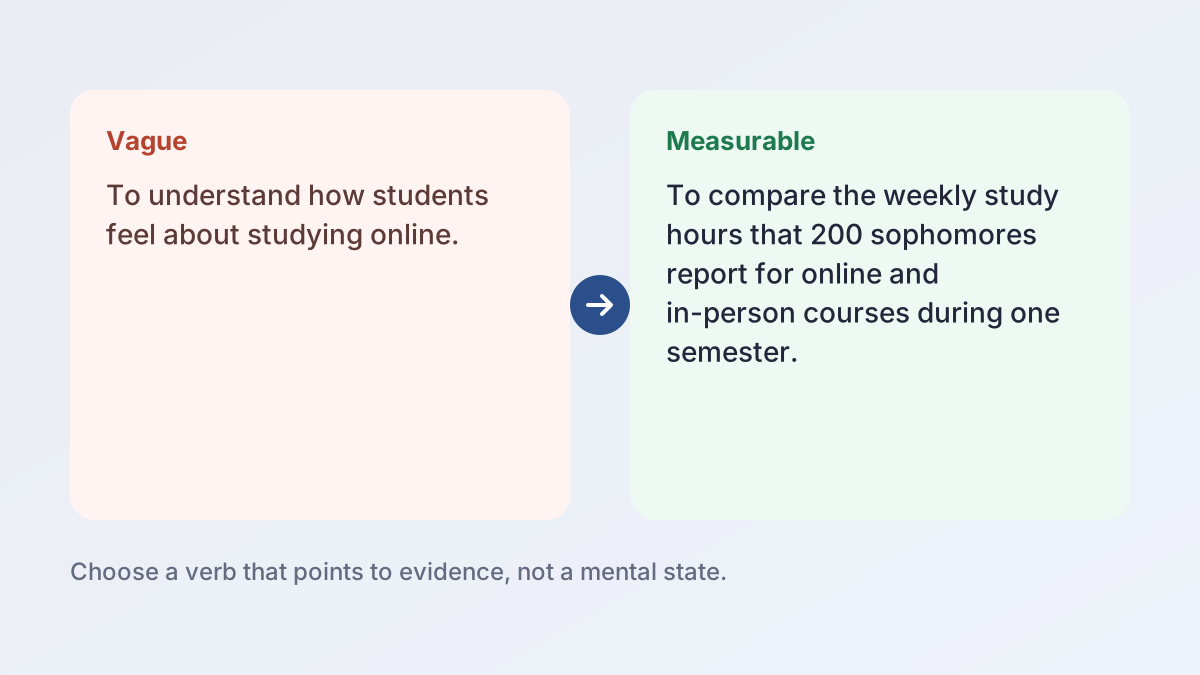
Choose verbs that point to evidence you can collect. Strong choices include identify, describe, measure, compare, evaluate, test and examine. Weak choices include know, appreciate and learn about, because no one can observe them. In qualitative work, "explore" and "understand" are accepted when paired with whose experience and which setting.
SMART Objectives
SMART stands for specific, measurable, achievable, relevant and time-bound. Some versions use "attainable" for the A or "realistic" for the R. Check each objective against it. If you cannot say how you would know the objective was met, rewrite it. SMART fits quantitative objectives best. Qualitative objectives explore experiences, so they usually do not carry numeric targets.
Research Objectives Examples (Invented)
Here is an invented study of tutoring at a community college. General objective: To evaluate whether weekly tutoring improves first-year writing course outcomes. Specific objectives: (1) To describe how many students attend tutoring in the fall term. (2) To compare final course grades of tutored and non-tutored students. (3) To identify the barriers students report to attending. (4) To recommend two changes to tutoring hours based on the findings.
Common Purpose Statement Mistakes
A few errors cause most of the trouble. Check your draft against this list, and use a research purpose statement generator to compare an alternative with your own.
Mixing up the purpose and the thesis
If your sentence makes a claim, it is a thesis. If it describes what you will do, it is a purpose statement. Keep them separate, and check which one your assignment asks for.
Using the wrong verb for your method
A qualitative study that "proves" something, or a quantitative study that "explores feelings," sends a mixed signal. Match the verb to the method.
Leaving out participants or setting
"The purpose of this study is to examine stress" does not say whose stress or where. Add one phrase for each.
Making it too long
A purpose statement should be one or two sentences. Move background to the introduction and definitions to their own section. Our student writing guides cover those sections.
Vague objectives
Objectives that start with "know" or a bare "understand" cannot be checked. Pick an action verb and a measurable result, and run your final list through the research objective generator for a second look.
Questions About Purpose Statements
What is a purpose statement?
A purpose statement is one or two sentences that say what your study, speech or project will do. In research it often begins "The purpose of this study is to."
What is a purpose statement in research?
It states the main aim of a study and usually names the method, the topic, the participants and the setting. It follows from the problem statement.
What is the purpose of a thesis statement?
A thesis statement tells the reader the main claim your paper will argue, shows your stance and holds the essay together.
What is the difference between a thesis statement and a purpose statement?
A thesis makes a claim that can be argued. A purpose statement describes what a paper or study will do.
What is a specific purpose statement?
In a speech, it is a planning sentence that joins a general purpose, such as to inform, with your audience and one narrow topic.
What is the difference between a general and a specific purpose?
The general purpose is the broad aim, such as to inform or to persuade. The specific purpose fits one audience and one topic.
How do you write a qualitative purpose statement?
Start with "The purpose of this qualitative study is to," add an open-ended verb, then name the central idea, the participants and the site.
What are some research objectives examples?
"To describe how many students attend tutoring" and "To compare course grades of tutored and non-tutored students" are invented samples.
How long should a purpose statement be?
Usually one or two sentences. Some programs allow a short paragraph, so check your handbook.
More free guides
- MLA In-Text CitationsAuthor-page citations for every kind of source, with examples.
- How to Cite a Website in MLAWorks Cited entries and in-text citations for web pages.
- MLA Works Cited PageFormat, order and hanging indents, with a full example page.
- MLA Annotated BibliographyFormat, annotation types and a complete example.
- APA Table FormatNumber, title, body and notes for APA 7 tables, with templates.
- MLA HeadingThe four-line first-page heading and the page header, with Word and Google Docs steps.
See all 80 free tools for students
Related tools
Last updated by The Study Corp editorial team.