Analytical Thesis and Paragraph Fixes: Weak vs. Strong
Each pair shows a common first-draft problem and a repaired version. Every sentence is invented for this guide, so use the pairs as models for your own text and wording.
Common problemThis essay is about symbolism in The Great Gatsby.
Stronger versionFitzgerald uses the green light to show that Gatsby's dream depends on a past that can't be repeated.
An analytical thesis makes an interpretation that others could challenge.
Common problemMacbeth is a play about a Scottish king.
Stronger versionShakespeare shows Macbeth's ambition turning into fear by changing how he speaks to himself.
A fact can't be analyzed; an interpretation can.
Common problemThen the narrator goes into the house and finds the letter.
Stronger versionThe narrator's slow entry into the house builds dread, which prepares us for the letter.
Ask how and why, not just what.
Common problemThe poem says, "Two roads diverged in a yellow wood."
Stronger versionThe opening line, "Two roads diverged in a yellow wood," sets a simple scene that the speaker will later complicate.
Introduce each quote and explain it right after.
Common problemThe setting is gloomy, and the characters also speak formally.
Stronger versionThe gloomy setting shows the family's decay. (Save the formal speech for the next paragraph.)
One claim per paragraph keeps analysis focused.
Common problemIn conclusion, I analyzed the poem's imagery.
Stronger versionSeeing the poem's calm tone as a performance changes it from a celebration into a gentle warning about how we narrate our choices.
Say what the analysis reveals.
How to Plan an Analytical Essay in 6 Steps
Most of the work of analysis happens before drafting. Follow these steps in order, and the plan almost builds itself.
- Read and annotate closely. Mark patterns, repeated words, shifts in tone and details that seem to matter, and write a short note on each.
- Ask how and why. Turn a pattern into a question about how the text creates an effect or why the writer made that choice.
- Draft an analytical thesis. Answer your question in one sentence that makes an interpretation someone could dispute.
- Sort evidence by point. Group quotations or details under two or three claims and choose the strongest in each group.
- Draft claim, evidence, analysis. Open each paragraph with a claim, add short evidence and explain how it supports the thesis.
- Revise and cite. Check that each paragraph proves the thesis, tighten the conclusion and cite every source.
What Is an Analytical Essay? A Plain Definition
So what is an analytical essay? It is an essay that breaks a subject into parts and explains how those parts work together to create meaning or an effect. The subject might be a poem, a speech, a historical event, a film or a data set. Instead of retelling it, you ask how and why, and the analytical essay structure is built around those answers. In some classes it's also called a critical analytical essay, though "critical" here means careful, not negative. If you want a draft to react to, the free analytical essay generator builds one around your thesis and marks where your own quotations and sources go.
Analysis vs. summary
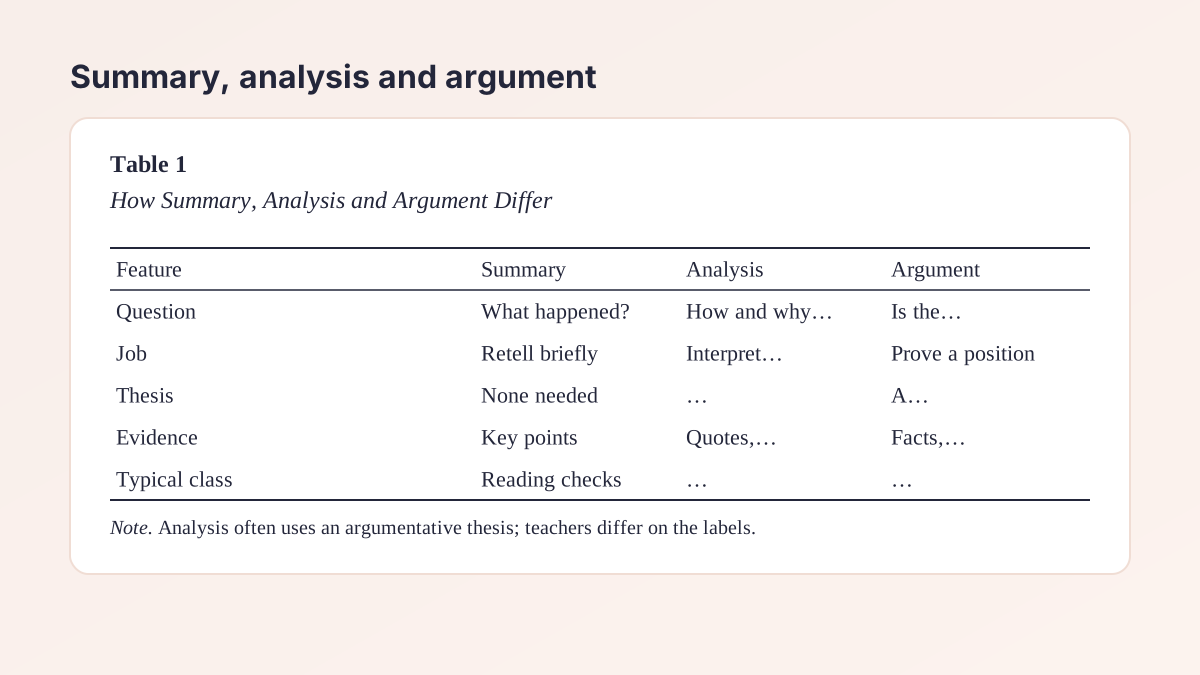
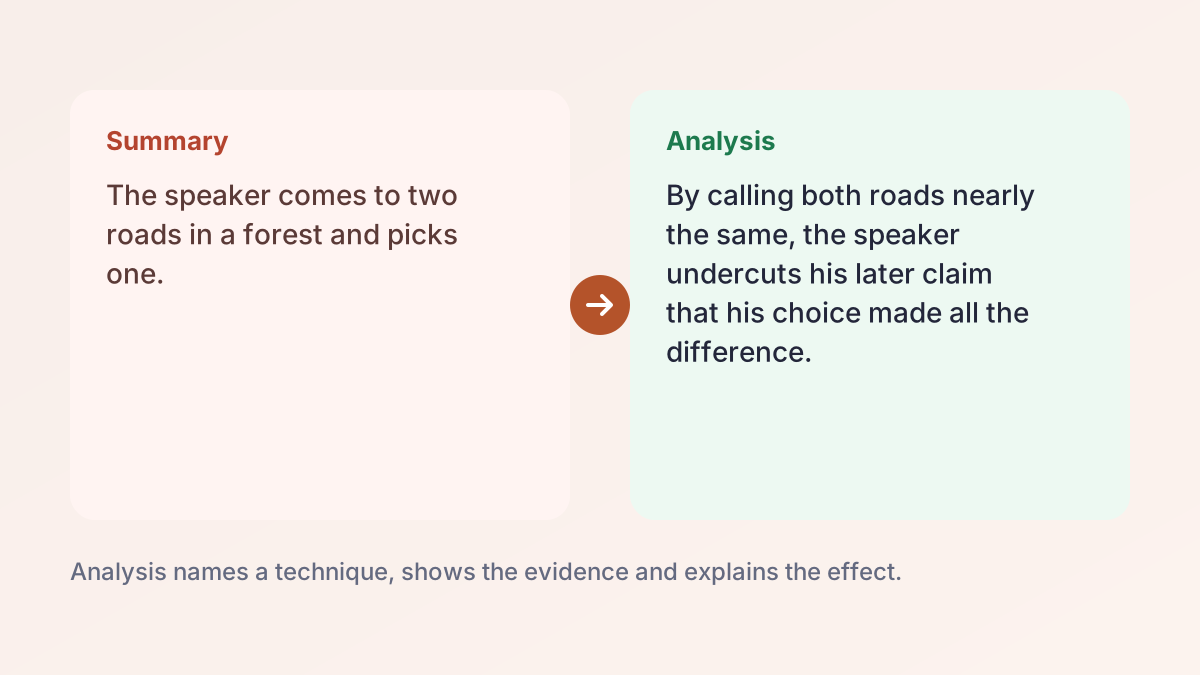
Summary tells the reader what happens, and a summary has no analytical essay thesis. Analysis tells the reader how the text works and why that matters. The table above shows the contrast at a glance. Most weak analytical drafts, whatever their analytical essay structure, are really summaries with a thesis tacked on, so test every paragraph by asking "so what?"
Analytical vs. argumentative
The two overlap, because an analytical thesis is an interpretation that others could dispute. In many classes, an argumentative essay defends a position on an issue, while an analytical essay interprets a text or subject. Our guide to what an argumentative essay is covers the neighboring genre, and what a rhetorical analysis is covers a close relative.
Analytical Essay Structure: The Five Parts
The analytical essay structure below is the one most high school and college literature, history and film classes expect. It's a convention, not a law, but if you can produce these parts in order you can adapt this analytical essay structure to almost any prompt.
| Part | What it does | Where it goes |
|---|---|---|
| Context | Names the text and gives brief background | Start of the introduction |
| Thesis | States an interpretation of how or why | End of the introduction |
| Body paragraphs | Each makes one claim with evidence and analysis | Middle of the essay |
| Transitions | Show how one point builds on the last | Between paragraphs |
| Conclusion | Says what the analysis reveals | Final paragraph |
Structure of an analytical essay in five paragraphs
The five-paragraph analytical essay structure is an introduction, three body paragraphs and a conclusion. It's a teaching tool, and timed tests often ask for it. Longer papers use the same logic, with several paragraphs per point. A point is usually a technique, a cause or a component, and the body's job is to examine each one.
Ways to order your body paragraphs
Choose an order that builds the argument. Moving through the text from beginning to end works for a poem or short story. Ordering by importance, with the strongest point last, works for a topic with one dominant idea. Moving from simple to complex suits a text with layers. Say the order in your thesis so that the analytical essay structure is clear from the first paragraph.
Format on the page
Layout is separate from structure. Most teachers expect a title, double spacing, a 12-point font and one-inch margins, plus a heading in your class's style. See our guides to the MLA heading and APA format guidelines. The assignment sheet overrides any general rule.
Analytical Essay Thesis: A Formula and Fixes
The analytical essay thesis is the most important sentence in the essay, and the whole analytical essay structure depends on it. The UNC Writing Center's guide to thesis statements puts it plainly: "A thesis is an interpretation of a question or subject, not the subject itself." It adds that a strong thesis makes a claim that others might dispute and works as a road map for the paper.
A formula you can adapt
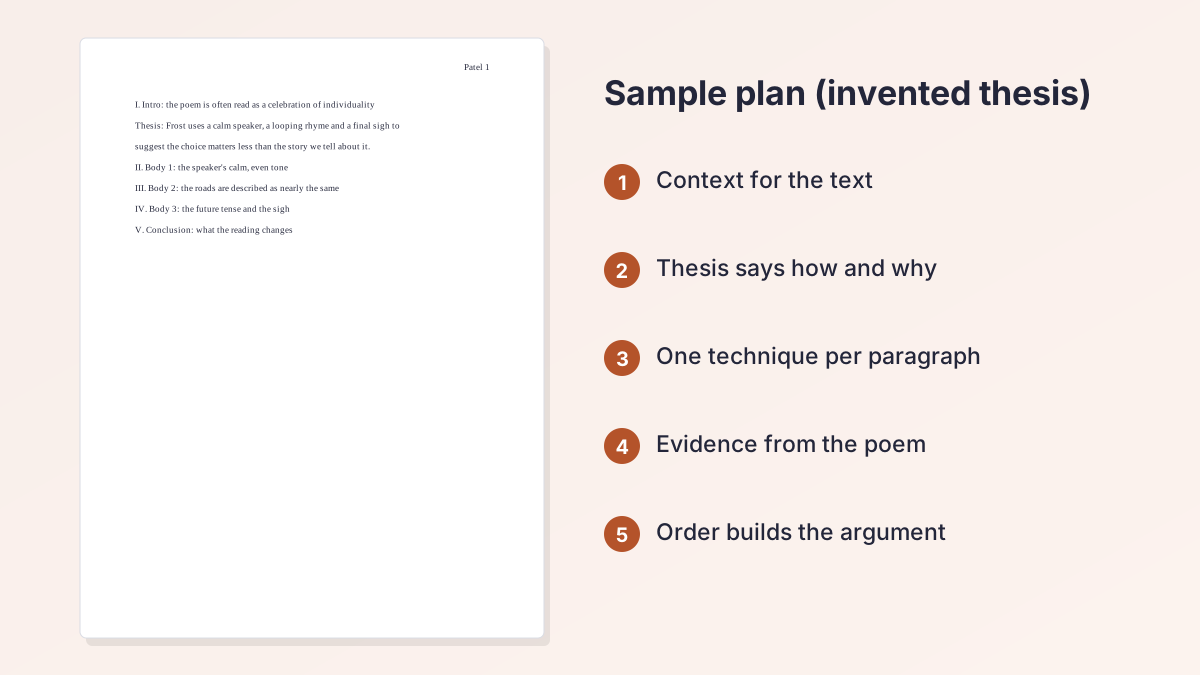
Try this pattern: "In [text], [author] uses [technique or choice] to show [effect or idea], which suggests [larger meaning]." For example: "In 'The Road Not Taken,' Frost uses a calm speaker and a looping rhyme to suggest that our choices matter less than the stories we tell about them." The sentence names the text, the techniques, the effect and the larger point. Treat it as scaffolding, then rewrite it in your own voice so it doesn't read like a template.
Testing your analytical essay thesis
To test an analytical essay thesis, ask three questions. Could a thoughtful reader disagree? Does it answer how or why, not what? Could you prove it with evidence from the text? If any answer is no, revise. The thesis statement generator can help you reword it.
Analytical essay introduction
A strong analytical essay introduction has three moves: name the text and its author, give a sentence or two of context and end with the thesis. Skip sweeping openers such as "Since the beginning of time." A short, specific hook about the text works better, and our guide on how to write an introduction covers hook types in detail.
Body Paragraphs: Claim, Evidence, Analysis
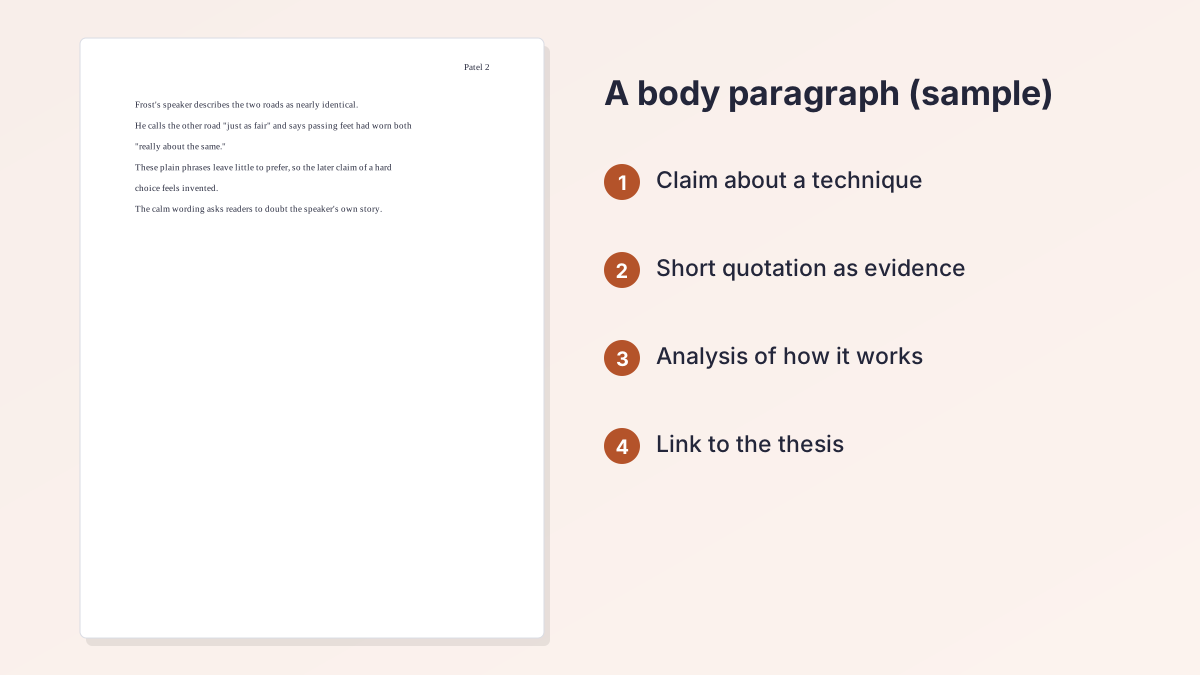
Each body paragraph in an analytical essay structure does one job: it proves one part of the thesis. The most reliable pattern has four moves. Open with a claim about the text. Add short evidence, such as a quotation, a detail or a statistic. Explain how the evidence supports the claim, which is the analysis. Close with a sentence that links to the thesis. Many classes teach this as a three-part chain of point, evidence and explanation, and the labels vary. Purdue OWL's paragraph guide advises keeping one idea to one paragraph.
A sample paragraph on a poem
The page above shows one built from these moves, using two short phrases from Robert Frost's "The Road Not Taken," first published in 1915. The claim is that the speaker describes the two roads as nearly identical. The evidence is the phrases "just as fair" and "really about the same." The analysis explains that the plain wording leaves little to prefer, so the speaker's later claim of a hard choice feels invented. The paragraph is a model written for this guide, not a finished reading of the poem.
Analyze more than you quote
A good rule of thumb is to write at least as much analysis as evidence. If a quote needs explaining, give it a sentence or two of your own directly after. For help on citing, see MLA in-text citation.
Transitions between points
Use "first," "in addition" and "most important" to order points. Use "as a result" and "this suggests" to move from evidence to meaning, and "however" to show a complication. Our guide to transition words for essays sorts them by purpose.
A Reusable Plan for Any Analytical Essay
An analytical essay template saves time because it turns the structure into blanks to fill with your own analysis. Keep this skeleton handy. Introduction: name the text and author, add context, state the thesis. Body paragraph one to three: claim about one technique, short evidence, analysis of how it works, link to the thesis. Conclusion: restate the thesis in new words, gather the points, say what the analysis reveals. Use this analytical essay template as scaffolding, then replace each blank with specifics from your own text. If you'd like a labeled plan generated from your thesis, the analytical essay outline on our tool page gives you one to edit, and the essay outline generator works for any essay type.
When the prompt asks for summary and analysis
You may also see the phrase analytical summary essay. Usage varies, so an analytical summary essay can mean different things, and some assignments mean a short summary of a text followed by an analysis of how it is built. If your prompt says this, spend a quarter of the essay on a neutral summary and the rest on analysis, with a thesis that makes the interpretation clear. Always check your assignment sheet, because teachers use the label differently.
Choosing a text and a focus
Pick a passage or a feature you can examine closely in your page limit. Every analytical essay template works better when the focus is narrow. If you need ideas, browse the free list of analytical essay topics and narrow whichever you choose to one technique or cause.
Analytical Essay Structure for a Poem or Film
The same analytical essay structure works for a poem, a short story, a film or a historical source. Only the evidence changes. Analyzing a poem starts with reading closely for sound, word choice, form and shifts, and the analytical essay structure then organizes what you notice.
What to look at in a poem
Check the speaker and tone, the imagery, the rhyme and rhythm, the form, and any turn where the poem changes direction. Choose two or three features that connect, rather than listing every device you can spot. For each, ask what it does to the reader. A thesis built from those answers is a solid analytical essay thesis, and each feature becomes one body paragraph in your analytical essay structure.
What to look at in a film or history source
For a film, look at camera angles, music, editing and the order of scenes. For a historical document, look at its audience, purpose, word choice and omissions. In all cases, evidence comes from the text itself, and the claim says how that evidence creates meaning. A strong analytical essay structure for a film might give one paragraph to sound, one to editing and one to the final scene.
Conclusion and Common Mistakes
The conclusion tells readers what the analysis reveals. Purdue OWL advises revisiting the thesis in light of the evidence, not just repeating it. Restate the thesis in fresh words, pull the points together in a sentence and say what changes about how we read the text. Don't open with "In conclusion" and don't add a new point. Our guide to how to write a conclusion has more patterns.
Mistakes to check before you submit
Weak drafts tend to fail in a few predictable ways, whatever the analytical essay structure.
- Summarizing instead of analyzing. If a paragraph only tells what happens, add how and why.
- A thesis that names a topic. Replace "this essay is about" with an interpretation.
- Quotes without comment. Explain every quotation right after it.
- Two claims in one paragraph. Split them.
- Speaking for the whole text. Make claims you can prove from the passages you chose.
A quick revision checklist
Before you submit, run through a short list. Does every paragraph open with a claim rather than a plot point? Is each quotation short, introduced and explained? Have you said what the evidence shows, in your own words, at least as often as you quote? Does the order of your points make sense to a reader who has not seen your notes? Read the draft aloud, since awkward sentences and sudden jumps are easier to hear than to see. If a paragraph still feels like a retelling, ask what choice the writer made and what effect it has, then add that explanation.
Revise by reading topic sentences
Check your analytical essay structure by reading the thesis, then only the topic sentences. They should add up to the thesis. For a draft to compare with yours, try the free analytical essay tool and see how it pairs every claim with a place for your evidence. Then browse our student writing and citation guides.
Questions About Analytical Essays
What is the structure of an analytical essay?
An introduction with context and a thesis, body paragraphs that each make a claim, give evidence and explain it, and a conclusion that says what the analysis reveals.
What is an analytical essay?
An essay that breaks a subject into parts and explains how and why they create meaning or an effect, rather than retelling it.
How do you write an analytical essay thesis?
Answer a how or why question with an interpretation that others could dispute, and name the techniques or points you will examine.
What is an analytical summary essay?
Usage varies. Often it means a brief summary of a text followed by analysis of how it works. Check your assignment sheet.
Is there a fill-in plan for an analytical essay?
Yes. Introduction with context and thesis, three body paragraphs of claim, evidence and analysis, and a conclusion. Fill it with your own text.
What is the difference between analysis and summary?
Summary says what happens. Analysis says how and why the text works and what that means.
How do you write an analytical essay introduction?
Name the text, add brief context and end with your thesis. Skip sweeping openers.
How do you structure an analytical essay on a poem?
Use the same structure. Pick two or three features, such as tone, imagery and form, and give each a paragraph of claim, quoted evidence and analysis.
How long should an analytical essay be?
It depends on the assignment. A short one runs five paragraphs, while college papers run longer. Follow your instructor's page limit.
More free guides
- MLA In-Text CitationsAuthor-page citations for every kind of source, with examples.
- How to Cite a Website in MLAWorks Cited entries and in-text citations for web pages.
- MLA Works Cited PageFormat, order and hanging indents, with a full example page.
- MLA Annotated BibliographyFormat, annotation types and a complete example.
- APA Table FormatNumber, title, body and notes for APA 7 tables, with templates.
- MLA HeadingThe four-line first-page heading and the page header, with Word and Google Docs steps.
See all 80 free tools for students
Related tools
Last updated by The Study Corp editorial team.