Example of Rhetorical Analysis vs. Summary, Line by Line
Each example of rhetorical analysis below pairs a summary of a passage with the analysis a teacher wants. The speeches are public-domain US government texts quoted from National Archives transcripts; the flyer is invented. The analysis always names a choice and its effect on an audience.
Summary: what it saysRoosevelt tells Congress that Japan attacked the United States on December 7.
Analysis: how it worksBy calling the day “a date which will live in infamy,” Roosevelt tells listeners how history will judge the attack before giving a single detail.
Name the word choice, then say what it makes this audience feel.
Summary: what it saysRoosevelt lists the other places Japan attacked.
Analysis: how it worksFour sentences in a row open with “Last night,” each adding a target. The list proves a pattern, so his later “Hostilities exist.” needs no defense.
Repetition is evidence here: say what it proves.
Summary: what it saysRoosevelt says he has ordered the military to defend the country.
Analysis: how it worksSpeaking “As Commander in Chief of the Army and Navy,” Roosevelt makes his request sound like the next lawful step, not a personal wish.
Ethos is why this audience should trust this speaker.
Summary: what it saysKennedy tells Americans to serve their country.
Analysis: how it worksThe reversal in “ask not what your country can do for you—ask what you can do for your country” flips the citizen's relationship to government and makes the line easy to remember.
Name the device, then explain why its shape fits the purpose.
Summary: what it saysKennedy says the United States will defend liberty.
Analysis: how it worksFive matching phrases, “pay any price, bear any burden, meet any hardship, support any friend, oppose any foe,” build momentum and signal a commitment without limits to allies and rivals.
Connect the pattern to the audience and the moment.
Summary: what it saysThe flyer asks parents to vote yes on the school levy.
Analysis: how it worksThe headline “Your vote keeps the Lincoln High library open” speaks to parents as “you” and names their school, so a tax question becomes a personal choice.
Ads, flyers and posts can be analyzed too, not just speeches.
How to Do a Rhetorical Analysis in 6 Steps
Here is how to do a rhetorical analysis for a class essay, a timed AP response or a communication course. Steps 1 to 4 are reading and planning; most writing time goes into steps 5 and 6.
- Read the text twice. Read once for the message and once with a pen, marking the opening, the closing, shifts in tone and repeated words.
- Map the rhetorical situation. Note the speaker, audience, purpose, context and exigence. SOAPSTone is a handy checklist.
- Find the key strategies. Pick the two to four choices that do the most persuading, such as a loaded word, a statistic, repetition or a story.
- Explain each choice's effect. For every strategy, write how it works and what it makes this audience think, feel or do.
- Write an analytical thesis. State the purpose, the main strategies and their effect in one or two sentences.
- Draft by strategy and revise. Give each strategy a paragraph with a claim, a short quotation and commentary, then cut any sentence that only retells the text.
What Is a Rhetorical Analysis? Definition and Purpose
Rhetoric is the art of persuasion. A rhetorical analysis studies the choices a speaker or writer makes to move an audience. Instead of asking whether you agree with a speech or an ad, it asks how the text tries to win its audience over and whether it works. To see a draft analysis of a text you're studying, try the free Rhetorical Analysis Generator and test it against your own reading.
Rhetorical analysis definition
Here is a rhetorical analysis definition you can use in an introduction: a rhetorical analysis is an essay that examines how an author uses strategies, such as appeals to credibility, emotion and logic, to achieve a purpose with a particular audience in a particular situation. Every rhetorical analysis definition has three parts: situation, strategies and effect.
Rhetorical analysis meaning in plain English
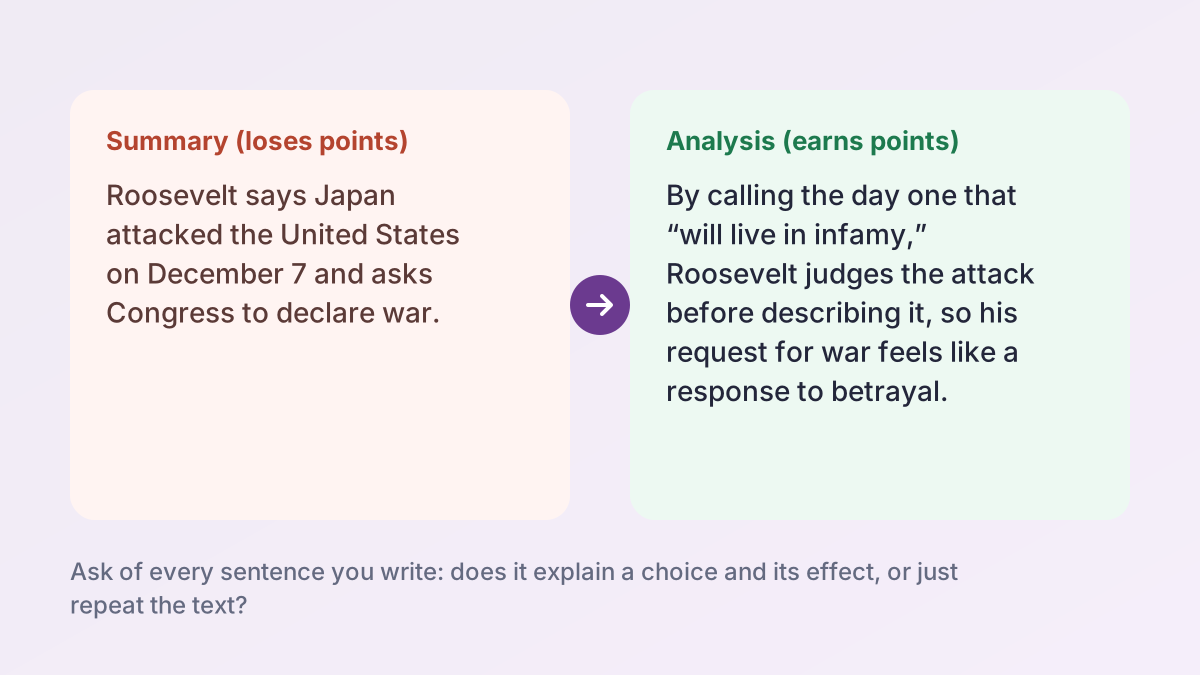
The rhetorical analysis meaning, in plain English, is "explain how it persuades." A summary says, "The speech asks Congress to declare war." An analysis says, "The speech makes war feel unavoidable by framing the attack as a betrayal." If you've wondered what is a rhetorical analysis asking you to do, that difference is the answer. Keep this rhetorical analysis meaning in mind as you write: every paragraph should explain, not retell.
What is the purpose of rhetorical analysis?
It makes you a sharper reader and a more deliberate writer. When you can explain why a sentence works, you can spot manipulation in an ad and borrow good techniques for your own arguments.
Rhetorical analysis vs. literary analysis
A literary analysis interprets fiction, poetry or drama: themes, symbols and characters. A rhetorical analysis usually looks at persuasive nonfiction, such as speeches, letters, editorials and ads, and always asks, "Who is this for, and what is it trying to get them to do?"
The Rhetorical Situation: Speaker, Audience, Purpose and Exigence
Every rhetorical analysis definition begins with context. Before you analyze a single word, describe the situation that produced the text. You can't call a choice effective without knowing whom it was meant to affect. The Purdue OWL's page on Aristotle's rhetorical situation is a good short reference.
Speaker and audience
Note the speaker's role at the moment of the text, not just their name. Then identify the intended audience and any wider one. Roosevelt's 1941 address was given to a joint session of Congress and broadcast to a nationwide radio audience.
Purpose
What should the audience think, feel or do afterward? Be specific: "to persuade" is too vague for a thesis.
Context and exigence
Context is the time, place and events around the text. Exigence is the problem that calls it into being. Lloyd Bitzer's 1968 essay "The Rhetorical Situation" described an exigence as "an imperfection marked by urgency," an idea Penn State's public speaking course builds on. For FDR, it was the attack on Pearl Harbor.
SOAPSTone
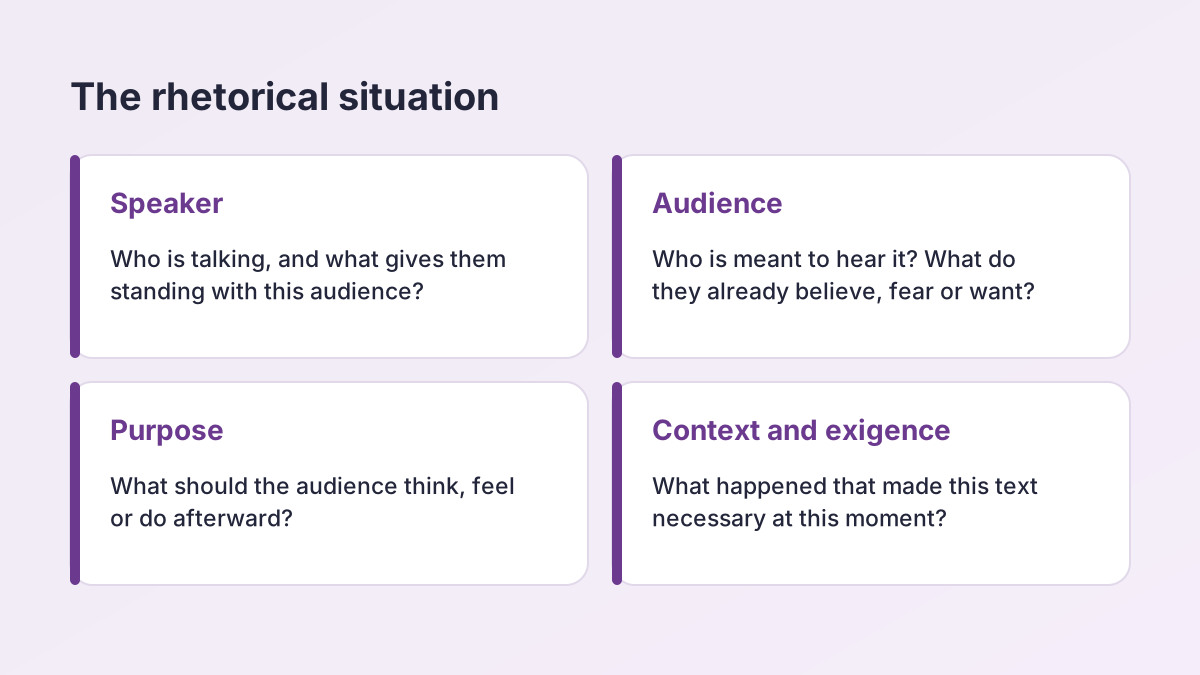
Many teachers use SOAPSTone to plan: Speaker, Occasion, Audience, Purpose, Subject and Tone. It's a planning checklist, not an essay structure.
Ethos, Pathos, Logos and Kairos Explained
Aristotle's three appeals are the vocabulary teachers expect, and kairos is often added as a fourth. When students ask "what are the 4 rhetorical strategies?" these are usually the four they mean. You'll find them in almost every example of rhetorical analysis your teacher shares.
| Appeal | What it means | Example from FDR, 1941 |
|---|---|---|
| Ethos | Credibility and character | “As Commander in Chief of the Army and Navy…” |
| Pathos | Emotion and values | “a date which will live in infamy” |
| Logos | Logic and evidence | The list of attacks on Malaya, Hong Kong, Guam and more |
| Kairos | Timing and fit to the moment | Delivered the day after the attack, before Congress voted |
Ethos, pathos and logos
Ethos is anything that makes a speaker seem trustworthy: a title, experience, or speaking for a group, as when Roosevelt says he interprets "the will of the Congress and of the people." Pathos appeals to feelings and shared values through loaded words, vivid images and stories. Logos is the logic: facts, examples, cause and effect, and the order of the reasoning.
Kairos
Kairos means saying the right thing at the right time. Roosevelt's address lasted about six minutes, and Congress passed the declaration of war the same day.
What's a Rhetorical Strategy? 7 Common Ones
A rhetorical strategy is any deliberate choice of language or structure meant to affect the audience. A strong rhetorical strategies analysis names the device briefly and spends most of its space on the effect. Learning how to do a rhetorical analysis well is mostly learning to explain these effects.
| Strategy | What it is | Typical effect |
|---|---|---|
| Diction | Specific, often loaded word choice | Sets tone and steers judgment |
| Anaphora | Repeated words at the start of sentences | Builds rhythm and accumulation |
| Parallelism | Matching structures in a series | Makes ideas feel balanced and memorable |
| Antithesis | Contrasting ideas in balanced phrases | Sharpens a choice |
| Chiasmus | Reversed word order in two phrases | Makes a line quotable |
| Anecdote | A brief story | Puts a human face on an issue |
| Rhetorical question | A question asked for effect | Pulls the audience into the reasoning |
How to identify rhetorical strategies
Start where the text works hardest: the opening, the ending, repeated words, and any change in tone. Ask, "Why is this sentence built this way and not another?"
How to analyze rhetorical strategies
For each device, explain the mechanism and the effect, then link it to the purpose. "Roosevelt uses repetition" is an observation; "the repeated 'Last night' turns separate reports into a pattern of aggression" is analysis.
A Full Example of Rhetorical Analysis: FDR's “Infamy” Speech
This worked example of rhetorical analysis uses President Franklin D. Roosevelt's address to Congress on December 8, 1941. The full transcript at the National Archives is only about 500 words long, so it's ideal practice for an AP English Language class or any rhetorical speech analysis.
The rhetorical situation
| Element | FDR's address |
|---|---|
| Speaker | President Roosevelt, as Commander in Chief |
| Occasion | The attack on Pearl Harbor and other Pacific targets, December 7, 1941 |
| Audience | Congress, which had to vote; the public, by radio |
| Purpose | Win a declaration of war and unite the country |
| Tone | Grave, controlled, resolute |
Thesis
"In his December 8, 1941, address, Franklin D. Roosevelt turns shock into resolve: loaded diction frames the attack as a betrayal, a drumbeat of short factual sentences proves the danger is real, and his authority as Commander in Chief makes war feel like the only answer."
Body paragraph: diction
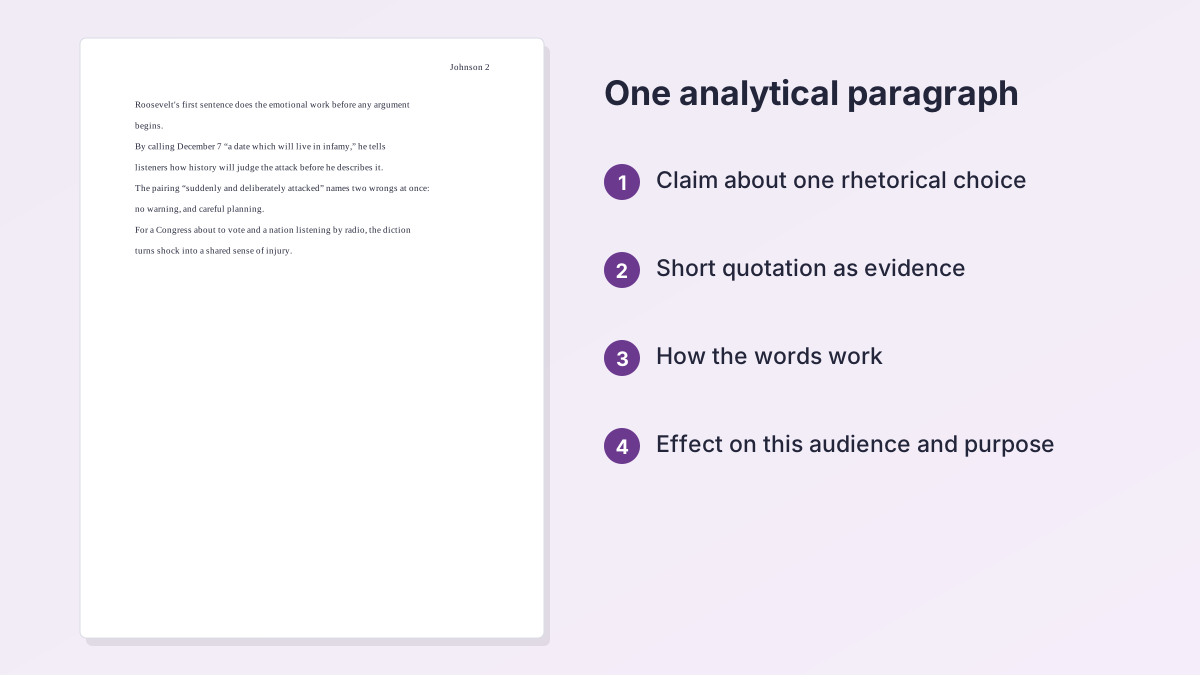
Roosevelt's first sentence does the emotional work before any argument begins. By calling December 7 "a date which will live in infamy," he tells listeners how history will judge the attack before he describes it. The pairing "suddenly and deliberately attacked" names two wrongs: no warning, and careful planning. His drafts, described by the National Archives, show he replaced "world history" with "infamy" and "simultaneously" with "suddenly," trading neutral words for judgmental ones.
Body paragraph: repetition and evidence
The middle of the speech argues by accumulation. Roosevelt opens four straight sentences with "Last night," including "Last night Japanese forces attacked Hong Kong." Together they show "a surprise offensive extending throughout the Pacific area," not a single incident. Right after the list, he says, "The facts of yesterday and today speak for themselves." Near the end comes a two-word conclusion: "Hostilities exist."
Conclusion
The final section pairs authority with confidence: the promise that "the American people in their righteous might will win through to absolute victory" answers the grief of the opening. The speech succeeded because it was brief, timely and built so every section prepared listeners for the request at the end.
Why this example of rhetorical analysis works
Each paragraph makes one claim, quotes a few words, and explains the effect on Congress and the radio audience. Nothing retells the speech in order. Use this example of rhetorical analysis as a model for your own essay.
The AP Lang Rhetorical Analysis Essay
In AP English Language and Composition, the rhetorical analysis essay is the second of three free-response questions. According to the College Board's AP Central exam page, you read a nonfiction passage and analyze how the writer's language choices contribute to its intended meaning. The free-response section lasts 2 hours and 15 minutes, including a 15-minute reading period, which leaves roughly 40 minutes per essay if you split the time evenly. Each essay is scored out of 6 points.
What is a rhetorical analysis question on the AP exam?
The prompt introduces the passage and its author, then asks you to write an essay that analyzes the rhetorical choices the writer makes to develop an argument.
| Rubric row | Points | What earns the top score |
|---|---|---|
| A. Thesis | 0–1 | A defensible thesis that analyzes the writer's rhetorical choices |
| B. Evidence and commentary | 0–4 | Specific evidence for every claim; explains how multiple rhetorical choices contribute to the argument, purpose or message |
| C. Sophistication | 0–1 | Sophistication of thought or a complex understanding of the rhetorical situation |
Row B is where most points are won, and it rewards commentary, not quotation. Plan for about 10 minutes, pick two or three strategies, quote a few words at a time, and spend two or three sentences explaining each quotation. Practice how to do a rhetorical analysis in 40 minutes with past prompts from AP Central.
Outline Template for Writing a Rhetorical Analysis Paper
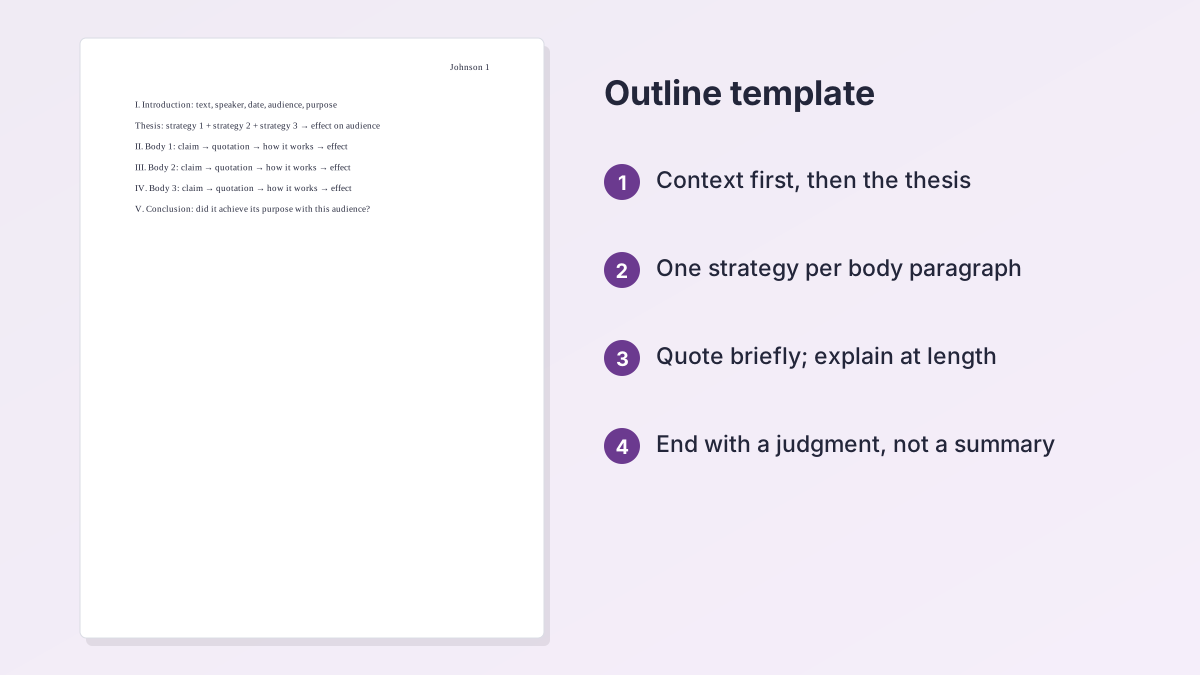
This outline shows how to do a rhetorical analysis on paper. Most essays for high school and first-year college courses, such as ENGL 1301 at a community college, follow it. Adjust the number of body paragraphs to your word count.
Introduction
- Context: title, speaker, date, audience and occasion.
- Thesis: the main strategies and their overall effect. The thesis statement generator can suggest versions to adapt.
Body paragraphs (one per strategy)
- Claim about one strategy and its effect.
- A short, embedded quotation.
- Two or three sentences on how the words work for this audience.
Conclusion
- Judge the text as a whole: did it achieve its purpose with this audience?
Organize by strategy, not by the order of the text; walking through it start to finish tempts you to summarize. If your teacher uses MLA, see how to cite quotations in MLA and set up an MLA heading. For a model of each part, reread the FDR example of rhetorical analysis above.
Common Mistakes: Summarizing Instead of Analyzing
Most weak essays describe the text instead of explaining it. A strong example of rhetorical analysis avoids these four habits.
Summarizing
If a sentence could appear in a news report, it isn't analysis. Replace "Roosevelt then lists the attacks" with what the list does to the audience.
Device-spotting without effect
"Kennedy uses chiasmus" earns almost nothing. Name the device in a phrase and spend your sentences on its effect.
Arguing with the speaker
You can disagree with an argument and still explain how it was built to persuade its original audience. Keep your opinion on the topic out of it.
Ignoring the audience
"Effective" means nothing without "for whom." Always tie a choice to the specific audience and situation.
Why Is Rhetorical Analysis Important?
Once you know what is a rhetorical analysis really asks, you'll see rhetoric everywhere. Every day you read headlines, ads and posts designed to change what you think or buy. Knowing how to rhetorically analyze a text helps you notice when emotion is standing in for evidence. The same skill powers history papers on primary sources and persuasive writing at work. Outside class, the rhetorical analysis meaning is simply media literacy.
If your essay quotes a speech, list it on your MLA Works Cited page, and browse all our student writing and citation guides. When you have a text to study, open the free rhetorical analysis tool: paste the speech or text, describe the audience, choose the text type (speech, writing, presentation or commercial), add the author and background, and select Analyze. Use its draft as a model, and make sure every claim in your essay rests on a quotation you found yourself.
Questions About Rhetorical Analysis
What is a rhetorical analysis in simple terms?
An essay that explains how a text persuades its audience: the choices the author makes, such as word choice, evidence and emotional appeals, and whether they work.
What does rhetorical analysis mean?
The rhetorical analysis meaning is simple: explaining how a text persuades a specific audience, rather than summarizing what it says.
Where can I find an example of rhetorical analysis?
This guide includes a full example of rhetorical analysis of FDR's December 8, 1941 address, plus short examples from JFK's 1961 inaugural address.
What is the purpose of a rhetorical analysis?
To understand how persuasion works, so you read more critically and write stronger arguments.
What are the 4 rhetorical strategies?
Usually ethos (credibility), pathos (emotion), logos (logic) and kairos (timing).
What's a rhetorical strategy?
A deliberate choice of language or structure meant to affect an audience, such as repetition, a loaded word or a rhetorical question.
How do you do a rhetorical analysis?
To learn how to do a rhetorical analysis, follow six steps: read twice, map the situation, find strategies, explain effects, write a thesis, and draft by strategy.
How do you start a rhetorical analysis essay?
Introduce the text, speaker, date, audience and purpose, then give a thesis naming the main strategies and their effect.
What is the difference between literary analysis and rhetorical analysis?
Literary analysis interprets fiction and poetry for meaning. Rhetorical analysis examines how persuasive texts work on an audience.
More free guides
- MLA In-Text CitationsAuthor-page citations for every kind of source, with examples.
- How to Cite a Website in MLAWorks Cited entries and in-text citations for web pages.
- MLA Works Cited PageFormat, order and hanging indents, with a full example page.
- MLA Annotated BibliographyFormat, annotation types and a complete example.
- APA Table FormatNumber, title, body and notes for APA 7 tables, with templates.
- MLA HeadingThe four-line first-page heading and the page header, with Word and Google Docs steps.
See all 80 free tools for students
Related tools
Last updated by The Study Corp editorial team.