Essay rewriter examples
Three sentences from a student essay, before and after. The claims, citations and hedges stay; the writing improves.
BeforeThis change is important because the news that people see on these apps is chosen by algorithms.
AfterThis change matters because algorithms choose the news people see on these apps.
Shorter and active, with the same claim.
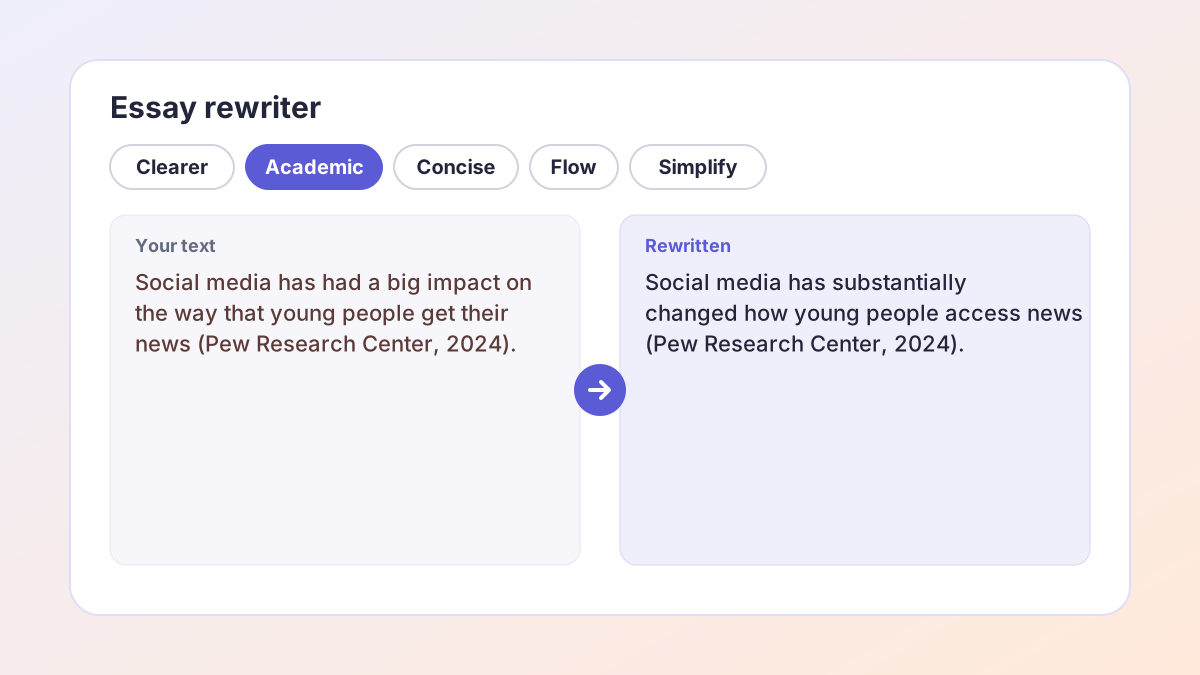
BeforeSocial media has had a big impact on the way that young people get their news.
AfterSocial media has substantially changed how young people access news.
Informal wording replaced without adding evidence.
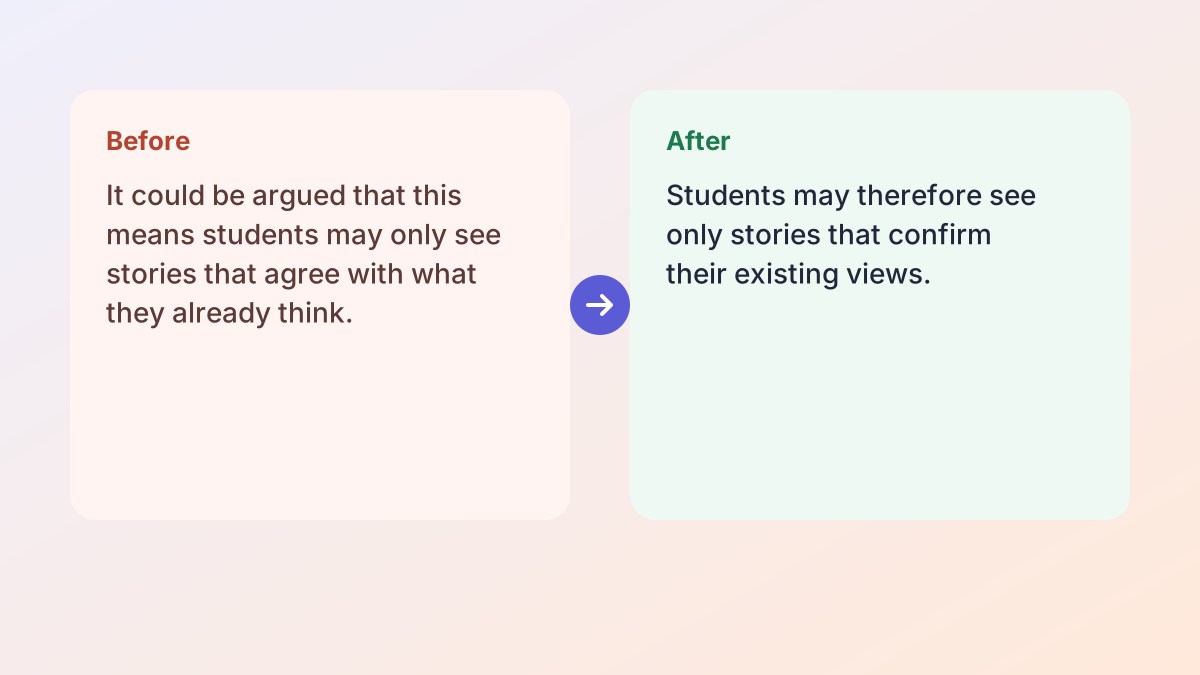
BeforeIt could be argued that this means students may only see stories that agree with what they already think.
AfterStudents may therefore see only stories that confirm their existing views.
Filler cut; the hedge “may” stays.
How to rewrite an essay with the essay rewriter
Rewrite an essay in passes: one goal per pass, one section at a time, and always a final read by you.
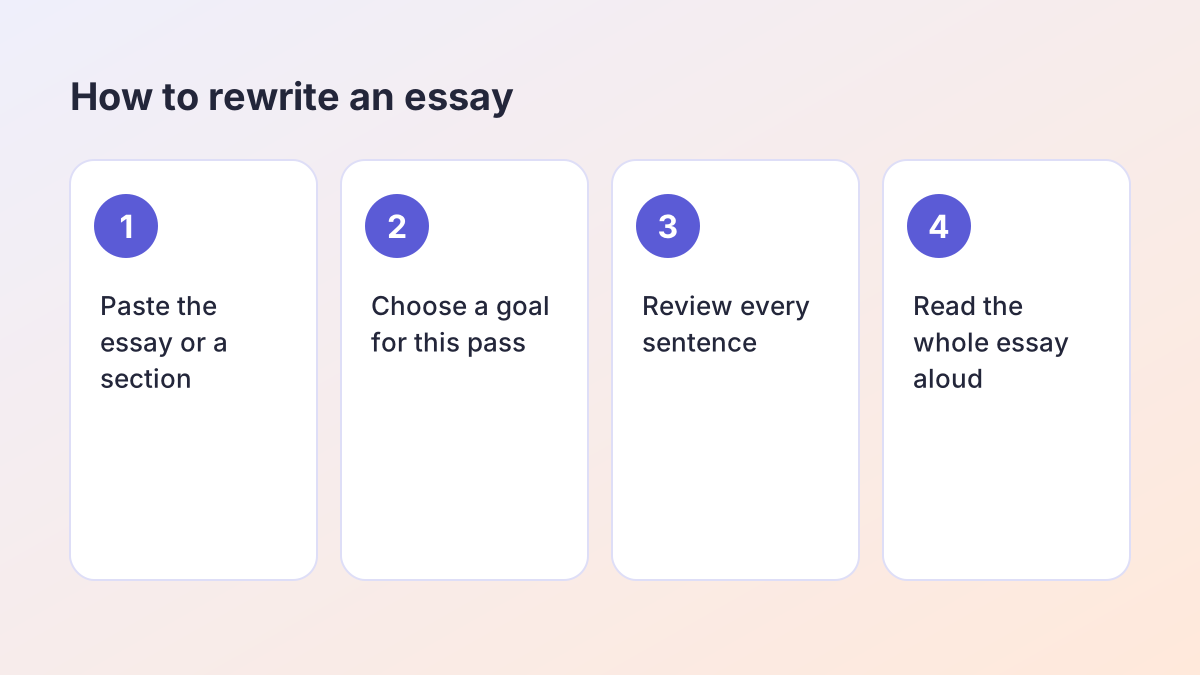
- Paste your essay. Paste up to 1,500 words, from one section to a short essay. Keep the paragraph breaks; each paragraph is rewritten in context.
- Choose a goal. Clearer untangles long sentences, Academic tone formalises wording, Concise trims filler, Improve flow smooths transitions, Simplify uses plainer words and Keep my voice makes light edits only.
- Set the amount of change. Under More options, choose Light, Balanced or Strong, and add any technical terms that must not change.
- Review each sentence. Keep your original, accept the new version or ask for alternatives. Sentences marked to check changed a negative, a hedge or a number.
- Copy and reread. Copy or download the essay, then read it aloud once from start to finish.
What the essay rewriter does
The essay rewriter rewrites the wording of your essay, not its argument. Paste up to 1,500 words, from a single section to a short essay, and every sentence comes back next to your original with the changes highlighted. Your paragraphs stay in the same order, so the structure you planned is still there when you finish.
Use it when the ideas are right but the essay reads badly: sentences that run on, the same words repeated in every paragraph, a tone that slips into speech, or a draft that is over the word count. It is also useful for the last pass before submission, with Keep my voice, to catch grammar and punctuation slips.
One tool for essays and papers
This page replaces three older tools: the Essay Reworder, the Essay Rephraser and the Research Paper Rewriter. They used the same engine for almost the same job, so they now share one page with all the features: whole-essay rewriting, paragraph-level polishing, and the safeguards for research data described below.
How to rewrite an essay without changing your argument
The safest way to rewrite an essay is in passes, each with one job. Trying to fix everything at once is how arguments drift.
- Structure first, by you. Check that each paragraph has one main point and that the order makes sense. No tool should decide your argument.
- Clarity pass. Run each section through the essay rewriter with Clearer. Long sentences get untangled; the meaning stays.
- Tone pass. Use Academic tone for informal patches: contractions, slang, “a lot of”, “really”.
- Flow pass. Use Improve flow on paragraphs that read like lists.
- Length pass. If you are over the word count, use Concise on the wordiest sections.
- Final read. Read the whole essay aloud once. Change back anything that no longer sounds like you.
Signs the essay needs a rewrite
- Your tutor's comments say “unclear”, “wordy” or “informal”.
- Several sentences are longer than about 35 words.
- You start many sentences with “This” or “It is”.
- The essay is more than 10% over the word count.
Rewrite my paper: research papers and reports
Research papers contain things that must never change in a rewrite: sample sizes, percentages, p-values, dates, names and citations. Before your paper is rewritten, the essay rewriter locks every number, citation, quotation, link and DOI, so they come back exactly as you wrote them.
Work one section at a time (methods, results, discussion, or part of your literature review), and choose the goal that fits the section:
- Methods: Clearer, or Academic tone for informal wording.
- Results: Concise, so findings are not buried. Every figure stays locked.
- Discussion: Improve flow, to strengthen the links between findings and interpretation.
Never let a claim get stronger
“Associated with” must not become “caused”, and “may” must not become “does”. The rewriter is instructed to keep the level of certainty, and it marks any sentence where a hedge disappeared, so you can put it back. Add your key terms (for example self-efficacy or randomised controlled trial) under More options so they are never swapped for synonyms.
How to paraphrase an RRL (review of related literature)
In a review of related literature, every paragraph reports what other researchers found, so paraphrasing and citing go together. Group studies by theme rather than summarising one study per paragraph. For each study, put the finding in your own words with its citation, then say how the studies agree, differ or leave a gap. That last part, the synthesis, is what makes a literature review more than a list.
Paste one theme at a time: the essay rewriter keeps every author, year and statistic exactly as written while it smooths the wording. It cannot read the studies for you, so write your first draft from your own notes. The University of Oregon's guide to writing a literature review puts it well: digest your sources rather than quote them.
Paraphrasing evidence in the essay
Paraphrased evidence is a source's finding put into your own sentence, with a citation. Introduce it (Fletcher and Nielsen (2018) found that…), keep the numbers and certainty exactly as the source states them, then explain what it shows for your argument.
More than an essay word changer
A basic essay word changer swaps words for synonyms one at a time. That is how “the results were significant” turns into “the outcomes were momentous”, and how a clear essay becomes harder to read. It also leaves the original sentence structure in place, which is exactly what plagiarism checkers and markers notice.
The essay rewriter rewrites whole sentences for the goal you choose, keeps your technical terms, and shows each change next to your original. The essay still sounds like you, and it still says what you meant.
About “essay rewriter” videos on TikTok
Short videos often promise an essay rewriter that makes any text undetectable or “turns an article into your essay”. That is not what this tool does, and using any tool that way is plagiarism. This one improves your own writing and keeps your citations so your sources stay credited.
How to rewrite my essay without plagiarizing
Rewriting your own essay is editing, and it never counts as plagiarism. Problems start when the essay contains other people's ideas without credit, or when a source's sentences were changed only slightly.
- Cite every source, whether you quote it or put it in your own words.
- Quote exact words in quotation marks, with a page number where your style requires it.
- Paraphrase properly: new structure and wording, same meaning, plus a citation.
- Don't paste a source into a rewriter and present the output as your own.
Purdue OWL's page on avoiding plagiarism explains what needs a citation and what counts as common knowledge. For references, use the APA citation generator or the MLA citation generator.
Check your course's rules on AI writing tools before using one on assessed work, and read every suggestion: you are responsible for what you submit.
What the essay rewriter never changes
Every rewrite is checked before you see it.
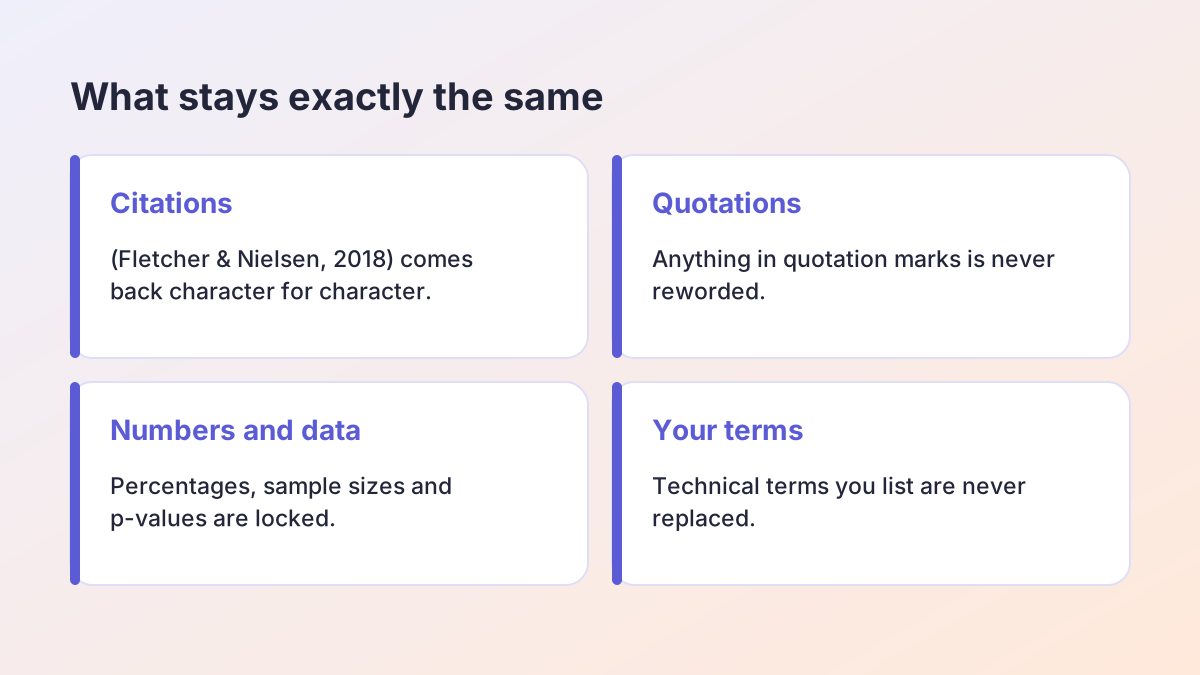
- Citations such as (Fletcher & Nielsen, 2018) or Smith (2020) are locked and restored character for character.
- Quotations in quotation marks are never reworded.
- Numbers, percentages, dates, links and DOIs are locked.
- Terms you list under More options are never replaced.
- Negatives and hedges are watched: if “not” or “may” changes, the sentence is marked to check.
If a rewrite would change a locked detail, the essay rewriter keeps your original sentence instead. Nothing replaces your text until you choose it.
Why this matters for marks
A changed number or a dropped “not” can turn a correct essay into an incorrect one, and a mangled citation can look like careless referencing. Markers notice both. Locking these details means a rewrite can only improve how your essay reads, never what it reports, so you can spend your checking time on the sentences that were actually marked.
Cutting an essay down to the word count
Going over the word limit is one of the most common reasons to rewrite an essay. Cutting whole paragraphs loses points; cutting filler does not.
Start with Concise on the wordiest sections, usually the introduction and any paragraph that summarises. Typical savings come from phrases such as “due to the fact that” (because), “in order to” (to), “it is important to note that” (delete it) and “a large number of” (many). The Writing Center at UNC's handout on writing concisely lists more.
If you need to compress a specific passage into one or two sentences, the Sentence Shortener does exactly that. If a section is too thin, the Sentence Expander can develop what it already says without inventing evidence.
Using the essay rewriter after tutor feedback
Tutor feedback is the best guide to what a rewrite should fix. Match each comment to a goal before you paste anything.
- “Unclear” or “hard to follow”: Clearer, on the paragraphs marked.
- “Too informal” or “colloquial”: Academic tone.
- “Wordy” or “over the limit”: Concise.
- “Disjointed” or “needs better transitions”: Improve flow.
- “Careless errors”: Keep my voice, for grammar and punctuation.
Comments about argument, evidence or analysis are different. “Needs more analysis” or “weak evidence” means you need to add thinking, not new wording, and no essay rewriter can do that for you. Fix those first, then rewrite the sentences.
When you resubmit, keep a copy of the version you received feedback on. Comparing the two helps you see which changes made the difference, and it is useful evidence of your own work if anyone asks how the essay developed.
Rewriting different types of essay
The same essay rewriter works for every essay type, but the best goal changes.
- Argumentative and persuasive essays: Clearer and Academic tone. Keep your hedges where the evidence is limited; a persuasive essay is more convincing when its claims are accurate.
- Compare-and-contrast essays: Improve flow, so that comparison words (similarly, in contrast, whereas) link the two sides.
- Reflective essays: Keep my voice. Reflection is personal, so only light edits.
- Literature essays: Academic tone, but never reword the quotations you analyse. They are locked automatically.
- Lab reports and research papers: Concise and Clearer, section by section, with data locked.
If you are still drafting rather than rewriting, The Study Corp's essay generators can help you plan, for example the argumentative essay generator.
Rewriting introductions and conclusions
Introductions and conclusions are the paragraphs markers read most closely, and the ones most often rewritten.
Introductions
An introduction should move from context to your thesis without wasting words. Use Clearer to tighten the opening sentences and Concise to remove throat-clearing such as “Since the dawn of time”. Keep your thesis sentence as it is unless you are sure the rewrite says the same thing.
Conclusions
A conclusion restates the thesis in new words, draws the main points together and ends with why it matters. The Restate Thesis Generator is built for the first part: it rewrites your thesis with a new structure while keeping the same claim.
Essay rewriter FAQ
Is the essay rewriter free?
Yes. It is free with no account or sign-up. A fair hourly allowance per visitor keeps it fast for everyone.
Can I rewrite a whole essay at once?
Yes, up to 1,500 words at a time. For longer essays, rewrite one section at a time so you can review each change properly.
Can it rewrite my research paper?
Yes, section by section. Numbers, statistics, citations, quotations, links and DOIs are locked, and any sentence where a hedge or negative changed is marked to check.
Will it change my citations, quotes or data?
No. They are locked first. If a suggestion alters one, the tool keeps your original sentence.
How do I rewrite my essay without plagiarizing?
Rewrite your own writing, and cite every idea that came from a source, however differently you phrase it. Never paste a source in and present the output as yours.
What happened to the Essay Rephraser and Paper Rewriter?
They used the same engine for almost the same job, so they are now part of this essay rewriter. Their old addresses redirect here.
Is my essay stored?
The Study Corp does not save your text. It is sent to our AI providers (Groq, with Google Gemini as a backup) only to create the suggestions you see.
More free rewriting tools
- AI Paraphrasing ToolParaphrase any text, and learn to paraphrase and cite well.
- AI Sentence RewriterFix an awkward sentence and choose from several better versions.
- Paragraph RewriterMake the sentences in one paragraph connect and flow.
- Rewording ToolReword any text in fresh words: emails, reports, applications and more.
- Restate Thesis GeneratorRestate your thesis in new words for the conclusion, keeping the same claim.
- Text SimplifierSimplify text to a reading level: grade 5, grade 7, grade 9 or plain English.
- Sentence ShortenerShorten text or combine it into 1, 2 or 3 sentences, keeping every key fact.
- Sentence FinisherGet five ways to finish a sentence you started.
- Say It BetterFind a better way to say a sentence or phrase, with alternatives.
- Sentence ExpanderExpand a sentence into a fuller, more detailed version without new facts.
- Poem RewriterParaphrase a poem line by line, modernise it, or polish your own poem.
See all 74 free tools for students
Related tools
Last updated by The Study Corp editorial team.