Quote analysis examples
What a student might type and the kind of result the tool gives. These are illustrative: your results will differ, and the Lincoln and Dickinson lines are public-domain texts.
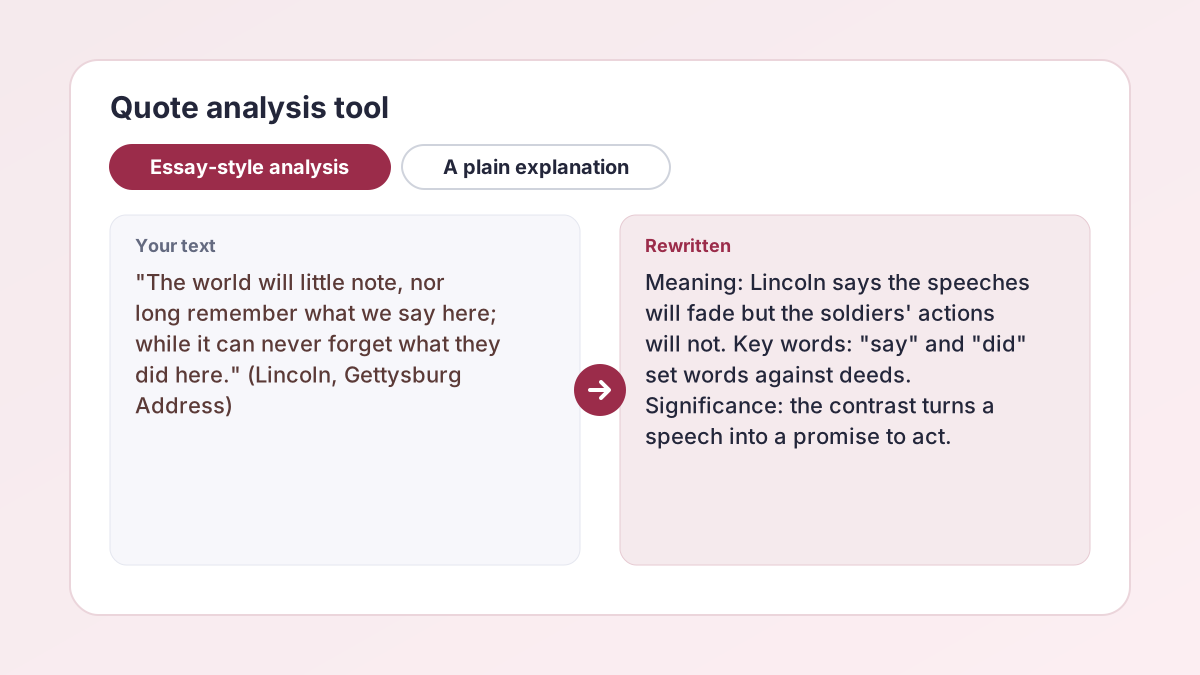
You typedQuote: "The world will little note, nor long remember what we say here; while it can never forget what they did here." Source: Abraham Lincoln, the Gettysburg Address. Context: my essay is about how Lincoln uses contrast.
Result (part of it)Key words and devices: Lincoln sets "say" against "did", an antithesis that puts words and actions on opposite sides. The verbs "note" and "remember" both concern how the world pays attention, and the speaker's own words are described as forgettable, a modest tone that shifts the honor to the soldiers.
Each device is named, quoted from your text and tied to an effect.
You typedQuote: "The world will little note, nor long remember what we say here; while it can never forget what they did here." (chip: A plain explanation)
Result (part of it)Meaning: Lincoln is saying that people will soon forget the speeches given at the ceremony, but they will not forget what the soldiers did. In simple terms, actions matter more than words. He includes himself in the "we", which makes the point feel humble rather than boastful.
Same quote, simpler language, for when you only need to understand it.
You typedQuote: "Hope" is the thing with feathers / That perches in the soul (Source: Emily Dickinson, poem 254, first published 1891. Level: College.)
Result (part of it)Key words and devices: the extended metaphor compares hope to a bird. "Perches" suggests something light and temporary that has nonetheless chosen to stay, and "soul" places the bird inside the self. The comparison makes an abstract feeling small, alive and easy to picture.
The tool names the device and says what the comparison does, not just that it exists.
You typedQuote: "Nobody ever thanks the person who held the door; they only notice the one who slammed it." (an invented line for this example) Source: left blank.
Result (part of it)Meaning: the quote claims that people notice rudeness more than kindness. Significance: because no speaker or source was given, this analysis looks only at the words. Adding who said it and where would let the tool connect the line to a character, theme or argument.
It does not guess who said a quote or where it is from.
You typedThe same Lincoln quote, with the context line from the first example.
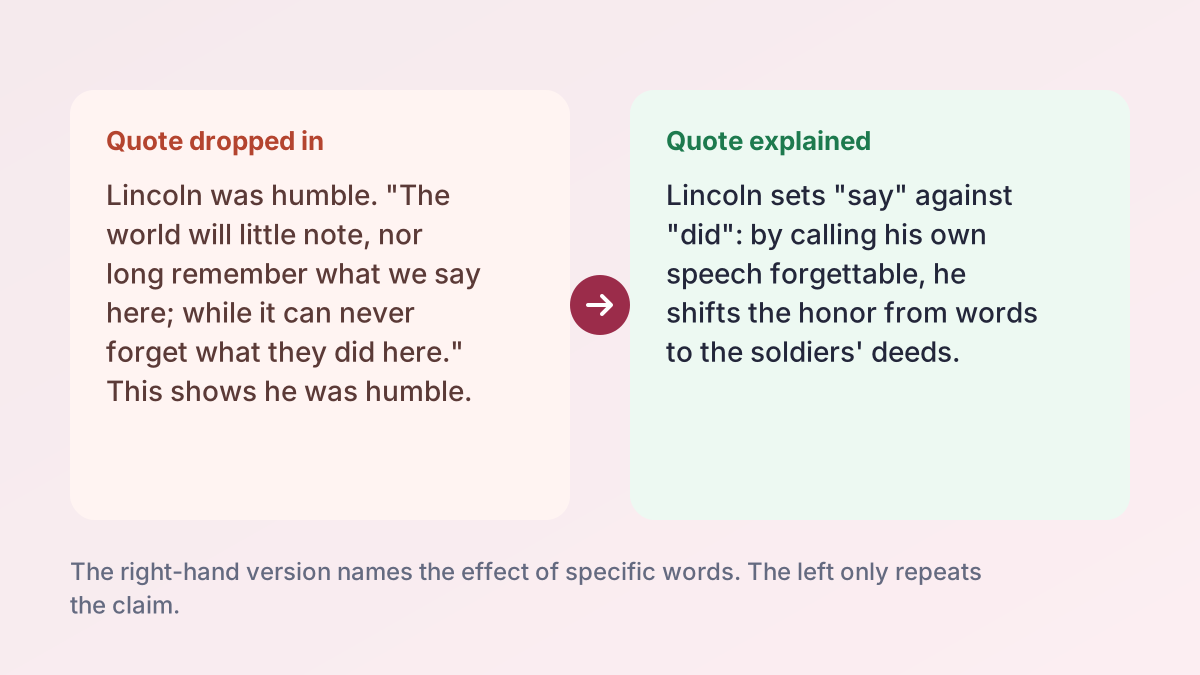
Result (part of it)Sample analysis paragraph: In the Gettysburg Address, Lincoln predicts, "The world will little note, nor long remember what we say here; while it can never forget what they did here." By setting "say" against "did", he turns a speech into a tribute to action. The contrast is also modest: Lincoln predicts that his own words will be forgotten, so the soldiers receive the credit.
A model paragraph that introduces, quotes and explains. Rewrite it in your own voice.
You typedQuote: "Hope" is the thing with feathers / That perches in the soul
Result (part of it)If a result put a quotation of four or more words in quotation marks that is not in the Quote box, the note [check this quote against your text] would appear right after it. Fragments of three words or fewer are not checked.
The check compares against the Quote box only, so a line from elsewhere in the poem would be flagged too.
How to use the quote analysis tool
The tool works from the words you paste, so the more accurately you copy them, the better the result.
- Choose what you need. Under I need, pick Essay-style analysis for a literature or history essay, or A plain explanation to understand the line.
- Paste the quote. Put the exact words in the Quote box, up to 1,200 characters. Keep line breaks for verse.
- Add who said it and the context. Fill in Who said it, and where it is from, and Context or your essay topic. Both are optional, but they stop the analysis from staying generic.
- Set the level. Choose High school, College, Middle school or Graduate. You can also switch between US and UK spelling.
- Select Analyze the quote. Read the four parts, copy the ones you want, and use Generate more for another take.
What quote analysis covers, and what the tool returns
Quote analysis means taking a short passage apart to show how its words make meaning, and then connecting that meaning to a bigger point. A quote is evidence, but evidence does nothing until you explain it. In most English and history classes, the explanation earns more credit than the quotation itself.
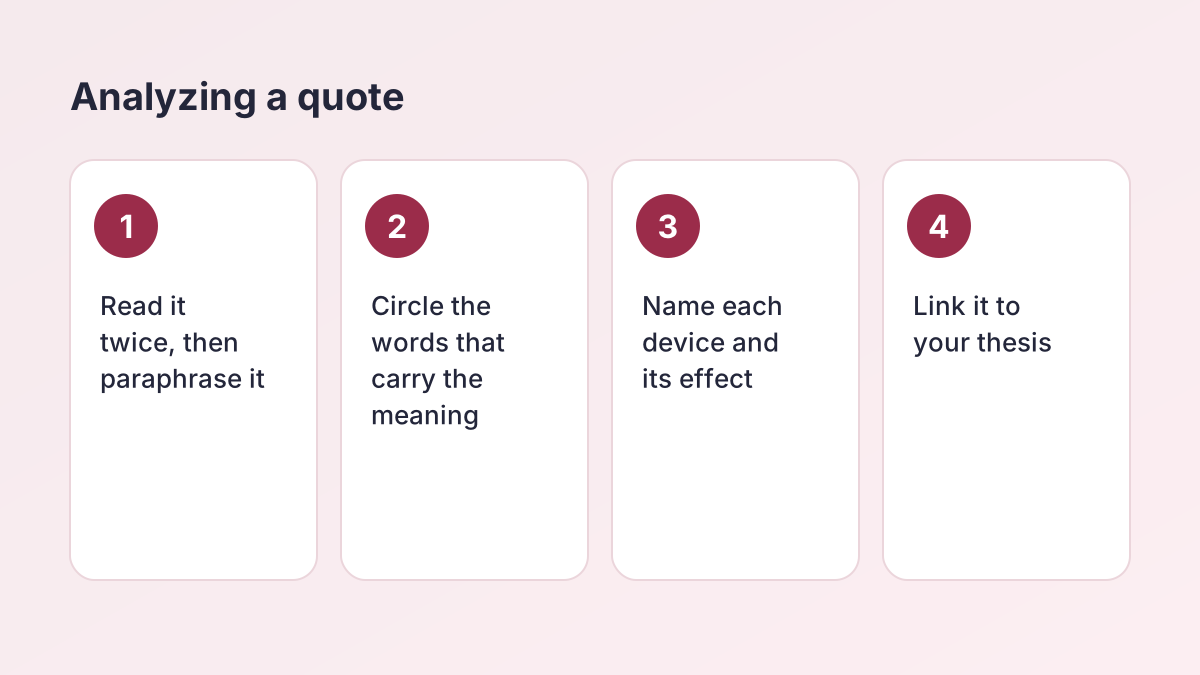
The tool returns four labeled parts:
- Meaning: what the quote says on the surface, then what it implies.
- Key words and devices: the words that carry the weight, plus each literary or rhetorical device it finds, with what that device does.
- Significance: why the quote matters to the theme, the character or the argument.
- Sample analysis paragraph: one paragraph of 120 to 170 words that introduces the quote, quotes it and explains it.
How the choices change the result
The I need chips set the approach. Essay-style analysis reads the quote the way a literature or history essay would. A plain explanation focuses on what the quote means and why it matters, in simpler terms. The Level menu tells the AI who it is writing for, from middle school to graduate, so the vocabulary and depth shift with it.
How to analyze a quote: a five-step method
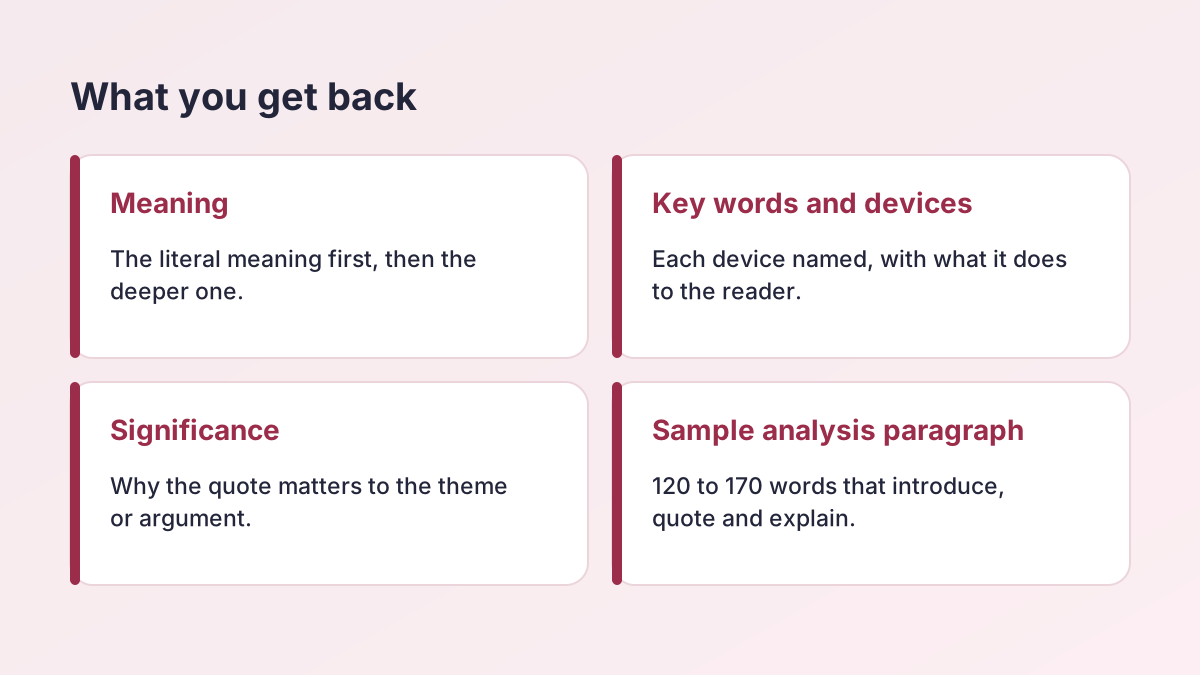
You can do this without any tool, and doing it yourself a few times makes the tool's output easier to judge. This is how to analyze a quote in five steps.
1. Read it twice and paraphrase it
Say the quote in your own plain words. If you cannot paraphrase a line, you do not yet understand it, and any analysis will be guesswork.
2. Find the words that carry the meaning
Circle the two or three words that you could not swap out without changing the effect. Look at verbs, adjectives and any word that repeats.
3. Name the devices and their effects
Metaphor, contrast, repetition, tone and sentence structure are the usual suspects. Naming a device is only half the job. Say what it makes the reader think or feel.
4. Place it in context
Who is speaking, to whom, and at what moment? The same sentence can mean different things in different scenes.
5. Link it to your argument
End by saying how the quote supports your thesis. If you cannot, the quote may not belong in your essay.
The University of North Carolina Writing Center's handout on quotations makes the same point: set each quote up with context and attribution, and explain its significance afterward.
Quote meaning: literal, deeper and why it matters
Good quote meaning has layers, and the tool's first part follows them in order.
Literal meaning
What do the words say if you take them at face value? In Lincoln's line, the world will not remember the speeches but will remember the deeds.
Deeper meaning
What does the quote suggest beyond the surface? Here, Lincoln is praising the soldiers by shrinking his own speech, and he is quietly asking the audience to match their words with actions.
Why it matters
This is the step students skip. Say what the quote adds to the work: a theme, a character's change, an argument's turning point. The Significance part of the result is built for exactly this.
Tone and speaker
Quotes sound different depending on who says them and when. If you tell the tool who said it and what is happening, the meaning stays tied to the scene instead of floating free. If you leave the source blank, the tool analyzes the words only and tells you the context would sharpen the result.
Using the quote analyzer well: source, context and level
The quote analyzer gets better as you give it more to work with. Each box has a job.
Quote
Paste the exact words, including punctuation. The box holds up to 1,200 characters, enough for a long sentence or a few lines of verse. Pasting a whole page will not help: choose the line you plan to use.
Who said it, and where it is from
Names, titles and chapters go here, for example a character and a chapter number. The tool uses only what you give it. It will not guess the speaker or the source for you.
Context or your essay topic
One or two sentences are enough. Either describe what is happening when the line is said, or paste your thesis. A thesis steers the analysis toward your argument, which makes the sample paragraph more usable.
Level and spelling
Pick the level that matches your class. The spelling menu switches between US English and UK English.
What it will not do
It will not invent background about an author or a book, and it will not add facts you did not provide. Where outside context would help, say so in the Context box yourself.
Quote analysis paragraph: a structure that works
A quote analysis paragraph has a simple shape that many teachers call a quote sandwich. The Sample analysis paragraph in your results follows it.
The structure
- Lead-in: a sentence that gives context and names the speaker.
- The quote: short, exact and in quotation marks.
- Explanation: what the words mean and how they work.
- Link: how this supports your thesis.
A short invented example
In a story about a school election, Maya tells her friend, “You do not lose when you stop, you lose when you stop trying.” The repeated word “lose” turns defeat into a choice, which suggests that effort, not the result, defines Maya's character. This supports the essay's claim that the story rewards persistence over winning.
Tips
- Keep the quotation shorter than your explanation.
- Use a varied verb to introduce it, such as argues, suggests or admits.
- Quote the shortest passage that proves your point.
For citation format, see our guides on how to cite a quote in APA and the MLA block quote.
Quote analysis in English, history and the sciences
The same four moves work across classes, with a different focus each time.
English and literature
Focus on devices, tone and theme: how the author's choices shape the reader's response. Context is usually a character, a scene or a chapter.
History
Treat the quote as a source. Ask who wrote it, when, for whom and why. A letter to a friend and a public speech can describe the same event very differently.
Social studies and civics
Look for the claim, the audience and the assumptions behind the words. Compare the quote with other sources before you rely on it.
Science and nursing
Quotations are rarer, but you may analyze a line from a guideline, a patient story or a research article. Say what it claims and what evidence supports it, and check the wording against the source.
When your quote analysis grows into an essay, the analytical essay generator and our guide to analytical essay structure help with the larger plan.
The quote check: why some quotes get flagged
Analysis tools can misquote, so this one checks itself. After the AI writes its answer, the site looks at every quotation of four or more words in the result and searches for it in the Quote box, ignoring case, punctuation and spacing. Quotations from other parts of the book are flagged too, because the tool has only the line you pasted. If it cannot find the words, it adds the note [check this quote against your text].
What to do with a flag
- Compare the flagged words with your source.
- Fix the quotation or cut it.
- Never submit a quotation you have not checked against the original.
What the check cannot do
It only compares the result with the text you pasted. It cannot tell you whether you pasted the quote correctly, and it does not look up your book. Copy from a reliable edition and keep the page number for your citation.
Short fragments
Quotations of three words or fewer are not checked, so look at those yourself. The tool is also told to keep each quotation under 25 words.
Common quote analysis mistakes
- Retelling instead of analyzing. If your explanation could replace the quote with a summary, you have not analyzed anything.
- Naming a device without an effect. “This is a metaphor” earns little. Say what the metaphor makes the reader see.
- Quoting too much. Long quotations hide your own thinking. Trim to the words you will discuss.
- Dropping the quote in. Every quote needs a lead-in and a follow-up.
- Ignoring context. A line spoken in anger reads differently from the same line spoken in jest.
- Forcing a device. If a line is plain, say so. Plainness can be the point.
- Skipping the link to your thesis. The last sentence should tell the reader why the quote matters to your argument.
A quick self-check
Read your paragraph and underline the quote. If the underlined part is more than a third of the text, trim it or add explanation.
Quote analysis checklist before you submit
- Did you copy the quote exactly, with the right punctuation?
- Did you introduce it with the speaker and the situation?
- Did you explain at least one specific word or device?
- Did you say what it shows about your theme or thesis?
- Did you add the citation your teacher expects?
- Is the explanation longer than the quote?
- Is every sentence in your own words?
If you answered no to any of these, revise the paragraph or run the line through the tool again and compare the new take with yours.
Is the quote analysis tool free, and is my quote saved?
The tool is free, with no account or sign-up. Each visitor can make 30 requests an hour.
The text you enter is sent to our AI providers (Groq, with Google Gemini as a backup) only to generate the analysis. The Study Corp does not save it.
Using it with integrity
Use the output to study and to draft: see how a quote is unpacked, then write your own analysis in your own words. Follow your school's AI policy, and check with your teacher if you are unsure what is allowed. For other study help, try the study notes generator, or the word counter to check essay length.
Quote analysis FAQ
What is quote analysis?
Quote analysis breaks a short passage into its meaning, key words, devices and significance, then connects it to your theme or argument.
How do I analyze a quote for an essay?
Paraphrase it, circle the key words, name the devices and their effects, place it in context, and link it to your thesis. The tool's Essay-style analysis covers the same ground.
Is the quote analyzer free?
Yes. There is no sign-up. Each visitor can make 30 requests an hour.
What do I get back?
Four parts: Meaning, Key words and devices, Significance and a Sample analysis paragraph of 120 to 170 words.
Does it know who said my quote?
Only if you tell it. It uses the source and context you enter and does not guess the speaker or where the line is from.
Why does a result say to check a quote?
A quotation of four or more words that is not found in the text you pasted gets a note to check it. Compare it with your source before you use it.
How long can the quote be?
Up to 1,200 characters. Choose the line you will actually discuss rather than a whole page.
Are my quote and notes saved?
No. The text goes to Groq, with Google Gemini as a backup, only to create the result, and The Study Corp does not save it.
Can I submit the sample paragraph as my own?
No. Use it as a model, write your own version in your own words, and follow your school's AI policy.
More free study tools
- Essay Summary GeneratorA summary in your chosen length, plus a one-sentence version, using only what the text says.
- Key Points GeneratorThe main idea and the 3 to 10 most important points of any text, ranked.
- Study Notes GeneratorOutline, Cornell, bullet or flashcard notes from your class material.
- Question GeneratorQuiz and study questions from any text, with an answer key.
- Case Study Analysis GeneratorA structured analysis of your case: general, SWOT, PESTLE, clinical or ethics.
- Rhetorical Analysis GeneratorSOAPSTone, appeals and rhetorical choices with exact quotes, or two AP-style body paragraphs.
- Poem Analysis ToolTheme, tone, structure and devices with quoted lines, plus a sample paragraph.
- Debate Argument GeneratorDefinitions, contentions with claim, warrant and impact, rebuttals and a closing.
- Speech GeneratorA timed speech for class, a campaign, graduation or a special occasion, with speaking notes.
See all 80 free tools for students
Last updated by The Study Corp editorial team.