Text simplifier examples
Real school-style passages simplified at different levels. Facts, names and numbers stay; only the wording gets easier.
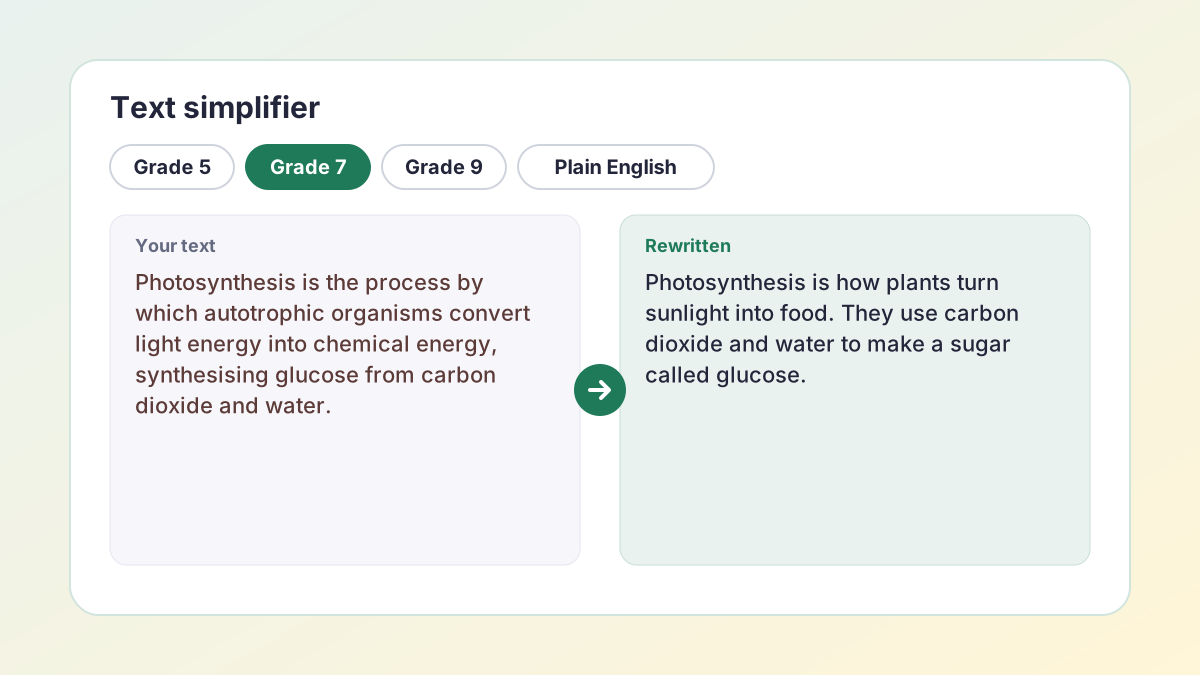
BeforePhotosynthesis is the process by which autotrophic organisms convert light energy into chemical energy, synthesising glucose from carbon dioxide and water while releasing oxygen as a by-product.
AfterPhotosynthesis is how plants turn sunlight into food. They use carbon dioxide and water to make a sugar called glucose, and they give off oxygen.
“Autotrophic organisms” becomes “plants”; glucose is kept and explained.
BeforeThe Industrial Revolution precipitated a mass migration from rural areas to rapidly expanding urban centres.
AfterDuring the Industrial Revolution, many people moved from the countryside to cities. The cities grew very fast.
One sentence becomes two, with very common words.
BeforeThe court's ruling established a precedent that subsequent jurisdictions were obliged to take into consideration.
AfterThe court's decision set a precedent that later courts had to consider.
Keeps the subject word “precedent” but cuts the padding.
BeforeStudents are advised that failure to submit the requisite documentation may result in the forfeiture of their place.
AfterIf you do not send the documents we need, you may lose your place.
Speaks directly to the reader, in the active voice.
BeforeInflation erodes purchasing power, meaning that a fixed sum of money buys progressively fewer goods over time.
AfterInflation means prices go up over time. So the same amount of money buys less than it used to.
The idea is explained, not just reworded.
BeforeThe protagonist's ambivalence towards her inheritance is a recurring motif throughout the novel.
AfterThe main character's mixed feelings about what she inherits come up again and again in the novel.
Simpler words only; the sentence length stays close.
How to use the text simplifier
It takes a few seconds and works on anything from one sentence to about 1,500 words.
- Paste your text. Copy the hard sentence, paragraph or page and paste it into the box.
- Choose a reading level. Grade 7 suits most readers. Choose Grade 5 for the simplest version, Grade 9 to keep more subject words, or Plain English for official writing.
- Select Simplify this. The simplified version appears next to the original, sentence by sentence.
- Check the meaning. Read both side by side. Any sentence where a number, negative or hedge changed is marked for you to check.
- Try another level. If it is still too hard, or too simple, switch levels and run it again.
What is a text simplifier?
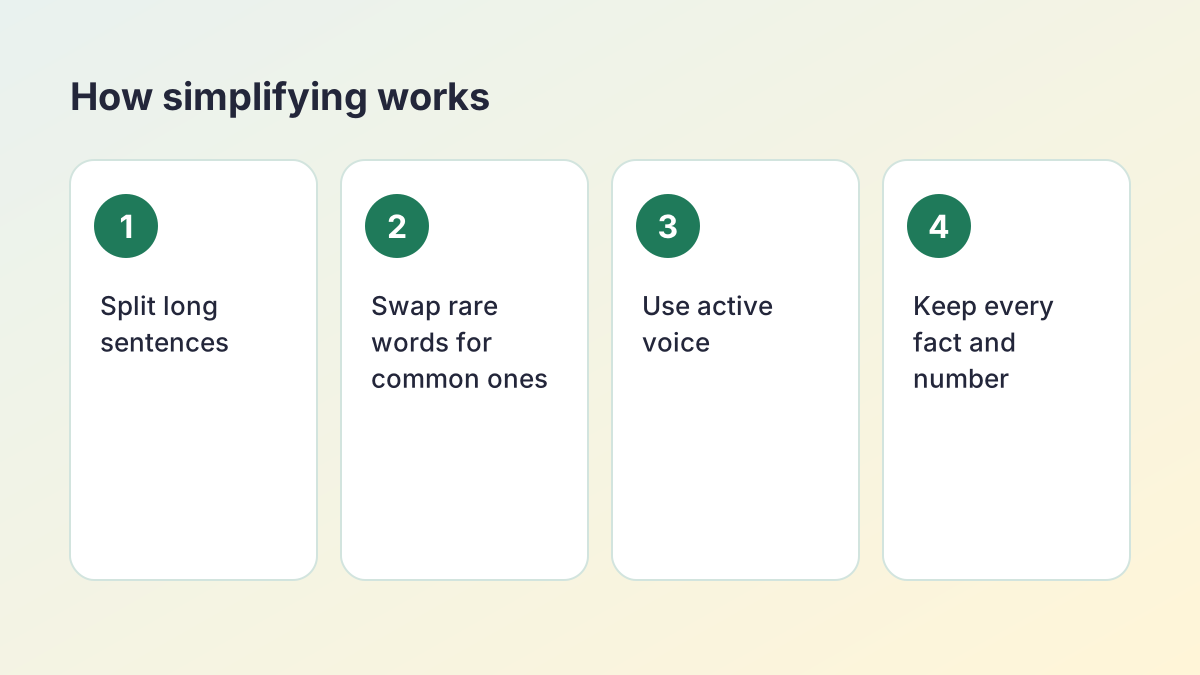
A text simplifier is a tool that rewrites difficult writing so it is easier to read, without changing what it says. It shortens long sentences, swaps rare or technical words for common ones, turns passive sentences into active ones and explains terms that cannot be removed.
Simplifying is different from summarising. A summary leaves things out to make the text shorter. A text simplifier keeps every point and fact, and only changes how they are expressed. The simplified version may even be a little longer, because a hard word sometimes needs a short explanation.
Who uses a text simplifier?
- Students reading textbooks, journal articles or primary sources above their level.
- English language learners who know the subject but not the vocabulary.
- Teachers adapting a reading for different groups in one class.
- Anyone facing a confusing letter, contract or set of instructions.
Is it the same as Rewordify?
Rewordify replaces hard words one at a time, often with a highlighted definition. This text simplifier rewrites whole sentences, so the grammar and flow change too, which usually makes the result easier to follow. If you only want hard words swapped and sentence length kept, choose the Simpler words goal.
Simplify this sentence: how it works
When you ask the tool to simplify this sentence, it works through four changes in order. Knowing them helps you judge the result and simplify by hand when you need to.
- Split long sentences. A sentence over about 25 words is hard to hold in your head. The simplifier breaks it at natural joints such as “and”, “which” or “because”.
- Use common words. “Utilise” becomes “use”, “subsequently” becomes “later”, “commence” becomes “start”.
- Use the active voice. “The results were analysed by the team” becomes “The team analysed the results”.
- Keep the facts. Names, numbers, dates, quotes and citations are protected, so they come back exactly as you wrote them.
Simplify this paragraph
The same steps work on a whole paragraph. Each sentence is simplified in context, so pronouns and links like “however” still point to the right ideas. If the paragraph is very dense, Grade 5 or Grade 7 will split it into more, shorter sentences.
Help me understand this
Sometimes you do not need a rewrite to hand in; you just need to understand what you are reading. Paste the passage, choose Grade 5, and read the simple version first. Then go back to the original. It will make much more sense, and you will learn the subject vocabulary along the way.
Make it sound like a 7th grader: choosing a reading level
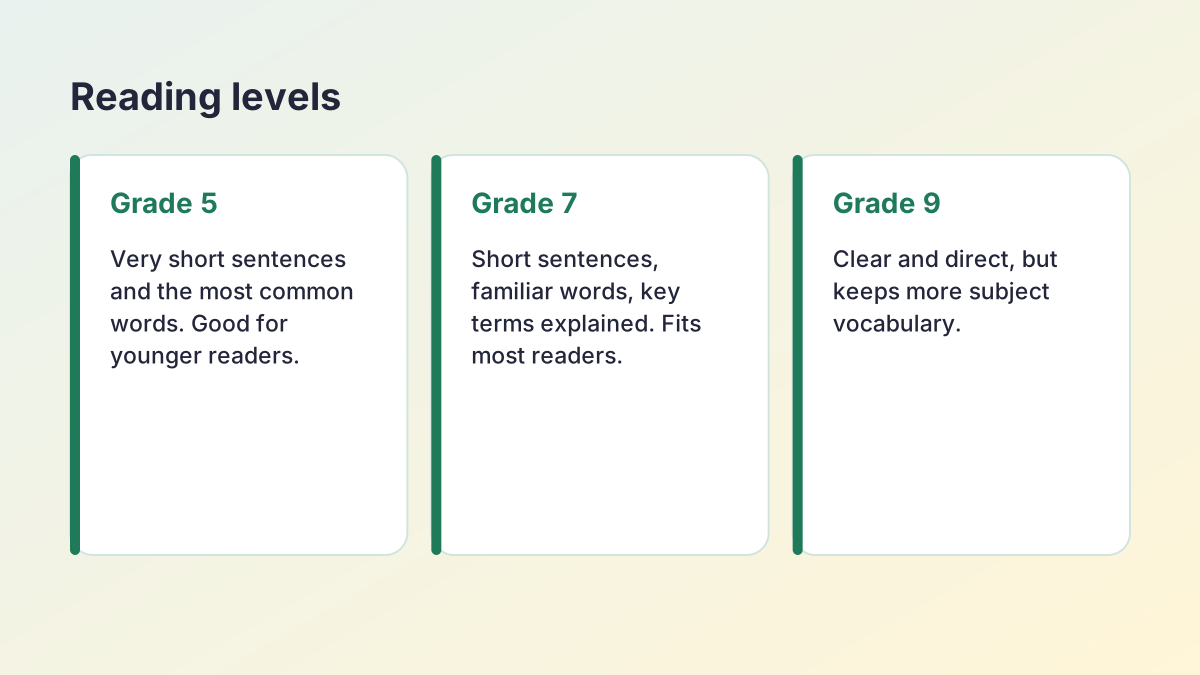
Many people search for a way to make it sound like a 7th grader wrote it, or to explain something “like I'm five”. Both mean the same thing: rewrite at a lower reading level. The text simplifier offers three grade levels plus plain English.
- Grade 5: the shortest sentences and the most common words. Good for younger students, early English learners or a first read of something very hard.
- Grade 7: short sentences and familiar words, with key terms kept and explained. This is the level most public writing aims for, and it suits most readers.
- Grade 9: clear and direct, but it keeps more of the subject's vocabulary. Good for high school work where the technical words matter.
- Plain English: written for adults, focused on clear official writing such as letters, policies and instructions.
What is a reading level?
Reading levels are usually measured with formulas like Flesch-Kincaid, which look at sentence length and the number of syllables per word. A Grade 7 score means a typical seventh grader could read the text comfortably. Readable's guide to Flesch-Kincaid explains how the scores are calculated.
Formulas are a guide, not a rule. A short sentence full of rare words can still be hard, so the text simplifier looks at both sentence length and word choice.
Plain English: the rules behind simple writing
Plain English is a set of habits that make writing clear for its reader on the first read. Governments use it for public documents; the US federal government publishes plain language guidelines for its own writers. The core rules are the same ones the text simplifier follows:
- Write for your reader, and address them as “you” where it fits.
- Keep sentences short, ideally 15 to 20 words on average.
- Use the active voice.
- Use common words, and define terms you must keep.
- Put the main point first.
- Use lists for steps or several items.
Simple is not childish
Simplifying does not mean talking down to the reader. Plain English is how the best science writers and journalists explain difficult ideas. The goal is that the reader spends their effort on the idea, not on decoding the sentence.
How students use a text simplifier
Reading hard sources
Journal articles and older texts are written for experts. Simplify the abstract or a tricky paragraph first, so you know what the source argues before you read it closely.
Studying for exams
Turn dense textbook notes into short, clear sentences you can remember. Simple notes are easier to turn into flashcards.
Learning English
If English is not your first language, simplified versions help you understand the content while you build vocabulary. Compare the two versions to learn what the hard words mean.
Making your own writing clearer
Paste your own draft and choose Grade 9 or Plain English. If your sentences get much shorter, your draft may be harder to read than it needs to be. The Paragraph Rewriter and the Rewording Tool can then help polish it.
A note on assignments
Simplifying a source to understand it is good study practice. Handing in a simplified version of someone else's text as your own writing is not. If you use ideas from a source, write them in your own words and cite it.
Does simplifying change the meaning?
It should not, and the text simplifier is built to avoid it. Numbers, dates, names, quotes and citations are protected before the text is rewritten and restored afterwards. After rewriting, each sentence is checked: if a negative such as “not” disappeared, a hedge such as “may” became “will”, or a number changed, the sentence is marked for you to review.
The biggest risk with any simplifier is losing nuance. “May reduce the risk” and “reduces the risk” are very different claims. Always read the simplified version against the original, especially for science, law or medicine.
Technical terms
Some words cannot be replaced without losing accuracy, such as photosynthesis, mitosis or precedent. The text simplifier keeps these and explains them in simple words instead. To be sure a term is never changed, add it under More options as a protected term.
Privacy
The Study Corp does not store your text. It is sent to our AI providers (Groq, with Google Gemini as a backup) only to create the version you see.
How to simplify writing by hand
Tools are fast, but it helps to know how to simplify without one, for exams or when you want full control. Work through a sentence with these questions.
Who is doing what? Find the real subject and the real action. In “An investigation was carried out by the committee into the complaints”, the committee is doing the action, and the action is investigating. So: “The committee investigated the complaints.”
Which words are doing no work? Phrases like “due to the fact that” (because), “in order to” (to), “at this point in time” (now) and “it is important to note that” (cut it) add length without meaning.
Is there a shorter, everyday word? Try saying the sentence out loud as if you were explaining it to a friend. The words you reach for naturally are usually the simple ones.
Can it be two sentences? If a sentence has more than one main idea, give each idea its own sentence. Readers handle one idea at a time best.
Does a term need explaining? If a word must stay, add a short explanation the first time it appears: “Glucose, a type of sugar, …”.
A worked example
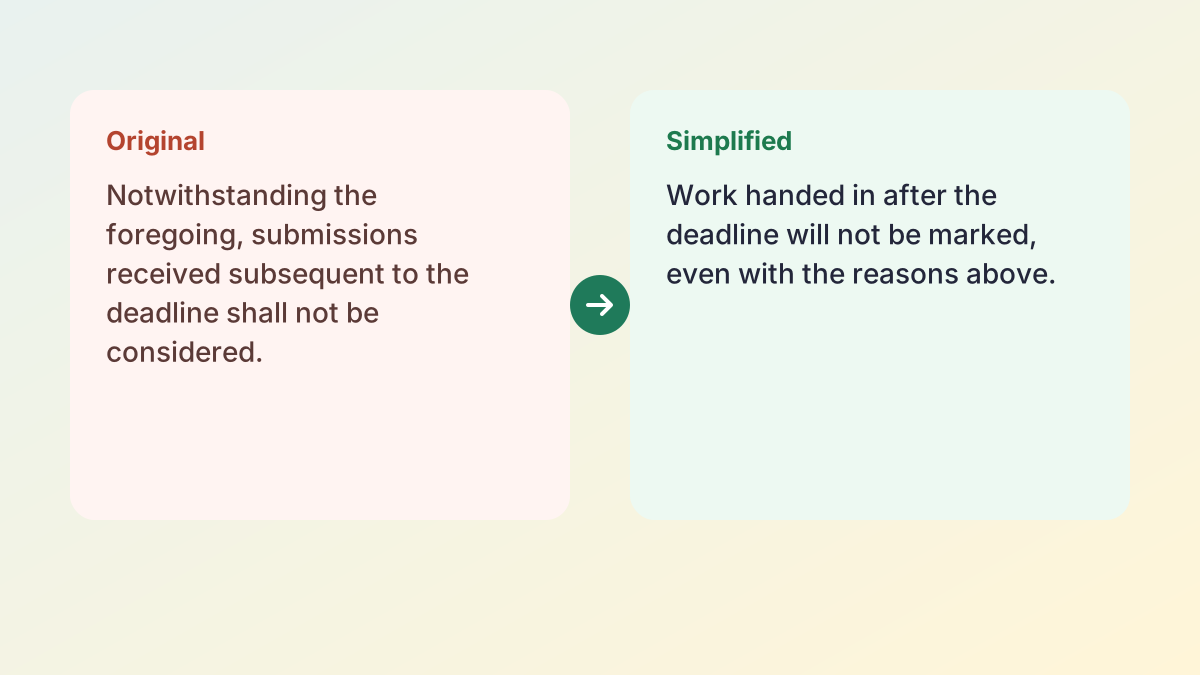
Original: “In light of the fact that numerous participants failed to complete the questionnaire, the reliability of the findings is, to a certain extent, called into question.”
Step by step: “In light of the fact that” becomes “because”. “Numerous participants failed to complete” becomes “many people did not finish”. “The reliability of the findings is called into question” becomes “the results may not be reliable”. “To a certain extent” is a hedge, so it stays as “may”.
Simplified: “Many people did not finish the questionnaire, so the results may not be fully reliable.”
Notice that the hedge survived. Keeping the writer's level of certainty is the part people most often get wrong when they simplify, and it is the part the tool checks for you.
Tips for better results from the text simplifier
- Simplify a paragraph at a time when the text is very dense. Smaller pieces keep the context tight.
- Start at Grade 7. Move down to Grade 5 if it is still hard, or up to Grade 9 if too much detail was lost.
- Protect key terms your teacher expects you to use, so they stay exactly as written.
- Read the original again afterwards. The simple version is a ladder, not a replacement.
- Check every marked sentence. A mark means a number, negative or hedge changed and needs a human look.
When to use a different tool
If you want the text shorter rather than simpler, use the Sentence Shortener. If you want a short overview of a long text, a summariser fits better. If you want your own writing to sound more polished rather than simpler, try Say It Better.
Text simplifier FAQ
Is the text simplifier free?
Yes. It is free with no account or sign-up. A fair hourly allowance per visitor keeps it fast for everyone.
How do I simplify this sentence?
Paste the sentence, choose a reading level such as Grade 7, and select Simplify this. The simple version appears next to the original.
Can it make text sound like a 7th grader wrote it?
Yes. Choose the Grade 7 level. It uses short sentences and familiar words, and explains any key terms it keeps.
Does simplifying remove information?
No. Simplifying keeps every fact; only the wording changes. If you want text shorter, use a summariser or the Sentence Shortener.
How much text can I simplify at once?
Up to about 1,500 words per run. For long texts, simplifying a paragraph at a time gives the best results.
Is it a good Rewordify alternative?
It works differently. Rewordify swaps single words; this text simplifier rewrites whole sentences at the reading level you choose.
Will it keep numbers and quotes?
Yes. Numbers, dates, names, quotes and citations are protected and come back exactly as written.
More free rewriting tools
- AI Paraphrasing ToolParaphrase any text, and learn to paraphrase and cite well.
- AI Sentence RewriterFix an awkward sentence and choose from several better versions.
- Paragraph RewriterMake the sentences in one paragraph connect and flow.
- Rewording ToolReword any text in fresh words: emails, reports, applications and more.
- Essay RewriterRewrite a whole essay or paper, paragraph by paragraph, keeping its structure.
- Restate Thesis GeneratorRestate your thesis in new words for the conclusion, keeping the same claim.
- Sentence ShortenerShorten text or combine it into 1, 2 or 3 sentences, keeping every key fact.
- Sentence FinisherGet five ways to finish a sentence you started.
- Say It BetterFind a better way to say a sentence or phrase, with alternatives.
- Sentence ExpanderExpand a sentence into a fuller, more detailed version without new facts.
- Poem RewriterParaphrase a poem line by line, modernise it, or polish your own poem.
See all 74 free tools for students
Related tools
Last updated by The Study Corp editorial team.