Turabian Format Example for Each Part of the Paper
Each example shows one part of a class paper done right. The notes and bibliography entries come from our citation engine using Turabian 9 rules; the sources are real books and a real journal article; page numbers are illustrative.
Part of the paperYou quote page 23 of Mark Noll's 1994 book for the first time.
In Turabian format1. Mark A. Noll, The Scandal of the Evangelical Mind (Grand Rapids, MI: Eerdmans, 1994), 23.
A full note the first time: the name in normal order, then the publication facts in parentheses.
Part of the paperYou cite Noll again, a few notes later.
In Turabian format3. Noll, Scandal of the Evangelical Mind, 23.
Turabian 9 prefers this shortened note to “ibid.” Drop the leading “The”; you may cut a long title to its key words, such as Evangelical Mind.
Part of the paperGeorge Marsden's book, second edition, Oxford University Press, 2006.
In Turabian formatMarsden, George M. Fundamentalism and American Culture. 2nd ed. New York: Oxford University Press, 2006.
Last name first, periods between parts, and a hanging indent on the page.
Part of the paperLynn White Jr.'s 1967 article in Science, volume 155, issue 3767, pages 1203–7.
In Turabian formatWhite, Lynn, Jr. “The Historical Roots of Our Ecologic Crisis.” Science 155, no. 3767 (March 1967): 1203–7. https://doi.org/10.1126/science.155.3767.1203.
The article title goes in quotation marks; the journal name is italic in your paper.
Part of the paperThe same Noll book, cited in the author-date system.
In Turabian format(Noll 1994, 23), with a reference list entry: Noll, Mark A. 1994. The Scandal of the Evangelical Mind. Grand Rapids, MI: Eerdmans.
The year moves up after the name. Use this system only when the assignment calls for it.
Part of the paperA quotation that runs to five or more lines of prose in your paper.
In Turabian formatSet it off as a block: indented 0.5 inch, single-spaced, a blank line before and after, no quotation marks, the note number at the end.
Shorter quotations stay in your paragraph inside quotation marks.
Part of the paperA table of survey results on page 6.
In Turabian formatTable 1. Students who attend chapel weekly, by class year (above the table, flush left)
Tables are labeled above; figures get “Figure 1.” and a caption below.
How to Set Up Turabian Format in Word or Google Docs
These steps set up a class paper from a blank document. The menu names are for current versions of Microsoft Word and Google Docs.
- Set margins and font. In Word, choose Layout > Margins > Normal for 1 inch on every side. In Google Docs, use File > Page setup and type 1 in each margin box. Pick Times New Roman or another readable font at 12 points.
- Double-space the text. Select the body text. In Word, use Home > Line and Paragraph Spacing > 2.0. In Google Docs, use Format > Line & paragraph spacing > Double. Indent the first line of each paragraph 0.5 inch.
- Add page numbers. In Word, choose Insert > Page Number and pick top right or bottom center; tick Different First Page so the title page shows no number. In Google Docs, use Insert > Page elements > Page number and pick the option that skips the first page.
- Insert footnotes. Place the cursor after the punctuation at the end of the sentence. In Word, choose References > Insert Footnote. In Google Docs, choose Insert > Page elements > Footnote. Single-space the notes and leave a blank line between them.
- Format block quotations. For five or more lines of prose, start a new line, indent the whole quotation 0.5 inch, single-space it and remove the quotation marks. Leave a blank line before and after.
- Start the bibliography page. Insert a page break after your conclusion, center the title Bibliography, and list sources alphabetically. Single-space each entry with a 0.5-inch hanging indent and a blank line between entries.
What Is Turabian Format?
Turabian is the set of rules in Kate L. Turabian's A Manual for Writers of Research Papers, Theses, and Dissertations, published by the University of Chicago Press. It adapts The Chicago Manual of Style for students: the citation rules are Chicago's, and the book adds plain guidance on formatting class papers, theses and dissertations. The current 9th edition (2018) follows the 17th edition of the Chicago manual.
Which edition to use
The University of Chicago Press has announced a 10th edition for late 2026. Until your instructor or school switches, the 9th edition remains the standard, and every rule on this page follows it. When the new edition arrives, check your syllabus before changing anything.
Who uses it
Turabian is common in history, religion, theology and other humanities courses. Many US Christian universities and seminaries require it in place of APA or MLA, so it's the house style for a large share of Bible, ministry and church history papers.
Tools for the first and last pages
For the first page of your paper, the Turabian Title Page Generator lays out the title, your name, the course and the date for you. For the notes and bibliography, the Turabian Citation Machine formats each source from a link, DOI or ISBN.
Turabian Formatting Rules at a Glance
Most Turabian formatting comes down to a few settings you choose once. Where Turabian gives a choice, such as where the page number goes, pick one option and use it on every page.
| Element | Turabian 9 rule | Notes |
|---|---|---|
| Margins | At least 1 inch on all sides | Word's Normal setting is already 1 inch |
| Font | A readable font, preferably 12 point | Times New Roman is the usual choice; never smaller than 10 point |
| Line spacing | Double-space the text | Single-space block quotes, notes, bibliography entries, table titles and figure captions |
| Paragraphs | Indent the first line 0.5 inch | No extra space between paragraphs |
| Page numbers | Top right or bottom center | Title page counts as 1 but shows no number |
| Headings | Up to five levels | Class papers rarely need more than two |
| Block quotations | Five or more lines of prose | Indented, single-spaced, no quotation marks |
| Notes | Footnotes or endnotes | Single-spaced, blank line between notes |
| Bibliography | New page, titled Bibliography | Alphabetical, hanging indent, blank line between entries |
Margins and font
Turabian asks for margins of at least 1 inch. Choose a plain, readable font. Times New Roman at 12 points is the safe default; Union University's Turabian formatting guide notes that nothing should be set smaller than 10 points.
Spacing
Double-space the body of the paper. The exceptions are single-spaced: block quotations, footnotes or endnotes, bibliography entries, table titles and figure captions. Leave a blank line between single-spaced items so each note or entry stands apart.
Page Numbers and the First Page
Number every page in Arabic numerals (1, 2, 3) in the same spot: the top right corner or the bottom center. Turabian allows either; many schools pick top right. Put nothing else in the header unless your instructor asks for your last name or a short title next to the number.
The title page and page 1
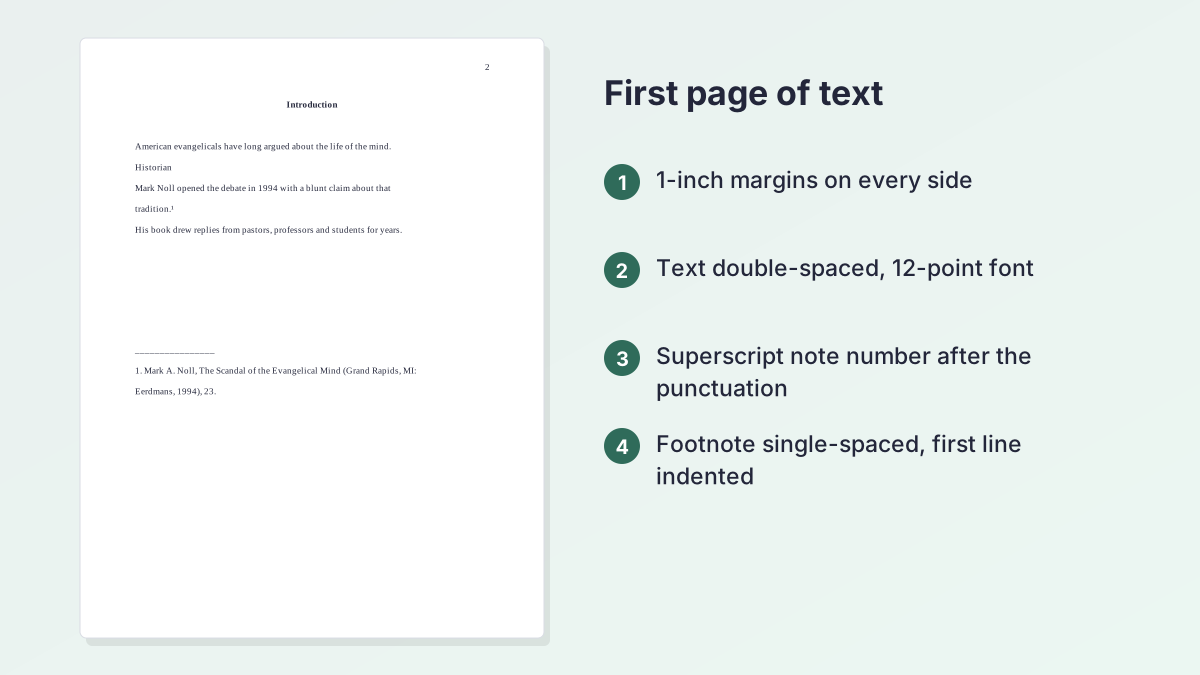
A class paper with a separate title page counts that page as page 1 but prints no number on it, so the first page of text shows 2. If your instructor wants no title page, put the title and your details at the top of page 1 and number from there. The layout of the title page itself is easiest to get right with the title page generator.
Headings in Turabian Format
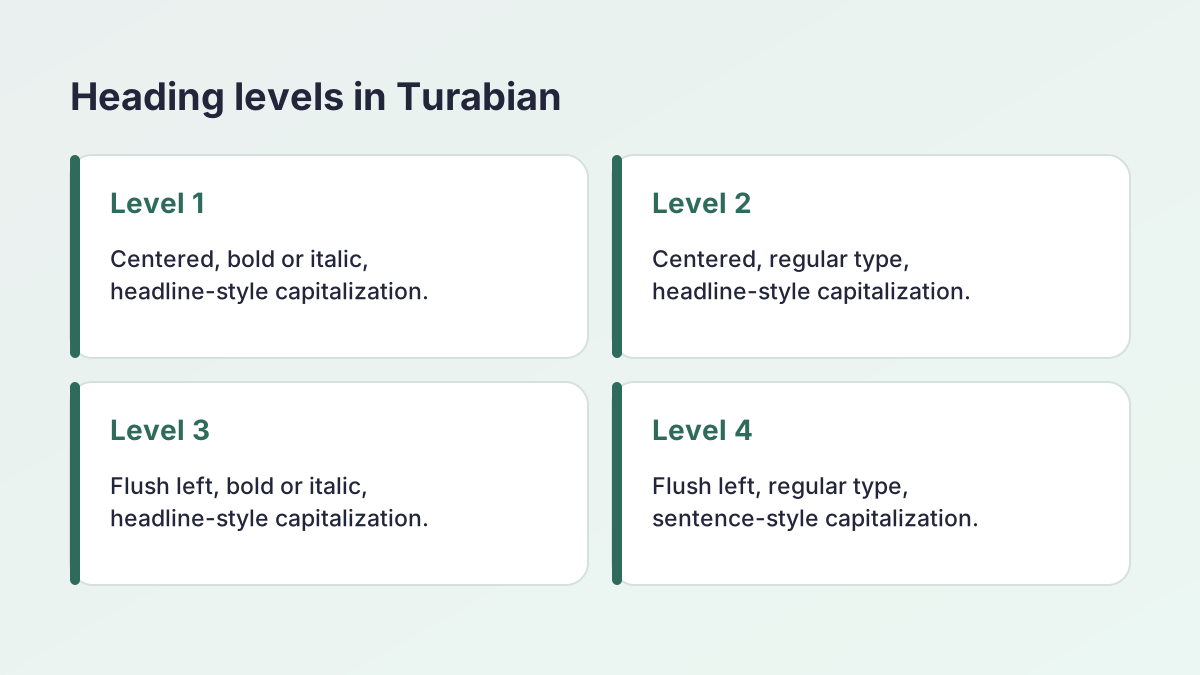
Turabian doesn't require headings in a short paper or insist on one style, but every heading at the same level must look the same. The 9th edition suggests this five-level system, which most schools adopt as is.
| Level | Position | Type and capitalization |
|---|---|---|
| 1 | Centered | Bold or italic, headline-style capitalization |
| 2 | Centered | Regular type, headline-style capitalization |
| 3 | Flush left | Bold or italic, headline-style capitalization |
| 4 | Flush left | Regular type, sentence-style capitalization |
| 5 | Run in at the start of the paragraph | Bold or italic, sentence-style, ending with a period |
How many levels a class paper needs
A typical paper for a history or theology class needs one or two levels: level 1 for main sections such as Introduction and Conclusion, and level 2 for subsections inside them. Don't number the headings unless your instructor wants numbers.
Keep headings with their text
Never leave a heading alone at the bottom of a page; move it to the top of the next one.
Short Quotations and Block Quotations
How you present a quotation depends on its length. Turabian draws the line at five lines of prose.
Run-in quotations
A quotation of four lines or fewer stays inside your paragraph, in quotation marks. The note number goes after the closing quotation mark and after any punctuation, so a sentence ends with a period, the quotation mark, then the superscript number.
Block quotations
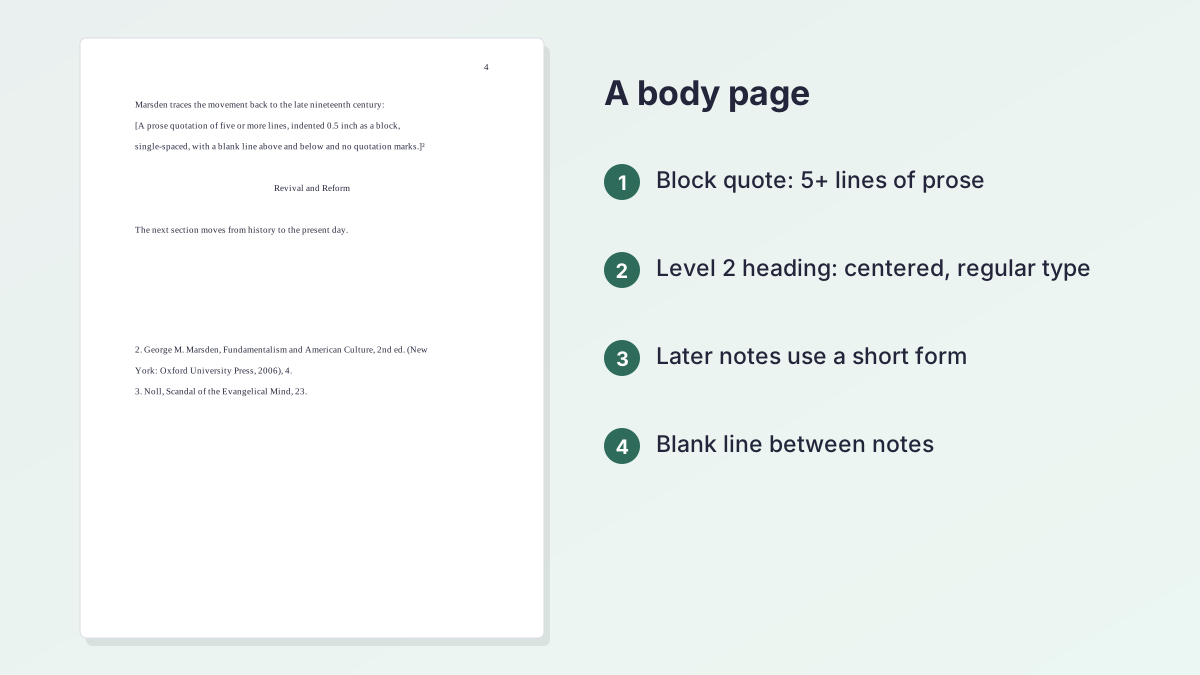
A quotation of five or more lines of prose becomes a block quotation. Start it on a new line, indent the whole passage 0.5 inch from the left margin, single-space it, and leave a blank line before and after. Don't put quotation marks around it. The note number goes at the end of the block, after the final punctuation.
Introduce every quotation
Lead into each quotation with your own words. A block quotation dropped in without an introduction draws comments in the margin.
Footnotes, Endnotes and the Bibliography
Most Turabian papers use the notes-bibliography system: a numbered note for each source you cite and a bibliography at the end. Turabian also describes an author-date system with parenthetical citations, used more in the social sciences; follow your assignment.
Where the notes go
Footnotes sit at the bottom of the page where you cite the source, below a short separator line. Endnotes collect all the notes on a new page after the text, titled Notes, before the bibliography. Footnotes are the usual choice for a class paper, and some schools don't allow endnotes at all.
How notes look
In your text, the note number is a superscript after the punctuation. Each note is single-spaced with the first line indented 0.5 inch, and a blank line separates one note from the next. Turabian allows either a full-size number followed by a period or a superscript number followed by a space at the start of the note itself, so the number your word processor inserts is fine. The first note for a source gives full details; later notes use a short form with the author's last name, a short title and the page.
Where the bibliography goes
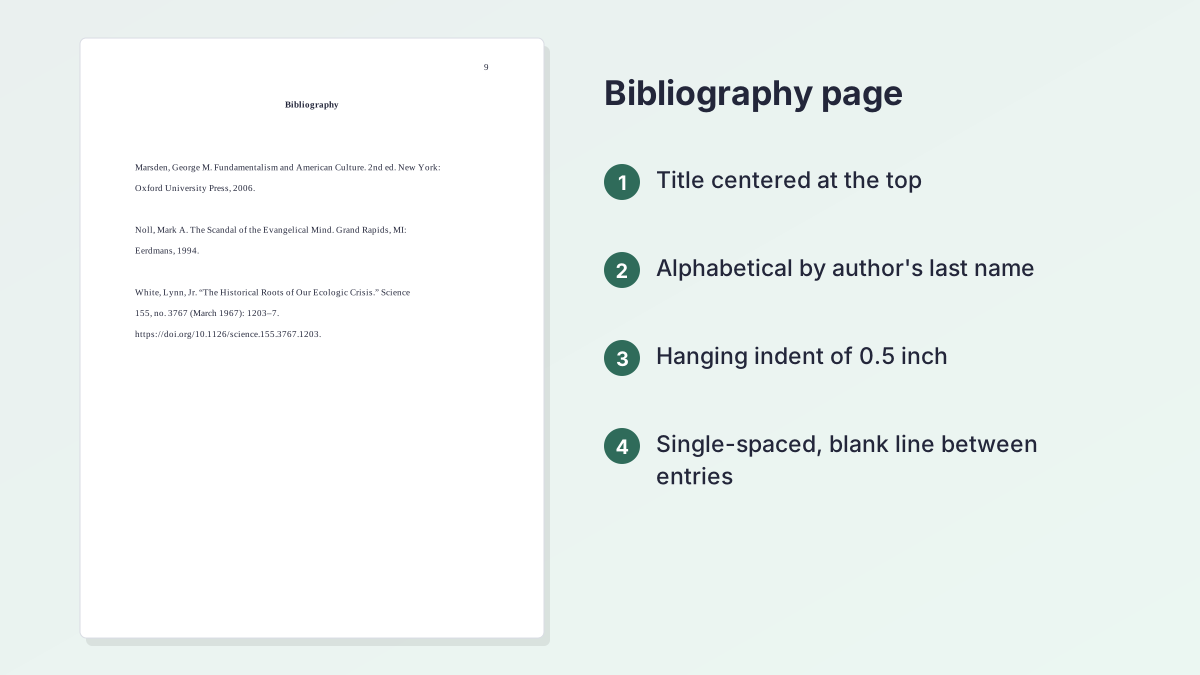
The bibliography begins on a new page after the text (and after any endnotes or appendixes, if your school puts appendixes first). Center the title Bibliography at the top, leave two blank lines, then list every source alphabetically by the author's last name. Single-space each entry with a 0.5-inch hanging indent and leave a blank line between entries. The Turabian citation generator produces the note, the short note and the bibliography entry for each source, and the Alphabetizer sorts a list you typed by hand.
Turabian format citation basics
The Turabian citation quick guide on the Chicago Manual of Style site shows the note and bibliography pattern for books, articles, websites and more. The key differences: notes use commas and parentheses and give the author's name in normal order; bibliography entries use periods and invert the first author's name.
Tables and Figures
Place each table or figure near the paragraph that first mentions it, and refer to it by number.
Tables
Label tables above the table, flush left, with the word Table, an Arabic numeral and a period, followed by a short title on the same line: Table 1. Students who attend chapel weekly, by class year. Single-space the title if it runs to two lines.
Figures
Charts, maps, photographs and diagrams are figures. Label them below the image, flush left: Figure 1. followed by a caption. Number figures separately from tables.
Sources for tables and figures
A table or figure taken from another work gets a source line below it, starting with Source: and a note-form citation.
Turabian Paper Example: A Sample Page Layout
Here is how a short research paper in Turabian style fits together from the first page to the last. The sample is an eight-page paper (title page included) for a church history course at a US Christian college, citing the real sources shown in the examples above.
| Page | What's on it | Number shown |
|---|---|---|
| Title page | Title one-third down; name, course, instructor and date lower on the page | None (counts as 1) |
| First page of text | Level 1 heading Introduction, opening paragraphs, first footnotes | 2 |
| Body pages | Level 1 and level 2 headings, a block quotation, footnotes at the bottom | 3–8 |
| Bibliography | Centered title, entries in alphabetical order with hanging indents | 9 |
What a body page looks like
On a body page, the text is double-spaced with 0.5-inch paragraph indents, a block quotation sits indented and single-spaced, and the footnotes at the bottom are single-spaced with a blank line between them.
A research paper in Turabian style, example by example
Noll's book gets a full first note (1. Mark A. Noll, The Scandal of the Evangelical Mind (Grand Rapids, MI: Eerdmans, 1994), 23.) and a short note after that (3. Noll, Scandal of the Evangelical Mind, 23.).
Turabian Format Example: The Bibliography Page
The last page of the sample is the bibliography. These three entries were formatted with our citation engine under Turabian 9 rules and are shown in alphabetical order:
Marsden, George M. Fundamentalism and American Culture. 2nd ed. New York: Oxford University Press, 2006.
Noll, Mark A. The Scandal of the Evangelical Mind. Grand Rapids, MI: Eerdmans, 1994.
White, Lynn, Jr. “The Historical Roots of Our Ecologic Crisis.” Science 155, no. 3767 (March 1967): 1203–7. https://doi.org/10.1126/science.155.3767.1203.
What to notice
Each entry starts at the left margin, and every following line is indented 0.5 inch. Book and journal titles are italic; the article title is in quotation marks. The DOI goes at the end as a full link. Single-space each entry and leave one blank line between them.
Turabian Format at Liberty University and Other Schools
Schools that require Turabian sometimes add rules of their own on top of the manual. Always follow your school's guide and your instructor's syllabus when they differ from the book.
Liberty University Turabian format
Liberty University's Turabian Format Quick Guide follows the 9th edition with a few house rules. Liberty uses the notes-bibliography system (author-date only for book reviews), does not permit endnotes, and requires ibid. for consecutive notes to the same source on the same page. Its guide notes that the ibid. rule differs from the 9th edition, which prefers shortened notes. Liberty also sets the five heading levels in a fixed style and puts the bibliography title in bold.
Papers for other classes
If your other courses use different styles, our guides to APA format guidelines and the MLA heading cover their first-page setups, and every guide is listed on the student writing guides page.
Common Turabian Formatting Mistakes
Most points lost on format come from a handful of slips. Check your draft against this list before you submit.
| Mistake | Fix |
|---|---|
| Footnotes double-spaced | Single-space each note, with a blank line between notes |
| Bibliography in citation order | Sort it alphabetically by the author's last name |
| No hanging indent | Indent every line after the first by 0.5 inch |
| Page number on the title page | Hide it; start showing numbers with 2 |
| Quotation marks around a block quote | Remove them; the indent shows it's a quotation |
| Note number before the period | Put it after the punctuation and closing quotation mark |
| Ibid. everywhere | Use shortened notes unless your school requires ibid. |
| Headings styled differently at one level | Match every heading at the same level |
A final check
Every source in your notes should appear once in the bibliography, in alphabetical order. If you'd rather not format each entry by hand, the Turabian Citation Machine does it from a link or DOI. Our IEEE reference format guide covers the numbered style used in engineering courses.
Turabian Format FAQ
What is Turabian format?
It's the student version of Chicago style, from Kate L. Turabian's A Manual for Writers. A class paper uses 1-inch margins, a readable 12-point font, double-spaced text, page numbers, footnotes and a bibliography.
Is Turabian format double spaced?
The body text is double-spaced. Block quotations, footnotes, bibliography entries, table titles and figure captions are single-spaced, with a blank line between items.
What are the margins for Turabian format?
At least 1 inch on all four sides. Word's Normal margin setting and Google Docs' default margins already meet this.
What font should I use for a Turabian paper?
A readable font such as Times New Roman, preferably at 12 points. Don't go below 10 points anywhere in the paper.
Where do page numbers go in Turabian format?
Top right or bottom center, in the same place on every page. The title page counts as page 1 but shows no number.
How long does a quote have to be for a block quote in Turabian?
Five or more lines of prose, or two or more lines of poetry. Indent it 0.5 inch, single-space it and leave out the quotation marks.
Where can I find a Turabian paper example?
This page walks through a sample paper page by page, with real footnotes and a bibliography.
Does Liberty University use Turabian format?
Yes. Liberty follows the 9th edition with house rules: notes-bibliography style, no endnotes, and ibid. for consecutive notes. Check its Turabian Format Quick Guide.
Which edition of Turabian should I use?
The 9th edition, until your instructor or school adopts the 10th edition announced for late 2026.
More free guides
- Turabian BibliographyEntry format, order and spacing for a Turabian 9 bibliography, with examples.
- Turabian FootnotesFull notes, short notes, ibid. and endnotes in Turabian 9.
- Turabian Book CitationNotes and bibliography entries for books, editions, chapters and the Bible in Turabian 9.
- Turabian vs ChicagoHow Turabian and Chicago relate, what differs, and which one your paper needs.
- MLA In-Text CitationsAuthor-page citations for every kind of source, with examples.
- How to Cite a Website in MLAWorks Cited entries and in-text citations for web pages.
See all 80 free tools for students
Related tools
Last updated by The Study Corp editorial team.