Chicago Turabian Citation Format: Side-by-Side Examples
Each pair shows one source under Turabian 9 (left) and Chicago 18 (right), rendered by our citation engine. Added by hand: the Noll pair (repeated author), which follows the 3-em dash rule and the Noll entries in our Turabian bibliography guide. Page numbers are illustrative.
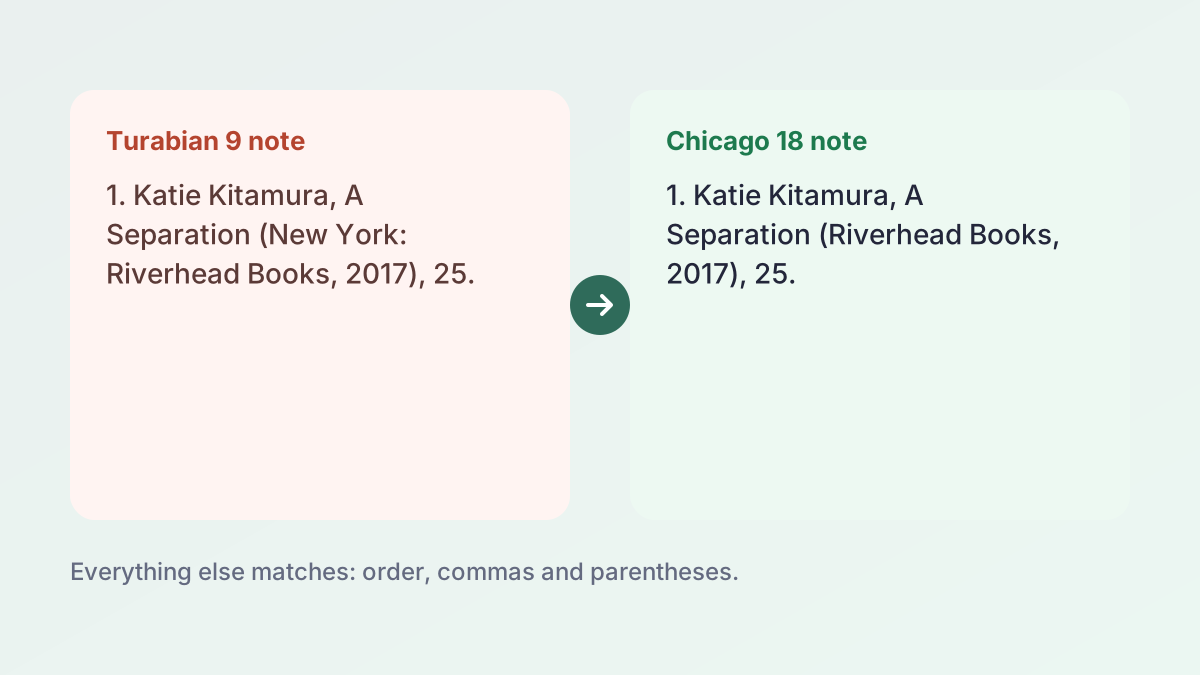
Turabian 9Katie Kitamura, A Separation (New York: Riverhead Books, 2017), 25.
Chicago 18Katie Kitamura, A Separation (Riverhead Books, 2017), 25.
The only change is the city of publication.
Turabian 9Kitamura, Katie. A Separation. New York: Riverhead Books, 2017.
Chicago 18Kitamura, Katie. A Separation. Riverhead Books, 2017.
Same order and punctuation; Chicago 18 drops the city.
Turabian 9Sharon Sassler and Amanda Jayne Miller, Cohabitation Nation: Gender, Class, and the Remaking of Relationships (Oakland: University of California Press, 2017), 114.
Chicago 18Sharon Sassler and Amanda Jayne Miller, Cohabitation Nation: Gender, Class, and the Remaking of Relationships (University of California Press, 2017), 114.
Two authors are listed in full under both manuals.
Turabian 9Kitamura, Separation, 91.
Chicago 18Kitamura, Separation, 91.
Short notes are identical; both manuals steer you to them instead of ibid.
Turabian 9Rowlandson, Mary. “The Narrative of My Captivity.” In The Making of the American Essay, edited by John D’Agata, 19–56. Minneapolis: Graywolf Press, 2016.
Chicago 18Rowlandson, Mary. “The Narrative of My Captivity.” In The Making of the American Essay, edited by John D’Agata. Graywolf Press, 2016.
Chicago 18 no longer requires the chapter's page range in the bibliography.
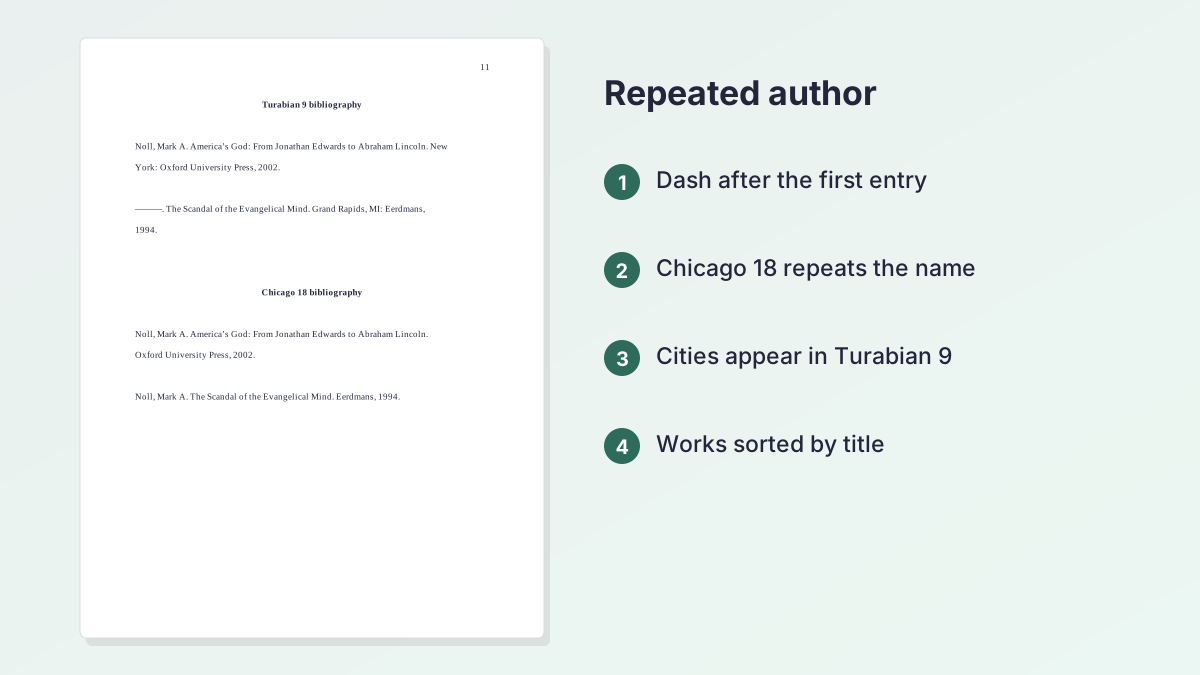
Turabian 9———. The Scandal of the Evangelical Mind. Grand Rapids, MI: Eerdmans, 1994.
Chicago 18Noll, Mark A. The Scandal of the Evangelical Mind. Eerdmans, 1994.
Hand-made pair; Chicago 18 repeats the author's name instead of a 3-em dash.
Turabian 9Kitamura, Katie. 2017. A Separation. New York: Riverhead Books.
Chicago 18Kitamura, Katie. 2017. A Separation. Riverhead Books.
In text, both write (Kitamura 2017, 25).
How to Choose Between Turabian and Chicago, Step by Step
Pick the manual by checking who set the rule, not by guessing from the name.
- Read the assignment. Look for the words Turabian, Chicago or CMOS, an edition number, and whether the course wants notes-bibliography or author-date.
- Check for a school guide. Many schools publish a Turabian guide with house rules. If yours does, it outranks both manuals.
- Match the manual to the work. A class paper, thesis or dissertation points to Turabian. An article or book for publication points to The Chicago Manual of Style.
- Ask which edition. Turabian 9 follows Chicago 17. If the syllabus names Chicago 18, ask whether to drop the city and apply the newer et al. rules.
- Format with one tool. Our Turabian citation tool builds notes and bibliography entries for either system, so you can switch editions without retyping sources.
Is Turabian the Same as Chicago? The Short Answer
Mostly yes. CMOS Shop Talk, the blog of the University of Chicago Press, calls Turabian the "student version" of The Chicago Manual of Style and says the two are compatible and, for the most part, use the same citation styles. Rogers State University's library guide says they "use the same guidelines," and SUNY Geneseo's guide describes Turabian as a simplified version of the Chicago manual.
So the answer to "is Turabian the same as Chicago" is yes for most citations, and a note formatted for one will usually pass the other. The differences come from three places: the audience each book serves, the edition of Chicago each one follows, and the extra paper-formatting advice Turabian adds. The sections below take them in turn. If you only need a quick answer for a syllabus, skip to the table.
Where to see the rules in action
Paste a source into the citation tool above to see a Turabian note and bibliography entry together. For a longer list, use the Turabian Citation Machine. Our guides to Turabian format, Turabian footnotes and the Turabian bibliography cover the paper itself.
Who Was Kate L. Turabian?
Kate L. Turabian (1893–1987) grew up on Chicago's South Side and worked at the University of Chicago for decades. According to the University of Chicago Press's history of the manual, she served as the university's dissertation secretary from 1930 to 1958, a post through which every accepted doctoral thesis passed. She also edited the university's official publications.
From a pamphlet to a manual
In 1937 she wrote a small pamphlet describing the university's required style for dissertations, and the Press began distributing it in 1947. The Press first published the work as a book in 1955, titled A Manual for Writers of Term Papers, Theses, and Dissertations. She died in 1987, months after the fifth edition appeared; later editions were revised by others.
Why her name stays on the cover
Later editions kept the name of Kate L. Turabian because the book still rests on her approach: plain rules for student writers. The 7th edition added a section on the research and writing process by Wayne C. Booth, Gregory G. Colomb and Joseph M. Williams, and the 9th was revised by Joseph Bizup and William T. FitzGerald. The Press says the book has sold more than nine million copies.
What Is A Manual for Writers of Research Papers, Theses, and Dissertations?
A Manual for Writers of Research Papers, Theses, and Dissertations is the book people mean when they say "Turabian." It is published by the University of Chicago Press, and the official Turabian site subtitles itself "Chicago Style for Students and Researchers."
What is inside
The manual covers more than citations. It walks writers through the research process, from choosing a topic to drafting, and it gives formatting rules for papers, theses and dissertations. Its citation chapters present the notes-bibliography and author-date systems, with the examples in its notes-bibliography quick guide and author-date quick guide.
The 9th edition and the 10th
The current edition of A Manual for Writers is the 9th, published in 2018, and the quick guide describes it as the ninth edition. A 10th edition is due in late 2026 on the Press's catalog page. It is revised by Joseph Bizup, William T. FitzGerald and Juli Parrish, is updated to match the latest Chicago Manual of Style and The Craft of Research, and adds guidance on generative AI. Until your school adopts it, expect the 9th.
Turabian vs Chicago: 8 Differences at a Glance
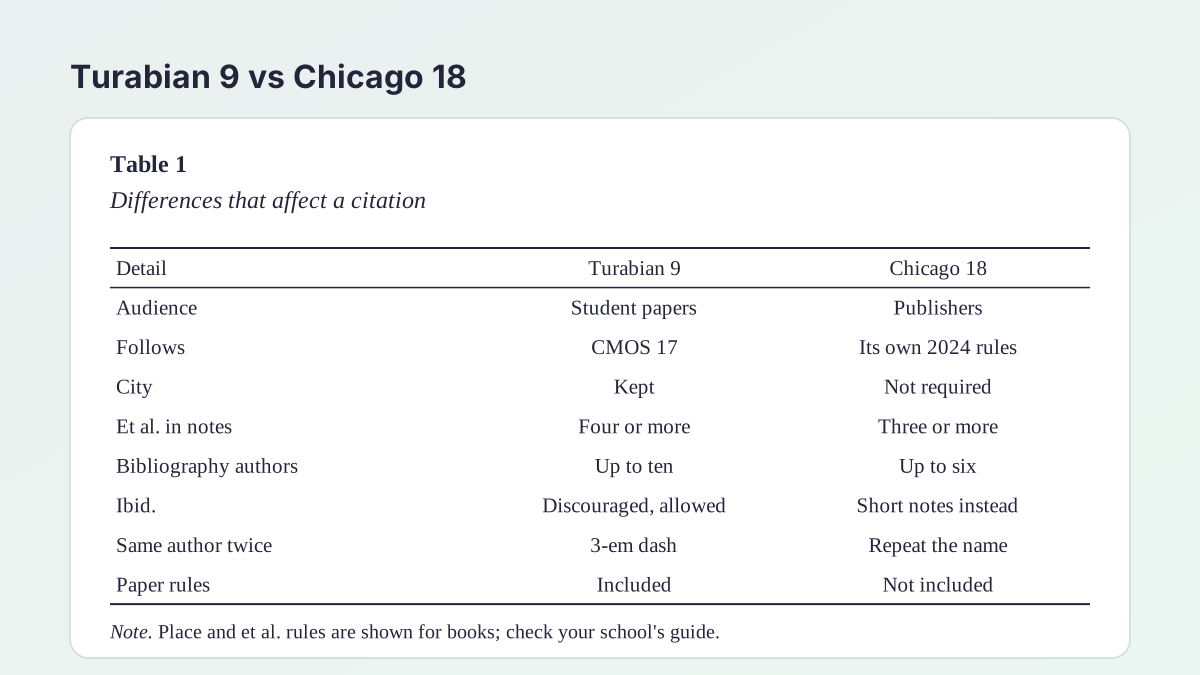
The first two rows of the table below come from the books' purposes. The rest come from the edition gap: Turabian 9 follows the 17th edition of Chicago, and Chicago's 18th edition (2024) changed several rules.
| Detail | Turabian 9 | Chicago 18 |
|---|---|---|
| Audience | Students writing papers, theses and dissertations | Authors, editors and publishers |
| Paper formatting | Margins, page numbers, title page and headings | Left to the publisher |
| City of publication | Kept before the publisher | No longer required for books since 1900 |
| Et al. in notes | Four or more authors | Three or more authors in notes |
| Authors in a bibliography | Up to ten; more, first seven and et al. | Up to six; more, first three and et al. |
| Ibid. | Discouraged but allowed | Shortened citations instead |
| Same author repeated | 3-em dash after the first entry | Repeat the name |
| Chapter page range | Given in the bibliography | No longer required |
What the Turabian vs Chicago table means in practice
Most of these differences touch a handful of entries in a paper. The city is the most visible one, because it appears in every book entry. If your instructor accepts either edition, pick one and apply it to every entry; don't mix a city in one entry with none in the next.
Where the sources agree
The University of Portland's and Widener University's summaries of Chicago 18 list the place, et al., 3-em dash and chapter changes. The Turabian side comes from the official quick guides, whose examples keep the city, and from Memorial University's and Northwest Missouri State University's Turabian 9 guides. Liberty University's guide notes that the 9th edition recommends against ibid.
Chicago Turabian Citation Format: Notes and Author-Date
Both manuals offer the same two systems, so the Chicago Turabian citation format you learn for one carries over to the other.
Notes and bibliography
A superscript number in the sentence points to a footnote or endnote with the source details and page. A bibliography at the end lists every source. Humanities courses such as history, religion and theology use it most. Our Chicago book citation guide covers the Chicago 18 version, and our Turabian book citation guide covers Turabian 9.
Author-date
A parenthetical citation holds the author, year and page, such as (Kitamura 2017, 25), and a reference list replaces the bibliography. See Chicago in-text citation for how the parentheses work. Don't mix the two systems in one paper.
Chicago Turabian bibliography and endnotes
A "Chicago Turabian bibliography" and "Chicago Turabian endnotes" are not separate styles. They mean the Turabian bibliography page and a Notes page after the text. Some schools, including Liberty University, don't allow endnotes at all, so check the school's rule.
Paper Formatting: What Turabian Adds for Students
The biggest practical difference is not in the citations. CMOS Shop Talk explains that Turabian adds paper formatting rules and detailed guidance on the research and writing process, while The Chicago Manual of Style omits that advice and focuses on publication. So a student needs Turabian to format a class paper.
What Turabian 9 settles
Our Turabian format guide covers these settings in detail:
- Margins of at least 1 inch on all sides.
- A readable font, preferably 12 point.
- A double-spaced body, with single-spaced block quotations, notes and bibliography entries.
- Page numbers at the top right or bottom center, with none on the title page.
- Up to five heading levels, though class papers rarely need more than two.
Schools add rules
Liberty University's Turabian guide, for example, requires ibid. for consecutive notes to the same source even though the manual discourages it. A school guide outranks both books.
Turabian vs Chicago in Different Courses
Where you are matters as much as what you are writing. Rogers State University's guide says Turabian is most commonly used in social science courses such as history, while Chicago appears across many disciplines, and literature, history and the arts in particular may choose it for the clean look of notes.
History, religion and theology
These courses lean on notes-bibliography citations in either manual. Many Christian universities and seminaries name Turabian outright, often with house rules for ibid. and endnotes. Our Turabian book citation guide also covers how to cite the Bible in those papers.
Art, music and literature
These fields more often cite Chicago directly, sometimes in the 18th edition. If a professor writes Chicago 18, drop the city and follow the newer rules in the table above. Our Chicago in-text citation guide shows both systems with examples.
Turabian or Chicago: Which One Should You Use?
Turabian vs Chicago is settled by your instructor or school, not by the manuals. When the assignment says only "Chicago" or "Chicago/Turabian," ask, because the name can point to either manual.
Use Turabian for student work
If you are writing a class paper, thesis or dissertation, the manual by Kate L. Turabian is the book written for you. Shop Talk suggests Turabian for student papers, theses and dissertations and The Chicago Manual of Style for professional publishing. SUNY Geneseo's guide goes further: if an instructor doesn't specify a guide, it recommends Turabian.
Use Chicago for publication
If you are preparing an article or book, or your department names the 18th edition, follow The Chicago Manual of Style. Many libraries give students free online access to it, which Shop Talk suggests checking with a librarian.
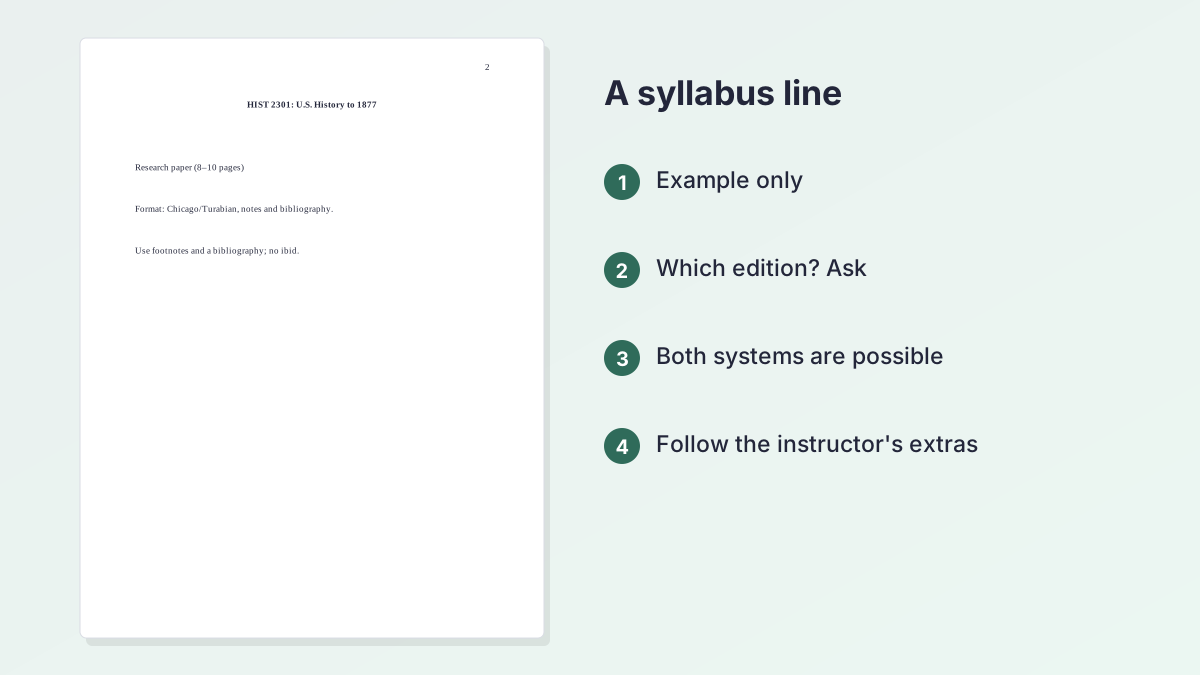
When the syllabus says Chicago/Turabian
A slash usually means the instructor accepts either book, since the citation systems are the same. On a syllabus, that is the practical answer to whether Turabian is the same as Chicago: the systems match, but the editions may not. The safe move is to ask three things: which edition, notes-bibliography or author-date, and whether the city of publication is required. Then format every entry the same way.
Common Turabian vs Chicago Mistakes
Most Turabian vs Chicago problems come from mixing the two sets of rules in one paper. Check yours against this list.
| Mistake | Fix |
|---|---|
| City in some entries, not others | Pick one edition's rule and use it throughout |
| Chicago 18 rules in a Turabian 9 class | Ask which edition the instructor wants |
| Ibid. everywhere | Use short notes unless your school requires ibid. |
| 3-em dash under Chicago 18 | Repeat the author's name |
| Notes and parentheses together | Choose notes-bibliography or author-date |
| Assuming Chicago has paper rules | Use Turabian's formatting for class papers |
A final check
Whichever manual you follow, every source in your notes should appear once in your bibliography. The Turabian Title Page Generator sets up the first page, and every guide is on our student writing guides page. When you're ready to cite, the free Turabian citation generator formats each note and entry, and our Chicago citation generator does the same for Chicago 18.
Turabian vs Chicago FAQ
Is Turabian the same as Chicago?
Mostly. Turabian is the student version of The Chicago Manual of Style and uses the same two citation systems. It adds paper formatting and research advice, and the 9th edition follows Chicago's 17th.
What is the difference between Turabian and Chicago?
Audience and edition. Turabian serves students writing papers; Chicago serves publishers. Turabian 9 keeps rules from Chicago 17, such as the city of publication.
Who was Kate L. Turabian?
A University of Chicago dissertation secretary from 1930 to 1958 who wrote the 1937 pamphlet that became the manual.
What is A Manual for Writers of Research Papers, Theses, and Dissertations?
The book known as Turabian, published by the University of Chicago Press. The current edition is the 9th; a 10th is listed for late 2026.
Does Turabian use footnotes?
Yes, in its notes-bibliography system. Its author-date system uses parenthetical citations instead.
Is Chicago/Turabian one style?
Usually it means either manual, since the citation systems are the same. Ask your instructor which edition and which system.
Should I use Turabian or Chicago for a class paper?
Use the one your instructor names. If none is named, Turabian is the book written for student papers.
Does Chicago 18 still include the city of publication?
No, it is no longer required for books published since 1900. Turabian 9 still includes it.
More free guides
- Turabian BibliographyEntry format, order and spacing for a Turabian 9 bibliography, with examples.
- Turabian FootnotesFull notes, short notes, ibid. and endnotes in Turabian 9.
- Turabian Book CitationNotes and bibliography entries for books, editions, chapters and the Bible in Turabian 9.
- Turabian FormatMargins, spacing, headings and page numbers for a Turabian 9 class paper.
- MLA In-Text CitationsAuthor-page citations for every kind of source, with examples.
- How to Cite a Website in MLAWorks Cited entries and in-text citations for web pages.
See all 80 free tools for students
Related tools
Last updated by The Study Corp editorial team.